
The Story So Far
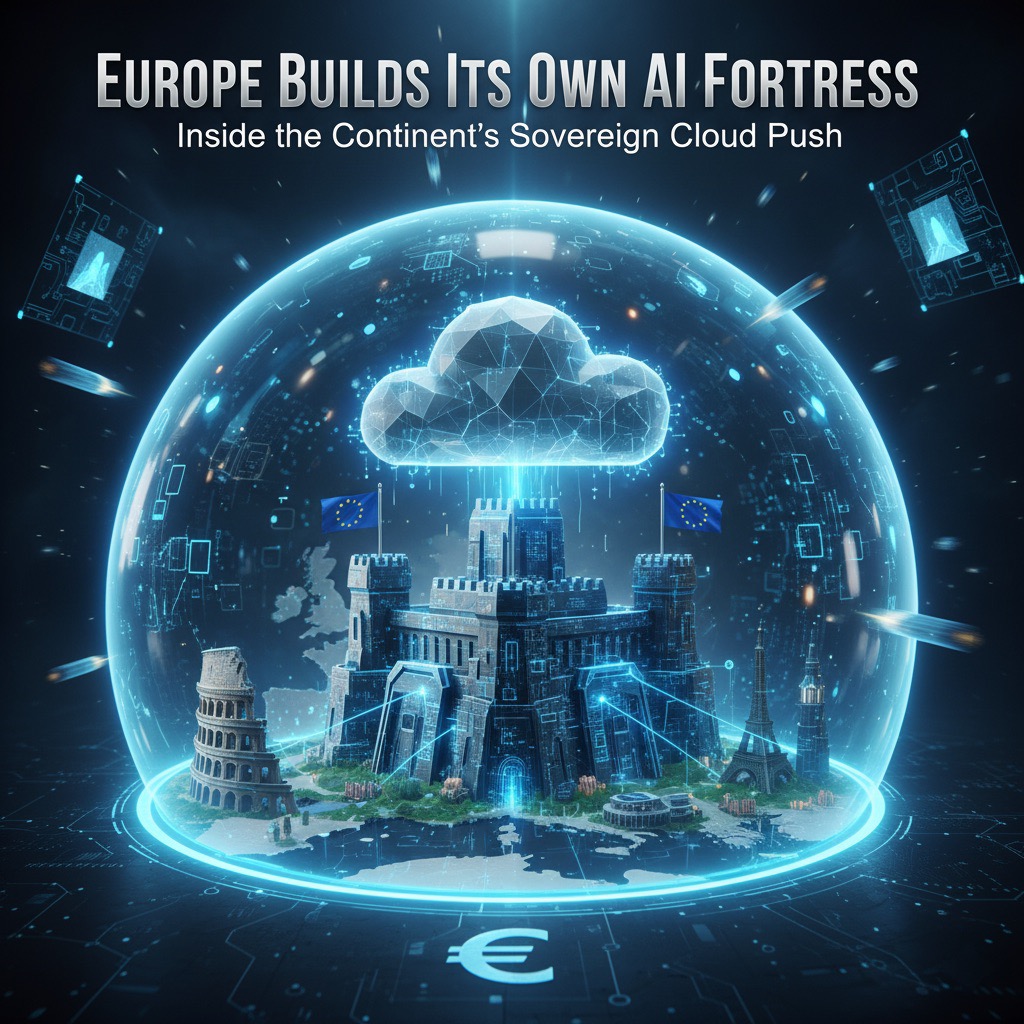
Europe’s cloud and AI markets are splitting from Silicon Valley’s gravitational pull. Driven by regulation and self-reliance, nations are building sovereign AI ecosystems that keep data, compute, and accountability inside EU borders.

Get audio and creator gear delivered free — and shop member deals
- Fast, free delivery on millions of items
- Access to Prime Big Deal Days deals on October 6–7
- Prime Video, Amazon Music and more included
Country Momentum
- Germany: SAP’s Delos Cloud is deploying OpenAI services on a sovereign Azure framework; AWS’s Brandenburg region will run under EU-only governance; Google’s T-Systems cloud provides similar guarantees.
- France: The Bleu project brings SecNumCloud-certified Azure data centers under French control, while Mistral AI grows into Europe’s largest private model developer.
- Spain: Government + IBM produce open Spanish-language models; Telefónica installs NVIDIA GPUs across its network for localized inference.
- Italy: Microsoft’s €4.3 billion cloud expansion anchors sovereign compute; Fastweb’s MIIA model and CINECA’s HPC center extend Italy’s footprint.
- Netherlands: ASML’s €1.3 billion stake in Mistral links Europe’s chip and AI supply chains.
Brussels’ Framework
The EU AI Act and Data Governance Act now give legal teeth to sovereignty. Gaia-X labeling and upcoming Fulcrum exchanges will certify providers and let workloads migrate securely across compliant clouds.
Market Impact
Hyperscalers are adapting fast:
- Microsoft scales “national partner” clouds (Bleu, Delos).
- AWS builds a fully isolated European Sovereign Cloud.
- Google deepens sovereign partnerships with Thales and T-Systems.
Meanwhile, startups like Mistral, Aleph Alpha, and Giskard are capitalizing on the compliance economy—offering models and audit tools aligned with EU law.
The Road to 2035
Expect multi-cloud sovereignty by 2030, a library of European foundation models, and AI factories blending HPC and edge compute. Europe’s hybrid model—global tech under EU control—may become the global benchmark for regulated innovation.
Internal Link Suggestions:
- AWS European Sovereign Cloud Details
- Mistral AI’s €1.7 B Raise Explained
- Gaia-X: What It Means for Businesses
As an affiliate, we earn on qualifying purchases.
Halloween Picks
halloween
As an affiliate, we earn on qualifying purchases.