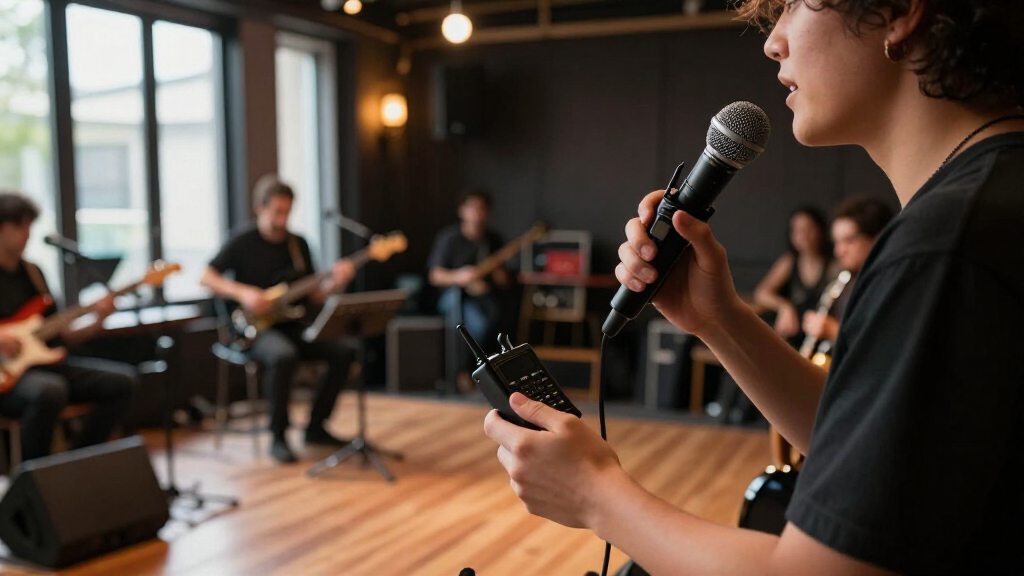

Choosing a wireless microphone system often comes down to two radio bands: 2.4 GHz and UHF. Both can carry clear speech or music without a cable between the microphone and receiver, but they handle crowded venues, setup, and future expansion differently. A 2.4 GHz kit can be an easy, affordable fit for a presenter, small creator, or occasional event. UHF is usually the stronger choice for touring, installed sound, and productions where a dropout would be costly and the operator needs to coordinate frequencies.

Get audio and creator gear delivered free — and shop member deals
- Fast, free delivery on millions of items
- Access to Prime Big Deal Days deals on October 6–7
- Prime Video, Amazon Music and more included

Phenyx Pro PTU-71-2H Dual UHF Wireless Handheld Microphone System
- ✔ Model: PTU-71-2H
- ✔ Channels: 2
- ✔ Selectable frequencies: 100 per channel

JBL Wireless Two-Microphone System with Dual-Channel Receiver, Black
- ✔ Microphones: 2 wireless microphones
- ✔ Receiver: Rechargeable dual-channel UHF
- ✔ Playback time: Up to 6 hours
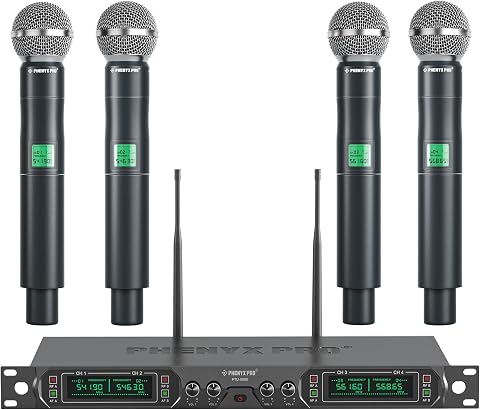
Phenyx Pro PTU-5000-4H 4-Channel UHF Wireless Microphone System
- ✔ Channels: 4
- ✔ Wireless band: UHF
- ✔ Fixed frequencies: 541.9, 546.3, 561.6, and 568.65 MHz
The practical tradeoff is convenience versus control. Many 2.4 GHz systems manage channel selection automatically and are widely available in compact kits; they also share spectrum with Wi-Fi and other everyday devices. UHF systems may need more planning and can cost more, but they typically provide more frequency choices and coordination options. Neither band guarantees reliable performance by itself: local radio conditions, antenna placement, obstacles, transmitter power, and system design all matter.
At a Glance
| Criteria | 2.4 GHz wireless microphone systems | UHF wireless microphone systems | Winner |
|---|---|---|---|
| Setup and operation | Often quick to pair, with automatic channel selection on many models | May require frequency scans and coordination, especially for larger setups | A |
| Crowded radio environments | Shares the 2.4 GHz band with Wi-Fi, Bluetooth, and other devices | Often offers more frequency choices, subject to local rules and available spectrum | B |
| Range and consistency | Can work well in open spaces; obstacles and local congestion can affect performance | Can be dependable when frequencies and antennas are selected for the venue | B |
| Multi-microphone use | Suitable for small setups, though simultaneous channel capacity varies by system | Generally better suited to coordinated, larger channel counts | B |
| Portability and compatibility | Common in compact creator kits and camera-ready systems | Available in handheld, bodypack, and rack systems; equipment can be less compact | A |
| Cost and value | Usually lower entry cost, especially for simple one- or two-microphone kits | Higher cost can buy control and capacity useful in professional work | Depends |
Phenyx Pro PTU-71-2H Dual UHF Wireless Handheld Microphone System
The PTU-71-2H is our strongest all-around choice for events where two people need wireless handheld microphones and the organizer wants some control over frequency selection. Its auto scan and lock functions, along with IR synchronization, help the receiver and microphones connect on a selected UHF frequency. That gives it a practical advantage over the JBL system’s simpler plug-and-play emphasis when frequency selection is a priority.Its stated 290–328-foot line-of-sight range is the longest of these three listed figures, but it depends on clear conditions and should not be treated as a guaranteed working distance indoors. Two dynamic cardioid microphones are designed to emphasize nearby voices and limit some ambient pickup. Metal construction and replaceable microphone heads add useful serviceability, while up to 16 hours of stated battery life is a substantial contrast with the JBL receiver’s up-to-six-hour playback figure.The tradeoff is a more involved setup than a bare plug-and-play system, plus four AA batteries to keep on hand. Buyers who need four separate microphones should step up to the PTU-5000-4H; those who want the simplest dual-mic setup may prefer JBL. For a typical two-mic event where frequency scanning and longer stated range are valuable, this is the most balanced pick.
Pros:
- Auto scan, lock, and IR synchronization assist frequency setup.
- Two metal handheld microphones use dynamic cardioid capsules.
- Stated 290–328-foot line-of-sight operating range.
- Includes audio cable, adapter, antennas, and other setup accessories.
Cons:
- The stated range depends on line-of-sight conditions.
- The microphones require four AA batteries.
Best for: Event hosts, DJs, and community organizations that need two handheld mics and want scan-assisted UHF frequency selection.
Not ideal for: Buyers who need four microphones, want a rechargeable microphone system, or cannot manage AA battery replacements.
Bottom line: We recommend the PTU-71-2H for most two-microphone events because it combines frequency scanning, included accessories, and the longest stated range in this comparison.
“We recommend the PTU-71-2H for most two-microphone events because it combines frequency scanning, included accessories, and the longest stated range in this comparison.”
JBL Wireless Two-Microphone System with Dual-Channel Receiver, Black
For buyers who value a quick route from unpacking to speaking, the JBL system makes the case for straightforward two-mic operation. It includes two wireless microphones and a rechargeable dual-channel UHF receiver that mixes both voices through a compatible speaker. That integrated approach can make more sense for casual karaoke, presentations, or small gatherings than the PTU-71-2H if the aim is a simple setup rather than hands-on frequency management.JBL’s receiver provides up to six hours of playback, and the microphones use replaceable AA batteries. The rechargeable receiver reduces the need to power that component from disposable batteries, but the runtime is shorter than the PTU-71-2H’s stated microphone battery life. The available product details also do not specify a range or selectable-frequency count, so buyers who need to plan around distance or coordinate channels have less information to compare against the Phenyx options.This is the most approachable pick in the lineup, but its simplicity is also its limit. The PTU-71-2H offers more stated frequency-selection detail and longer listed battery life; the PTU-5000-4H serves groups that need four mics and separate XLR outputs. Choose JBL when plug-and-play dual-mic use and a rechargeable receiver are more important than extensive system specifications.
Pros:
- Two wireless microphones can be used at once.
- Rechargeable dual-channel UHF receiver mixes both voices.
- Plug-and-play setup favors quick operation.
- Microphones use replaceable AA batteries.
Cons:
- Receiver playback is listed for up to six hours.
- The provided specifications do not state operating range or selectable-frequency count.
Best for: First-time users and hosts who want two microphones with a rechargeable receiver for a compatible speaker.
Not ideal for: Buyers who need a stated long operating range, extensive frequency coordination details, or more than two microphones.
Bottom line: We’d choose the JBL system for uncomplicated two-mic events where a rechargeable receiver and quick setup outweigh detailed frequency and range specifications.
“We’d choose the JBL system for uncomplicated two-mic events where a rechargeable receiver and quick setup outweigh detailed frequency and range specifications.”
Phenyx Pro PTU-5000-4H 4-Channel UHF Wireless Microphone System
The PTU-5000-4H is the clear option when four people need handheld microphones at the same event. Its receiver provides four XLR outputs and individual volume controls, giving an operator more direct control of each microphone than the two-channel PTU-71-2H or JBL system. That separation can be useful for speeches, small performances, or events where voices need individual adjustment at a mixer.All four included microphones use dynamic cardioid cartridges, which are designed to focus on the speaker and reduce some unwanted pickup. The all-metal receiver, LCD, snap-on antennas, and included accessories make this a more event-oriented package than the simpler JBL setup. Its stated range is up to 260 feet—shorter than the PTU-71-2H’s stated line-of-sight range—and battery life is listed at up to eight hours.The main compromise is flexibility: the four frequencies are fixed, and the system is not intended for multiset operation. That makes it less adaptable than the PTU-71-2H, which offers selectable frequencies and scan functions. Buyers also need an amplifier or speaker for sound output. If four individual mic feeds are unnecessary, the two-mic PTU-71-2H is the more flexible choice; if a group needs four mics and separate outputs, this kit earns its larger footprint.
Pros:
- Four handheld microphones support larger groups.
- Individual volume controls and four XLR outputs give the operator separate control.
- Dynamic cardioid cartridges are designed to limit some unwanted pickup.
- Includes batteries, cables, antennas, and mounting accessories.
Cons:
- Fixed frequencies limit coordination flexibility.
- Requires an amplifier or speaker for sound output.
- Stated range is up to 260 feet, below the PTU-71-2H figure.
Best for: Small performance groups, event operators, and hosts who need four handheld microphones with individual XLR outputs.
Not ideal for: Users who need adjustable frequency choices, plan to operate multiple matching systems, or lack an amplifier or speaker.
Bottom line: We recommend the PTU-5000-4H when four simultaneous microphones and individual XLR feeds matter more than adjustable frequencies or the longest stated range.
“We recommend the PTU-5000-4H when four simultaneous microphones and individual XLR feeds matter more than adjustable frequencies or the longest stated range.”
As an Amazon Associate we earn from qualifying purchases.
Key Differences
The sharpest difference appears when the radio environment is busy. A 2.4 GHz system operates in a band also used by common wireless devices. Good systems can select channels or adapt to changing conditions, but they cannot make that shared spectrum disappear. In a quiet room or a modest home setup, this may not matter. At a conference, venue, or event surrounded by access points and personal devices, congestion can make performance less predictable. UHF systems offer frequency options that can be scanned and coordinated, giving an experienced operator more ways to work around interference. The advantage depends on usable local frequencies and compliance with regional rules.
That control has a cost in both money and preparation. For a single presenter who wants to clip on a mic and start recording, a compact 2.4 GHz kit may be the more sensible purchase. It can reduce setup effort and leave money for a better microphone or recording equipment. A production with several speakers, wireless handhelds, or recurring venue work has different needs: UHF coordination can prevent systems from competing with each other and help an audio team troubleshoot. Paying more for UHF makes sense when that flexibility avoids real production risk; it is wasted capacity for many occasional users.
Range is less straightforward than a band-versus-band ranking suggests. Manufacturers’ range figures usually describe favorable conditions, and actual results vary with transmitter power, antenna design and placement, obstructions, and interference. UHF’s potential advantage is the ability to select a cleaner channel and deploy suitable antennas, not an automatic promise of greater range. Check the system’s legal frequency range, channel count, battery life, connectors, and receiver outputs against the venue and recording setup. A well-chosen system in either band can outperform a poorly placed or incompatible one.
Detailed Comparison
Setup and operation (2.4 GHz wireless microphone systems wins — moderate)
2.4 GHz wins for speed and simplicity; the gap is moderate. Many systems pair quickly and choose a channel automatically, which suits a creator working alone or a presenter without a dedicated audio operator. UHF setups can be just as routine once configured, but adding channels or changing venues may call for a scan and frequency coordination. The practical difference is less time spent learning radio setup with a basic 2.4 GHz kit, versus more control once the job grows.
Crowded radio environments (UHF wireless microphone systems wins — major)
UHF usually wins; the gap can be major for critical events. The 2.4 GHz band is shared with Wi-Fi, Bluetooth, and other devices, so a busy venue can complicate a connection even when the microphone system has automatic channel selection. UHF gives operators more options to find and coordinate usable frequencies, though local spectrum limits still apply. For an interview at home, the distinction may be minor; for a live show or conference with many wireless systems, UHF’s flexibility can be decisive.
Range and consistency (UHF wireless microphone systems wins — moderate)
UHF has an advantage when a system can be properly coordinated; the gap is moderate and venue-dependent. Neither band guarantees a particular working distance: walls, bodies, antennas, transmitter placement, and interference can all reduce it. UHF’s frequency choices and antenna options can help an operator maintain a link across a larger or more complex space. A 2.4 GHz system can be entirely adequate in a small room or clear line of sight. Compare reliable real-world specifications and test at the intended venue rather than relying on a best-case range claim.
Multi-microphone use (UHF wireless microphone systems wins — major)
UHF generally wins for larger setups; the gap is major as channel counts rise. Several wireless microphones have to coexist without interfering with one another. Professional UHF systems commonly support frequency scanning and coordination tools intended for that job. Some 2.4 GHz products support multiple transmitters, but the number that can operate reliably together depends on the specific design and the surrounding traffic. A two-person interview may work well with a suitable 2.4 GHz kit; a panel, stage, or production rack is a stronger case for coordinated UHF.
Portability and compatibility (2.4 GHz wireless microphone systems wins — minor)
2.4 GHz often wins for compact creator workflows; the gap is minor overall. Many products in this band are sold as small kits with camera, phone, or computer connections, making them easy to pack for short-form video and interviews. UHF also comes in portable bodypack and handheld systems, but professional receivers may be larger and use connectors that require adapters or a mixer. Choose by matching the receiver outputs and microphone type to your camera, phone, or sound desk; the frequency band alone does not settle compatibility.
Cost and value (moderate difference)
There is no universal winner; the difference is moderate and depends on the job. A simple 2.4 GHz kit often costs less upfront and can deliver good value for one or two microphones in a controlled setting. UHF costs more in many professional configurations, but the price can buy coordination features, expansion options, or receiver connections that a regular production needs. Pay the premium when frequency control and channel capacity reduce meaningful risk. For occasional speech recording, spend the savings on a suitable mic, headphones, or backup recording instead.
2.4 GHz wireless microphone systems: Pros and Cons
Pros:
- Often straightforward to pair and operate
- Compact kits are widely available for cameras and mobile recording
- Usually lower entry cost for simple setups
Cons:
- Shares spectrum with common Wi-Fi and Bluetooth devices
- Can offer less control over frequency choice and coordination
- Simultaneous channel capacity varies and may limit expansion
UHF wireless microphone systems: Pros and Cons
Pros:
- More frequency choices can help avoid local interference
- Better fit for coordinated, multi-microphone productions
- Professional systems often offer flexible receivers and antenna options
Cons:
- Often costs more, especially for systems with multiple channels
- Scanning and coordination can add setup work
- Available frequencies and legal use depend on location
Who Should Choose What
Choose 2.4 GHz wireless microphone systems if:
- You record one or two people in a home, office, or relatively controlled location.
- You want a compact kit that connects directly to a camera, phone, or computer.
- You value quick setup and a low purchase price more than frequency coordination.
Choose UHF wireless microphone systems if:
- You work in venues where many wireless devices or systems may be active.
- You need several microphones to run together reliably.
- You operate live events or recurring productions where frequency scans, coordination, and antenna options justify the added cost.
Skip both if: Skip wireless if the microphone will stay in one place and a cable is practical. A wired microphone avoids radio congestion and batteries, often at lower cost.
Value for Money
A 2.4 GHz system is usually the better value for simple, small-scale recording because its convenience and lower entry price match what many occasional users need. UHF is worth paying more for when you rely on multiple microphones, work in changing or crowded venues, or need an audio operator to manage frequencies and antennas. The added expense buys useful flexibility only if the production will use it. If neither wireless range nor freedom of movement matters, a wired setup may deliver better sound-system value for less.
Final Verdict
For most solo creators, interviews in controlled spaces, and occasional presentations, choose a well-reviewed 2.4 GHz system with the right connectors and enough channels. It is easier to set up and usually costs less, while meeting the practical needs of a small rig. Choose UHF for live events, larger channel counts, and work where a dropout has significant consequences: frequency coordination and system flexibility justify the extra cost there. The biggest deciding factor is the radio environment and number of microphones you need to run, not a headline range figure. If the mic can stay wired, skip both and avoid the radio tradeoff altogether.
Frequently Asked Questions
Is UHF always more reliable than 2.4 GHz?
No. UHF offers more ways to select and coordinate frequencies, which can help in crowded environments, but its performance still depends on available spectrum, setup, antennas, and obstacles. A suitable 2.4 GHz system can be reliable in a controlled space.
Can several 2.4 GHz microphones work at the same time?
Some systems support multiple transmitters, but the reliable channel count depends on the model and local wireless traffic. Check the manufacturer’s simultaneous-channel specification and test the complete setup in the intended location before relying on it for an event.
Does UHF provide longer range?
Not automatically. A clean frequency, suitable antenna placement, line of sight, and system design affect usable range. UHF can offer more tools for maintaining a link in a challenging venue, but advertised maximum distances may assume ideal conditions.
Is 2.4 GHz wireless suitable for video recording?
Yes, particularly for solo creators and small interviews where the receiver connects conveniently to a camera, phone, or computer. Check output compatibility, latency, battery life, and local interference before buying.
What should I check before buying a UHF system?
Confirm that its frequency range is legal and usable where you plan to work. Also check how many channels can operate together, receiver outputs, microphone options, battery life, antenna connections, and whether you can scan and coordinate frequencies for the venues you use.
Fall Picks
fall essentials
As an affiliate, we earn on qualifying purchases.