For compact synthesizers for music production, my best overall pick is the Roland MC-101, since it combines sound generation and sequencing in a portable production workstation. The Behringer PRO-800 is a stronger fit when polyphonic analog synthesis matters most, while the Yamaha REFACE DX suits players who want a built-in keyboard and hands-on FM sounds. These options differ in how much they can do alone: some make complete patterns, while others need a keyboard, sequencer, or computer to become part of a production setup. Size also brings tradeoffs in keys, controls, connectivity, and sound design depth. Read on for the full breakdown and help matching each instrument to your workflow.

Get audio and creator gear delivered free with Prime
- Fast, free delivery on millions of items
- Prime Video, Amazon Music and more included
- Member-only deals all year
Complete the kit


Key Takeaways
- The MC-101 is the most self-contained production choice here, while most of the other picks focus on synthesis or performance and may need external sequencing.
- The PRO-800 prioritizes eight-voice analog polyphony; the smaller Behringer synths trade that breadth for more portable, specialized sound design.
- The REFACE DX and ESI Xsynth include playable keyboards, a practical advantage for entering notes directly without adding a separate controller.
- The J-6 and MPK Mini Play serve different roles: the J-6 generates and sequences chord ideas, while the MPK Mini Play is primarily a keyboard controller with onboard sounds.
- Compact does not mean production-ready on its own: check sequencing, audio connections, MIDI needs, and how you plan to record before choosing.
| Behringer PRO-800 Classic Analog 8-Voice Polyphonic Synthesizer |  | Best for Analog Polyphony | Type: Tabletop synthesizer | Voices: 8 | Oscillators per voice: 2 | VIEW LATEST PRICE | See Our Full Breakdown |
| Roland MC-101 Groovebox Compact Music Production Workstation |  | Best for Portable Production | Mixer channels: 4 | Keys: 49 (as listed) | Connectivity: USB and MIDI | VIEW LATEST PRICE | See Our Full Breakdown |
| Behringer PHARA-O MINI Mini Synthesizer for Compact Sound Design |  | Best for Minimal Setups | Brand: Behringer | Model: PHARA-O MINI | Dimensions: 9.21 x 6.1 x 2.56 inches | VIEW LATEST PRICE | See Our Full Breakdown |
| Roland AIRA Compact J-6 Chord Synth Portable Song Creation Machine |  | Best for Chord Sketching | Synth engine: JUNO-60 | Instrument type: Chord synthesizer | Sequencer: Programmable | VIEW LATEST PRICE | See Our Full Breakdown |
| ESI Xsynth Ultra-Thin 25-Key Synthesizer with Integrated Master Keyboard and Audio/MIDI Interface |  | Best for DAW Keyboard Control | Keys: 25 | Key response: Velocity-sensitive with polyphonic aftertouch | Connectivity: USB Type-C | VIEW LATEST PRICE | See Our Full Breakdown |
| Stylophone The Original Pocket Electronic Synthesizer |  | Best for Pocket-Sized Retro Sounds | Model: Original | Number of octaves: 3 | Power source: 3 x AA batteries | VIEW LATEST PRICE | See Our Full Breakdown |
| Behringer UB-Xa MINI Synthesizer |  | Best for Classic Analog Sequencing | Brand: Behringer | Model: UB-Xa MINI | Oscillators: 3 VCOs | VIEW LATEST PRICE | See Our Full Breakdown |
| Akai Professional MPK Mini Play MK3 25-Key USB MIDI Keyboard Controller |  | Best for Portable Beat Making | Number of keys: 25 | Connectivity: USB | Drum pads: 8 velocity-sensitive MPC pads | VIEW LATEST PRICE | See Our Full Breakdown |
| Behringer AKS MINI Synthesizer |  | Best for Experimental Analog Textures | Oscillators: 3 VCOs | Polyphony: 3 voices | Keyboard: 27-key touch-sensitive | VIEW LATEST PRICE | See Our Full Breakdown |
| Yamaha REFACE DX Portable FM Synthesizer |  | Best for a Self-Contained Keyboard Setup | Number of keys: 37 | Sound engine: 4-operator FM | Voice memories: 32 | VIEW LATEST PRICE | See Our Full Breakdown |
| Behringer Pro VS Mini Portable 5-Voice Hybrid Synthesizer with 4 Vector Morphing Oscillators |  | Best for Vector Sound Design | Voices: 5 | Oscillators per voice: 4 | Filter: Analog low-pass | VIEW LATEST PRICE | See Our Full Breakdown |
| compact synthesizers for music production | Dimensions |
|---|---|
| Behringer PRO-800 Classic Anal | 22.48 x 16.65 x 8.43 inches |
| Roland MC-101 Groovebox Compac | — |
| Behringer PHARA-O MINI Mini Sy | 9.21 x 6.1 x 2.56 inches |
| Roland AIRA Compact J-6 Chord | — |
| ESI Xsynth Ultra-Thin 25-Key S | 5.31 x 15.28 x 1.18 inches |
| Stylophone The Original Pocket | 2.05 x 3.41 x 1.86 inches |
| Behringer UB-Xa MINI Synthesiz | — |
| Akai Professional MPK Mini Pla | — |
| Behringer AKS MINI Synthesizer | — |
| Yamaha REFACE DX Portable FM S | 29.52 x 9.4 x 3.9 inches |
| Behringer Pro VS Mini Portable | 8.45 × 5.45 × 2.35 inches |
More Details on Our Top Picks
Behringer PRO-800 Classic Analog 8-Voice Polyphonic Synthesizer
The PRO-800 is the strongest fit here for producers who want layered analog chords and a dedicated hardware voice. Its eight voices, each with two oscillators, give it more room for sustained polyphonic parts than the Roland J-6, which focuses on chord patterns and song sketching. The arpeggiator, sequencer, and 400 program memories make it practical for saving sounds and building parts without relying on a computer for every step. The tradeoff is its listed Eurorack format, which may call for additional rack gear, and its roughly 22-inch listed width makes it less convenient to carry than the J-6. Its controls may also take more time to learn than a simpler portable instrument.
Pros:- Eight-voice analog polyphony supports full chords and layered parts.
- Two oscillators per voice and three listed waveforms offer sound-shaping range.
- Arpeggiator and sequencer support hands-on pattern creation.
- 400 program memories provide space to save sounds.
Cons:- Eurorack format may require additional equipment to fit a studio setup.
- Its listed dimensions make it less portable than compact grooveboxes.
- The interface may be challenging for newcomers to synthesis.
Best for: Electronic producers building analog chord, bass, and lead parts in a home or Eurorack studio.
Not ideal for: Traveling musicians or beginners who want a self-contained, immediately approachable instrument.
- Type:Tabletop synthesizer
- Voices:8
- Oscillators per voice:2
- Waveforms:Saw, triangle, pulse
- Program memory:400 programs
- Format:Eurorack
- Dimensions:22.48 x 16.65 x 8.43 inches
- Weight:1645 g
- Connectivity:USB Type B
Our verdict“Choose the PRO-800 for hands-on analog polyphony and saved patches, provided its Eurorack format suits your setup.”
Roland MC-101 Groovebox Compact Music Production Workstation
The MC-101 is the most production-oriented pick in this group for someone who wants to arrange several parts in a compact hardware workflow. Its four tracks, built-in sounds, effects, and sequencing put it closer to a portable music workstation than a single-purpose synth. That makes it more suited to sketching a complete idea away from a computer than the Behringer PRO-800, whose appeal is analog polyphony and patch shaping. Four tracks still impose a ceiling: dense arrangements may need an external recorder or another device. The product information also lists 49 keys, though the description emphasizes a groovebox format, so buyers should check the exact control layout before choosing it as a keyboard. It rewards producers willing to learn its workflow.
Pros:- Four-track sequencing supports arranging multiple parts in one device.
- Built-in sounds and effects reduce the need for extra gear while sketching.
- Portable design and battery inclusion support work away from a desk.
- USB and MIDI connectivity can link it with a broader production setup.
Cons:- Four tracks can constrain larger or denser arrangements.
- The interface may take time to learn for users new to production hardware.
- The listed 49-key specification is unclear alongside the groovebox description.
Best for: Mobile producers who want to sequence and layer a multi-part sketch on one compact device.
Not ideal for: Keyboard players seeking a clearly specified full-sized keybed or producers needing more than four onboard tracks.
- Mixer channels:4
- Keys:49 (as listed)
- Connectivity:USB and MIDI
- Supported software:Ableton Live
- Included components:Owner’s manual, 4 AA batteries, SD card
- Materials:Metal and plastic
Our verdict“Pick the MC-101 if portable, multi-part sequencing matters more to you than a dedicated analog synth voice.”
Behringer PHARA-O MINI Mini Synthesizer for Compact Sound Design
The PHARA-O MINI earns a place for buyers who prioritize a small, durable instrument and MIDI connectivity. At 9.21 inches long and 0.65 kg, it is easier to place in a crowded studio or pack than the substantially larger Behringer PRO-800. Its alloy steel body also gives it a different practical emphasis from the plastic-and-wood ESI Xsynth. The limitation is the sparse product information: it does not specify the synthesis engine, sound controls, sequencing, or memory, so I can’t judge how it would serve as a main production synth from these details alone. That uncertainty makes it a more cautious pick than the Roland J-6, whose chord engine and sequencer are described. Treat it as a compact MIDI-connected option, and confirm its musical features before buying.
Pros:- Compact listed dimensions suit crowded desks and portable rigs.
- Alloy steel construction offers a durable alternative to lighter plastic bodies.
- MIDI connectivity can fit into a broader hardware production setup.
Cons:- Available product details do not specify its synthesis engine or sound controls.
- Sequencing and patch storage capabilities are not stated.
- Power supply details are not provided.
Best for: Producers seeking a small, metal-bodied MIDI instrument to fit into an existing compact hardware rig.
Not ideal for: First-time synth buyers or anyone who needs confirmed sound-design, sequencing, or sound-storage features.
- Brand:Behringer
- Model:PHARA-O MINI
- Dimensions:9.21 x 6.1 x 2.56 inches
- Weight:0.65 kg
- Material:Alloy steel
- Finish:Polished
- Color:Black
- Connector:MIDI
Our verdict“Consider the PHARA-O MINI for its compact metal build and MIDI connection only after confirming the sound features you need.”
Roland AIRA Compact J-6 Chord Synth Portable Song Creation Machine
The J-6 is a focused songwriting tool: its JUNO-60-inspired engine, chord library, and programmable sequencer help turn harmonic ideas into patterns without requiring a keyboard technique-first workflow. That gives it a clearer role for chord-led sketches than the Behringer PHARA-O MINI, whose supplied product details don’t describe a sound engine or sequencing. Compared with the Roland MC-101, the J-6 centers on chords and synth tone rather than a four-track arrangement workflow. The compact format and included lithium-ion battery support portable use, while rubber pads provide a direct way to enter and shape parts. Its specialized chord approach can limit players who want broad note-by-note performance, and the available specs say little about its interface or connections, so check those details against your setup.
Pros:- Chord library makes it quick to build harmonic progressions.
- Programmable sequencer turns chord ideas into repeatable patterns.
- JUNO-60 synth engine and real-time shaping support tonal variation.
- Included lithium-ion battery suits portable sessions.
Cons:- Chord-focused workflow may feel restrictive for free-form keyboard performance.
- The available product data gives limited detail about the user interface.
- Detailed connectivity specifications are not included in the supplied data.
Best for: Songwriters and producers who want to generate chord progressions and turn them into sequenced ideas on the go.
Not ideal for: Players who need a conventional keyboard for free-form melodies or a multi-track workstation in one device.
- Synth engine:JUNO-60
- Instrument type:Chord synthesizer
- Sequencer:Programmable
- Chord library:Extensive
- Included battery:Lithium-ion
- Included controls:High-quality rubber pads
Our verdict“Choose the J-6 when chord progressions and portable pattern creation are your main production needs.”
ESI Xsynth Ultra-Thin 25-Key Synthesizer with Integrated Master Keyboard and Audio/MIDI Interface
The ESI Xsynth is best understood as a compact keyboard and interface for a computer-centered setup, rather than a self-contained sound source. Its 25 velocity-sensitive keys with polyphonic aftertouch offer more expressive input than the pad-based Roland J-6, while its integrated audio/MIDI interface can reduce the number of separate devices needed at a desk. At just 1.18 inches thick, it is easy to fit into a small workstation. The tradeoff is that the supplied information lists no built-in sounds, so it depends on external instruments or software to produce tones. Its two-octave range also limits hands-on playing compared with a larger keyboard. Unlike the MC-101, it is not presented as a multi-track groovebox for standalone arrangement.
Pros:- Polyphonic aftertouch allows expressive control from its compact keybed.
- Integrated audio/MIDI interface can simplify a computer-based setup.
- Ultra-thin 1.18-inch profile fits tight desk spaces.
- USB Type-C provides a modern connection.
Cons:- No built-in sounds are listed, so external instruments or software are needed.
- The 25-key range can constrain two-handed parts and broad melodic lines.
- Plastic and wood construction may not suit buyers seeking a metal-bodied unit.
Best for: DAW producers who want a slim 25-key controller with expressive aftertouch and integrated audio/MIDI functions.
Not ideal for: Musicians seeking a standalone synth with built-in sounds or a keyboard with a wider playing range.
- Keys:25
- Key response:Velocity-sensitive with polyphonic aftertouch
- Connectivity:USB Type-C
- Dimensions:5.31 x 15.28 x 1.18 inches
- Weight:0.99 kg
- Materials:Plastic and wood
- Warranty:3 years
Our verdict“Choose the Xsynth if you make music in a DAW and value aftertouch and a slim keyboard over standalone synthesis.”
Stylophone The Original Pocket Electronic Synthesizer
The Stylophone is the smallest, most immediate sound-making option here: its stylus plays notes directly on a metal touch surface, and its built-in speaker makes quick ideas possible without a keyboard or computer. That makes it more of a portable sketching instrument than a full production hub. Compared with the Yamaha REFACE DX, it is far easier to slip into a pocket, but offers a much narrower playing surface and simpler recording connections. Its three-octave range and auxiliary connector suit short riffs, quirky leads, and sampled textures better than broad keyboard parts or detailed studio routing. I’d choose it for its distinctive vintage character and playful approach, while advanced players may outgrow its limited controls.
Pros:- Very small, lightweight body is easy to carry
- Stylus-on-metal playing offers a distinctive, direct way to find notes
- Built-in speaker supports quick idea making without extra gear
- Retro tonal character can add a contrasting texture to a production
Cons:- Three-octave range and simple controls limit detailed performance and sound shaping
- Auxiliary connection offers fewer routing options than USB-equipped instruments
- Three AA batteries need replacing
Best for: Producers who want a pocketable instrument for quick retro lead ideas, travel sketches, and sample making.
Not ideal for: Keyboard players who need expressive full-range parts, extensive sound editing, or flexible studio connectivity.
- Model:Original
- Number of octaves:3
- Power source:3 x AA batteries
- Dimensions:2.05 x 3.41 x 1.86 inches
- Weight:8.8 ounces
- Material:Metal
- Sound profile:Warm, vintage, rich, retro
- Connector type:Auxiliary
Our verdict“Choose the Stylophone for portable, characterful riffs and textures; skip it if you need a flexible main production keyboard.”
Behringer UB-Xa MINI Synthesizer
The UB-Xa MINI puts hands-on analog tone shaping and a motion sequencer into a portable format. Its three VCOs, dual-slope low-pass filter, and ring modulator give producers more room to shape a sound than the Stylophone, whose appeal is immediate playability and retro simplicity. The 16-step sequencer with memory slots also makes it better suited to repeating studio patterns and evolving sequences. The tradeoff is a steeper learning curve: this is a sound-design instrument, not an obvious pick for someone who wants keys and onboard sounds ready to play. Product details supplied here do not specify a built-in keyboard or extensive connectivity, so buyers who need a self-contained performance setup should compare it with the Yamaha REFACE DX.
Pros:- Three VCOs provide several sources for building layered analog tones
- Dual-slope low-pass filter supports varied tone shaping
- Ring modulator adds a distinct sound-design option
- 16-step motion sequencer with 10 memory slots supports repeatable patterns
Cons:- Limited product details make it harder to judge setup and integration needs
- No built-in keyboard is specified, so a separate control method may be needed
- Hands-on synthesis and sequencing may be challenging for beginners
Best for: Synthesis-curious producers who want portable analog sound design and short motion-sequenced patterns in the studio.
Not ideal for: Players who need an all-in-one keyboard instrument with clearly documented performance and connection options.
- Brand:Behringer
- Model:UB-Xa MINI
- Oscillators:3 VCOs
- Filter:12/24 dB dual-slope low-pass
- Sound shaping:Built-in ring modulator
- Sequencer:16-step motion sequencer
- Sequencer memory:10 memory slots
Our verdict“Pick the UB-Xa MINI for portable analog sequencing and tone shaping, provided its control and connection details fit your setup.”
Akai Professional MPK Mini Play MK3 25-Key USB MIDI Keyboard Controller
The MPK Mini Play MK3 is the most production-oriented controller in this group for beat makers who want keys and drum pads in one compact unit. Its 25 velocity-sensitive keys, eight MPC pads, arpeggiator, and onboard sounds support quick sketching, while USB connects it to Mac or Windows production software. Compared with the Yamaha REFACE DX, it gives beat-focused players a more direct pad-based workflow and software control; the Yamaha offers a larger keyboard and a dedicated FM synth engine. The Akai’s built-in speaker is convenient for private idea checks, but is not suited to loud performance. Its short key range also constrains piano-style parts, and buyers should distinguish its controller role from a full-featured synthesizer despite the onboard sounds.
Pros:- 25 velocity-sensitive keys combine note entry and performance in a small format
- Eight MPC drum pads support expressive beat programming
- Onboard sounds and built-in speaker enable quick sketches away from a computer
- USB works with Mac and Windows production software
Cons:- Two-octave keyboard can constrain chord voicings and melodic performance
- Built-in speaker is not powerful enough for loud playing
- Controller-focused workflow may not satisfy buyers seeking a dedicated synthesizer engine
Best for: Mobile beat makers and songwriters who want compact keys, drum pads, onboard sounds, and USB software control.
Not ideal for: Performers who need a wide keyboard range, powerful speakers, or a standalone instrument with deeper synthesis.
- Number of keys:25
- Connectivity:USB
- Drum pads:8 velocity-sensitive MPC pads
- Additional features:Built-in arpeggiator, digital display, integrated effect, touch-sensitive pad
- Supported software:MPC Beats; Hype, Stage Piano and Electric from AIR Music Tech
- Platforms:Mac, Windows
- USB ports:1
- Control type:Keyboard controller
Our verdict“Choose the MPK Mini Play MK3 for compact beat production and software control, but look elsewhere for a broad keyboard or standalone synthesis rig.”
Behringer AKS MINI Synthesizer
The AKS MINI is aimed at producers who want an unusual analog voice in a space-saving instrument. Three VCOs, a touch-sensitive 27-key surface, an AKS filter, and built-in digital spring reverb give it a characterful route to experimental tones. USB-C power and MIDI support make it easier to fit into a compact studio than the battery-powered Stylophone, while its three-voice limit keeps arrangements and simultaneous notes constrained. Compared with the UB-Xa MINI, this model is more specifically tied to an AKS-inspired sound and includes a touch keyboard and reverb in the supplied specifications. That focus is its strength, but also its boundary: buyers seeking a broad, conventional keyboard sound palette may prefer the more performance-oriented Yamaha REFACE DX.
Pros:- Three VCOs support layered analog sound creation
- 27-key touch-sensitive keyboard offers direct note control
- Built-in digital spring reverb adds space without an external effect
- USB-C power and MIDI support aid compact studio integration
Cons:- Three-voice polyphony limits chords and overlapping parts
- AKS-focused character may be less versatile for conventional production duties
- Touch-based playing and analog sound design can take time to learn
Best for: Electronic producers and analog synth fans seeking an AKS-inspired voice, touch playing, and reverb in a compact studio setup.
Not ideal for: Players who need broad polyphony, familiar keyboard performance, or a general-purpose sound library.
- Oscillators:3 VCOs
- Polyphony:3 voices
- Keyboard:27-key touch-sensitive
- Filter:AKS filter
- Reverb:Built-in digital spring reverb
- MIDI support:Yes (NRPN/CC)
- Power supply:USB Type-C
Our verdict“Choose the AKS MINI for compact, experimental analog textures and skip it if your main need is broad polyphonic performance.”
Yamaha REFACE DX Portable FM Synthesizer
The Yamaha REFACE DX is the most complete keyboard instrument in this group for players who want to shape and perform sounds without relying on a computer. Its 37 keys give it more room for two-handed ideas than the MPK Mini Play MK3, and its four-operator FM engine, 32 Voice memories, onboard effects, speakers, and phrase looper make it a capable sketching instrument. That range of features comes with a larger, heavier body than the pocketable Stylophone, so it is portable rather than truly pocket-sized. FM editing can also be less intuitive for newcomers than playing presets or programming drum pads. I’d choose it when keyboard performance and sound recall matter more than minimum size; its limited key count still falls short for players who depend on a full-length keyboard.
Pros:- 37 keys provide more playing range than the 25-key MPK Mini Play MK3
- Four-operator FM engine supports detailed digital sound creation
- 32 Voice memories make it easy to save and recall sounds
- Built-in speakers, effects, and phrase looper support self-contained sketching
Cons:- At 6 pounds and nearly 30 inches long, it is less compact than pocket synths
- 37 keys may be limiting for performances requiring a broad range
- FM editing can feel complex for players new to synthesis
Best for: Songwriters and keyboard players who want portable FM sound design, onboard speakers, and stored sounds for practice or production sketches.
Not ideal for: Travelers who need pocket-sized gear or keyboardists who require a full-length key range.
- Number of keys:37
- Sound engine:4-operator FM
- Voice memories:32
- Special features:Built-in speaker system, phrase looper
- Connector:3.5 mm jack
- Power source:Battery powered
- Dimensions:29.52 x 9.4 x 3.9 inches
- Weight:6 pounds
Our verdict“Pick the REFACE DX if you want a portable, self-contained keyboard for FM sounds and song sketches, and can accommodate its larger footprint.”
Behringer Pro VS Mini Portable 5-Voice Hybrid Synthesizer with 4 Vector Morphing Oscillators
The Pro VS Mini earns its place for producers who want evolving, layered tones in a small instrument. Its four vector-morphing oscillators per voice offer more timbral movement than the straightforward chord-making focus of the Roland AIRA Compact J-6, while the analog low-pass filter can shape those digital oscillator combinations into warmer textures. Five-voice polyphony supports compact chords and pads, though it gives less room for dense parts than the eight-voice Behringer PRO-800. A 16-step sequencer and arpeggiator help build ideas without extra gear, and battery or USB power suits a portable setup. The tradeoff is hands-on performance: its 27 keys limit range, and the compact interface may take patience to learn. I’d choose it for sound exploration, not as a full keyboard replacement.
Pros:- Four vector-morphing oscillators per voice enable layered, moving tones.
- Analog low-pass filter adds a different shaping stage from the digital oscillator section.
- Battery or USB power supports portable use.
- Built-in 16-step sequencer and arpeggiator support quick musical sketches.
Cons:- Five-voice polyphony is more limited for dense chords than the Behringer PRO-800.
- The 27-key range can constrain two-handed playing and performance.
- The interface may be difficult for beginners to learn.
Best for: Producers who want a battery-powered sound-design synth for evolving textures, short sequences, and portable studio or live setups.
Not ideal for: Keyboard players who need a broad playing range or beginners who prefer a simple, immediately clear control layout.
- Voices:5
- Oscillators per voice:4
- Filter:Analog low-pass
- Sequencer:16 steps
- Connectivity:USB-C
- Power:Battery or USB
- Dimensions:8.45 × 5.45 × 2.35 inches
- Color:Black
Our verdict“Choose the Pro VS Mini if portable vector sound design matters more to you than a full-sized keyboard or higher voice count.”
How We Picked
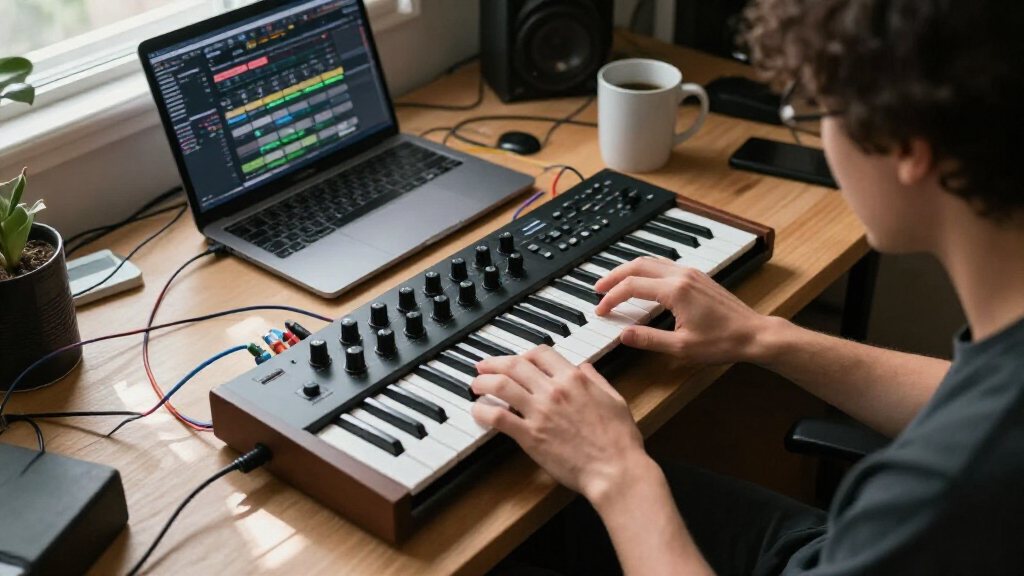
I ranked these instruments by how well they support actual music production in a compact setup. The main factors were whether each model can make sound on its own, how directly it supports writing or sequencing parts, its playable controls and keys, and how easily it can connect to a larger studio or live rig. I also weighed sound-design range against the space and workflow compromises that come with small hardware.
The MC-101 ranks first because its workstation approach covers more of the production process in one unit. The PRO-800 follows for focused polyphonic synthesis, while the REFACE DX and ESI Xsynth offer more direct keyboard input. Smaller instruments such as the PHARA-O MINI, UB-Xa MINI, AKS MINI, and Pro VS Mini are more specialized picks; the J-6 emphasizes chord-led creation, and the Stylophone and MPK Mini Play are best understood through their narrower roles. The ranking favors useful production capability over compact size alone.
Factors to Consider When Choosing Compact Synthesizers For Music Production
Before choosing a compact synth, decide what job it needs to do in your setup. A small instrument can be a sound source, a sequencer, a keyboard, or a complete sketching station, and those roles are not interchangeable.
Decide Whether You Need a Synth, a Sequencer, or Both
A synthesizer creates or shapes sound, while a sequencer stores and plays note patterns; a production workstation may combine both. If you expect to build full ideas away from a computer, check whether the device can arrange parts and patterns in the way you work. A synth without sequencing can still be a strong studio choice when your DAW or another hardware unit handles notes. The common mistake is buying by sound engine alone, then discovering that every part needs another device to play it. Sketching and finishing are separate needs, so decide which one the instrument must cover. This distinction often matters more than the number of presets or synthesis modes.
Match the Playing Interface to Your Input Style
Small hardware often saves space by shrinking the keyboard or leaving it out altogether. If you play melodies by hand, check the key count, key size, and whether the controls support expressive playing. If you mostly program notes, a compact unit with a good sequencer may be more useful than a larger keyboard. A controller can add keys to a sound module, but it also adds cables and occupies more desk space. Touch plates, buttons, and step entry can suit short phrases or performance gestures, yet they may slow down parts that depend on two-handed playing. Try to picture the most common part you will enter before choosing an interface.
Plan the Signal Path Before You Buy
Compact synths vary in how they connect to computers, mixers, controllers, and other instruments. Check for the specific audio and MIDI connections your setup uses, rather than assuming a USB port replaces every cable. Some devices can act as an audio interface or keyboard controller, while others primarily send or receive musical data. If you record several hardware sources at once, the number of audio inputs you already own may shape the choice. A frequent oversight is forgetting monitoring: a headphone output, mixer, or interface may be needed to hear the synth alongside a computer session. Map the route from playing a note to recording it before committing to a device.
Choose Sound Design Depth You Will Actually Use
A large sound engine can reward exploration, but it can also make quick writing slower if the controls are buried in menus. Hands-on knobs and a focused architecture can help when you want to shape a sound while composing. Presets and limited parameters may be a better fit when the instrument’s main job is to supply a particular tone or spark an idea. More synthesis types do not automatically mean more useful sounds for your tracks. Consider whether you enjoy building patches or prefer to reach a workable sound quickly. Leave room for the fact that a compact panel may require menus even on an otherwise capable instrument.
Think About Polyphony and Layering in the Arrangement
Polyphony determines how many notes can sound together, but the right amount depends on the parts you write. Chords, sustained pads, and overlapping releases can use more voices than a simple bass line or sequenced riff. A limited-voice instrument may still fit well if you record parts one at a time and build a track in layers. That approach depends on your willingness to capture takes and manage them in a DAW. Buyers sometimes focus on voice count without considering whether the instrument is monophonic, paraphonic, or designed for layered parts. Think about the arrangement you make most often, then decide whether simultaneous notes or rapid overdubbing matters more.
Set a Practical Limit for Size and Portability
Small dimensions help only if the controls remain usable where you plan to work. A pocket instrument can be easy to carry but awkward as the main studio keyboard, while a slim keyboard may fit a desk yet still need an external sound system or computer. Consider whether you will use the synth at a desk, rehearse with it, or carry it in a bag, since each setting favors different controls and connections. Battery operation and onboard speakers can be handy for quick ideas, but they do not replace checking recording and monitoring options. Also account for power supplies, adapters, and cables when estimating the real footprint. Choose the smallest instrument that still supports your regular workflow.
Frequently Asked Questions
Which compact synth can I use to make a track without a computer?
The Roland MC-101 is the clearest fit in this lineup for standalone production because it combines sound generation with pattern-based music making. The J-6 can help create chord-led ideas, but its narrower focus differs from a full production workstation. Before going computer-free, confirm how you will arrange longer pieces, record or export audio, and connect any extra instruments. Standalone pattern creation does not always mean a complete linear recording workflow. Choose based on whether your aim is to sketch, perform, or finish whole tracks on the device.
Should I buy a compact synth with keys or use a separate MIDI controller?
Choose built-in keys if immediate playing and fewer separate devices matter to you. The REFACE DX and ESI Xsynth offer keyboard input as part of the instrument, while a separate controller can serve multiple sound sources in a studio. A standalone controller such as the MPK Mini Play should not be mistaken for the same kind of synth as a dedicated sound module. Check key size and playing feel as well as the headline key count. A separate controller gives flexibility, but it adds setup steps and takes up space.
Is a compact analog synth a good first hardware synth?
It can be, if you know how you will play and record it. A focused analog instrument such as the PRO-800 gives polyphonic synthesis a central role, but a buyer seeking guided sequencing or an all-in-one sketchpad may prefer the MC-101. A first hardware synth also needs a practical way to receive notes and send audio to speakers, headphones, or a recording setup. Check whether you need to add a controller or sequencer before comparing sound engines. The best first choice is the one that fits your existing setup and encourages you to finish parts.
Can the Akai MPK Mini Play replace a synthesizer?
The MPK Mini Play is primarily a keyboard controller with onboard sounds, so it can make sound without a computer in some uses, but it serves a different role from a dedicated production synth. Its main value is compact note input and control; buyers should check whether its onboard sound options cover the parts they intend to record. If sound design or a particular synthesis engine is the priority, a dedicated synth from this lineup is a more direct match. If you already use virtual instruments, a controller-centered device may integrate more naturally. Confirm the connections and recording path for your setup before treating it as a standalone instrument.
What should I check before choosing a pocket-sized synthesizer?
Start with the tasks you expect it to handle: playing notes, sequencing patterns, shaping sounds, or providing a portable idea starter. Then check its audio output, MIDI options, power needs, and whether you can monitor it in the places you plan to use it. Pocketable models such as the Stylophone make a different compromise from keyboard-based choices: portability and immediacy come before conventional playing range. Make sure that tradeoff suits the parts you write, especially if you need chords or long performances. A compact device is a useful addition when its limits fit your workflow rather than interrupt it.
Conclusion
For the broadest compact production setup, I recommend the Roland MC-101 as best overall, since it brings sound and pattern-making together. The Behringer PRO-800 is my value pick for buyers who want eight-voice analog polyphony in a focused instrument. For a keyboard-led premium choice, the Yamaha REFACE DX offers a more direct playing experience and a distinct FM sound-design path. Beginners who want a self-contained place to sketch should start with the MC-101; those learning synthesis at a keyboard may prefer the REFACE DX. Choose the J-6 for chord-driven ideas, the PHARA-O MINI, UB-Xa MINI, AKS MINI, or Pro VS Mini for compact specialized sound sources, and the MPK Mini Play or Stylophone when their narrower controller or pocket-instrument roles match your needs.
Fall Picks
fall essentials
As an affiliate, we earn on qualifying purchases.