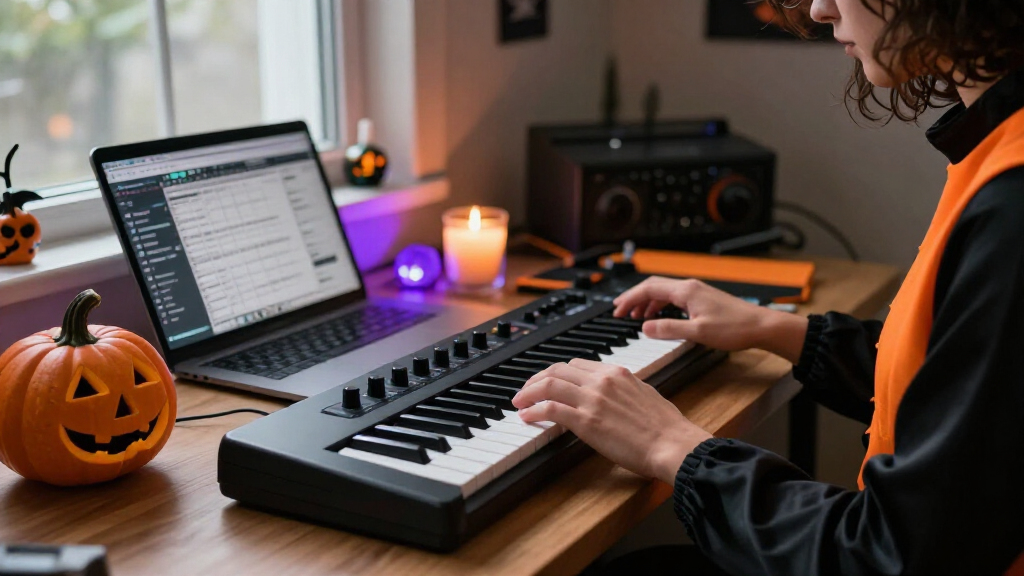

The best Halloween MIDI keyboard controllers make it easier to create eerie melodies, trigger spooky samples, and build seasonal tracks in your preferred music software. I’d choose the Akai Professional MPK Mini IV as the best overall option for its compact format and hands-on controls, while the Novation FLkey 2 Mini stands out for FL Studio users and the M-Audio Keystation 49 MK3 for players who want a wider keyboard. The main tradeoff is between portable 25-key controllers with pads and knobs and larger or wireless models that suit different setups. Software compatibility, connection type, and whether you need built-in sounds all affect the fit. Read on for the full breakdown and a guide to choosing a controller for your Halloween music workflow.

Get audio and creator gear delivered free with Prime
- Fast, free delivery on millions of items
- Prime Video, Amazon Music and more included
- Member-only deals all year
Complete the kit


Key Takeaways
- The MPK Mini IV is the strongest all-around fit for a compact Halloween production setup, balancing keyboard play with hands-on control without taking up much desk space.
- Controller type matters more than Halloween branding: most picks send MIDI data, so spooky sounds come from compatible software, samples, or external instruments rather than the keyboard itself.
- Key count creates the clearest tradeoff: 25-key models favor portability, while the M-Audio Keystation 49 MK3 and Irfora 49-key controller offer more room for two-handed parts.
- Workflow-specific options can beat a general-purpose controller: the Novation FLkey 2 Mini is the more targeted choice for FL Studio users, while the MPK Mini Play MK3 adds a built-in sound option for playing without a computer.
- Wireless features are not interchangeable: Bluetooth and wireless models may simplify placement, but buyers should check their device and software setup before assuming wireless MIDI will work smoothly.
| Donner DMK25 Pro 25-Key MIDI Keyboard Controller |  | Best for Feature-Rich Compact Control | Keys: 25 mini keys | Drum pads: 8 | Connectivity: USB-C | VIEW LATEST PRICE | See Our Full Breakdown |
| Pissente 25-Key USB MIDI Keyboard Controller with 8 Backlit Drum Pads |  | Best for Knob-Based Sound Shaping | Keyboard: 25 velocity-sensitive keys | Drum pads: 8 assignable, backlit, velocity-sensitive pads | Knobs: 8 assignable potentiometer knobs | VIEW LATEST PRICE | See Our Full Breakdown |
| Wireless 32-Key MIDI Keyboard Controller with Built-in Speaker |  | Best for Standalone Halloween Jam Sessions | Keys: 32 | Connectivity: Bluetooth Low Energy MIDI | Battery life: Up to 6 hours | VIEW LATEST PRICE | See Our Full Breakdown |
| Akai Professional LPK25 25-Key USB MIDI Keyboard Controller |  | Best for Simple, Portable DAW Entry | Keys: 25 velocity-sensitive mini keys | Connectivity: USB | Power: USB-powered | VIEW LATEST PRICE | See Our Full Breakdown |
| Irfora 25-Key USB MIDI Keyboard Controller with 8 RGB Pads and 8 Knobs |  | Best for RGB Pad Performance | Keys: 25 velocity-sensitive mini keys | Drum pads: 8 RGB backlit pads with velocity sensitivity and aftertouch | Knobs: 8 assignable 360-degree encoders | VIEW LATEST PRICE | See Our Full Breakdown |
| M-Audio Keystation 49 MK3 USB MIDI Controller |  | Best for Full-Size Keys | Keys: 49 full-size, velocity-sensitive keys | Controls: Volume fader, transport and directional buttons, pitch and modulation wheels, octave buttons | Pedal input: 1/4-inch (6.3 mm) sustain pedal input | VIEW LATEST PRICE | See Our Full Breakdown |
| 25-Key MIDI Keyboard Controller with 8 RGB Backlit Pads and 8 Knobs – Beat Maker for Music Production |  | Best Wireless Control Set | Keys: 25 velocity-sensitive keys | Pads: 8 RGB backlit pads | Controls: 8 assignable knobs and 2 capacitive touch strips | VIEW LATEST PRICE | See Our Full Breakdown |
| Akai Professional MPK Mini IV 25-Key USB-C MIDI Keyboard Controller |  | Best for Portable Creative Control | Keys: 25 velocity-sensitive mini keys | Pads: 8 velocity- and pressure-sensitive RGB MPC pads | Knobs: 8 assignable 360-degree encoders | VIEW LATEST PRICE | See Our Full Breakdown |
| Novation FLkey 2 Mini 25-Key USB MIDI Controller Keyboard |  | Best for FL Studio Users | Keys: 25 mini keys | Pads: 16 velocity-sensitive pads | Controls: 8 knobs, pitch and mod touch strips | VIEW LATEST PRICE | See Our Full Breakdown |
| Irfora USB MIDI Keyboard Controller with 49 Keys and 8 RGB Trigger Pads |  | Best for Hands-On Studio Control | Keys: 49 velocity-sensitive keys | Trigger pads: 8 assignable RGB backlit pads | Knobs: 8 assignable 360-degree rotating knobs | VIEW LATEST PRICE | See Our Full Breakdown |
| Akai Professional MPK Mini Play MK3 25-Key USB MIDI Keyboard Controller |  | Best for Standalone Spooky Sound Design | Keys: 25 velocity-sensitive keys | Connectivity: USB | Built-in sounds: 128+ instruments and drum kits | VIEW LATEST PRICE | See Our Full Breakdown |
| Akai Professional MPK Mini Plus 37-Key USB MIDI Keyboard Controller |  | Best for Hardware-Connected Halloween Composing | Keys: 37 velocity-sensitive mini keys | Connectivity: USB, MIDI I/O, CV/Gate | Drum pads: 8 RGB MPC pads | VIEW LATEST PRICE | See Our Full Breakdown |
| Synido Wireless 25-Key MIDI Keyboard and TempoPad P16 MIDI Pad Controller |  | Best for Guided Mobile Music Making | Keys: 25 | Connectivity: Wireless MIDI, USB | Battery: 3000mAh rechargeable | VIEW LATEST PRICE | See Our Full Breakdown |
| DaierTek 25-Key Bluetooth and USB MIDI Keyboard Controller |  | Best for Wireless Hands-On Control | Keys: 25 velocity-sensitive keys | Connectivity: Bluetooth and USB MIDI | Pads: 8 RGB backlit, velocity-sensitive pads with aftertouch | VIEW LATEST PRICE | See Our Full Breakdown |
| Badafaci 25-Key Bluetooth MIDI Keyboard Controller |  | Best for Essential Wireless Controls | Keys: 25 velocity-sensitive keys | Connectivity: USB-C and Bluetooth MIDI | Material: ABS | VIEW LATEST PRICE | See Our Full Breakdown |
| Halloween MIDI keyboard controller | Keys | Connectivity | Controls |
|---|---|---|---|
| Donner DMK25 Pro 25-Key MIDI K | 25 mini keys | USB-C | Touch bar, 4 wheels, 6 transport controllers |
| Pissente 25-Key USB MIDI Keybo | — | — | Pitch and modulation touch sensors |
| Wireless 32-Key MIDI Keyboard | 32 | Bluetooth Low Energy MIDI | — |
| Akai Professional LPK25 25-Key | 25 velocity-sensitive mini keys | USB | Octave controls, sustain button, arpeggiator |
| Irfora 25-Key USB MIDI Keyboar | 25 velocity-sensitive mini keys | — | — |
| M-Audio Keystation 49 MK3 USB | 49 full-size, velocity-sensitive keys | — | Volume fader, transport and directional buttons, pitch and modulation wheels, octave buttons |
| 25-Key MIDI Keyboard Controlle | 25 velocity-sensitive keys | — | 8 assignable knobs and 2 capacitive touch strips |
| Akai Professional MPK Mini IV | 25 velocity-sensitive mini keys | USB-C and full-size MIDI Out | — |
| Novation FLkey 2 Mini 25-Key U | 25 mini keys | USB | 8 knobs, pitch and mod touch strips |
| Irfora USB MIDI Keyboard Contr | 49 velocity-sensitive keys | USB 2.0, MIDI IN/OUT | — |
| Akai Professional MPK Mini Pla | 25 velocity-sensitive keys | USB | 4 assignable rotary encoder knobs |
| Akai Professional MPK Mini Plu | 37 velocity-sensitive mini keys | USB, MIDI I/O, CV/Gate | — |
| Synido Wireless 25-Key MIDI Ke | 25 | Wireless MIDI, USB | — |
| DaierTek 25-Key Bluetooth and | 25 velocity-sensitive keys | Bluetooth and USB MIDI | 8 assignable encoders, mini display, 2 capacitive touch strips |
| Badafaci 25-Key Bluetooth MIDI | 25 velocity-sensitive keys | USB-C and Bluetooth MIDI | — |
More Details on Our Top Picks
Donner DMK25 Pro 25-Key MIDI Keyboard Controller
For Halloween sessions built around a laptop and a cast of eerie software instruments, the Donner DMK25 Pro puts more performance tools within reach than a bare-bones mini keyboard. Its OLED display, eight drum pads, touch bar, and four wheels make it easier to shape sounds and trigger beats without relying only on mouse clicks. Scale, arpeggio, note repeat, and chord modes can also help sketch spooky motifs quickly. Compared with the Akai Professional LPK25, Donner offers substantially more hands-on controls, though the Akai is lighter and simpler to pack. The tradeoff is familiar for this class: 25 mini keys limit comfortable two-handed playing, and this controller makes no sound without compatible software. Its green-and-black finish suits a Halloween-themed setup, but the real advantage is its flexible control layout.
Pros:- Eight drum pads and several physical controls support hands-on beat and sound shaping.
- OLED display makes key settings easier to check while working.
- Scale, arpeggio, note repeat, and chord modes can speed up eerie melody sketches.
- Works with compatible DAW software on computers and mobile devices.
Cons:- It cannot produce sound without a connected DAW or other compatible software.
- Mini keys may feel cramped for players accustomed to full-size keyboards.
- Its many controls may be more than a beginner needs for basic note entry.
Best for: Laptop-based Halloween music makers who want pads, expressive controls, and songwriting modes in a compact controller.
Not ideal for: Players who need full-size keys, standalone sounds, or a controller with a very simple control layout.
- Keys:25 mini keys
- Drum pads:8
- Connectivity:USB-C
- Display:OLED
- Controls:Touch bar, 4 wheels, 6 transport controllers
- Features:Scale mode, arpeggiator, note repeat, chord functions
- Compatibility:Windows, Mac, Android, iOS
- Color:Green and black
Our verdict“Choose the DMK25 Pro if you want a compact Halloween production controller with more performance controls than the simpler Akai LPK25.”
Pissente 25-Key USB MIDI Keyboard Controller with 8 Backlit Drum Pads
The Pissente is a fit for Halloween producers who would rather tweak several software parameters by hand than work through menus. Its eight assignable knobs give it a distinct role beside the Akai Professional LPK25, which focuses on compact key control and offers fewer hands-on sound-shaping options. Eight backlit, velocity-sensitive pads add a beat-making surface for suspenseful pulses and impact sounds, while the arpeggiator and chord mode help build ideas from a short phrase. The 25 velocity-sensitive keys keep the unit portable, but they do not provide much room for two-handed parts. It also needs USB power, so a cable and compatible host are part of any portable setup. Choose it for tactile control over a software workflow, not for standalone playing or broad keyboard range.
Pros:- Eight assignable knobs provide hands-on control of compatible software parameters.
- Backlit, velocity-sensitive pads make beat triggering more expressive and visible.
- Arpeggiator and chord mode support quick composition from short keyboard parts.
- Listed compatibility includes several common music applications.
Cons:- USB connection is required for power, limiting cable-free use.
- The 25-key range can constrain two-handed playing and wider arrangements.
- The listed warranty period is 90 days.
Best for: DAW users making Halloween tracks who want assignable knobs and illuminated pads in a small, USB-powered controller.
Not ideal for: Musicians seeking standalone sounds, wireless operation, full-size keys, or enough range for more involved keyboard parts.
- Keyboard:25 velocity-sensitive keys
- Drum pads:8 assignable, backlit, velocity-sensitive pads
- Knobs:8 assignable potentiometer knobs
- Controls:Pitch and modulation touch sensors
- Features:Arpeggiator, chord mode, display
- Power and connector:USB 5V power; USB connector
- Compatibility:Phone and PC; listed software includes Cubase, Logic Pro, FL Studio, GarageBand, and Studio One
- Dimensions:380.5 × 181.5 × 56.9 mm
Our verdict“Pick the Pissente over the simpler Akai LPK25 if assignable knobs and backlit pads matter more to your Halloween DAW workflow than standalone portability.”
Wireless 32-Key MIDI Keyboard Controller with Built-in Speaker
Unlike the other four controllers here, the K32 is described as having built-in sounds and a speaker, so it can support an impromptu Halloween jam without requiring a computer or DAW. That makes it the clearest choice for casual playing away from a desk; the Donner DMK25 Pro, by comparison, depends on connected software to make sound. Its 32-key layout gives a little more melodic range than the 25-key options, and BLE MIDI, eight knobs, and eight pads add flexibility when you do connect it to a compatible setup. The cost of that freedom is a rechargeable battery rated for up to six hours, which may not cover a long event without charging. The supplied details do not identify its built-in sound selection, so buyers should not assume it includes a particular Halloween patch.
Pros:- Built-in sounds and speaker allow standalone playing according to the product description.
- BLE MIDI supports wireless connection to compatible setups.
- 32 keys offer more range than the four 25-key controllers in this batch.
- Eight assignable knobs and eight drum pads provide hands-on controls.
Cons:- Battery life is listed as up to six hours and may not suit extended sessions.
- The provided product details do not specify which built-in sounds are included.
- Its standalone speaker is a different fit from a dedicated DAW-first controller such as the Donner DMK25 Pro.
Best for: People who want to play simple Halloween melodies and beats away from a computer, with the option to send MIDI wirelessly.
Not ideal for: Producers who need a long-session battery, a documented sound library, or a controller focused solely on DAW integration.
- Keys:32
- Connectivity:Bluetooth Low Energy MIDI
- Battery life:Up to 6 hours
- Speaker:Built-in
- Knobs:8 assignable
- Drum pads:8
- Display:OLED
- Power:Rechargeable
Our verdict“Choose the K32 if standalone, wireless Halloween playing matters more than longer battery life or a clearly documented sound set.”
Akai Professional LPK25 25-Key USB MIDI Keyboard Controller
The Akai Professional LPK25 is the straightforward pick for Halloween producers who mainly need to enter notes and trigger an arpeggiated phrase in a DAW. Its lightweight 0.48 kg body and compact dimensions make it easier to carry than the broader-control Donner DMK25 Pro, while octave buttons and a sustain button add useful basics without crowding the surface. The eight programmable presets can help keep preferred setups at hand. This is a deliberately lean option, not a beat-production workstation: unlike the Pissente, it has no listed drum pads or assignable knobs. Its mini keys suit quick parts better than extended piano-style playing, and it needs a computer or another compatible USB host. For a Halloween setup built around software instruments, that simplicity is an advantage; for hands-on sound design, it is a limitation.
Pros:- Lightweight design makes it easy to carry between a home studio and other setups.
- Arpeggiator, octave controls, and sustain button cover useful basic performance needs.
- Eight programmable presets support repeatable controller setups.
- USB power avoids the need for a separate power supply.
Cons:- Mini keys may feel small for players used to a full-size keyboard.
- A computer or other compatible USB host is required to use it.
- Compared with the Pissente, it lacks listed drum pads and assignable knobs.
Best for: Mobile producers who want a light, no-frills keyboard for entering Halloween melodies into Mac or PC music software.
Not ideal for: Beat makers who want pads and assignable knobs, players who need full-size keys, or anyone seeking standalone sound.
- Keys:25 velocity-sensitive mini keys
- Connectivity:USB
- Power:USB-powered
- Programmable presets:8
- Controls:Octave controls, sustain button, arpeggiator
- Compatibility:Mac and PC
- Dimensions:3.96 × 13.68 × 1.44 in
- Weight:0.48 kg
Our verdict“Choose the LPK25 for portable, uncomplicated note entry, but pick the Pissente or Donner if your Halloween production needs pads and more hands-on controls.”
Irfora 25-Key USB MIDI Keyboard Controller with 8 RGB Pads and 8 Knobs
For a Halloween workstation where visual pad feedback helps keep drum parts organized, the Irfora pairs eight RGB pads with eight assignable encoders and an OLED display. The pads are described as velocity-sensitive and supporting aftertouch, note repeat, and full-level options, giving this controller a more performance-focused pad section than the basic Akai Professional LPK25. A sustain pedal input is another useful distinction: it supports more expressive keyboard playing than the LPK25’s built-in sustain button, provided you supply a compatible pedal. The tradeoff is that the Irfora still has only 25 mini keys and is USB-powered, so it is not a standalone or cable-free option. Its plastic construction and listed 90-day warranty may also be a concern for buyers seeking a more substantial build or longer stated coverage.
Pros:- Eight RGB pads offer velocity sensitivity and listed aftertouch support.
- Eight assignable 360-degree encoders allow hands-on software adjustments.
- OLED display and sustain pedal input add useful performance control.
- USB Type-C connection and sub-kilogram listed weight suit compact setups.
Cons:- The 25 mini keys may feel cramped for two-handed parts.
- USB power means it is not a cable-free or standalone instrument.
- Plastic construction and the listed 90-day warranty may not suit buyers prioritizing durability or longer coverage.
Best for: Halloween beat makers who want illuminated, expressive pads, assignable encoders, and a sustain-pedal connection in a compact controller.
Not ideal for: Players who need full-size keys, wireless or standalone operation, or a controller with a stated warranty longer than 90 days.
- Keys:25 velocity-sensitive mini keys
- Drum pads:8 RGB backlit pads with velocity sensitivity and aftertouch
- Knobs:8 assignable 360-degree encoders
- Display:OLED
- Connections:USB data port; 6.35 mm sustain pedal input
- Power:USB Type-C
- Compatibility:iOS, macOS 10.7 or later, Windows 7 SP1 or later
- Dimensions and weight:34.2 × 17.4 × 4.8 cm; 783 g
Our verdict“Choose the Irfora over the Akai LPK25 if RGB pads, assignable encoders, and a sustain-pedal input are more useful to your Halloween performance setup than minimal size.”
M-Audio Keystation 49 MK3 USB MIDI Controller
For Halloween scoring or arranging that calls for more natural two-handed playing, I’d put the Keystation 49 MK3 ahead of the compact 25-key options. Its 49 full-size, velocity-sensitive keys give you more room to sketch eerie melodies and chords without constantly shifting octaves. Pitch and modulation wheels add direct expression, while transport and directional controls make basic DAW operation easier from the keyboard. It runs over USB without a separate power supply or driver setup, and the included software bundle gives a new producer tools to start with. Compared with the more control-heavy Irfora 49-Key MIDI Keyboard, this model has no pads or banks of assignable controls. Its simpler layout is easier to approach, but the sustain pedal is sold separately, and connecting an iOS device requires an additional adapter.
Pros:- 49 full-size velocity-sensitive keys support more comfortable two-handed playing than 25-key controllers.
- Pitch and modulation wheels provide immediate performance expression.
- USB power and driver-free Mac and PC connection simplify desk setup.
- Includes a selection of music software and online lessons.
Cons:- A sustain pedal is not included.
- iOS connection requires a separately sold Apple to USB Camera Adapter.
- No drum pads or multiple assignable knobs for pad-based beat production.
Best for: Halloween composers and beginner producers who want full-size keys for melodies, chords, and virtual instruments at a computer.
Not ideal for: Beatmakers who want built-in trigger pads and extensive hands-on mixing controls, or mobile iOS users who do not want to buy an adapter.
- Keys:49 full-size, velocity-sensitive keys
- Controls:Volume fader, transport and directional buttons, pitch and modulation wheels, octave buttons
- Pedal input:1/4-inch (6.3 mm) sustain pedal input
- Power:USB-powered
- Compatibility:Mac and PC; iOS via separately sold Apple to USB Camera Adapter
- Included software:MPC Beats, Ableton Live Lite, Velvet, XPand2, Mini Grand, Touch Loops
Our verdict“Choose the Keystation 49 MK3 if full-size playing range matters more to your Halloween music workflow than pads and extensive controller customization.”
25-Key MIDI Keyboard Controller with 8 RGB Backlit Pads and 8 Knobs – Beat Maker for Music Production
If your Halloween sessions move between a desk and a laptop away from outlets, this controller’s built-in battery and wireless design are its defining advantage. The 25 velocity-sensitive keys cover short motifs, while eight RGB pads, eight assignable knobs, and two touch strips offer more performance and sound-shaping options than the simpler Akai Professional LPK25. Up to 16 hours of stated battery life supports portable sessions without tying the keyboard to a USB cable. Broad compatibility across computer and mobile systems also makes it a flexible fit for a mixed-device setup. The tradeoff is range: 25 keys can feel restrictive for longer parts or two-handed arrangements. It also has no built-in speakers or audio output, so you still need a computer, device, or separate audio setup to hear your sounds.
Pros:- Built-in 2000 mAh battery is rated for up to 16 hours of use.
- Velocity-sensitive keys and pads support expressive playing.
- Eight knobs and two touch strips add hands-on sound and DAW control.
- Compatible with Windows, macOS, Android, and iOS.
Cons:- The 25-key range limits extended or two-handed piano parts.
- No built-in speakers or audio output; sounds must be heard through connected equipment.
- Wireless setup may be less direct than the USB-powered Akai MPK Mini IV.
Best for: Mobile beatmakers who want a battery-powered controller with pads and knobs for building Halloween loops across computer or mobile devices.
Not ideal for: Pianists composing long two-handed parts, or buyers seeking a self-contained keyboard with speakers or audio output.
- Keys:25 velocity-sensitive keys
- Pads:8 RGB backlit pads
- Controls:8 assignable knobs and 2 capacitive touch strips
- Battery:Built-in Li-ion, 2000 mAh
- Battery life:Up to 16 hours
- Compatible systems:Windows, macOS, Android, iOS
- Supported DAWs:Ableton Live, FL Studio, Cubase, Logic Pro X, Reason, Studio One, GarageBand
- Material and color:ABS, black
Our verdict“Pick this model for portable, battery-powered beatmaking with plenty of control, but choose a larger keyboard for extended melodic playing.”
Akai Professional MPK Mini IV 25-Key USB-C MIDI Keyboard Controller
The MPK Mini IV is a strong fit for Halloween producers who want more than a small keyboard: its eight pressure-sensitive RGB MPC pads, assignable encoders, and performance modes make it easy to move between melodies, drum hits, and chord ideas. Scale and chord modes can help beginners play a consistent eerie motif, while the arpeggiator gives repeating notes a quick rhythmic shape. A full-color screen and full-size MIDI Out add useful control and connection options beyond the basic USB setup. Compared with the FL Studio-focused Novation FLkey 2 Mini, the Akai offers broader DAW flexibility, but it has half as many pads. Its 25 mini keys are compact for travel yet can feel cramped for players used to full-size keys, and some bundled content may require separate downloads or accounts.
Pros:- Pressure-sensitive RGB pads support expressive drum and sample triggering.
- Arpeggiator, chord mode, and scale mode offer practical tools for shaping motifs.
- USB-C and full-size MIDI Out provide computer and external MIDI connection options.
- Includes a sound collection and music software bundle.
Cons:- The 25 mini keys may feel cramped for players accustomed to full-size keys.
- Eight pads provide fewer trigger surfaces than the Novation FLkey 2 Mini’s 16.
- Some included software and trials may require separate downloads or accounts.
Best for: Portable producers who want a compact controller for melodies, drum programming, and performance tools across compatible DAWs.
Not ideal for: Players who need full-size keys or a wider playing range, and buyers who prefer a controller with 16 pads or a dedicated FL Studio layout.
- Keys:25 velocity-sensitive mini keys
- Pads:8 velocity- and pressure-sensitive RGB MPC pads
- Knobs:8 assignable 360-degree encoders
- Connectivity:USB-C and full-size MIDI Out
- Display:Full-color screen
- Performance features:Arpeggiator, chord and scale modes, pitch and modulation wheels
- Compatible platforms:Mac, Windows, and mobile setups
- Included software:Studio Instrument Collection with 1,000+ sounds, Ableton Live Lite 12, 30-day Melodics trial, 2 months of Splice
Our verdict“Choose the MPK Mini IV for a portable, broadly compatible controller with strong performance tools, provided mini keys suit your playing style.”
Novation FLkey 2 Mini 25-Key USB MIDI Controller Keyboard
For Halloween tracks made in FL Studio, the FLkey 2 Mini earns its place through workflow-specific control rather than broad DAW versatility. Its 16 velocity-sensitive pads, eight knobs, and pitch and mod touch strips put beat triggering and sound adjustment within reach, while step sequencing and mixing support hands-on work inside the software. Scale and chord modes plus an arpeggiator can help generate ominous patterns without relying only on piano technique. The included six months of FL Studio Producer Edition also gives FL Studio users a direct path into the intended workflow. Compared with the Akai MPK Mini IV, this Novation has twice the pads but is more focused on one DAW. Its 25 mini keys remain restrictive for longer parts, and buyers using other software may not get the same integration benefit.
Pros:- Designed around FL Studio workflows, including step sequencing and mixing.
- Sixteen velocity-sensitive pads provide more trigger space than the Akai MPK Mini IV.
- Scale and chord modes and an arpeggiator support quick pattern creation.
- Includes six months of FL Studio Producer Edition.
Cons:- The 25 mini keys provide limited range for longer or two-handed parts.
- Its strongest workflow features are focused on FL Studio.
- Plastic construction may not suit buyers seeking a more substantial-feeling controller.
Best for: FL Studio producers who want compact keyboard, pad, sequencing, and mixing controls for making Halloween beats and motifs.
Not ideal for: Musicians who need full-size keys, a wider keyboard range, or equal emphasis on integration with several DAWs.
- Keys:25 mini keys
- Pads:16 velocity-sensitive pads
- Controls:8 knobs, pitch and mod touch strips
- Connectivity:USB
- Compatible software:FL Studio
- Compatible devices:PC, synthesizer, groovebox
- Included components:USB cable, safety information sheet
- Warranty:3 years
Our verdict“Choose the FLkey 2 Mini if FL Studio is your main Halloween production tool and its compact key range fits your playing needs.”
Irfora USB MIDI Keyboard Controller with 49 Keys and 8 RGB Trigger Pads
The Irfora pairs a 49-key range with a notably large control surface, making it the most control-dense choice here for producers who want to shape Halloween arrangements from one keyboard. Alongside eight RGB trigger pads and eight assignable knobs, it has a master volume slider and eight assignable sliders—more physical mixing control than the M-Audio Keystation 49 MK3, which is the simpler pick for straightforward keyboard playing. MIDI IN/OUT and two assignable pedal interfaces also make it better suited to a setup with external gear and pedals. Those additions come with a cost in space and weight: at 3.5 kg and 76.5 cm wide, it is less convenient to move than the compact MPK Mini IV. Its plastic body and missing 9V adapter are also worth factoring into a studio setup.
Pros:- 49 velocity-sensitive keys offer more playing range than 25-key controllers.
- Eight RGB pads and eight assignable knobs support beat triggering and sound adjustment.
- Master and assignable sliders provide substantial hands-on control.
- MIDI IN/OUT and two assignable pedal interfaces suit expanded studio setups.
Cons:- At 3.5 kg and 76.5 cm wide, it is less portable than the Akai MPK Mini IV.
- The optional 9V power adapter is not included.
- Software compatibility information is unclear or incomplete in the product data.
Best for: Home-studio producers who want 49 keys, pad triggering, extensive fader control, and MIDI connections for external equipment.
Not ideal for: Traveling musicians who need a light, compact controller, or beginners who want clearly specified software support and a simpler control layout.
- Keys:49 velocity-sensitive keys
- Trigger pads:8 assignable RGB backlit pads
- Knobs:8 assignable 360-degree rotating knobs
- Sliders:1 master volume slider and 8 assignable sliders
- Connectivity:USB 2.0, MIDI IN/OUT
- Pedal interfaces:2 assignable
- Power:USB or optional DC 9V adapter
- Compatibility:Windows 10/8/7/XP/Vista and Mac OS X
- Dimensions and weight:76.5 × 26.5 × 6 cm; 3.5 kg
Our verdict“Pick the Irfora if your Halloween studio needs a broad 49-key controller with extensive faders and external MIDI connections, not a travel-friendly board.”
Akai Professional MPK Mini Play MK3 25-Key USB MIDI Keyboard Controller
For Halloween music making away from a computer, I’d put the MPK Mini Play MK3 ahead of controllers that need a DAW to make any sound. Its built-in speaker and library of 128+ instruments and drum kits let you sketch eerie motifs or test sounds on the spot, while the battery-powered design suits portable sessions. The eight velocity-sensitive MPC pads add a direct way to tap out knocks, hits, and rhythmic patterns. Compared with the Akai MPK Mini Plus, this model favors self-contained portability over a longer keyboard, sequencing, and connections for external gear. Its 25-key range can pinch when a cue needs wide chords, and the onboard speaker is less suited to detailed monitoring than headphones. I’d choose it for quick ideas, not as my main full-range studio keyboard.
Pros:- Built-in speaker and battery power support standalone portable playing.
- More than 128 onboard instruments and drum kits provide sounds without relying on a computer.
- Velocity-sensitive keys and MPC pads allow expressive notes and beat programming.
- Included production and learning software supports a move from sketches to computer-based work.
Cons:- The 25-key layout limits the range available for broad chords and two-handed parts.
- Batteries are not included.
- Compared with the MPK Mini Plus, it lacks the listed sequencer and MIDI/CV connections for external gear.
Best for: Mobile creators who want to sketch Halloween melodies and beats without keeping a computer or DAW running.
Not ideal for: Players who need a wider key range, advanced external-gear connections, or detailed sound monitoring from built-in speakers.
- Keys:25 velocity-sensitive keys
- Connectivity:USB
- Built-in sounds:128+ instruments and drum kits
- Drum pads:8 velocity-sensitive MPC pads
- Controls:4 assignable rotary encoder knobs
- Display:OLED
- Battery life:14+ hours
- Headphone output:1/8-inch
- Included software:MPC Beats, Hype, AIR Essential Keyboards, Electric, Melodics
Our verdict“Choose the MPK Mini Play MK3 if you want a portable, self-contained starting point for Halloween sounds and beats.”
Akai Professional MPK Mini Plus 37-Key USB MIDI Keyboard Controller
The MPK Mini Plus is my pick here for Halloween producers who want to control more than a computer. Its 37 mini keys give melodies and chords more room than the 25-key MPK Mini Play MK3, and the built-in 64-step sequencer supports composing a repeating suspense figure without depending on a DAW. MIDI I/O and CV/Gate connections also make it the more adaptable choice for pairing with external synthesizers or modular equipment. Eight RGB pads and assignable knobs provide hands-on control for drum parts and sound shaping. The tradeoff is that it is not a standalone sound source like the MPK Mini Play MK3: you’ll need compatible sound-generating gear or software. Mini keys may also feel cramped for players used to full-size keys, and the included Komplete 15 Select bundle is a choice of one option, not every option.
Pros:- 37 keys offer more room for melodies and chords than the 25-key options in this batch.
- Built-in 64-step sequencer supports pattern-based composing without relying on a DAW.
- USB, MIDI I/O, and CV/Gate connections accommodate computers and external music equipment.
- Eight RGB pads and eight assignable knobs give direct control over beats and parameters.
Cons:- Mini keys may feel cramped for players accustomed to full-size keyboards.
- It has no listed built-in sound engine, so sound requires software or external equipment.
- The Komplete 15 Select offer is a choice of one bundle option rather than all three.
Best for: Halloween composers who use a DAW alongside hardware synthesizers or modular gear and want a compact controller with sequencing.
Not ideal for: Players seeking standalone sounds, full-size keys, or the simplest plug-in-and-play controller for basic computer use.
- Keys:37 velocity-sensitive mini keys
- Connectivity:USB, MIDI I/O, CV/Gate
- Drum pads:8 RGB MPC pads
- Rotary knobs:8 assignable
- Sequencer:64-step; one drum track and one melody or chord track
- Software compatibility:Windows and Mac OS
- Included software:MPC Beats; choice of Komplete 15 Select bundle
Our verdict“Pick the MPK Mini Plus if sequencing and connections to external Halloween-sound gear matter more than standalone playback.”
Synido Wireless 25-Key MIDI Keyboard and TempoPad P16 MIDI Pad Controller
For a beginner building a Halloween track on a phone or tablet, the Synido’s Smart Scale and Smart Chord features can make note choices less intimidating while leaving room to experiment. Its wireless connection, rechargeable battery, and 2.75-pound weight suit a portable setup, and customizable RGB pad lighting gives beat controls a clear visual identity. Unlike the Akai MPK Mini Play MK3, the Synido requires music software to produce sound; its listed 120 instrument sounds and eight drum kits should not be mistaken for a standalone sound engine. The five-hour maximum battery life is also shorter than the listed runtimes of the Akai Play and DaierTek. I’d favor this over the Badafaci when beginner-friendly scale and chord aids are the priority, but the supplied software support is specifically listed as FL Studio.
Pros:- Wireless MIDI and USB support portable computer and mobile workflows.
- Smart Scale and Smart Chord can help beginners build melodies and harmonies.
- Rechargeable 3000mAh battery provides up to five hours of use.
- Customizable full RGB pad lighting and mapping help distinguish beat controls.
Cons:- Requires music software to produce sound, unlike the standalone Akai MPK Mini Play MK3.
- Up to five hours of battery life is shorter than the runtimes listed for the Akai Play and DaierTek.
- Supported software is listed as FL Studio, so buyers using other DAWs should verify compatibility.
Best for: Beginners making Halloween music on a laptop, tablet, or phone who want wireless portability and guided scale or chord features.
Not ideal for: Musicians who need standalone sound, longer battery sessions, or confirmed compatibility beyond the listed FL Studio support.
- Keys:25
- Connectivity:Wireless MIDI, USB
- Battery:3000mAh rechargeable
- Battery life:Up to 5 hours
- Weight:2.75 lbs
- Pad lighting:Customizable full RGB
- Included sounds:120 instrument sounds and 8 drum kits; music software required for sound
- Compatible devices:Laptop, tablet, smartphone, PC
- Supported software:FL Studio
Our verdict“Choose the Synido if you want a beginner-oriented, wireless controller for software-based Halloween music on mobile devices.”
DaierTek 25-Key Bluetooth and USB MIDI Keyboard Controller
The DaierTek stands out for a compact Halloween setup that needs more than keys and pads: it combines eight assignable encoders, two capacitive touch strips, and a mini display for direct control over a DAW or compatible instrument. Its Bluetooth and USB MIDI options work across desktop and mobile platforms listed in the product data, while smart chord, smart scale, and arpeggio features offer different ways to generate or shape spooky parts. Compared with the Synido, it lists a longer battery runtime and more physical controls, but the Synido is lighter and explicitly gives its battery capacity. Like the Badafaci, the DaierTek makes no sound on its own, so software or a DAW is required. Bluetooth MIDI setup may also call for a compatible app or Windows driver, making USB the more straightforward choice when wireless pairing is awkward.
Pros:- Bluetooth and USB MIDI offer wireless and wired connection options.
- Eight assignable encoders, touch strips, and a mini display expand hands-on control.
- Smart chord, smart scale, and arpeggio functions support varied composition approaches.
- About 16 hours of listed battery operation suits longer portable sessions.
Cons:- It does not generate sound without compatible music software or a DAW.
- Bluetooth MIDI may require a compatible app or a Windows driver.
- The 25-key range offers less room for extended parts than the 37-key Akai MPK Mini Plus.
Best for: Mobile and desktop producers who want wireless MIDI plus knobs and touch strips for hands-on Halloween sound control.
Not ideal for: Buyers who need a standalone instrument, a wide keyboard, or a guaranteed no-setup Bluetooth connection.
- Keys:25 velocity-sensitive keys
- Connectivity:Bluetooth and USB MIDI
- Pads:8 RGB backlit, velocity-sensitive pads with aftertouch
- Controls:8 assignable encoders, mini display, 2 capacitive touch strips
- Battery:2000mAh; about 16 hours of operation
- Compatibility:Windows, Mac OS, Android, iOS
- Supported software:Ableton Live, FL Studio, Cubase, GarageBand, and other compatible DAWs
- Additional features:Arpeggio, smart chord, smart scale
Our verdict“Pick the DaierTek if wireless flexibility and extra real-time controls matter more than standalone sound or a longer keyboard.”
Badafaci 25-Key Bluetooth MIDI Keyboard Controller
The Badafaci is a stripped-back choice for Halloween creators who want a portable 25-key controller with expressive pads and a useful set of performance shortcuts. Its USB-C and Bluetooth MIDI connections cover wired and wireless setups, while octave, transpose, pitch, modulation, scale, chord, arpeggiator, and note-repeat controls offer several ways to shape a simple motif or beat. The feature set overlaps with the DaierTek, but the DaierTek lists eight encoders, touch strips, a display, and named DAW compatibility; the Badafaci’s appeal is its focused control set rather than those extra interface details. It does not make sound independently, and the product data does not identify supported software, so compatibility deserves checking before purchase. The 25-key span is handy for travel but a real limit for wider arrangements.
Pros:- USB-C and Bluetooth MIDI provide wired and wireless connection choices.
- Velocity-sensitive keys and RGB pads support expressive playing and beat triggering.
- Scale, chord, arpeggiator, and note-repeat controls offer several performance shortcuts.
- Compact 25-key layout suits mobile workspaces and smaller setups.
Cons:- It requires music software or a DAW to produce sound.
- The product data does not specify software compatibility.
- A 25-key layout limits the range for broad chords and more involved parts.
Best for: Traveling beginners who want a compact wireless controller with scale, chord, arpeggio, and note-repeat functions for a compatible DAW.
Not ideal for: Buyers who need standalone sounds, a broader key range, detailed DAW compatibility information, or extra knobs and touch controls.
- Keys:25 velocity-sensitive keys
- Connectivity:USB-C and Bluetooth MIDI
- Material:ABS
- Keyboard battery:2000mAh
- Receiver battery:110mAh
- Drum pads:RGB-backlit velocity-sensitive pads
- Controls and features:Octave, transpose, pitch, modulation, scale, chord, arpeggiator, note repeat
- Warranty:90 days
Our verdict“Choose the Badafaci for a compact wireless controller with essential creative shortcuts, provided your software supports it.”

How We Picked
I compared the 15 listed controllers by how well they fit practical Halloween music-making needs: entering melodies, triggering samples, controlling software instruments, and fitting into a home or portable setup. I gave weight to key count and playability, the usefulness of pads and knobs, connection options, software workflow, and whether a product offers a distinct advantage such as wireless operation or built-in sounds. I also treated usability and setup demands as part of the value: extra controls only help when they suit the buyer’s software and working style.
The ranking favors models with a clear role and a credible balance of features over products whose listed details offer less differentiation. That puts the MPK Mini IV first as a versatile compact pick, while specialized choices rank higher for the specific people they serve. Larger keyboards, FL Studio-focused controls, and built-in playback can be better fits for some buyers, but they are not universal upgrades. Since MIDI controllers generally depend on connected software or instruments for sound, I also weighed whether a feature addresses a real Halloween production need rather than implying that the controller creates spooky audio on its own.
Factors to Consider When Choosing Halloween MIDI Keyboard Controllers
A Halloween-ready controller is not defined by a particular key count or color scheme. I’d start with the job it needs to do in your setup: play a melody, trigger sound effects, control a software instrument, or make music away from a computer. These broader checks can help you avoid paying for controls you will not use or choosing a compact model that feels limiting once you start arranging parts.
Match Key Count to How You Compose
Short keyboards are easy to fit beside a laptop, but they can make wide melodic passages and two-handed playing awkward. A 25-key controller is often enough for entering bass lines, simple melodies, and notes one part at a time. If you plan to perform piano-like parts or want to keep both hands on the keys, a 37- or 49-key model can reduce octave changes and interruptions. Do not assume more keys automatically mean a better controller; a larger unit needs more desk space and may be less convenient to carry. Before choosing, think about whether you record one layer at a time or play full arrangements in real time.
Check Your Software Before Prioritizing Controls
Knobs, pads, and transport controls are useful only when they connect to functions you actually use. A pad can trigger a Halloween sound-effect sample, while knobs may adjust a synthesizer filter or effect, but those assignments depend on your software and setup. A controller designed around a specific music program can make common tasks faster, yet it may be less compelling if you use another digital audio workstation. Confirm operating-system support and any software bundle details from the seller or manufacturer before buying. Avoid choosing by the number of controls alone: a smaller set with clear software integration can be more practical than a crowded panel.
Decide Whether You Need Standalone Sound
Most MIDI keyboards act as controllers: they send performance information to a computer, tablet, or external sound module, but do not make sound independently. That distinction matters if you expect to play a Halloween melody without opening music software. A model with built-in sounds can suit casual practice or a computer-free setup, while a standard controller usually offers a broader software-instrument workflow. Even with onboard audio, check what sounds are available and how the device handles external MIDI. If your goal is to use detailed cinematic effects, plan on finding suitable instruments or samples rather than relying on the keyboard alone.
Treat Wireless as a Setup Choice, Not a Shortcut
Bluetooth or other wireless connections can reduce cable clutter and give you more freedom to place a controller around a small room. They do not remove the need to check compatibility, power, pairing, and software support. Some setups may still need a USB connection for power or dependable operation, and wireless performance can vary across devices. For recording tightly timed parts, a wired connection may be the simpler choice. Choose wireless because it solves a real placement problem, not because the feature sounds more convenient in every situation.
Choose Pads for Sample Work, Not Decoration
Backlit pads can make it easier to trigger a door creak, bell, impact, or other one-shot effect while a track plays. Their practical value depends on sensitivity, assignability, and whether your software lets you map sounds in a way that suits your workflow. If you mainly compose melodies, keys may matter more than extra pads. If you perform live or build tracks from samples, pads can save time and make sound triggering more direct. Check whether pads are part of the control surface you need, rather than treating lighting or pad count as proof of better sample handling.
Budget for the Whole Halloween Setup
The keyboard is only one part of a seasonal music workflow; you may also need a computer or tablet, music software, headphones, and suitable instruments or samples. A feature-rich controller can be poor value if its controls duplicate functions you already have or if its software does not fit your setup. On the other hand, a larger keybed or built-in sound option may save frustration if it replaces a separate piece of equipment. Check included cables, power requirements, software access, and the space needed for the device before deciding. I’d pay for a feature that changes how you create or perform, not for a long spec list by itself.
Frequently Asked Questions
Do Halloween MIDI keyboard controllers come with spooky sounds?
Usually, a MIDI controller sends note and control data rather than producing a complete sound library on its own. You will generally need music software, a virtual instrument, samples, or an external sound module to create ghosts, horror-style drones, and seasonal effects. A controller with built-in sounds is a different case, but its sound selection may not include the specific effects you want. Check what audio functions are actually built into a model before buying. Plan for the software or samples as part of your setup, not as an automatic feature of MIDI control.
Is a 25-key controller enough for making Halloween music?
A 25-key model is enough for many Halloween projects if you enter melodies, bass lines, and chords in separate passes. It is also convenient for a compact desk or a portable setup. The limitation becomes more noticeable when you want to play two-handed parts, span a wider range without octave controls, or perform live without stopping to shift registers. A 37- or 49-key option can make those tasks more comfortable. Choose by how you plan to play, rather than assuming every seasonal track needs a large keyboard.
Can I use these controllers with a tablet or phone?
Possibly, but compatibility depends on the controller’s connection options, the mobile device, its operating system, and the music app. A USB controller may need an adapter or a powered hub, while a Bluetooth model still needs support from the app and device. Check the manufacturer’s compatibility information and the app’s MIDI support before purchasing. Also confirm how the controller receives power when connected to a mobile device. A setup that works with a computer is not automatically a plug-and-play mobile setup.
Should I choose a controller with pads or one with more keys?
Choose pads if you expect to trigger one-shot effects, drum hits, or samples while building or performing a track. Choose more keys if you want to play longer melodies, use both hands, or reduce octave switching. Neither feature is a universal upgrade: pads can go unused in a keyboard-focused workflow, while extra keys add size and may not help someone entering short parts into software. Think about the tasks you repeat most often. If both matter, compare the actual layout and software mapping rather than relying on the feature count.
Is Bluetooth MIDI a good choice for recording and live use?
Bluetooth MIDI can be useful when cable-free placement matters, but it depends on reliable pairing and support across the controller, computer or mobile device, and software. For recording parts where timing and a straightforward connection matter, wired USB is often the simpler starting point. Live use adds another question: a wireless connection can reduce visible cables, but a pairing or power issue may disrupt a performance. Check whether a model also supports USB so you have another connection path. Choose Bluetooth for its placement benefit, not on the assumption that every setup will behave the same way.
Conclusion
For one compact controller to cover melodies, sample triggering, and general software control, I recommend the Akai Professional MPK Mini IV as the best overall pick. Buyers seeking the best value should compare the Donner DMK25 Pro and Akai Professional LPK25 against their actual need for pads and knobs, since a simpler control layout may be enough. The Novation FLkey 2 Mini is my best fit for FL Studio users, while the Akai Professional MPK Mini Play MK3 is the standout for someone who wants built-in sound capability. For beginners, I’d favor a straightforward USB model that matches their software over a controller packed with controls they have not yet learned. Choose the M-Audio Keystation 49 MK3 or another larger-key option if playing range matters most; choose a wireless model only when cable-free placement is a real need. The right Halloween controller is the one that fits your playing style and connects cleanly to the software or sounds you plan to use.