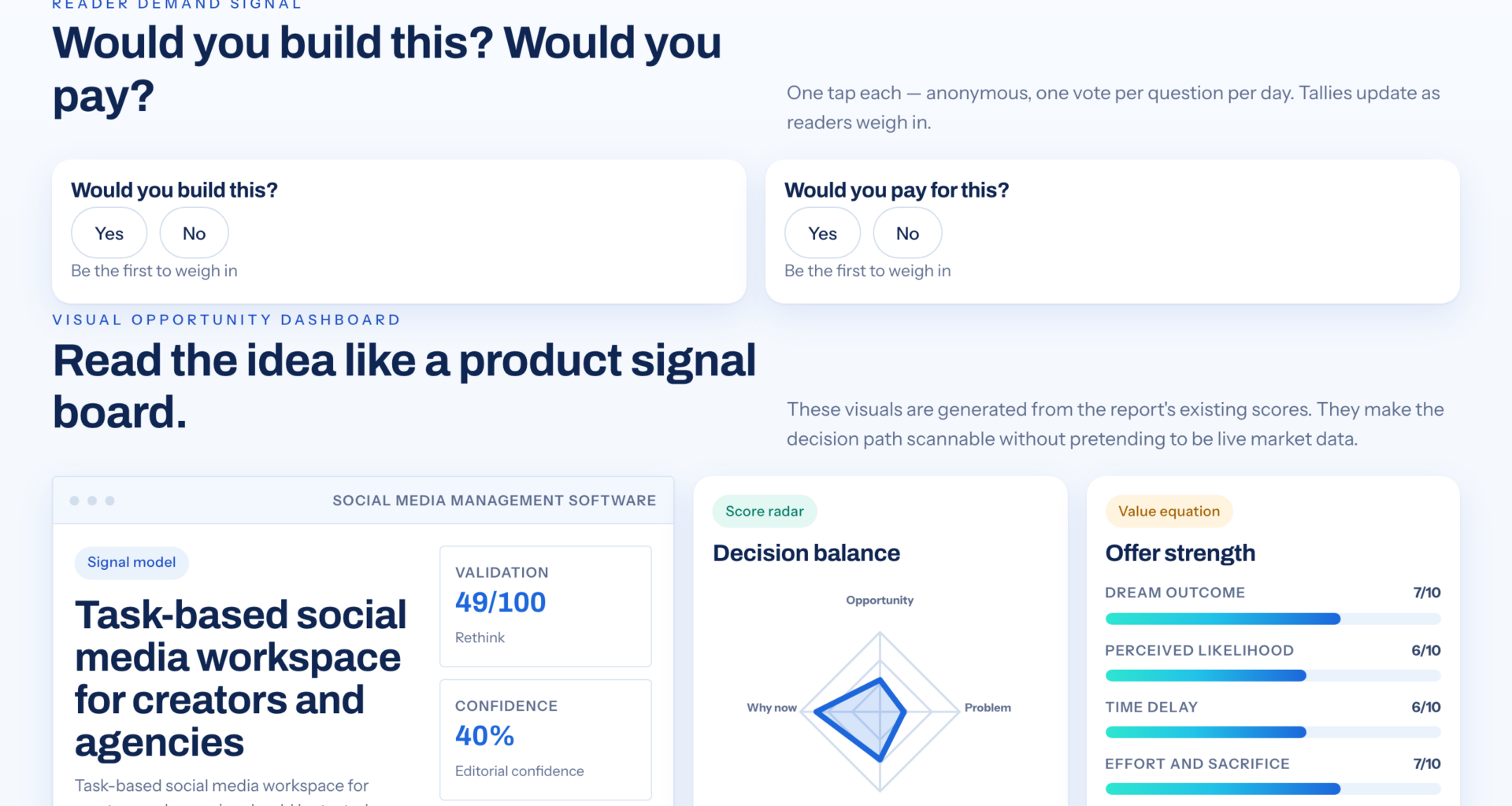

📊 Full opportunity report: Build A Clearer Social Media Workflow Around Tasks on IdeaNavigator AI — validation score, market gap, and execution plan.

Get audio and creator gear delivered free with Prime
- Fast, free delivery on millions of items
- Prime Video, Amazon Music and more included
- Member-only deals all year
TL;DR
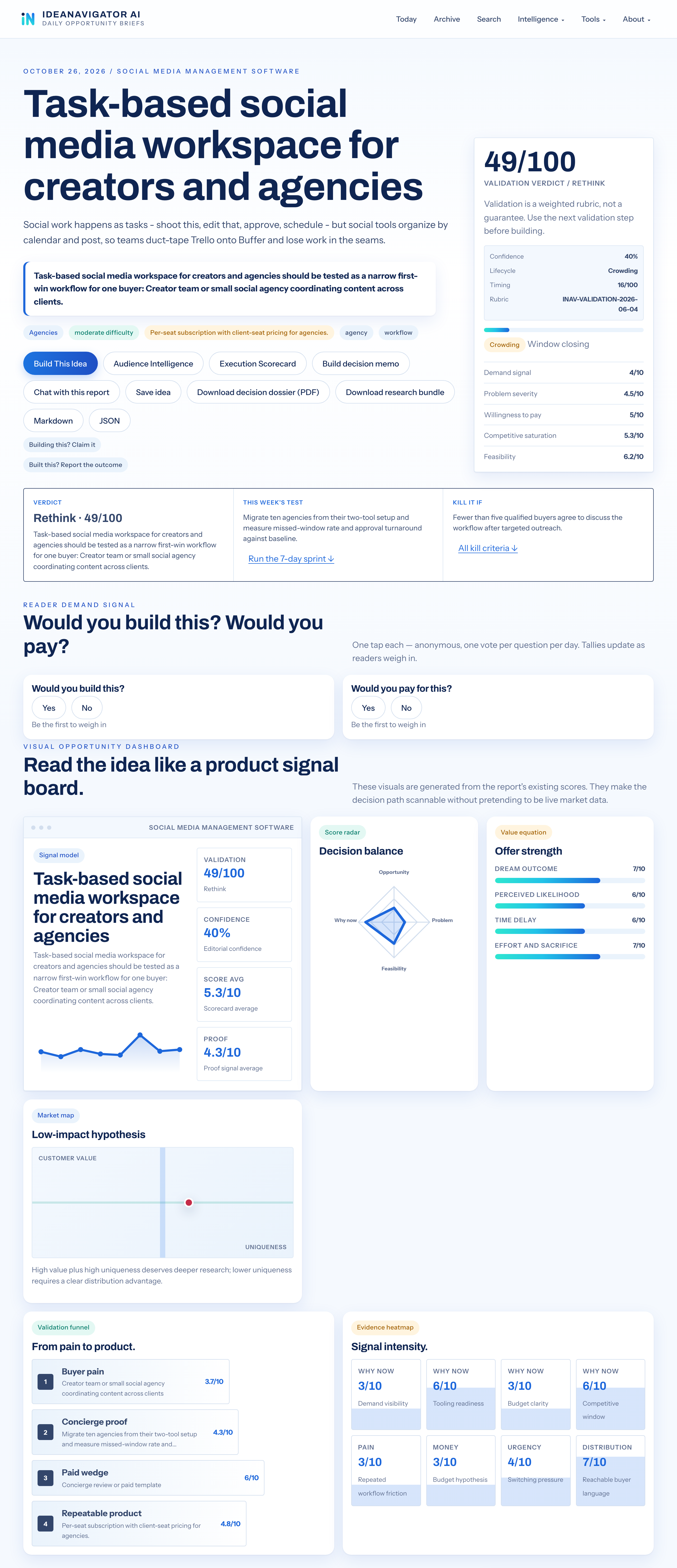
IdeaNavigator AI has outlined a product concept for a social media workspace that treats each post as a task, linking briefs, assets, edits, approvals and scheduling. The proposal targets creator teams and small agencies, but it is not a launched product or a validated result; its suggested test is a 10-agency pilot measuring missed publishing windows and approval times.
IdeaNavigator AI has proposed a task-based social media workspace for creator teams and small social agencies that coordinate content across clients, with each post moving through a shared workflow from brief to publication. The concept addresses a gap between social scheduling tools and general project-management apps, but no product launch, customer adoption or test results have been reported.
The proposed workspace would organize work around individual posts rather than a calendar alone. Each post would be tracked through stages including brief, asset, edit, approval and scheduled, with client-facing approval links and asset versioning. Scheduling would be built into the workflow once a post is approved, connecting planning and publishing in one pipeline.
The intended users are creator teams and small agencies managing multiple clients. The concept describes a common coordination problem: social content involves separate tasks such as shooting, editing, reviewing and scheduling, while teams may rely on a scheduling service alongside a general-purpose project tool. According to the proposal, work can be lost between those systems.
The suggested business model is a per-seat subscription, with pricing for client seats aimed at agencies. To test demand and performance, the proposal recommends moving 10 agencies from their existing two-tool setups and comparing missed publishing windows and approval turnaround times with each agency’s baseline. No baseline figures, pilot schedule or measured outcomes are supplied.
Testing the Workflow Gap
The idea focuses on a practical operational question for teams producing social content: whether bringing task tracking, client review and scheduling into one workspace can reduce coordination failures. For a small agency, delays in feedback or uncertainty over which asset is approved can affect a planned publishing window. A unified workflow could make ownership and status easier to follow, if the product works as described.
The proposal also identifies a potential distinction from tools centered mainly on calendars and publishing. A post-level task system would place the work required to produce and approve content alongside its eventual schedule. That could make the concept relevant to agencies juggling several clients, where review links and client access may matter as much as the publishing calendar.
Those benefits remain hypotheses, not demonstrated outcomes. The proposed pilot’s measures—missed-window rate and approval turnaround—could help determine whether the workflow improves on teams’ current arrangements. Without results, pricing detail or evidence of willingness to switch, the commercial opportunity is not established.
Products Worth Considering

DJI Osmo Mobile 8 3-Axis Smartphone Gimbal Stabilizer

Samsung 27-Inch Odyssey QD-OLED G8 4K 240Hz Gaming Monitor

Apple iPad Air 11-inch (M2), 512GB, Wi-Fi, Space Gray
As an affiliate, we earn on qualifying purchases.
From Calendars to Post Tasks
Social media management software commonly supports planning and scheduling posts, while teams may use separate project-management tools to assign production work. The concept argues that this split leaves an organizational layer underserved: general task tools do not inherently model post assets, client approvals or the connection between approval and publication.
Its timing rationale is that expectations for content volume have increased the number of tasks and handoffs in social workflows, while scheduling-tool providers have left much of that work-management function to generic project software. These are claims in the product proposal; it provides no market figures or independent evidence quantifying the trend.
The proposal is framed as a narrow first use case rather than a broad platform for every social media team. Its initial audience is creator teams or small agencies coordinating posts across clients, and its suggested validation is to compare a 10-agency migration against each participant’s existing process.
Pilot Evidence Still Missing
No working product, launch date or participating agencies are identified. It is also unclear whether the 10-agency test is planned, underway or simply recommended, and no results are available for missed publishing windows or approval times.
Other open questions include which social networks would be supported, how client permissions and asset versions would work, and whether scheduling would connect directly to existing publishing services or replace them. The proposal does not specify subscription prices, what counts as a client seat, or how its performance measures would be calculated. Until those details and test results are available, claims of reduced delays or fewer missed posts cannot be confirmed.
A Ten-Agency Validation Test
The next step described in the proposal is to migrate 10 agencies from their current combination of project and scheduling tools. The test would track missed-window rates and approval turnaround against each agency’s baseline, providing a way to assess whether the task-based workflow improves coordination.
No timing or recruitment details have been announced. A useful account of any future test would need to show how the baseline is established, how long agencies use the workspace, and whether changes in publishing and approval measures persist across clients. Until such evidence is reported, the concept remains a proposed product direction rather than a proven replacement for existing tools.
Source: IdeaNavigator AI
Key Questions
Is the task-based social media workspace available now?
No launch or availability information is provided. The material describes a product concept, not a confirmed release.
Who is the proposed workspace for?
It is aimed at creator teams and small social agencies coordinating content for multiple clients.
What would the workspace include?
The proposed workflow would track each post through briefing, asset preparation, editing, approval and scheduling, with client approval links and asset versioning.
How would the concept be tested?
The proposal recommends moving 10 agencies from their existing two-tool setups and measuring missed publishing windows and approval turnaround against their baselines. No pilot results are reported.
What is not yet known?
There is no confirmed launch date, pricing, platform support list, participating agency roster or evidence that the proposed workflow improves publishing outcomes.
Source: IdeaNavigator AI