
By StrongMocha Editorial Team

Get audio and creator gear delivered free with Prime
- Fast, free delivery on millions of items
- Prime Video, Amazon Music and more included
- Member-only deals all year
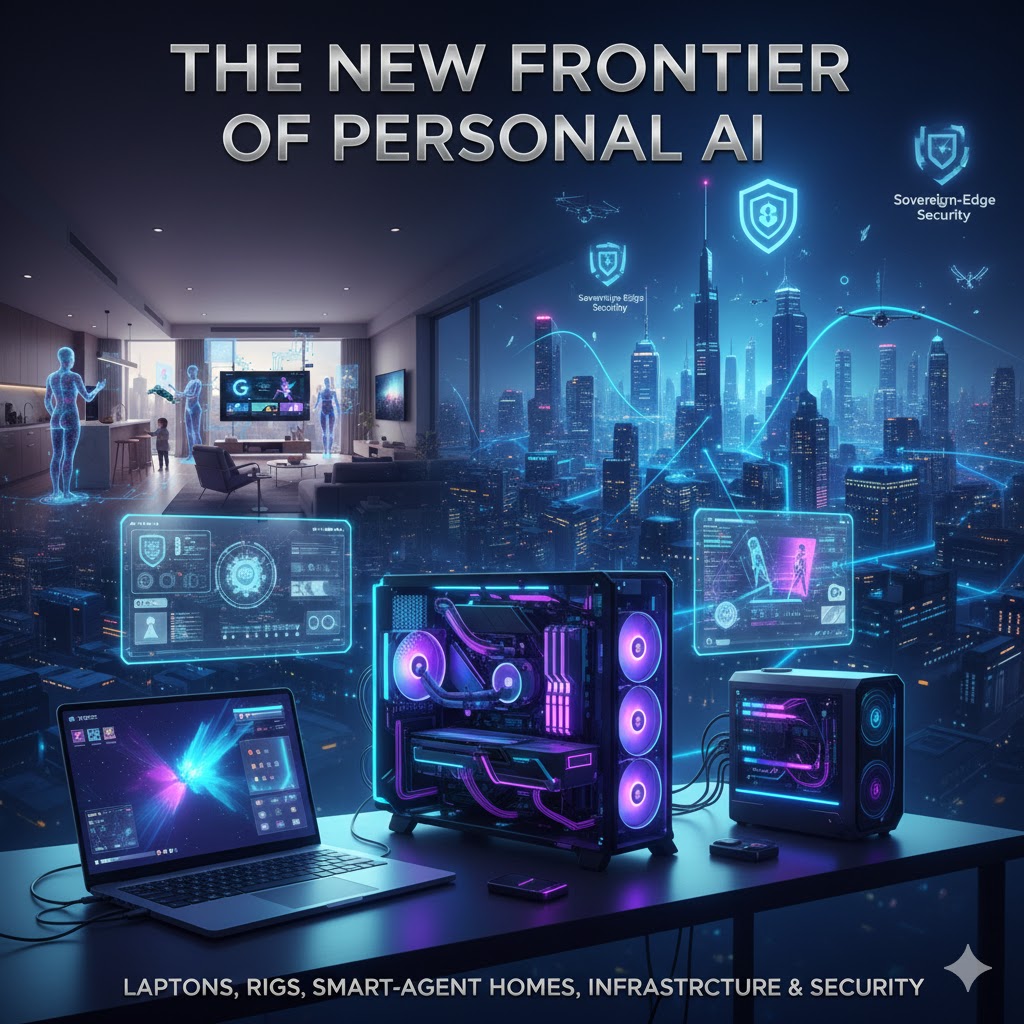
2025 is shaping up to be the year AI fully leaves the cloud and becomes part of our physical environment.
Not just in our browsers — but in our laptops, our towers, our living rooms, and even the security layers that sit between us and the sovereign cloud.
Across the ecosystem, five major trends are converging into something bigger:
the personal AI era — where individuals run models locally, deploy agents at home, safeguard their digital borders, and own more of their computational future than ever before.
This single StrongMocha report breaks down the five developments defining this shift.
1. Gemini-3-Ready AI Laptops and the Rise of the NPU Era
The “AI laptop” isn’t marketing fluff anymore.
The launch of Gemini 3 and competitors finally pushed manufacturers to build devices that run complex inference workloads on-device — thanks to NPUs (Neural Processing Units).
Why it matters
- NPUs allow low-latency, on-device inference
- Users can run private AI agents offline
- Battery efficiency improves because the CPU/GPU doesn’t have to carry the workload
- Gemini-3-optimized laptops will accelerate consumer agency, from coding to video editing to real-time translation
What it means for consumers
AI laptops are no longer an optional upgrade.
They’re quickly becoming the default machine for users who want to run multimodal models without relying on cloud inference.
As an affiliate, we earn on qualifying purchases.
2. Claude Opus 4.5 Coding Rigs: The Creative Workstation Strikes Back
As Anthropic’s Claude Opus 4.5 and similar large-context coding models accelerate, developers are returning to a familiar truth:
There is no replacement for a powerful workstation when you’re building with AI.
Whether you’re running local coding assistants, containerized agents, or performing heavy RAG pipelines, the workstation is back — and it’s stronger than ever.
Common workstation specs in the 2025 “Agent Era”
- 128–256GB RAM for local vector DBs
- Multi-GPU setups for model fine-tuning
- High-core-count CPUs (Threadripper, Xeon)
- Aggressive cooling to keep inference stable
- NVMe RAID arrays for huge project context windows
These machines aren’t just for “coders.”
They’ve become the backbone for creators, researchers, YouTubers, and small AI teams who need Cloud-minus-Cloud capabilities.
3. The Smart-Agent Home: Where AI Moves Into Your Living Space
AI is no longer something that lives in a tab.
In 2025, more households are adding smart-agent starter kits — small bundles combining:
- A smart hub
- Switches and sensors
- Smart speakers
- Agent-compatible routines
- Local automation options (not only cloud)
But this wave isn’t “smart home 1.0.”
This is smart-home-with-agency — where systems can interpret, decide, and act.
Examples:
- AI that sees your calendar and adjusts climate automatically
- An agent that locks your home when your car leaves the driveway
- Smart routines that negotiate energy consumption dynamically
- Multimodal home assistants that understand and summarize household activity
This is the first real merging of physical space + decision-making AI.
4. Lab-Grade UPS & Cooling: Infrastructure for AI PCs
If you run an AI workstation or high-performance desktop, you quickly realize:
AI machines behave like mini-servers, not like normal PCs.
They need:
- Clean, stable power
- Protection from voltage dips
- Thermal headroom
- Continuous airflow
- Professional-grade UPS units
A good UPS prevents:
- File corruption during inference
- Sudden shutdowns while agents are running RAG cycles
- Hardware degradation from unstable voltage
Meanwhile, liquid cooling and high-static-pressure air systems have become standard for keeping inference-heavy GPUs (especially multi-GPU workstations) from throttling.
If laptops are the new “personal terminals,” then these towers are the home datacenters — quietly humming next to your desk.
5. Security Keys & Privacy Routers: The Sovereign-Cloud Boundary
The rise of sovereign cloud frameworks in Europe, Asia, and North America has triggered a parallel trend:
individuals are hardening their personal infrastructure.
Security is no longer just enterprise territory.
It’s now part of personal digital identity.
What consumers are adopting
- Hardware security keys (FIDO2 / passkey)
- Privacy-focused routers with encrypted firmware
- Secure Wi-Fi mesh systems
- Local-only identity authentication
- Zero-trust workflows for personal AI agents
This is the new “digital border.”
Not controlled by big tech — controlled by the user.
Why it matters
If AI agents perform actions on your behalf, access your files, and automate parts of your life, securing the edge device becomes as important as securing a server.
The sovereign cloud isn’t just a nation-state idea anymore.
It’s becoming a household practice.
What It All Means: The Individual Is Becoming the Platform
Across these five developments — AI laptops, coding rigs, smart-agent homes, UPS + cooling infrastructure, and sovereign-edge security — a single theme emerges:
Individuals are becoming their own AI-powered platforms.
Not SaaS subscribers.
Not cloud-dependents.
Not passive users.
But operators of personal AI ecosystems.
This is the most important shift since the early internet — and unlike previous waves, this time the power is distributed.
StrongMocha will continue following the transition from cloud-first AI to personal agency — and how it reshapes the way we build, work, live, and secure our digital selves.
Fall Picks
fall essentials
As an affiliate, we earn on qualifying purchases.