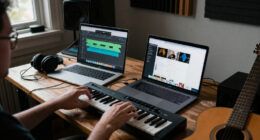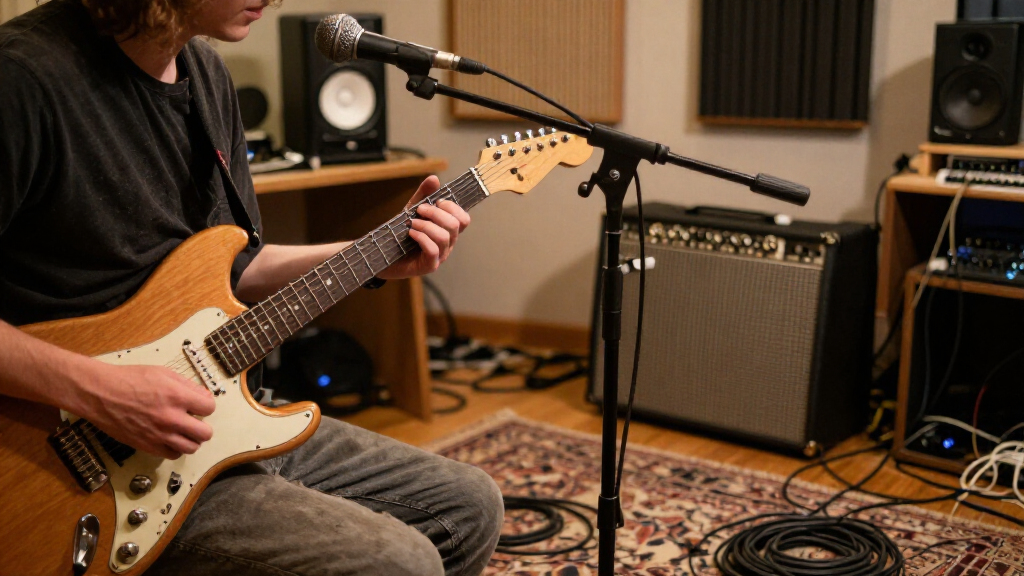
For most players recording both amplified and acoustic guitar, I’d choose the Shure SM57 as the best overall guitar recording microphone for its practical, focused dynamic-mic approach. The RØDE NT1 Signature Series is a standout for detailed acoustic recordings and quiet sources, while the Sennheiser e 609 Silver suits guitar amps when a side-address mic that hangs in front of a speaker is more convenient. The main tradeoff is between durable dynamics that can handle loud amps and condensers that capture more detail but can reveal room noise and demand phantom power. USB kits add convenience, but are less adaptable to a conventional XLR recording setup. Read on for the full breakdown and recommendations by recording need.

Get audio and creator gear delivered free with Prime
- Fast, free delivery on millions of items
- Prime Video, Amazon Music and more included
- Member-only deals all year
Complete the kit

Key Takeaways
- The Shure SM57 is the most flexible starting point in this lineup: it is an XLR dynamic mic suited to loud guitar amps, though it does not provide the same fine acoustic detail as the condenser options.
- The two Sennheiser e 609 entries serve the same basic amp-recording role. The bundle adds a cable and cleaning cloth; the standalone version makes more sense if those accessories are unnecessary.
- The RØDE NT1 Signature Series and Shure SM81-LC favor detail over room rejection. They are better fits for acoustic guitar or controlled rooms than for players who need a simple close mic on a loud cabinet.
- The AKG P170 and MXL 990/991 bundle offer different condenser paths. The P170 is a single small-diaphragm option, while the MXL package supplies both large- and small-diaphragm mics for broader experimentation.
- The Dejasound DJM5 is the convenience outlier, not a direct substitute for the XLR picks. Its USB connection and included accessories suit a simple computer setup, while most other options fit standard audio-interface workflows.
| Superlux PRA628MKII Supercardioid Instrument Microphone |  | Best Compact Amp-Miking Pick | Microphone type: Instrument microphone | Connectivity: Wired XLR | Polar pattern: Supercardioid | VIEW LATEST PRICE | See Our Full Breakdown |
| RØDE NT1 Signature Series Large-Diaphragm Condenser Microphone, Black |  | Best for Studio Vocals and Acoustic Guitar | Microphone type: Large-diaphragm condenser | Capsule: HF6 1-inch true condenser | Polar pattern: Cardioid | VIEW LATEST PRICE | See Our Full Breakdown |
| Sennheiser e 609 Silver Instrument Microphone Bundle with 20 ft XLR Cable and Cleaning Cloth |  | Best Dynamic Pick for Guitar Cabinets | Microphone type: Dynamic | Polar pattern: Supercardioid | Frequency response: 40–18,000 Hz | VIEW LATEST PRICE | See Our Full Breakdown |
| WEYMIC WM57 Unidirectional Dynamic Handheld Microphone |  | Best Budget-Style General-Purpose Dynamic | Microphone type: Dynamic, moving coil | Polar pattern: Unidirectional | Form factor: Handheld | VIEW LATEST PRICE | See Our Full Breakdown |
| AKG P170 Small-Diaphragm Condenser Microphone |  | Best for Acoustic Guitar Detail | Microphone type: Small-diaphragm condenser | Diaphragm: 0.5 inch | Connector: XLR | VIEW LATEST PRICE | See Our Full Breakdown |
| MXL 990/991 Large- and Small-Diaphragm Condenser Microphone Bundle |  | Best Two-Mic Starter Bundle | Microphone types: Large-diaphragm condenser (990) and small-diaphragm condenser (991) | Connectivity: Wired XLR | Polar pattern: Cardioid (990); unidirectional (991) | VIEW LATEST PRICE | See Our Full Breakdown |
| Shure SM57 Dynamic XLR Instrument Microphone |  | Best Dynamic Mic for Amplified Guitar | Microphone type: Dynamic | Connectivity: Wired XLR | Polar pattern: Unidirectional cardioid | VIEW LATEST PRICE | See Our Full Breakdown |
| Shure SM81-LC Cardioid Condenser Instrument Microphone |  | Best for Detailed Acoustic Guitar Recording | Connectivity: XLR | Polar pattern: Cardioid (unidirectional) | Frequency response: 20 Hz–20 kHz | VIEW LATEST PRICE | See Our Full Breakdown |
| Dejasound DJM5 USB Condenser Microphone Kit with Isolation Shield and Pop Filter |  | Best USB Kit for Simple Home Recording | Connectivity: USB | Connector types: USB Type-B, 3.5 mm jack | Polar pattern: Conflicting listing: cardioid in description; hypercardioid in specifications | VIEW LATEST PRICE | See Our Full Breakdown |
| Sennheiser e 609 Silver Supercardioid Instrument Microphone |  | Best for Close-Miking Guitar Cabinets | Microphone type: Dynamic | Polar pattern: Supercardioid | Frequency response: 40–18,000 Hz | VIEW LATEST PRICE | See Our Full Breakdown |
| guitar recording microphone | Polar pattern | Frequency response | Microphone type | Connectivity |
|---|---|---|---|---|
| Superlux PRA628MKII Supercardi | Supercardioid | 80 Hz–18 kHz | Instrument microphone | Wired XLR |
| RØDE NT1 Signature Series Larg | Cardioid | — | Large-diaphragm condenser | XLR |
| Sennheiser e 609 Silver Instru | Supercardioid | 40–18,000 Hz | Dynamic | — |
| WEYMIC WM57 Unidirectional Dyn | Unidirectional | 45 Hz–16,000 Hz | Dynamic, moving coil | — |
| AKG P170 Small-Diaphragm Conde | Unidirectional | — | Small-diaphragm condenser | — |
| MXL 990/991 Large- and Small-D | Cardioid (990); unidirectional (991) | 20 Hz–20 kHz (990); 30 Hz–18 kHz (991) | — | Wired XLR |
| Shure SM57 Dynamic XLR Instrum | Unidirectional cardioid | 40 Hz–15 kHz | Dynamic | Wired XLR |
| Shure SM81-LC Cardioid Condens | Cardioid (unidirectional) | 20 Hz–20 kHz | — | XLR |
| Dejasound DJM5 USB Condenser M | Conflicting listing: cardioid in description; hypercardioid in specifications | 30 Hz–16 kHz | — | USB |
| Sennheiser e 609 Silver Superc | Supercardioid | 40–18,000 Hz | Dynamic | Wired XLR |
More Details on Our Top Picks
Superlux PRA628MKII Supercardioid Instrument Microphone
The Superlux PRA628MKII is built for a focused job: placing a microphone close to a guitar or bass speaker without taking up much room. Its supercardioid pattern helps narrow the pickup area, while its 150 dB maximum SPL gives it headroom near loud cabinets. Compared with the handheld WEYMIC WM57, its compact form and included gooseneck clamp make positioning at an amp more convenient; the WEYMIC is the more flexible choice for vocals and general instrument use. The Superlux trades that versatility for a setup tailored to cabinets, and its wired XLR connection means placement depends on cable reach. It comes with a clip and carrying pouch, but you will need to supply the XLR cable.
Pros:- Compact shape and gooseneck clamp support close placement at speaker cabinets.
- Supercardioid pattern helps focus capture and reduce surrounding sound.
- Handles sound pressure levels up to 150 dB.
- Includes a microphone clip, gooseneck clamp, and carrying pouch.
Cons:- XLR cable is not included.
- Wired placement is limited by cable reach.
- Its amp-focused design is less adaptable than a general-purpose handheld microphone.
Best for: Guitarists and bassists who record loud speaker cabinets in a compact home or project studio.
Not ideal for: Buyers seeking one microphone for vocals, acoustic guitar, and amp recording, or anyone without a separate XLR cable.
- Microphone type:Instrument microphone
- Connectivity:Wired XLR
- Polar pattern:Supercardioid
- Frequency response:80 Hz–18 kHz
- Maximum SPL:150 dB
- Impedance:200 ohms
- Included accessories:HM10 microphone clip, HM12DA gooseneck clamp, carrying pouch
- Cable:XLR cable not included
Our verdict“Choose the PRA628MKII for compact, close-miked guitar or bass cabinets, but pick a more versatile mic if you also need vocal coverage.”
RØDE NT1 Signature Series Large-Diaphragm Condenser Microphone, Black
For a recording setup that needs to cover both vocals and acoustic guitar, the RØDE NT1 Signature Series is the broadest-purpose condenser in this group. Its 1-inch HF6 capsule and 4 dB self-noise rating support quiet, detailed sources, while the cardioid pattern favors sound in front of the mic over much of the room. That makes it a different choice from the AKG P170: the P170 is a smaller-diaphragm option aimed at acoustic instruments and transient detail, while the NT1 is better suited to a vocal-and-instrument recording station. The included shock mount, pop filter, and 6 m XLR cable make its package more ready to connect than the P170’s. The tradeoff is that it requires an audio interface and corded power, and its larger form may be less convenient for tight amp placement than the Superlux PRA628MKII.
Pros:- Low 4 dB self-noise supports clean capture of quieter sources.
- Cardioid pickup pattern focuses on the source in front of the microphone.
- Includes a shock mount with pop filter, 6 m XLR cable, and dust cover.
- Large-diaphragm design suits both vocals and instrument recording.
Cons:- Requires an audio interface and a wired recording setup.
- Less convenient for compact, close-to-cabinet placement than the Superlux PRA628MKII.
- A large-diaphragm condenser may be more microphone than a guitar-cab-only setup needs.
Best for: Home recordists with an audio interface who want one condenser for vocals, acoustic guitar, and other close studio sources.
Not ideal for: Players focused mainly on tight guitar-cabinet placement or those without an XLR audio interface and phantom-power-capable setup.
- Microphone type:Large-diaphragm condenser
- Capsule:HF6 1-inch true condenser
- Polar pattern:Cardioid
- Self-noise:4 dB
- Signal-to-noise ratio:78 dB
- Connectivity:XLR
- Included accessories:SM6 shock mount with pop filter, 6 m XLR cable, dust cover
- Microphone weight:313 g
Our verdict“Pick the NT1 if vocals and acoustic guitar share your recording space; choose a purpose-built instrument mic for cabinet recording alone.”
Sennheiser e 609 Silver Instrument Microphone Bundle with 20 ft XLR Cable and Cleaning Cloth
The Sennheiser e 609 is the most directly cabinet-oriented dynamic option here, pairing a supercardioid pattern with a rugged metal body and a hum-compensating coil. That focused pickup suits loud guitar amps, especially when other instruments or electrical noise are present. Unlike the RØDE NT1 Signature Series, it does not target quiet acoustic detail or vocal versatility; it is a simpler fit for miking an amplified instrument. The bundle’s 20 ft XLR cable also gives it a practical setup advantage over the Superlux PRA628MKII, which arrives without a cable. In exchange, this remains a wired, instrument-first microphone, so it is a less natural choice for a singer-songwriter seeking one mic for vocals and acoustic guitar. The listed weight and dimensions may also warrant checking against your intended stand or placement method.
Pros:- Supercardioid pattern helps isolate a guitar cabinet from nearby sources.
- Hum-compensating coil helps reduce electrical interference.
- Metal construction suits regular stage and studio handling.
- Bundle includes a 20 ft XLR cable.
Cons:- Wired XLR connection restricts placement to cable reach.
- Its instrument-focused design is less versatile for vocal and acoustic recording than the RØDE NT1 Signature Series.
- Does not include a stand or mounting accessory in the listed bundle.
Best for: Guitarists recording loud cabinets who want a rugged dynamic mic and a long XLR cable in the bundle.
Not ideal for: Singer-songwriters wanting a single microphone for detailed acoustic guitar and vocals, or buyers seeking a wireless setup.
- Microphone type:Dynamic
- Polar pattern:Supercardioid
- Frequency response:40–18,000 Hz
- Sensitivity:1.5 mV/Pa at 1 kHz (nominal)
- Nominal impedance:350 ohms
- Connector:XLR
- Included accessories:20 ft XLR cable, microfiber cleaning cloth
- Enclosure material:Alloy steel, metal
Our verdict“Choose the e 609 bundle for rugged, focused guitar-cab recording with a cable included, rather than for all-purpose studio work.”
WEYMIC WM57 Unidirectional Dynamic Handheld Microphone
The WEYMIC WM57 offers a straightforward dynamic format for guitarists who want to record instruments as well as vocals, drums, or percussion. Its unidirectional pickup and metal enclosure make it a more general handheld option than the cabinet-shaped Superlux PRA628MKII, whose clamp and compact body are better tailored to amp placement. The WM57’s 45 Hz–16 kHz response covers a useful range for amplified instruments, but the product data does not specify a maximum SPL, so I would favor the Sennheiser e 609 when loud-cab headroom and cabinet isolation are the priority. The tradeoff is a basic setup: it needs a separately supplied XLR cable and a compatible audio device, and its handheld form may require a stand or holder for consistent recording positions.
Pros:- Unidirectional pickup focuses on sound in front of the microphone.
- Metal construction suits regular studio or stage handling.
- Handheld format works across vocals and several instrument sources.
- Frequency response spans 45 Hz–16,000 Hz.
Cons:- XLR cable is not included.
- No maximum SPL specification is provided for comparing loud-cab use.
- Handheld shape is less convenient for close cabinet mounting than the Superlux PRA628MKII.
Best for: New home recordists who want one wired dynamic microphone for occasional guitar, vocals, drums, and percussion.
Not ideal for: Players recording very loud cabinets who want stated SPL handling, or anyone who needs a cable and mounting accessories included.
- Microphone type:Dynamic, moving coil
- Polar pattern:Unidirectional
- Form factor:Handheld
- Connector:XLR
- Frequency response:45 Hz–16,000 Hz
- Impedance:600 ohms ±30%
- Sensitivity:-52 ±1 dB
- Cable included:No
Our verdict“The WM57 suits beginners who need a basic all-purpose dynamic, while cabinet specialists should favor the Sennheiser e 609 or Superlux PRA628MKII.”
AKG P170 Small-Diaphragm Condenser Microphone
The AKG P170 is the most targeted pick here for acoustic guitar and other stringed instruments when attack and transient clarity matter. Its 0.5-inch condenser diaphragm and 20 Hz–20 kHz frequency range suit detailed instrument capture, while the switchable attenuation pad helps accommodate loud sources up to a stated 155 dB SPL. Compared with the RØDE NT1 Signature Series, the P170 uses a smaller diaphragm and is more clearly aimed at instruments rather than shared vocal-and-guitar duties. It is also much less suitable than the Sennheiser e 609 for isolating a loud amp cabinet with a dynamic microphone. The all-metal body is a practical plus, but this unidirectional condenser needs an XLR setup with corded power, and the listed package includes only a stand adapter.
Pros:- Small-diaphragm condenser design supports clear transient response on acoustic instruments.
- Switchable attenuation pad supports high-SPL recording up to 155 dB SPL.
- All-metal body is suited to regular studio use.
- Broad 20 Hz–20 kHz frequency range.
Cons:- Unidirectional pickup limits capture to a single direction.
- Requires an XLR connection and corded power.
- Listed package includes a stand adapter but no XLR cable.
Best for: Acoustic guitarists and string players with an XLR recording setup who want a small-diaphragm condenser for detailed instrument capture.
Not ideal for: Players seeking a handheld dynamic for vocals or a compact, purpose-built microphone for guitar amp cabinets.
- Microphone type:Small-diaphragm condenser
- Diaphragm:0.5 inch
- Connector:XLR
- Polar pattern:Unidirectional
- Frequency range:20 Hz–20 kHz
- Maximum SPL:155 dB SPL
- Signal-to-noise ratio:75 dB
- Included items:P170 microphone, stand adapter
Our verdict“Choose the P170 for acoustic guitar detail and loud instrument sources, but select a dynamic cabinet mic for amplified guitar isolation.”
MXL 990/991 Large- and Small-Diaphragm Condenser Microphone Bundle
The MXL bundle earns its place by giving guitar recordists two different condenser perspectives: the 991 small-diaphragm mic is the more direct fit for acoustic guitar, while the 990 large-diaphragm mic can cover vocals or a fuller instrument sound. That flexibility is a better starting point for someone recording songs than a single-purpose mic such as the Shure SM81-LC, though the SM81 offers more control over low-frequency rolloff and attenuation. A shock mount, pop filter, and 20-foot XLR cable also reduce the number of separate pieces to source. The tradeoff is that both mics need 48V phantom power and a compatible XLR recording setup; this is not a direct-to-phone kit. Buyers focused only on precise acoustic-guitar capture may prefer a dedicated small-diaphragm option.
Pros:- Includes a small-diaphragm 991 suited to acoustic guitar and a large-diaphragm 990 for vocals or other sources.
- Comes with a shock mount, pop filter, and 20-foot XLR cable.
- Cardioid pickup helps reduce sound arriving from the sides and rear.
- Both microphones cover broad frequency ranges for recording varied sources.
Cons:- Both microphones require 48V phantom power.
- XLR connectivity requires a compatible interface, mixer, or preamp.
- The 990 and 991 serve different jobs, so guitarists focused only on acoustic instruments may not need both.
Best for: Home recordists with an XLR interface and phantom power who want to record acoustic guitar and vocals with separate microphones.
Not ideal for: Players seeking a USB mic or a single, dedicated acoustic-guitar microphone; both condensers require phantom power and the 990 is less guitar-specific than the 991.
- Microphone types:Large-diaphragm condenser (990) and small-diaphragm condenser (991)
- Connectivity:Wired XLR
- Polar pattern:Cardioid (990); unidirectional (991)
- Frequency response:20 Hz–20 kHz (990); 30 Hz–18 kHz (991)
- Power requirement:48V phantom power
- Included accessories:Shock mount, pop filter, 20-foot XLR cable
- Impedance:200 ohms
- Signal-to-noise ratio:78 dB
Our verdict“Choose this bundle if you have phantom-powered XLR gear and want one package for acoustic guitar and vocals.”
Shure SM57 Dynamic XLR Instrument Microphone
For recording an electric guitar cabinet, the SM57 offers a straightforward alternative to condensers: its dynamic capsule needs no phantom power, and its contoured response brings pick attack and instrument detail forward. The cardioid pattern can help limit room sound and bleed, which is useful in a busy home studio or when tracking alongside other sources. Compared with the condenser-based MXL 990/991 bundle, the SM57 is less flexible for capturing subtle acoustic-guitar detail, but it is the more focused choice for close-miking an amplifier. Its rugged, compact design also suits a mic that may travel between rehearsal spaces and recording sessions. The tradeoffs are wired XLR operation and a frequency range that stops at 15 kHz, so it is not the broadest or most neutral option for acoustic instruments.
Pros:- Dynamic design does not require phantom power.
- Contoured response emphasizes instrument attack and detail on amplified guitar.
- Cardioid pickup helps reduce background sound and bleed.
- Compact, rugged construction suits frequent transport and demanding use.
Cons:- Wired XLR connection requires compatible recording equipment.
- Its 40 Hz–15 kHz response is less extended than the MXL 990/991 condenser bundle.
- A dynamic mic is less suited than a small-diaphragm condenser to capturing fine acoustic-guitar nuance.
Best for: Electric guitarists recording close to an amp who want a durable, phantom-free dynamic mic for studio or rehearsal use.
Not ideal for: Acoustic guitarists seeking airy, detailed string capture or USB users who need a direct computer connection.
- Microphone type:Dynamic
- Connectivity:Wired XLR
- Polar pattern:Unidirectional cardioid
- Frequency response:40 Hz–15 kHz
- Channels:1
- Compatible device:Amplifier
- Weight:10 oz
- Dimensions:6.19 × 1.25 × 1.25 in
Our verdict“Pick the SM57 for close-miked electric guitar cabinets and durable, no-phantom-power operation.”
Shure SM81-LC Cardioid Condenser Instrument Microphone
The SM81-LC is the most control-oriented acoustic-instrument choice in this group. Its 20 Hz–20 kHz response and selectable low-frequency rolloff let a recordist adapt the capture to a guitar’s body resonance or reduce unwanted bass buildup from close placement. A lockable 10 dB attenuator adds headroom for loud sources, while the cardioid pattern helps keep room sound and nearby instruments under control. Compared with the MXL 991 in the 990/991 bundle, the SM81-LC offers more recording adjustments and arrives with a windscreen and carrying case; the MXL bundle, however, gives you a second mic for vocals. The cost in convenience is setup dependence: this is an XLR condenser that needs phantom power, and it does not include a cable. Its specialized feature set may be more than a casual home recorder needs.
Pros:- Full 20 Hz–20 kHz response supports detailed instrument capture.
- Selectable low-frequency rolloff helps manage proximity effect and unwanted bass.
- Lockable 0 dB/10 dB attenuator accommodates louder sources.
- Steel construction and included windscreen and carrying case support studio and transport use.
Cons:- Requires phantom power, with best performance at 48 Vdc.
- A balanced XLR-to-XLR or XLR-to-TRS cable is required and is not listed among the included accessories.
- Its recording controls may be unnecessary for buyers seeking a simple, lower-complexity setup.
Best for: Acoustic-guitar players and studio recordists who want a dedicated condenser with response controls for placement and source level.
Not ideal for: USB-only creators, buyers without phantom-powered XLR inputs, or beginners who want a complete mic-and-cable bundle.
- Connectivity:XLR
- Polar pattern:Cardioid (unidirectional)
- Frequency response:20 Hz–20 kHz
- Power requirement:Phantom power; best at 48 Vdc, operates down to 11 Vdc
- Low-frequency response:Selectable flat, 6 or 18 dB/octave rolloff
- Attenuator:Lockable 0 dB/10 dB switch
- Impedance:150 ohms
- Included accessories:Swivel adapter, attenuator-switch lock, foam windscreen, carrying case
Our verdict“Choose the SM81-LC if detailed acoustic-instrument capture and adjustable low-frequency handling matter more than a bundled cable or second mic.”
Dejasound DJM5 USB Condenser Microphone Kit with Isolation Shield and Pop Filter
The DJM5 is the only option here built around USB recording and a broad accessory kit, making it a practical fit for guitarists who want to connect to a compatible computer or phone without adding an XLR interface. Its foldable five-panel shield, pop filter, tripod, headphones, and device adapters provide a ready-made desk setup; compared with the Shure SM57, it is easier to connect to supported devices but less suited to close-miking a loud guitar cabinet. Echo, volume, and mute controls add convenience for home recording and streaming. Guitar buyers should be cautious about the listing’s conflicting polar-pattern information: the description says cardioid while the specs say hypercardioid. The 30 Hz–16 kHz response is also narrower than the SM81-LC’s, and the stand-and-shield kit takes more space than a standalone instrument mic.
Pros:- USB connection supports recording with compatible computers and smartphones.
- Includes a foldable five-panel isolation shield, tripod, and pop filter.
- Headphone monitoring and echo, volume, and mute controls add desk-side convenience.
- Lightning and Type-C adapters broaden device compatibility.
Cons:- The product information conflicts on whether the pickup pattern is cardioid or hypercardioid.
- Its 30 Hz–16 kHz response is less extended than the Shure SM81-LC’s 20 Hz–20 kHz range.
- The shield and tripod make the full kit less compact than a standalone instrument microphone.
Best for: Home musicians recording acoustic guitar, demos, or vocals to a compatible computer or smartphone who want a USB setup with accessories included.
Not ideal for: Players who need dependable polar-pattern specifications, close-miking a loud guitar cabinet, or a compact XLR mic for an existing interface.
- Connectivity:USB
- Connector types:USB Type-B, 3.5 mm jack
- Polar pattern:Conflicting listing: cardioid in description; hypercardioid in specifications
- Diaphragm:16 mm
- Sampling rate:192 kHz / 24-bit
- Frequency response:30 Hz–16 kHz
- Included accessories:Five-panel isolation shield, pop filter, tripod, headphones, Lightning and Type-C adapters, foam cover
- Kit weight:4.1 lb (1.86 kg)
Our verdict“Choose the DJM5 for an accessory-rich USB home setup, but skip it if you need clear, consistent pickup-pattern information or an amp-focused mic.”
Sennheiser e 609 Silver Supercardioid Instrument Microphone
The e 609 Silver is designed around a specific guitar-recording job: placing a microphone right against an amplifier cabinet. Its flat-profile, side-address body can hang close to a speaker without the usual stand positioning, while the capsule is built to handle high sound pressure levels. The supercardioid pattern helps focus on the cabinet and reject other nearby sources, a useful contrast with the broader acoustic-instrument role of the Shure SM81-LC. The e 609 is a better fit for loud electric-guitar tracking than the MXL 991, but it is not the versatile pick for acoustic guitar or vocals. It uses wired XLR, so an interface or preamp is still needed, and the listed 180 g weight excludes the cable. Buyers who want a mic for varied sources should choose a more general-purpose option.
Pros:- Flat-profile, laterally mounted capsule suits close placement against guitar cabinets.
- Handles high sound pressure levels without distortion.
- Supercardioid pattern helps isolate the cabinet from nearby sound sources.
- Metal construction and hum-compensating coil support durability and reduced electrical interference.
Cons:- Its design is focused on close instrument miking, especially guitar cabinets and toms.
- Wired XLR operation requires compatible recording equipment.
- The listed 180 g weight excludes the cable.
Best for: Electric guitarists recording loud cabinets at close range who want a side-address dynamic mic that can sit near the speaker.
Not ideal for: Acoustic-guitar recordists seeking detailed string and body tone, or buyers who need one mic for a wide range of sources.
- Microphone type:Dynamic
- Polar pattern:Supercardioid
- Frequency response:40–18,000 Hz
- Sensitivity:1.5 mV/Pa at 1 kHz
- Minimum terminating impedance:1,000 ohms
- Connectivity:Wired XLR
- Dimensions:55 × 34 × 134 mm
- Weight:180 g without cable
Our verdict“Choose the e 609 Silver for close, high-level guitar-cabinet recording rather than acoustic guitar or all-purpose studio work.”
How We Picked
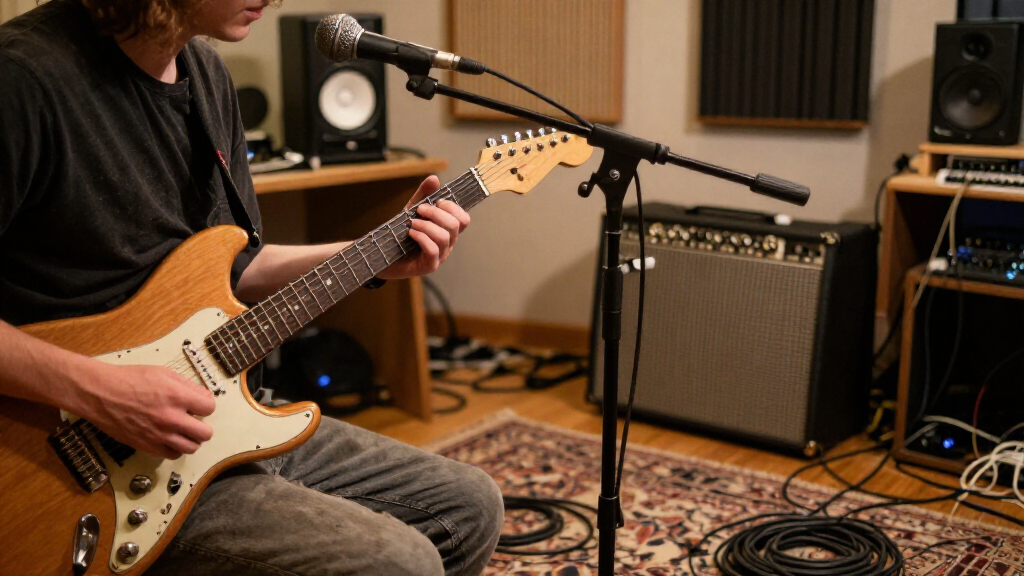
I ranked these guitar recording microphones by how well their design matches common recording jobs: close-miking electric guitar cabinets, capturing acoustic guitar detail, and getting a usable signal into a home or project studio. I weighed microphone type and pickup pattern alongside connection requirements, practical placement, and the amount of setup flexibility each option offers. A mic’s likely usefulness for one specific task counted more than a feature list that sounds impressive but may not suit a guitarist’s room or recording chain.
The ranking favors versatility and a clear use case over treating every microphone as interchangeable. The SM57 leads as a broadly useful XLR dynamic; the e 609 is a more specialized amp-placement pick; and the condenser models rise for acoustic detail and studio flexibility. I also considered tradeoffs that affect ownership, including phantom-power needs, room sensitivity, included accessories, and whether a USB mic fits a buyer’s existing workflow. The two e 609 listings are ranked by their practical package differences, not as unrelated microphone designs.
| guitar recording microphone | Microphone type | Connectivity |
|---|---|---|
| Superlux PRA628MKII Supercardi | Instrument microphone | Wired XLR |
| RØDE NT1 Signature Series Larg | Large-diaphragm condenser | XLR |
| Sennheiser e 609 Silver Instru | Dynamic | — |
| WEYMIC WM57 Unidirectional Dyn | Dynamic, moving coil | — |
| AKG P170 Small-Diaphragm Conde | Small-diaphragm condenser | — |
| MXL 990/991 Large- and Small-D | — | Wired XLR |
| Shure SM57 Dynamic XLR Instrum | Dynamic | Wired XLR |
| Shure SM81-LC Cardioid Condens | — | XLR |
| Dejasound DJM5 USB Condenser M | — | USB |
| Sennheiser e 609 Silver Superc | Dynamic | Wired XLR |
Factors to Consider When Choosing Guitar Recording Microphones
Choosing a guitar mic is less about finding one universal winner than matching the microphone to your instrument, room, and recording chain. I’d settle those details before comparing extras, since placement and room sound can change a recording more than a small spec difference.
Decide Whether You’re Recording an Amp or an Acoustic Guitar
Electric guitar through a speaker cabinet and acoustic guitar in a room create different recording problems. A close mic on an amp needs to handle high sound pressure and fit around a speaker, while an acoustic recording benefits from capturing string attack, body resonance, and performance nuance. A dynamic mic is often a straightforward choice for a loud cabinet; a condenser can reveal more acoustic detail but may capture more of the room too. Buyers who record both should decide whether they prefer one adaptable mic or separate tools for each task. Avoid choosing by the word “instrument” alone: placement, pattern, and sensitivity matter as much as the product label.
Match the Microphone to Your Room
A microphone does not remove room problems; some designs make them more apparent. In a small untreated room, reflections, computer fans, and household noise can become part of a sensitive condenser recording, particularly when recording acoustic guitar from a distance. Close-miking a speaker or instrument can reduce the room’s influence, but it changes the balance of the sound and may require careful placement. Before paying for greater sensitivity, listen to the room and consider whether basic treatment or a quieter recording position would help more. A practical mistake is buying a detailed mic for a space that makes every detail sound boxy or noisy.
Check Your Interface, Phantom Power, and Connection
Most microphones in this roundup use XLR, which means you’ll generally need an audio interface or mixer with a suitable input and preamp. Condenser models commonly require phantom power, so check that your recording gear supplies it before placing an order. Dynamic microphones generally avoid that requirement, making them easier to use with simpler chains, though they still need a proper mic input. The Dejasound USB option follows a different path by connecting directly to a computer, which can reduce setup steps but may not integrate as neatly with an existing XLR studio. Match the mic to the equipment you own rather than buying around a connection you cannot use.
Treat Placement as Part of the Purchase Decision
Mic placement can alter tone more than a change between two broadly similar microphones. On an amp, moving a mic from the speaker center toward the edge usually changes the balance of brightness and body; distance also affects room sound and low-frequency buildup. With acoustic guitar, aiming at the sound hole can produce excess boom, so many players start near the neck-body area and adjust by ear. A side-address design can make speaker placement easier, while a conventional handheld shape may need a stand and careful positioning. Leave room in your setup for a stand, clip, and cable, and plan to make small placement changes before adding EQ.
Choose One Mic or a Multi-Mic Setup
One microphone keeps recording simple and avoids phase problems, but it cannot capture every useful angle at once. A second mic can add room ambience or a different tonal perspective, yet the signals may become thin or uneven if their timing and polarity are not managed. A bundle with different microphone types can help a curious home recordist compare approaches, but it is not automatically better value if only one mic will see regular use. Start with a single mic and learn how it responds to position before building a multi-mic setup. When adding another, record each mic separately first so you can hear what it contributes.
Spend on the Weakest Link in Your Recording Chain
A premium microphone cannot compensate for poor performance, noisy electronics, an unsuitable room, or inconsistent placement. If you already have a solid interface and a quiet space, a more revealing condenser may offer useful detail for acoustic guitar. If your setup is basic or you mainly record loud amp tones, a durable dynamic may deliver more practical value than extra sensitivity. Accessories matter when they solve a real setup issue, but a bundled cable or shield should not outweigh the microphone’s fit for your use. I’d put budget toward the part of the chain that currently limits the recording, then upgrade the mic when that limitation is clear.
Frequently Asked Questions
Can one microphone record both electric and acoustic guitar well?
Yes, but “well” depends on the sound and room you want to capture. A dynamic such as the Shure SM57 is a practical choice for loud amp recordings and can record acoustic guitar, though it may not capture the same delicate detail as a condenser. A condenser can handle both jobs too, but its sensitivity may expose room reflections and background noise. If you record both regularly, compare how often you need amp durability versus acoustic nuance before choosing a single mic. Technique and placement will still shape the result more than switching microphones alone.
Do I need phantom power for a guitar recording microphone?
It depends on the microphone type, not on the fact that you are recording guitar. The condenser options in this roundup generally need phantom power from an interface, mixer, or suitable preamp, while the dynamic picks typically do not. The USB Dejasound connects to a computer by USB and follows a different setup path. Check your recording device’s specifications before buying, especially if you plan to use a condenser. If your interface lacks phantom power, a dynamic XLR mic may be the simpler fit.
Is the Sennheiser e 609 bundle meaningfully different from the standalone e 609?
The microphone is the same model, so the main distinction is the package: the listed bundle includes a 20-foot XLR cable and a cleaning cloth. That can be convenient if you are building a setup and need a cable of that length. If you already own a suitable cable, the added items may not change your recording options. Neither listing should be treated as a different tonal choice based on the package name alone. Compare what is included with the accessories you already have before deciding.
Should I start with a USB mic or an XLR microphone for guitar?
A USB mic can simplify a basic computer recording setup by reducing the need for a separate interface. XLR models give you a more conventional studio connection and can work with interfaces, mixers, and other compatible equipment. The Dejasound DJM5 is the USB choice here, while the other listed microphones are aimed at XLR workflows. If you already own an interface, an XLR mic is usually the more natural fit; if you want a direct computer connection, USB may reduce setup complexity. Think about future expansion too, since that can affect whether an all-in-one connection still suits you later.
Will a more sensitive condenser sound better in an untreated room?
Not necessarily. A condenser can capture subtle guitar detail, but it can also pick up reflections, traffic, fan noise, and other sounds that a closer or less sensitive setup may leave less prominent. In an untreated room, try reducing the distance to the source and recording at a quieter time before assuming you need a different microphone. Acoustic treatment and placement often make a larger difference than upgrading to a more revealing model. If room noise is hard to control, a close-miked dynamic may be a more forgiving starting point.
Conclusion
For a single versatile XLR starting point, I’d choose the Shure SM57 as the best overall pick, particularly if guitar amps are your main focus. The best value depends on what you already own: the standalone Sennheiser e 609 suits amp recording when you do not need the bundled accessories, while the MXL 990/991 package makes sense for buyers who want two condenser formats to explore. For a best premium choice aimed at detailed acoustic work, I’d look to the Shure SM81-LC or RØDE NT1 Signature Series, based on your preferred setup and room. Beginners who want a familiar, straightforward XLR dynamic can start with the SM57; those who want direct USB computer connection can look at the Dejasound DJM5 instead. For a specific amp-placement need, pick the Sennheiser e 609; for a compact small-diaphragm condenser approach, consider the AKG P170. The right choice comes down to matching your room, recording chain, and most frequent guitar source—not buying the microphone with the broadest-sounding claims.