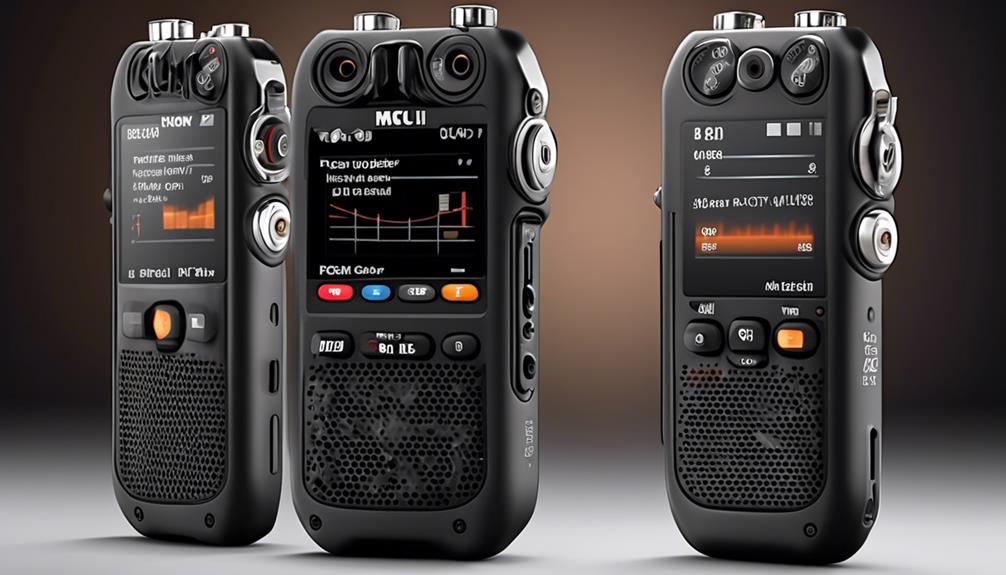
If you’re searching for a PCM recorder, you’re likely balancing sound quality, usability, and features. The Philips VoiceTracer DVT4115 stands out as the best overall, offering advanced speech-to-text and versatile recording modes. The TASCAM DR-60DmkII is ideal for videographers needing multi-channel audio, while the Zoom H1 Essential is perfect for musicians and podcasters on a budget. Each of these options has tradeoffs—higher fidelity often means higher cost, and simpler models may lack professional features. Continue reading for a detailed breakdown to find the best PCM recorder for your specific needs.

Get audio and creator gear delivered free with Prime
- Fast, free delivery on millions of items
- Prime Video, Amazon Music and more included
- Member-only deals all year
Complete the kit


Key Takeaways
- The best PCM recorders balance audio fidelity with ease of use, with professional models offering richer sound but at a higher price point.
- Multi-channel and XLR input support are key features for videographers and musicians, making certain models more suitable for complex recording setups.
- Budget-friendly options like the Zoom H1 series provide solid PCM recording capabilities, but often lack advanced features like multi-track recording or extensive storage.
- Built-in microphones vary significantly in quality; high-end models feature Tresmic or stereo microphones that improve clarity in different environments.
- Connectivity options such as Bluetooth, USB, and SD card support influence how easily the recorder integrates into existing workflows.


| pcm recorder | Connectivity | Memory |
|---|---|---|
| Philips VoiceTracer DVT4115 Di | Smartphone app remote control | — |
| Philips DVT2075 VoiceTracer | — | 8 GB |
| OM SYSTEM Olympus WS-882 Digit | USB direct | 4GB internal (expandable with microSD) |
| TASCAM 4-Channel Portable Audi | XLR, TRS, 3.5mm | — |
| OM SYSTEM Olympus VN-541PC Dig | — | 4GB |
| OM SYSTEM Olympus LS-P5 PCM Re | Bluetooth, USB | 16GB |
| OM SYSTEM Olympus Voice Record | — | 4GB (up to 985 hours) |
| Zoom H1 Essential Handheld Rec | USB-C, SD card slot | — |
| Zoom H4 Essential Handheld Rec | — | — |
| Zoom H1 XLR 2-Channel Recorder | — | — |
More Details on Our Top Picks
Philips VoiceTracer DVT4115 Digital Voice Recorder, Audio Recorder with Sembly AI Speech-to-Text Trial for Meetings, Lectures & Interviews
This model stands out for its specialized stereo microphones, which excel at capturing clear audio from distant speakers, making it ideal for meetings, lectures, and interviews. Its smartphone app remote control adds convenience, allowing users to manage recordings from afar—a feature that surpasses simpler models like the Olympus VN-541PC. The inclusion of automatic speech-to-text and multi-speaker transcription makes documentation faster, though these features rely on AI and may not be perfectly accurate. The 8 GB internal memory supports extensive recording time, but compared to higher-capacity options, it might be limiting for long-term use without file management. This pick is perfect for professionals needing reliable multi-speaker capture and transcription, but those seeking advanced editing or larger internal storage should consider alternatives.
Pros:- Specialized stereo microphones for distant speaker clarity
- Remote control via smartphone app for easy management
- Automatic speech-to-text and multi-speaker transcription
Cons:- Limited internal memory for very long recordings without external storage
- AI transcription accuracy may vary depending on environment
Best for: Professionals and students who need high-quality, multi-speaker recordings with transcription features.
Not ideal for: Casual users or travelers who prefer compact, simple recorders without advanced features.
- Memory Capacity:8 GB
- Recording Formats:Stereo MP3 and PCM
- Microphones:Three specialized stereo microphones
- Connectivity:Smartphone app remote control
- Speech-to-Text:Automatic with multi-speaker support
- Battery Life:Not specified
Our verdict“Ideal for meeting, lecture, and interview settings where transcription and remote control are priorities.”
Philips DVT2075 VoiceTracer, Audio Recorder, MP3 and PCM, Microphones, Rich Stereo Sound. Sembly AI Trial License: Transcription, AI Created Summaries, AI Powered Meeting Insights
This model makes a strong case for users who want rich stereo sound combined with AI-powered meeting insights, including summaries and action points. Its dual high-sensitivity microphones produce natural, immersive audio, superior to basic mono mics found in entry-level recorders like the Olympus VN-541PC. The 30-day Sembly AI trial enhances productivity, offering transcription and key decision highlights, but relies on an internet connection and may incur additional costs after the trial. Voice-activation simplifies hands-free recording, though it can sometimes trigger accidentally in noisy environments. With expandable storage options and up to 35 hours of battery life, it suits busy professionals, but those seeking ultra-long recordings without external cards might find the internal memory limiting.
Pros:- Rich stereo sound with dual high-sensitivity microphones
- AI-generated summaries and key action points for meetings
- Voice-activation for hands-free operation
- Expandable storage with microSD slot
Cons:- AI features require internet and may involve extra costs
- Battery life of 35 hours may be limiting for very long sessions
Best for: Business professionals who prioritize audio quality, AI summaries, and meeting insights.
Not ideal for: Casual users or those who prefer simple, straightforward recordings without AI features.
- Memory:8 GB
- Formats:MP3 and PCM
- Microphones:Dual high-sensitivity stereo
- AI Features:Transcription, summaries, insights
- Battery Life:Up to 35 hours
- Expandable Storage:microSD card support
Our verdict“A smart choice for professionals who want premium audio quality combined with AI meeting insights.”
OM SYSTEM Olympus WS-882 Digital Voice Recorder
The Olympus WS-882 offers exceptional long recording capacity—up to 1040 hours—making it ideal for journalists or researchers needing continuous recording without frequent file management. Its support for microSD cards up to 32GB enhances storage flexibility, surpassing models like the Olympus VN-541PC, which has fixed internal memory. The device’s stereo microphones deliver clear audio quality, but its straightforward design and limited editing features make it less suited for users wanting advanced editing or real-time transcription. The requirement of AAA batteries, while convenient, could be a downside compared to rechargeable options. For those prioritizing extended recording and simple transfer, this model is a solid choice, though it lacks some modern smart features.
Pros:- Massive recording capacity up to 1040 hours
- Supports microSD cards up to 32GB for extra storage
- USB direct connection for easy file transfer
- Stereo microphones for clear recordings
Cons:- Requires AAA batteries, which may need frequent replacement
- Limited display and no advanced editing features
Best for: Researchers and journalists needing reliable, long-duration recordings with easy file transfer.
Not ideal for: Casual users or those needing features like AI transcription or voice activation.
- Memory:4GB internal (expandable with microSD)
- Recording Time:Up to 1040 hours
- Microphones:Stereo built-in
- Connectivity:USB direct
- Power:2 AAA batteries
- Display:1.61-inch screen
Our verdict“Best suited for users who prioritize long-term, bulk recording with simple transfer options.”
TASCAM 4-Channel Portable Audio Recorder for Videographers, 2 Combo XLR/TRS, Dual 3.5mm Inputs, Limiter, HP Filter (DR-60DmkII)
The TASCAM DR-60DmkII excels for videographers who need multi-channel recording in the field, supporting up to four channels at 96kHz/24-bit resolution. Unlike simple PCM recorders, it offers professional XLR inputs with phantom power, making it suitable for capturing multiple audio sources simultaneously. Its rugged design fits under DSLR rigs, and the lockable XLR connectors prevent accidental disconnections. However, its complexity and focus on multi-channel audio might be overkill for solo interview or lecture recording, where simpler PCM recorders like the Olympus WS-882 suffice. It trades off portability for professional-grade multi-input capability, making it ideal for serious videographers but less so for casual recording needs.
Pros:- Supports up to four channels at 96kHz/24-bit
- XLR inputs with phantom power for professional microphones
- Rugged design compatible with DSLR rigs
- Locking XLR connectors prevent accidental disconnection
Cons:- Bulkier and heavier compared to handheld PCM recorders
- Complex interface may be intimidating for beginners
Best for: Videographers and field recordists requiring multi-mic inputs and professional audio quality.
Not ideal for: Casual users or those needing a compact, straightforward PCM recorder for quick notes or interviews.
- Channels:4 (2 XLR/TRS, 2 stereo 3.5mm)
- Sample Rate:96kHz/24-bit
- Power:Battery or AC power
- Connectivity:XLR, TRS, 3.5mm
- Dimensions:Larger than handheld models
- Supported Formats:WAV
Our verdict“Best for videographers needing multi-mic recording with professional audio inputs in the field.”
OM SYSTEM Olympus VN-541PC Digital Voice Recorder
The Olympus VN-541PC offers straightforward recording with one-touch operation, making it ideal for users new to digital voice recording. Its noise cancellation feature improves playback clarity, especially in noisy environments, and four scene modes add a touch of versatility. However, as an entry-level device, it lacks the advanced features like AI transcription or multi-channel recording found in higher-end models like the Philips DVT2075. Its 4GB internal memory may be insufficient for long or frequent recording sessions, especially for users who need high-quality or lossless audio. This model makes sense for casual users or students who want a simple, reliable device without excess complexity.
Pros:- Simple one-touch recording operation
- Effective noise cancellation for clearer playback
- Multiple scene modes for different environments
- Includes basic accessories like a micro-USB cable
Cons:- Limited internal memory for frequent recording
- Lacks advanced features like AI transcription or multi-mic support
Best for: Students or casual users seeking an easy-to-use recorder with noise cancellation.
Not ideal for: Professional users or those needing extensive, long-term recording capacity or advanced features.
- Memory:4GB
- Recording Time:570 hours (LP mode)
- Features:One-touch slide recording, noise cancellation
- Scene Modes:4
- Included Accessories:Micro-USB cable
Our verdict“A practical, budget-friendly choice for beginners or students needing basic, reliable recording.”
OM SYSTEM Olympus LS-P5 PCM Recorder with Tresmic 3-Microphone, Bluetooth, USB Microphone Mode, High-Resolution Sound, Low-Cut Filter, 16GB Built-in Memory
The Olympus LS-P5 stands out for its high-resolution 96 kHz/24 bit audio quality, making it ideal for professional field recordings or music capturing. Unlike the Zoom H1 Essential, which offers portability but lacks advanced noise controls, the LS-P5’s Tresmic 3-microphone array provides versatile stereo imaging and noise reduction. Its Bluetooth connectivity adds convenience for wireless transfer, yet the 16GB internal memory can quickly become limiting if you record lengthy sessions without external storage. The absence of detailed battery life info leaves some uncertainty for extended use. Compared with the H4 Essential, the LS-P5 emphasizes sound fidelity over multi-track recording, making it better suited for solo high-quality recordings but less versatile for complex multi-mic setups.
Pros:- Exceptional 96 kHz/24 bit audio quality for detailed recordings
- Flexible Tresmic 3-microphone array for versatile stereo capturing
- Wireless Bluetooth transfer adds convenience
- Includes noise cancelling and low-cut filter for cleaner sound
Cons:- Limited internal memory may require frequent external storage
- No specific battery life info, which could impact extended sessions
Best for: Professional content creators needing high-resolution, portable PCM recordings with noise control.
Not ideal for: Casual users seeking long recording sessions without external storage options or extensive editing features.
- Microphone:Tresmic 3-Microphone
- Recording Formats:PCM, FLAC, MP3
- Sample Rate:96 kHz/24 bit
- Memory:16GB
- Connectivity:Bluetooth, USB
- Features:Noise cancelling, Low-cut filter
Our verdict“This pick is best suited for professionals prioritizing high-fidelity recordings in a portable form factor.”
OM SYSTEM Olympus Voice Recorder DM-720 with 4GB, Micro SD Slot, USB Charging, Direction PC Connection, Transcription Mode, Silver
The Olympus DM-720 offers an impressive 4GB internal memory, supporting up to 985 hours of recording, which makes it ideal for long lectures or interviews. While this capacity surpasses many basic recorders like the Philips DVT4115, its internal storage can still be limiting for very long sessions unless paired with a Micro SD card, which it supports easily. Its transcription mode and USB charging simplify workflow, but the audio quality and microphone sensitivity aren’t highlighted, suggesting it’s more suited for speech than music. Compared with the Zoom H1, the DM-720’s larger memory and expandability make it a more practical choice for students or journalists needing extended, straightforward recordings without complex features.
Pros:- Massive internal memory for long recording sessions
- Expandable storage via Micro SD slot
- Easy USB charging and PC connection for quick data transfer
- Simple interface with transcription mode
Cons:- Limited to 4GB internal storage without Micro SD expansion
- Lack of detailed info on audio quality or microphone sensitivity
Best for: Students, journalists, or conference attendees looking for affordable, long-duration recording with easy transfer.
Not ideal for: Musicians or podcasters needing high-fidelity or multi-track recording capabilities, as the device focuses on speech clarity.
- Memory:4GB (up to 985 hours)
- Micro SD Slot:Yes
- USB Charging:Yes
- Transcription Mode:Yes
- Color:Silver
Our verdict“This recorder offers excellent value for those needing extended recordings at an affordable price, with expandability in mind.”
Zoom H1 Essential Handheld Recorder for Musicians, Podcasters & Filmmakers with Stereo Microphones, 32-Bit Float, USB Microphone Mode
The Zoom H1 Essential offers an accessible entry point into high-quality stereo recording, making it ideal for podcasters, musicians, and filmmakers needing quick, reliable audio capture. Its built-in X/Y microphones deliver crisp stereo sound, but lack the flexibility of external mics or multi-mic setups like the H4. The 32-bit float WAV format ensures distortion-free recordings even at unpredictable levels, but the device’s basic features and limited editing options may be a drawback for advanced users. Compared to the H4, the H1 is more portable and straightforward, though it lacks multiple XLR inputs and multi-track recording. It’s best suited for those starting out or needing a lightweight recorder for on-the-go content creation.
Pros:- Excellent stereo sound with built-in X/Y microphones
- 32-bit float recording prevents distortion at high levels
- Compact, lightweight design for portability
- Versatile connectivity including USB-C and SD card slot
Cons:- Limited advanced editing or multi-mic capabilities
- Battery life may be constrained with continuous use
- No external microphone or multi-directional options
Best for: Beginners, vloggers, or mobile journalists who want easy, high-quality stereo audio without complex features.
Not ideal for: Pro musicians or filmmakers requiring multi-mic, multi-track, or studio-grade features, as it focuses on simplicity and portability.
- Microphone Type:X/Y stereo microphones
- Recording Format:32-bit float WAV
- Connectivity:USB-C, SD card slot
- Power Source:2×AA batteries or USB power
- Features:USB microphone mode, portable design
Our verdict“This recorder is perfect for beginners or mobile content creators prioritizing simplicity and quality in a portable device.”
Zoom H4 Essential Handheld Recorder for Musicians, Podcasters & Filmmakers with Stereo Microphones, 2 XLR/TRS Inputs, 4 Tracks of 32-Bit Float Recording, & USB Audio Interface | 2 Xlr and Trs Combo Inputs with Phantom, USB-C 4-In/2-Out, SDXC Up to 1TB
The Zoom H4 Essential excels in capturing complex projects with its 4-track recording capability, making it suitable for musicians, videographers, and serious podcasters. Its combination of built-in stereo microphones and dual XLR/TRS inputs allows for flexible mic setups, comparable to the H1 but with expanded multi-channel options. The device supports 32-bit float recording, ensuring high fidelity even in loud environments. While the interface may seem overwhelming for beginners, its inclusion of USB-C and SDXC compatibility with up to 1TB storage offers extended recording sessions and seamless integration with computers. Compared with the H1, the H4’s multi-track capacity makes it a better choice for multi-mic setups, though it comes at a higher complexity and price point.
Pros:- Four-track recording for complex projects
- Multiple input options including XLR/TRS with phantom power
- High-quality 32-bit float audio for dynamic range
- Supports large SDXC cards for extended sessions
Cons:- Steeper learning curve for beginners
- Higher price point compared to simpler recorders
- Bulkier and less portable than basic models
Best for: Musicians, filmmakers, and advanced podcasters requiring multi-mic, multi-track recording with professional-grade features.
Not ideal for: Casual users or those needing a simple, single-mic recorder, as its features may be more than necessary, increasing complexity.
- Inputs:2 XLR/TRS combo inputs
- Additional Inputs:3.5mm stereo mic/line in
- Display:OLED waveform display
- Recording Resolution:32-bit / 96kHz
- Storage Support:SDXC up to 1TB
- Phantom Power:48V
Our verdict“This device is ideal for professionals or experienced creators needing multi-mic, multi-track recording capabilities in a portable form.”
Zoom H1 XLR 2-Channel Recorder for Musicians, Filmmakers & Podcasters with 2 XLR/TRS Locking Inputs, 3.5mm Stereo Mic/Line In, and 32-Bit Float
The Zoom H1 XLR 2-Channel Recorder provides professional-level audio with two XLR/TRS inputs featuring locking connectors, making it highly suitable for live performances and field recordings where secure connections matter. Its 32-bit float recording ensures distortion-free audio even in challenging environments, similar to the H4 but with fewer inputs. The OLED display offers easy level monitoring, and the device supports SDXC cards up to 1TB for extended use. While its portability and professional features make it appealing, the device may seem complex for casual users and lacks the multi-mic versatility of higher-end models like the H4.
Pros:- High-quality 32-bit/96kHz recording with XLR/TRS inputs
- Locking connectors ensure secure mic connections
- OLED display for easy level checks
- Supports SDXC cards up to 1TB
Cons:- Complex for users new to professional audio gear
- Limited to two channels, not suitable for multi-mic setups
- Requires SDXC cards for maximum storage capacity
Best for: Professional musicians, filmmakers, or podcasters who need secure, high-quality dual-channel recording in the field.
Not ideal for: Beginners or casual users who require simple, all-in-one recording devices without XLR inputs or advanced features.
- Recording Resolution:32-bit / 96kHz
- Inputs:2 XLR/TRS combo inputs
- Additional Inputs:3.5mm stereo mic/line in
- Display:OLED waveform display
- Storage Support:SDXC up to 1TB
- Phantom Power:48V
Our verdict“This recorder is best suited for professionals needing secure, high-quality dual-mic recording on the go, with a focus on reliability and fidelity.”

How We Picked
The products in this roundup were evaluated based on several critical factors: recording quality, usability, build quality, versatility, and value. Priority was given to PCM fidelity, with higher bit depths and sample rates earning higher scores. Ease of operation and interface design also played a role, especially for beginners. Additional features like input options, connectivity, and battery life influenced rankings, as they impact real-world usability. The selection includes a range of models—from simple voice recorders to professional multi-channel devices—reflecting different user needs and budgets.| pcm recorder | Connectivity |
|---|---|
| Philips VoiceTracer DVT4115 Di | Smartphone app remote control |
| Philips DVT2075 VoiceTracer | — |
| OM SYSTEM Olympus WS-882 Digit | USB direct |
| TASCAM 4-Channel Portable Audi | XLR, TRS, 3.5mm |
| OM SYSTEM Olympus VN-541PC Dig | — |
| OM SYSTEM Olympus LS-P5 PCM Re | Bluetooth, USB |
| OM SYSTEM Olympus Voice Record | — |
| Zoom H1 Essential Handheld Rec | USB-C, SD card slot |
| Zoom H4 Essential Handheld Rec | — |
| Zoom H1 XLR 2-Channel Recorder | — |
Factors to Consider When Choosing Pcm Recorder
Choosing the right PCM recorder involves balancing several factors that directly impact your recording experience and final sound quality. It’s important to consider your primary use case, whether for professional interviews, music, or casual dictation, as this shapes the features you’ll need. Beyond basic specs, understanding how different features interact helps you avoid common pitfalls and select the best fit for your workflow.Recording Quality and Bit Depth
High-quality PCM recordings typically use 24-bit depth and sample rates of 48kHz or higher. These specs ensure clearer, more detailed sound, especially important for professional work. Cheaper or simpler models often max out at 16-bit or 44.1kHz, which suffices for casual use but may fall short in demanding settings. Prioritize higher specs if your goal is professional editing or archival quality, but be aware that larger files and more storage are necessary.
Input Options and Connectivity
Consider whether you need XLR inputs, microphone jacks, or line-in options, especially for multi-microphone setups. External inputs expand recording flexibility but can add complexity and cost. Wireless connectivity like Bluetooth or Wi-Fi is less common but can facilitate remote control or file transfer. Always match input options to your existing equipment to avoid needing adapters or additional gear that complicate your workflow.
Battery Life and Storage
Long recording sessions require reliable power sources and ample storage. Look for models with extended battery life and support for SD cards or internal memory. Some recorders offer USB power, which is handy for extended use. Consider whether the device allows for quick SD card swaps if you plan to record for hours at a stretch. Also, check if the recorder supports high-capacity cards to prevent running out of space mid-session.
Ease of Use and Interface
Simplicity can be crucial, especially for beginners. An intuitive interface with clear controls and menus reduces the learning curve and helps avoid accidental errors. For professional use, more complex interfaces with multiple modes and customizable settings can be advantageous but may require a learning period. Evaluate whether the device’s layout matches your comfort level and whether it offers features like digital meters or level controls for better oversight during recording.
Durability and Portability
If you’ll be recording outdoors or in rugged environments, durability becomes a key factor. Look for shock-resistant or weatherproof models if needed. Portability also matters—compact, lightweight devices are easier to carry around but may sacrifice some features or battery capacity. Balance your need for ruggedness and ease of transport based on your typical recording conditions.
Frequently Asked Questions
Is higher bit depth always better for PCM recordings?
Higher bit depth, like 24-bit versus 16-bit, generally captures more audio detail and provides greater dynamic range, which is beneficial for professional editing and archival purposes. However, it also results in larger files and may require more storage and processing power. For casual use or voice memos, 16-bit recordings are often sufficient and more storage-efficient. Consider your final use case when choosing the appropriate bit depth.
Can I use a PCM recorder for field interviews?
Yes, many PCM recorders are well-suited for field interviews, especially those with built-in good-quality microphones and external input options. Look for models with noise reduction features and long battery life to ensure clear recordings in variable environments. Also, portable and lightweight designs make it easier to carry and operate during on-location interviews.
What is the difference between stereo and multi-channel PCM recorders?
Stereo PCM recorders capture two channels of audio, suitable for music, interviews, and general recording needs. Multi-channel recorders, often with XLR inputs, can handle multiple microphones simultaneously, providing separate channels for each source. This is essential for professional video production, live recordings, or complex sound environments. Your choice depends on whether you need simple stereo sound or multi-mic flexibility.
Are budget PCM recorders reliable enough for professional work?
Budget PCM recorders can deliver decent sound quality for casual or semi-professional use, but they often lack advanced features like multi-channel inputs, high-resolution recording, or robust build quality. For professional work requiring high fidelity and reliability, investing in higher-end models with better components and durability is advisable. Always check user reviews and specifications to ensure the device meets your quality standards.
How important is the microphone quality built into the recorder?
Built-in microphone quality significantly impacts the clarity and fidelity of your recordings, especially if you don’t plan to use external mics. Higher-end models feature Tresmic or stereo microphones designed to pick up sound accurately across different environments. For critical recordings, consider an external microphone connection, but for casual or quick recordings, a good internal mic might suffice. Always match your microphone choice to your recording needs.
Conclusion
For most users, the Philips VoiceTracer DVT4115 offers a compelling mix of quality, features, and ease of use, making it the best overall choice. Budget-conscious buyers will find the Zoom H1 Essential or Olympus LS-P5 excellent for casual or mobile recording. Professionals needing multi-channel, XLR inputs, or rugged durability should consider the TASCAM DR-60DmkII or Zoom H4 Essential. Beginners or those seeking straightforward voice recording will appreciate simpler models, while high-end users benefit from premium features and build quality. Tailor your choice to your specific recording environment and future needs for the best results.
As an affiliate, we earn on qualifying purchases.Halloween Picks
halloween