🔍 Read the full analysis: A Closer Look At AI And The Living Exhibition Of “After Action” on ThorstenMeyerAI.com

Get audio and creator gear delivered free with Prime
- Fast, free delivery on millions of items
- Prime Video, Amazon Music and more included
- Member-only deals all year
TL;DR
After Action is a live, fictional exhibition that reframes 24 web experiences as productions in a Wing V debrief theater. Its continuous, navigable credits roll is intercut with code-built miniature scenes; the work is explicitly not a real company or a record of military activity.
After Action, a live AI-built exhibition framed as a fictional Wing V debrief theater, turns a collection of 24 web experiences into a continuous cinema-style credit roll. The project matters as a designed example of how an AI-directed web brief can become an interactive exhibition, as detailed in the original analysis, but its military setting is fictional: the source explicitly says it is not a real company or an account of real military activity.
Rather than arrange its subjects as a gallery of cards, After Action asks visitors to watch a single, navigable roll of credits. The names of the projects appear as productions, with chapter stops and controls that let visitors pause or jump between sections. The credits are interrupted at intervals by small, three-dimensional sand-table scenes, making the browsing experience resemble a closing reel with intermissions.
The source describes the exhibition as crediting 24 Wing V rooms, including titles such as Ghost Division, Flightdeck and Viper. It calls for production and department-style labels, links to individual rooms and a stationary, plain-text register after the animated theater. The register gives visitors another way to reach the same material without following moving text.
The room uses a cinema palette of black, projector-beam white, sand amber and credit gold. Compressed display lettering evokes film credits, while monospace type handles labels and explanatory text. The visual framing includes letterbox bars, grain, registration marks and a projected beam. According to the source, the miniatures are generated with CSS techniques such as tilted terrain panels and layered gradients; the hero uses a locally stored still image.
FABLE / 175 · Room 125 · Exhibition Study
A Closer Look at AI and the Living Exhibition of “After Action”
A fictional debrief theater turns 24 web experiences into one continuous, navigable credit roll, punctuated by code-built miniature scenes.
01 / A different way to browse
From gallery to closing reel
The browsing format becomes part of the exhibition’s artistic idea.
Rather than separate project tiles, After Action presents the collection as a timed sequence with a shared beginning, middle, and ending. Visitors can follow the cinematic roll or take control and reach the material directly.
Credits in motion
Project names appear as productions in a continuous, cinema-style roll, giving the collection a sense of shared authorship and closure.
Choose your route
Chapter jumps and pause controls support browsing at a visitor’s pace; a stationary linked register offers a direct alternative.
Miniature scenes
Stylized sand-table dioramas interrupt the credits at intervals, adding small visual set pieces to the sequence.
02 / Visitor journey
How the theater unfolds
A single stream with multiple ways to explore.
Enter the room
A projector-inspired hero establishes the fictional theater.
Follow the roll
Credits connect the 24 experiences into one continuous sequence.
Pause or jump
Chapter controls let visitors stop or move between sections.
Use the register
A plain-text index links to the rooms without moving credits.
03 / Inside the art direction
A theater built from web materials
The brief describes a set of visual motifs and implementation requirements.
Sand-table intermission
The source describes tilted terrain panels and layered gradients for toy-scale scenes, including a shield formation, a catapult arc, and two keys approaching a shared lock.
04 / Reading the evidence
What the source does and doesn’t verify
A brief describes intent; independent checks establish outcomes.
Described in the material
- A fictional “Wing V Debrief Theater,” identified as Room 125 of 175.
- 24 credited experiences, with titles including Ghost Division, Flightdeck, Viper, Titanworks, Sandstorm, Citadelle, and Vampire Hour.
- A brief calling for responsive layouts, keyboard access, reduced-motion support, and locally hosted assets.
Not independently established
- Accessibility, contrast, performance, or screen-size test results.
- Who implemented each part, or how much of the finished work was generated by AI.
- Launch date, current availability of all linked rooms, or whether the unavailable video has since changed.
05 / Context matters
Fictional staging, real craft
Military language and imagery are part of the theatrical conceit.
Wing V is fictional
The source explicitly says this is not a real company or an account of real military activity.
Interaction over harm
The scenes are described as stylized, toy-scale constructions intended to foreground interaction design.
AI role is not detailed
The exhibition is labeled AI-built, while the division of work between people and AI is not specified.
Visit After Action and inspect the credit controls, transitions, and linked register. Further reporting could test keyboard and reduced-motion routes, check all 24 links, and measure behavior across screen sizes. Until then, these remain source descriptions and brief requirements, not verified results.
06 / Key questions
Quick answers
What is After Action?
A live, AI-built exhibition presented as a fictional Wing V debrief theater, organizing 24 web experiences as credits with miniature interludes.
Is Wing V a real military organization?
No. The source describes the setting as fictional and says the exhibition is not an account of real military activity.
How can visitors navigate the credits?
The source describes chapter stops, pause and jump controls, a stationary linked register, and a manual-scroll alternative for reduced motion.
Are the miniatures photographs?
The sand-table scenes are described as CSS-built effects using perspective and layered gradients. The hero uses a locally stored still image.
Has accessibility been independently verified?
Not in the supplied material. The brief lists accessibility requirements, but no independent test results are provided.
What remains to check?
Current room links, keyboard access, reduced-motion behavior, screen-size performance, and the live controls need direct review.
A Different Way to Browse the Collection
After Action makes the format of browsing part of the artwork. A familiar website collection often presents each project as a separate tile; here, a timed sequence gives the collection a shared beginning, middle and ending. Visitors can still take control through chapter jumps, pause controls and the linked register, so the cinematic presentation does not have to be the only route through the material.
The project also makes its production method visible. Its source includes the art-direction brief that shaped the room, including requirements for responsive layouts, keyboard access, reduced-motion support and locally hosted assets. That creates a documented link between AI-assisted creative direction and a specific web interface. It does not, by itself, establish who performed each implementation task or how much of the finished work was generated by AI.
The distinction between fictional staging and real events is important because the room borrows military language and imagery. The source describes the miniatures as stylized, toy-scale scenes and says their purpose is to emphasize interaction design rather than harm. Readers should understand the setting as a theatrical conceit, not evidence of an operation or organization.
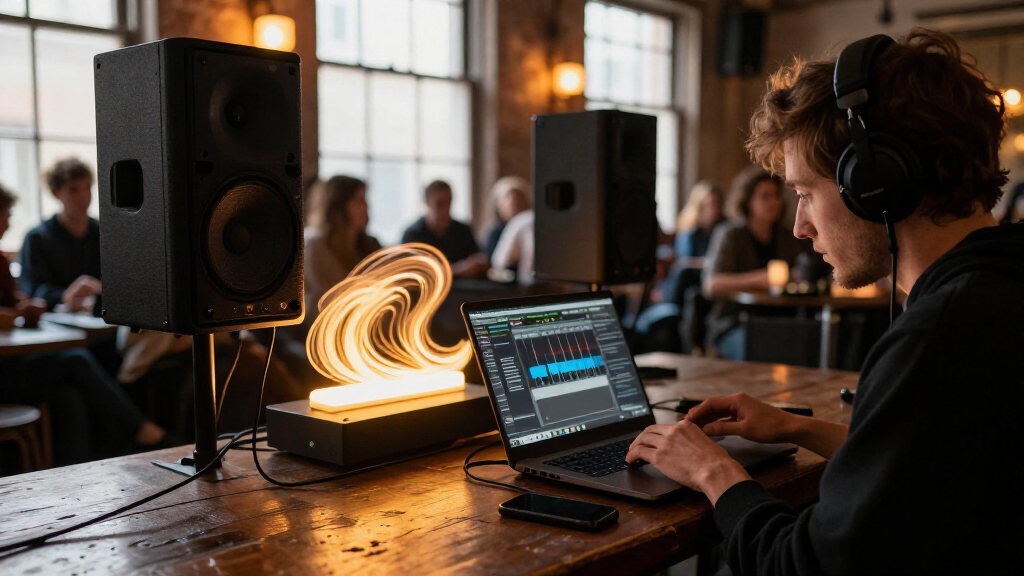
interactive digital exhibition display
As an affiliate, we earn on qualifying purchases.
As an affiliate, we earn on qualifying purchases.
The Brief Behind the Theater
The supplied material identifies After Action as Room 125 of 175 in a broader sequence and gives the room the subtitle “Wing V Debrief Theater.” Its central premise is that the collection of web experiences is taking a final bow. The listed room slugs include Ghost Division, Titanworks, Sandstorm, Citadelle and Vampire Hour.
The embedded art-direction brief describes a single-page site built with HTML, CSS and JavaScript, without frameworks, build tools or external requests. It asks for a continuous end-credits sequence, a plain-text index, responsive behavior at specified screen widths, visible keyboard focus and motion alternatives. Those are stated requirements in the brief; the supplied source does not include an independent audit confirming that every requirement was met.
The brief also specifies sand-table scenes after roughly every eight credits, featuring motifs such as a shield formation, a catapult arc and two keys approaching a shared lock. In the described build, an intended ambient video was unavailable, so the theater uses a local still image with visual effects instead. The source says reduced-motion settings return the presentation to the still image.
““A final reel, not a gallery.””
— After Action source description
What the Source Does Not Verify
The supplied account describes the site and its intended behavior, but does not provide an independent technical review, accessibility test results, performance measurements or visitor data. Requirements in the embedded brief—such as maintaining frame rates, meeting contrast thresholds and checking several screen widths—should not be treated as verified outcomes on the basis of the brief alone.
The material also does not state when the site launched, who built each part, what tools were used to generate or edit the implementation, or whether all 24 linked rooms remain available. It says a live site can be visited, but supplies no dated status report. The relationship between the room’s label as an AI-built exhibition and the division of work between people and AI is not detailed.
The ambient video was unavailable in the build described by the source. It is not clear whether that limitation has since changed. The source says optional synthetic projector audio starts off and can be stopped when disabled, but provides no independent test of how that control behaves in the live version.
Check the Live Room and Its Links
The immediate next step for readers is to visit the live After Action room and check the credit controls, scene transitions and linked register directly. The source points to the room at the FABLE/175 site and describes pause, chapter-jump and manual-scroll routes, but does not report a forthcoming update or scheduled event.
Further reporting could establish whether the complete set of 24 rooms is accessible, test the stated keyboard and reduced-motion alternatives, and confirm how the page performs across screen sizes. Until those checks are available, the technical and accessibility details should be understood as descriptions in the source and requirements in the embedded brief, not independently verified results.
Key Questions
What is After Action?
After Action is a live, AI-built exhibition presented as a fictional Wing V debrief theater. It organizes 24 web experiences as a continuous set of credits, interrupted by miniature scenes.
Is Wing V a real military organization?
The source says the setting is fictional and that After Action is not an account of real military activity. Its military language and sand-table imagery are part of the exhibition’s staging.
How can visitors navigate the moving credits?
The source describes chapter stops, pause and jump controls, plus a stationary linked register after the theater. It also says reduced-motion users have a manual-scroll alternative.
Are the miniature scenes photographs or rendered images?
The source says the sand-table dioramas are built with CSS effects, including perspective and layered gradients. It distinguishes those scenes from the hero, which uses a locally stored still image.
Has the site’s accessibility been independently verified?
Not in the supplied material. The art-direction brief lists accessibility requirements, and the source describes several accommodations, but it provides no independent audit or test results.
Source: ThorstenMeyerAI.com
Halloween Picks
halloween
As an affiliate, we earn on qualifying purchases.