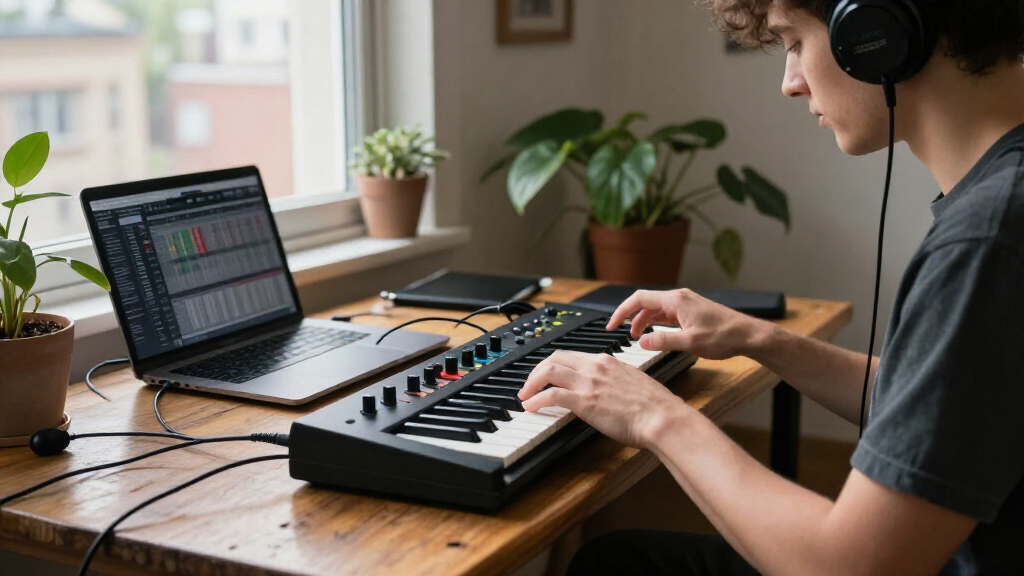
The best portable synthesizer for music production overall is the Teenage Engineering OP-1 Field, thanks to its blend of synthesis, sampling, and standalone composition tools. For hands-on sequencing and connected studio setups, the Novation Circuit Tracks is a more focused groovebox, while the Akai MPC Sample suits beatmakers who want a sampler-led workflow. The main choice is between a self-contained instrument, a sequencer that works well with other gear, and a small sound-making device that may need extra equipment for complete tracks. Portability also means tradeoffs in controls, connectivity, and how much of a song you can build without a computer. Read on for the full breakdown and a guide to choosing the right fit for your setup.

Get audio and creator gear delivered free with Prime
- Fast, free delivery on millions of items
- Prime Video, Amazon Music and more included
- Member-only deals all year
Complete the kit


Key Takeaways
- The OP-1 Field ranks first because it combines synthesis, sampling, and standalone music-making in a single portable instrument; its scope comes with a more involved workflow than a focused groovebox.
- Circuit Tracks is the strongest choice for pattern-based production when sequencing external equipment matters as much as its built-in synth parts.
- OP–XY and OP-1 Field serve different premium priorities: OP–XY centers on sequencing and performance control, while OP-1 Field offers a broader standalone creation approach.
- The lineup splits between production tools and idea starters. MPC Sample, Circuit Tracks, and J-6 offer clearer routes into arranging or sequencing than the pocket Stylophone models.
- Compact and low-cost designs make tradeoffs in depth and integration. The PHARA-O MINI, M-VAVE FM options, and Stylophones can suit specific sound or portability needs, but are less complete as all-in-one production setups.
| Teenage Engineering OP-1 Field Portable Synthesizer and Sampler |  | Best All-in-One Portable Studio | Synth engines: 12 | Sampler time: 20 seconds | Tape recording: Over 160 minutes across 4 digital tapes | VIEW LATEST PRICE | See Our Full Breakdown |
| Teenage Engineering OP–XY Portable Synthesizer, Sampler, and 64-Step Sequencer |  | Best for Live Sequencing and External Gear | Instrument tracks: 8 | Auxiliary tracks: 8 | Synth engines: 8 | VIEW LATEST PRICE | See Our Full Breakdown |
| SONICWARE LIVEN Evoke Portable Synthesizer |  | Best for Textural and Granular Sound Design | Sound engine: 34 acoustic instrument tones, 20 wavetables, and 2 noise types | Granular effect: Up to 12 grains; tempo-synced harmonization and randomization | Reverb: 10 types | VIEW LATEST PRICE | See Our Full Breakdown |
| Behringer PHARA-O MINI Compact Synthesizer |  | Best for a Simple, Compact MIDI-Controlled Setup | Brand: Behringer | Model number: 0722-AAU | Body material: Alloy steel | VIEW LATEST PRICE | See Our Full Breakdown |
| M-VAVE FM-1 Orange 6-Operator FM Synthesizer |  | Best Lightweight FM Synth for Mobile Sketching | Synthesis: 6-operator FM with 32 algorithms | Polyphony: Up to 12 voices | Presets: 128 factory presets; supports DX7 SysEx patch import | VIEW LATEST PRICE | See Our Full Breakdown |
| Akai Professional MPC Sample Portable Sampler |  | Best for Standalone Sampling | Pads: 16 responsive MPC pads | Display: 2.4-inch full-color display | Effects: 4 processors with 60 effect types | VIEW LATEST PRICE | See Our Full Breakdown |
| Novation Circuit Tracks Groovebox Sequencer and Synthesizer |  | Best for Portable Track Building | Tracks: 2 synth, 2 MIDI, and 4 drum tracks | Sequencer: 32-step patterns; chainable up to 256 steps per track | MIDI and sync: Full-size MIDI in, out, and thru; analogue sync out | VIEW LATEST PRICE | See Our Full Breakdown |
| M-VAVE FM001 Portable Wireless FM Synthesizer with Built-In Speaker |  | Best for Pocket-Sized FM Synthesis | Keys: 27 full-range silicone keys | FM engine: 6 operators and 32 algorithms | Presets: 128 | VIEW LATEST PRICE | See Our Full Breakdown |
| Stylophone Original Pocket Electronic Synthesizer |  | Best for Simple, Characterful Portable Parts | Playing method: Stylus played on a touch-sensitive metal surface | Range: Three octaves | Sound features: Optional vibrato; warm, vintage, retro organ-like profile | VIEW LATEST PRICE | See Our Full Breakdown |
| Stylophone GENX-2 Portable Analogue Synthesizer |  | Best for Portable Analog Sound Design | Keyboard: Two-octave stylus-powered keyboard | Power and speaker: Battery-operated; built-in speaker | Oscillation and modulation: LFO with square and triangle waves; pulse-width modulation | VIEW LATEST PRICE | See Our Full Breakdown |
| Roland AIRA Compact J-6 Chord Synthesizer |  | Best for Chord-Driven Songwriting | Synth engine: Four-voice JUNO-60 engine with Analog Circuit Behavior technology | Chord sets: 100 | Arpeggio and phrase styles: 9 styles with 12 variations each | VIEW LATEST PRICE | See Our Full Breakdown |
| portable synthesizers for music production | Connectivity |
|---|---|
| Teenage Engineering OP-1 Field | USB-C, MIDI, Bluetooth MIDI |
| Teenage Engineering OP–XY Port | CV, MIDI-in, USB-C MIDI, Bluetooth LE, audio-in, multi-out jack |
| SONICWARE LIVEN Evoke Portable | LINE IN, MIDI, SYNC, auxiliary |
| Behringer PHARA-O MINI Compact | — |
| M-VAVE FM-1 Orange 6-Operator | USB-C, Bluetooth BLE MIDI, 3.5 mm MIDI IN |
| Akai Professional MPC Sample P | USB-C audio/MIDI, stereo 1/4-inch TRS line in/out, 1/8-inch headphone output, MIDI in/out via adapter, sync out |
| Novation Circuit Tracks Groove | — |
| M-VAVE FM001 Portable Wireless | — |
| Stylophone Original Pocket Ele | Auxiliary connection; 3.5 mm stereo cable |
| Stylophone GENX-2 Portable Ana | Headphone and audio outputs; CV/Gate via five 3.5 mm jack sockets |
| Roland AIRA Compact J-6 Chord | Audio, MIDI, sync I/O, AIRA Link, USB-C audio and MIDI |
More Details on Our Top Picks
Teenage Engineering OP-1 Field Portable Synthesizer and Sampler
The OP-1 Field earns my all-in-one pick because it can take an idea from sound design to a finished arrangement without requiring a computer: its 12 synth engines, sampler, drum machine, sequencer, and four-track tape recorder cover several production stages in one compact unit. A built-in microphone and speaker also make sketching possible away from other gear, while USB-C and MIDI support connection to a larger setup. Compared with the OP–XY, the OP-1 Field leans more toward self-contained tape-style composition than multitrack performance routing. Its sampler’s 20-second limit is a real constraint for longer source recordings, and buyers seeking detailed external-instrument control may prefer the OP–XY’s CV and multiple track types. I’d choose this for portable composition, not as a replacement for a full-sized studio workstation.
Pros:- Combines synthesis, sampling, drum programming, sequencing, and four-track recording
- Built-in microphone and speaker support standalone idea capture
- Rechargeable battery with USB-C charging
- USB-C, MIDI, and Bluetooth MIDI support integration with computers and compatible devices
Cons:- Sampler recording time is limited to 20 seconds
- Tape-style four-track workflow is less suited to complex multitrack arrangements than a computer-based setup
Best for: Mobile producers who want one self-contained instrument for synths, sampling, drums, and arranging ideas into multitrack sketches.
Not ideal for: Producers who need long sample recordings or extensive CV-based control of external modular gear.
- Synth engines:12
- Sampler time:20 seconds
- Tape recording:Over 160 minutes across 4 digital tapes
- Effects:8 styles
- Connectivity:USB-C, MIDI, Bluetooth MIDI
- Compatibility:iOS, macOS, Windows
- Dimensions:11.81 x 4.72 x 0.79 inches
- Materials:Aluminum and polycarbonate plastic
Our verdict“Choose the OP-1 Field if you want a portable, self-contained composition and recording tool; choose the OP–XY if external routing and performance sequencing matter more.”
Teenage Engineering OP–XY Portable Synthesizer, Sampler, and 64-Step Sequencer
The OP–XY is the lineup’s strongest fit for producers who want a portable instrument to coordinate a broader rig. Its 8 instrument tracks and 8 auxiliary tracks give sequences room for layered parts and supporting functions, while tracks running at different speeds and lengths enable polyrhythmic patterns. Built-in CV, MIDI, audio input, and multi-out make it more adaptable to external instruments and effects than the OP-1 Field, which puts greater emphasis on its four-track tape workflow. Eight synth engines and sampling also keep it useful on its own. The tradeoff is that the supplied details give no battery-life or dimension figures, so I can’t judge endurance or bag fit as confidently as with the OP-1 Field or the much lighter M-VAVE FM-1. Its feature set is best matched to hands-on sequencing rather than minimal, quick-start sketching.
Pros:- Eight instrument tracks plus eight auxiliary tracks support layered sequencing
- Tracks can run at different speeds and lengths for polyrhythmic patterns
- CV, MIDI, audio input, and multi-out support a connected hardware setup
- Combines eight synth engines, sampling, sequencing, and a built-in speaker
Cons:- Battery life and dimensions are not specified in the supplied product details
- Its extensive track and routing options may be more involved than the OP-1 Field’s tape-centered workflow
Best for: Performers and producers building polyrhythmic sequences that need to control both the OP–XY’s sounds and external MIDI or CV equipment.
Not ideal for: Buyers who need confirmed battery runtime and physical dimensions before choosing a travel instrument, or who want a simpler sketchpad.
- Instrument tracks:8
- Auxiliary tracks:8
- Synth engines:8
- Sequencer:64-step
- Connectivity:CV, MIDI-in, USB-C MIDI, Bluetooth LE, audio-in, multi-out jack
- Built-in features:Speaker and microphone
- Model number:TE033AS001
- Included components:USB cable and battery
Our verdict“Pick the OP–XY for portable performance sequencing and broad hardware connections, but favor the OP-1 Field for a more self-contained tape-recording approach.”
SONICWARE LIVEN Evoke Portable Synthesizer
The LIVEN Evoke makes the most sense for producers who want unusual, evolving tones rather than a broad all-purpose production hub. Its sound engine combines 34 acoustic instrument tones, 20 wavetables, and two noise types, while granular processing and 10 reverbs provide tools for turning those sources into atmospheric parts. The four-track sequencer adds step and real-time recording, parameter locking, and probability playback, so the instrument can develop patterns rather than just supply a single sound. Compared with the OP-1 Field, Evoke is more focused on texture and less equipped as a complete sampler-and-tape studio; compared with the OP–XY, it offers fewer tracks and less extensive external routing. Battery power and a built-in speaker help it travel, but the plastic body and unspecified battery runtime leave durability and session length less certain.
Pros:- Combines acoustic tones, wavetables, and noise sources in one sound engine
- Granular effects and 10 reverb types support varied atmospheric processing
- Four-track sequencer offers step and real-time recording, parameter locking, and probability playback
- Battery-powered design includes a built-in speaker
Cons:- Plastic body may suit lighter portable use better than buyers seeking a more robust-feeling instrument
- Battery life is not specified in the supplied product details
- Four tracks and its focused sound-design approach offer less of a complete production workflow than the OP-1 Field
Best for: Sound designers and electronic producers seeking portable acoustic-inspired, wavetable, and granular textures for ambient or experimental arrangements.
Not ideal for: Producers who need a broad multitrack workstation, detailed external-gear routing, or a specified battery runtime.
- Sound engine:34 acoustic instrument tones, 20 wavetables, and 2 noise types
- Granular effect:Up to 12 grains; tempo-synced harmonization and randomization
- Reverb:10 types
- Sequencer:4 tracks; step and real-time recording
- Chord mode:16 chord styles
- Connectivity:LINE IN, MIDI, SYNC, auxiliary
- Power and speaker:Battery-powered; built-in speaker
- Dimensions and weight:6.93 x 11.69 x 1.89 inches; 790 g
Our verdict“Choose the LIVEN Evoke for portable textural sound design and sequenced atmosphere, not as a substitute for a full multitrack production center.”
Behringer PHARA-O MINI Compact Synthesizer
The PHARA-O MINI is the most stripped-back choice here: its appeal is a compact 0.65 kg body with a MIDI connector, rather than a documented suite of production functions. That makes it a possible fit for a buyer prioritizing a small synth to add to a MIDI-based rig, but the supplied details do not describe its sound engine, keyboard, sequencing, battery, or audio outputs. I would not rank it alongside the OP-1 Field or OP–XY as a proven self-contained production instrument: both of those specify sequencing and multiple creative tools, while the PHARA-O MINI’s capabilities remain unclear from the available information. Its alloy-steel body may appeal to buyers who prefer a metal enclosure, though the polished finish and compact measurements alone don’t answer how it handles a complete music-making session.
Pros:- Compact dimensions suit a space-limited desk or portable setup
- Weight is listed as 0.65 kg
- MIDI connector supports connection to compatible MIDI equipment
- Alloy-steel body with polished finish
Cons:- Supplied details do not specify the sound engine or synthesis features
- No sequencing, sampling, battery, or built-in speaker details are provided
- The stated MIDI connector alone does not clarify its full connection or audio-output options
Best for: MIDI-focused producers looking for a compact synth whose stated attributes are its small footprint, metal body, and MIDI connection.
Not ideal for: Buyers who need documented sampling, sequencing, battery operation, keyboard details, or a clear standalone production workflow.
- Brand:Behringer
- Model number:0722-AAU
- Body material:Alloy steel
- Finish:Polished
- Dimensions:9.21 x 6.1 x 2.56 inches
- Weight:0.65 kg
- Connector type:MIDI
Our verdict“Consider the PHARA-O MINI only if its compact metal build and MIDI connection match your setup and you can confirm the missing production details before buying.”
M-VAVE FM-1 Orange 6-Operator FM Synthesizer
At 251 g, the FM-1 is the easiest option here to carry as a dedicated sound module with keys. Its six-operator FM engine, 32 algorithms, 128 presets, and DX7 SysEx import give producers a direct route to classic bell, bass, and evolving digital tones, while the 27-key keyboard keeps note entry on the device. An arpeggiator, 16-step sequencer, six effects, built-in speaker, and rechargeable battery make it more immediately self-contained than the Behringer PHARA-O MINI, whose supplied details don’t describe those functions. The tradeoff is a very compact keyboard and a narrower FM focus than the OP-1 Field’s mix of synthesis, sampling, drums, and tape recording. Its listed battery life is up to 12 hours, so runtime will vary rather than guaranteeing a full-day session.
Pros:- Very light 251 g design with a built-in speaker and rechargeable battery
- Six-operator FM engine includes 32 algorithms and DX7 SysEx patch import
- 27 keys, octave shifting, arpeggiator, and 16-step sequencing support portable idea-making
- USB-C and Bluetooth BLE MIDI plus 3.5 mm MIDI input offer several connection options
Cons:- The 27-key keyboard is compact and requires octave shifts across its stated eight-octave range
- FM synthesis is a more focused sound palette than the OP-1 Field’s combination of synth engines, sampling, and drums
- Battery runtime is specified as up to 12 hours, not a guaranteed duration
Best for: Traveling producers who want a lightweight FM instrument for entering notes, editing tones, and sketching patterns without a computer.
Not ideal for: Players who need a larger keyboard, a broad range of synthesis styles, or a fully specified multitrack recording workflow.
- Synthesis:6-operator FM with 32 algorithms
- Polyphony:Up to 12 voices
- Presets:128 factory presets; supports DX7 SysEx patch import
- Keyboard:27 keys with octave shift covering 8 octaves
- Sequencer and arpeggiator:16-step sequencer storing up to 16 sequences; arpeggiator with 7 modes
- Effects:Filter, reverb, delay, distortion, chorus, phaser
- Connectivity:USB-C, Bluetooth BLE MIDI, 3.5 mm MIDI IN
- Battery, weight, and dimensions:2000 mAh; up to 12 hours; 251 g; 161.5 × 96.5 × 28.6 mm
Our verdict“Choose the FM-1 for a lightweight, keyboard-equipped FM sketching tool, but look to the OP-1 Field for broader sound sources and recording functions.”
Akai Professional MPC Sample Portable Sampler
The MPC Sample is the strongest fit here for producers who want to build tracks from recorded or imported audio without bringing a computer. Its 16 MPC pads, sample-chopping tools, over 100 kits, and four effects processors make it more focused on turning samples into arranged music than the sound-design-first M-VAVE FM001. A built-in speaker and microphone also support quick capture and playback away from the studio, while USB-C audio/MIDI and stereo line connections let it join a larger setup. The tradeoff is that it is a sampler and sequencer, not a conventional synth; buyers seeking keyboard-led synthesis should look to the Stylophone GENX-2 instead. Storage relies on microSD, and the MIDI DIN adapter is not included, so factor those into a portable rig.
Pros:- Standalone, rechargeable operation supports music making without a computer
- Sixteen MPC pads and sample-chopping tools suit hands-on beat creation
- Built-in speaker and microphone support portable playback and recording
- USB-C, stereo line connections, and MIDI options fit studio and live rigs
Cons:- Its sampling workflow does not replace a keyboard-based synthesizer
- MIDI DIN adapter is not included
- Uses microSD storage for sample management
Best for: Beatmakers who want a battery-powered, pad-based sampler for chopping sounds and sketching tracks away from a computer.
Not ideal for: Players who want a keyboard-centered synthesizer or a self-contained setup with full-size MIDI DIN cables included.
- Pads:16 responsive MPC pads
- Display:2.4-inch full-color display
- Effects:4 processors with 60 effect types
- Factory kits:Over 100
- Power:Rechargeable lithium-ion battery
- Storage:microSD card
- Connectivity:USB-C audio/MIDI, stereo 1/4-inch TRS line in/out, 1/8-inch headphone output, MIDI in/out via adapter, sync out
Our verdict“Choose the MPC Sample if portable sample-based beatmaking matters more to you than playing or programming a traditional synth.”
Novation Circuit Tracks Groovebox Sequencer and Synthesizer
The Circuit Tracks earns its place as the most balanced portable arrangement tool in this group: it combines two synth tracks, four drum tracks, and two MIDI tracks in one rechargeable groovebox. Its 32-step sequencer adds microtiming, probability, pattern mutation, and chains up to 256 steps per track, giving sketches more room to develop than the Stylophone Original’s performance-focused format. Full-size MIDI in, out, and thru also make it a practical hub for external instruments. The limitation is that its two internal synth tracks must cover the melodic work, so producers who want extensive sample manipulation may prefer the Akai MPC Sample. Battery operation is listed for up to four hours, and sample loading requires a microSD card; it is portable, but not a replacement for a large, expandable studio workstation.
Pros:- Combines two synth, four drum, and two MIDI tracks in one unit
- Sequencer supports microtiming, probability, pattern mutation, and long pattern chains
- Full-size MIDI in, out, and thru simplify connections to external gear
- Rechargeable battery supports mobile production
Cons:- Only two dedicated synth tracks are available
- Loading samples requires a microSD card
- Listed battery runtime is up to four hours
Best for: Electronic producers who want one battery-powered unit for sequencing drums, synth parts, and external MIDI gear.
Not ideal for: Producers who need many dedicated synth parts, deep sample editing, or longer unplugged sessions than the listed battery runtime supports.
- Tracks:2 synth, 2 MIDI, and 4 drum tracks
- Sequencer:32-step patterns; chainable up to 256 steps per track
- MIDI and sync:Full-size MIDI in, out, and thru; analogue sync out
- Audio outputs:Stereo line outputs and headphone output
- Sample storage:microSD card for loading samples
- Battery:Built-in rechargeable battery, up to 4 hours
- Included components:Circuit Tracks, USB-A to USB-C cable, USB power adaptor, safety information sheet
Our verdict“Pick the Circuit Tracks if you want a compact, hands-on sequencer that can run a small electronic arrangement and control external gear.”
M-VAVE FM001 Portable Wireless FM Synthesizer with Built-In Speaker
The M-VAVE FM001 is a compact way to explore FM tones without carrying a full-size keyboard or studio setup. Its six operators and 32 algorithms offer a broader sound-design starting point than the Stylophone Original, while 128 presets give beginners usable sounds before they tackle FM programming. An arpeggiator, 16-step sequencer, six effects, speaker, and battery operation make it more than a silent MIDI controller for quick musical ideas. Bluetooth MIDI and USB MIDI also offer flexible ways to connect, although the stated 27 silicone keys limit playing range and feel unlike a conventional keyboard. Compared with the Novation Circuit Tracks, the FM001 is more focused on one synthesizer voice and less suited to arranging a layered track. Battery life is not specified, which makes planning longer sessions difficult.
Pros:- Six-operator FM engine with 32 algorithms supports varied timbres
- 128 presets provide ready-to-play sounds and a starting point for editing
- Built-in effects, arpeggiator, and 16-step sequencer support quick sketches
- Battery operation, built-in speaker, USB MIDI, and Bluetooth MIDI suit portable use
Cons:- The 27-key range is restrictive for two-handed parts
- Battery life is not specified
- Plastic body and silicone keys offer a different playing feel from a standard keyboard
Best for: Traveling producers and FM-curious beginners who want a tiny, self-contained instrument for melodic sketches and sound exploration.
Not ideal for: Keyboard players who need a wide key range, specified long-session battery performance, or a multitrack groovebox for complete arrangements.
- Keys:27 full-range silicone keys
- FM engine:6 operators and 32 algorithms
- Presets:128
- Effects:6: filter, reverb, delay, distortion, chorus, and phaser
- Sequencer:16-step
- MIDI:USB MIDI, Bluetooth MIDI, and 3.5 mm MIDI IN
- Dimensions and weight:6.4 x 3.8 x 1.2 inches; 9.6 ounces
Our verdict“Choose the FM001 for portable FM experimentation and short melodic ideas, not as the main controller for a full production setup.”
Stylophone Original Pocket Electronic Synthesizer
The Stylophone Original takes a deliberately simple route: play notes by touching a stylus to its metal surface, then use its compact, three-octave range for short melodic lines, riffs, and distinctive retro tones. That makes it more immediately characterful than the preset-driven M-VAVE FM001, but far less suited to building a complete arrangement than the Novation Circuit Tracks. A built-in speaker supports quick ideas, while the headphone socket and auxiliary connection let it feed a recording setup. Its small playing surface keeps the instrument pocketable, though accurate navigation may take practice and it lacks the sequencing and sound-shaping options that matter in a production centerpiece. It runs on three AA batteries rather than a rechargeable pack, so mobile producers need to carry spares.
Pros:- Distinctive warm, retro organ-like sound adds character to recorded parts
- Three-octave touch surface offers a wider note range than its size suggests
- Built-in speaker and headphone socket support quick practice and monitoring
- Auxiliary connection allows recording or integration with other gear
Cons:- Small stylus playing surface can take practice to navigate accurately
- Requires three AA batteries
- Limited sound controls and no sequencer make it less capable as a production hub
Best for: Producers seeking a tiny, stylus-played instrument for adding unusual melodic hooks or retro-toned layers to recorded tracks.
Not ideal for: Buyers who need a sequencer, extensive tone programming, a conventional keyboard, or rechargeable power for regular travel.
- Playing method:Stylus played on a touch-sensitive metal surface
- Range:Three octaves
- Sound features:Optional vibrato; warm, vintage, retro organ-like profile
- Power:3 AA batteries
- Audio features:Built-in speaker and headphone socket
- Connectivity:Auxiliary connection; 3.5 mm stereo cable
- Dimensions and weight:2.05 x 3.41 x 1.86 inches; 8.8 ounces
Our verdict“Pick the Stylophone Original for compact, distinctive melodic parts, but look to the Circuit Tracks or MPC Sample for full track-building tools.”
Stylophone GENX-2 Portable Analogue Synthesizer
The Stylophone GENX-2 is the better choice over the Original when sound shaping matters more than straightforward pocket play. Its resonant low-pass filter, LFO, attack/decay envelope, pulse-width modulation, sub-octave switches, and analogue delay give producers more ways to sculpt a part before recording it. The finger-sensitive expression strip also adds performance movement without requiring a full keyboard. Compared with the M-VAVE FM001, this is an analogue-focused instrument with CV/Gate connections rather than a preset-rich FM synth with Bluetooth MIDI. Its two-octave stylus keyboard remains unconventional, and the product data does not list a full-size keyboard; external keyboard or DAW control is the route for players who need that format. It can contribute a distinctive voice, but it is less self-contained for sequencing complete arrangements than the Circuit Tracks.
Pros:- Filter, LFO, envelope, pulse-width modulation, and sub-octave controls support detailed tone shaping
- Analogue delay adds movement and space without an external effects unit
- Expression strip provides performance control beyond the stylus keyboard
- CV/Gate and external keyboard or DAW control support integration with other equipment
Cons:- Stylus-based two-octave keyboard may feel unfamiliar and limits conventional playing
- Full-size keyboard play requires external equipment
- Not a standalone arrangement tool like the Novation Circuit Tracks
Best for: Producers who want a portable analogue voice with hands-on sound controls and CV/Gate links to modular or vintage-style gear.
Not ideal for: Players who need a conventional built-in keyboard, a complete sequencer-led production system, or an instrument with specified battery runtime.
- Keyboard:Two-octave stylus-powered keyboard
- Power and speaker:Battery-operated; built-in speaker
- Oscillation and modulation:LFO with square and triangle waves; pulse-width modulation
- Filter and envelope:Resonant low-pass filter; attack/decay envelope
- Additional sound features:Dual sub-octave switches and analogue delay
- Connectivity:Headphone and audio outputs; CV/Gate via five 3.5 mm jack sockets
- Included components:Stylus and headphones
Our verdict“Choose the GENX-2 if portable analogue sound design and CV/Gate connectivity matter more than a conventional keyboard or complete groovebox workflow.”
Roland AIRA Compact J-6 Chord Synthesizer
The J-6 is the most focused songwriting tool in this roundup: its 100 chord sets and programmable sequencer make it quick to build harmonic ideas without entering every note individually. The four-voice JUNO-60-inspired engine adds familiar synth tones, while real-time sound shaping, delay, and reverb help turn those ideas into parts ready for a track. Compared with the broader Novation Circuit Tracks, the J-6 puts more emphasis on chord progressions than on building a full multi-part groovebox arrangement. Its 64 user patterns, each up to 64 steps, leave room to develop and save sketches, and USB-C audio and MIDI make it practical to connect to a production setup. The tradeoff is limited polyphony: dense voicings and layered arrangements can exceed four voices, so this is better as a portable composition companion than a complete studio centerpiece.
Pros:- 100 chord sets and sequencer patterns make it fast to explore harmonic ideas
- JUNO-60-inspired four-voice engine offers recognizable synth tones with real-time shaping
- Arpeggio and phrase variations add rhythmic movement without manual note programming
- USB-C audio and MIDI support straightforward connection to a computer-based setup
Cons:- Four-voice polyphony can restrict dense chords and overlapping parts
- Its chord-centered design is less suited to producing complete multi-part arrangements than a groovebox
- A compact control set offers less detailed sound editing than a larger synthesizer
Best for: Songwriters and electronic producers who want a compact, battery-powered way to sketch chord progressions and sequence JUNO-style synth parts before moving ideas into a larger setup.
Not ideal for: Producers who need broad polyphony, several independent parts, or a complete groovebox in one unit; the four-voice engine and chord-focused workflow are more restrictive than a larger production hub.
- Synth engine:Four-voice JUNO-60 engine with Analog Circuit Behavior technology
- Chord sets:100
- Arpeggio and phrase styles:9 styles with 12 variations each
- Sequencer patterns:64 user patterns, up to 64 steps each
- Synth presets:64
- Effects:Delay and reverb
- Connectivity:Audio, MIDI, sync I/O, AIRA Link, USB-C audio and MIDI
- Power:Lithium-ion battery included
Our verdict“Choose the J-6 if portable chord sketching and JUNO-inspired sounds matter more than high polyphony or an all-in-one arrangement workflow.”
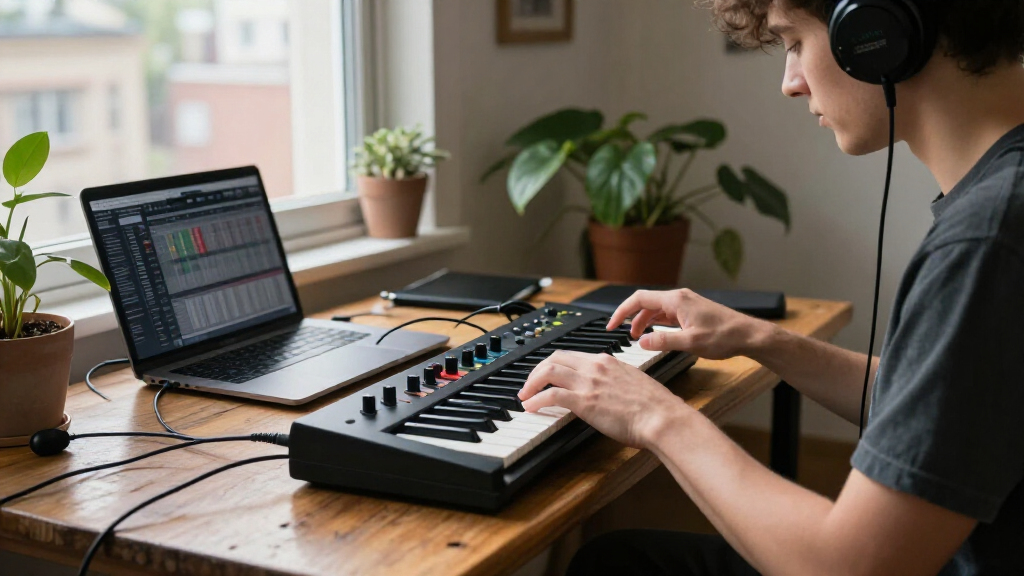
How We Picked
I ranked these instruments by how well they support actual music production away from a full studio, not by size or novelty alone. I weighed standalone capability, sound-making and sampling options, sequencing and arrangement workflow, hands-on control, and how readily each unit can fit into a wider setup. Portability mattered, but a small footprint did not outrank a device that offers a clearer path from musical idea to finished pattern or track.
The ranking favors versatile tools that can support more than one stage of a production session, which puts the OP-1 Field and Circuit Tracks ahead for different reasons. Specialized instruments can still be the better choice for a buyer with a defined workflow: OP–XY for sequencing-centered performance, MPC Sample for sample-based work, or J-6 for chord patterns. More limited pocket instruments rank lower because they suit sound exploration and quick ideas better than complete production tasks. I also accounted for the practical tradeoff between compact controls and the speed of editing detailed parts.
Factors to Consider When Choosing Portable Synthesizers For Music Production
Portable synths can mean anything from a complete song-making workstation to a tiny instrument that supplies one distinctive sound. I would choose by mapping the device to the job it must do in your setup, then checking whether its limits will slow down the way you work. These factors help separate a capable production center from a fun but narrower companion.
Decide Whether You Need a Standalone Production Center
Start by asking whether you want to make a complete arrangement on the instrument or capture ideas to finish elsewhere. A standalone workflow can reduce dependence on a laptop, but it may also mean adapting to a smaller screen, fewer controls, or a device-specific way of organizing songs. If your computer is already the center of your setup, a compact synth or sequencer may be more useful than paying for functions you will rarely use. Think through a typical session: creating a sound, recording a part, arranging sections, and exporting or connecting the result. A product that handles only the first step is better treated as a sound source than as your main production tool. This distinction helps explain why versatile devices lead this roundup while pocket instruments are more specialized picks.
Match the Workflow to How You Build Music
Pattern-based writers, sample-focused beatmakers, and players who develop songs from a keyboard have different needs. A sequencer makes it easier to build and repeat parts, while a sampler-led workflow puts recorded or chopped audio at the center. A chord tool can speed up harmonic ideas without replacing a full arrangement system. Before buying, list the steps you repeat most often and check whether the instrument makes those steps direct rather than forcing workarounds. A common mistake is choosing by the number of sounds or features instead of the workflow you will use every session. The OP–XY, MPC Sample, and J-6 illustrate why focused tools can be better than a broader device for a specific method of composing.
Check How It Connects to Your Existing Gear
Portability does not automatically mean a device will fit neatly into a studio or live setup. Check what connections and synchronization options it supports, then compare them with your interface, computer, headphones, and other instruments. A unit that can sequence external gear may add more value to an established setup than another self-contained sound source. If you plan to record audio into a computer, consider how many steps that takes and whether you need extra cables or adapters. Buyers sometimes focus on onboard features and discover later that routing or synchronization is the real bottleneck. Decide whether the instrument should work alone, extend existing gear, or do both before treating portability as the main requirement.
Balance Portability Against Editing Comfort
A small instrument is easy to carry, but compact controls can make detailed sound design and arrangement slower. Consider where you will use it: a desk, a bag, a rehearsal space, or a commute all place different demands on size and accessibility. Built-in speakers can help with quick sketches, but they are not a substitute for checking a mix on suitable headphones or monitors. Small displays and limited controls may suit short patterns and performance gestures better than long editing sessions. Avoid assuming that the smallest device will be the most practical if you need to make frequent changes. For production, comfortable access to the controls you use most can matter more than shaving off a little extra space.
Pay More for Workflow, Not Just More Features
A higher-end portable synth earns its place when it removes friction from repeated tasks, expands how you compose, or replaces several pieces of gear you would otherwise carry. More features are less useful if the interface slows down your creative process or overlaps with tools you already own. A budget instrument can be a smart choice when you need a particular sound or a compact sketching tool, but it may not cover sequencing, arrangement, and recording in one place. Compare the total setup you need, including headphones, cables, and any computer or external gear required to finish a track. The lineup shows both sides: premium all-in-one instruments offer breadth, while smaller, simpler units make sense when their narrower role is exactly what you need. Spend according to the production task you want to make easier.
Frequently Asked Questions
Can a portable synthesizer replace a laptop for making complete tracks?
Some portable instruments support a more self-contained process than others, but the answer depends on your expectations for editing, arrangement, and finishing. The OP-1 Field is the clearest fit here for a broad standalone workflow, while devices such as the Circuit Tracks and MPC Sample center on more defined production approaches. A smaller synth or chord instrument may be excellent for generating parts but still need another device to arrange and record a full song. Consider whether you need finished exports on the instrument or simply want to compose away from your desk. If detailed editing and mixing are central to your work, a laptop may remain part of the setup even with a capable portable synth.
Should I choose a groovebox or a portable synthesizer?
Choose a groovebox if your priority is building repeating parts, sequencing sounds, and shaping a track from patterns. Choose a synth if sound design and playing a particular type of sound matter more than arranging a complete piece on the device. This roundup includes instruments that blur the line, so look at the role each one plays rather than relying on its label. Circuit Tracks is a strong fit for pattern-driven production and external sequencing, while a compact synth may be better as an additional voice in an existing setup. If you are unsure, write down the first three tasks you want the device to handle and favor the option that supports all three directly.
Will a small portable synth work with my existing MIDI setup?
Do not assume that a compact size guarantees the connections your setup needs. Check the exact MIDI, audio, and synchronization options for the model, along with any adapters or cables required to connect it to your gear. Also confirm whether you want the portable instrument to send notes, receive notes, control other devices, or simply provide audio. Those jobs can require different connection paths, and a device that handles one may not cover the others. If external sequencing is central to your workflow, prioritize integration before choosing based on sound or size. Testing your planned signal path on paper can prevent a mismatch after purchase.
Are pocket synthesizers suitable for producing finished music?
They can contribute to finished tracks, but many pocket instruments are more naturally suited to sketches, distinctive parts, or performance gestures than full arrangements. The Stylophone models and compact M-VAVE options make the most sense when their size or focused sound is the point of the purchase. You may need another sequencer, recorder, or computer to turn an idea into a complete production. That is not a flaw if you already have those tools and want a portable sound source. If you expect one small device to handle synthesis, sequencing, arrangement, and recording, favor a more production-oriented option from this lineup.
What should I prioritize if I am buying my first portable synthesizer?
Prioritize a workflow you can understand and use regularly over a long feature list. Think about whether you want to play notes, create patterns, sample audio, or make tracks without a computer; each points toward a different type of instrument in this roundup. Check how easy the controls are to follow and whether you will need extra gear to hear, record, or sequence it. Beginners often buy a specialized device for one appealing sound and later find that it does not support their next production step. If you are still exploring, a versatile instrument or a clear groovebox workflow can leave more room to develop before you add specialized tools.
Conclusion
For most people seeking one portable production instrument, I recommend the Teenage Engineering OP-1 Field as the best overall because it covers synthesis, sampling, and standalone creation in one device. The Novation Circuit Tracks is my best value for pattern-based production and for musicians who want sequencing to connect with external gear; the Akai MPC Sample is the more direct fit for sample-centered beatmaking. For a premium, sequencing-led instrument, choose the OP–XY; for a first step into making patterns, the Circuit Tracks offers a clearer production route than the pocket synths. If you want a compact chord idea tool, the Roland AIRA Compact J-6 has a distinct role, while the PHARA-O MINI, M-VAVE FM models, and Stylophones suit buyers who value a specific sound or extra-small format over an all-in-one workflow. Choose based on the job you want the device to do, not portability alone.
Halloween Picks

10 ft Halloween Inflatable Archway with Built-in LEDs

Pumpkin Halloween Fog Machine with 12-Color LED Lights, Bluetooth Speaker, and Remote

Thuodo 8 FT Tall Halloween Inflatable Three-Headed Dragon with LEDs
As an affiliate, we earn on qualifying purchases.