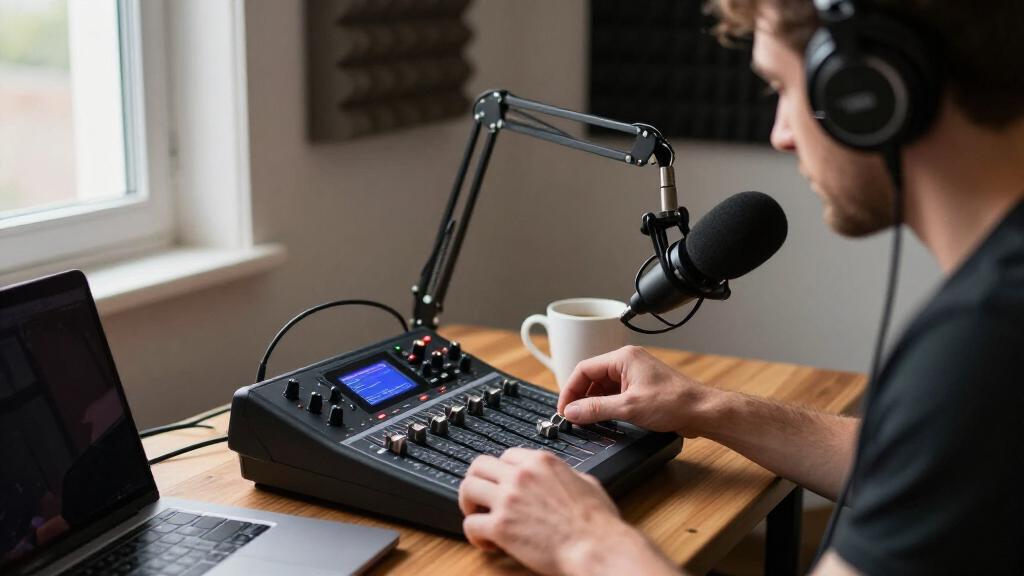

Wireless podcasting mixers span a wide range, from budget bundles with Bluetooth streaming to pro-grade production consoles, and the biggest tradeoff you’ll face is between all-in-one convenience and long-term audio quality. My top pick, the MAONO AME2 Audio Interface Mixer, hits the sweet spot with genuine XLR inputs, built-in effects, and enough channel flexibility to grow with your show. If you want a premium studio experience, the RØDE RØDECaster Duo is in a class of its own for sound processing and build, while the FIFINE AmpliGame SC3 delivers standout value for solo streamers who want per-channel faders without a big spend. Meanwhile, bundles like the 4-Person Podcast Equipment Bundle with M100 make multi-host shows possible out of the box. Read on for the full breakdown of what each mixer does well, where each one falls short, and which fits your setup.

Get audio and creator gear delivered free with Prime
- Fast, free delivery on millions of items
- Prime Video, Amazon Music and more included
- Member-only deals all year
Complete the kit


Key Takeaways
- True wireless capability varies dramatically: only the 5-Channel Mixer with Dual UHF Mics, the DGNOG R4-PROS, and the BOMGE BM-05 offer genuine wireless microphone input, while most ‘wireless’ mixers only provide Bluetooth playback — a distinction that reshaped my ranking.
- The RØDE RØDECaster Duo is the only console here with broadcast-grade preamps and processing, but its price and single-mic-bundle-absence mean it makes sense only for podcasters already committed to quality XLR microphones.
- Budget bundles (Also GO, Maonocaster Lite, TENLAMP G10) consistently trade preamp quality and headroom for accessories — fine for beginners, frustrating once you upgrade microphones.
- The MAONO AME2 emerged as best overall because it bridges categories: real XLR inputs, onboard effects, and a price far closer to the budget bundles than the RØDECast Duo.
- Bundles with four microphones, like the M100 and MAONO E2 Gen2B, are the fastest path to a multi-host show but lock you into their included mics, limiting future upgrades more than mixer-only purchases.
| 4-Person Podcast Equipment Bundle with M100 Audio Mixer and Dynamic Microphones |  | Best for Group Podcasts | Microphones Included: 4 dynamic | Mixer Model: M100 Audio Mixer | Inputs: Dual XLR and dual 3.5mm | VIEW LATEST PRICE | See Our Full Breakdown |
| MAONO Podcast Equipment Bundle with Audio Mixer & 3.5mm Mic (Maonocaster Lite AM200) |  | Best for Multi-Platform Streaming | Model: Maonocaster Lite AM200 | Channels: 9 | Connectivity: 3.5mm, USB Type-C, AUX, Bluetooth | VIEW LATEST PRICE | See Our Full Breakdown |
| FIFINE AmpliGame SC3 Gaming Audio Mixer |  | Best for Streamers Using XLR Mics | Channels: 4 | Connectivity: USB, XLR mic input | Power: USB-C | VIEW LATEST PRICE | See Our Full Breakdown |
| BOMGE BM-05 5-Channel Digital Mixer with USB Bluetooth |  | Best Wired-and-Wireless Flexibility | Channels: 5 | Mic Inputs: 3 XLR with 48V phantom power | Line Inputs: 1 pair 6.35mm, 1 pair RCA stereo | VIEW LATEST PRICE | See Our Full Breakdown |
| 5-Channel Audio Mixer with Dual UHF Wireless Microphones |  | Best Truly Wireless Kit | Channels: 5 | Wireless Microphones: 2 UHF handheld | Wireless Range: Up to 180 feet | VIEW LATEST PRICE | See Our Full Breakdown |
| DGNOG R4-PROS 4 Channel Karaoke Mixer with 2 Wireless Microphones |  | Best for Karaoke and Parties | Channels: 4 | Connectivity: USB, Bluetooth | Wireless Mics Included: 2 (UHF) | VIEW LATEST PRICE | See Our Full Breakdown |
| PUPGSIS Gaming Audio Mixer for PC Streaming with Voice Changer, Soundboard, and RGB |  | Best for Streamers and Gamers | Channels: 4 | Connectivity: USB, Bluetooth (input only) | Audio Input: 1/4″ TRS (XLR mics only) | VIEW LATEST PRICE | See Our Full Breakdown |
| MAONO E2 Gen2B Podcast Equipment Bundle for 2 with Dual XLR Condenser Mic Mixer |  | Best for Two-Person Podcasts | Preamp Gain: 60dB | Inputs: Dual XLR combo inputs | Sound FX Buttons: 8 (up to 20-second custom clips) | VIEW LATEST PRICE | See Our Full Breakdown |
| RØDE RØDECaster Duo Compact Audio Production Studio |  | Best Premium Pick | Inputs: 2x Neutrik combo jacks | Preamp Gain: 76dB | Preamp EIN: -131.5dBV | VIEW LATEST PRICE | See Our Full Breakdown |
| Also GO Podcast Equipment Bundle with F998 Audio Mixer and BM800 Microphone |  | Best Budget Starter Kit | Channels: 2 | Connectivity: Bluetooth, USB, 3.5mm jack | Microphone Type: Studio condenser (BM800) | VIEW LATEST PRICE | See Our Full Breakdown |
| TENLAMP G10 Creator Audio Mixer Bundle with Microphone for Streaming |  | Best Entertainment Bundle for Live Performers | Included Microphone: Condenser microphone with accessories | Key Effects: Voice changer, sound effects, reverb, pitch | Performance Feature: Follow-singing mode with private monitoring | VIEW LATEST PRICE | See Our Full Breakdown |
| MAONO AME2 Audio Interface Mixer – Podcast Studio Console with XLR Input |  | Best Pro-Ready Podcast Console | Channels: 10-channel | Mic Gain: Up to 60dB, 3-level adjustment | Phantom Power: 48V | VIEW LATEST PRICE | See Our Full Breakdown |
| 4-Channel Bluetooth Audio Mixer with XLR USB Interface and 99 DSP Effects |  | Best Value Effects Mixer | Channels: 4 | Connectivity: XLR, 1/4-inch, USB, Bluetooth (input only) | DSP Effects: 99 | VIEW LATEST PRICE | See Our Full Breakdown |
| wireless podcasting mixer | Connectivity | Channels |
|---|---|---|
| 4-Person Podcast Equipment Bun | USB plug-and-play, Bluetooth | — |
| MAONO Podcast Equipment Bundle | 3.5mm, USB Type-C, AUX, Bluetooth | 9 |
| FIFINE AmpliGame SC3 Gaming Au | USB, XLR mic input | 4 |
| BOMGE BM-05 5-Channel Digital | — | 5 |
| 5-Channel Audio Mixer with Dua | — | 5 |
| DGNOG R4-PROS 4 Channel Karaok | USB, Bluetooth | 4 |
| PUPGSIS Gaming Audio Mixer for | USB, Bluetooth (input only) | 4 |
| MAONO E2 Gen2B Podcast Equipme | USB-C, 3.5mm AUX, Bluetooth | — |
| RØDE RØDECaster Duo Compact Au | — | — |
| Also GO Podcast Equipment Bund | Bluetooth, USB, 3.5mm jack | 2 |
| TENLAMP G10 Creator Audio Mixe | 3.5mm to PC, phone, tablet | — |
| MAONO AME2 Audio Interface Mix | USB-C, Bluetooth, XLR, 6.35mm instrument, 3.5mm AUX | 10-channel |
| 4-Channel Bluetooth Audio Mixe | XLR, 1/4-inch, USB, Bluetooth (input only) | 4 |
More Details on Our Top Picks
4-Person Podcast Equipment Bundle with M100 Audio Mixer and Dynamic Microphones
Most podcast bundles stop at two hosts, but this kit is built around a four-microphone setup with dynamic mics, desktop stands, earphones, and every cable you need in the box. That alone separates it from two-person kits like the Maonocaster Lite AM200, which caps out at a single host and a guest. The M100 mixer adds smart noise reduction, adjustable EQ, reverb, and pitch correction, so a roundtable recorded in an untreated room still comes out listenable. The built-in 4000 mAh battery means the whole rig can run untethered — handy for outdoor shows or convention-floor recording that the FIFINE AmpliGame SC3 simply can’t do on its own USB-C power. The tradeoff is depth: there’s no multitrack recording integration, so each mic can’t be edited independently afterward, and solo podcasters are paying for three microphones they’ll never use.
Pros:- Four dynamic microphones, stands, earphones, and cables included in one box
- Built-in 4000 mAh battery enables fully portable, off-grid recording
- Noise reduction, EQ, reverb, and pitch correction shape group audio without software
- Plug-and-play USB connection works with Windows, iOS, and Android with no drivers
Cons:- No multitrack recording, so each speaker’s audio can’t be edited separately in post
- Overkill in cost and inputs for solo or two-person shows
Best for: Roundtable shows with 3-4 hosts who want a complete, portable recording kit in one purchase
Not ideal for: Solo podcasters and producers who need multitrack editing — three of the four mics go to waste and there’s no per-track recording
- Microphones Included:4 dynamic
- Mixer Model:M100 Audio Mixer
- Inputs:Dual XLR and dual 3.5mm
- Battery:4000 mAh rechargeable
- Connectivity:USB plug-and-play, Bluetooth
- Compatibility:Windows, iOS, Android; TikTok, YouTube, Twitch
- Extras:4 adjustable RGB lighting modes
Our verdict“Buy this if you record a multi-host show and want the only kit here that arms four people out of the box — skip it if you edit tracks individually.”
MAONO Podcast Equipment Bundle with Audio Mixer & 3.5mm Mic (Maonocaster Lite AM200)
Where most mixers here focus on recording, the AM200 is engineered for the simultaneous multi-platform streamer — it handles two people, four devices, and four platforms at once, which none of the other bundles in this lineup can claim. The voice changer, sound pads, denoise, and reverb are geared toward live TikTok and Twitch audiences rather than studio polish. Compared with the FIFINE AmpliGame SC3, the AM200 wins on device and platform routing but loses on mic flexibility: it only accepts a 3.5mm microphone input with no phantom power, so upgrading to a serious condenser later isn’t an option the way it is on the SC3’s XLR input. Beginners should also budget patience — setup spans multiple cables and adapters, and phones without headphone jacks need an OTG adapter that isn’t in the box.
Pros:- Simultaneous support for 2 people, 4 devices, and 4 streaming platforms
- Voice changer, sound effects, denoise, and reverb built in for live broadcasts
- Works across Windows, macOS, iOS, and Android
- Complete bundle with mic, tripod, windscreen, and cables
Cons:- No phantom power and only a 3.5mm mic input limits microphone upgrades
- Setup is complicated for beginners and requires extra adapters for modern phones
Best for: Live streamers broadcasting to TikTok, YouTube, and Twitch simultaneously with a co-host
Not ideal for: Podcasters planning to upgrade to XLR condenser microphones — the 3.5mm-only input and lack of phantom power cap audio quality
- Model:Maonocaster Lite AM200
- Channels:9
- Connectivity:3.5mm, USB Type-C, AUX, Bluetooth
- Power:Battery powered (5V charging)
- Simultaneous Support:2 people, 4 devices, 4 platforms
- Dimensions:9.44 x 5.11 x 1.65 inches
- Weight:1.3 kg
- Included:Microphone, tripod, windscreen, mixer, cables, manual
Our verdict“This is the pick for simulcasting live shows across platforms — not for producers who want a mic-upgrade path.”
FIFINE AmpliGame SC3 Gaming Audio Mixer
The SC3 occupies a middle ground the bundles don’t: it’s a compact 4-channel mixer with 48V phantom power, meaning it drives professional condenser microphones that the Maonocaster Lite AM200 physically can’t accept. The individual faders for mic, line in, headphone, and line out give you hands-on volume control mid-stream — a genuine advantage over button-based consoles when you need to duck music without looking away from your game. Six voice-changing modes, twelve auto-tune options, and four programmable sound pads keep it fun without burying the core mixing controls. The compromises are real, though: it’s limited to a single XLR input, rejects USB microphones entirely, and ships without an XLR cable, so factor that purchase in on day one.
Pros:- 48V phantom power supports professional condenser microphones
- Dedicated faders for mic, line in, headphone, and line out channels
- Voice changer, 12 auto-tune options, and 4 customizable sound pads
- Plug-and-play on both Mac and Windows with no drivers
Cons:- Single XLR input caps you at one microphone
- XLR cable not included, and quality depends on the cable you buy
Best for: Solo streamers and podcasters who already own or plan to buy an XLR condenser microphone
Not ideal for: Owners of USB microphones or multi-host shows — it accepts only one XLR mic and nothing USB
- Channels:4
- Connectivity:USB, XLR mic input
- Power:USB-C
- Phantom Power:48V
- Outputs:3.5mm line out and headphones
- Dimensions:4.44″D x 6.45″W x 1.6″H
- Weight:Approx. 0.5 kg (1.1 lbs)
- Compatibility:Mac OS, Windows
Our verdict“The smartest choice here for a solo creator committed to the XLR upgrade path — wrong choice if you need multiple mics or already use a USB mic.”
BOMGE BM-05 5-Channel Digital Mixer with USB Bluetooth
This is the most traditional console in the batch — a proper 5-channel DJ-style mixing board with three XLR inputs, 6.35mm and RCA stereo lines, and 48V phantom power across the mic channels. Unlike the FIFINE SC3, it takes multiple microphones and instruments at once, making it a better fit for a small band, a hybrid panel with a keyboard, or a podcast that pipes in a phone caller via RCA. Bluetooth lets you stream backing music wirelessly, and a USB-A port plays MP3s from or records to a flash drive without a computer in the room. The catch is a strange one: Bluetooth, USB, and channel 4/5 functions are mutually exclusive — you pick one mode at a time — and the 1.5-foot Bluetooth range means your phone basically has to sit on the console. Connecting to a phone for recording also demands a separate OTG adapter.
Pros:- 3 XLR mic inputs with switchable 48V phantom power for condensers
- Multiple input types: XLR, 6.35mm, RCA, USB, and Bluetooth
- USB-A port records directly to a flash drive without a computer
- Per-channel 2-band EQ, gain controls, LED peak indicators, echo and delay
Cons:- Bluetooth, USB, and channel 4/5 functions cannot be used simultaneously
- Bluetooth range of roughly 1.5 feet defeats the point of wireless playback
Best for: Creators and small performers who need multiple mics, instruments, and speakers connected to one board
Not ideal for: Phone-first streamers — OTG adapters are required, Bluetooth range is 1.5 feet, and modes can’t run simultaneously
- Channels:5
- Mic Inputs:3 XLR with 48V phantom power
- Line Inputs:1 pair 6.35mm, 1 pair RCA stereo
- Outputs:1 pair RCA, 1 pair 6.35mm main out
- USB:USB-B recording interface, USB-A playback/recording
- Wireless:Bluetooth with play/pause and track controls
- Effects:2-band EQ, gain, echo, delay
- Power:USB to Type-C power cable
Our verdict“Choose this when you need a real multi-input console for mics, instruments, and speakers — avoid it if wireless freedom is the goal.”
5-Channel Audio Mixer with Dual UHF Wireless Microphones
This is the only product in the roundup where wireless is the headline: two UHF handheld microphones work up to 180 feet from the board, so hosts can roam a stage, a party, or a karaoke room with no cables dragging behind them. That’s a genuinely different proposition from the BOMGE BM-05, whose Bluetooth only reaches about 1.5 feet and exists for music playback, not microphones. The 5-channel board backs the wireless mics with full per-channel volume, EQ, echo, and gain control, 48V phantom power for wired condensers, and a USB audio interface for recording straight to a PC or phone. Two weaknesses temper the appeal: both wireless mics share channel 2, so you can’t balance them independently, and Bluetooth 3.0 with a 35-foot range is a decade out of date for music streaming.
Pros:- Two UHF wireless handheld mics included with up to 180 feet of range
- Full per-channel volume, EQ, echo, and gain control across 5 channels
- Built-in USB audio interface records to PC and smartphones
- 48V phantom power supports wired condenser microphones
Cons:- Both wireless microphones share channel 2, preventing independent level control
- Bluetooth 3.0 is outdated with a limited 35-foot range
Best for: Karaoke hosts, DJs, and live performers who need roaming wireless microphones at events
Not ideal for: Desk-based podcasters — wireless range is wasted at a table, and shared channel control limits two-mic balancing
- Channels:5
- Wireless Microphones:2 UHF handheld
- Wireless Range:Up to 180 feet
- Mic Frequencies:CHA 576.1-590.1MHz, CHB 560.1-574.1MHz
- Bluetooth:Bluetooth 3.0, up to 35 feet
- Inputs:RCA, Aux, Bluetooth, USB
- Phantom Power:48V
- Mic Batteries:2 x AA per mic (4-6 hours)
Our verdict“If your show happens on your feet rather than at a desk, this bundle’s wireless mics justify it — seated podcasters get more value elsewhere.”
DGNOG R4-PROS 4 Channel Karaoke Mixer with 2 Wireless Microphones
This option stands out for being the only entry in this lineup that ships with two UHF wireless microphones in the box — a genuine advantage over the Also GO bundle, which forces you into a single wired condenser. For karaoke nights and party hosting, the anti-interference UHF connection matters more than studio fidelity, and the 24 DSP reverb effects let singers dial in vocal polish without touching a computer. The 48V phantom power and wide input selection (XLR, TRS, RCA, 3.5mm) mean it can moonlight as a podcasting mixer when the party ends. The tradeoff is real, though: this is a karaoke-first device, not a production tool. Compared with the RØDECaster Duo, there is no touchscreen, no broadcast-grade processing, and no track record in professional circles.
Pros:- Two UHF wireless microphones included with anti-interference performance
- Independent volume control for each microphone channel
- 24 built-in DSP reverb effects for vocal customization
- Wide input compatibility with 48V phantom power for condenser mics
Cons:- Karaoke-oriented feature set lacks podcast production tools like multitrack recording
- Newer brand with little established reputation or firmware update history
- Bluetooth is for audio streaming only, not a full wireless workflow
Best for: Party hosts and karaoke enthusiasts who want dual wireless mics and effects out of one box
Not ideal for: Podcasters focused on production quality — this is built for live vocal fun, not edited studio work
- Channels:4
- Connectivity:USB, Bluetooth
- Wireless Mics Included:2 (UHF)
- DSP Effects:24 reverb effects
- Phantom Power:48V
- Inputs/Outputs:XLR, 1/4″ TRS, RCA, 3.5mm
- Weight:1635 g
Our verdict“Buy this if your priority is wireless dual-mic entertainment; skip it if you’re building a serious podcast studio.”
PUPGSIS Gaming Audio Mixer for PC Streaming with Voice Changer, Soundboard, and RGB
Where the DGNOG R4-PROS leans toward singers, this model is built squarely for the Twitch and Discord crowd. The built-in voice changer, four programmable sound pads, and RGB lighting translate directly into on-stream entertainment value, and the hardware-only controls mean no software fiddling mid-broadcast — a real advantage over the FIFINE AmpliGame SC3, which takes a more conventional mixer approach. The Bluetooth input for background music is a smart wireless touch. But the limitations are unusually strict here: it accepts XLR microphones only via a separately purchased TRS cable, and it cannot run 48V or USB mics at all. Bluetooth is input-only too, so wireless headphones are off the table and monitoring must be wired.
Pros:- All-in-one hub combining voice changer, sound pads, and adjustable reverb
- Effective noise cancellation for clear voice in noisy gaming setups
- Bluetooth input for wirelessly streaming background music or effects
- No software required — dedicated hardware controls for real-time adjustments
Cons:- Not compatible with 48V dynamic or USB microphones
- XLR mics require a separately purchased TRS-to-XLR cable
- Bluetooth is input only; wired monitoring is mandatory for zero latency
Best for: PC streamers and gamers who want voice effects, sound pads, and RGB flair without software complexity
Not ideal for: Podcasters with USB or 48V condenser microphones — the compatibility list excludes them entirely
- Channels:4
- Connectivity:USB, Bluetooth (input only)
- Audio Input:1/4″ TRS (XLR mics only)
- Sound Pads:4 programmable + 2 interactive
- Power Source:Corded Electric (5V)
- Output Connector:USB
- Microphone Compatibility:XLR only; no 48V dynamic or USB mic support
Our verdict“A fun, effects-heavy streamer’s console for XLR mic owners — anyone with a USB mic should look elsewhere.”
MAONO E2 Gen2B Podcast Equipment Bundle for 2 with Dual XLR Condenser Mic Mixer
This pick makes the most sense for duo shows, because its dual XLR combo inputs with 60dB low-noise preamps can drive professional dynamic mics without an external booster — something the smaller MAONO AME2 handles with less headroom. The 8-hour battery sets it apart from everything corded in this roundup, including the RØDECaster Duo, opening up truly mobile recording from phones and tablets over USB-C or Bluetooth. Eight customizable sound pads and pitch-shifting voice effects give interview shows personality. Two honest caveats: despite the bundle label, no microphones are included, so budget for a pair — and the 8-hour battery may run flat during marathon sessions or back-to-back episodes without a top-up.
Pros:- Dual XLR combo inputs with 60dB gain for professional dynamic microphones
- 8-hour battery enables fully mobile, untethered recording
- Plug-and-play across Mac, Windows, smartphones, and tablets
- 8 customizable sound effect buttons plus voice and reverb effects
Cons:- Microphones not included despite the bundle labeling
- 8-hour battery may need charging during extended recording sessions
- Effects quality falls short of studio processors like APHEX on the RØDECaster Duo
Best for: Two-person podcast teams who already own or plan to buy XLR mics and want a portable, battery-powered interface
Not ideal for: Buyers expecting a complete out-of-box kit — the bundle includes the interface and cables only, no mics
- Preamp Gain:60dB
- Inputs:Dual XLR combo inputs
- Sound FX Buttons:8 (up to 20-second custom clips)
- Battery Life:8 hours
- Connectivity:USB-C, 3.5mm AUX, Bluetooth
- Compatibility:Mac, Windows, smartphones, tablets, instruments
Our verdict“The strongest choice here for a two-host show that values portability — provided you source your own mics.”
RØDE RØDECaster Duo Compact Audio Production Studio
This is the professional benchmark of the batch. With Revolution Preamps at 76dB gain and -131.5dBV noise floor, the Duo outclasses every budget option here — the MAONO E2 Gen2B’s 60dB preamps are respectable, but this is a different league of cleanliness. The haptic touchscreen and six SMART pads with bank switching make the DGNOG and PUPGSIS hardware layouts feel toy-like by comparison, and the APHEX processing (Aural Exciter, Big Bottom) delivers broadcast polish that software effects on cheaper boards can’t replicate. The wireless angle is the weakest part: like most here, its wireless story is Bluetooth streaming rather than wireless mics. And compared with the full-size RØDECaster Pro II, you give up inputs — just two combo jacks — which caps it at small setups.
Pros:- Ultra-low-noise Revolution Preamps with 76dB gain for any dynamic mic
- Studio-grade APHEX effects including Aural Exciter and Big Bottom
- Intuitive haptic touchscreen plus SMART pads with bank switching
- Four broadcast-quality faders for hands-on mixing
Cons:- Only two combo inputs limit multi-guest setups
- Premium pricing far above every other mixer in this roundup
- Compact form factor sacrifices expansion options of larger RØDECaster models
Best for: Serious podcasters and content creators who want studio-grade preamps and processing in a compact console
Not ideal for: Budget-first buyers or groups of three or more hosts — two combo inputs and a premium price tag rule it out
- Inputs:2x Neutrik combo jacks
- Preamp Gain:76dB
- Preamp EIN:-131.5dBV
- Faders:4 broadcast-quality faders
- SMART Pads:6 with bank switching
- Display:High-resolution touchscreen with haptic feedback
- Effects:APHEX processing (Aural Exciter, Big Bottom)
- Headphone Input:3.5mm TRRS
Our verdict“If audio quality is non-negotiable and your budget allows it, this is the mixer the rest of this list is measured against.”
Also GO Podcast Equipment Bundle with F998 Audio Mixer and BM800 Microphone
Unlike the MAONO E2 Gen2B, which arrives mic-less, this bundle genuinely includes everything a first-timer needs: the F998 mixer, a BM800 condenser mic, boom arm, shock mount, pop filter, and cables. That completeness is its whole argument. The 16 background sound effects, 7 recording modes, and 4 voice changer modes give newcomers plenty to experiment with, and plug-and-play USB or Bluetooth across PCs, phones, and even consoles means no drivers and no troubleshooting. The tradeoffs are the flip side of the low cost: the super-cardioid condenser is entry-level quality, the two-channel board lacks the preamp headroom of the MAONO or RØDE options, and Bluetooth to phones can be less dependable than the wired connection.
Pros:- Truly all-inclusive bundle with mic, boom arm, shock mount, and pop filter
- Plug-and-play with Windows, Mac, iOS, Android, and gaming consoles
- Rich feature set: 16 sound effects, voice changers, and 7 recording modes
- Nine adjustable knobs give hands-on control for learning the basics
Cons:- Entry-level BM800 condenser falls short of dedicated XLR microphones on sound quality
- Only 2 channels and modest preamp performance limit growth
- Requires full charging before first use; Bluetooth to mobile devices can be unreliable
Best for: Complete beginners who want an affordable, everything-included kit to start podcasting or streaming immediately
Not ideal for: Creators upgrading from starter gear — the condenser mic and 2-channel board will be quickly outgrown
- Channels:2
- Connectivity:Bluetooth, USB, 3.5mm jack
- Microphone Type:Studio condenser (BM800)
- Polar Pattern:Super cardioid
- Sound Effects:16 background effects, 4 voice changer modes, 7 recording modes
- Compatible Devices:PC, laptop, smartphone, speaker, voice recorder, Xbox
- Power Source:Corded Electric with built-in rechargeable battery
- Dimensions:4.52 x 1.77 x 7.4 inches
Our verdict“The cheapest credible path from zero to your first episode — plan to upgrade the microphone as you improve.”
TENLAMP G10 Creator Audio Mixer Bundle with Microphone for Streaming
The TENLAMP G10 stands out for one feature nobody else in this lineup offers: a follow-singing mode that lets you hear the original track in your headphones while your audience gets only your voice and music. For TikTok singers and live performers, that alone justifies a look. Compared with the Also GO Podcast Equipment Bundle, which is similarly bundled but streamer-focused, the G10 leans harder into performance and interactivity, with voice changers and triggerable effects like applause and laughter built for audience engagement rather than clean production.
The tradeoff is audio depth. There is no phantom power, no XLR input, and no real gain control for pro microphones — the MAONO AME2 is a far better tool if you ever plan to upgrade to an SM7B-class mic. Real-time bass, treble, reverb, and pitch knobs give it more hands-on control than a basic phone adapter, but this is a plug-and-play entertainment kit, not a studio console.
Pros:- Follow-singing mode delivers a clean audience mix while you monitor the original track privately
- Built-in voice changer and triggerable sound effects add live-stream interactivity
- Complete bundle includes mixer, condenser mic, and accessories in one purchase
- Plug-and-play with Windows, Mac, iOS, and Android — no drivers needed
Cons:- No XLR input or 48V phantom power, locking you into consumer-grade microphones
- Fixed 3.5mm-based audio chain limits upgrade path as your show grows
Best for: Live singers, TikTok streamers, and entertainers who want voice effects, sound buttons, and follow-singing monitoring in one affordable kit
Not ideal for: Podcasters planning to upgrade to XLR dynamic or condenser microphones — there’s no phantom power or XLR input
- Included Microphone:Condenser microphone with accessories
- Key Effects:Voice changer, sound effects, reverb, pitch
- Performance Feature:Follow-singing mode with private monitoring
- Controls:Real-time bass, treble, reverb, pitch adjustment
- Connectivity:3.5mm to PC, phone, tablet
- Compatibility:Windows, Mac, iOS, Android — plug and play
Our verdict“Buy this if your content is performance-first — singing, voice gimmicks, and live interaction — and skip it if podcast fidelity is the goal.”
MAONO AME2 Audio Interface Mixer – Podcast Studio Console with XLR Input
Where most mixers in this roundup treat microphones as an afterthought, the MAONO AME2 is built around them. Its preamps deliver up to 60dB of low-noise gain with 48V phantom power, which means it can drive a Shure SM7B straight out of the box — something the TENLAMP G10 or the MAONO E2 Gen2B bundle simply cannot do. That single fact makes it the most future-proof pick here: your microphone can grow with your show.
Production tools run deep too, with 11 customizable sound pads (including looping pads up to 60 seconds), six reverb modes, 12-step auto-tune, and a 32-bit chipset with denoise. Compared with the RØDECaster Duo, the AME2 trades polish and app integration for raw channel count and price accessibility, but the learning curve is real. There are a lot of buttons, and it takes time before the workflow feels natural. Also note that USB microphones are not supported — if you own one, this console won’t see it.
Pros:- 60dB gain with 48V phantom power drives demanding dynamic mics like the SM7B without a separate preamp
- 11 customizable sound pads with looping give live shows real production value
- Connects to PC, smartphones, tablets, and cameras alongside instrument and AUX inputs
- Full effects suite: reverb, auto-tune, pitch, EQ, and denoise on a 32-bit chipset
Cons:- Steep learning curve — the sheer number of controls overwhelms first-time users
- No USB microphone support, a hard limit for some existing setups
Best for: Podcasters and streamers using XLR dynamic or condenser mics who want sound pads, effects, and room to grow into a serious setup
Not ideal for: Owners of USB microphones — they’re unsupported — and beginners who want a one-cable setup without studying a manual
- Channels:10-channel
- Mic Gain:Up to 60dB, 3-level adjustment
- Phantom Power:48V
- Sound Pads:11 customizable (3x60s looping, 8x20s)
- Effects:6 reverb modes, 12-step auto-tune, EQ, denoise (32-bit chipset)
- Connectivity:USB-C, Bluetooth, XLR, 6.35mm instrument, 3.5mm AUX
- Compatibility:PC, smartphones, tablets, cameras; Windows, Mac OS
Our verdict“This is the pick for creators who see XLR microphones in their future and want a console that won’t be outgrown in a year.”
4-Channel Bluetooth Audio Mixer with XLR USB Interface and 99 DSP Effects
This no-name-brand mixer earns its spot through spec generosity: 99 DSP effects, a 7-band EQ, +48V phantom power, and an all-metal chassis — a combination that undercuts more established boards like the BOMGE BM-05 while offering finer tonal control than the 2–3 band EQs common at this level. For a podcaster or home studio owner who likes to shape sound rather than accept presets, the 7-band EQ alone is the differentiator — it lets you carve out rumble or harshness that fixed knobs can’t touch.
The honest tradeoff is Bluetooth input only: you can stream backing tracks or call audio into the mixer, but you cannot send your mix out wirelessly to a speaker, so this isn’t the cable-free desk some buyers will imagine. And with just 4 channels, a multi-guest show will hit the ceiling fast — the MAONO AME2 or the 4-Person Podcast Equipment Bundle handle bigger tables. USB playback from a flash drive is a handy bonus for intros and stingers, though.
Pros:- 99 DSP effects covering reverb, delay, chorus, and flange for creative shaping
- 7-band EQ offers far more precise tone control than typical 2–3 band budget mixers
- +48V phantom power supports professional condenser microphones
- Durable all-metal chassis in a compact footprint that travels easily
Cons:- Bluetooth is input-only — no wireless output to speakers
- Only 4 channels, limiting for multi-host or guest-heavy shows
Best for: Budget-conscious home studio owners and solo podcasters who want deep EQ and effects shaping with condenser mic support
Not ideal for: Multi-guest podcast tables needing more than 4 channels, or anyone expecting wireless output to speakers
- Channels:4
- Connectivity:XLR, 1/4-inch, USB, Bluetooth (input only)
- DSP Effects:99
- EQ:7-band
- Phantom Power:+48V
- USB Playback:MP3 from USB drive
- Build:All-metal chassis, compact portable design
Our verdict“A smart budget buy for solo creators who want to tweak their sound in detail, as long as four channels and wired outputs fit your setup.”

How We Picked
I evaluated each mixer through the lens a podcaster actually uses: how many people can record at once, whether the preamps and processing can handle real voices without noise or clipping, and how genuinely wireless the system is. A mixer advertised as wireless sometimes means UHF wireless microphones included, sometimes just Bluetooth audio streaming — those are very different products, and I weighted them accordingly. I also looked at onboard effects (reverb, voice changing, sound pads), monitoring options, and whether the unit works as a USB audio interface for recording software.
Usability and growth potential separated the ranked picks from the rest. Consoles with physical faders per channel, clear labeling, and XLR inputs for future microphone upgrades scored higher than closed bundles. Build quality, power flexibility (battery versus USB versus wall adapter), and how much value the included accessories add versus what you’d buy anyway rounded out the scoring. Products are ordered by how well they serve a podcaster across all these factors, not by feature count alone.
Factors to Consider When Choosing Wireless Podcasting Mixers
Before committing to a wireless podcasting mixer, it helps to understand what you’re actually paying for at each tier and where the common traps are.Wireless Means Two Different Things
The single biggest source of buyer confusion in this category is the word wireless itself. Some mixers include UHF wireless microphones that transmit into a receiver on the console, while others only offer Bluetooth for playing music or background audio from a phone. If your goal is untethered hosts or guests roaming a stage, you need the former — confirm wireless mic channels are actually included, not just Bluetooth playback. If you only want to blend intro music into your show, Bluetooth alone is fine and costs far less. Mistaking one for the other is the most common disappointment reported with these products, so check the feature list carefully.
Bundle Versus Console-Only
Bundles like the M100 kit or MAONO E2 Gen2B package microphones, headphones, and cables with the mixer, which saves money on day one. The tradeoff is that included microphones almost always become the ceiling on your sound quality, and replacing them doesn’t help if the mixer’s preamps are the weak link. Console-only options such as the MAONO AME2 or RØDECaster Duo cost more upfront but let you choose microphones that suit your voice and upgrade incrementally. My general advice: buy a bundle if you’re starting from zero, buy a console if you already own a decent microphone or plan to grow.
Channel Count and Headroom
Count your hosts, guests, and any future plans before choosing channel count. A two-person show can live happily on two XLR inputs, but adding a remote guest via phone, a co-host, or sound effects pads changes the math quickly. Also check whether each channel has its own physical fader and gain control — shared or menu-driven adjustments slow down live production. The 4-person bundles and 5-channel consoles like the BOMGE BM-05 exist precisely for this reason. Buying one channel too few is the most expensive mistake in this category because it forces a full replacement rather than an upgrade.
Onboard Effects and Sound Pads
Voice changers, reverb, and soundboard pads look fun in product photos, but their usefulness depends on your format. Comedy and gaming streams benefit from sound pads and voice effects, while interview podcasts gain more from clean preamps and a noise gate. The 99-DSP-effect 4-Channel Bluetooth mixer and the PUPGSIS unit lean heavily into effects; the RØDECaster Duo offers more tasteful processing. A common mistake is paying extra for dozens of effects you’ll use twice. Match the effects package to your show’s tone, not to the spec sheet.
Interface Functionality and Recording Workflow
Most of these mixers double as USB audio interfaces, but not all record multitrack — some send a single mixed stereo signal to your computer. If you edit your show, multitrack recording lets you fix one person’s mistakes without touching everyone else’s audio. If you publish live or stream, a stereo feed is fine. Check whether the mixer works with your software without proprietary drivers, especially on Mac. Also confirm monitoring: a headphone output with latency-free local monitoring matters more than most beginners expect, because hearing yourself delayed makes natural speech difficult.
When to Pay More
The step from budget mixers to the RØDECaster Duo tier buys quieter preamps, better build, and software support that lasts years. That investment only pays off if your microphones, room treatment, and editing workflow are already decent — a premium console can’t fix an echoey spare bedroom. If you’re still experimenting with podcasting, a sub-premium bundle teaches you the workflow cheaply, and you can upgrade later without guilt. Pay for premium processing when your audience or clients notice audio quality, not before.
Frequently Asked Questions
Do I actually need wireless microphones for a podcast?
Can these mixers record remotely with guests over Zoom or Discord?
Is a 4-person bundle worth it if I usually record solo?
What’s the real difference between the MAONO AME2 and the RØDECaster Duo?
Are voice changers and RGB lighting useful for podcasting, or just streaming gimmicks?
Conclusion
For most podcasters, the MAONO AME2 is the best overall choice — it delivers real XLR flexibility and onboard processing at a price that leaves room in the budget for a good microphone. If value is your priority, the FIFINE AmpliGame SC3 covers the streaming essentials with per-channel faders for far less, and the Maonocaster Lite AM200 keeps a beginner’s total cost low with a complete bundle. On the premium end, the RØDECaster Duo is worth the stretch for anyone whose audio quality is directly tied to their income or audience growth. Beginners who want everything in one box should start with the MAONO E2 Gen2B two-person bundle, while the 4-Person M100 bundle suits multi-host roundtables. For specific needs: the 5-Channel UHF wireless mixer and DGNOG R4-PROS are the picks when untethered microphones genuinely matter, the BOMGE BM-05 handles multi-source live events, and the PUPGSIS and TENLAMP G10 fit entertainment-focused streamers who want effects and flair. Match the mixer to your show’s format first — that single decision will do more for your sound than any spec on the box.
Halloween Picks
halloween
As an affiliate, we earn on qualifying purchases.