Choosing the best 27-inch gaming monitors requires balancing speed, resolution, and panel technology to match your specific gaming habits. The Samsung 27-Inch Odyssey G3 stands out as the best overall pick for competitive players who need high refresh rates without breaking the bank, while the LG 27-inch UltraGear QHD OLED offers unparalleled color depth for immersive single-player experiences. Most buyers face a tradeoff between response time and image quality, as faster panels often sacrifice contrast. This guide breaks down the top 14 options to help you decide which specs matter most for your setup.

Get audio and creator gear delivered free with Prime
- Fast, free delivery on millions of items
- Prime Video, Amazon Music and more included
- Member-only deals all year
Complete the kit


Key Takeaways
- The Samsung Odyssey G3 dominates the budget competitive segment by offering high refresh rates at an entry-level price, making it ideal for esports titles where speed outweighs visual fidelity.
- OLED technology, represented by the LG UltraGear 27GX704A-B, provides the best contrast and black levels but comes with a higher price tag and potential burn-in risks for static UI elements.
- QHD (1440p) resolution has become the sweet spot for 27-inch screens, offering a clear visual upgrade over 1080p without demanding the extreme GPU power required for 4K.
- High refresh rates (180Hz+) are now standard even on budget models like the Sceptre E275B-FW180T, meaning buyers should prioritize panel quality over raw Hz numbers at this size.
- Curved monitors like the LG UltraGear 27GS60QC-B enhance immersion for racing and flight sims but may introduce distortion for competitive FPS players who prefer flat panels for precise aiming.
| Samsung 27-Inch Odyssey G3 (G30D) FHD Gaming Monitor |  | Best for Ergonomic Adjustability | Screen size: 27 inches | Resolution: 1920 × 1080 (FHD) | Refresh rate: 180 Hz | VIEW LATEST PRICE | See Our Full Breakdown |
| Sceptre 27-Inch Full HD Gaming Monitor, 180Hz (E275B-FW180T Series) |  | Best for Multi-Device Setups | Screen size: 27 inches | Resolution: 1920 × 1080 (Full HD) | Refresh rate: 180 Hz | VIEW LATEST PRICE | See Our Full Breakdown |
| LG UltraGear 27GS60QC-B 27-Inch Curved QHD Gaming Monitor |  | Best Curved QHD Pick | Screen size: 27 inches | Resolution: 2560 × 1440 (QHD) | Panel type: VA LCD | VIEW LATEST PRICE | See Our Full Breakdown |
| ASUS TUF Gaming VG27AQ3A 27-Inch QHD 180Hz Gaming Monitor |  | Best Overall for QHD Gaming | Screen size: 27 inches | Resolution: 2560 × 1440 (QHD) | Panel type: Fast IPS | VIEW LATEST PRICE | See Our Full Breakdown |
| Dell SE2726HG 27-Inch FHD 240Hz Gaming Monitor |  | Best for Competitive Full HD Play | Screen size: 27 inches | Resolution: 1920 × 1080 (FHD) | Refresh rate: 240 Hz | VIEW LATEST PRICE | See Our Full Breakdown |
| AOC Q27G41ZE 27-Inch QHD Gaming Monitor |  | Best for High-Refresh QHD on IPS | Screen size: 27 inches | Resolution: 2560 × 1440 (QHD) | Panel type: IPS | VIEW LATEST PRICE | See Our Full Breakdown |
| LG 27-inch UltraGear QHD OLED Gaming Monitor (27GX704A-B) |  | Best Premium OLED | Screen size: 27 inches | Resolution: 2560 × 1440 (QHD) | Panel type: OLED | VIEW LATEST PRICE | See Our Full Breakdown |
| Acer Nitro KG271U 27-inch QHD IPS Gaming Monitor | 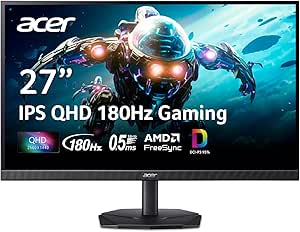 | Best for Mixed Gaming and Creative Work | Screen size: 27 inches | Resolution: 2560 × 1440 (QHD) | Panel type: IPS | VIEW LATEST PRICE | See Our Full Breakdown |
| ASUS ROG Strix XG27ACMES 27-Inch QHD 255Hz Fast IPS Gaming Monitor |  | Best for Fast Play and USB-C | Screen size: 27 inches | Resolution: 2560 × 1440 (QHD) | Panel technology: Fast IPS | VIEW LATEST PRICE | See Our Full Breakdown |
| Samsung 27-Inch Odyssey G5 G51F QHD Gaming Monitor |  | Best for Contrast and Ergonomic Adjustments | Screen size: 27 inches | Resolution: 2560 × 1440 (QHD) | Panel type: VA LCD | VIEW LATEST PRICE | See Our Full Breakdown |
| Sceptre E275W-FW100T 27-Inch Full HD 100Hz Gaming Monitor |  | Best for Budget-Minded Casual Gaming | Screen size: 27 inches | Resolution: 1920 × 1080 (Full HD) | Refresh rate: 100 Hz | VIEW LATEST PRICE | See Our Full Breakdown |
| Acer Nitro XV272U 27-Inch QHD 240Hz IPS Gaming Monitor |  | Best for High-Refresh Competitive Gaming | Screen size: 27 inches | Resolution: 2560 × 1440 (QHD) | Panel type: IPS | VIEW LATEST PRICE | See Our Full Breakdown |
| Samsung 27-Inch Odyssey OLED G5 QHD Gaming Monitor (G50SF) |  | Best OLED Picture Quality | Screen size: 27 inches | Display type: QD-OLED | Resolution: 2560 × 1440 (QHD) | VIEW LATEST PRICE | See Our Full Breakdown |
| Samsung 27-Inch Odyssey G5 QHD Gaming Monitor (G50F) |  | Best Adjustable-Stand QHD Pick | Screen size: 27 inches | Resolution: 2560 × 1440 (QHD) | Panel type: Fast IPS | VIEW LATEST PRICE | See Our Full Breakdown |
| 27-inch gaming monitor | Screen size | Resolution | Refresh rate | Response time |
|---|---|---|---|---|
| Samsung 27-Inch Odyssey G3 | 27 inches | 1920 × 1080 (FHD) | 180 Hz | 1 ms MPRT |
| Sceptre 27-Inch Full HD Gaming | 27 inches | 1920 × 1080 (Full HD) | 180 Hz | 1 ms |
| LG UltraGear 27GS60QC-B 27-Inc | 27 inches | 2560 × 1440 (QHD) | Up to 180 Hz | 1 ms GtG |
| ASUS TUF Gaming VG27AQ3A 27-In | 27 inches | 2560 × 1440 (QHD) | 180 Hz | 1 ms |
| Dell SE2726HG 27-Inch FHD 240H | 27 inches | 1920 × 1080 (FHD) | 240 Hz | 0.5 ms advertised; 5 ms listed |
| AOC Q27G41ZE 27-Inch QHD Gamin | 27 inches | 2560 × 1440 (QHD) | 240Hz native; up to 260Hz overclocked | 0.3ms MPRT |
| LG 27-inch UltraGear QHD OLED | 27 inches | 2560 × 1440 (QHD) | 240Hz | 0.03ms GtG |
| Acer Nitro KG271U 27-inch QHD | 27 inches | 2560 × 1440 (QHD) | 180Hz | 0.5ms GTG |
| ASUS ROG Strix XG27ACMES 27-In | 27 inches | 2560 × 1440 (QHD) | 255Hz (overclocked) | 0.3ms minimum |
| Samsung 27-Inch Odyssey G5 G51 | 27 inches | 2560 × 1440 (QHD) | 180Hz | 1ms MPRT |
| Sceptre E275W-FW100T 27-Inch F | 27 inches | 1920 × 1080 (Full HD) | 100 Hz | 1 ms |
| Acer Nitro XV272U 27-Inch QHD | 27 inches | 2560 × 1440 (QHD) | Up to 240Hz via DisplayPort; up to 144Hz via HDMI | Up to 0.5ms (G to G) |
| Samsung 27-Inch Odyssey OLED G | 27 inches | 2560 × 1440 (QHD) | 180 Hz | 0.03ms (GTG) |
| Samsung 27-Inch Odyssey G5 QHD | 27 inches | 2560 × 1440 (QHD) | 180 Hz | 1 ms (GtG) |
More Details on Our Top Picks
Samsung 27-Inch Odyssey G3 (G30D) FHD Gaming Monitor
The Samsung Odyssey G3 is a sensible pick for players who want a fast refresh rate and a stand that can adapt to their setup. Its 180 Hz refresh rate and FreeSync support suit quick-moving games, while height, tilt, swivel, and pivot adjustments make it easier to find a comfortable position than with the tilt-only LG UltraGear 27GS60QC-B. The tradeoff is Full HD on a 27-inch screen: compared with that LG’s QHD resolution, fine details and text look less crisp. The glossy finish can also reflect nearby lights, unlike the matte Sceptre E275B-FW180T. Gaming extras such as Black Equalizer and Virtual Aim Point add useful on-screen options, but this is a fit-and-speed choice rather than a sharpness upgrade.
Pros:- 180 Hz refresh rate and FreeSync support responsive, tear-reduced gameplay.
- Height, tilt, swivel, and pivot adjustments offer more positioning flexibility than the tilt-only LG UltraGear 27GS60QC-B.
- Black Equalizer and Virtual Aim Point provide gaming-focused display options.
- Pivot adjustment can help with portrait-oriented reading or chat windows.
Cons:- 1920 × 1080 resolution looks less detailed than QHD options in this roundup.
- Glossy screen finish may reflect room lights and windows.
- 250 cd/m² brightness is modest for bright viewing environments.
Best for: Players who prioritize flexible monitor positioning and high-refresh-rate Full HD gaming at a desk shared with other tasks.
Not ideal for: Buyers who want crisp QHD detail on a 27-inch screen or play in a bright room where the glossy finish may reflect light.
- Screen size:27 inches
- Resolution:1920 × 1080 (FHD)
- Refresh rate:180 Hz
- Response time:1 ms MPRT
- Adaptive sync:AMD FreeSync
- Contrast ratio:3000:1
- Brightness:250 cd/m²
- Connectivity:DisplayPort, HDMI
- Stand adjustments:Height, tilt, swivel, and pivot
Our verdict“Choose the Odyssey G3 if ergonomic adjustability matters more to you than QHD sharpness or a matte screen.”
Sceptre 27-Inch Full HD Gaming Monitor, 180Hz (E275B-FW180T Series)
The Sceptre E275B-FW180T makes the most sense when you want a straightforward gaming screen that can stay connected to several devices. Its two HDMI ports and two DisplayPort connections give it more input flexibility than the Samsung Odyssey G3, which lists one HDMI and one DisplayPort connection. The matte finish is also a practical advantage in rooms with overhead lighting, and the built-in speakers can cover basic audio without another device. That convenience comes with limits: the speakers are unlikely to replace a dedicated headset or speaker setup, and the Full HD resolution is less crisp at 27 inches than the QHD ASUS TUF Gaming VG27AQ3A. Its 180 Hz refresh rate suits fast play, but buyers seeking sharper visuals should look to QHD alternatives.
Pros:- Two HDMI ports and two DisplayPort connections make it easier to keep multiple devices plugged in.
- 180 Hz refresh rate and 1 ms response time with Blur Reduction target smooth motion.
- Matte screen finish is less prone to distracting reflections than the glossy Samsung Odyssey G3.
- Built-in speakers and VESA mounting add setup flexibility.
Cons:- Full HD resolution is less sharp on a 27-inch screen than QHD monitors such as the ASUS TUF Gaming VG27AQ3A.
- Built-in speakers may not satisfy buyers who want fuller or more immersive game audio.
- No stand adjustment details are provided, so ergonomic flexibility is unclear.
Best for: PC and console players who switch among multiple connected devices and want a matte display with basic built-in audio.
Not ideal for: Buyers who want QHD detail, premium audio, or a highly adjustable stand; the supplied information lists VESA mounting but not stand ergonomics.
- Screen size:27 inches
- Resolution:1920 × 1080 (Full HD)
- Refresh rate:180 Hz
- Response time:1 ms
- Screen finish:Matte
- Color gamut:94% sRGB
- Connectivity:2 HDMI ports, 2 DisplayPort connections, audio out jack
- Features:Adaptive-Sync, Blur Reduction, Blue-Light Shift, built-in speakers
- Mounting:VESA wall-mountable
Our verdict“Pick the Sceptre if multiple video inputs and a matte screen matter more than QHD sharpness or stronger audio.”
LG UltraGear 27GS60QC-B 27-Inch Curved QHD Gaming Monitor
The LG UltraGear 27GS60QC-B is the choice here for players who want QHD detail and a pronounced curved screen without giving up a high refresh rate. Its 2560 × 1440 resolution gives games and desktop text more definition than the Full HD Samsung Odyssey G3 or Sceptre E275B-FW180T, while refresh rates up to 180 Hz and AMD FreeSync support responsive play. The 1000R curve is much more enveloping than the flat ASUS TUF Gaming VG27AQ3A, but that shape is a matter of preference and may feel less natural for some games or everyday work. The stand only tilts, so it gives up the Samsung’s broad ergonomic adjustments. HDR10 and gaming tools add flexibility, though the listed color-gamut figures conflict, making that spec less clear.
Pros:- QHD resolution provides more detail than the Full HD Samsung Odyssey G3 and Sceptre E275B-FW180T.
- Refresh rates up to 180 Hz and 1 ms GtG response time suit fast gameplay.
- 1000R curve gives the screen a more enveloping feel than the flat ASUS TUF Gaming VG27AQ3A.
- AMD FreeSync and Black Stabilizer support smoother play and visibility in dark scenes.
Cons:- Stand adjustment is limited to tilt, unlike the Samsung Odyssey G3’s height, swivel, and pivot options.
- The 1000R curve may not suit buyers who prefer a flat screen or use the monitor for varied work.
- Color gamut is reported inconsistently as up to 99% or 95% sRGB.
Best for: Gamers who want a curved, higher-resolution 27-inch display for immersive single-player play and fast-refresh gaming.
Not ideal for: Buyers who prefer a flat screen, need height or swivel adjustments, or want clearly specified color-gamut coverage.
- Screen size:27 inches
- Resolution:2560 × 1440 (QHD)
- Panel type:VA LCD
- Refresh rate:Up to 180 Hz
- Response time:1 ms GtG
- Screen curvature:1000R
- Adaptive sync:AMD FreeSync
- HDR:HDR10
- Connectivity:2 HDMI ports, DisplayPort, headphone connection
Our verdict“Choose this LG if you want QHD sharpness with a strongly curved screen and can accept limited stand adjustment.”
ASUS TUF Gaming VG27AQ3A 27-Inch QHD 180Hz Gaming Monitor
The ASUS TUF Gaming VG27AQ3A is the most balanced pick in this group for players who want QHD resolution, high refresh, and a flat IPS screen. Its 180 Hz refresh rate and 1 ms response time are paired with FreeSync Premium, G-SYNC compatibility, and ELMB Sync, giving it broader motion-smoothing support than the LG UltraGear 27GS60QC-B, which lists AMD FreeSync. The Fast IPS panel also avoids the LG’s 1000R curve, a better fit for mixed gaming and everyday use. That versatility has limits: its 1000:1 contrast ratio is modest compared with the Samsung Odyssey G3’s listed 3000:1, and HDR10 does not by itself promise dramatic highlights. The stand’s adjustment range is not specified, and the supplied data lists mounting support rather than ergonomic controls.
Pros:- QHD resolution and 180 Hz refresh rate balance image detail with smooth gameplay.
- FreeSync Premium, G-SYNC compatibility, AdaptiveSync, and ELMB Sync offer broad motion-management support.
- Fast IPS panel provides wide 178-degree viewing angles and 130% sRGB coverage.
- Built-in speakers provide basic audio without an additional device.
Cons:- Listed 1000:1 contrast ratio may produce less convincing dark-scene contrast than the Samsung Odyssey G3.
- HDR support is limited to HDR10, with no stronger HDR capability specified.
- Stand adjustment details are not provided, limiting confidence about ergonomic flexibility.
Best for: PC gamers who want a flat QHD IPS screen with broad variable-refresh support for both competitive and general gaming.
Not ideal for: Players who prioritize deep blacks, a curved display, or a clearly documented height-adjustable stand.
- Screen size:27 inches
- Resolution:2560 × 1440 (QHD)
- Panel type:Fast IPS
- Refresh rate:180 Hz
- Response time:1 ms
- Adaptive sync:FreeSync Premium, G-SYNC compatible, VESA AdaptiveSync
- HDR:HDR10
- Color gamut:130% sRGB
- Connectivity:HDMI, DisplayPort, 3.5 mm audio
Our verdict“Choose the ASUS for a flat, feature-rich QHD gaming setup with broad adaptive-sync support, not for deep blacks or a curved view.”
Dell SE2726HG 27-Inch FHD 240Hz Gaming Monitor
The Dell SE2726HG is built around one priority: very high refresh at Full HD. Its 240 Hz panel gives competitive players more frequent updates than the 180 Hz Samsung Odyssey G3 and Sceptre E275B-FW180T, while FreeSync Premium and HDMI VRR help manage tearing. The IPS panel, matte finish, and 99% sRGB coverage also make it a more versatile everyday screen than a speed-only spec sheet suggests. The tradeoff is resolution: on a 27-inch display, its 1920 × 1080 image is less detailed than the QHD ASUS TUF Gaming VG27AQ3A or LG UltraGear 27GS60QC-B. Response-time information is inconsistent, with 0.5 ms advertised and 5 ms also listed, so I would not choose it on that figure alone. Its stand only tilts.
Pros:- 240 Hz refresh rate exceeds the 180 Hz Samsung Odyssey G3 and Sceptre E275B-FW180T.
- FreeSync Premium and HDMI VRR support smoother gameplay with reduced tearing.
- IPS panel, 178-degree viewing angles, and 99% sRGB coverage suit mixed gaming and general use.
- Matte finish and TÜV Rheinland 3-star eye comfort certification support longer sessions.
Cons:- Full HD resolution is less sharp at 27 inches than the QHD ASUS TUF Gaming VG27AQ3A.
- Stand adjustment is limited to tilt.
- Response-time details conflict between 0.5 ms advertised and 5 ms listed.
Best for: Competitive players who value a 240 Hz refresh rate, use a Full HD gaming setup, and want an IPS screen for varied viewing angles.
Not ideal for: Buyers who want QHD detail, broad stand adjustment, or a response-time specification that is consistent across the product information.
- Screen size:27 inches
- Resolution:1920 × 1080 (FHD)
- Refresh rate:240 Hz
- Panel type:IPS
- Response time:0.5 ms advertised; 5 ms listed
- Adaptive sync:AMD FreeSync Premium, HDMI VRR
- Color gamut:99% sRGB
- Ports:2 × HDMI, DisplayPort 1.4
- Adjustment:Tilt
Our verdict“Pick the Dell if competitive Full HD play and 240 Hz matter more than QHD detail or ergonomic stand adjustments.”
AOC Q27G41ZE 27-Inch QHD Gaming Monitor
The AOC Q27G41ZE pairs a sharp 27-inch QHD IPS image with a 240Hz native refresh rate, giving competitive players more motion clarity than 180Hz options such as the Acer Nitro KG271U. It can reach 260Hz through overclocking, though that small extra gain depends on your system and is not the main reason to choose it. Adaptive-Sync and gaming controls add practical flexibility, while the three-sided frameless design suits a multi-monitor desk. The tradeoff is its glossy finish, which can reflect bright rooms, and the stand only tilts; the ASUS ROG Strix XG27ACMES offers a matte screen and USB-C connectivity instead. I’d shortlist the AOC for fast PC gaming, but not for a workspace that needs broader ergonomic adjustment.
Pros:- QHD resolution on a 27-inch IPS panel balances image detail with broad viewing angles.
- Native 240Hz refresh rate, with an optional overclock up to 260Hz.
- Adaptive-Sync and G-SYNC compatibility help reduce tearing.
- Game presets, Shadow Control, and a three-sided frameless design add useful setup flexibility.
Cons:- Glossy screen finish can reflect windows and room lighting.
- Stand offers tilt adjustment only.
- The 260Hz ceiling requires overclocking and may offer little practical benefit over 240Hz.
Best for: PC players who want QHD detail and a native 240Hz IPS panel for fast competitive games.
Not ideal for: Players in bright rooms or buyers who need height adjustment, swivel, or pivot from the stand.
- Screen size:27 inches
- Resolution:2560 × 1440 (QHD)
- Panel type:IPS
- Refresh rate:240Hz native; up to 260Hz overclocked
- Response time:0.3ms MPRT
- Adaptive sync:Adaptive-Sync; NVIDIA G-SYNC compatible
- Brightness:300 cd/m²
- Connectivity:1 × DisplayPort 1.4, 2 × HDMI 2.0, audio out
Our verdict“Choose the AOC if native 240Hz QHD gaming matters more than a matte screen or a fully adjustable stand.”
LG 27-inch UltraGear QHD OLED Gaming Monitor (27GX704A-B)
The LG UltraGear 27GX704A-B is the premium image-quality pick here: its QHD OLED panel combines 240Hz motion with deep blacks and a stated 0.03ms response time. Compared with the IPS-based AOC Q27G41ZE, the LG is better suited to players who value contrast and HDR presentation alongside speed, rather than simply chasing the highest refresh figure. Dual HDMI 2.1 ports, USB connectivity, and a stand with height, tilt, swivel, and pivot make it a more adaptable centerpiece for PC and console setups. The costs of that OLED advantage are practical: image-retention care matters, and the glossy finish can be distracting in bright spaces. Its peak brightness is not the whole story for everyday use, so I’d pick it for controlled lighting and varied content, not static desktop workloads.
Pros:- OLED panel delivers deep blacks and high contrast for games and HDR content.
- 240Hz refresh rate and 0.03ms GtG response time suit fast gameplay.
- Dual HDMI 2.1 ports plus USB and DisplayPort support varied setups.
- Height, tilt, swivel, and pivot adjustments make positioning easier.
Cons:- Glossy finish may show reflections in bright rooms.
- OLED image-retention precautions may not suit static, all-day desktop use.
- The 240Hz ceiling is lower than the ASUS ROG Strix XG27ACMES’s overclocked 255Hz.
Best for: Gamers who want OLED contrast, fast QHD play, and flexible connections for both a gaming PC and current consoles.
Not ideal for: Buyers who leave static interfaces on screen for long periods, game in a brightly lit room, or prefer to avoid OLED image-retention care.
- Screen size:27 inches
- Resolution:2560 × 1440 (QHD)
- Panel type:OLED
- Refresh rate:240Hz
- Response time:0.03ms GtG
- HDR certification:VESA DisplayHDR True Black 400
- Sync technology:NVIDIA G-SYNC Compatible; AMD FreeSync Premium Pro
- Connectivity:2 × HDMI 2.1, 1 × DisplayPort 1.4, USB 3.2 (1 upstream, 2 downstream)
- Stand adjustments:Height, tilt, swivel, pivot
Our verdict“Pick the LG for OLED contrast and flexible console connections if you can manage reflections and OLED care.”
Acer Nitro KG271U 27-inch QHD IPS Gaming Monitor
The Acer Nitro KG271U makes a case for buyers who split their time between games and color-focused work. Its QHD IPS panel covers a stated 95% of DCI-P3, while 180Hz and FreeSync deliver responsive play without pushing into the faster, higher-spec territory of the AOC Q27G41ZE or ASUS ROG Strix XG27ACMES. That is a sensible compromise if you want a capable all-round screen rather than the shortest possible response time. HDR10 support and built-in speakers are convenient extras, but the 250-nit brightness and standard 1000:1 contrast limit impact in bright rooms and dark scenes. I’d choose it for a mixed-use desk, not for buyers prioritizing strong HDR or deep blacks. Its zero-frame styling also suits multi-monitor arrangements.
Pros:- QHD IPS display offers a useful balance of detail and viewing angles.
- 95% DCI-P3 coverage suits color-rich games and creative tasks.
- 180Hz refresh rate and FreeSync support smooth gameplay.
- Zero-frame design, VESA mounting, and built-in speakers simplify a compact setup.
Cons:- 250-nit brightness can be limiting in bright rooms.
- 1000:1 contrast does not produce deep blacks like the LG OLED or Samsung VA option.
- HDR10 support is paired with modest brightness, limiting HDR impact.
Best for: Players who also edit photos or video and want QHD resolution, wide color coverage, and a high-refresh IPS panel.
Not ideal for: Competitive players seeking 240Hz-plus performance or users who need a bright display with convincing dark-scene contrast.
- Screen size:27 inches
- Resolution:2560 × 1440 (QHD)
- Panel type:IPS
- Refresh rate:180Hz
- Response time:0.5ms GTG
- Color gamut:95% DCI-P3
- Brightness:250 nits
- HDR support:HDR10
- Connectivity:2 × HDMI, DisplayPort
Our verdict“Choose the Acer for a color-capable QHD screen that handles gaming and creative work, rather than maximum competitive speed.”
ASUS ROG Strix XG27ACMES 27-Inch QHD 255Hz Fast IPS Gaming Monitor
The ASUS ROG Strix XG27ACMES stands out for combining a matte Fast IPS panel with a 255Hz overclocked refresh rate and USB-C with DisplayPort Alt Mode. That makes it a compelling choice for a gaming desk that also connects to a compatible laptop, whereas the AOC Q27G41ZE reaches 260Hz only through overclocking and lacks the listed USB-C connection. The ASUS also has a stated 400-nit brightness and a matte finish, useful in rooms where screen reflections are a concern. Its 255Hz figure is itself overclocked, so buyers should not treat it as a guaranteed native rate; HDR is also limited to DisplayHDR 400 rather than OLED-level contrast. I’d favor this model for a fast, flexible PC setup, while the LG OLED is the stronger fit for contrast-led gaming.
Pros:- Fast IPS panel pairs QHD resolution with a 255Hz overclocked refresh rate.
- Matte finish helps limit distracting reflections.
- USB-C with DisplayPort Alt Mode adds laptop connectivity.
- FreeSync Premium and G-SYNC compatibility support variable-refresh gaming.
Cons:- 255Hz requires overclocking.
- DisplayHDR 400 offers limited HDR impact compared with the LG OLED.
- The 0.3ms figure is a minimum response-time claim, not a guarantee of identical performance in every mode.
Best for: Competitive PC gamers who want a fast QHD IPS display, a matte finish, and USB-C laptop connectivity.
Not ideal for: Buyers seeking OLED blacks or robust HDR impact, or anyone who wants the listed refresh rate without overclocking.
- Screen size:27 inches
- Resolution:2560 × 1440 (QHD)
- Panel technology:Fast IPS
- Refresh rate:255Hz (overclocked)
- Response time:0.3ms minimum
- Brightness:400 cd/m²
- HDR:VESA DisplayHDR 400
- Adaptive sync:AMD FreeSync Premium; G-SYNC Compatible
- Connectivity:DisplayPort 1.4, HDMI, USB, USB-C with DisplayPort Alt Mode
Our verdict“Choose the ASUS for high-refresh QHD gaming with matte-screen comfort and USB-C, not for OLED-grade HDR.”
Samsung 27-Inch Odyssey G5 G51F QHD Gaming Monitor
The Samsung Odyssey G5 G51F takes a different route from the IPS models: its VA panel’s stated 3000:1 contrast ratio can make dark scenes look richer than on the Acer Nitro KG271U, while QHD resolution keeps detail crisp at 27 inches. Its 180Hz refresh rate is a step below the AOC Q27G41ZE and ASUS ROG Strix XG27ACMES, so this is better suited to immersive single-player games and general play than to chasing the highest frame rates. The matte finish and stand with height, tilt, and pivot adjustments are useful for practical setups. HDR10 is included, but the listed specs do not suggest OLED-like HDR performance. Connectivity is also basic, with only DisplayPort and HDMI listed; buyers needing USB-C or extra ports should look elsewhere.
Pros:- VA panel’s 3000:1 contrast ratio supports richer dark scenes than the IPS alternatives listed here.
- QHD resolution provides detailed images at 27 inches.
- 180Hz refresh rate and AMD FreeSync support responsive, tear-reduced gameplay.
- Stand adjusts for height, tilt, and pivot, and the screen has a matte finish.
Cons:- 180Hz refresh rate trails the AOC Q27G41ZE and ASUS ROG Strix XG27ACMES for high-frame-rate play.
- Only DisplayPort and HDMI are listed; USB-C is absent.
- HDR10 does not match the LG OLED’s contrast-led HDR presentation.
Best for: QHD gamers who favor stronger dark-scene contrast and a stand with height, tilt, and pivot adjustment.
Not ideal for: Competitive players prioritizing 240Hz-plus refresh rates or buyers who need USB-C and a wider selection of connections.
- Screen size:27 inches
- Resolution:2560 × 1440 (QHD)
- Panel type:VA LCD
- Refresh rate:180Hz
- Response time:1ms MPRT
- Contrast ratio:3000:1
- Brightness:300 cd/m²
- Adaptive sync:AMD FreeSync
- Stand adjustments:Tilt, pivot, height
Our verdict“Pick the Samsung if VA contrast and adjustable positioning matter more to you than peak refresh rate or broad connectivity.”
Sceptre E275W-FW100T 27-Inch Full HD 100Hz Gaming Monitor
The Sceptre E275W-FW100T is the straightforward choice here for casual play and everyday computing, with 100Hz refresh and AMD FreeSync offering smoother motion than a standard 60Hz display. Its Full HD resolution is easier to drive than the QHD panels on the Samsung Odyssey G5 G50F and Acer Nitro XV272U, but at 27 inches it also looks less detailed. That tradeoff makes more sense for lighter gaming or systems that prioritize consistent frame rates over sharpness. Two HDMI ports, DisplayPort, built-in speakers, and VESA compatibility add practical flexibility without requiring extra accessories. The main limitations are its modest refresh rate beside the faster options in this roundup and the listed 170-degree viewing angle. I’d choose it for a simple, lower-demand setup, not competitive play or detail-focused games.
Pros:- 100Hz refresh rate and 1ms response time support smoother everyday gameplay.
- AMD FreeSync helps reduce screen tearing with compatible systems.
- Two HDMI ports and one DisplayPort provide flexible connections.
- Built-in speakers and VESA mounting support simplify a basic setup.
Cons:- Full HD looks less detailed at 27 inches than the QHD alternatives in this roundup.
- Its 100Hz refresh rate is a substantial step below faster gaming picks.
- The listed 170-degree viewing angle is narrower than the 178-degree viewing angles specified for several alternatives.
Best for: Casual PC and console players who want a 27-inch screen with smoother-than-basic refresh and built-in audio.
Not ideal for: Competitive gamers or buyers who want crisp QHD detail; its 100Hz refresh and Full HD resolution trail the Acer Nitro XV272U and Samsung Odyssey G5 G50F.
- Screen size:27 inches
- Resolution:1920 × 1080 (Full HD)
- Refresh rate:100 Hz
- Response time:1 ms
- Adaptive sync:AMD FreeSync
- Color gamut:100% sRGB
- Ports:2 HDMI, 1 DisplayPort
- Audio:Built-in speakers, audio-in port, headphone jack
- Mounting:VESA wall mountable
Our verdict“Choose the Sceptre for casual gaming and everyday use if you value simple connectivity over QHD sharpness and high refresh rates.”
Acer Nitro XV272U 27-Inch QHD 240Hz IPS Gaming Monitor
The Acer Nitro XV272U is the performance-first pick for PC players who want both QHD resolution and refresh rates up to 240Hz over DisplayPort. That combination gives it a sharper image than the Full HD Sceptre E275W-FW100T while keeping fast motion fluid for competitive games. AMD FreeSync Premium and the stated 0.5ms response time support that focus, though the refresh ceiling depends on the connection: HDMI tops out at 144Hz. Unlike the Samsung Odyssey G5 G50F, the Acer includes built-in speakers and a stand with height, swivel, tilt, and pivot adjustments, so it is easier to fit into a varied desk setup. Those speakers are only 2W each, and the 1,000:1 contrast ratio is modest. I’d favor it for high-frame-rate PC gaming, not for buyers who need full refresh over HDMI.
Pros:- QHD IPS resolution combines sharper detail with refresh rates up to 240Hz via DisplayPort.
- AMD FreeSync Premium supports adaptive gameplay.
- Stand adjusts for height, tilt, swivel, and pivot.
- DisplayHDR 400, built-in speakers, and multiple video inputs add versatility.
Cons:- HDMI refresh rate is limited to 144Hz, so the full 240Hz capability requires DisplayPort.
- The 2W-per-speaker built-in audio is limited for games and media.
- Its 1,000:1 contrast ratio offers less deep-black performance than the QD-OLED Samsung Odyssey OLED G5.
Best for: PC competitive players with a DisplayPort-capable graphics card who want QHD detail, very high refresh, and an adjustable stand.
Not ideal for: Console-focused buyers or anyone relying on HDMI for high-refresh play, since HDMI is limited to 144Hz.
- Screen size:27 inches
- Resolution:2560 × 1440 (QHD)
- Panel type:IPS
- Refresh rate:Up to 240Hz via DisplayPort; up to 144Hz via HDMI
- Response time:Up to 0.5ms (G to G)
- Adaptive sync:AMD FreeSync Premium
- Brightness:400 nits
- Ports:1 DisplayPort 1.4, 2 HDMI 2.0, 1 audio out
- Stand adjustments:Height, tilt, swivel, and pivot
Our verdict“Pick the Acer Nitro XV272U if you game on PC over DisplayPort and want QHD clarity with a 240Hz ceiling and a highly adjustable stand.”
Samsung 27-Inch Odyssey OLED G5 QHD Gaming Monitor (G50SF)
The Samsung Odyssey OLED G5 G50SF is the picture-quality specialist in this group. Its QD-OLED panel pairs QHD resolution with a stated 1,000,000:1 contrast ratio, giving dark scenes a different character from the IPS Acer Nitro XV272U and Samsung Odyssey G5 G50F. The 180Hz refresh rate and 0.03ms response time also suit fast games, while both G-Sync compatibility and AMD FreeSync support adaptive refresh across compatible setups. Glare Free matte treatment can help in brighter rooms, and OLED Safeguard features address burn-in risk, though they do not make OLED maintenance irrelevant for static desktop use. Its listed brightness is 280 cd/m², and just one HDMI port limits device hookups compared with the Acer. This makes the most sense for players who put contrast and motion response ahead of connection count and higher stated brightness.
Pros:- QD-OLED panel and QHD resolution deliver high contrast and detailed images.
- 180Hz refresh rate and 0.03ms response time suit fast-paced games.
- G-Sync compatibility and AMD FreeSync support adaptive refresh.
- Matte Glare Free finish and OLED Safeguard features address glare and burn-in concerns.
Cons:- Only one HDMI port limits simultaneous device connections.
- Listed brightness of 280 cd/m² is lower than the Acer Nitro XV272U’s 400 nits.
- OLED protection features do not remove the need to account for burn-in risk with static content.
Best for: QHD gamers who prioritize OLED contrast, fast response, and adaptive sync, and who can manage static desktop content thoughtfully.
Not ideal for: Buyers who need several HDMI-connected devices or a brighter display; it has one HDMI port and listed brightness of 280 cd/m².
- Screen size:27 inches
- Display type:QD-OLED
- Resolution:2560 × 1440 (QHD)
- Refresh rate:180 Hz
- Response time:0.03ms (GTG)
- Contrast ratio:1,000,000:1
- Brightness:280 cd/m²
- Adaptive sync:NVIDIA G-Sync Compatible, AMD FreeSync
- Burn-in protection:Thermal Modulation System, Logo and Taskbar Detection, Screen Saver
Our verdict“Choose the Samsung OLED G5 for OLED contrast and exceptionally fast response, provided its single HDMI port and brightness level suit your setup.”
Samsung 27-Inch Odyssey G5 QHD Gaming Monitor (G50F)
The Samsung Odyssey G5 G50F is a practical middle ground for players who want QHD sharpness and 180Hz gaming without moving to OLED. Its fast IPS panel and 1ms response time target responsive play, while G-Sync compatibility and AMD FreeSync help limit tearing with compatible hardware. Compared with the OLED Samsung Odyssey G5 G50SF, this model avoids OLED’s burn-in considerations, but its 1,000:1 contrast ratio cannot match that screen’s deep blacks. The height-adjustable stand adds pivot, tilt, and swivel, making it easier to position than the Sceptre E275W-FW100T, whose listed features include VESA mounting but not an adjustable stand. HDR10 is included, though the 300 cd/m² brightness and IPS contrast suggest modest HDR impact. Connectivity is also basic, with only DisplayPort and HDMI listed.
Pros:- QHD resolution provides detailed images on a 27-inch screen.
- 180Hz refresh rate and 1ms response time support responsive gameplay.
- Height-adjustable stand includes pivot, tilt, and swivel.
- G-Sync compatibility and AMD FreeSync help reduce tearing.
Cons:- The 1,000:1 contrast ratio cannot match the OLED Samsung Odyssey G5 G50SF for dark-scene depth.
- 300 cd/m² brightness limits the impact of HDR10 compared with brighter displays.
- Connectivity is limited to DisplayPort and HDMI.
Best for: Players seeking a QHD 180Hz IPS monitor with an adjustable stand and no OLED panel-care concerns.
Not ideal for: Buyers focused on deep blacks, more impactful HDR, or multiple peripheral connections; the contrast is 1,000:1 and only DisplayPort and HDMI are listed.
- Screen size:27 inches
- Resolution:2560 × 1440 (QHD)
- Panel type:Fast IPS
- Refresh rate:180 Hz
- Response time:1 ms (GtG)
- Brightness:300 cd/m²
- HDR:HDR10
- Adaptive sync:G-Sync Compatible, AMD FreeSync
- Connectivity:DisplayPort, HDMI
Our verdict“Choose the Samsung G5 G50F for a flexible QHD IPS gaming setup with an adjustable stand, but skip it if OLED-level contrast or stronger HDR is your priority.”
How We Picked
I evaluated these monitors by analyzing panel technology, response time claims, and refresh rate capabilities against real-world gaming scenarios. My primary focus was on the balance between speed and visual clarity, recognizing that a fast monitor with poor color accuracy fails to deliver an immersive experience, while a beautiful screen with high input lag frustrates competitive players. I prioritized models that offer adaptive sync compatibility (G-Sync or FreeSync) to eliminate screen tearing, a non-negotiable feature for smooth gameplay in 2027.
Ranking logic favored monitors that provide the best value per feature set. For instance, a 1080p monitor with 240Hz might rank higher than a mediocre 1440p panel with 144Hz for esports enthusiasts, while the reverse applies for story-driven gamers. I also considered build quality and ergonomic adjustability, as long gaming sessions require comfortable viewing angles and sturdy stands to prevent eye strain and neck discomfort.
Factors to Consider When Choosing Best 27-inch Gaming Monitors
Selecting the right 27-inch monitor involves more than just picking the highest number on the spec sheet. Here are the critical factors that should drive your decision, moving beyond basic specs to real-world performance implications.Resolution and Pixel Density
At 27 inches, 1080p (FHD) often results in visible pixelation, making 1440p (QHD) the preferred standard for crisp text and detailed game textures. While 1080p monitors are cheaper and easier to drive with mid-range GPUs, they lack the sharpness needed for modern AAA titles. If you play competitive shooters, 1080p might suffice for the extra frame rates, but most gamers will find 1440p offers the best compromise between visual fidelity and GPU load. 4K at 27 inches is generally overkill and requires high-end hardware, so sticking to QHD is often the smarter choice for this screen size.
Panel Technology: IPS, VA, and OLED
IPS panels offer the best viewing angles and color accuracy, making them versatile for both gaming and content creation, though they often suffer from ‘IPS glow’ in dark rooms. VA panels provide superior contrast and deeper blacks, which is excellent for immersive single-player games but can exhibit smearing during fast motion. OLED panels combine the best of both worlds with infinite contrast and instant response times, but they are expensive and require care to avoid burn-in. Your choice depends on whether you prioritize color vibrancy, dark-room immersion, or absolute speed.
Refresh Rate and Response Time
While 144Hz is the baseline for gaming, 180Hz to 240Hz is becoming the new standard for competitive play. However, refresh rate alone is misleading; a monitor must have a low pixel response time (measured in GtG or MPRT) to prevent motion blur. A 240Hz panel with a 5ms response time will look worse than a 165Hz panel with 1ms response time. Look for monitors that explicitly state low MPRT figures, as this correlates better with perceived clarity in fast-moving scenes than the advertised GtG time.
Ergonomics and Adjustability
A monitor that looks great on paper but sits too high or too low will cause fatigue during long sessions. Prioritize models with height adjustment, tilt, swivel, and pivot capabilities. Many budget options, like some entry-level Sceptre models, may offer fixed stands that require VESA mounting for adjustment. Investing in a monitor with robust ergonomic features saves you from buying a separate arm and ensures you can maintain proper posture, which is critical for both comfort and competitive performance.
Connectivity and Future-Proofing
Check the available ports: HDMI 2.1 is necessary for unlocking high refresh rates at 4K or using next-gen consoles, while DisplayPort 1.4 remains the standard for PC gaming. USB hubs are a nice-to-have feature for connecting peripherals directly to the monitor, keeping your desk tidy. If you plan to use the monitor for productivity as well, look for models with USB-C power delivery, which can charge your laptop while transmitting video data, reducing cable clutter significantly.
Frequently Asked Questions
Is 1080p still worth buying for a 27-inch gaming monitor?
For most gamers, 1080p at 27 inches is not recommended due to low pixel density, which can result in blurry text and jagged edges in games. However, it remains a viable option for competitive esports players who prioritize maximum frame rates over visual clarity and have mid-range hardware. If you are building a budget setup specifically for titles like Valorant or CS2, a high-refresh 1080p monitor like the Samsung Odyssey G3 makes sense. For any other use case, stepping up to 1440p provides a much sharper and more immersive experience without a massive price jump.
Should I choose a curved or flat monitor for gaming?
Curved monitors, such as the LG UltraGear 27GS60QC-B, enhance immersion by wrapping the image around your peripheral vision, which is beneficial for racing, flight simulators, and RPGs. Flat monitors are generally preferred for competitive FPS games and productivity tasks because they offer more accurate geometry and less distortion. The curvature radius matters too; 1000R curves are more aggressive and immersive, while 1500R curves are subtler. Your choice should align with your primary game genres, with flat being the safer default for general use.
Do I need G-Sync or FreeSync on my gaming monitor?
Yes, adaptive sync technology is highly recommended to eliminate screen tearing and stuttering when your GPU frame rate doesn’t match the monitor’s refresh rate. FreeSync is widely available on AMD and many NVIDIA GPUs, while G-Sync Compatible certification ensures seamless integration with NVIDIA cards. Most modern monitors support both standards, but verifying compatibility with your specific GPU is wise. Without it, you may experience visual artifacts during intense gameplay, which can be distracting and affect performance in competitive scenarios.
How does OLED burn-in affect gaming monitors?
OLED monitors like the LG 27-inch UltraGear offer stunning visuals but carry a risk of permanent image retention if static elements (like health bars or HUDs) are displayed for extended periods. Modern OLEDs include pixel shifting and screen saving features to mitigate this, but gamers should still vary their content and avoid leaving static images on screen for hours. If you play mostly dynamic games with no static UI, the risk is low. However, for users who also use the monitor for productivity with static windows, an IPS or VA panel might be a safer long-term investment.
Is a higher refresh rate always better for gaming?
While higher refresh rates like 240Hz or 360Hz provide smoother motion, the benefit diminishes if your GPU cannot consistently output frames at that rate. Moving from 60Hz to 144Hz is a noticeable leap, but the jump from 144Hz to 240Hz is subtle and primarily beneficial for professional esports players. Additionally, achieving high refresh rates often requires sacrificing resolution or panel quality. For most gamers, a 144Hz to 180Hz monitor with excellent response times and color accuracy offers the best balance of performance and visual quality.
Conclusion
Selecting the best 27-inch gaming monitors ultimately depends on your primary gaming style and budget constraints. For competitive players who need every millisecond advantage, the Samsung 27-Inch Odyssey G3 and ASUS ROG Strix XG27ACMES offer the speed required for esports titles. Immersive gamers seeking cinematic visuals should look toward the LG 27-inch UltraGear QHD OLED for its superior contrast and color depth, despite the higher cost. Budget-conscious buyers will find the Sceptre 27-Inch Full HD and Acer Nitro KG271U provide excellent value without compromising on essential features. Finally, those needing a versatile all-rounder for both work and play should consider the ASUS TUF Gaming VG27AQ3A for its balanced performance and ergonomic design. Match the monitor to your GPU capabilities and game preferences to maximize your return on investment.