Building a streaming setup in 2027 comes down to balancing three things: image quality, audio clarity, and how much of your budget each one eats. For an all-around upgrade, the FIFINE AmpliGame AM8T Dynamic Gaming Microphone Set stands out because its dual USB/XLR connectivity means it grows with you from casual streams to a full broadcast setup without needing replacement. On the video side, the Wegear 4K Webcam with Sony Sensor delivers the sharpest picture in this lineup, while the Rybozen HDMI Capture Card is the cheapest way to get console footage into your PC. The main tradeoff you’ll face is dynamic versus condenser microphones (room noise rejection versus sensitivity) and 4K webcam resolution versus low-light performance. Read on for the full ranked breakdown of all 15 picks.

Get audio and creator gear delivered free — and shop member deals
- Fast, free delivery on millions of items
- Access to Prime Big Deal Days deals on October 6–7
- Prime Video, Amazon Music and more included
Complete the kit


Key Takeaways
- Five of the fifteen products are FIFINE microphones, and the comparison showed clear separation between them: the AM8T and K688CT win on room-noise rejection and XLR upgrade paths, while the budget A6T and T669 kits only make sense in quiet, treated rooms.
- Dynamic microphones (AM8T, AM8, K688CT) dominated the top of the ranking for streamers in untreated rooms; every condenser-based pick ranked lower for most buyers because they pick up keyboard clacks and fan noise.
- None of the 4K webcams in this lineup actually stream in 4K — they all output compressed 1080p or 30fps 4K, so paying for 4K only matters if you also record or crop your frame.
- The mixer bundles (KS5, MAONO G1 NEO, two-person podcast kit) only justify their cost if you’ll actually use live fader control or voice effects — otherwise a standalone mic is the smarter buy.
- The Rybozen capture card is the only product here that solves console streaming, making it non-negotiable for PlayStation, Xbox, or Switch streamers and irrelevant for PC-only streamers.
| wegear 4K USB-A Webcam with Sony Sensor |  | Best Webcam for Sharp Autofocus | Sensor: 8MP CMOS Sony 1/2.55 inch | Video resolution: 4K at 30fps; 1080p at 60fps | Autofocus: PDAF | VIEW LATEST PRICE | See Our Full Breakdown |
| Rybozen HDMI Video Capture Card with USB 3.0 |  | Best Value Capture Card | Capture resolution: Up to 1080p | HDMI input: Up to 4K at 60 Hz | HDMI loop-out: Yes | VIEW LATEST PRICE | See Our Full Breakdown |
| NexiGo N680E Pro 4K Webcam with Ring Light |  | Best Webcam for Dark Rooms | Sensor: Sony 1/2.5-inch 4K CMOS | Video resolution: 4K; 1080p at 60 fps | Autofocus: PDAF | VIEW LATEST PRICE | See Our Full Breakdown |
| FIFINE AmpliGame AM8T Dynamic Gaming Microphone Set with USB/XLR Connectivity |  | Best Microphone Kit for Growing Streamers | Microphone type: Dynamic, cardioid | Connectivity: USB-C and XLR | Controls: Mute button, gain knob, headphone volume | VIEW LATEST PRICE | See Our Full Breakdown |
| FIFINE AmpliGame AM8 USB/XLR Dynamic Microphone |  | Best Value Dynamic Streaming Mic | Microphone type: Dynamic, unidirectional cardioid | Connectivity: USB, XLR | Frequency response: 50 Hz–16 kHz | VIEW LATEST PRICE | See Our Full Breakdown |
| YoloLiv YoloCam S3 4K Streaming Webcam |  | Best Premium Webcam | Sensor: 1/1.3-inch | Video modes: 4K at 30 fps; 1080p at 60 fps | Field of view: 82° | VIEW LATEST PRICE | See Our Full Breakdown |
| FIFINE AmpliGame KS5 Gaming Microphone and Audio Mixer Bundle |  | Best Mic-and-Mixer Combo | Microphone type: Dynamic | Connections: XLR and USB | Mixer features: Mute control, headphone monitoring, volume fader, entertainment modes | VIEW LATEST PRICE | See Our Full Breakdown |
| TONOR TC310+ USB Gaming Condenser Microphone Set with Boom Arm | 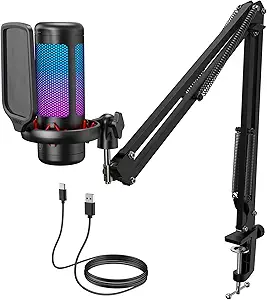 | Best for Console Streamers | Connectivity: USB-A, corded electric | Compatible devices: Desktop, laptop, Mac OS, PS4, PS5 | Polar pattern: Unidirectional | VIEW LATEST PRICE | See Our Full Breakdown |
| Acer A640 4K Webcam with AI Noise-Canceling Microphone |  | Best All-in-One 4K Webcam | Maximum resolution: 4K at 30 fps | Supported video modes: 2K or 1080p at 60 fps | Image sensor: Sony 1/2.8-inch | VIEW LATEST PRICE | See Our Full Breakdown |
| Podcast Equipment Bundle for 2 with Audio Mixer, Voice Changer, and Condenser Microphones |  | Best for Two-Person Streams | Microphones: 2 condenser microphones | Mixer: Audio mixer with 10 sound effects and 4 voice variations | Included accessories: 2 boom arms, 2 shock mounts, 2 pop filters, 2 foam covers, 2 XLR cables, USB cable, 3.5 mm earphone, 2 audio cables | VIEW LATEST PRICE | See Our Full Breakdown |
| NBPOWER 1080p 60 FPS Streaming Webcam with Microphone, RGB Fill Light, Autofocus, and Privacy Cover |  | Best Budget All-in-One Webcam | Resolution: 1080p Full HD | Frame rate: 60 FPS | Microphone: Built-in noise-canceling | VIEW LATEST PRICE | See Our Full Breakdown |
| MAONO G1 NEO Gaming Mixer and PD200XS XLR Dynamic Microphone Bundle |  | Best Premium Audio Upgrade | Channels: 4 | Connectivity: Auxiliary, Bluetooth, USB-C, XLR | Audio inputs: Microphone, Bluetooth, computer, smartphone | VIEW LATEST PRICE | See Our Full Breakdown |
| FIFINE AmpliGame A6T USB Gaming Microphone Kit |  | Best Beginner Streaming Mic | Microphone type: USB condenser | Polar pattern: Cardioid | Compatibility: Windows, Mac OS, PS4, PS5 | VIEW LATEST PRICE | See Our Full Breakdown |
| FIFINE AmpliTank K688CT USB/XLR Dynamic Podcast Microphone Kit |  | Best Grow-With-You Microphone | Microphone type: Dynamic | Connectivity: USB, XLR | Polar pattern: Cardioid (unidirectional) | VIEW LATEST PRICE | See Our Full Breakdown |
| gaming streaming equipment | Connectivity |
|---|---|
| wegear 4K USB-A Webcam with So | — |
| Rybozen HDMI Video Capture Car | — |
| NexiGo N680E Pro 4K Webcam wit | USB-A |
| FIFINE AmpliGame AM8T Dynamic | USB-C and XLR |
| FIFINE AmpliGame AM8 USB/XLR D | USB, XLR |
| YoloLiv YoloCam S3 4K Streamin | — |
| FIFINE AmpliGame KS5 Gaming Mi | — |
| TONOR TC310+ USB Gaming Conden | USB-A, corded electric |
| Acer A640 4K Webcam with AI No | USB with USB-A to USB-C adapter |
| Podcast Equipment Bundle for 2 | USB, XLR, 3.5 mm audio |
| NBPOWER 1080p 60 FPS Streaming | — |
| MAONO G1 NEO Gaming Mixer and | Auxiliary, Bluetooth, USB-C, XLR |
| FIFINE AmpliGame A6T USB Gamin | — |
| FIFINE AmpliTank K688CT USB/XL | USB, XLR |
More Details on Our Top Picks
wegear 4K USB-A Webcam with Sony Sensor
Among webcams in this roundup, the wegear stands out for its PDAF autofocus, which keeps a streamer’s face locked in focus even when leaning back or reaching for a controller — a step up from the contrast-detect focus found on cheaper options like the NBPOWER 1080p model. The Sony 8MP sensor gives streamers 4K at 30fps for recording or 1080p at 60fps for smoother live output, and automatic light adjustment helps when a room’s lighting shifts mid-session. Compared with the NexiGo N680E Pro, this model trades the built-in ring light for a slightly wider sensor and lighter 3.5-ounce body, which suits tripod mounting better. The tradeoffs are real, though: USB-A only means newer laptop owners need an adapter, and the 5-foot non-detachable cable limits how far the camera can sit from the PC.
Pros:- PDAF autofocus keeps moving subjects sharp
- 4K at 30fps and 1080p at 60fps output options
- Automatic light adjustment handles uneven room lighting
- Dual noise-canceling microphones and sliding privacy cover included
Cons:- USB-A only, requiring adapters on modern laptops
- Built-in 5-foot cable limits mounting flexibility
Best for: Streamers who want reliable face-tracking autofocus and 4K recording quality without fussing over camera settings
Not ideal for: Owners of USB-C-only laptops or anyone wanting to mount a camera far from the computer, since the fixed 5-foot USB-A cable constrains placement
- Sensor:8MP CMOS Sony 1/2.55 inch
- Video resolution:4K at 30fps; 1080p at 60fps
- Autofocus:PDAF
- Viewing angle:73 degrees
- Connection:USB-A, 5-foot built-in cable
- Microphones:Dual noise-canceling
- Compatibility:Windows 10/11, macOS 10.14+, ChromeOS
Our verdict“This pick makes the most sense for streamers who prioritize fast, accurate autofocus over integrated lighting.”
Rybozen HDMI Video Capture Card with USB 3.0
Console streamers don’t need to spend much to get gameplay onto Twitch, and this capture card proves it. The HDMI loop-out is the headline feature: gameplay passes through to a monitor with minimal added latency, so competitive players aren’t punished while broadcasting. Setup is genuinely plug-and-play over USB 3.0 — no drivers, no external power — which makes it friendlier for beginners than mixer-based bundles like the FIFINE AmpliGame KS5. The 3.5 mm mic input is a nice touch for commentary, though it demands a TRS headset rather than a USB mic like the FIFINE AM8. The compromise is resolution: capture tops out at 1080p, and next-gen consoles running 4K at 120 Hz won’t pass through at all. For 1080p streaming, that’s a non-issue; for 4K archives, it’s disqualifying.
Pros:- HDMI loop-out enables low-latency gameplay while streaming
- Plug-and-play with no drivers or external power
- Works with major streaming software, consoles, and cameras
- 3.5 mm microphone input for live commentary
Cons:- Capture resolution limited to 1080p
- No support for 4K input at 120 Hz or 144 Hz
- Mic input requires a 3.5 mm TRS headset
Best for: Console streamers on a budget who want to broadcast 1080p gameplay to Twitch or YouTube with zero setup friction
Not ideal for: PS5 or Xbox Series X players who game at 4K 120 Hz, since the card doesn’t pass those signals through
- Capture resolution:Up to 1080p
- HDMI input:Up to 4K at 60 Hz
- HDMI loop-out:Yes
- Interface:USB 3.0
- Microphone input:3.5 mm TRS
- Video format:MJPEG
- Operating systems:Windows, Mac OS, Linux
Our verdict“A no-fuss, budget-friendly capture card for 1080p console streamers who refuse to accept input lag.”
NexiGo N680E Pro 4K Webcam with Ring Light
Lighting is the difference between a professional-looking stream and a murky one, and the N680E Pro solves it at the source with a tri-tone ring light offering stepless brightness control — something neither the wegear 4K nor the Acer A640 includes. That makes this model better suited to streamers in dim bedrooms or basements who don’t want a separate light stand crowding the desk. The Sony 4K CMOS sensor and PDAF autofocus keep image quality competitive with the wegear, while the 80° field of view frames a bit wider, which helps when gesturing on camera. The catches: 4K output depends on camera software rather than being guaranteed out of the box, and anyone hoping to use it with a Switch 2 needs a separate USB-C to USB-A adapter. USB-A connectivity again means adapter hunting on modern laptops.
Pros:- Tri-tone ring light with stepless brightness control
- Sony 4K sensor with PDAF autofocus
- Privacy shutter and 1/4-inch tripod mount
- Broad OS compatibility including older Windows versions
Cons:- 4K output depends on camera software
- Switch 2 requires a separate USB-C to USB-A adapter
Best for: Streamers in poorly lit spaces who want built-in adjustable lighting instead of buying a separate fill light
Not ideal for: Streamers who need guaranteed 4K output or a clutter-free USB-C setup, since neither is assured here
- Sensor:Sony 1/2.5-inch 4K CMOS
- Video resolution:4K; 1080p at 60 fps
- Autofocus:PDAF
- Lighting:Tri-tone ring light, stepless brightness
- Field of view:80°
- Connectivity:USB-A
- Mount:Flexible clip, 1/4-inch tripod thread
Our verdict“This is the webcam for streamers whose biggest image problem is the room itself, not the sensor.”
FIFINE AmpliGame AM8T Dynamic Gaming Microphone Set with USB/XLR Connectivity
The AM8T’s dual USB and XLR connectivity is what separates it from single-connection mics like the TONOR TC310+ — start plug-and-play today, then graduate to a mixer such as the MAONO G1 NEO later without replacing the mic. The included boom arm clears the mic off the desk and out of the keyboard’s way, a real ergonomic win over desktop-stand mics, while the dynamic capsule ignores fan hum and room echo far better than condenser kits. On-mic gain, mute, and headphone monitoring give the streamer live control without alt-tabbing to software. Two gripes keep it from a clean sweep: the XLR cable isn’t included, so the upgrade path costs extra from day one, and the C-clamp only fits desks under 2 inches thick, which rules out some thick butcher-block setups.
Pros:- USB plug-and-play plus XLR for future mixer upgrades
- Boom arm and clamp included for desk-free positioning
- On-mic mute, gain, and headphone monitoring
- Dynamic capsule rejects background noise well
Cons:- XLR cable not included
- Desk clamp fits only desktops under 2 inches thick
Best for: Streamers who want a complete boom-arm kit today and a mixer-ready XLR upgrade path tomorrow
Not ideal for: Owners of thick desktops over 2 inches, since the included clamp won’t fit, or buyers who expect XLR cables in the box
- Microphone type:Dynamic, cardioid
- Connectivity:USB-C and XLR
- Controls:Mute button, gain knob, headphone volume
- Monitoring:Headphone jack, real-time
- Lighting:Customizable RGB
- Included accessories:Boom arm, C-clamp, 8.2 ft USB-C cable, windscreen
- Sensitivity:-50 dB
Our verdict“The most future-proof mic kit here for streamers who know they’ll eventually outgrow USB-only audio.”
FIFINE AmpliGame AM8 USB/XLR Dynamic Microphone
Essentially the bare-mic sibling of the AM8T, the AM8 keeps the same dynamic cardioid capsule and USB/XLR flexibility but drops the boom arm and windscreen to hit a lower price. For streamers who already own a stand — its built-in 3/8-inch and 5/8-inch threads fit most of them — skipping the included hardware is smart economy. Compared with condenser options like the FIFINE T669 kit, this dynamic design tolerates untreated rooms, refusing to broadcast every fan and keyboard click. The limitation to understand before buying: RGB lighting and the function keys go dead in XLR mode, so mixer users lose tap-to-mute and must control levels downstream. And like its bigger sibling, there’s no XLR cable in the box. Compared with the AM8T, the savings are real, but the missing arm shifts setup cost onto buyers starting from zero.
Pros:- Both USB and XLR connectivity at a lower price
- Cardioid dynamic design rejects off-axis room noise
- Built-in stand threads in two common sizes
- Tap-to-mute and headphone monitoring in USB mode
Cons:- RGB lighting and function keys inactive in XLR mode
- XLR cable not included
- No boom arm or mounting hardware in the box
Best for: Budget-conscious streamers who already own a mic stand or arm and want dynamic sound with XLR headroom
Not ideal for: First-time streamers with no existing mic hardware, or XLR users who want onboard mute and gain controls
- Microphone type:Dynamic, unidirectional cardioid
- Connectivity:USB, XLR
- Frequency response:50 Hz–16 kHz
- Signal-to-noise ratio:80 dB
- Features:Tap-to-mute, headphone monitoring, gain control, RGB
- Stand compatibility:Built-in 3/8-inch and 5/8-inch threads
- Enclosure:ABS plastic and metal
Our verdict“The smart buy for streamers with a stand already on the desk who want to skip paying twice for hardware they own.”
YoloLiv YoloCam S3 4K Streaming Webcam
Where the Acer A640 and NexiGo N680E Pro deliver 4K capture at mainstream prices, the YoloCam S3 plays in a different league thanks to its 1/1.3-inch sensor — noticeably larger than the Acer’s 1/2.8-inch chip, which translates to cleaner detail in dim gaming caves. The PDAF autofocus locks onto faces quickly during movement, and the aluminum chassis handles the heat that long streams generate, though it can feel warm to the touch. Manual image controls and 4x zoom at 1080p give it genuine camera-like flexibility. The main catch is software: Picasso Resolve color grading runs on Windows only, so Mac streamers lose one of this camera’s headline features entirely.
Pros:- Large 1/1.3-inch sensor outclasses typical webcam imaging
- 4K at 30 fps or 1080p at 60 fps with fast PDAF autofocus
- Manual controls and 4x digital zoom at 1080p
- Aluminum body and magnetic mount with 1/4-20 tripod threading
Cons:- Picasso Resolve color software currently Windows-only
- Aluminum body runs warm during extended sessions
- Requires a USB 3.0 port for uncompressed 4K
Best for: Serious PC streamers who want DSLR-adjacent image quality and manual control without a capture card
Not ideal for: Mac users — the color grading software that justifies the premium is Windows-only
- Sensor:1/1.3-inch
- Video modes:4K at 30 fps; 1080p at 60 fps
- Field of view:82°
- Autofocus:PDAF
- Digital zoom:4x at 1080p
- Connection:USB 3.0, PC and Mac
- Mount:Foldable magnetic mount with 1/4-20 tripod interface
- Body:Aluminum for heat dissipation
Our verdict“The pick for image-quality obsessives on Windows who treat their face cam as seriously as their gameplay.”
FIFINE AmpliGame KS5 Gaming Microphone and Audio Mixer Bundle
This bundle makes the most sense for streamers ready to graduate from knob-free USB mics to hardware mixing — a mute button, gain knob, volume fader, and headphone monitoring right on the desk, so you never tab out mid-match to fix audio. Compared with the FIFINE T669, the dynamic capsule handles noisy rooms far better, and versus the standalone AmpliGame AM8 you get the mixer interface as the star of the show. The catch is a real one: plug in via XLR and nearly every control dies — mute, monitoring, and RGB all go dark because they only function in USB mode. The MAONO G1 NEO bundle makes for a similar rival if you want to compare mixer layouts before committing.
Pros:- Bundles a dynamic mic and hardware mixer at once
- Real-time headphone monitoring prevents audio surprises
- Dual XLR and USB connectivity leaves room to upgrade
- Five RGB effects match a lit battlestation aesthetic
Cons:- Mixer controls, mute, and monitoring are unavailable in XLR mode
- More desk clutter than a simple USB mic like the T669
Best for: Growing streamers who want fingertip audio control and a room-forgiving dynamic mic in one purchase
Not ideal for: Streamers planning to run XLR into an audio interface, since the mixer’s controls only work in USB mode
- Microphone type:Dynamic
- Connections:XLR and USB
- Mixer features:Mute control, headphone monitoring, volume fader, entertainment modes
- RGB lighting:Five effects; static or flowing
- USB mode controls:Mute, gain, real-time monitoring, headphone volume
- XLR mode:RGB, mute, monitoring, and volume controls unavailable
- Intended uses:Gaming, streaming, podcasting
Our verdict“The natural next step after a basic USB mic, provided you’ll actually use it in USB mode.”
TONOR TC310+ USB Gaming Condenser Microphone Set with Boom Arm
Its standout trait is console compatibility — plug-and-play support for PS4 and PS5 puts it ahead of the FIFINE T669 and most USB mics in this lineup, which lock you to a PC. On-desk controls feel genuinely useful mid-stream: one-tap mute and a gain knob mean no hotkey fumbling when someone walks into the room. The RGB lighting with brightness control is cosmetic but matches the aesthetic the FIFINE KS5 pushes harder. Mounting has limits worth knowing: the desk clamp only fits desks up to 2.36 inches thick, so chunky desktop builds may need an alternative, and the Type-C connector must be fully seated or the mic won’t register at all.
Pros:- Plug-and-play support for PS4, PS5, PC, and Mac
- One-tap mute and adjustable gain on the mic itself
- Boom arm and desk clamp included for flexible positioning
- Customizable RGB lighting with brightness control
Cons:- Desk clamp fits desks no thicker than 2.36 inches
- Type-C connector must be fully seated or the mic fails to connect
Best for: PlayStation streamers who want a boom-arm mic with on-device mute and gain controls
Not ideal for: Streamers with thick desktops or those needing Xbox support — the clamp caps at 2.36 inches and Xbox isn’t listed
- Connectivity:USB-A, corded electric
- Compatible devices:Desktop, laptop, Mac OS, PS4, PS5
- Polar pattern:Unidirectional
- Signal-to-noise ratio:78 dB
- Controls:One-tap mute, gain, RGB effects, brightness
- Clamp capacity:Desks up to 2.36 inches thick
- Materials:ABS plastic, alloy steel
Our verdict“The easiest microphone upgrade for PlayStation streamers who don’t want a PC-only setup.”
Acer A640 4K Webcam with AI Noise-Canceling Microphone
This option stands out for balanced versatility: 4K at 30 fps, 2K or 1080p at 60 fps, and confirmed compatibility with Twitch, Zoom, Teams, and even the Switch 2 — a broader platform list than most rivals here. Against the pricier YoloCam S3, it concedes sensor size (1/2.8-inch Sony versus 1/1.3-inch) but counters with practical touches the YoloCam lacks: a physical privacy shutter and an AI noise-canceling microphone that can stand in for a dedicated mic on casual streams. Compared with the NBPOWER 1080p model, the resolution ceiling is far higher for streamers who crop or zoom in post. Two annoyances: there are no built-in speakers, and the mic input must be manually selected in both system and app settings before it works properly.
Pros:- 4K at 30 fps with 2K or 1080p at 60 fps modes
- AI noise-canceling microphone built in
- Physical sliding privacy shutter
- Automatic low-light correction and PDAF autofocus
Cons:- No built-in speakers
- Microphone input must be manually selected in system and app settings
Best for: Multi-platform streamers and remote workers who want one webcam that covers Twitch, Teams, and Switch 2
Not ideal for: Anyone hoping the webcam doubles as a speakerphone — there are no built-in speakers
- Maximum resolution:4K at 30 fps
- Supported video modes:2K or 1080p at 60 fps
- Image sensor:Sony 1/2.8-inch
- Autofocus:Phase Detection Autofocus (PDAF)
- Microphone:AI noise cancellation
- Connectivity:USB with USB-A to USB-C adapter
- Privacy feature:Physical sliding shutter
- Built-in speakers:No
Our verdict“A well-rounded 4K webcam for streamers who split time between gaming platforms and video calls.”
Podcast Equipment Bundle for 2 with Audio Mixer, Voice Changer, and Condenser Microphones
Most streaming gear in this roundup assumes a solo broadcaster, but this bundle is built around co-streaming and duos — two condenser microphones, two boom arms, two shock mounts, and a shared mixer straight out of the box. Compared with the MAONO G1 NEO bundle, which centers on a single mic with richer sound-pad customization, this kit trades polish for capacity: you get 10 sound effects and four voice variations for entertainment value, plus instrument input if a guest wants to plug in a guitar. The compatibility list is unusually broad, spanning consoles and phones. The tradeoff is that condenser mics pick up more room noise than dynamic options like the FIFINE AmpliTank K688CT, so untreated rooms will sound livelier than you’d like.
Pros:- Complete two-person setup with mics, boom arms, and accessories included
- Sound effects and voice variations add live entertainment value
- Instrument input supports guitar and bass
- Works across computers, phones, and consoles including PS4 and Xbox
Cons:- Condenser microphones capture more room noise than dynamic alternatives
- First use requires a full charge and the driver may not install automatically
Best for: Duo podcasters, co-op streamers, and couples or friends who broadcast together and want a complete two-mic setup in one purchase
Not ideal for: Solo streamers in echoey or noisy rooms — the condenser mics will capture ambient sound and the second mic goes to waste
- Microphones:2 condenser microphones
- Mixer:Audio mixer with 10 sound effects and 4 voice variations
- Included accessories:2 boom arms, 2 shock mounts, 2 pop filters, 2 foam covers, 2 XLR cables, USB cable, 3.5 mm earphone, 2 audio cables
- Connectivity:USB, XLR, 3.5 mm audio
- Compatibility:Windows, iOS, Android, Mac OS, Chrome OS, PS4, Xbox
- Instrument input:Guitar, bass, and other instruments
Our verdict“This is the pick for two-person channels that want everything in one box, while solo streamers with noisy rooms should lean toward a dynamic mic instead.”
NBPOWER 1080p 60 FPS Streaming Webcam with Microphone, RGB Fill Light, Autofocus, and Privacy Cover
Where 4K webcams elsewhere in this roundup — like the NexiGo N640E Pro and Acer A640 — chase resolution, this option chases smooth motion, delivering 1080p at a genuine 60 FPS. For fast-paced gaming streams, frame rate arguably matters more than resolution: a crisp 60 FPS feed keeps on-camera movement fluid where 30 FPS cams look choppy. The built-in RGB fill light is a practical touch for streamers without studio lighting, and the privacy cover adds peace of mind. The compromises are real, though — the integrated noise-canceling mic is a convenience rather than a broadcast tool, and anyone serious about audio will still want a dedicated microphone like the FIFINE AmpliGame A6T.
Pros:- True 60 FPS at 1080p keeps motion smooth during gameplay
- Built-in RGB fill light helps in dim rooms
- Privacy cover included
- Plug-and-play over USB 2.0 or 3.0 with no drivers needed
Cons:- 1080p ceiling falls short of the 4K webcams in this roundup
- Built-in microphone is basic and unspecified beyond noise cancellation
Best for: New streamers and gamers on a budget who want smooth 60 FPS face-cam video with basic lighting built in
Not ideal for: Streamers chasing maximum image quality or professional audio — the resolution ceiling and basic mic will feel limiting fast
- Resolution:1080p Full HD
- Frame rate:60 FPS
- Microphone:Built-in noise-canceling
- Focus:Autofocus
- Lighting:RGB fill light
- Connection:USB 2.0/3.0, plug and play
- Cable length:1.7 meters
- Compatibility:Windows and Mac; Zoom, YouTube, OBS, Teams, Skype
Our verdict“A sensible entry-level webcam that prioritizes fluid motion over resolution, best paired with a separate microphone.”
MAONO G1 NEO Gaming Mixer and PD200XS XLR Dynamic Microphone Bundle
This is the audio centerpiece of the roundup: a four-channel mixer paired with a proper XLR dynamic microphone. Compared with the FIFINE AmpliGame A6T, which handles everything on the mic itself, the G1 NEO setup moves control to the desk — customizable sound pads, voice effects, reverb, sidechain, Bluetooth accompaniment, one-click mute, loopback, and direct monitoring all sit at your fingertips mid-stream. That matters for broadcasters who trigger sound bites and adjust levels live rather than in post. The RGB lighting with 11 color variations matches a battle-station aesthetic without affecting function. The restrictions are worth flagging: no Xbox support and no USB-mic compatibility, so check your platform before committing, unlike the console-friendlier podcast bundle for two.
Pros:- Four-channel mixer with customizable sound pads and voice effects
- One-click mute, loopback, and direct monitoring for live control
- Bluetooth accompaniment input for background music
- Works with computers, phones, tablets, PS4, and PS5
Cons:- No Xbox compatibility and no support for USB microphones
- Warranty details are not provided
- More setup and learning curve than a simple USB mic
Best for: Established streamers on PC or PlayStation who want live sound control, effects, and sound pads while broadcasting
Not ideal for: Xbox streamers and anyone wanting a simple plug-and-play mic — this needs a mixer workflow and platform support Microsoft consoles lack
- Channels:4
- Connectivity:Auxiliary, Bluetooth, USB-C, XLR
- Audio inputs:Microphone, Bluetooth, computer, smartphone
- Output connectors:3.5 mm, USB-C
- Features:Sound pads, voice effects, reverb, sidechain, one-click mute, loopback, direct monitoring, RGB with 11 colors
- Compatibility:PCs, phones, tablets, PS4, PS5
- Dimensions:6.29 x 2 x 5.19 inches
- Weight:1.2 pounds
Our verdict“The strongest choice for streamers ready to graduate from USB mics to a mixer-driven audio rig on PC or PlayStation.”
FIFINE AmpliGame A6T USB Gaming Microphone Kit
For a first streaming microphone, the friction points are setup and reach — and the A6T handles both. It’s plug and play across Windows, Mac, PS4, and PS5, with touch mute and a gain knob right on the mic, so new streamers can silence coughs and adjust levels without diving into OBS audio settings. Compared with the FIFINE AmpliTank K688CT, the A6T skips XLR entirely — which is fine at this stage, since XLR only pays off once you add an interface or mixer like the MAONO G1 NEO. The cardioid pattern keeps focus on your voice rather than your keyboard, and the included boom arm, shock mount, and pop filter cover the full accessory checklist. Just verify your desk is under 2 inches thick before clamping.
Pros:- True plug-and-play on Windows, Mac, PS4, and PS5
- Touch mute and volume control are easy to reach mid-stream
- Boom arm, shock mount, and pop filter all included
- Cardioid pickup focuses on your voice, not keyboard noise
Cons:- No XLR output limits future upgrade paths
- C-clamp fits desks up to only 2 inches thick
- Boom arm adjustment requires loosening the clamp screw
Best for: First-time streamers who want a complete, desk-ready mic kit with zero configuration on PC or PlayStation
Not ideal for: Streamers planning to upgrade to an audio interface soon — the USB-only design has no XLR path to grow into
- Microphone type:USB condenser
- Polar pattern:Cardioid
- Compatibility:Windows, Mac OS, PS4, PS5
- Connection:USB-C to USB-A/C
- Cable length:8.2 ft (2.5 m)
- Boom arm rotation:Nearly 180° up and down
- Maximum desk thickness:2 inches
- Included accessories:Shock mount, pop filter, boom arm stand with adapter, USB cable, C-clamp
- Features:RGB lighting, touch mute, volume control
Our verdict“The easiest on-ramp into quality streaming audio, as long as you’re content staying USB-only.”
FIFINE AmpliTank K688CT USB/XLR Dynamic Podcast Microphone Kit
The K688CT’s defining strength is its dual USB and XLR connectivity, which lets you start simple today and add an interface or mixer later without buying a new mic — a clear step up from the USB-only FIFINE AmpliGame A6T. As a dynamic mic with a cardioid pattern and 130 dB SPL handling, it also rejects room noise far better than the condensers in the two-person podcast bundle, making it the safer bet for untreated bedrooms. USB mode brings on-mic mute, gain, and headphone monitoring, though those controls go dark the moment you switch to XLR. Note that dynamics demand close placement — a few inches from your mouth — so streamers who like leaning back should factor that habit in.
Pros:- USB and XLR connectivity in a single microphone
- Dynamic capsule and cardioid pattern reduce ambient room noise
- Metal boom arm, shock mount, and windscreen included
- USB mode adds mute, gain, and headphone monitoring controls
Cons:- On-mic controls are disabled when connected via XLR
- C-clamp only fits desks under 2 inches thick
- Requires close mic placement for full volume
Best for: Streamers and podcasters who want one microphone that works now over USB and scales to an XLR mixer setup later
Not ideal for: Streamers who sit back from the mic while gaming — dynamic mics need close placement to sound their best
- Microphone type:Dynamic
- Connectivity:USB, XLR
- Polar pattern:Cardioid (unidirectional)
- Maximum SPL:130 dB
- Frequency range:50 Hz–16 kHz
- Signal-to-noise ratio:80 dB
- Controls:USB mute button, gain knob, headphone monitoring and volume
- Included accessories:Metal boom arm, shock mount, windscreen
- Desk clamp capacity:Desks under 2 inches thick
Our verdict“The smartest single-mic purchase for streamers who expect their audio rig to grow — just keep it close to your mouth.”
How We Picked
I evaluated every product through one lens: how it improves a live gaming stream for its price tier. For microphones, that meant prioritizing noise rejection (dynamic capsules over condensers for untreated rooms), connectivity flexibility (USB/XLR hybrid designs score higher because they survive upgrades), and whether included accessories like boom arms and shock mounts are sturdy enough to actually use. For webcams, I weighed real-world streaming output — bitrate handling, low-light behavior, autofocus speed — over headline resolution numbers, since most platforms cap uploads well below 4K anyway.
Ranking also reflected fit-for-purpose over raw specs. A capture card that unlocks console streaming earns its slot even with modest specs, while a feature-rich mixer bundle ranks lower if most buyers will never touch its voice changer. Products with clear upgrade paths ranked above dead-end gear, and every pick needed a genuine drawback noted — no option in this category is perfect for everyone.
Factors to Consider When Choosing Best Gaming Streaming Equipment
Before picking specific gear, it helps to understand the bigger decisions that shape any streaming setup — because the wrong category choice wastes more money than the wrong brand.Dynamic vs. Condenser: The Decision That Matters Most
This is the single biggest audio fork in the road, and it’s where most beginners overspend. Condenser microphones capture fine detail and make voices sound rich, but they also grab every keyboard press, chair creak, and fan hum within several feet — great for a closet studio, punishing in a bedroom next to a gaming PC. Dynamic microphones demand you speak close to the capsule, yet they isolate your voice from a noisy environment far better, which is why most working streamers eventually land on dynamics. The common mistake is assuming a more sensitive mic is a better mic; for streaming, the opposite is usually true. If your room is untreated and your PC runs loud, a budget dynamic beats a premium condenser every time. Only choose condenser if you have acoustic treatment or a genuinely silent space.
USB vs. XLR: Plan Your Upgrade Path Early
USB microphones plug straight into your PC and work immediately — zero interfaces, zero configuration. XLR microphones require an audio interface or mixer, which adds cost and complexity but unlocks cleaner preamps, hardware gain control, and professional-grade processing. The trap is buying a USB-only mic, then outgrowing it six months later and rebuying everything. Hybrid USB/XLR models solve this by letting you start on USB today and add an interface later without replacing the mic itself. For a first serious microphone, hybrids offer the best long-term value in this category. If you’re certain streaming will stay a casual hobby, a USB-only model is perfectly fine and cheaper.
Webcam Resolution Marketing vs. Streaming Reality
Nearly every webcam here advertises 4K, and nearly all of them deliver 1080p once you’re live — Twitch, YouTube Live, and similar platforms compress heavily and most viewers watch on mobile anyway. What 4K sensors actually help with is recording editable footage, digital zooming without pixelation, and downscaled sharpness at 1080p. What matters more for a facecam is low-light performance, because streaming rooms are often dim and backlit by monitors. A good autofocus matters too — nothing kills a stream’s polish like a webcam hunting for focus every time you lean back. Judge webcams by sensor size and real output quality, not the resolution printed on the box.
Console vs. PC: The Capture Card Question
If you stream PC games, a capture card does almost nothing for you — your PC can capture its own output. If you stream PlayStation, Xbox, or Switch, a capture card is the bridge that gets console footage onto your broadcasting software, and it becomes the first thing you should buy. Bandwidth matters here: USB 3.0 capture cards handle 1080p 60fps passthrough cleanly, while cheaper USB 2.0 units can introduce lag or compression artifacts that viewers notice. Also check passthrough support if you game on a monitor while streaming — you want to play on your display directly, not through the capture preview. Buying a capture card you don’t need is one of the most common wasted purchases in streaming.
Mixers and Bundles: When Extra Hardware Earns Its Desk Space
Mixer bundles promise live faders, mute buttons, voice effects, and multi-input control — genuinely useful if you run sound effects, host guests, or adjust levels mid-stream without alt-tabbing. But they also add desk clutter, a learning curve, and cost that could instead go toward a better microphone or webcam. The honest test: if you can’t name two things you’d do with hardware controls during a live stream, skip the mixer and buy a standalone mic. Bundles earn their keep for two-person setups or streamers producing podcast-style content alongside gameplay. Everyone else should put that budget into the microphone capsule itself, since a great mic with software control beats a mediocre mic with fancy knobs.
Upgrade Order: Where Your First Dollar Should Go
Viewers tolerate mediocre video far longer than they tolerate bad audio — a fuzzy facecam with clear voice retains audiences; a crisp 4K facecam with hissy, echoing audio does not. That’s why the smart upgrade order is microphone first, webcam second, extras third. A boom arm matters more than people expect too: it positions the mic close to your mouth (especially important for dynamics) and kills desk-bumping noise. Ring lights and RGB fill built into webcams can substitute for a dedicated light in a pinch, but they’re convenience features, not replacements for proper lighting. Resist buying everything at once — upgrade one link in the chain, see what actually improves your stream, then spend again.
Frequently Asked Questions
Do I need a 4K webcam if streaming platforms compress everything to 1080p?
For pure live streaming, no — platforms compress your feed so aggressively that viewers can’t distinguish a 4K webcam from a good 1080p one at typical bitrates. Where 4K sensors earn their price is recording content for later editing, cropping your frame without pixelation, and producing sharper downscaled 1080p output. If you plan to make YouTube highlights or clips from your streams, a 4K model like the Wegear or YoloLiv pays off. If you only go live, spend the difference on a better microphone or lighting instead. Also compare low-light handling between models, because that affects your stream more than resolution ever will in a dim room.
Is a USB/XLR hybrid microphone worth it if I’m just starting out?
Yes, and it’s arguably the safest purchase in this entire category. A hybrid like the AM8T or K688CT works as a simple plug-and-play USB mic on day one, then connects to an interface or mixer later when you want hardware gain control and cleaner audio processing. The alternative — buying a USB-only mic now and an XLR mic later — means paying for two microphones. The only situation where a hybrid is wasted money is if you’re certain streaming will stay an occasional hobby and you’ll never add gear. Compared with entry USB-only mics, hybrids hold their value because the capsule itself is usually a tier above budget models.
Can I use a gaming microphone for podcasting or voice-over work?
Many of these mics pull double duty, but the match depends on capsule type. Dynamic mics like the K688CT and AM8 handle voice-over work well because broadcast and podcast studios use dynamics almost exclusively — they suit untreated rooms and close speaking. Condenser kits such as the T669 and A6T can work for podcasting in a quiet, softly furnished room, but they’ll expose room echo on spoken-word content more than on gameplay commentary where music and game audio mask it. If podcasting is a real part of your plan, choose a dynamic with XLR output, since that’s the standard in podcast production. Mixer bundles make sense here too, because multi-person shows need multiple inputs and live level control.
Do I need a capture card to stream console games from my PS5, Xbox, or Switch?
For Switch streaming, yes — there’s no native broadcasting option, so a capture card is mandatory. PlayStation and Xbox have built-in streaming, but it’s limited: no overlays, limited scene control, and no integration with the PC-based tools most serious streamers use. A USB 3.0 card like the Rybozen lets your PC receive the console feed so you can run full broadcasting software with alerts, layouts, and chat integration. Check that the card supports 1080p 60fps passthrough so your own gameplay stays lag-free on your display. PC gamers, on the other hand, should skip capture cards entirely — your machine can capture its own output with zero extra hardware.
What’s the minimum setup I need before going live for the first time?
Functionally, you need three things: a stable microphone, a camera (even a modest one), and broadcasting software, which is free. Beyond that, the gear that most improves a first stream is a boom arm to position the mic close to your mouth and a basic light source, because viewers forgive soft video but click away from muddy audio and dark frames. A headset mic is a legitimate starting point if budget is tight — upgrade audio before anything else. What you don’t need on day one: mixers, voice changers, 4K cameras, or multi-mic setups. Those solve problems you won’t have until you’ve streamed enough to notice them, and early purchases guided by actual needs always beat purchases guided by spec sheets.
Conclusion
The right pick here depends less on which product is objectively best and more on where you are in your streaming journey. For the best overall choice, the FIFINE AmpliGame AM8T dynamic set wins because it combines noise rejection, a full accessory kit, and a USB-to-XLR upgrade path that keeps it relevant as your setup grows. Best value goes to the Rybozen capture card for console streamers — nothing else in this price range unlocks PlayStation, Xbox, and Switch streaming — while the FIFINE T669 kit takes the value crown for PC-only beginners who want a complete mic setup in one box. Best premium is the YoloLiv YoloCam S3, which pairs 4K capture with broadcast-oriented features that cheaper webcams skip.
For beginners, the TONOR TC310+ or FIFINE A6T keeps the entry cost low without shipping anything unusable, and the hybrid upgrade pick is the FIFINE K688CT if you want one mic that never needs replacing. Specific needs round out the map: the two-person podcast bundle for co-hosted streams, the MAONO G1 NEO bundle for streamers who want live hardware control, and the NexiGo N680E Pro for creators who stream in dim rooms and need built-in lighting. Choose based on your room, your platform, and your commitment level — in that order — and you won’t outgrow your purchase in six months.
Fall Picks
fall essentials
As an affiliate, we earn on qualifying purchases.