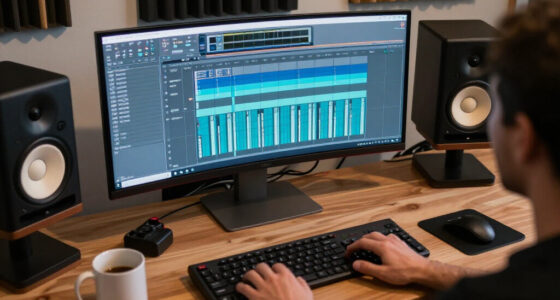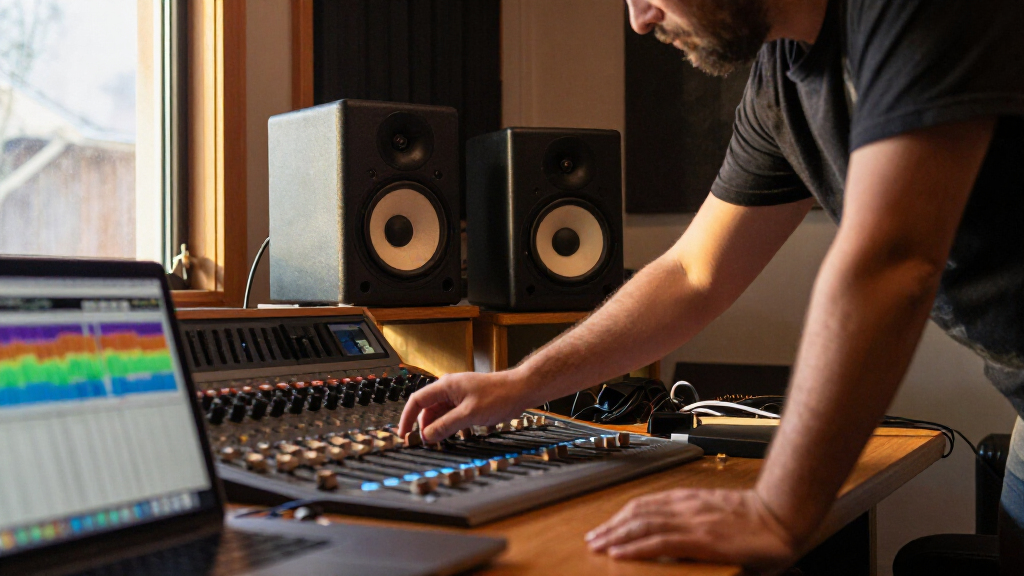

Studio monitor speakers vary most in room fit, bass reach, and how much flexibility they offer beyond reference listening. I’d pick the JBL 305P MkII as the best overall option in this lineup for its balance of nearfield monitoring features and practical versatility. The Yamaha HS8 is the standout for larger rooms and fuller low-frequency monitoring, while the PreSonus Eris E5 offers a more compact alternative for smaller studios. The tradeoff is straightforward: larger speakers can reveal more bass but need more space, while small desktop models are easier to place but have less low-end reach. Read on for the full breakdown, buying advice, and answers to common setup questions.

Get audio and creator gear delivered free with Prime
- Fast, free delivery on millions of items
- Prime Video, Amazon Music and more included
- Member-only deals all year
Complete the kit


Key Takeaways
- The JBL 305P MkII is the strongest all-rounder: it sits between compact desktop models and larger, more room-demanding monitors, making it the most flexible starting point for many home studios.
- The Yamaha HS8 is the clear large-room pick: its 8-inch woofer favors deeper bass monitoring, but the extra size makes room placement and listening distance more demanding.
- PreSonus Eris models span distinct needs: the E5 balances a modest footprint with more monitor-oriented scale, while the Eris 3.5 and E4.5 are better suited to tighter desks and nearfield listening.
- The smallest models make a placement-first compromise: the Yamaha HS3, HS4, Eris 3.5, and Mackie CR3.5 are easier to fit, but buyers should not expect them to reproduce the lowest bass with the authority of larger monitors.
- Several listings are color or model variants, not different performance tiers: the white and black Yamaha HS4, HS5, and Ortizan C7 listings should be compared by their underlying model and intended use, not treated as separate upgrades.
| PreSonus Eris E5 2-Way 5.25-Inch Nearfield Studio Monitors, Pair |  | Best for Flexible Studio Connections | Quantity: Pair | Woofer: 5.25-inch woven composite | Tweeter: 1-inch silk-dome | VIEW LATEST PRICE | See Our Full Breakdown |
| PreSonus Eris E7 XT 2-Way Active Studio Monitor |  | Best for a Wide Mixing Sweet Spot | Woofer: 6.5-inch woven composite | Tweeter: 1.25-inch silk-dome | Maximum output power: 130 watts | VIEW LATEST PRICE | See Our Full Breakdown |
| Yamaha HS8 8-Inch Powered Studio Monitor Pair, Black |  | Best for Full-Range Mixing | Quantity: Pair | Woofer: 8 inches | Tweeter: 1-inch dome | VIEW LATEST PRICE | See Our Full Breakdown |
| Ortizan C7 Powered Studio Monitors, Pair, Bluetooth 5.3, White |  | Best for Flexible Desktop Listening | Quantity: Pair | Bluetooth: Version 5.3 | Mid-bass driver: 3.5-inch carbon fiber | VIEW LATEST PRICE | See Our Full Breakdown |
| Yamaha HS4 Powered Studio Monitors, Black, Pair |  | Best Compact Pair for Editing | Quantity: Pair | Woofer: 4.5 inches | Tweeter: 1-inch dome | VIEW LATEST PRICE | See Our Full Breakdown |
| Yamaha HS5 W 5-Inch Powered Studio Monitors, White, 2-Pack |  | Best for Mixing with a Matched Pair | Quantity: 2 monitors | Speaker type: Powered nearfield studio monitor | Design: 2-way, bass-reflex, bi-amplified | VIEW LATEST PRICE | See Our Full Breakdown |
| JBL 305P MkII 5-Inch 2-Way Powered Studio Reference Monitors (Pair) |  | Best for Room Adjustment and Imaging | Quantity: 2 monitors | Speaker type: 2-way powered studio monitor | Drivers: 5-inch woofer and 1-inch tweeter | VIEW LATEST PRICE | See Our Full Breakdown |
| Ortizan C7 Powered Studio Monitor Speakers, Pair, with Bluetooth 5.3, Black |  | Best for Versatile Desktop Setups | Quantity: Pair | Bluetooth: Version 5.3 | Inputs: USB, RCA, 3.5 mm AUX, 6.35 mm balanced TRS | VIEW LATEST PRICE | See Our Full Breakdown |
| Yamaha HS4 Powered Studio Monitors, White, Pair |  | Best Compact Studio Pair | Quantity: Pair | Speaker configuration: Powered 2-way, bass-reflex | Woofer: 4.5-inch cone | VIEW LATEST PRICE | See Our Full Breakdown |
| Yamaha HS5 Powered Studio Monitors, Pair |  | Best for Straightforward Reference Monitoring | Quantity: 2 monitors | Speaker type: 2-way bass-reflex nearfield monitor | Woofer: 5 inches | VIEW LATEST PRICE | See Our Full Breakdown |
| PreSonus Eris 3.5 Powered Studio Monitors, Stereo Pair |  | Best Compact All-Rounder | Configuration: Active near-field stereo pair | Amplifier power: 50 watts | Woofer: 3.5-inch woven-composite | VIEW LATEST PRICE | See Our Full Breakdown |
| Mackie CR3.5 Powered Studio Monitors, Pair, 3.5-Inch Woofers, Tone Knob, Black | 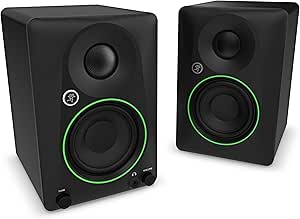 | Best for Flexible Desk Placement | Configuration: Powered stereo pair | Woofer: 3.5 inches | Tweeter: 1 inch | VIEW LATEST PRICE | See Our Full Breakdown |
| Yamaha HS3 Powered Studio Monitors, Black, Pair |  | Best for Compact Editing Setups | Configuration: 2-way, bass-reflex powered pair | Woofer: 3.5 inches | Tweeter: 0.75 inch | VIEW LATEST PRICE | See Our Full Breakdown |
| PreSonus Eris E4.5 2-Way 4.5-Inch Nearfield Studio Monitors (Pair) |  | Best for Fuller Sound in a Small Studio | Configuration: 2-way stereo pair | Woofer: 4.5 inches | Tweeter: 1 inch | VIEW LATEST PRICE | See Our Full Breakdown |
| studio monitor speaker | Tweeter | Woofer | Inputs | Quantity |
|---|---|---|---|---|
| PreSonus Eris E5 2-Way 5.25-In | 1-inch silk-dome | 5.25-inch woven composite | Balanced XLR and 1/4-inch; unbalanced RCA | Pair |
| PreSonus Eris E7 XT 2-Way Acti | 1.25-inch silk-dome | 6.5-inch woven composite | — | — |
| Yamaha HS8 8-Inch Powered Stud | 1-inch dome | 8 inches | — | Pair |
| Ortizan C7 Powered Studio Moni | 0.75-inch silk-dome | — | USB, RCA, 3.5 mm AUX, 6.35 mm TRS | Pair |
| Yamaha HS4 Powered Studio Moni | 1-inch dome | 4.5 inches | XLR/TRS combo, RCA, stereo mini | Pair |
| Yamaha HS5 W 5-Inch Powered St | 1-inch dome | 5 inches | — | 2 monitors |
| JBL 305P MkII 5-Inch 2-Way Pow | — | — | Balanced XLR and 1/4-inch TRS | 2 monitors |
| Ortizan C7 Powered Studio Moni | — | — | USB, RCA, 3.5 mm AUX, 6.35 mm balanced TRS | Pair |
| Yamaha HS4 Powered Studio Moni | 1-inch dome | 4.5-inch cone | XLR/TRS combo, RCA, stereo mini | Pair |
| Yamaha HS5 Powered Studio Moni | 1-inch dome | 5 inches | XLR and TRS phone jack; balanced or unbalanced signals | 2 monitors |
| PreSonus Eris 3.5 Powered Stud | 1-inch silk-dome | 3.5-inch woven-composite | Balanced TRS, RCA, front-panel aux | — |
| Mackie CR3.5 Powered Studio Mo | 1 inch | 3.5 inches | — | — |
| Yamaha HS3 Powered Studio Moni | 0.75 inch | 3.5 inches | XLR/TRS combo, RCA, stereo mini | — |
| PreSonus Eris E4.5 2-Way 4.5-I | 1 inch | 4.5 inches | 1/4-inch TRS, RCA, 1/8-inch stereo aux | — |
More Details on Our Top Picks
PreSonus Eris E5 2-Way 5.25-Inch Nearfield Studio Monitors, Pair
The PreSonus Eris E5 pair is a versatile nearfield choice for a small studio that needs to connect different kinds of gear. Its XLR, 1/4-inch, and RCA inputs make it easier to switch between an audio interface and consumer playback sources than on the XLR-only Yamaha HS8. Room-tuning controls also help adapt the monitors when desk or wall placement colors what you hear. The 5.25-inch woofers and 80-watt bi-amplification offer a middle ground between the compact Yamaha HS4 and larger monitors such as the HS8, though they cannot provide the HS8’s stated 38Hz low-frequency reach. These are professional monitors rather than wireless all-purpose speakers, and Bluetooth is not listed. I’d choose them for adaptable wired studio use, not for a room-filling system or casual wireless listening.
Pros:- XLR, 1/4-inch, and RCA inputs accommodate both studio and consumer audio sources.
- Acoustic tuning controls help compensate for the listening environment.
- 5.25-inch woofer and 80-watt bi-amplification offer more scale than compact 4.5-inch monitors such as the Yamaha HS4.
- Over-temperature and subsonic protection are listed.
Cons:- No wireless connectivity is listed.
- The Yamaha HS8 specifies lower-frequency extension to 38Hz, while no frequency-response range is provided here.
- The 5.25-inch cabinets take more desk space than compact monitors.
Best for: Home-studio owners who connect an audio interface alongside RCA-equipped playback gear and need room-adjustment controls.
Not ideal for: Buyers who want Bluetooth, a compact desktop footprint, or the deeper stated frequency extension of the Yamaha HS8.
- Quantity:Pair
- Woofer:5.25-inch woven composite
- Tweeter:1-inch silk-dome
- Amplification:80-watt Class AB bi-amplification
- Maximum continuous SPL:102 dB
- Inputs:Balanced XLR and 1/4-inch; unbalanced RCA
- Dimensions:7.7 x 7 x 10.2 inches (D x W x H)
- Weight:11.6 pounds
Our verdict“Choose the Eris E5 if you want a flexible set of wired nearfields with room tuning and several input types.”
PreSonus Eris E7 XT 2-Way Active Studio Monitor
The PreSonus Eris E7 XT is the pick for producers who want a broad listening area, especially when more than one person needs to hear a mix. Its EBM waveguide is specified for 100° horizontal and 60° vertical coverage, a clear distinction from the more compact Eris E5 and Yamaha HS4. The 6.5-inch woofer and 130-watt output also make it a larger, more powerful option than either of those models; the ported enclosure is described as delivering deep, tight bass. Acoustic tuning controls help tailor its response to the room. The tradeoff is physical scale: at 16 inches tall, it needs more space than a small desktop setup may offer. The listing gives no numeric frequency-response range, and its stated weight of 16 ounces appears inconsistent with the monitor’s size.
Pros:- EBM waveguide specifies broad 100° horizontal and 60° vertical coverage.
- 6.5-inch woofer and 130-watt maximum output provide more scale than the Eris E5 and Yamaha HS4.
- Acoustic tuning controls allow response adjustments for the room.
- Includes Studio One Prime and Studio Magic software.
Cons:- Its 16-inch height makes it a poor fit for many compact desks.
- No numeric frequency-response range is provided in the supplied specifications.
- The listed 16-ounce weight appears unreliable for a monitor of this size.
Best for: Producers working in a shared or wider listening position who have room for a tall 6.5-inch monitor and want adjustable room response.
Not ideal for: Desk-bound users with limited space or buyers who need clearly stated weight and frequency-response figures before choosing.
- Woofer:6.5-inch woven composite
- Tweeter:1.25-inch silk-dome
- Maximum output power:130 watts
- Waveguide coverage:100° horizontal x 60° vertical
- Enclosure:Ported
- Acoustic controls:Room-tuning controls
- Included software:Studio One Prime and Studio Magic
- Dimensions:11.5 x 9.8 x 16 inches (D x W x H)
Our verdict“Pick the Eris E7 XT if a wide sweet spot and larger-driver output matter more than a compact footprint or fully specified measurements.”
Yamaha HS8 8-Inch Powered Studio Monitor Pair, Black
For a dedicated studio where low-end detail matters, the Yamaha HS8 pair is the largest and most explicitly wide-ranging option in this group. Its 38Hz–30kHz frequency response and 8-inch woofer give mixers more bass information than the compact Yamaha HS4 or the 5.25-inch PreSonus Eris E5 can offer on paper. Separate low- and high-frequency amplification supports its powered two-way design, and the pair is intended for accurate, transparent mixing. That reach comes with a practical cost: large woofers need suitable room and placement, so these may overwhelm a small desk or cramped untreated room. Connectivity is listed as XLR only, narrower than the Eris E5’s multiple inputs. I’d favor the HS8 for a fixed mixing setup, not for portability or casual multi-source use.
Pros:- Stated 38Hz–30kHz frequency response offers broad monitoring coverage.
- 8-inch woofer provides more low-frequency reach than the Yamaha HS4’s 4.5-inch driver.
- Separate low- and high-frequency amplification supports the two-way powered design.
- Sold as a matched pair for stereo monitoring.
Cons:- The 8-inch cabinets require more space and careful placement than the Eris E5 or Yamaha HS4.
- XLR is the only listed connection, limiting direct compatibility with other source types.
- Corded electric power restricts placement flexibility.
Best for: Mix engineers with a dedicated room who need to hear more low-frequency content from their main nearfield monitors.
Not ideal for: Small-room producers who cannot give 8-inch monitors space, or buyers who need RCA, mini-jack, or wireless connections.
- Quantity:Pair
- Woofer:8 inches
- Tweeter:1-inch dome
- Frequency response:38Hz–30kHz
- Amplification:Bi-amplified
- Power output:120W total (75W LF + 45W HF)
- Connectivity:XLR
- Power source:Corded electric
Our verdict“Choose the HS8 pair for a spacious mixing setup where its stated low-frequency reach is more useful than compact size or broad connectivity.”
Ortizan C7 Powered Studio Monitors, Pair, Bluetooth 5.3, White
The Ortizan C7 stands apart from the Yamaha HS8 and PreSonus Eris E5 by combining studio-oriented connections with easy everyday playback. Bluetooth 5.3, USB, RCA, AUX, and balanced 6.35 mm TRS let one pair serve a computer, mobile device, or audio interface, while the front headphone output is convenient at a desk. A 24-bit DAC and 3.5-inch carbon-fiber mid-bass drivers suit compact desktop use, but the small drivers are not a substitute for the HS8’s 8-inch woofer when you need dependable low-end information for mixing. The supplied details also omit both output power and frequency response, making performance harder to compare with the Yamaha HS4. I’d shortlist the C7 for a mixed work-and-listening setup, while buyers focused on critical low-frequency decisions should choose a larger, better-specified monitor.
Pros:- Bluetooth 5.3 and several wired inputs support varied playback and studio sources.
- Balanced 6.35 mm TRS input accommodates compatible audio equipment.
- Front-panel headphone output makes private listening convenient at a desk.
- 24-bit DAC is specified for digital audio conversion.
Cons:- No output power or frequency-response figures are provided in the supplied details.
- 3.5-inch mid-bass drivers offer less scale for low-frequency monitoring than the Yamaha HS8’s 8-inch woofer.
- Requires corded electric power despite offering Bluetooth.
Best for: Desktop creators who switch among a computer, phone, and audio interface and want a front headphone connection.
Not ideal for: Mixers who need documented frequency response, specified output power, or stronger low-frequency monitoring than 3.5-inch drivers can provide.
- Quantity:Pair
- Bluetooth:Version 5.3
- Mid-bass driver:3.5-inch carbon fiber
- Tweeter:0.75-inch silk-dome
- DAC:24-bit
- Inputs:USB, RCA, 3.5 mm AUX, 6.35 mm TRS
- Headphone output:Front panel
- Power source:Corded electric
Our verdict“Choose the C7 for a compact desktop that mixes studio connections with Bluetooth playback, but not as a documented full-range mixing reference.”
Yamaha HS4 Powered Studio Monitors, Black, Pair
The Yamaha HS4 pair suits close-range work where desk space matters more than maximum output or deep bass. Each speaker uses a 4.5-inch woofer and 1-inch dome tweeter, with room-control and high-trim response controls to help adapt the sound to a small workspace. That makes it a more compact alternative to the PreSonus Eris E5, while its XLR/TRS combo, RCA, and stereo mini inputs offer more connection variety than the XLR-only Yamaha HS8. The stated response runs from 60Hz to 22kHz at -10 dB, so buyers mixing bass-heavy music should not expect the low-end coverage listed for the HS8. Output is specified at 26W, and the pair includes cables and anti-slip pads. I’d pick the HS4 for video editing or compact production, not for high-output monitoring.
Pros:- Compact 4.5-inch woofer design fits smaller workspaces more easily than the Eris E5 or Yamaha HS8.
- Room-control and high-trim response controls help tailor playback to the workspace.
- XLR/TRS combo, RCA, and stereo mini inputs support several wired sources.
- Includes anti-slip pads and connection cables.
Cons:- 26W output and 4.5-inch woofers are a less suitable match for high-output monitoring than the larger HS8.
- Stated frequency response begins at 60Hz (-10 dB), limiting its usefulness for judging deep bass.
- Requires corded power and is not water resistant.
Best for: Video editors and home producers who need a compact stereo pair with room-adjustment controls and connections for common desktop sources.
Not ideal for: Bass-focused mixers or users who need higher stated output and broader low-frequency coverage than this compact pair specifies.
- Quantity:Pair
- Woofer:4.5 inches
- Tweeter:1-inch dome
- Frequency response:60Hz–22kHz (-10 dB)
- Output power:26W
- Inputs:XLR/TRS combo, RCA, stereo mini
- Included accessories:Anti-slip pads, 2.5 m speaker cable, 1.5 m stereo mini–RCA cable
- Warranty:1-year manufacturer warranty
Our verdict“Choose the HS4 for compact music production or video editing, and step up to a larger monitor if deep bass or higher output is a priority.”
Yamaha HS5 W 5-Inch Powered Studio Monitors, White, 2-Pack
The Yamaha HS5 W pair suits producers who want two matching, powered nearfield monitors for focused mixing rather than a speaker that doubles as a wireless entertainment hub. Its 5-inch woofer and 1-inch dome tweeter use a bi-amplified, two-way design, a setup aimed at separating low and high frequencies for monitoring. Compared with the compact Yamaha HS4, the HS5’s larger woofer is the more fitting choice when you want a dedicated mix position and have room for larger cabinets. This bundle’s clear tradeoff is a limited connection story: the listed input is XLR, and each speaker needs corded power. Choose it for a compatible audio interface and a fixed desk or studio setup; skip it if you need USB, Bluetooth, or the HS4’s multiple listed inputs.
Pros:- Includes two matching powered monitors for stereo monitoring.
- Bi-amplified, two-way design separates woofer and tweeter duties.
- Five-inch woofers make it a more studio-focused fit than compact desktop options such as the Ortizan C7.
Cons:- Listed XLR connectivity may require an audio interface or other compatible equipment.
- Corded power and wired inputs do not suit a wireless or easily moved setup.
Best for: Home-studio producers who want a matched pair of 5-inch nearfield monitors and already use XLR-compatible audio equipment.
Not ideal for: Desktop listeners who need Bluetooth or USB audio, or buyers whose interface lacks compatible XLR outputs.
- Quantity:2 monitors
- Speaker type:Powered nearfield studio monitor
- Design:2-way, bass-reflex, bi-amplified
- Woofer:5 inches
- Tweeter:1-inch dome
- Maximum output power:70 watts
- Connectivity:XLR
- Color:White
Our verdict“Choose this white HS5 pair for a fixed, XLR-based mixing setup; pick the HS4 instead if you need more input options in a smaller monitor.”
JBL 305P MkII 5-Inch 2-Way Powered Studio Reference Monitors (Pair)
The JBL 305P MkII pair is the most adaptable pick here for a room where speaker placement or acoustics are less than ideal. Its Image Control Waveguide is designed to support precise stereo imaging across a wider listening area, while Boundary EQ and HF Trim give you tools to adjust the response to the room. That makes it a more flexible alternative to the Yamaha HS5 pair, whose listed specification emphasizes XLR connectivity but does not list comparable room controls. JBL also provides both balanced XLR and 1/4-inch TRS inputs, making it easier to connect with varied studio gear. The tradeoff is that adjustment controls cannot fix every room problem, and this is still a corded, wired monitor pair—not a Bluetooth desktop speaker. Choose it for a working mix space; skip it if simplicity matters more than tuning options.
Pros:- Boundary EQ and HF Trim provide room-related response adjustments.
- Image Control Waveguide is designed for clear imaging and a wider sweet spot.
- Balanced XLR and 1/4-inch TRS inputs accommodate common studio connections.
- The pair includes two powered monitors with dual 41-watt Class-D amplifiers per monitor.
Cons:- Requires wired connections and a separate power connection for each monitor.
- Room controls offer adjustment but do not replace suitable placement or room treatment.
Best for: Home-studio mixers who need placement-related response controls and want XLR and TRS connections for an audio interface or mixer.
Not ideal for: Listeners seeking a wireless all-purpose speaker, or buyers who want to avoid adjusting monitor settings to suit their room.
- Quantity:2 monitors
- Speaker type:2-way powered studio monitor
- Drivers:5-inch woofer and 1-inch tweeter
- Amplification:Dual 41-watt Class-D amplifiers per monitor
- Inputs:Balanced XLR and 1/4-inch TRS
- Controls:Boundary EQ and HF Trim
- Dimensions:9.9 × 7.3 × 11.75 inches (D × W × H)
- Item weight:10.4 pounds
Our verdict“Pick the JBL 305P MkII if imaging and room-adjustment controls matter more than the Yamaha HS5’s straightforward monitoring setup.”
Ortizan C7 Powered Studio Monitor Speakers, Pair, with Bluetooth 5.3, Black
The Ortizan C7 makes the most sense when studio monitoring shares desk space with gaming, video, or casual listening. Its USB input and built-in 24-bit DAC offer a direct computer connection, while Bluetooth, RCA, AUX, and balanced TRS let it serve more sources than the studio-oriented Yamaha HS5. A headphone output also helps keep a compact workstation self-contained. That flexibility comes with a clear studio compromise: the 3.5-inch mid-bass drivers are smaller than the five-inch drivers in the HS5 and JBL 305P MkII, so buyers focused on judging low-end content may prefer one of those larger monitors. The C7’s small footprint is useful on a crowded desk, but it is less suited to a dedicated mixing room where wired monitoring and larger drivers take priority.
Pros:- USB audio with a built-in 24-bit DAC supports a direct computer connection.
- Bluetooth 5.3, RCA, AUX, and balanced TRS cover a broad range of sources.
- Headphone output is useful in a compact desktop workflow.
- Small cabinets suit desks where larger monitors such as the JBL 305P MkII may take up too much space.
Cons:- The 3.5-inch mid-bass drivers may not provide the low-frequency reach needed for bass-critical mixing.
- Bluetooth range is listed inconsistently, at 10 to 18 meters.
Best for: Desktop creators who switch between computer audio, gaming, and casual listening and want USB, Bluetooth, and balanced TRS in one compact pair.
Not ideal for: Mixers who need stronger low-frequency monitoring or prefer a dedicated wired studio monitor without Bluetooth-oriented features.
- Quantity:Pair
- Bluetooth:Version 5.3
- Inputs:USB, RCA, 3.5 mm AUX, 6.35 mm balanced TRS
- Drivers:3.5-inch carbon-fiber mid-bass driver and 0.75-inch silk-dome tweeter
- DAC:Built-in 24-bit
- Headphone output:Yes
- Dimensions:5.11 × 5.9 × 7.67 inches
- Color:Black
Our verdict“Choose the Ortizan C7 for a compact desk that serves both creative work and everyday playback, not for low-end-critical mixing.”
Yamaha HS4 Powered Studio Monitors, White, Pair
The Yamaha HS4 pair is aimed at editors and producers whose desk cannot accommodate a larger monitor. Each speaker combines a 4.5-inch woofer with a 1-inch dome tweeter, and the compact cabinets are listed at 8.4 × 5.9 × 9.4 inches. Compared with the Yamaha HS5, the HS4 gives up woofer size and low-frequency reach but adds a broader set of listed connections: XLR/TRS combo, RCA, and stereo mini. Its room-control and high-trim settings provide some response adjustment, while the included cables and anti-slip pads help with a straightforward desk setup. The compromise is visible in its stated 60 Hz–22 kHz frequency response; buyers mixing bass-heavy material may want a larger option such as the JBL 305P MkII instead.
Pros:- Compact dimensions suit space-limited desks better than the Yamaha HS5.
- XLR/TRS combo, RCA, and stereo mini inputs support multiple wired sources.
- Room-control and high-trim settings allow response adjustments.
- Includes a speaker cable, stereo mini-to-RCA cable, and anti-slip pads.
Cons:- The 4.5-inch woofer and 60 Hz lower frequency figure limit low-end monitoring compared with larger monitors.
- Corded power means these are not a wireless or portable playback option.
Best for: Video editors and home producers working at a small desk who need compact powered monitors with several wired input types.
Not ideal for: Producers who need deeper low-frequency monitoring for bass-heavy mixes or want the larger drivers of a five-inch pair.
- Quantity:Pair
- Speaker configuration:Powered 2-way, bass-reflex
- Woofer:4.5-inch cone
- Tweeter:1-inch dome
- Frequency response:60 Hz–22 kHz (-10 dB)
- Output power:26 W + 26 W
- Inputs:XLR/TRS combo, RCA, stereo mini
- Dimensions:8.4 × 5.9 × 9.4 inches
Our verdict“Choose the HS4 for compact editing and production desks; step up to the HS5 or JBL 305P MkII if low-frequency monitoring takes priority.”
Yamaha HS5 Powered Studio Monitors, Pair
The Yamaha HS5 pair is a straightforward choice for producers who want a dedicated five-inch nearfield monitor and do not need wireless playback features. Its 70-watt bi-amplified design pairs a 5-inch woofer with a 1-inch dome tweeter, and the listed 54 Hz–30 kHz response describes the range covered by each monitor. XLR and TRS inputs accept balanced or unbalanced signals, giving it more stated connection flexibility than the XLR-only HS5 W bundle in this lineup. Compared with the compact Yamaha HS4, this pair has larger woofers and a lower listed frequency limit, but needs more desk or stand space. It is a focused studio option, not an all-purpose desktop speaker: the listing does not include Bluetooth, and the monitors are not water resistant.
Pros:- Pair of 5-inch nearfield monitors suits dedicated mixing and studio monitoring.
- Bi-amplified 70-watt system assigns amplification to the woofer and tweeter.
- XLR and TRS inputs accept balanced or unbalanced signals.
- The listed 54 Hz–30 kHz response extends lower than the Yamaha HS4’s stated range.
Cons:- Larger five-inch monitors may be awkward on a very small desk.
- No wireless input is listed, and the monitors are not water resistant.
- Product information gives unusually large dimensions that may need verification.
Best for: Producers setting up a dedicated nearfield mix position who want a matched five-inch pair with XLR and TRS input options.
Not ideal for: Small-desk users who need compact cabinets, or listeners who want Bluetooth, USB audio, or water-resistant speakers.
- Quantity:2 monitors
- Speaker type:2-way bass-reflex nearfield monitor
- Woofer:5 inches
- Tweeter:1-inch dome
- Frequency response:54 Hz–30 kHz
- Amplification:Bi-amplified
- Power output:70 watts per monitor (45 W LF + 25 W HF)
- Inputs:XLR and TRS phone jack; balanced or unbalanced signals
Our verdict“Choose this HS5 pair for a wired, dedicated mixing setup with larger drivers than the HS4; choose the Ortizan C7 for broader desktop connectivity.”
PreSonus Eris 3.5 Powered Studio Monitors, Stereo Pair
The PreSonus Eris 3.5 is a practical fit for a small desk that needs both studio connections and convenient everyday playback. Its 50 watts of built-in amplification, balanced TRS and RCA inputs, and front-panel aux input make it easier to connect an interface, computer, or other source than a monitor with fewer connection choices. High- and low-frequency tuning offers some room to adjust the sound, while the headphone jack keeps private listening within reach. Compared with the Yamaha HS3, the Eris adds a 1-inch tweeter and more stated amplifier power; the HS3, by contrast, lists a lower bass extension. Its 3.5-inch woofer still limits deep bass, so it is less suited to low-end-critical mixing than the larger Eris E4.5. Bluetooth is not listed.
Pros:- 50 watts of built-in amplification in a compact stereo pair
- Balanced TRS, RCA, and front-panel aux inputs accommodate several wired sources
- High- and low-frequency tuning provides some adjustment for the room
- Front-panel headphone output supports private listening
Cons:- 3.5-inch woofers limit low-bass output compared with the Eris E4.5
- Bluetooth connectivity is not listed
- No water-resistance rating is listed
Best for: Desk-based producers and editors who want compact wired monitors with flexible inputs and a front-panel headphone jack
Not ideal for: Bass-heavy producers who need substantial low-frequency detail, or buyers who require wireless playback
- Configuration:Active near-field stereo pair
- Amplifier power:50 watts
- Woofer:3.5-inch woven-composite
- Tweeter:1-inch silk-dome
- Frequency response:80 Hz–20 kHz
- Inputs:Balanced TRS, RCA, front-panel aux
- Controls:High- and low-frequency tuning; front-panel volume
- Dimensions:5.5 x 6 x 8.3 inches
- Weight:6.4 pounds
Our verdict“Choose the Eris 3.5 for a small, flexible wired setup, but pick the Eris E4.5 if you want larger woofers for fuller bass.”
Mackie CR3.5 Powered Studio Monitors, Pair, 3.5-Inch Woofers, Tone Knob, Black
The Mackie CR3.5 is the most placement-oriented choice here: its location switch adjusts bass response for desktop or bookshelf use, and the included isolation pads and cables reduce the amount of setup gear to source separately. A tone knob also lets listeners tailor the presentation for different material, though turning it away from a neutral setting can make these less useful as reference monitors. Compared with the PreSonus Eris 3.5, Mackie gives placement and voicing adjustments more prominence, while the Eris lists a front-panel headphone output and a front aux input. Both use 3.5-inch woofers, so neither is the right step up for deep bass; the larger PreSonus Eris E4.5 is a better fit when fuller low-end reproduction matters. The CR3.5’s appeal is convenience, not extended bass.
Pros:- Location switch adapts bass response for desktop or bookshelf placement
- Tone knob offers quick sound-voicing adjustment
- Isolation pads and cables are included
- Compact stereo pair suits desks and small studios
Cons:- 3.5-inch woofers provide limited low-frequency output
- Tone adjustments can move playback away from a reference presentation
- No front-panel headphone output is listed in the supplied product data
Best for: Home-studio owners who move monitors between a desk and bookshelf and want included pads and cables
Not ideal for: Mixers seeking a consistently neutral reference or listeners who need strong low-frequency output from small speakers
- Configuration:Powered stereo pair
- Woofer:3.5 inches
- Tweeter:1 inch
- Maximum output power:50 watts
- Connectivity:RCA, TRS
- Controls:Tone knob and location switch
- Mounting type:Tabletop
- Dimensions:7.1 x 5.5 x 8.1 inches
- Included accessories:Isolation pads and cables
Our verdict“Pick the CR3.5 if flexible placement and included setup accessories matter more than extended bass or a fixed reference voicing.”
Yamaha HS3 Powered Studio Monitors, Black, Pair
The Yamaha HS3 makes sense when desk space is tight but a project still calls for wired studio-monitor connections and room adjustments. Its XLR/TRS combo, RCA, and stereo mini inputs accommodate a range of audio equipment, while room-control and high-trim settings provide ways to address placement-related tonal balance. The listed frequency response reaches 70 Hz at the -10 dB point, a lower figure than the Eris 3.5’s stated 80 Hz lower limit, though neither small monitor replaces a subwoofer for demanding bass work. Compared with the Mackie CR3.5, the HS3 supplies a more explicitly studio-focused set of controls and connection options; the Mackie instead includes isolation pads and a placement switch. The HS3’s 0.75-inch tweeter is smaller than the 1-inch units on those alternatives, and wireless playback is not included.
Pros:- XLR/TRS combo, RCA, and stereo mini inputs support varied wired sources
- Room-control and high-trim adjustments help tailor placement response
- Compact pair is intended for space-limited setups
- Stereo mini-to-RCA cable, speaker cable, and anti-slip pads are included
Cons:- 3.5-inch woofers constrain bass output compared with the Eris E4.5
- No wireless connectivity is listed
- The 0.75-inch tweeter is smaller than the 1-inch units in the Eris 3.5 and Mackie CR3.5
Best for: Video editors and music makers with limited desk space who need multiple wired input formats and room-related controls
Not ideal for: Listeners who want wireless playback, larger drivers, or strong bass without adding a subwoofer
- Configuration:2-way, bass-reflex powered pair
- Woofer:3.5 inches
- Tweeter:0.75 inch
- Frequency response:70 Hz–22 kHz (-10 dB)
- Output power:26 W and above
- Inputs:XLR/TRS combo, RCA, stereo mini
- Controls:Room control and high trim
- Included accessories:Stereo mini-to-RCA cable, 2.5 m speaker cable, anti-slip pads
- Warranty:1 year manufacturer warranty
Our verdict“Choose the HS3 for compact wired editing or production with room-adjustment controls, not for wireless use or weighty bass.”
PreSonus Eris E4.5 2-Way 4.5-Inch Nearfield Studio Monitors (Pair)
The PreSonus Eris E4.5 is the step-up choice for a compact room where 3.5-inch monitors leave too little bass presence. Its 4.5-inch woofers give it a larger low-frequency driver than the Eris 3.5, Mackie CR3.5, and Yamaha HS3, while 50 watts of Class AB amplification and high- and low-frequency tuning keep it suited to near-field production and everyday listening. That does not make it a substitute for a subwoofer when a mix depends on deep bass; the product data specifically suggests one for more low-frequency output. Its wired TRS, RCA, and 1/8-inch aux inputs cover studio and consumer sources, and the front headphone jack is convenient for a desk. Compared with the HS3, the Eris has a larger woofer and headphone output, but its listed frequency response is not provided here, limiting direct spec-to-spec comparison.
Pros:- 4.5-inch woofers are larger than those in the Eris 3.5, HS3, and CR3.5
- 50 watts total Class AB amplification, split as 25 watts per side
- TRS, RCA, and 1/8-inch aux inputs support studio and consumer sources
- Front headphone output, integrated headphone amplifier, and adjustable frequency controls
Cons:- An optional subwoofer may be needed for additional low-frequency output
- No wireless playback is described
- Larger woofers require more desk space than the other compact models in this batch
Best for: Home producers and editors who want a larger woofer and convenient headphone monitoring without moving to full-size monitors
Not ideal for: Bass-focused mixers who need deep sub-bass without a separate subwoofer, or buyers who require wireless playback
- Configuration:2-way stereo pair
- Woofer:4.5 inches
- Tweeter:1 inch
- Amplifier:50 watts total; 25 watts per side, Class AB
- Inputs:1/4-inch TRS, RCA, 1/8-inch stereo aux
- Enclosure material:Medium-density fiberboard
- Controls:Front-panel volume; high- and low-frequency tuning
- Headphone features:Front-panel output with integrated headphone amplifier
- Additional feature:Power-saving mode after 40 minutes of idle time
Our verdict“Choose the Eris E4.5 if you want more low-end presence than the smaller monitors offer and can accept a wired setup or add a subwoofer.”
How We Picked
I compared these studio monitor speakers by the decisions that matter in a working room: cabinet and woofer size, likely low-frequency reach, suitability for nearfield listening, placement demands, and features that affect daily use. I also separated true monitoring priorities—clear, useful playback for mixing—from convenience features such as Bluetooth, tone controls, or a compact footprint. Because these products range from small desktop pairs to larger active monitors, the ranking favors usefulness for a broad home-studio audience rather than raw size alone.
The JBL 305P MkII ranks first as the most balanced fit across common nearfield setups. Larger models such as the Yamaha HS8 move up for buyers with room and space to use their bass extension, but are less universal. Compact models rank well for desks, beginners, or secondary systems, though their smaller cabinets impose real limits. Color variants are treated as the same model class; they do not receive separate performance credit.
Factors to Consider When Choosing Studio Monitor Speakers
Before choosing a pair, I’d match the monitors to the room and the work rather than buying the largest speakers that fit the budget. These factors help prevent common mismatches that no feature list can fix.
Match Woofer Size to the Room, Not Just the Bass You Want
A larger woofer can extend lower, but that does not automatically make a monitor more accurate in a small room. Nearfield speakers are usually heard from a short distance, and a compact pair can be easier to place and listen to consistently at a desk. An 8-inch model may suit a larger room or a listener who needs more low-frequency information, but it can excite room modes and make bass harder to judge if the room is untreated. Small speakers also have limits: they may not expose deep bass problems, so a subwoofer or reference headphones may be needed for occasional checks. Choose for the space where you will actually mix, not a future room you may never have.
Plan for Placement Before You Buy
Speaker position can affect what you hear as much as a change in model. Start by placing the left and right speakers symmetrically, forming a listening triangle with your head, and keeping tweeters near ear height. Rear ports need breathing room from walls, while front-ported designs can be easier to position close to a boundary—but neither design removes room effects. A desk can reflect sound toward your ears, so stands or isolation pads may help reduce unwanted vibration and improve alignment. Check cabinet dimensions and connection access before ordering, especially if your monitors must sit beside a display or against a wall.
Treat Connectivity as a Workflow Decision
Active monitors commonly accept balanced connections such as XLR or TRS, while some compact models also provide consumer-oriented inputs or wireless playback. For a recording interface, balanced cables are generally the sensible choice because they help reject noise over typical studio cable runs. Bluetooth can be convenient for casual listening or checking a mix from a phone, but wireless playback is not a substitute for a dependable wired monitoring path. Confirm that your interface outputs match the speaker inputs and that you can set both channels to a sensible level. A mismatch can add adapters, clutter, or noise without improving the sound.
Decide Whether You Need a Matched Pair or Flexible Controls
Some listings clearly identify a pair, while other monitor listings can describe a single speaker, so verify the box contents before comparing options. A stereo pair is needed for normal stereo mixing; buying one speaker by mistake can delay a setup or leave you with an uneven system. Tone controls and placement switches can help tailor playback when the room or desk is less than ideal, but they cannot correct severe room problems. Keep adjustments conservative and make changes symmetrically on both speakers. If a model offers convenient controls, value them as setup aids rather than a replacement for careful positioning.
Spend More for a Specific Monitoring Need
Paying for larger monitors makes sense when you have the room, listening distance, and work that benefit from greater bass extension and output. It is less useful if the speakers will be squeezed into a small desk setup where placement is compromised. For spoken-word editing, electronic music, or bass-heavy production, reliable low-frequency checks matter; for general editing and learning, balanced midrange and repeatable nearfield listening may matter more. A less expensive compact pair can be a better first step if it leaves room in the setup for stands, an interface, or acoustic treatment. I would prioritize a well-positioned, appropriately sized pair over a larger model used in poor conditions.
Frequently Asked Questions
Should I choose the Yamaha HS8 or a 5-inch monitor for a small home studio?
I’d choose based on room size, listening distance, and placement options rather than woofer size alone. The HS8 is the more suitable choice when you have room to position larger cabinets and need their greater low-frequency reach. In a cramped bedroom or desk setup, a 5-inch pair is often easier to place and may give you more consistent nearfield listening. If you choose the HS8 for a small room, plan to check placement carefully and treat bass judgments with caution. Headphones can help cross-check the deepest lows whichever option you select.
Can small studio monitors work for mixing if they do not reproduce deep bass?
Yes, small monitors can support useful editing and mixing, especially for vocals, dialogue, and many midrange decisions. Their limitation is that the lowest bass may be quiet or absent, so a mix can sound fuller on the speakers than it will on systems that reproduce deeper frequencies. Check bass-heavy material on headphones or another system, and avoid boosting low end to compensate for what the speakers cannot reproduce. Keep the same listening position and level when comparing references. For bass-focused production, a larger monitor or a carefully integrated subwoofer may be a better fit.
Do I need an audio interface to connect studio monitor speakers?
No, an interface is not mandatory, but it is often the cleanest way to connect monitors to a computer and manage recording inputs and outputs. Some speakers accept consumer connections or Bluetooth, which can work for casual listening or simple desktop use. For a recording setup, check that your source and monitors share compatible inputs, then use balanced connections when available. An interface also gives you a more direct way to control monitor level and route audio. Avoid assuming a wireless feature replaces a reliable wired connection for critical listening.
Is Bluetooth suitable for checking mixes on studio monitors?
Bluetooth is useful for quick playback from a phone or for listening without connecting a computer, but I would not make it the primary path for critical mix decisions. Wireless codecs and device processing can affect playback, and Bluetooth adds a connection step that a wired setup avoids. Use a direct cable from an interface or other source when checking balance, panning, and detail. Bluetooth is best treated as a convenience feature for casual listening or an extra reference point. A wireless listen can still tell you how a mix feels, but it should not replace a consistent monitoring chain.
Should I buy one monitor now and add the second speaker later?
For stereo mixing, a matched pair is the more useful purchase because panning, stereo width, and left-right balance depend on hearing both channels. A single monitor can work for mono checks or a temporary editing setup, but it will not let you make normal stereo decisions. Before ordering, confirm whether the listing includes one speaker or a pair; product names and listing formats can be easy to misread. If you must buy in stages, make sure the second unit will be the same model and revision. A pair also makes it easier to position both speakers symmetrically from the start.
Conclusion
For most home-studio buyers, I’d start with the JBL 305P MkII as the best overall because it offers the most balanced fit across common nearfield setups. Choose the PreSonus Eris E5 as the best value-oriented pick if you want a capable monitor without stepping up to a large cabinet, and consider the Yamaha HS8 as the best premium choice when your room and work justify fuller low-frequency monitoring. Beginners with limited desk space can start with the PreSonus Eris 3.5 or Yamaha HS4, accepting that deep bass will need a separate reference. For compact setups, look at the Yamaha HS3 or Mackie CR3.5; for convenient wireless playback, the Ortizan C7 is the specific-use option. Choose the pair that fits your room and workflow, then invest attention in placement before moving up in size.