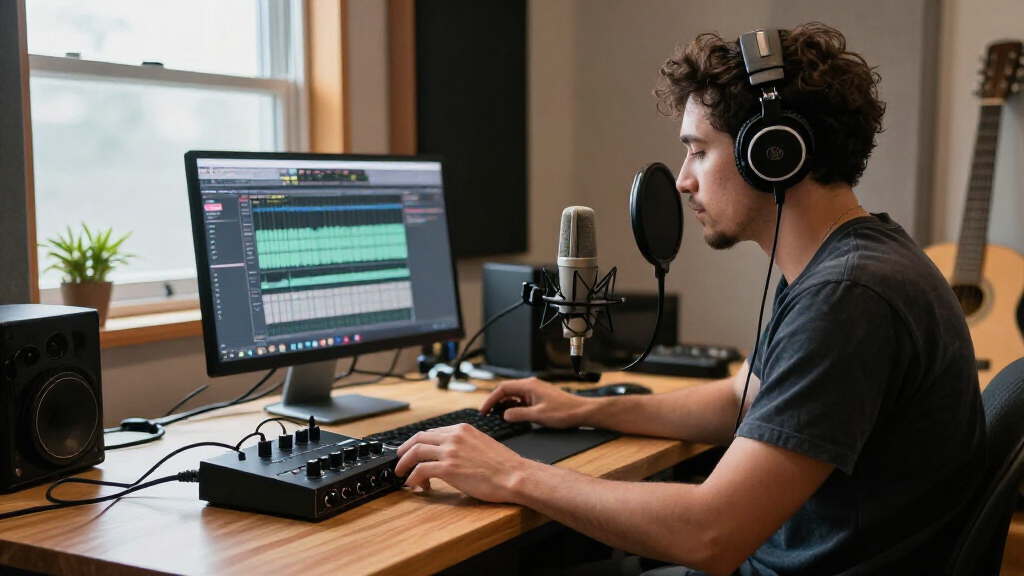

For most home studios, I’d choose the Focusrite Scarlett 2i2 4th Gen as the best overall USB audio interface: its two inputs suit common vocal-and-instrument setups without forcing a jump to a larger system. The Scarlett Solo 4th Gen is a better fit for one source at a time, while the M-Audio M-Track Duo offers a straightforward two-input alternative. The main tradeoff is between paying for better recording flexibility and keeping the setup simple, especially when choosing between a standalone interface and a bundle. Input count, included gear, and computer-versus-phone use also separate these options. Read on for the full breakdown and help matching an interface to your home studio.

Get audio and creator gear delivered free with Prime
- Fast, free delivery on millions of items
- Prime Video, Amazon Music and more included
- Member-only deals all year
Complete the kit


Key Takeaways
- Two inputs are the practical dividing line. The Scarlett 2i2 4th Gen and M-Track Duo better suit recording two sources together; the Scarlett Solo is aimed at one-source workflows.
- Newer Solo and older Solo models serve different priorities. The Scarlett Solo 4th Gen is the stronger pick for a current one-input setup, while the 3rd Gen may appeal to buyers who do not need the latest generation.
- Bundles trade choice for convenience. Focusrite, LyxJam, and PreSonus kits can help new studios assemble a setup, but buyers should check that every included item suits their recording needs.
- Phone-focused models fill a different role. MAONO’s P1 and P2 are worth attention for mobile or hybrid recording, while conventional desktop interfaces are a more direct match for computer-based studio work.
- Budget interfaces need closer input and connection checks. Models such as the XTUGA Q-12 and BOMGE 22M may cover basic needs, but buyers should verify compatibility and workflow details before choosing them over familiar studio-focused options.
| Focusrite Scarlett Solo 4th Gen USB-C Audio Interface |  | Best Overall for Solo Recording | Connectivity: USB-C | Channels: 2 | Microphone inputs: 1 XLR mic preamp | VIEW LATEST PRICE | See Our Full Breakdown |
| Focusrite Scarlett Solo 3rd Generation USB-C Audio Interface |  | Best for a Simple, Compact Setup | Connectivity: USB | Channels: 2 | Maximum sample rate: 192 kHz | VIEW LATEST PRICE | See Our Full Breakdown |
| Focusrite Scarlett Solo 4th Gen USB-C Audio Interface Studio Bundle |  | Best Complete Starter Bundle | Interface generation: 4th | Channels: 2-in/2-out | Connectivity: USB-C | VIEW LATEST PRICE | See Our Full Breakdown |
| Focusrite Scarlett 2i2 Studio 4th Gen USB-C Audio Interface Bundle |  | Best for Two-Mic Home Recording | Connectivity: USB-C | Channels: 2 | Microphone preamps: 2 | VIEW LATEST PRICE | See Our Full Breakdown |
| XTUGA Q-12 USB Audio Interface with XLR and 3.5 mm Inputs |  | Best for Basic Computer Recording | Model: Q-12 | Channels: 2 | Audio resolution: 16-bit/48 kHz | VIEW LATEST PRICE | See Our Full Breakdown |
| M-Audio M-Track Solo USB Audio Interface |  | Best for a Minimal Solo Setup | Audio resolution: 48 kHz | Inputs: 1 combo XLR/line input with phantom power; 1 switchable line/instrument input | Outputs: Stereo RCA outputs; 1/8-inch headphone output | VIEW LATEST PRICE | See Our Full Breakdown |
| Mackie Onyx Artist 1×2 USB Audio Interface |  | Best for Higher-Resolution Solo Recording | Inputs and outputs: 2 in × 2 out | Resolution: 24-bit/192 kHz | Microphone preamp: Onyx | VIEW LATEST PRICE | See Our Full Breakdown |
| MAONO P1 USB Audio Interface for Computers, Phones, Tablets, and Guitar |  | Best for Mobile Streaming and Software Routing | Channels: 2 | Maximum gain: 70 dB | Maximum recording format: 24-bit/192 kHz | VIEW LATEST PRICE | See Our Full Breakdown |
| M-Audio M-Track Duo USB Audio Interface |  | Best Value for Two-Mic Home Recording | Audio resolution: 48 kHz | Inputs: 2 combo XLR/line/instrument inputs | Preamps: Crystal Preamps with phantom power | VIEW LATEST PRICE | See Our Full Breakdown |
| LyxJam 2×2 USB Audio Interface Bundle with White PreSonus Eris 3.5 Monitors, Bluetooth MIDI Pad Controller, Microphone, Headphones, Isolation Shield, and Software |  | Best Complete Starter Studio Bundle | Audio interface: 2-in/2-out USB 2.0 | Recording resolution: Up to 24-bit/192 kHz | Interface features: Dual combo inputs, Hi-Z switches, +48 V phantom power, direct/DAW monitoring, headphone output, dual TRS main outputs | VIEW LATEST PRICE | See Our Full Breakdown |
| MAONO P2 Hybrid USB Audio Interface with Dual XLR Inputs |  | Best for Computer-and-Mobile Streaming | Connectivity: USB-C | Channels: 2 | Microphone gain: 56 dB | VIEW LATEST PRICE | See Our Full Breakdown |
| BOMGE 22M 2-Channel USB Audio Interface with XLR Inputs and 48V Phantom Power |  | Best for Basic Two-Mic Setups | Channels: 2 | Inputs: 2 combo XLR/MIC/LINE | Outputs: RCA stereo and 1/4-inch stereo | VIEW LATEST PRICE | See Our Full Breakdown |
| Focusrite Scarlett 2i2 4th Gen USB-C Audio Interface |  | Best Overall for Two-Input Recording | Connectivity: USB-C | Channels: 2 | Microphone preamps: 2 | VIEW LATEST PRICE | See Our Full Breakdown |
| Focusrite Scarlett Solo Studio 4th Gen USB-C Audio Interface Bundle |  | Best Ready-to-Record Vocal Bundle | Connectivity: USB-C | Channels: 2 | Inputs: 1 XLR microphone preamp and 1 Hi-Z instrument input | VIEW LATEST PRICE | See Our Full Breakdown |
| PreSonus AudioBox USB 96 Studio Recording Bundle |  | Best Bundle for Two-Person Recording | Connectivity: USB | Channels: 2 | Maximum sample rate: 96 kHz | VIEW LATEST PRICE | See Our Full Breakdown |
| USB audio interfaces for home studio | Connectivity | Channels | Inputs |
|---|---|---|---|
| Focusrite Scarlett Solo 4th Ge | USB-C | 2 | — |
| Focusrite Scarlett Solo 3rd Ge | USB | 2 | XLR microphone and instrument |
| Focusrite Scarlett Solo 4th Ge | USB-C | 2-in/2-out | — |
| Focusrite Scarlett 2i2 Studio | USB-C | 2 | — |
| XTUGA Q-12 USB Audio Interface | USB | 2 | XLR and 3.5 mm microphone jack |
| M-Audio M-Track Solo USB Audio | — | — | 1 combo XLR/line input with phantom power; 1 switchable line/instrument input |
| Mackie Onyx Artist 1×2 USB Aud | USB 2.0 | — | — |
| MAONO P1 USB Audio Interface f | USB; dual USB connectivity | 2 | XLR microphone; instrument |
| M-Audio M-Track Duo USB Audio | — | — | 2 combo XLR/line/instrument inputs |
| LyxJam 2×2 USB Audio Interface | — | — | — |
| MAONO P2 Hybrid USB Audio Inte | USB-C | 2 | — |
| BOMGE 22M 2-Channel USB Audio | USB | 2 | 2 combo XLR/MIC/LINE |
| Focusrite Scarlett 2i2 4th Gen | USB-C | 2 | — |
| Focusrite Scarlett Solo Studio | USB-C | 2 | 1 XLR microphone preamp and 1 Hi-Z instrument input |
| PreSonus AudioBox USB 96 Studi | USB | 2 | Combo inputs for microphones, instruments, and line-level sources |
More Details on Our Top Picks
Focusrite Scarlett Solo 4th Gen USB-C Audio Interface
The Scarlett Solo 4th Gen is my strongest fit for a home studio built around one vocalist or instrumentalist at a time. Its single XLR preamp and separate Hi-Z instrument input let you record a mic and guitar or bass together, while 24-bit/192 kHz capture and a 120 dB dynamic range provide headroom for detailed recording. The switchable Air modes offer a way to add presence without making the setup more complicated, and independent headphone volume makes monitoring adjustments straightforward.
Compared with the older Scarlett Solo 3rd Gen, this model offers a newer USB-C connection and listed 120 dB dynamic range, though both remain one-mic interfaces. Skip it if you need two microphone preamps; the Scarlett 2i2 Studio 4th Gen is the better fit for two-mic recording, but takes up more space and is sold as a larger bundle. The Solo also depends on a compatible USB-connected device.
Pros:- One XLR preamp and a separate Hi-Z input support simultaneous vocal and instrument recording.
- 24-bit/192 kHz recording and 120 dB dynamic range support detailed capture.
- Air modes offer tonal options for vocals and guitars.
- Independent headphone volume control simplifies monitoring adjustments.
Cons:- Only one microphone preamp is available.
- Requires a USB-connected compatible computer or device.
Best for: Solo home-studio musicians who record one microphone and one guitar or bass input at the same time and want current-generation recording features.
Not ideal for: Duos, interview hosts, or small bands that need two microphone inputs; this interface has only one XLR preamp.
- Connectivity:USB-C
- Channels:2
- Microphone inputs:1 XLR mic preamp
- Instrument inputs:1 Hi-Z instrument input
- Recording resolution:24-bit
- Maximum sample rate:192 kHz
- Dynamic range:120 dB
- Dimensions:3.78 × 5.63 × 1.83 in
- Included software:Pro Tools Intro+, Ableton Live Lite, Cubase LE, Hitmaker Expansion
Our verdict“Choose the Scarlett Solo 4th Gen if your home-studio sessions center on one mic and one instrument rather than multiple microphones.”
Focusrite Scarlett Solo 3rd Generation USB-C Audio Interface
The Scarlett Solo 3rd Generation suits a home-studio setup that needs a mic preamp, an instrument input, and little else. Its gain Halo metering gives a quick visual cue when setting levels, which can help newer recordists avoid overly quiet or clipped takes. Balanced outputs support connection to studio monitors, while USB operation without an external power supply keeps the desk setup simple. It records at 24-bit/192 kHz and includes a switchable Air mode for added clarity.
Against the Scarlett Solo 4th Gen, it keeps the same basic one-mic, one-instrument workflow but is the older generation. That makes the 4th Gen a more current alternative for buyers prioritizing the newer model’s stated feature set. Neither Solo is suited to two-mic sessions; for that, I’d look at the Scarlett 2i2 Studio 4th Gen. The included software also requires registration and download, so this is not a fully self-contained recording kit.
Pros:- Gain Halo metering provides a clear visual aid when setting input levels.
- Switchable Air mode offers an option for vocal and acoustic recordings.
- Balanced outputs connect to studio monitors.
- USB operation does not require an external power supply.
Cons:- The single microphone preamp limits multi-mic recording.
- Included software requires registration and download.
- It is an older generation than the Scarlett Solo 4th Gen.
Best for: A beginner or solo musician who wants a compact interface with visual gain guidance, monitor outputs, and no external power supply.
Not ideal for: Recordists who need two microphone preamps, want a complete mic-and-headphone kit, or prefer the newer Scarlett Solo generation.
- Connectivity:USB
- Channels:2
- Maximum sample rate:192 kHz
- Recording resolution:24-bit
- Inputs:XLR microphone and instrument
- Supported operating systems:Mac OS, Windows OS, iOS
- Dimensions:1.71 × 5.65 × 3.77 in
- Weight:12.32 oz
- Warranty:3 years
Our verdict“Pick the Scarlett Solo 3rd Gen for a straightforward solo setup when its basic one-mic workflow matters more than having the newer generation.”
Focusrite Scarlett Solo 4th Gen USB-C Audio Interface Studio Bundle
This Scarlett Solo Studio Bundle is aimed at someone starting a home studio without a microphone, headphones, or basic mic accessories. Alongside the 4th Gen Solo interface, it includes a CM25 MkIII condenser microphone, closed-back SH-450 headphones, a stand, pop filter, and cables. That package makes it easier to assemble a vocal-recording station in one purchase than buying the Scarlett Solo 4th Gen interface alone, which suits buyers who already own their recording gear. Air mode, loopback, and zero-latency direct monitoring add useful options for recording, streaming, and hearing a live input without relying on software monitoring.
The tradeoff is that the interface still has only one XLR preamp, so this bundle is not a two-mic solution. Its fixed-boom stand is less adjustable than a flexible studio arm, and the USB-C-to-USB-A cable may not match devices without USB-A ports. For two-mic sessions and a similar mic-and-headphone package, the Scarlett 2i2 Studio 4th Gen is a closer match, though it is a different, two-preamp setup.
Pros:- Includes a CM25 MkIII condenser microphone and SH-450 closed-back headphones.
- Stand, pop filter, and cables help form a working vocal-recording setup.
- Loopback supports routing computer audio for streaming.
- Zero-latency direct monitoring lets users hear input without software-monitoring delay.
Cons:- The interface has only one XLR microphone preamp.
- The included microphone stand has a fixed boom.
- The supplied USB-C-to-USB-A cable may not suit devices without USB-A ports.
Best for: First-time home vocalists, podcasters, and streamers who need an interface, condenser mic, closed-back headphones, and basic recording accessories together.
Not ideal for: Musicians who already own a microphone and headphones, or hosts and duos who need two XLR microphone inputs.
- Interface generation:4th
- Channels:2-in/2-out
- Connectivity:USB-C
- Audio conversion:24-bit / 192 kHz
- Microphone:CM25 MkIII cardioid condenser
- Headphones:SH-450 closed-back
- Included accessories:XLR cables, USB-C-to-USB-A cable, fixed-boom mic stand, pop filter, clamp-on headphone holder
- Features:48V phantom power, zero-latency direct monitoring, Air mode, loopback, standalone mode
- Compatible systems:Mac, Windows, iPadOS
Our verdict“Choose this bundle if you are building a first vocal or streaming setup and want the core recording gear in one package.”
Focusrite Scarlett 2i2 Studio 4th Gen USB-C Audio Interface Bundle
The Scarlett 2i2 Studio 4th Gen is the most practical choice in this group for a home studio that records two microphones at once. Its two mic preamps support interviews, duets, and stereo mic setups, while Auto Gain helps set recording levels and Clip Safe helps guard against clipping during louder takes. Those controls address common setup mistakes more directly than the Scarlett Solo 4th Gen, which has one mic preamp and a separate instrument input. The bundle also supplies a CM25 MkIII microphone, SH-450 headphones, pop filter, and XLR cable, reducing the list of essentials a new studio must source separately.
That extra flexibility comes with a larger, heavier bundle and does not turn the interface into a multichannel recording rig: it remains limited to two channels and two audio inputs. If you only record one voice or instrument at a time, the Scarlett Solo Studio Bundle is a more fitting alternative. Software compatibility can vary by operating system, so check that your chosen recording applications suit your setup.
Pros:- Two mic preamps allow simultaneous two-microphone recording.
- Auto Gain helps set input levels, while Clip Safe helps prevent clipping.
- Includes a condenser microphone, headphones, pop filter, and XLR cable.
- 24-bit/192 kHz recording and 120 dB dynamic range support detailed capture.
Cons:- Limited to two channels and two audio inputs.
- The bundle weighs 3.5 lb and takes more room than a compact Solo interface.
- Software compatibility varies by operating system.
Best for: Home-studio duos, interview podcasters, and musicians who need to record two microphone sources and want a mic-and-headphone bundle.
Not ideal for: Solo recordists who need only one mic input, or bands that need more than two simultaneous inputs.
- Connectivity:USB-C
- Channels:2
- Microphone preamps:2
- Maximum sample rate:192 kHz
- Analogue gain:69 dB
- Dynamic range:120 dB
- Included microphone:CM25 MkIII
- Included headphones:SH-450
- Weight:3.5 lb
Our verdict“Choose the 2i2 Studio bundle when two mic inputs matter more than the smaller footprint and simpler workflow of a Solo.”
XTUGA Q-12 USB Audio Interface with XLR and 3.5 mm Inputs
The XTUGA Q-12 covers a narrow, straightforward job: connecting a microphone to a computer for basic recording. Its XLR input and 3.5 mm microphone jack provide two connection types, and switchable 48 V phantom power supports compatible condenser microphones. USB plug-and-play operation means no separate power adapter is needed, making it a simple alternative to the more feature-rich Scarlett Solo 4th Gen. The Q-12 may suit spoken-word projects or an entry-level setup where the priority is getting an input into software rather than using advanced monitoring and recording options.
Its limits are more apparent beside the Focusrite models: the Q-12 tops out at 16-bit/48 kHz, compared with 24-bit/192 kHz on the Scarlett Solo options, and the supplied data lists no Hi-Z instrument input. It also needs a computer for power and operation, so it is not a standalone recorder. I’d skip it for demanding music production, guitar recording, or sessions where higher recording resolution and a dedicated instrument input matter.
Pros:- XLR and 3.5 mm microphone inputs support different microphone connection types.
- Switchable 48 V phantom power supports compatible condenser microphones.
- USB plug-and-play operation draws power from the computer.
- Compact 0.31 kg design is easy to fit into a small setup.
Cons:- Recording is limited to 16-bit/48 kHz.
- The listed inputs do not include a dedicated Hi-Z instrument input.
- Requires a computer for power and operation.
Best for: A beginner recording basic vocals or other microphone sources to a computer who wants XLR and 3.5 mm input options.
Not ideal for: Guitarists who need a stated Hi-Z instrument input, or home producers who want 24-bit/192 kHz recording like the Scarlett Solo models.
- Model:Q-12
- Channels:2
- Audio resolution:16-bit/48 kHz
- Inputs:XLR and 3.5 mm microphone jack
- Phantom power:Switchable 48 V
- Connectivity:USB
- Compatible devices:Personal computers
- Dimensions:5.98 × 4.92 × 1.97 in
- Warranty:1 year
Our verdict“Choose the Q-12 for basic computer-based microphone recording, but opt for a Scarlett Solo if you need higher-resolution capture or a dedicated instrument input.”
M-Audio M-Track Solo USB Audio Interface
The M-Track Solo keeps a home recording setup simple: one combo input handles a microphone or line source, while the separate switchable input accommodates an instrument. Its USB-powered design and direct monitoring make it a straightforward fit for recording a vocal and guitar without hearing distracting computer delay. Compared with the M-Track Duo, it gives up a second combo input, so it is less suited to two-microphone interviews or recording two performers at once. The 48 kHz ceiling is also more modest than the Mackie Onyx Artist 1×2’s 192 kHz capability, though many basic home projects do not need the higher rate. Choose it for a compact, uncomplicated desk; skip it if your sessions or ambitions require more simultaneous inputs.
Pros:- Compact and USB-powered for a portable, low-clutter setup.
- Combo input provides phantom power for compatible condenser microphones.
- Direct monitoring helps avoid distracting latency while recording.
- Includes MPC Beats and Ableton Live Lite.
Cons:- Only one combo microphone input is available.
- Recording resolution tops out at 48 kHz.
- Using it with the listed iOS setup requires a separate Lightning to USB 3 Camera Adapter.
Best for: Solo home musicians, podcasters, and streamers who need one microphone input plus a separate instrument connection.
Not ideal for: Two-person podcasts or musicians recording multiple microphones at once; the single combo input limits simultaneous mic capture.
- Audio resolution:48 kHz
- Inputs:1 combo XLR/line input with phantom power; 1 switchable line/instrument input
- Outputs:Stereo RCA outputs; 1/8-inch headphone output
- Monitoring:Zero-latency direct monitoring with USB/Direct balance switch
- Power:USB-powered
- Supported software:Ableton Live Lite; MPC Beats
- Operating systems:Windows 7–10; macOS High Sierra–Big Sur; iOS with Apple Lightning to USB 3 Camera Adapter
- Recommended headphone impedance:16–50 ohms
Our verdict“Choose the M-Track Solo for straightforward one-mic home recording, but pick the M-Track Duo if you need two microphone inputs.”
Mackie Onyx Artist 1×2 USB Audio Interface
The Mackie Onyx Artist 1×2 is a focused choice for a home setup built around one microphone and one instrument. Its Onyx preamp, +48 V phantom power, and Hi-Z instrument input cover common vocal, guitar, and bass recording without asking for extra boxes; direct monitoring keeps the performer’s signal available without computer delay. Against the M-Audio M-Track Solo, the Mackie supports up to 24-bit/192 kHz recording rather than 48 kHz, giving users a higher-resolution recording option. That specification does not add a second mic preamp, though: it remains a one-microphone interface, much like the Solo. Its USB 2.0 connection and single preamp make it a less flexible pick for expanding sessions, but a capable fit when resolution and a simple signal path matter more than channel count.
Pros:- Records up to 24-bit/192 kHz.
- Onyx microphone preamp includes +48 V phantom power.
- Hi-Z instrument input suits guitar and bass.
- Bus-powered operation and direct monitoring suit portable recording.
Cons:- Only one microphone preamp is provided.
- USB 2.0 connectivity may be less appealing to buyers seeking a newer connection standard.
- The 1-year warranty is limited compared with a longer-term support commitment.
Best for: Solo vocalists and guitarists who want a bus-powered interface with a Hi-Z input and recording up to 24-bit/192 kHz.
Not ideal for: Duos, interview podcasters, or growing home studios that need two microphone preamps or room to record more sources simultaneously.
- Inputs and outputs:2 in × 2 out
- Resolution:24-bit/192 kHz
- Microphone preamp:Onyx
- Phantom power:+48 V
- Instrument input:¼-inch TRS with Hi-Z switch
- Connectivity:USB 2.0
- Monitoring:Zero-latency direct monitoring
- Dimensions and weight:6.4 × 4.4 × 1.9 inches; 1.2 pounds
Our verdict“Pick the Onyx Artist 1×2 for higher-resolution solo recording, not for sessions that need two microphone inputs.”
MAONO P1 USB Audio Interface for Computers, Phones, Tablets, and Guitar
The MAONO P1 is the most streaming-oriented interface in this group. Alongside an XLR microphone input and an instrument input, it offers loopback and software audio routing, which can help a solo creator combine a microphone with computer audio for a stream or recording. Its listed 70 dB of gain also makes it a more suitable match for gain-hungry dynamic microphones than simpler options such as the M-Audio M-Track Solo. The tradeoff is scope: the P1 is designed for solo creators, not a band or a large podcast with several microphones. Although it records up to 24-bit/192 kHz and supports desktop and mobile operating systems, buyers should check their device and software connection needs before choosing it. Its feature set is compelling when routing matters more than adding inputs.
Pros:- Up to 70 dB of gain can suit dynamic microphones that need substantial input gain.
- Loopback and software routing support combining audio sources for streaming.
- Records up to 24-bit/192 kHz.
- Metal housing and dual USB connectivity suit compact desktop or mobile setups.
Cons:- Two-channel design is not a substitute for a multi-input interface in group recording sessions.
- The listed 48 V phantom power is intended for compatible condenser microphones, not every microphone type.
- Buyers may need to verify device and software compatibility for their particular mobile setup.
Best for: Solo streamers and mobile creators who need loopback, software routing, and an interface that supports a range of computer and mobile operating systems.
Not ideal for: Bands, multi-mic podcasts, and home studios that need to record several microphones or instruments simultaneously.
- Channels:2
- Maximum gain:70 dB
- Maximum recording format:24-bit/192 kHz
- Inputs:XLR microphone; instrument
- Phantom power:48 V
- Equivalent input noise:-130 dB EIN
- Connectivity:USB; dual USB connectivity
- Compatible operating systems:Android, ChromeOS, Windows, iOS
- Housing and dimensions:Metal; 5.9 × 5.98 × 3.46 inches
Our verdict“Choose the MAONO P1 if you are a solo creator who needs loopback and routing options, rather than extra inputs for group sessions.”
M-Audio M-Track Duo USB Audio Interface
For a home studio that needs two microphone connections without a complicated setup, the M-Track Duo is a practical step up from the M-Track Solo. Its two combo inputs accept XLR, line, or instrument sources, so a two-person podcast or a vocal-and-instrument session can be recorded at once. Both inputs have phantom power and Crystal Preamps, while the USB/Direct switch provides zero-latency monitoring. The tradeoff is a 48 kHz recording ceiling, below the Mackie Onyx Artist 1×2’s 24-bit/192 kHz capability; the Mackie, however, has only one microphone preamp. That makes the Duo the more useful choice for simultaneous sources, but not for buyers prioritizing the highest listed resolution. Its compact USB-powered design and included MPC Beats suit a modest, expandable-by-need desktop setup.
Pros:- Two combo inputs handle microphone, line, and instrument sources.
- Phantom power supports compatible condenser microphones.
- USB/Direct monitoring helps performers hear input without computer latency.
- USB-powered design and included MPC Beats suit a compact starter setup.
Cons:- Recording resolution tops out at 48 kHz, below the Mackie Onyx Artist 1×2’s listed maximum.
- Only two inputs are available, limiting full-band recording.
- The listed iOS setup requires a separate Lightning to USB 3 Camera Adapter.
Best for: Two-person podcasters, singer-songwriters, and home musicians who want to record two microphones or a microphone and instrument at the same time.
Not ideal for: Recordists who require higher-resolution capture than 48 kHz or need more than two input channels for a band session.
- Audio resolution:48 kHz
- Inputs:2 combo XLR/line/instrument inputs
- Preamps:Crystal Preamps with phantom power
- Outputs:Stereo 1/4-inch outputs; 1/4-inch headphone output
- Monitoring:USB/Direct switch for zero-latency monitoring
- Power:USB-powered
- Supported software:Ableton Live Lite; MPC Beats
- Operating systems:Windows 7–10; macOS High Sierra–Big Sur; iOS with Apple Lightning to USB 3 Camera Adapter
Our verdict“Choose the M-Track Duo when recording two sources matters more than the higher sample-rate ceiling offered by the Mackie Onyx Artist 1×2.”
LyxJam 2×2 USB Audio Interface Bundle with White PreSonus Eris 3.5 Monitors, Bluetooth MIDI Pad Controller, Microphone, Headphones, Isolation Shield, and Software
The LyxJam bundle suits a buyer assembling an entire home recording desk rather than replacing a single interface. It pairs a 2-in/2-out interface with PreSonus Eris 3.5 monitors, a condenser microphone and accessories, headphones, an isolation shield, a MIDI pad controller, and software. That breadth makes it a different proposition from the standalone M-Audio M-Track Duo, which offers two combo inputs but leaves speakers and recording accessories to the buyer. The interface also lists 24-bit/192 kHz recording, phantom power, Hi-Z switches, and direct monitoring. The compromise is that the small 3.5-inch monitor woofers are less suited to judging deep bass than larger speakers, and the interface depends on a connected computer for USB power. Choose the bundle for an all-at-once setup, not for someone seeking a small interface alone.
Pros:- Includes a 2-in/2-out interface with dual combo inputs, Hi-Z switches, and phantom power.
- Supplies monitors, microphone, headphones, MIDI controller, and recording accessories in one bundle.
- Interface supports recording up to 24-bit/192 kHz.
- Monitors include room-tuning EQ and multiple input options.
Cons:- The 3.5-inch monitor woofers offer limited low-frequency reach compared with larger studio monitors.
- The USB-powered interface depends on a connected computer for operation.
- The bundle takes more space and includes more equipment than a buyer seeking only an interface needs.
Best for: First-time home-studio builders who need an interface, monitors, microphone, headphones, MIDI pads, and recording accessories in one package.
Not ideal for: Producers who already own core studio gear, need larger monitors for bass-heavy mixing, or want an interface that operates independently of a computer.
- Audio interface:2-in/2-out USB 2.0
- Recording resolution:Up to 24-bit/192 kHz
- Interface features:Dual combo inputs, Hi-Z switches, +48 V phantom power, direct/DAW monitoring, headphone output, dual TRS main outputs
- Monitor drivers:3.5-inch woven-composite woofers; 1-inch silk-dome tweeters
- Monitor amplification:25 W per speaker; 50 W per pair
- Monitor frequency response:Approximately 80 Hz–20 kHz
- MIDI controller:4×4 RGB velocity-sensitive pads; USB and Bluetooth MIDI
- Microphone:Large-diaphragm condenser with cardioid polar pattern
- Included accessories:Shockmount, pop filter, foam windscreen, folding acoustic isolation shield, closed-back headphones
Our verdict“Choose the LyxJam bundle to outfit a new home studio in one purchase, but skip it if you already own monitors or need stronger bass monitoring.”
MAONO P2 Hybrid USB Audio Interface with Dual XLR Inputs
The MAONO P2 suits a home creator who records or streams from more than one device: its dual USB ports can connect a computer alongside a phone or tablet. Loopback, direct monitoring, and separate mute and monitoring controls also make it more adaptable to a live-stream workflow than the recording-focused Focusrite Scarlett 2i2 4th Gen. Its 24-bit/192 kHz recording support and 56 dB of microphone gain cover common home vocal and instrument sessions, while the angled aluminum housing keeps controls accessible on a desk. The tradeoff is that the product data gives only a 20 kHz frequency-response figure, so it offers less clearly specified audio performance than the Scarlett’s stated 120 dB dynamic range. Some routing and VST functions also depend on MAONO’s ProStudio 2 software.
Pros:- Dual USB connections support simultaneous computer and phone or tablet workflows.
- Loopback and direct monitoring suit streaming as well as recording.
- 56 dB microphone gain and recording support up to 24-bit/192 kHz.
- Independent mute and monitoring controls in a compact aluminum housing.
Cons:- The supplied frequency-response specification lists only 20 kHz, with no broader performance details.
- Some routing and VST features depend on ProStudio 2 software.
Best for: Home creators who want to record with a computer while routing audio to a phone or tablet for streaming.
Not ideal for: Buyers prioritizing clearly documented converter performance or a conventional music-recording interface over mobile streaming features.
- Connectivity:USB-C
- Channels:2
- Microphone gain:56 dB
- Maximum recording quality:24-bit/192 kHz
- Audio inputs:Microphone, guitar, PC, smartphone, and iPad
- Monitoring and routing:Direct monitoring and loopback
- Housing:Aluminum alloy
- Dimensions:6.42 × 8.27 × 3.23 in
Our verdict“Choose the MAONO P2 if connecting a computer and mobile device is more useful to you than the Scarlett 2i2’s documented dynamic-range specification.”
BOMGE 22M 2-Channel USB Audio Interface with XLR Inputs and 48V Phantom Power
The BOMGE 22M is a straightforward fit for a small home setup that needs two mic or line inputs, phantom power, and direct monitoring without a bundle of extra recording features. Its two combo inputs accommodate microphones, instruments, or line-level sources, giving it more flexibility for a simple two-person podcast or simultaneous vocal-and-instrument recording than the single-XLR Focusrite Scarlett Solo Studio 4th Gen bundle. The compromise is a maximum sample rate of 48 kHz, well below the 96 kHz AudioBox USB 96 and 192 kHz Focusrite options in this group. RCA stereo connections may also call for suitable cables or adapters when connecting other studio equipment. I’d treat it as a basic computer interface rather than a feature-rich centerpiece for a growing studio.
Pros:- Two combo XLR/MIC/LINE inputs handle microphones, instruments, and line-level sources.
- 48V phantom power supports compatible condenser microphones.
- Direct monitoring provides a low-latency way to hear input signals.
- Compact, lightweight design is convenient for a small desk or portable setup.
Cons:- Maximum sample rate is 48 kHz, lower than the PreSonus AudioBox USB 96 and Focusrite models in this group.
- RCA stereo connections may need adapters or specific cables for studio equipment.
- Listed operating-system support is limited to Mac OS X and Windows XP or later.
Best for: Home podcasters or musicians who need two input channels, phantom power, and direct monitoring for a modest Mac or Windows setup.
Not ideal for: Producers who want higher sample-rate recording, mobile compatibility, or clearly described modern USB-C connectivity.
- Channels:2
- Inputs:2 combo XLR/MIC/LINE
- Outputs:RCA stereo and 1/4-inch stereo
- Phantom power:48V
- Maximum sample rate:48 kHz
- Headphone output:1/4 inch
- Connectivity:USB
- Weight:0.32 kg
Our verdict“Pick the BOMGE 22M for uncomplicated two-input recording when basic connections matter more than higher sample rates or broader feature sets.”
Focusrite Scarlett 2i2 4th Gen USB-C Audio Interface
The Scarlett 2i2 4th Gen is the most balanced choice here for a home studio built around two microphones, two instruments, or one of each. Its two low-noise preamps, two Hi-Z inputs, and 120 dB dynamic range give a buyer a clearer recording-oriented specification than the streaming-focused MAONO P2, while Auto Gain and Clip Safe help reduce level-setting mistakes during a session. Air mode offers an optional tonal lift for vocals and guitars, and the included software gives new projects a useful starting point. Its main limit is also its defining shape: there are only two audio inputs, so recording a larger band at once calls for a different class of interface. The Scarlett Solo Studio bundle adds a mic and headphones, but has only one XLR preamp; this 2i2 is the better fit when two sources need to be captured together.
Pros:- Two low-noise microphone preamps and two Hi-Z instrument inputs support varied two-source sessions.
- 120 dB dynamic range and recording support up to 192 kHz.
- Auto Gain and Clip Safe help manage recording levels.
- Air mode and included recording software add useful options for vocals, guitars, and production.
Cons:- Two channels limit simultaneous recording of larger groups or multi-microphone setups.
- A compatible computer or mobile device and recording software are needed.
Best for: Home musicians and podcasters who need two simultaneous inputs, practical level assistance, and a recording-focused interface.
Not ideal for: People who need to record more than two sources at once or want a microphone and headphones included in the box.
- Connectivity:USB-C
- Channels:2
- Microphone preamps:2
- Instrument inputs:2 Hi-Z
- Maximum sample rate:192 kHz
- Dynamic range:120 dB
- Included software:Pro Tools Intro+, Ableton Live Lite, Cubase LE, and Hitmaker Expansion
- Weight:1.3 lb
Our verdict“Choose the Scarlett 2i2 if two-source recording and level-setting help matter more than the bundled mic-and-headphone setup of the Scarlett Solo Studio.”
Focusrite Scarlett Solo Studio 4th Gen USB-C Audio Interface Bundle
The Scarlett Solo Studio 4th Gen makes sense for a first home vocal setup because the box includes the interface, a CM25 MkIII condenser microphone, SH-450 headphones, a pop filter, and an XLR cable. That coordinated starter kit is more immediately useful than the standalone Scarlett 2i2, which has two microphone preamps but does not include these recording essentials. The Solo bundle still supports 24-bit/192 kHz recording, a stated 120 dB dynamic range, Air mode, and the same listed software collection, so it is not merely a starter interface. The key limitation is its input layout: one XLR microphone preamp plus one Hi-Z instrument input cannot record two microphones at the same time. Buyers who already own a mic and headphones may get more practical recording flexibility from the 2i2 instead.
Pros:- Includes a condenser microphone, headphones, pop filter, and XLR cable for a ready-to-record setup.
- Supports 24-bit/192 kHz recording with a stated 120 dB dynamic range.
- Air mode offers an additional tonal option for vocals and guitars.
- Comes with recording software and the Hitmaker Expansion.
Cons:- Only one XLR microphone preamp, so it cannot capture two microphones simultaneously.
- The supplied frequency-response figure is listed as 20 kHz, without further detail.
Best for: First-time home vocalists or singer-songwriters who need an interface, condenser microphone, headphones, and basic recording accessories together.
Not ideal for: Two-person podcasts, duos recording separate microphones, or studio owners who already have a suitable mic and headphones.
- Connectivity:USB-C
- Channels:2
- Inputs:1 XLR microphone preamp and 1 Hi-Z instrument input
- Maximum sample rate:192 kHz
- Bit depth:24-bit
- Dynamic range:120 dB
- Included accessories:CM25 MkIII microphone, SH-450 headphones, pop filter, and XLR cable
- Included software:Pro Tools Intro+, Ableton Live Lite, Cubase LE, and Hitmaker Expansion
Our verdict“Choose this bundle if you need a complete single-vocalist setup, but select the Scarlett 2i2 if two microphone inputs matter more than included accessories.”
PreSonus AudioBox USB 96 Studio Recording Bundle
The PreSonus AudioBox USB 96 Studio Bundle combines two mic preamps with an M7 condenser microphone, HD7 headphones, a stand, cables, and production software. That makes it a more complete fit for a home setup recording two people or a vocal and instrument together than the Scarlett Solo Studio 4th Gen, whose included interface has only one XLR microphone preamp. The AudioBox also has MIDI In/Out and zero-latency hardware monitoring, useful additions for a studio with MIDI gear or performers who need to hear themselves directly. Its sample-rate ceiling is 96 kHz, below the 192 kHz support of the Focusrite bundles and Scarlett 2i2. The USB connection and stated Windows/macOS compatibility make it a computer-centered choice, rather than the better match for mobile-device workflows found with the MAONO P2.
Pros:- Two class-A mic preamps allow simultaneous recording of two microphone sources.
- Bundle includes an M7 condenser microphone, HD7 headphones, stand, and cables.
- Zero-latency hardware monitoring helps performers hear input signals while recording.
- MIDI In/Out and included production software broaden its usefulness beyond basic vocal recording.
Cons:- Maximum sample rate is 96 kHz, below the 192 kHz Focusrite and MAONO options in this group.
- Listed operating-system compatibility is limited to Windows and macOS.
- The two-channel design does not suit larger multi-microphone recording sessions.
Best for: New home-studio owners who want a bundled mic and headphones plus two preamps for recording two performers or sources together.
Not ideal for: Creators who need 192 kHz recording support, mobile-device compatibility, or a setup without a full-size computer.
- Connectivity:USB
- Channels:2
- Maximum sample rate:96 kHz
- Microphone preamps:Two class-A preamps with +48 V phantom power
- Inputs:Combo inputs for microphones, instruments, and line-level sources
- Outputs:Balanced 1/4-inch main outputs and headphone output
- MIDI:MIDI In/Out
- Included accessories:M7 microphone, HD7 headphones, stand, USB cable, and required cables
Our verdict“Choose the AudioBox USB 96 bundle when you want two mic preamps and a broad starter kit, and favor the Scarlett Solo Studio only if its higher sample-rate support and single-vocalist layout suit you better.”
How We Picked
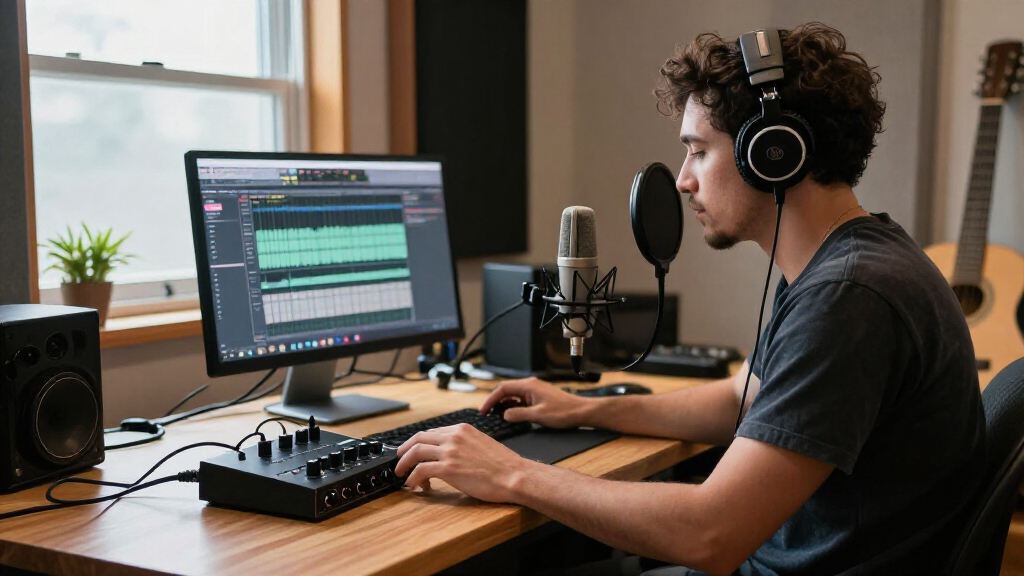
I ranked these USB audio interfaces for home studios by how well each matches common recording setups, not by feature count alone. I weighed the number and type of inputs, usefulness for recording vocals and instruments, suitability for solo or simultaneous recording, connection flexibility, and the practical value of included equipment. A model designed for a single microphone should not outrank a genuinely useful two-input option for buyers recording duets or instruments alongside vocals.
Usability and fit shaped the order: familiar desktop interfaces and clearly defined recording bundles rank ahead of less established options when they offer a more predictable path for a typical home studio. I also accounted for tradeoffs such as paying for accessories a buyer may not need, choosing a previous-generation model, or selecting a mobile-oriented device for a computer-first setup. Because the listed products cover different use cases, the ranking reflects usefulness to a broad range of home-studio buyers while the recommendations identify where each alternative makes more sense.
| USB audio interfaces for home studio | Connectivity |
|---|---|
| Focusrite Scarlett Solo 4th Ge | USB-C |
| Focusrite Scarlett Solo 3rd Ge | USB |
| Focusrite Scarlett Solo 4th Ge | USB-C |
| Focusrite Scarlett 2i2 Studio | USB-C |
| XTUGA Q-12 USB Audio Interface | USB |
| M-Audio M-Track Solo USB Audio | — |
| Mackie Onyx Artist 1×2 USB Aud | USB 2.0 |
| MAONO P1 USB Audio Interface f | USB; dual USB connectivity |
| M-Audio M-Track Duo USB Audio | — |
| LyxJam 2×2 USB Audio Interface | — |
| MAONO P2 Hybrid USB Audio Inte | USB-C |
| BOMGE 22M 2-Channel USB Audio | USB |
| Focusrite Scarlett 2i2 4th Gen | USB-C |
| Focusrite Scarlett Solo Studio | USB-C |
| PreSonus AudioBox USB 96 Studi | USB |
Factors to Consider When Choosing USB Audio Interfaces For Home Studios
Before choosing an interface, I’d map the recording setup you want to use—not just the equipment you already own. These factors help prevent common mismatches, like buying too few inputs or paying for a bundle that adds gear you will replace.
Count Sources You Need to Record at the Same Time
Count the sources you may want to capture simultaneously, rather than the total number of microphones or instruments you own. A singer who records vocals and guitar in separate passes can often work with one input, while recording both together calls for separate inputs and control over each signal. The same applies to two-person podcasts: two microphones need independent inputs if you want to adjust their levels separately. Buying an interface with too few inputs can force workarounds or an early replacement. Buying far more inputs than your sessions need can leave useful capacity unused. I’d choose around your likely recording routine, with a modest allowance for a second source if collaboration is part of the plan.
Match Inputs to Your Microphones and Instruments
Input count alone does not tell you whether an interface suits your gear. Check that it has the right connections for your microphones and instruments, and confirm whether phantom power is available if your microphone requires it. A guitar or bass may need an instrument input rather than a standard line input to produce a suitable level. Avoid assuming that a connector accepting a cable guarantees the interface has the input mode you need. If you record several kinds of sources, look for clear switching or controls that make each input type easy to use. A simple interface with the right connections is often more useful than a larger model with a confusing workflow.
Choose a Computer-First or Mobile-First Workflow
Think about where recording and monitoring will happen most often. A desktop interface is a natural fit for a computer-based studio, while a phone-oriented model may be more appealing for portable recording, streaming, or a setup shared across devices. Check the connection requirements for the specific computer, phone, or tablet you own; a USB connection does not by itself guarantee compatibility with every device. Also account for power, adapters, and monitoring needs when recording away from a desk. Buyers sometimes select a mobile-friendly unit for a computer studio and then discover they do not need its extra routing. Choose the workflow first, then compare interfaces designed to support it.
Treat Bundles as a Shortcut, Not an Automatic Saving
A bundle can reduce setup friction by grouping an interface with a microphone, headphones, monitors, or other studio gear. Its value depends on whether those items match your room, recording style, and quality expectations. For example, bundled monitors take up space and need a suitable listening position; they may not help someone who records quietly on headphones. Check the exact contents rather than relying on a bundle name, and identify which accessories you would otherwise buy. A package can be a sensible first setup when its components work together, but a standalone interface gives you more control over each purchase. I’d prioritize the interface’s inputs and workflow before letting a long accessory list decide.
Plan for Monitoring and Your Recording Space
An interface is only one part of a usable home studio: you also need a way to hear recordings clearly and a space that does not mask problems. Decide whether headphones, speakers, or both will be your main monitoring method, then check that the rest of your setup supports it. Room reflections and background noise can affect recordings more than small differences between interfaces, particularly for vocals. A large bundle cannot correct a noisy room, and extra equipment may add clutter before it improves results. Start with a quiet recording position and reliable monitoring, then add accessories as a real need appears. This approach helps keep the interface choice grounded in the limits of the room.
Weigh Familiar Controls Against Minimal Cost
Clear controls and predictable setup matter when recording time is limited or you are learning how gain and monitoring work. A minimal interface may cover the basics, but check whether its controls make input selection, level adjustment, and listening straightforward. Also confirm computer compatibility and the included software or setup information before buying; unfamiliar products can require extra research. Paying more can make sense when it buys inputs you will use, a workflow that better fits your sessions, or a more complete setup. It makes less sense when the added features duplicate equipment you already own. I’d compare the actual recording task each feature solves rather than treating a longer feature list as proof of a better fit.
Frequently Asked Questions
Should I buy a one-input interface or a two-input model?
Choose one input if you normally record a single microphone or instrument at a time and are happy to overdub separate parts. Two inputs give you room to capture a singer and instrument together, record two microphones, or work with another person in one session. Among these picks, the Scarlett Solo suits a one-source workflow, while the Scarlett 2i2 and M-Track Duo offer more flexibility for simultaneous recording. Consider how you actually perform: some musicians prefer playing and singing together, even if they could record each part separately. If that describes you, the second input can prevent a frustrating limitation.
Is a bundle a better first purchase than an interface by itself?
A bundle can be a practical starting point if you need several items at once and expect to use what is included. It is not automatically the better choice if you already own headphones, a microphone, or speakers that suit your needs. Check the package contents and think about which pieces you would choose independently. A Focusrite or PreSonus recording kit may simplify buying a complete setup, while a standalone interface leaves more room to select gear gradually. I’d compare usefulness item by item rather than judging a bundle by how much equipment it contains.
Can I use a USB audio interface with my phone or tablet?
Some interfaces are aimed at mobile use, but compatibility depends on the device, operating system, connection, and power requirements. The MAONO P1 and P2 are the mobile-focused options in this roundup; conventional desktop models are more directly aimed at computer recording. Before buying, check the manufacturer’s compatibility details for your exact phone or tablet and whether you need an adapter or external power. Also decide whether the interface supports the monitoring and microphone setup you want while mobile. A product described as USB does not automatically work with every USB-equipped device.
Do I need phantom power for a home-studio microphone?
Phantom power is needed by many condenser microphones, but not every microphone requires it. Check your microphone’s specifications before choosing an interface, and verify that the interface supplies phantom power if your mic needs it. The BOMGE 22M is listed with 48V phantom power, while other models should be checked against their own specifications and intended microphone types. Do not choose based on the label alone: the input connection and gain range also need to suit the microphone. If you have not picked a mic yet, selecting the mic and interface as a compatible pair can avoid an unnecessary mismatch.
Is a previous-generation interface still a sensible choice?
It can be, if the older model has the inputs and controls your recording setup needs and works with your current computer. The Scarlett Solo 3rd Gen remains a potential one-input choice, while the 4th Gen Solo is the newer alternative in this lineup. Compare the features that affect your actual sessions rather than assuming a newer generation is required. Check software and operating-system support as part of the decision, especially if you plan to keep the interface for several years. If you are choosing between generations, pay particular attention to any differences in connections, controls, and bundled software.
Conclusion
For most home studios, my best overall pick is the Focusrite Scarlett 2i2 4th Gen, because two inputs handle more common recording situations than a solo-input model. The M-Audio M-Track Duo is my best value-style choice for buyers who want a straightforward two-input interface, while the Scarlett Solo 4th Gen is my best pick for beginners who record one source at a time and want a simpler setup. For a more complete first studio, I’d compare the Focusrite Scarlett 2i2 Studio bundle and PreSonus AudioBox USB 96 Studio bundle against the gear you already own; the LyxJam package is aimed at buyers seeking a broader collection of included equipment. The MAONO P1 or P2 makes more sense for mobile-oriented recording, while the XTUGA Q-12 and BOMGE 22M merit a closer compatibility check before purchase. Choose by simultaneous input needs first, then weigh bundles and portability against the simplest interface that supports your recording routine.