
Affordable home security systems range from basic siren-and-sensor kits to app-connected systems with optional professional monitoring. My best overall pick is the SimpliSafe 8 Piece Wireless Home Security System, which balances a familiar DIY setup with monitoring flexibility. The Ring Alarm 14-Piece Kit stands out for broader sensor coverage, while the X-Sense 5-Piece Set suits buyers who want a smaller app-connected starter kit. The main tradeoff is between low ongoing costs and services such as professional monitoring, alongside choosing a system that covers every entry point without paying for unused devices. Read on for the full breakdown, buying advice, and answers to common questions.

Get audio and creator gear delivered free with Prime
- Fast, free delivery on millions of items
- Prime Video, Amazon Music and more included
- Member-only deals all year
Complete the kit


Key Takeaways
- SimpliSafe is the clearest all-around choice in this lineup for shoppers who want a recognizable DIY alarm system and the option to add monitoring, rather than a siren-only kit.
- Ring’s 14-piece kit favors broader coverage, while the 8-piece kit is a better fit for smaller homes or buyers who want to start with fewer sensors.
- X-Sense offers a compact app-connected starting point; its five-piece set is less suited to homes with many doors and windows unless you plan to expand coverage.
- Several generic WiFi and WiFi-plus-cellular kits emphasize low ongoing costs, but buyers should verify app support, cellular service terms, sensor expansion, and backup behavior before choosing one.
- The camera options serve different jobs from alarm kits: GMK’s four outdoor cameras focus on exterior video coverage, while AOQEE’s two plug-in cameras are better suited to fixed indoor monitoring.



| affordable home security system | Connectivity | Power source | Maximum range |
|---|---|---|---|
| WiFi Security Alarm System Kit | Wireless; Wi-Fi | Battery powered | — |
| SimpliSafe 8 Piece Wireless Ho | Wireless | Battery powered | — |
| X-Sense Smart Home Security Sy | Wireless; 2.4 GHz Wi-Fi | Battery powered | — |
| Ring Alarm 14-Piece Kit | Ethernet, Wi-Fi, Z-Wave, Bluetooth, cellular backup | — | — |
| GMK Security Cameras Wireless | — | — | — |
| Cove 6 Piece DIY Home Security | Wireless | Battery powered | 150 feet |
| 2026 Home Security System | WiFi and GSM/4G | Battery powered | 100 meters |
| Ring Alarm 8-Piece Kit | Ethernet, Wi-Fi, Z-Wave, and Bluetooth | — | — |
| Home Security System Wireless | Wireless; requires 2.4GHz WiFi | Battery powered | 10 meters |
| PGST Wireless Home Alarm Syste | WiFi and 4G; 5G not supported | AC/DC | 300 feet |
| Wireless Alarm System for Home | Wi-Fi and GSM / 4G LTE | — | 330 feet |
| Home Security System | Wi-Fi and GSM | — | 50 feet |
| AOQEE 2K Cameras for Home Secu | 2.4GHz Wi-Fi | — | — |
| PGST Home Security Systems 12- | Wi-Fi and GSM/4G | — | 100 meters |
More Details on Our Top Picks
WiFi Security Alarm System Kit with 120dB Siren, Remote Control, Door Contact & Motion Sensors
I’d pick this kit for buyers who want an audible warning and app alerts without wiring a system into the house. Its 120dB siren, door contacts, motion sensors, and remote controls provide a straightforward way to cover common entry points and alert people nearby. Compared with the X-Sense 5-piece set, this kit emphasizes a stronger siren and includes 10 units, while X-Sense highlights Alexa compatibility and expandable sensors. The tradeoff is that this system depends on Wi-Fi for full functionality, and the provided information does not describe professional monitoring. Its sensor count may also fall short in a larger home, and setup can take more effort than the simple wireless format suggests. I’d choose it for basic local deterrence, not as a substitute for monitored security.
Pros:- 120dB siren provides a forceful audible warning
- Wireless installation avoids wall damage
- Includes door contacts, motion sensors, and remote controls
- App control and notifications support remote awareness
Cons:- Full functionality depends on a Wi-Fi connection
- The 10-unit kit may not cover larger homes without expansion
- Setup may be complex for buyers who want a simple guided installation
Best for: Renters or homeowners seeking a wireless alarm with a loud siren, remote controls, and app alerts for a modest number of entry points
Not ideal for: Owners of larger properties who need extensive sensor coverage or buyers who want professional monitoring or protection that does not rely on Wi-Fi
- Power source:Battery powered
- Connectivity:Wireless; Wi-Fi
- Controls:App and remote
- Audible alarm:120 dB
- Sensor technology:IR and motion sensor
- Alert type:Audio and motion
- Compatible device:Smartphone
- Unit count:10
Our verdict“Choose this kit for loud, app-controlled DIY deterrence across a limited number of entry points, but skip it if you need monitoring or broad coverage out of the box.”
SimpliSafe 8 Piece Wireless Home Security System – No Contract, Compatible with Alexa and Google Assistant
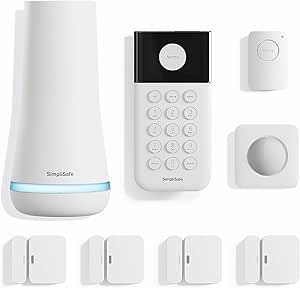
The SimpliSafe 8-piece system is the strongest fit here for buyers who want a path from DIY setup to professional monitoring. Its entry and motion sensors, keypad, and base station make a more structured alarm setup than the basic siren-focused WiFi Security Alarm System Kit, and the base station includes backup power. Alexa and Google Assistant compatibility also gives it broader smart-home support than the X-Sense 5-piece set, which lists Alexa compatibility only. The key tradeoff is ongoing cost: professional monitoring requires a subscription, so the no-contract positioning does not mean every service is included. The listed motion sensors are also not designed for pets over 60 pounds, and availability is limited to the US. I’d favor it when monitoring options matter more than avoiding recurring service fees.
Pros:- Wireless setup avoids wiring and drilling
- Supports professional monitoring services
- Works with Alexa and Google Assistant
- Base station includes backup power
Cons:- Professional monitoring requires a subscription
- Motion sensors are not intended for pets over 60 pounds
- Listed availability is limited to the US
Best for: US households that want easy wireless installation, smart-assistant support, and the option to add professional monitoring
Not ideal for: Households with pets over 60 pounds or buyers who want professional monitoring without a recurring subscription
- Power source:Battery powered
- Connectivity:Wireless
- Audible alarm:95 dB
- Backup battery life:24 hours
- Smart-home compatibility:Alexa and Google Assistant
- Video capture resolution:720p
- Voltage:12 volts
- Battery cell type:Alkaline
Our verdict“Pick SimpliSafe if you want a DIY alarm with a clear option for professional monitoring, and skip it if subscription costs or large pets make that setup a poor fit.”
X-Sense Smart Home Security System, Wireless 5-Piece Set with App Alerts and Alexa Compatibility
For a compact alarm setup, I’d start with the X-Sense 5-piece set. Its keypad, base station, and sensors suit buyers who want to monitor a few doors or windows without installing a larger kit. Pre-pasted installation can reduce hassle for renters, while the app and Alexa support add convenient control. Compared with the 10-unit WiFi Security Alarm System Kit, X-Sense offers fewer pieces and does not advertise the same 120dB siren; its appeal is a smaller, expandable starter setup rather than a loud deterrent kit. It is also less suited than SimpliSafe to shoppers seeking an explicit professional-monitoring option, since none is listed. Check your router before buying: it supports only 2.4 GHz Wi-Fi, and its batteries will eventually need replacement.
Pros:- Five-piece kit suits a small starter setup
- Pre-pasted installation supports DIY placement
- App control and alerts enable remote access
- Expandable with additional sensors
Cons:- Works with 2.4 GHz Wi-Fi, not 5.0 GHz
- No professional-monitoring option is specified
- Battery replacement is needed over time
Best for: Apartment residents or first-time DIY buyers who need app alerts and basic monitoring for a small number of doors or windows
Not ideal for: Buyers with only a 5.0 GHz Wi-Fi network or households that require listed professional monitoring
- Power source:Battery powered
- Connectivity:Wireless; 2.4 GHz Wi-Fi
- Unit count:5
- Installation:Pre-paste
- Controls:Mobile app and Alexa
- Sensor technology:Motion sensor
- Antenna location:Indoor
- Dimensions:11.4 x 8.3 x 2 inches
Our verdict“Choose X-Sense for a modest, expandable DIY alarm with app and Alexa control, but look elsewhere if your Wi-Fi is 5 GHz-only or monitoring is a priority.”
Ring Alarm 14-Piece Kit (Newest Model) – Wireless Smart Home Security System with Mobile App Control and Alexa Compatibility
Among the alarm kits here, the Ring Alarm 14-piece kit is the clearest match for a 2–4 bedroom home that needs sensors across several rooms and entry points. Its included keypads, contact sensors, motion detectors, and range extender offer a broader starting layout than the SimpliSafe 8-piece system or the compact X-Sense 5-piece set. Connectivity options also include Ethernet, Wi-Fi, Z-Wave, Bluetooth, and cellular backup, giving the base station more connection paths than the Wi-Fi-dependent alarm kits. The tradeoff is that the advertised professional monitoring and Alexa voice control require a subscription, and some functions may need extra accessories or plans. This is an indoor alarm system, not a set of outdoor cameras. I’d choose it for coverage and expansion, not for a subscription-free setup.
Pros:- 14-piece kit provides a broad starting set of components
- Includes a range extender for wider sensor coverage
- Supports Ethernet, Wi-Fi, Z-Wave, Bluetooth, and cellular backup
- Can expand with additional sensors and accessories
Cons:- Professional monitoring and Alexa voice control require a subscription
- Some features may need additional accessories or plans
- Designed for indoor security rather than outdoor monitoring
Best for: Households in 2–4 bedroom homes that need a larger sensor layout, app alerts, and room to expand the alarm system
Not ideal for: Buyers who want professional monitoring or Alexa voice control without a subscription, or anyone seeking outdoor camera coverage
- Included accessories:Keypad, contact sensors, motion detectors, range extender
- Connectivity:Ethernet, Wi-Fi, Z-Wave, Bluetooth, cellular backup
- Backup:Rechargeable, 24-hour backup
- Base station power:100–240V, 50/60Hz
- Security modes:Disarmed, Away, Home
- Installation:Wall mount or flat surface
- Operating conditions:-4°F to 104°F (-20°C to 40°C)
- Base station dimensions:6.65 x 6.65 x 1.46 inches
Our verdict“Choose Ring for a larger, expandable indoor alarm setup with multiple connection options, but account for subscription requirements before relying on its monitored or voice-control features.”
GMK Security Cameras Wireless Outdoor 4 Pack, 2K Battery Powered Cameras for Home Security, Color Night Vision, Motion Detection, 2-Way Talk, IP65 Waterproof, Remote Access, Cloud/SD Storage
This four-camera set serves a different purpose from the alarm kits: it gives buyers outdoor video coverage rather than a keypad-and-sensor alarm network. Its 2K resolution, color and infrared night vision, motion alerts, and two-way talk can help identify activity and let you communicate near a camera. The Ring Alarm 14-piece kit is a better match for monitoring doors and motion across a home with an alarm base station; GMK is the more direct pick when views of several outdoor areas matter most. Battery power and IP65 weather resistance simplify placement, but battery life is listed as one to six months on standby and will vary with activity. It also requires 2.4 GHz Wi-Fi. I’d treat it as camera coverage, not a full replacement for an alarm system.
Pros:- Four cameras can cover multiple outdoor areas
- 2K video with full-color and infrared night vision
- Battery-powered setup avoids outdoor power wiring
- IP65 weather resistance and two-way talk add practical outdoor utility
Cons:- Supports 2.4 GHz Wi-Fi only
- Battery life varies with use and motion triggers
- Camera coverage does not provide the same alarm-system functions as Ring Alarm or SimpliSafe
Best for: Homeowners who want several outdoor camera views, motion alerts, and two-way talk without running power cables
Not ideal for: Buyers who need a keypad-based alarm system, depend on 5 GHz Wi-Fi, or want a fixed battery replacement schedule
- Camera resolution:2K, 3 MP
- Night vision:Full color and infrared
- Power:Rechargeable battery
- Battery life:1–6 months standby
- Wi-Fi:2.4 GHz only
- Weather resistance:IP65
- Storage:Cloud and SD card
- Included cameras:4
Our verdict“Choose GMK when outdoor video and two-way communication matter more than an integrated alarm, and skip it if you need a standalone sensor-and-keypad security system.”
Cove 6 Piece DIY Home Security System with 3-Month Monitoring
Cove’s clearest value is its included three months of professional monitoring, giving buyers a chance to try a monitored setup before deciding whether to keep paying for the service. The tool-free installation and app-based control also make it more approachable than systems that call for a more involved setup. Unlike the PGST 8-Piece Kit, which emphasizes no recurring monitoring fees, Cove’s ongoing cost depends on whether you continue with a paid plan after the trial. The kit includes an indoor camera, but its supplied sensors and indoor focus may not cover a larger home or outdoor entry points without added devices. I’d choose Cove for a renter or first-time buyer who wants guided, monitored protection with room to expand; I’d skip it if avoiding future subscriptions is the main goal.
Pros:- Tool-free DIY installation with step-by-step guidance
- Three months of professional monitoring included
- Can be expanded with additional compatible devices
- Remote system management through the Cove app
Cons:- Professional monitoring requires a paid plan after the included three months
- The included sensors and camera provide limited coverage for larger homes
- The camera is for indoor use, leaving outdoor areas to separate equipment
Best for: Renters or first-time system owners who want a simple DIY setup and a short professional-monitoring trial before choosing a longer-term plan.
Not ideal for: Households that want to avoid recurring monitoring costs or need outdoor coverage from the included equipment.
- Included devices:Wireless alarm hub, sensors, and indoor camera
- Monitoring:Three months of professional monitoring included
- Power source:Battery powered
- Connectivity:Wireless
- Video resolution:1920 × 1080
- Alerts:Audio and motion
- Maximum range:150 feet
- Compatible devices:Android and iOS devices
- Dimensions:7 × 6 × 4 inches
Our verdict“Choose Cove if you want an easy DIY kit with a limited professional-monitoring trial, but compare it with the PGST 8-Piece Kit if recurring fees are a deal-breaker.”
2026 Home Security System, 7-Piece Wireless Smart Alarm Kit with App Alerts & WiFi+GSM/4G, Alexa Compatible
This seven-piece kit is aimed squarely at compact homes, where a modest sensor set and app-based control can cover the main entry points without a more extensive system. Its motion detection, instant alerts, and Alexa compatibility give it useful day-to-day convenience, while the listed 100-meter maximum range offers flexibility for sensor placement. That makes it a simpler small-home alternative to the Ring Alarm 8-Piece Kit, whose range extender and broader connectivity options better suit buyers who want more established expansion paths. The tradeoff is that this system is specified for one- to two-bedroom homes and depends on WiFi or 4G connectivity; buyers should check which connection is available and how the system behaves if it drops. I’d shortlist it for a compact apartment, not a larger or connectivity-sensitive property.
Pros:- Seven-piece wireless kit includes sensors, motion detectors, remotes, and a base station
- Mobile app supports remote control and instant alerts
- Alexa compatibility adds voice-control convenience
- Expandable with additional sensors and cameras
Cons:- Designed for small homes, so the included kit may not cover a larger layout
- Operation depends on WiFi or 4G connectivity
- The supplied information does not specify professional monitoring
Best for: People in one- or two-bedroom apartments who want wireless sensors, app alerts, and Alexa control without assembling a large system.
Not ideal for: Owners of larger homes or buyers who need dependable operation where WiFi or 4G service is unreliable.
- Kit size:7 pieces
- Connectivity:WiFi and GSM/4G
- Power source:Battery powered
- Sensor technology:PIR motion detection
- Alerts:Audible and visual
- Control method:App
- Maximum range:100 meters
- Dimensions:7 × 3.1 × 3 inches
- Weight:7.2 ounces
Our verdict“This is a practical fit for a compact apartment that needs app-controlled entry and motion alerts, while larger homes are better served by a broader kit such as Ring Alarm 8-Piece.”
Ring Alarm 8-Piece Kit (Newest Model) – Home & Business Security System with Optional 24/7 Professional Monitoring
Ring Alarm’s advantage is its combination of a familiar app, flexible connectivity, and room to add devices. The eight-piece kit includes a keypad, contact sensors, motion detector, base station, and range extender, so it has a more defined coverage setup than the smaller Cove 6 Piece kit. Ethernet, Wi-Fi, Z-Wave, and Bluetooth support give it more connection options, while the range extender can help sensors reach the base station across a home. Mobile notifications and Alexa compatibility suit households already using Ring or Amazon smart-home devices. The affordability tradeoff is that professional monitoring and some features require paid plans, so the kit is not a fully fee-free route to monitored protection. Its stated fit is one- to two-bedroom homes, and the system is intended for indoor security.
Pros:- Eight-piece kit includes a keypad, contact sensors, motion detector, and range extender
- Ring app provides mobile notifications and remote control
- Supports Ethernet, WiFi, Z-Wave, and Bluetooth
- Optional professional monitoring and Alexa compatibility
Cons:- Professional monitoring requires a subscription
- Some features require additional paid plans
- Designed for indoor use and smaller homes
Best for: Ring or Alexa households in a one- or two-bedroom home that want app alerts, a keypad, and the option to add sensors over time.
Not ideal for: Buyers seeking professional monitoring without a subscription, outdoor protection in the box, or coverage for a large property.
- Kit size:8 pieces
- Connectivity:Ethernet, Wi-Fi, Z-Wave, and Bluetooth
- Base station power:100–240V, 50/60Hz
- Battery backup:Rechargeable, up to 24 hours
- Security modes:Disarmed, Away, and Home
- Installation:Wall mount or flat surface
- Base station dimensions:6.65 × 6.65 × 1.46 inches
- Operating conditions:-4°F to 104°F (-20°C to 40°C)
Our verdict“Choose Ring Alarm if app control and expandable coverage matter more than avoiding subscriptions; Cove’s included monitoring trial may suit buyers who want to sample monitoring first.”
Home Security System Wireless, Smart WiFi Alarm Kit with 120dB Siren, Door & Window Sensors, Remote Control, App Alerts, Compatible with Alexa & Google Home
Alexa and Google Home compatibility set this WiFi alarm apart for households that want one basic system to fit into either smart-home setup. Its 120dB siren, door and window sensors, app alerts, and remote control focus on straightforward intrusion warnings rather than professional monitoring. The system supports up to 100 accessories, giving buyers a way to add coverage as needs change—more flexible on paper than the fixed starter setup of the 2026 seven-piece kit. That expansion potential comes with a network caveat: it requires 2.4GHz WiFi, does not support 5GHz, and the stated wireless range is only 10 meters. Battery-powered operation also means keeping replacement batteries on hand. I’d pick it for a small home with a suitable router and compatible smart speakers, but not for a property where sensors must communicate across long distances.
Pros:- 120dB siren provides a loud local alarm
- Supports up to 100 accessories for future expansion
- Works with Alexa and Google Home
- Self-adhesive installation avoids wiring
Cons:- Requires 2.4GHz WiFi and does not support 5GHz networks
- Listed maximum range is 10 meters, which may restrict sensor placement
- Battery-powered components need periodic battery replacement
Best for: Smart-home users with a 2.4GHz WiFi network who want a loud local siren, app alerts, and compatibility with Alexa or Google Home.
Not ideal for: Homes with only 5GHz WiFi, large layouts that exceed the stated range, or buyers seeking included professional monitoring.
- Power source:Battery powered
- Connectivity:Wireless; requires 2.4GHz WiFi
- Compatible devices:Alexa and Google Home
- Siren:120dB
- Maximum range:10 meters
- Installation:Self-adhesive
- Dimensions:6.3 × 3.94 × 1.18 inches
- Weight:136 grams
- Voltage:5 volts
Our verdict“Choose this kit for smart-speaker integration and expandable sensor coverage in a small WiFi-connected home, but favor the Ring Alarm 8-Piece Kit if broader connectivity options matter more.”
PGST Wireless Home Alarm System 8-Piece Kit, WiFi/4G Alarm System for Home Security with Phone APP Alert (Door Sensor,Siren, Remote, Motion Detector) for Home,Apartment, Compatible with Alexa(105-A)
PGST’s strongest affordability argument is its stated no-monthly-fee setup: it relies on the Smart Life app, push alerts, and a 120dB siren rather than requiring a monitoring plan. The eight-piece kit includes door sensors, a motion detector, a siren, and a remote, and it can support up to 99 sensors and five remotes as coverage grows. Compared with Cove’s 6 Piece kit, PGST avoids the paid-plan decision after an included monitoring period, but it does not offer the same stated professional-monitoring trial. WiFi and 4G connectivity add flexibility, though the product notes that 5G is not supported; the listed battery average life is eight hours, so backup duration deserves attention. I’d choose it for a fee-conscious household comfortable relying on app alerts and a local alarm.
Pros:- Advertised with no monthly fees for the alarm system
- 120dB siren and Smart Life app push alerts
- Supports up to 99 sensors and five remotes
- Offers WiFi/4G connectivity and Alexa voice control
Cons:- No professional monitoring is specified
- Does not support 5G networks
- Listed average battery life is eight hours
Best for: Budget-focused apartment or home residents who want an expandable alarm with app alerts and no stated monthly monitoring fee.
Not ideal for: Buyers who want professional monitoring included, need 5G network support, or expect long battery backup during an outage.
- Kit size:8 pieces
- Connectivity:WiFi and 4G; 5G not supported
- Power source:AC/DC
- Siren:120dB
- Maximum range:300 feet
- Battery average life:8 hours
- Control methods:App, push button, remote, and voice
- Smart-home compatibility:Alexa
- Expandable capacity:Up to 99 sensors and 5 remotes
Our verdict“Pick PGST if avoiding recurring monitoring fees is your priority and app alerts are enough; choose Cove instead if you want a professional-monitoring trial.”
Wireless Alarm System for Home Security, 24 Pcs WiFi+4G, No Monthly Fees
For buyers who want to cover many doors and rooms without adding a monthly monitoring bill, this 24-piece kit offers the broadest sensor package among these four picks. Its Wi-Fi and 4G connectivity can keep alerts moving if the home internet drops, though the 4G feature requires a separately purchased SIM card. Compared with the PGST 12-piece kit, this system supplies more sensors and a longer stated range, making it a better fit for a larger layout; the tradeoff is a more involved setup and reliance on the Smart Life or Tuya app ecosystem. The keypad, app controls, voice-assistant support, and backup battery add useful ways to manage the alarm, but this is not the simplest choice for someone who wants a quick, uncomplicated starter kit.
Pros:- 24-piece kit supports coverage across more doors and rooms than the smaller kits here.
- Wi-Fi and 4G connectivity provide an alternative alert path when home internet is unavailable.
- No monthly fees are required, according to the product description.
- Includes a 48-hour backup battery, keypad, app control, and voice-assistant support.
Cons:- A SIM card is not included, adding a separate setup step for 4G use.
- Setup may be complex for buyers who want a straightforward alarm kit.
- App support is limited to Smart Life and Tuya ecosystems.
Best for: Households that want to cover multiple entrances and rooms with a large DIY sensor kit and no recurring subscription.
Not ideal for: Buyers who want a simple setup, do not want to purchase a separate SIM card, or prefer an app outside the Smart Life and Tuya ecosystems.
- Kit size:24 pieces
- Connectivity:Wi-Fi and GSM / 4G LTE
- Alert types:Audible alarm, push notification, and SMS alert
- Maximum range:330 feet
- Audible alarm:110 dB
- Sensor types:Magnetic contact, passive infrared (PIR), and RFID
- Power:AC adapter with battery backup
- Installation:DIY self-installation
Our verdict“Choose this kit if you need extensive sensor coverage and can handle a more involved setup and separate SIM purchase.”
Home Security System, 8-Piece WiFi/GSM Alarm Kit with Motion Detector and Alexa Compatibility
This 8-piece alarm kit suits buyers who want a compact setup with a dedicated touchscreen rather than relying mainly on a phone app. The 2.4-inch panel, motion detector, door and window contacts, and 120 dB siren provide a clear starter configuration, while app, remote, touch, and voice controls give household members several ways to manage it. Compared with the much larger 24-piece WiFi+4G system, it covers fewer points and is less suited to a home with many entrances; its smaller kit can be easier to place in a modest home. The listed 50-foot range and 2.4GHz Wi-Fi requirement also narrow its fit, and the description does not specify included monitoring. I’d skip it if you need broad sensor coverage or depend on a 5GHz-only network.
Pros:- Touchscreen panel provides a central control point beyond app-only operation.
- Includes motion and door/window sensors in an 8-piece kit.
- Supports app, remote, touch, and voice control.
- 120 dB siren supplies a strong local alert.
Cons:- The 8-piece kit may need expansion to cover larger homes.
- Requires 2.4GHz Wi-Fi and is incompatible with 5GHz-only networks.
- Listed maximum range is 50 feet, which limits placement flexibility.
Best for: Residents of apartments or smaller homes who want a dedicated touchscreen panel and several control options in a modest alarm kit.
Not ideal for: Owners of larger homes who need many sensors, or households whose Wi-Fi network does not support 2.4GHz.
- Kit size:8 pieces
- Control panel:2.4-inch HD touchscreen
- Connectivity:Wi-Fi and GSM
- Siren:120 dB
- Maximum range:50 feet
- Control methods:App, remote, touch, and voice
- Battery average life:3 years
- Dimensions:6.61 x 3.27 x 3.27 inches
Our verdict“Pick this kit for a smaller home where touchscreen controls matter more than extensive sensor coverage.”
AOQEE 2K Cameras for Home Security-Outdoor/Indoor Camera for Dog/Cat/Pet/Nanny/Baby/Elderly, Color Night Vision, White Light, Siren, 24/7 SD Recordings, Works with Alexa, Plug in (C1-White-2pack-2.4G)
Unlike the alarm kits in this roundup, this two-camera set focuses on seeing and speaking to people or pets rather than building a sensor-based entry alarm. Its 2K video, color night vision, motion alerts, two-way audio, and built-in siren make it a practical choice for checking a yard, entryway, nursery, or pet area from a phone. The IP65 rating supports outdoor placement, and local recording is available with a separately purchased microSD card, reducing reliance on cloud storage. Compared with the 8-piece touchscreen alarm kit, AOQEE gives you visual monitoring and recorded footage but does not provide the same collection of door and window contacts. Both cameras need power, and the 2.4GHz Wi-Fi requirement and optional cloud service may not suit every home.
Pros:- Two cameras provide coverage at separate indoor or outdoor locations.
- 2K resolution and color night vision support clearer viewing in low light.
- Two-way audio and a siren allow direct interaction and a local deterrent.
- Supports continuous SD recording and optional cloud storage.
Cons:- Plug-in power limits placement where outlets are unavailable.
- MicroSD card is not included, and cloud storage is optional.
- Camera monitoring does not replace a multi-sensor alarm kit.
Best for: Renters and homeowners who want indoor or outdoor video checks for entrances, pets, or family members without starting with a full alarm sensor kit.
Not ideal for: Buyers seeking a complete door-and-window alarm system, battery-powered cameras, or a setup that works on 5GHz Wi-Fi only.
- Camera quantity:2
- Resolution:2K
- Placement:Indoor and outdoor
- Weather resistance:IP65
- Night vision:Color night vision with white light
- Audio:Two-way talk
- Local storage:TF / microSD card up to 128 GB; card not included
- Connectivity:2.4GHz Wi-Fi
Our verdict“Choose AOQEE if video, two-way communication, and local recording matter more than door and window alarm coverage.”
PGST Home Security Systems 12-Piece Kit, WiFi + GSM/4G, Smart App Control, Alexa Compatible
The 12-piece PGST kit lands between the eight-piece touchscreen system and the 24-piece WiFi+4G alarm: it offers more room for sensor placement than the former without the larger kit’s stated scale. Its wireless setup, app control, Alexa compatibility, and 4G fallback are appealing for households that want remote alerts and an alternative connection without a monthly subscription. A 110 dB alarm and stated 100-meter maximum range suit a small or medium home, though those figures do not solve the main limitation: the kit is not positioned for extensive properties, and extra sensors or cameras must be purchased separately. Unlike the touchscreen-led 8-piece option, this model emphasizes app control. Battery power avoids a fixed installation point, but owners should plan for battery replacement.
Pros:- 12-piece kit provides a middle ground between smaller starter sets and larger sensor bundles.
- Wi-Fi with GSM/4G fallback supports connectivity if the primary network is interrupted.
- Wireless installation and app control avoid a fixed control location.
- No monthly fees or subscriptions are listed.
Cons:- Additional sensors and cameras require separate purchases.
- Product description limits its intended fit to small and medium homes.
- Battery-powered components may need replacement over time.
Best for: People in small or medium homes who want a wireless app-controlled alarm, Alexa support, and 4G fallback without a subscription.
Not ideal for: Owners of large homes who need extensive included sensor coverage, or buyers who want cameras and add-on sensors in the initial kit.
- Kit size:12 pieces
- Connectivity:Wi-Fi and GSM/4G
- Control:App control
- Voice assistant:Alexa compatible
- Maximum range:100 meters
- Audible alarm:110 dB
- Sensor technology:PIR motion detection
- Power:Battery powered
Our verdict“Choose the PGST 12-piece kit if you want a mid-size, subscription-free alarm for a small or medium home and are comfortable adding components later.”

How We Picked
I compared these 14 systems by the job they can do for a household, not by the number of devices listed in a kit. The main criteria were entry-point and room coverage, setup burden, app and smart-home features, power and connectivity resilience, monitoring options, and how clearly the product information describes ongoing service needs. I also separated alarm systems from camera-only options, since video monitoring does not replace door and motion sensors.
The ranking gives more weight to clearer setup paths, useful coverage, and flexible monitoring than to a large device count alone. SimpliSafe leads as a balanced starter system; Ring’s larger kit ranks for households needing more sensors, with its smaller kit serving compact spaces. X-Sense is a simpler entry point, while the WiFi and WiFi-plus-4G kits may suit buyers focused on self-monitoring or avoiding recurring charges, provided they check compatibility and service details. Camera picks rank for targeted video needs rather than whole-home alarm coverage.
| affordable home security system | Power source |
|---|---|
| WiFi Security Alarm System Kit | Battery powered |
| SimpliSafe 8 Piece Wireless Ho | Battery powered |
| X-Sense Smart Home Security Sy | Battery powered |
| Ring Alarm 14-Piece Kit | — |
| GMK Security Cameras Wireless | — |
| Cove 6 Piece DIY Home Security | Battery powered |
| 2026 Home Security System | Battery powered |
| Ring Alarm 8-Piece Kit | — |
| Home Security System Wireless | Battery powered |
| PGST Wireless Home Alarm Syste | AC/DC |
| Wireless Alarm System for Home | — |
| Home Security System | — |
| AOQEE 2K Cameras for Home Secu | — |
| PGST Home Security Systems 12- | — |
Factors to Consider When Choosing Affordable Home Security Systems
Before choosing among affordable home security systems, map the weak points in your home and decide what you expect the system to do when something happens. A lower initial outlay can mean more self-management, fewer included sensors, or dependence on a phone and internet connection. These questions help separate a useful starter setup from a kit that looks complete but leaves important gaps.
Match Sensor Count to Your Layout
Count the doors and accessible ground-floor windows you actually want monitored, then note any hallways or rooms where motion detection makes sense. A kit with many components can still leave a key entrance uncovered if it includes remotes or accessories instead of contact sensors. For apartments, a few entry sensors may do more than a large bundle designed for several rooms. Check whether additional sensors from the same brand can be added later and whether the app can identify each one clearly. Avoid placing motion sensors where pets, heating vents, or frequent activity could cause unwanted alerts. Build coverage around likely entry routes rather than buying by piece count.
Compare Self-Monitoring With Professional Response
Self-monitoring keeps you in charge of alerts, but it also means you or another contact must notice and act on them. Professional monitoring may provide a response path when your phone is unavailable, but it can add recurring costs or require a service plan. Read what a monitoring offer actually includes: its duration, what happens after that period, and whether cellular backup or emergency dispatch requires a subscription. Do not assume a kit’s app alerts mean a monitoring center is involved. If you travel often or cannot reliably answer alerts, response coverage may matter more than avoiding a monthly fee. If you are usually nearby and comfortable managing notifications, self-monitoring may be a reasonable compromise.
Check What Happens During Internet or Power Loss
WiFi-dependent alarms can lose remote alerts or app control when the router or broadband connection fails. A system advertised with GSM or 4G may offer another communication route, but buyers should verify whether cellular service is included, requires activation, or depends on a paid plan. Ask whether the hub and sensors have battery backup and how long the system can operate without household power. A loud local siren can still help alert people nearby, but it does not by itself notify you when you are away. Treat backup claims as a specific feature to confirm, not an assumption based on a product title. Homes with unreliable internet should give this point extra weight.
Separate Alarm Coverage From Camera Coverage
Cameras can show what is happening, while contact and motion sensors can trigger an alarm when an entry is opened or a space is crossed. Buying cameras alone may leave you without a reliable entry alert, and an alarm kit may not give you video evidence. Decide whether you need deterrence, live viewing, recorded footage, or sensor-based alerts; these are related but different jobs. For outdoor cameras, check weather protection, power arrangements, storage options, and whether recording features depend on a subscription. For indoor cameras, consider privacy controls and whether the camera must remain plugged in. A blended setup can make sense, but only if the devices work together in the way you expect.
Read the Fine Print on Storage and Ongoing Costs
Claims such as no monthly fees do not always mean every feature is free: cloud video storage, cellular connectivity, or advanced app services may have separate terms. Local SD storage can reduce reliance on a cloud plan, but it may require you to retrieve footage from the device and protect the card from tampering. Check how long recordings are retained and whether alerts or playback remain available without a subscription. Also review whether the system requires a specific app account, hub, or compatible network band. These details can shape the long-term cost and convenience more than the kit’s initial contents. Choose based on the functions you will use, not on a broad no-fee claim alone.
Prioritize Usability Before Smart-Home Extras
Voice-assistant compatibility can make arming or checking status easier, but it is not a substitute for dependable alerts and clear controls. Confirm that the functions you care about—such as arming, disarming, or checking a camera feed—are supported, since compatibility can vary by device and service. Think about who else in the household needs access and whether they can manage the app without confusion. Simple installation matters too: wireless sensors can avoid wiring work, but batteries still need occasional attention. A system that is easy for everyone to use is more likely to stay active. Give core alarm controls and understandable notifications priority over a long list of connected features.
Frequently Asked Questions
Can I use an affordable alarm system without paying for professional monitoring?
Some systems let you manage alerts yourself, but the exact features available without a plan vary. Check whether app notifications, remote arming, and event history remain available without a subscription, and whether cellular backup is included or paid. Self-monitoring works best when someone can respond to alerts promptly and has a plan for contacting help. If no one will reliably see notifications, a lower ongoing cost may come with a meaningful response gap. Read the service terms for the specific kit before buying.
Is a larger sensor kit always better value for a house?
Not necessarily: a bigger bundle is useful only if its sensors match your doors, windows, and room layout. Some kits include components that do not add useful coverage for a particular home, while a smaller kit may leave a second entrance unprotected. Make a simple coverage map and check which sensor types are in the box before comparing bundles. Also confirm that compatible sensors can be purchased separately if you want to expand later. Fit matters more than the device count on the package.
Should I choose a WiFi-only kit or one with WiFi and 4G?
A WiFi-only kit may be sufficient if your internet is dependable and you are comfortable with the system’s behavior during an outage. WiFi-plus-4G can add another path for alerts, but it only helps if cellular service is supported where you live and the service terms are clear. Check whether 4G connectivity requires a subscription, whether the hub has battery backup, and which features continue during an outage. A cellular label alone does not guarantee uninterrupted monitoring. For a home with frequent broadband interruptions, verified backup may justify choosing a more capable system.
Do security cameras replace door and motion sensors?
No. Cameras provide video and may detect motion, but they do not automatically offer the same entry alerts or alarm response as a dedicated sensor system. Camera motion detection can also be affected by lighting, movement in the scene, or placement. If you want to know when a specific door or window opens, use a contact sensor designed for that job. Cameras are useful for checking activity and recording footage, so they can complement an alarm. Choose camera-only products when video is the main need, not as a substitute for every type of alarm coverage.
What should I verify before buying a system advertised as having no monthly fees?
Confirm which functions are included without payment, since app alerts, cloud recording, remote access, cellular backup, and monitoring can have separate requirements. Check whether video is saved locally or in the cloud and how long recordings remain accessible. For a WiFi-plus-4G kit, look for the cellular service terms rather than assuming that connection is free. Also see whether the system can be used without a trial or account plan ending after a set period. A no-fee claim is most useful when it matches the features you intend to rely on.
Conclusion
For most shoppers seeking a balanced DIY setup, I would start with the SimpliSafe 8 Piece Wireless Home Security System as the best overall choice. Buyers who need more entry-point coverage should compare it with the Ring Alarm 14-Piece Kit; the Ring Alarm 8-Piece Kit is a more restrained option for smaller spaces and is my best value pick for buyers who do not need as many sensors. For beginners who want a compact app-connected alarm, the X-Sense 5-Piece Set is the simplest starting point here, while SimpliSafe makes more sense if monitoring flexibility is a priority. I’d treat a WiFi-plus-4G kit as a specific-needs choice when backup connectivity or self-managed alerts matter, after checking service terms. For video-focused needs, choose GMK’s outdoor camera set for exterior coverage or AOQEE’s plug-in cameras for indoor viewing; neither is a full replacement for an alarm system.
Halloween Picks

Govee Outdoor Halloween Projector Light

Pumpkin Halloween Fog Machine with 12-Color LED Lights, Bluetooth Speaker, and Remote

Panefright Halloween Window Projector – Scary Projector for Spooky Decor
As an affiliate, we earn on qualifying purchases.