

For a camera under $250, I’d start with the Kodak PIXPRO FZ45 as the best overall pick for straightforward photos, optical zoom, and a familiar point-and-shoot design. The Kodak PIXPRO FZ55 offers a little more optical reach, while the Kodak PIXPRO C1 is a better fit for selfies and casual vlogging thanks to its flip screen. The main tradeoff is between dependable, clearly described compact-camera features and newer models that advertise higher resolution or 4K video but may offer less certainty about real-world image quality. A used DSLR such as the Sony Alpha A200K brings interchangeable-lens flexibility, but its age and bulk make it a different kind of purchase. Continue reading for the full breakdown and help matching a camera to how you plan to use it.

Get audio and creator gear delivered free with Prime
- Fast, free delivery on millions of items
- Prime Video, Amazon Music and more included
- Member-only deals all year
Complete the kit


Key Takeaways
- The FZ45 is the clearest all-rounder: its 4X optical zoom and 27mm wide-angle lens make it a sensible pick for everyday scenes, while the bundled case and memory card in one listing add convenience.
- The FZ55 and FZ45 trade reach for simplicity: the FZ55 lists 5X optical zoom, giving it an advantage for distant subjects, while both Kodak models keep the experience closer to a traditional point-and-shoot.
- The C1’s flip screen serves a specific purpose: it is the most direct match for framing selfies or on-camera clips, not necessarily the strongest choice for buyers who mainly photograph distant subjects.
- Several 4K models lean on headline specifications: their flip screens and extra accessories suit casual video experiments, but resolution and zoom claims alone do not establish lens quality or low-light performance.
- The Sony A200K is the outlier: its DSLR system and included 18–70mm lens may appeal to learners who want manual control, but age, size, and used-condition uncertainty make it less convenient than the compact picks.




| camera under 250 | Display | Battery |
|---|---|---|
| Kodak PIXPRO FZ45 Digital Came | 2.7-inch screen | — |
| Kodak PIXPRO C1 Digital Camera | 2.8-inch LCD, flips 180 degrees | Built-in lithium-ion |
| KODAK PIXPRO FZ55 16MP Compact | 2.7 inches | Rechargeable lithium-ion |
| Sony Alpha A200K 10.2MP Digita | 2.7-inch LCD | Lithium-ion |
| 4K Digital Camera for Beginner | 180-degree flip screen | — |
| Duluvulu 4K Digital Camera for | — | Two rechargeable batteries |
| 4K Digital Camera for Photogra | — | — |
| Kodak PIXPRO FZ45 Digital Came | — | — |
| Yatao 6K WiFi Flip Screen Digi | — | Two lithium-ion batteries |
More Details on Our Top Picks
Kodak PIXPRO FZ45 Digital Camera, 16MP Compact Point & Shoot, 4X Optical Zoom, 27mm Wide Angle Lens, 1080P Full HD Video, Black + Camera Case & 32GB SD Card
The FZ45 makes the most sense for a beginner who wants a straightforward camera kit without tracking down a memory card and case separately. Its 16MP sensor, 4X optical zoom, and 27mm wide-angle lens cover everyday photos and group scenes, while optical zoom retains more detail than the digital zoom on the 4K Digital Camera for Beginners & Teens. The included 32GB card means there’s storage ready for photos and 1080p clips from the start. Compared with the Kodak PIXPRO FZ55, though, the FZ45 gives up one step of optical zoom, so distant subjects are harder to frame closely. Its small screen and basic feature set also make it less suited to careful composition or creative control. I’d choose it for uncomplicated travel and family shooting, not specialized or wet-weather photography.
Pros:- 16MP sensor and 1080p video suit everyday photos and clips.
- 4X optical zoom provides genuine reach beyond the wide-angle view.
- 27mm lens is useful for group photos and travel scenes.
- Includes a camera case and 32GB SD card for a ready-to-use kit.
Cons:- 4X optical zoom offers less reach than the Kodak PIXPRO FZ55’s 5X zoom.
- No built-in viewfinder, and the 2.7-inch screen limits comfortable image review.
- Basic feature set and limited water resistance rule it out for demanding shoots.
Best for: First-time camera buyers who want an easy point-and-shoot with a case and memory card included for family outings or casual travel.
Not ideal for: Photographers who need a longer reach, advanced controls, a viewfinder, or a camera for underwater use.
- Still resolution:16MP
- Video:1080p Full HD
- Optical zoom:4X
- Lens:27mm wide angle
- Sensor:1/2.3-inch CMOS
- Display:2.7-inch screen
- Storage included:32GB SD card
- Included accessories:Camera case
- File formats:MP4, JPEG
Our verdict“Choose the FZ45 if you want a beginner-friendly camera bundle with real optical zoom and storage included.”
Kodak PIXPRO C1 Digital Camera, 13MP Compact Point & Shoot with 4X Optical Zoom, 180 Degree Flip Screen, 1080p HD Video, Black
The PIXPRO C1 is the clearest pick here for people who want to frame themselves without guessing: its 180-degree flip screen faces forward for selfies and simple vlogs. That makes it more creator-friendly than the Kodak PIXPRO FZ45, whose fixed 2.7-inch screen is better suited to composing from behind the camera. Both offer 4X optical zoom and 1080p video, but the C1 has a 13MP sensor rather than the FZ45’s 16MP, and its description doesn’t include a memory card or case. The rechargeable battery and USB charging are convenient, although battery-life details aren’t provided. This is still a basic point-and-shoot, not a feature-rich video setup, and the lack of stated image stabilization may matter for handheld clips. I’d favor it for casual face-to-camera content over maximum photo resolution.
Pros:- 180-degree flip screen makes self-framing easier for selfies and vlogs.
- 4X optical zoom gives more useful reach than digital zoom.
- 1080p video supports casual recording and social content.
- Rechargeable lithium-ion battery charges over USB.
Cons:- 13MP resolution is lower than the 16MP Kodak PIXPRO FZ45 and FZ55.
- No memory card or case is listed among the included items.
- Image stabilization and battery-life details are not specified.
Best for: New vloggers, students, and selfie-focused users who want a screen that turns toward them while recording or taking photos.
Not ideal for: Buyers prioritizing a bundled memory card, higher stated still resolution, or documented image stabilization.
- Sensor:13MP CMOS
- Optical zoom:4X
- Lens:26mm wide angle
- Display:2.8-inch LCD, flips 180 degrees
- Video:1080p HD
- Battery:Built-in lithium-ion
- Charging:USB
Our verdict“Pick the C1 if a forward-facing screen matters more to you than a bundled card or the higher resolution of the FZ45.”
KODAK PIXPRO FZ55 16MP Compact Digital Camera, 5X Optical Zoom, Black
The FZ55 edges ahead of the FZ45 for buyers who want a little more framing flexibility without leaving the compact point-and-shoot category. Its 5X optical zoom reaches farther than the FZ45’s 4X while keeping the same 16MP resolution and 1080p video, which is useful for travel details and family moments when moving closer isn’t practical. Digital image stabilization is listed, but it isn’t a substitute for a more advanced stabilization system, especially for video. The 2.7-inch screen is modest, and the FZ55 lacks Wi-Fi and Bluetooth, so transferring images won’t be as direct as on the WiFi-equipped 4K Digital Camera for Beginners & Teens. Unlike the FZ45 bundle, the listed FZ55 details don’t include a card or case. I’d rank it for optical reach, not connectivity or creator extras.
Pros:- 5X optical zoom reaches farther than the Kodak PIXPRO FZ45’s 4X zoom.
- 16MP CMOS sensor and 1080p video cover everyday photography and clips.
- Compact form and rechargeable battery suit on-the-go shooting.
- Supports SD, SDHC, and SDXC cards up to 512GB.
Cons:- No Wi-Fi or Bluetooth for direct wireless sharing.
- 2.7-inch screen is small for checking focus and fine details.
- No card or case is listed, unlike the FZ45 bundle.
Best for: Travelers and families who want a compact camera with more optical reach than a basic 4X point-and-shoot.
Not ideal for: Vloggers seeking a flip screen, buyers who expect wireless sharing, or anyone wanting an included memory card and case.
- Sensor:16MP, 1/2.3-inch CMOS
- Optical zoom:5X
- Lens:28mm wide angle
- Video:1080p Full HD
- Image stabilization:Digital
- Display:2.7 inches
- Memory support:Class 10 SD, SDHC, SDXC up to 512GB
- Battery:Rechargeable lithium-ion
Our verdict“Choose the FZ55 over the FZ45 when an extra step of optical zoom matters more than included accessories.”
Sony Alpha A200K 10.2MP Digital SLR Camera Kit with 18-70mm Lens
The Sony Alpha A200K is the outlier in this group: it trades pocketable convenience for a DSLR body, an included 18–70mm lens, and Super SteadyShot stabilization. That makes it a better fit for someone learning interchangeable-lens photography than the fixed-lens Kodak PIXPRO FZ55 or FZ45. The stabilization can help reduce blur from camera shake, while the eye-start autofocus is designed to begin focusing as you bring the camera to your eye. But this is an older model with a 10.2MP sensor and dated storage options, including CF I/II and Memory Stick Pro Duo. Unlike the compact Kodaks, it won’t be as easy to carry everywhere, and its listed specs offer no modern wireless sharing. I’d consider it only if DSLR handling and the included zoom lens matter more than simplicity and current conveniences.
Pros:- Included 18–70mm lens offers framing flexibility beyond the fixed lenses on the Kodak compacts.
- Super SteadyShot stabilization helps counter camera shake.
- Eye-start autofocus is designed to begin focusing as the camera is raised.
- DSLR controls and handling suit learners interested in a more traditional camera system.
Cons:- Older 10.2MP design has fewer modern conveniences than the compact alternatives.
- CF I/II and Memory Stick Pro Duo storage are less common than SD cards.
- DSLR body is less convenient to carry than the Kodak PIXPRO FZ45 or FZ55.
Best for: Beginners who specifically want a DSLR body and included zoom lens to learn traditional camera handling.
Not ideal for: Travelers seeking a light pocketable camera, or buyers who want modern wireless connectivity and commonly available storage.
- Resolution:10.2MP
- Included lens:18–70mm f/3.5–5.6
- Image stabilization:Super SteadyShot
- Display:2.7-inch LCD
- Autofocus:Eye-Start
- Battery:Lithium-ion
- Storage formats:CF I/II, Memory Stick Pro Duo
Our verdict“Choose the A200K only if you want DSLR handling and an included zoom lens more than a small, modern point-and-shoot.”
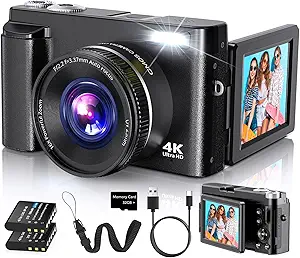
4K Digital Camera for Beginners & Teens, Autofocus Vlogging Camera with 180° Flip Screen, 18X Zoom, Easy-to-Use Compact Travel Camera, WiFi, 2 Batteries, 32GB Card
This camera packs the most creator-oriented conveniences in the group: 4K video**, a 180-degree flip screen, Wi-Fi, two batteries, and a 32GB card. Those extras make it more appealing for a teen or beginner who wants to try social video than the Kodak PIXPRO FZ55, which records 1080p and has no wireless connectivity. The headline 18X zoom is digital, however, not optical; image clarity can fall as you zoom in, unlike the FZ55’s 5X optical zoom. The listing also describes 64MP photos but supplies no sensor details, so I wouldn’t choose it over the better-specified Kodaks purely on resolution claims. Its strongest case is a ready-made kit for short-distance shooting and sharing, with compromises in zoom quality and technical transparency.
Pros:- 4K video and a 180-degree flip screen support casual vlogging.
- Wi-Fi offers a way to share content without relying solely on a cable.
- Includes two batteries and a 32GB memory card.
- Autofocus and simple controls are aimed at first-time users.
Cons:- 18X zoom is digital, so detail may decrease as magnification increases.
- The listing provides no sensor specifications to support its 64MP claim.
- For distant subjects, its digital zoom is less dependable than the Kodak PIXPRO FZ55’s 5X optical zoom.
Best for: Teens and first-time creators who want a flip screen, Wi-Fi, 4K recording, and basic accessories in one kit.
Not ideal for: Buyers who need dependable long-range detail, verified sensor specifications, or optical zoom for travel and distant subjects.
- Claimed photo resolution:64MP
- Video:4K
- Zoom:18X digital zoom
- Display:180-degree flip screen
- Connectivity:Wi-Fi
- Focus:Autofocus
- Included batteries:2
- Included storage:32GB card
Our verdict“Choose this kit for beginner-friendly video extras and bundled accessories, not for high-detail zoomed photos.”
Duluvulu 4K Digital Camera for Photography Autofocus, 48MP Vlogging Camera with 16X Zoom, 3″ Flip Screen, Includes SD Card and 2 Batteries
The Duluvulu makes the most sense for a beginner who wants a ready-to-use camera setup for selfies, travel clips, and casual videos. Its 180° flip screen helps with framing yourself, while the included SD card and two batteries reduce the need to gather extras before filming. Compared with the Kodak PIXPRO FZ45, it offers 4K video and a vlogging-friendly screen, but gives up the Kodak’s 4X optical zoom: the Duluvulu’s 16X zoom is digital, so distant subjects may look less detailed as you zoom in. Slow motion, time-lapse, and face detection add options for casual projects, though they may take some learning. Low-light results and ruggedness are not specified, so I’d keep it to ordinary indoor and outdoor use.
Pros:- 180° screen makes it easier to frame selfies and vlog footage
- Records 4K video and captures 48MP photos
- Includes an SD card and two rechargeable batteries
- Slow-motion, time-lapse, and face-detection modes offer creative options
Cons:- 16X zoom is digital rather than optical, limiting detail at long zoom settings
- Low-light performance is not specified
- No waterproof or rugged protection is listed
Best for: New vloggers, teens, and travelers who want a flip screen, 4K recording, and basic accessories in one beginner-focused kit.
Not ideal for: Buyers who regularly photograph distant subjects, need dependable low-light results, or want a weather-resistant camera.
- Photo resolution:48MP
- Video resolution:4K
- Zoom:16X digital zoom
- Screen:3-inch, 180° flip screen
- Autofocus:Yes
- Battery:Two rechargeable batteries
- Included storage:SD card
- Additional functions:Slow motion, time-lapse, face detection, webcam mode
Our verdict“Choose the Duluvulu for beginner vlogging with useful included accessories, but pick the Kodak PIXPRO FZ45 if optical zoom matters more than a flip screen and 4K video.”
4K Digital Camera for Photography and Vlogging with 56MP, 16X Zoom, and Flip Screen
This camera suits buyers who want a straightforward route from casual photography to video calls or beginner streaming. The webcam mode and USB transfer give it a practical desk-side role that the Kodak PIXPRO FZ45 does not emphasize, while its 180° flip screen helps with self-recording. It also specifies 4K video at 30FPS and includes a 32GB card, so the basic setup is ready for short clips. Its 16X zoom is digital, however, unlike the Kodak’s 4X optical zoom; that makes the Kodak the safer choice for keeping detail when framing distant subjects. Battery life is not stated, and the simple controls are aimed at beginners rather than photographers who want advanced exposure options.
Pros:- Records 4K video at 30FPS
- 180° flip screen supports self-recording
- Webcam mode supports streaming and video calls
- Includes a 32GB memory card and specifies three years of product support
Cons:- 16X zoom is digital, not optical
- Battery life is not specified
- Basic feature set may restrict buyers who want advanced photographic control
Best for: Beginning creators and remote workers who want one compact camera for self-recorded clips, webcam use, and casual travel photos.
Not ideal for: Photographers seeking optical zoom, advanced manual controls, or clearly specified battery endurance.
- Photo resolution:56MP
- Video resolution:4K at 30FPS
- Zoom:16X digital zoom
- Screen:3-inch, 180° flip screen
- Autofocus:Fast autofocus
- Included storage:32GB card
- Connectivity:USB transfer
- Other functions:Webcam mode; three years of product support
Our verdict“Pick this model for beginner-friendly webcam and flip-screen use; choose the Kodak PIXPRO FZ45 instead if optical zoom and a simpler point-and-shoot approach matter more.”
Kodak PIXPRO FZ45 Digital Camera, 16MP Point & Shoot with 4X Optical Zoom, 27mm Wide Angle, 2.7 Inch LCD, 1080p Video, Red
The Kodak PIXPRO FZ45 is the uncomplicated pick for buyers who value optical zoom over a flip screen or high-resolution video claims. Its 4X optical lens can frame a subject without relying on digital enlargement, making it a more sensible choice for casual travel photos than the Duluvulu or the 56MP 4K camera when you want to zoom in. The 27mm wide-angle lens also helps fit more into a scene, while support for SD cards up to 512GB gives room for plenty of files. The tradeoff is a simpler feature set: video tops out at 1080p, and the 2.7-inch LCD does not flip. Two AA batteries are convenient to replace, but buyers who prefer rechargeable-camera batteries may find that setup less appealing.
Pros:- 4X optical zoom preserves a more direct approach to framing distant subjects
- 27mm wide-angle lens suits group shots and travel scenes
- Supports SD, SDHC, and SDXC cards up to 512GB
- Compact point-and-shoot design is suited to everyday carry
Cons:- Video is limited to 1080p rather than 4K
- 2.7-inch screen is fixed and has no touch functionality
- Powered by two AA batteries rather than a specified rechargeable pack
Best for: Travelers and everyday photographers who want a simple point-and-shoot with optical zoom and broad SD-card support.
Not ideal for: Vloggers who need a selfie screen or 4K recording, and buyers who prefer a rechargeable battery system.
- Sensor resolution:16MP
- Optical zoom:4X
- Lens:27mm wide angle
- Video resolution:1080p Full HD
- Screen:2.7-inch LCD
- Memory support:SD, SDHC, and SDXC up to 512GB
- Power:Two AA batteries
- Color:Red
Our verdict“Choose the FZ45 for uncomplicated photos and optical zoom, but favor the Duluvulu or 56MP 4K model if a flip screen and higher-resolution video are priorities.”
Yatao 6K WiFi Flip Screen Digital Camera with Microphone & Fill Light
The Yatao is the feature-heavy choice here for a new creator who wants more than a camera body: the listing includes a microphone and fill light, plus a flip screen and Wi-Fi. Its stated 6K video and 64MP still resolution exceed the Duluvulu’s listed 4K and 48MP figures on paper, and the wide-angle and macro lenses suggest more variety for close-ups and broader scenes. Those headline numbers do not establish real-world image quality, though, and the product details provide little information about battery life or how the companion app works. Compared with the simpler Kodak PIXPRO FZ45, the Yatao is aimed at social video and creative modes rather than dependable optical zoom; no optical zoom specification is given. I’d favor it only if its bundled creator tools match your plans.
Pros:- Lists 6K video and 64MP still resolution
- Flip screen supports selfies and self-recording
- Includes a microphone and fill light for creator setups
- Wi-Fi connectivity and wide-angle and macro lens options add flexibility
Cons:- Optical zoom is not specified, so it is difficult to compare its reach with the Kodak PIXPRO FZ45
- Battery-life details are not provided
- Some functions may depend on app or software updates
Best for: Beginner social-video creators who want a flip-screen camera with a microphone, fill light, Wi-Fi, and wide-angle and macro options.
Not ideal for: Buyers who prioritize proven optical zoom, well-documented battery life, or clearly described app and software support.
- Sensor:CMOS, 1/2.7-inch
- Still resolution:64MP
- Video resolution:6K
- Screen:3-inch flip screen
- Connectivity:Wi-Fi and USB
- Storage:64GB
- Battery:Two lithium-ion batteries
- Included accessories:Microphone and fill light
- Lens options:Wide-angle and macro
Our verdict“Choose the Yatao for its bundled vlogging accessories and creative lens options, but opt for the Kodak PIXPRO FZ45 if clearly specified optical zoom is your priority.”

How We Picked
I ranked these cameras by how well their stated features match common needs at this budget: casual still photography, travel, beginner use, selfies, and simple video. I gave more weight to practical details such as optical zoom, lens range, screen design, portability, and a clearly described camera system than to large megapixel or video-resolution claims on their own. I also considered what comes in the box, since a memory card, spare battery, or case can make a camera easier to use straight away.
The order favors options with a clear role and fewer unanswered questions, not the biggest number on the package. The Kodak FZ45 leads as a straightforward everyday choice, with the FZ55 and C1 close behind for different needs. Flip-screen 4K models rank as feature-led alternatives where specifications are less informative about image quality, while the older Sony DSLR sits apart for buyers who value lens flexibility over compact convenience. The red FZ45 is listed separately, but its core camera specifications match the black version, so color and bundle contents should guide that choice.
| camera under 250 | Battery |
|---|---|
| Kodak PIXPRO FZ45 Digital Came | — |
| Kodak PIXPRO C1 Digital Camera | Built-in lithium-ion |
| KODAK PIXPRO FZ55 16MP Compact | Rechargeable lithium-ion |
| Sony Alpha A200K 10.2MP Digita | Lithium-ion |
| 4K Digital Camera for Beginner | — |
| Duluvulu 4K Digital Camera for | Two rechargeable batteries |
| 4K Digital Camera for Photogra | — |
| Kodak PIXPRO FZ45 Digital Came | — |
| Yatao 6K WiFi Flip Screen Digi | Two lithium-ion batteries |
Factors to Consider When Choosing Camera Under 250
Before choosing a camera under $250, I’d match the camera’s strengths to the pictures and videos you actually want to make. A high-resolution label cannot answer every useful question, and add-ons are only valuable if they fit your workflow. These checks help separate a convenient everyday camera from a more specialized or uncertain purchase.
Choose Optical Zoom for Subjects You Cannot Approach
Optical zoom changes the lens view, while digital zoom enlarges an image electronically and can make detail look softer. For travel, family gatherings, and outdoor subjects, compare the stated optical zoom range before treating a large zoom number as a benefit. A wider starting view helps with interiors and group shots; longer reach is more useful for performers, wildlife, or details across a street. Neither range guarantees sharp results, since focus, light, and camera handling still matter. A common mistake is buying for maximum zoom when most photos are taken indoors or at arm’s length. If that describes your use, prioritize a comfortable wide view and ease of framing instead.
Read Resolution and Video Claims With Care
Megapixels describe image dimensions, not the whole quality of a photograph. Sensor size, lens performance, focus, and available light all affect whether a picture looks clean, especially indoors or after sunset. Likewise, a camera advertised for 4K video may not offer the same stabilization, sound quality, or dependable autofocus as a more established system. Check whether the listing clearly identifies the recording modes and whether those features match your intended use. For family clips or social posts, straightforward operation may matter more than the largest resolution figure. Avoid choosing by headline numbers alone when the supporting details are unclear.
Decide Whether a Flip Screen Fits Your Shooting Style
A flip screen is useful when you need to see yourself while recording, take self-portraits, or hold the camera at an awkward angle. It adds little for someone who mostly takes ordinary eye-level snapshots, and it does not automatically improve autofocus or video quality. If you plan to vlog, think about the whole setup: framing, sound, battery life, and how comfortably you can hold the camera matter together. Built-in microphones can capture handling noise or distant voices, so a listed external microphone or accessory should not be treated as proof of polished audio. Choose a screen design for a real framing problem, rather than as a feature to collect.
Weigh a Fixed-Lens Compact Against an Older DSLR
A compact point-and-shoot keeps lens choice and daily setup simple, which suits travel and casual use. A DSLR can offer manual controls and the chance to change lenses, making it a stronger learning tool for buyers who want to explore exposure and composition. The tradeoff is a larger kit and more questions about the condition of an older camera, including battery health, lens wear, and accessory compatibility. Before buying a used DSLR, confirm what is included and whether the lens covers the types of scenes you photograph. Paying for interchangeable-lens capability makes sense only if you expect to learn or expand the system. If you want a camera you can carry without planning around it, a compact model is the easier fit.
Check the Complete Kit, Not Just the Camera Listing
Included memory cards, spare batteries, cases, microphones, and fill lights can reduce setup friction, but their usefulness varies. A spare battery may matter more on a day trip than an accessory you never plan to attach. Confirm the card type and capacity supported by the camera, and check whether batteries can be replaced or charged in the way you prefer. Bundled accessories can also make two otherwise similar listings look different, even when the camera body is the same. For the two FZ45 listings here, the core camera is alike, so compare color and what each package includes. Treat add-ons as practical extras, not a substitute for a suitable lens, controls, or recording features.
Frequently Asked Questions
Is a camera under $250 likely to take better pictures than my phone?
Not automatically. A compact camera can be useful when you want optical zoom, a dedicated camera grip, or physical controls, but a recent phone may handle quick snapshots and low-light processing better. The difference depends on the specific camera, the scene, and how much you edit or share photos. If your phone already takes the pictures you want, choose a camera only for a clear advantage such as zoom reach, learning manual settings, or a separate device for travel. Compare those benefits with the extra battery, card, and charging gear you will carry.
Should I choose 4K video or optical zoom for a travel camera?
Pick the feature that solves the problem you encounter most often. Optical zoom helps you frame distant subjects without moving closer, while 4K records more video detail when the camera, lighting, and playback setup support it. A travel camera used mainly for landmarks and candid stills may benefit more from useful lens reach than from 4K. If video is the priority, also check stabilization, autofocus behavior, audio options, and battery capacity rather than relying on resolution alone. Neither feature makes a camera the better choice for every traveler.
Is the Kodak FZ45 bundle a better buy than the FZ55?
The choice depends on the package and the type of subject you photograph. The FZ45 listings specify a 4X optical zoom and a 27mm wide-angle lens; one listing also includes a case and memory card. The FZ55 lists 5X optical zoom, which may be more useful when you want extra reach. Check the contents of the exact listing you plan to buy, since bundles can differ even when the camera body is similar. If distant framing matters more than included accessories, the FZ55 has the more relevant stated advantage.
Is a flip-screen camera a good first choice for vlogging?
A flip screen makes it easier to check your framing, so it is a practical feature for solo recording. It does not by itself guarantee reliable focus, steady footage, clear sound, or long recording sessions. Before choosing, check the camera’s microphone options, battery setup, and how easily it can be held or mounted. A beginner making short, casual clips may value simple controls and included batteries more than advanced recording modes. For regular video work, consider whether a phone or a camera with stronger documented audio and stabilization features would serve you better.
Does the Sony A200K make sense as a first camera today?
It can make sense for someone who wants to learn DSLR controls and values using a lens system more than having a small, modern camera. Its included 18–70mm lens gives a learner room to practice different framing choices without starting with a fixed lens. The tradeoff is that this is an older model, so condition, battery health, and included accessories deserve close attention. It is less suited to buyers who want a pocketable camera or current convenience features for casual video. Confirm the seller’s description and the camera’s working condition before choosing it over a compact model.
Conclusion
For most buyers seeking a simple everyday camera, I’d choose the Kodak PIXPRO FZ45 as the best overall, with the FZ55 as the best value for extra optical reach when its package suits your needs. The FZ45 bundle is the practical pick for someone who wants a card and case included, while the Kodak PIXPRO C1 is best for beginners who want a flip screen for selfies and casual clips. For a feature-led video option, the Yatao 6K model is the best premium-style choice within this group for buyers drawn to its listed microphone and fill light, though I would not treat its headline resolution as proof of better image quality. The Sony A200K is best for a learner who specifically wants DSLR controls and accepts an older, larger setup. Choose a compact Kodak for uncomplicated snapshots, a flip-screen model for self-framing, or the Sony for hands-on photography learning.
Halloween Picks
halloween
As an affiliate, we earn on qualifying purchases.