For most mirrorless shooters, I’d start with the DJI RS 4 for its camera-focused design and broad compatibility; the FeiyuTech SCORP-C2 stands out for built-in AI tracking and a higher listed payload, while the DJI RS 3 Mini suits lighter travel setups. Choosing among gimbals for mirrorless cameras means balancing camera-and-lens weight, carrying comfort, tracking tools, and how much setup control you need. A larger payload can leave room for heavier glass, but it may mean carrying a bulkier rig than necessary. Compact models are easier to bring along, though they leave less headroom for accessories and future camera upgrades. Read on for my full comparison and recommendations by shooting style.

Get audio and creator gear delivered free with Prime
- Fast, free delivery on millions of items
- Prime Video, Amazon Music and more included
- Member-only deals all year
Complete the kit


Key Takeaways
- The DJI RS 4 is the strongest general-purpose starting point in this lineup for buyers who want a dedicated camera gimbal and broad brand compatibility, while compact options prioritize carry comfort.
- Payload claims separate the SCORP-C2 models from the mini gimbals: the SCORP-C2 listing specifies 7.72 pounds, whereas the RS 3 Mini lists 2 kg; verify the complete camera rig weight before choosing.
- Built-in AI tracking is a distinctive SCORP advantage across several FeiyuTech options, but tracking features matter less if your camera’s lens, accessories, or framing needs require manual control.
- The RS 3 Mini and Weebill 3E options target lighter travel rigs; they make more sense with compact camera-and-lens combinations than with heavier cinema-style setups.
- Several listings are close variants or duplicates, including SCORP-C2 and Weebill 3E entries, so compare exact kit contents, model generation, and condition rather than relying on a similar product name.
| Feiyu SCORP Mini 2 Kit 3-Axis Gimbal Stabilizer for Cameras & Smartphones |  | Best for Mixed-Device Shoots | Brand: FeiyuTech | Model: SCORP Mini 2 | Payload: 2.65 lb | VIEW ON AMAZON | See Our Full Breakdown |
| ZHIYUN CINEPEER WEEBILL 3E Mirrorless Gimbal Stabilizer |  | Best Compact Mirrorless Pick | Payload capacity: 3 kg / 6.6 lb | Compatibility: Mirrorless cameras from Canon, Sony, Panasonic, and Nikon | Design: Compact, described as approximately A4-paper-sized | VIEW ON AMAZON | See Our Full Breakdown |
| FeiyuTech SCORP 2 Gimbal Stabilizer for DSLR and Mirrorless Camera |  | Best for Built-In AI Tracking | Payload: 2.5 kg | Stabilization: 3-axis | Tracking: Integrated AI tracking sensor | VIEW ON AMAZON | See Our Full Breakdown |
| DJI RS 4 Gimbal Stabilizer for Camera |  | Best for Long Shooting Days | Payload capacity: 3 kg / 6.6 lb | Battery runtime: Up to 29.5 hours | Vertical shooting: Second-generation vertical shooting | VIEW ON AMAZON | See Our Full Breakdown |
| FeiyuTech SCORP-C2 Camera Gimbal Stabilizer with AI Tracking |  | Best for Heavy Camera Rigs | Payload capacity: 7.72 lb / 3,500 g | Weight: 2.9 lb | Battery runtime: Up to 14 hours | VIEW ON AMAZON | See Our Full Breakdown |
| FeiyuTech SCORP-C Gimbal Stabilizer for Cameras, DSLR and Mirrorless |  | Best for Long Shooting Days | Stabilization: Three-axis | Compatibility: Mainstream mirrorless and DSLR cameras, including Sony α7, Panasonic GH, Canon 5D, Nikon D750, and Fujifilm X-T3/T4 series | Battery capacity: 2500mAh | VIEW ON AMAZON | See Our Full Breakdown |
| FeiyuTech Official SCORP Mini 2 Kit Gimbal, 3-Axis Camera Stabilizer with AI Tracker, Fill Light, Touch Screen, Carrying Case and Extension Rod, White |  | Best for Mixed-Device Creators | Stabilization: Three-axis | Maximum payload: 1.2 kg | Weight: 852 g | VIEW ON AMAZON | See Our Full Breakdown |
| DJI RS 3 Mini 3-Axis Mirrorless Gimbal Stabilizer (Renewed) |  | Best Renewed Compact Pick | Model: DJI RS 3 Mini | Condition: Renewed | Stabilization: Three-axis | VIEW ON AMAZON | See Our Full Breakdown |
| ZHIYUN Weebill 3E 3-Axis Lightweight Gimbal Stabilizer for DSLR and Mirrorless Cameras |  | Best for Heavier Camera Rigs | Stabilization: Three-axis | Maximum payload: 3 kg (6.6 lb) | Weight: 1.05 kg | VIEW ON AMAZON | See Our Full Breakdown |
| DJI RS 3 Mini Camera Gimbal Stabilizer | | Best Compact Pick for Solo Creators | Model: DJI RS 3 Mini | Weight: 795 g in portrait mode; 850 g in horizontal mode, excluding extended grip and tripod | Maximum payload: 2 kg (4.4 lb) | VIEW ON AMAZON | See Our Full Breakdown |
| SCORP C2 Camera Gimbal Stabilizer with AI Tracking for Mirrorless Cameras |  | Best for Heavier Camera Setups | Payload capacity: 7.72 lb | Approximate weight: 3.5 lb | Supported cameras: Mirrorless and DSLR cameras; listed examples include Canon EOS, Fujifilm X series, and Nikon Z series | VIEW ON AMAZON | See Our Full Breakdown |
| FeiyuTech SCORP-C2 Camera Gimbal Stabilizer with Built-in AI Tracking |  | Best for On-Gimbal Adjustments | Compatibility: Mirrorless and DSLR cameras | Maximum payload: 7.72 lb | Tracking: Built-in face recognition | VIEW ON AMAZON | See Our Full Breakdown |
| DJI RS 4 Mini Combo Gimbal Stabilizer for Canon, Sony, Nikon, Fujifilm |  | Best Compact Combo for Vertical Content | Model: P24M | Maximum payload: 2 kg / 4.4 lb | Vertical shooting: 3rd-generation native vertical shooting | VIEW ON AMAZON | See Our Full Breakdown |
| DJI RS 4 Mini Gimbal Stabilizer for Camera, Compatible with Canon, Sony, Nikon, Fujifilm |  | Best for a Lean, Straightforward Kit | Model: P24M | Maximum payload: 2 kg / 4.4 lb | Vertical shooting: 3rd-generation native vertical shooting | VIEW ON AMAZON | See Our Full Breakdown |
| FeiyuTech SCORP Mini-3-Pro Gimbal Stabilizer for Camera, Smartphone, and Action Cameras | 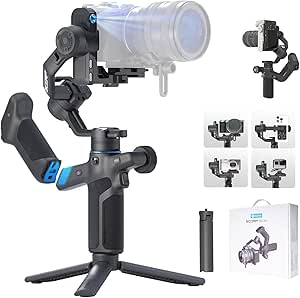 | Best Multi-Device Pick | Payload capacity: 4.4 lb / 2 kg | Weight: 4.4 lb | Compatibility: Mirrorless cameras, compact cameras, smartphones, and action cameras | VIEW ON AMAZON | See Our Full Breakdown |
| gimbals for mirrorless camera | Vertical shooting | Weight |
|---|---|---|
| Feiyu SCORP Mini 2 Kit 3-Axis | — | 1.9 lb |
| ZHIYUN CINEPEER WEEBILL 3E Mir | Native vertical switch | — |
| FeiyuTech SCORP 2 Gimbal Stabi | Quick-install vertical mounting system | 1,070 g |
| DJI RS 4 Gimbal Stabilizer for | Second-generation vertical shooting | — |
| FeiyuTech SCORP-C2 Camera Gimb | Native vertical mounting | 2.9 lb |
| FeiyuTech SCORP-C Gimbal Stabi | — | — |
| FeiyuTech Official SCORP Mini | — | 852 g |
| DJI RS 3 Mini 3-Axis Mirrorles | Native vertical shooting | 795 g |
| ZHIYUN Weebill 3E 3-Axis Light | Native vertical shooting | 1.05 kg |
| DJI RS 3 Mini Camera Gimbal St | Native vertical shooting | 795 g in portrait mode; 850 g in horizontal mode, excluding extended grip and tripod |
| SCORP C2 Camera Gimbal Stabili | — | — |
| FeiyuTech SCORP-C2 Camera Gimb | — | — |
| DJI RS 4 Mini Combo Gimbal Sta | 3rd-generation native vertical shooting | — |
| DJI RS 4 Mini Gimbal Stabilize | 3rd-generation native vertical shooting | — |
| FeiyuTech SCORP Mini-3-Pro Gim | — | 4.4 lb |
More Details on Our Top Picks
Feiyu SCORP Mini 2 Kit 3-Axis Gimbal Stabilizer for Cameras & Smartphones
The SCORP Mini 2 Kit makes the most sense for creators who switch between a mirrorless camera, phone, and action camera rather than building a rig around one camera alone. Its 2.65 lb payload fits lighter camera-and-lens combinations, while built-in AI tracking and the touchscreen add solo-shooting control without requiring a separate tracking accessory. Compared with the FeiyuTech SCORP 2, this kit prioritizes broader device compatibility and travel flexibility over a higher camera payload. That versatility has a limit: heavier mirrorless setups may exceed its capacity, and the product data does not specify battery runtime. The ergonomic handle and quick-mount system help with frequent setup changes, but newcomers should expect some adjustment time before balancing and controls feel familiar.
Pros:- Supports mirrorless cameras, smartphones, and action cameras
- Built-in AI tracking helps solo operators keep a subject in frame
- OLED touchscreen provides on-gimbal status and control
- T-shaped ergonomic handle and quick-mount system suit frequent setup changes
Cons:- 2.65 lb payload rules out many heavier camera-and-lens combinations
- Balancing and operating the controls may take practice
- Battery runtime is not specified in the supplied product data
Best for: Travel creators who alternate between a lightweight mirrorless camera, smartphone, and action camera on solo shoots.
Not ideal for: Photographers using heavier camera-and-lens combinations above 2.65 lb or anyone who needs a clearly specified runtime for long shoots.
- Brand:FeiyuTech
- Model:SCORP Mini 2
- Payload:2.65 lb
- Weight:1.9 lb
- Stabilization:3-axis
- Screen:1.3-inch OLED touchscreen
- Folded size:12 x 6 x 4 in
- Compatible devices:Cameras, mirrorless cameras, smartphones, and GoPro-style action cameras
Our verdict“Choose the SCORP Mini 2 Kit if you need one compact stabilizer for lightweight mirrorless and mobile devices, but skip it for heavier rigs.”
ZHIYUN CINEPEER WEEBILL 3E Mirrorless Gimbal Stabilizer
The WEEBILL 3E is the portability-focused choice here: it is described as compact as an A4 sheet while still supporting mirrorless rigs up to 6.6 lb. That gives it considerably more payload headroom than the Feiyu SCORP Mini 2, making it a better fit when a small travel footprint matters but a camera-and-lens combination is too substantial for a mini gimbal. Native vertical shooting also avoids relying on a separate orientation setup for portrait-format clips, and Bluetooth shutter control reduces cable clutter with compatible cameras. The tradeoff is that the listing gives no exact weight or battery runtime, and this is a mirrorless-focused tool rather than a multi-device stabilizer. Buyers new to balancing gimbals may also need time to get the most from Sling Mode 2.0.
Pros:- Supports payloads up to 6.6 lb
- Compact design is suited to portable mirrorless setups
- Native vertical shooting simplifies portrait-format filming
- Bluetooth shutter control offers wireless operation with compatible cameras
Cons:- The supplied data does not give an exact weight or battery runtime
- Limited to mirrorless cameras rather than a broad range of device types
- Balancing and getting comfortable with Sling Mode 2.0 may take practice
Best for: Mirrorless shooters who travel light, need native portrait orientation, and want more payload capacity than a mini gimbal provides.
Not ideal for: Creators seeking one stabilizer for phones and action cameras, or buyers who want a detailed weight and runtime specification before choosing.
- Payload capacity:3 kg / 6.6 lb
- Compatibility:Mirrorless cameras from Canon, Sony, Panasonic, and Nikon
- Design:Compact, described as approximately A4-paper-sized
- Shutter control:Bluetooth
- Vertical shooting:Native vertical switch
- Operating mode:Sling Mode 2.0
- Color options:Black or grey
Our verdict“Pick the WEEBILL 3E for a compact mirrorless-first gimbal with substantial payload headroom, provided you are comfortable learning gimbal setup.”
FeiyuTech SCORP 2 Gimbal Stabilizer for DSLR and Mirrorless Camera
The SCORP 2 suits mirrorless and DSLR shooters who want subject tracking built into the stabilizer rather than added as a separate accessory. Its integrated AI sensor can follow a subject through gesture control, while the 2.5 kg payload gives it room for more substantial camera setups than the SCORP Mini 2. The 1.3-inch touchscreen, multifunction knob, and cable or Bluetooth camera control offer several ways to adjust a shot without reaching for a phone. Compared with the ZHIYUN WEEBILL 3E, the SCORP 2 puts more emphasis on onboard tracking and direct controls; the WEEBILL 3E instead highlights compactness and its Sling Mode. Vertical mounting is supported, but the listing does not specify battery runtime, and the range of app and camera-control features may mean more setup than a simpler gimbal requires.
Pros:- Integrated AI tracking works without an added tracking accessory
- 2.5 kg payload accommodates more than the SCORP Mini 2
- Supports quick vertical mounting
- Touchscreen, multifunction knob, and wired or Bluetooth camera control provide flexible operation
Cons:- Battery runtime is not provided in the supplied specifications
- App options and multiple controls may add setup complexity
- A 2.5 kg payload still excludes heavier camera rigs
Best for: Solo mirrorless or DSLR operators who want built-in subject tracking, vertical filming, and on-gimbal controls.
Not ideal for: Travelers prioritizing a clearly stated lightweight design, or buyers who need a published battery runtime and a simple, minimal-control setup.
- Payload:2.5 kg
- Stabilization:3-axis
- Tracking:Integrated AI tracking sensor
- Screen:1.3-inch touchscreen
- Vertical shooting:Quick-install vertical mounting system
- Camera control:Wired control cable or Bluetooth
- Weight:1,070 g
- Folded dimensions:10.16 x 2.79 x 9.84 in
Our verdict“Choose the SCORP 2 if built-in AI tracking and direct camera controls matter more to you than the WEEBILL 3E’s compact-focused design.”
DJI RS 4 Gimbal Stabilizer for Camera
The DJI RS 4 stands apart for production days where battery capacity and a 3 kg payload matter more than a particularly small travel package. Its listed runtime of up to 29.5 hours gives crews room for extended filming between charges, while second-generation vertical shooting supports portrait content without giving up horizontal operation. Teflon-coated axis arms are intended to make balancing adjustments smoother, and the joystick mode switch gives operators direct control over camera movement. Compared with the FeiyuTech SCORP 2, the RS 4’s clearest advantage is its stated long runtime; the SCORP 2 offers built-in AI tracking, which the supplied RS 4 details do not list. Switching orientations can require rebalancing, so fast format changes are less seamless than the vertical-shooting feature may suggest. Check camera compatibility and app availability before committing.
Pros:- Up to 29.5 hours of listed battery runtime
- Supports camera payloads up to 3 kg / 6.6 lb
- Second-generation vertical shooting supports portrait and landscape work
- Teflon-coated axis arms and joystick mode switching support controlled adjustments
Cons:- Changing shooting orientation may require rebalancing
- The supplied product details flag potential app compatibility complications
- Its feature set and battery grip may be more than casual travel shooters need
Best for: Videographers and solo creators with a compatible camera who need a 3 kg payload, vertical and horizontal filming, and extended operating time.
Not ideal for: Travel-first creators who want a small stabilizer, or shooters who frequently switch orientation and need to avoid rebalancing.
- Payload capacity:3 kg / 6.6 lb
- Battery runtime:Up to 29.5 hours
- Vertical shooting:Second-generation vertical shooting
- Axis arms:Teflon-coated
- Tilt axis:Extended tilt axis
- Control port:RSA communication port
- Included items:Gimbal, BG21 battery grip, quick-release plate, extended grip/tripod
- Listed camera compatibility:Canon, Sony, Nikon, and Fujifilm
Our verdict“Choose the RS 4 for extended shoots and portrait-orientation flexibility, but look at a more compact option if portability or frequent orientation changes lead your workflow.”
FeiyuTech SCORP-C2 Camera Gimbal Stabilizer with AI Tracking
For a mirrorless shooter carrying a larger lens or a more built-out camera, the SCORP-C2 offers the most payload headroom in this group: up to 7.72 lb. That capacity gives it a different job from the 3 kg DJI RS 4 and the lighter SCORP Mini 2, both of which are better matches for less demanding rigs. The C2 also combines built-in AI tracking, native vertical mounting, an underslung handle, and quick axis locks, making it suited to solo work that mixes low-angle footage with portrait clips. Its stated 14-hour runtime and USB-C fast charging add practical flexibility for longer days. The tradeoff is its 2.9 lb body and larger folded footprint; it is a less appealing carry for lightweight travel kits. Buyers should also confirm that their specific camera controls work as expected.
Pros:- 7.72 lb payload supports heavier camera rigs than the other listed gimbals
- Built-in AI tracking includes gesture control
- Native vertical mounting supports portrait-format content
- Listed 14-hour runtime and 18 W USB-C fast charging
Cons:- At 2.9 lb, it is heavier than a compact travel-focused stabilizer
- Its folded size is larger than the SCORP Mini 2’s listed dimensions
- Camera compatibility and control support should be checked for the specific setup
Best for: Mirrorless filmmakers with heavier camera-and-lens setups who want built-in tracking and portrait shooting without changing gimbals.
Not ideal for: Travelers with small mirrorless bodies or compact lenses who value low carry weight over payload capacity.
- Payload capacity:7.72 lb / 3,500 g
- Weight:2.9 lb
- Battery runtime:Up to 14 hours
- Charging:18 W USB-C fast charging
- Tracking:Built-in AI tracking with gesture control
- Vertical shooting:Native vertical mounting
- Handle:Integrated underslung handle
- Folded dimensions:11.77 x 2.59 x 9.95 in
Our verdict“Pick the SCORP-C2 when your camera rig needs more than 3 kg of payload capacity, and skip it if a light travel kit is the priority.”
FeiyuTech SCORP-C Gimbal Stabilizer for Cameras, DSLR and Mirrorless
The FeiyuTech SCORP-C suits mirrorless shooters who want long runtime and broad camera compatibility more than the lightest possible rig. Its stated 10–13-hour battery life can reduce interruptions on event or travel shoots, while the Arca quick-release plate and five-way balance adjustment help with setup across different camera combinations. Compared with the DJI RS 3 Mini, it offers more listed shooting modes and broader DSLR compatibility, but the DJI is lighter and has native vertical shooting specified. The SCORP-C’s trajectory memory, time-lapse, and panoramic modes add creative options, though their controls and balancing adjustments may take practice. Its main tradeoff is handling weight: extended handheld work may feel tiring, especially beside smaller alternatives. I’d choose it when endurance and camera flexibility matter more than a compact carry.
Pros:- Stated 10–13-hour runtime supports long shooting sessions.
- Compatibility includes popular mirrorless and DSLR camera families.
- Arca quick-release plate and five-way balance adjustment aid camera setup.
- Offers trajectory memory, panoramic, time-lapse, and vertical-shooting modes.
Cons:- Relatively heavy for prolonged handheld use.
- Multiple adjustments and modes can make setup less approachable for new gimbal users.
- The supplied information does not give a payload limit, making lens-and-camera fit harder to verify.
Best for: Mirrorless and DSLR owners filming long events or extended sessions who value battery runtime and multiple creative modes.
Not ideal for: Travel creators prioritizing a light handheld setup, or beginners who want a simpler balancing and control process.
- Stabilization:Three-axis
- Compatibility:Mainstream mirrorless and DSLR cameras, including Sony α7, Panasonic GH, Canon 5D, Nikon D750, and Fujifilm X-T3/T4 series
- Battery capacity:2500mAh
- Runtime:10–13 hours
- Charging:Supports 18W fast charging
- Balancing:Five-way center-of-gravity adjustment
- Quick release:Arca quick-release plate
- Listed modes:AB Trajectory Memory, Flash, Panoramic, Time-lapse, Space, and Vertical-shooting
Our verdict“Choose the SCORP-C for long shoots and broad camera compatibility, but pick the lighter DJI RS 3 Mini if portability matters more.”
FeiyuTech Official SCORP Mini 2 Kit Gimbal, 3-Axis Camera Stabilizer with AI Tracker, Fill Light, Touch Screen, Carrying Case and Extension Rod, White
The SCORP Mini 2 Kit is the most flexible pick here for creators who switch between a mirrorless camera, phone, and action camera. Its 1.2 kg payload is more limited than the ZHIYUN Weebill 3E’s 3 kg capacity, so it suits compact camera-and-lens setups rather than heavier rigs. In return, it weighs 852 g and includes a built-in AI tracker that can follow faces or objects without an app connection, plus a touchscreen and extension rod for varied framing. Those extras make solo filming more convenient, but the lower payload narrows camera choices, and device changes still mean adapting the setup. I’d favor it over the SCORP-C when portability and device variety matter more than long battery specifications or DSLR-oriented capacity.
Pros:- Supports mirrorless cameras, smartphones, action cameras, and other compatible video cameras.
- Built-in AI tracking works without connecting to an app.
- 852 g body weight is relatively portable for a multi-device stabilizer.
- Touchscreen, five-way joystick, extension rod, and fill light support flexible solo shooting.
Cons:- 1.2 kg payload is below the capacity of the ZHIYUN Weebill 3E and may rule out heavier setups.
- The supplied product information does not state battery runtime.
- Changing among device types can require rebalancing and adjusting the rig.
Best for: Solo creators who alternate among a lightweight mirrorless camera, smartphone, and action camera and want onboard subject tracking.
Not ideal for: Videographers using heavier full-frame camera-and-lens combinations or anyone who needs a payload above 1.2 kg.
- Stabilization:Three-axis
- Maximum payload:1.2 kg
- Weight:852 g
- Compatible devices:Mirrorless cameras, smartphones, DSLR cameras, and action cameras
- Tracking:Built-in AI tracking for faces and objects; works without app connection
- Screen:1.3-inch touchscreen
- Controls:Five-way joystick; Bluetooth and cable control
- Included kit items:Carrying case, extension rod, and fill light
Our verdict“Pick the SCORP Mini 2 Kit for lightweight, mixed-device solo filming, not for a heavy mirrorless rig.”
DJI RS 3 Mini 3-Axis Mirrorless Gimbal Stabilizer (Renewed)
This renewed DJI RS 3 Mini is a compact choice for mirrorless users who want native vertical shooting without carrying a larger stabilizer. At 795 g and a 2 kg payload, it balances portability with room for many camera-and-lens combinations. Compared with the ZHIYUN Weebill 3E, it is lighter but gives up 1 kg of payload capacity and the ZHIYUN’s stated 16-hour runtime. Bluetooth shutter control can simplify recording, though support depends on camera compatibility. The listing specifies a 90-day limited warranty, a meaningful point of distinction from the standard RS 3 Mini listing in this batch, which does not specify that warranty term. Because this unit is renewed, buyers should weigh its compact format against the shorter stated warranty and check compatibility before relying on wireless controls.
Pros:- 795 g weight makes it easy to carry for travel and solo shooting.
- 2 kg payload supports a range of mirrorless camera-and-lens combinations.
- Native vertical shooting avoids a separate orientation workaround.
- Bluetooth shutter control can operate compatible cameras from the gimbal.
Cons:- Renewed unit has a stated 90-day limited warranty.
- Lower payload than the ZHIYUN Weebill 3E’s 3 kg capacity.
- Battery runtime is not specified in the supplied product data.
Best for: Traveling mirrorless creators who want a lightweight gimbal with native vertical shooting and are comfortable buying a renewed unit.
Not ideal for: Buyers who need a longer stated warranty, carry camera setups near or above 2 kg, or want a gimbal for larger DSLR rigs.
- Model:DJI RS 3 Mini
- Condition:Renewed
- Stabilization:Three-axis
- Weight:795 g
- Maximum payload:2 kg (4.4 lb)
- Compatibility:Mirrorless cameras
- Bluetooth shutter control:Yes, with compatible cameras
- Vertical shooting:Native vertical shooting
- Warranty:90-day limited warranty
Our verdict“Choose this renewed RS 3 Mini for a compact mirrorless travel rig if its 2 kg payload and stated warranty suit your needs.”
ZHIYUN Weebill 3E 3-Axis Lightweight Gimbal Stabilizer for DSLR and Mirrorless Cameras
The ZHIYUN Weebill 3E is the practical step up when a mirrorless camera carries a larger lens or the setup needs more payload headroom. Its 3 kg capacity exceeds both DJI RS 3 Mini listings, which top out at 2 kg, while its stated battery life reaches 16 hours. That combination is better suited to longer shoots and heavier DSLR or mirrorless builds than the lighter DJI options. The tradeoff is a 1.05 kg body and extra control-cable requirements: Panasonic users get a specified cable, while Canon and Sony users need additional cables for wired control. Native vertical shooting and Bluetooth shutter control support social clips, but the required accessories can complicate a tidy setup. I’d pick this over the SCORP Mini 2 when camera load matters more than all-in-one portability.
Pros:- 3 kg payload accommodates heavier camera-and-lens combinations than either DJI RS 3 Mini.
- Stated battery life of up to 16 hours suits extended filming days.
- Supports native vertical shooting for social video.
- 14W PD fast charging can reduce downtime between sessions.
Cons:- At 1.05 kg, it is heavier than the 795 g DJI RS 3 Mini.
- Additional control cables are needed for Canon and Sony cameras.
- Sling grip and wrist rest are optional accessories rather than included items.
Best for: Videographers using heavier mirrorless or DSLR setups, such as a compatible camera with a 24–70mm f/2.8 lens, who need long runtime.
Not ideal for: Travel shooters who prioritize the lowest carry weight, or Canon and Sony users who expect all control cables to be included.
- Stabilization:Three-axis
- Maximum payload:3 kg (6.6 lb)
- Weight:1.05 kg
- Dimensions:12 × 8 × 3 inches
- Battery life:Up to 16 hours
- Charging:14W PD fast charging
- Vertical shooting:Native vertical shooting
- Control cable:Panasonic LN-UCUC-A02 specified; additional cables needed for Canon and Sony
- Supported camera examples:Mirrorless and DSLR cameras, including listed 24–70mm f/2.8 and FE 24–105mm f/4G setups
Our verdict“Choose the Weebill 3E when your camera rig needs more payload and runtime than the compact DJI RS 3 Mini can offer.”
DJI RS 3 Mini Camera Gimbal Stabilizer
The DJI RS 3 Mini makes the clearest case for creators who carry a mirrorless camera all day and need a gimbal that stays manageable. At a stated 795 g in portrait mode, it is lighter than the ZHIYUN Weebill 3E, while its 2 kg payload remains suitable for many mainstream mirrorless combinations. Native vertical mounting helps social-video creators change orientation without a separate bracket, and the 1.4-inch touchscreen puts common settings on the gimbal. Compared with the renewed RS 3 Mini in this batch, this listing describes the standard model rather than a renewed unit, but it does not provide the same explicit 90-day warranty term. Its lower capacity and unspecified battery runtime make it less appropriate than the Weebill 3E for heavier or all-day rigs. Check camera compatibility, including app requirements, before buying.
Pros:- 795 g portrait-mode weight supports travel and extended handheld use.
- 2 kg payload suits many mirrorless camera-and-lens combinations.
- Native vertical shooting makes social-video framing straightforward.
- 1.4-inch color touchscreen offers direct access to common settings.
Cons:- 2 kg payload is below the ZHIYUN Weebill 3E’s 3 kg limit.
- Battery runtime is not specified in the supplied listing.
- DJI Ronin app is required for activation and full functionality, with installation guidance needed for Android users.
Best for: Solo mirrorless creators who travel light, shoot vertical and horizontal footage, and use camera-and-lens combinations under 2 kg.
Not ideal for: Owners of heavier DSLR or mirrorless rigs, or buyers who want a stated battery runtime and do not want to manage DJI app activation.
- Model:DJI RS 3 Mini
- Weight:795 g in portrait mode; 850 g in horizontal mode, excluding extended grip and tripod
- Maximum payload:2 kg (4.4 lb)
- Payload range:0.4–2 kg
- Stabilization:Three-axis, third-generation RS stabilization algorithm
- Vertical shooting:Native vertical shooting
- Screen:1.4-inch full-color touchscreen
- Bluetooth shutter control:Yes, with compatible cameras
- App requirement:DJI Ronin app required for activation and full functionality
Our verdict“Pick the standard RS 3 Mini for lightweight mirrorless travel and vertical content, but choose the Weebill 3E for heavier rigs or longer stated runtime.”
SCORP C2 Camera Gimbal Stabilizer with AI Tracking for Mirrorless Cameras
The SCORP C2 suits mirrorless shooters who need more payload headroom than the DJI RS 4 Mini offers. Its stated 7.72 lb capacity can accommodate larger camera-and-lens combinations, while AI face tracking and gesture control can simplify solo filming without relying on an app for face tracking. The quick-release system and modes such as panorama, time-lapse, and Inception also give it more room for deliberate camera moves than a basic stabilization setup. That capability comes with a tradeoff: at approximately 3.5 lb before camera gear, it may tire arms during long handheld sessions. The many controls and creative modes also ask for more setup time than the compact RS 4 Mini. Battery-life details are not provided, so I would not pick it for shoots where runtime is a deciding factor.
Pros:- Stated 7.72 lb payload supports heavier camera-and-lens combinations than the DJI RS 4 Mini.
- AI face tracking and gesture control support solo shooting.
- Includes time-lapse, panorama, Inception, and A/B motion path modes.
- Dual-layer quick-release system is designed to speed mounting and balancing.
Cons:- Approximately 3.5 lb body weight can become tiring during extended handheld filming.
- The feature set may take longer to learn than the simpler compact DJI RS 4 Mini.
- Battery-life information is not supplied.
Best for: Mirrorless and DSLR operators using heavier lenses who want high payload capacity, built-in tracking, and creative motion modes.
Not ideal for: Travel vloggers or solo operators prioritizing a lightweight rig, or buyers who need confirmed battery-runtime details before a long shoot.
- Payload capacity:7.72 lb
- Approximate weight:3.5 lb
- Supported cameras:Mirrorless and DSLR cameras; listed examples include Canon EOS, Fujifilm X series, and Nikon Z series
- Connectivity:Bluetooth and Type-C
- Tracking and control:AI tracking and gesture control
- Shooting modes:Time-lapse, panorama, Inception, and A/B motion path
- Additional controls:Vertical shooting and Magic Wheel focus/zoom
Our verdict“Choose the SCORP C2 if your mirrorless rig needs more payload capacity and creative controls than a compact gimbal provides.”
FeiyuTech SCORP-C2 Camera Gimbal Stabilizer with Built-in AI Tracking
This SCORP-C2 is a strong fit for mirrorless operators who want to adjust settings from the gimbal rather than depend on a phone screen. Its OLED display makes adjustments easier to view at the rig, and built-in face recognition and gesture control help when filming alone. Like the other SCORP C2 in this roundup, it lists a 7.72 lb payload, putting it in a different class from the lighter-duty DJI RS 4 Mini, whose capacity is 2 kg. The tradeoff is that the available details say less about shooting modes and camera controls than the other SCORP C2 listing, so buyers should confirm the functions they need. The setup must also be balanced for the specific camera and lens, and an additional handle grip is sold separately.
Pros:- OLED screen provides an on-gimbal way to view and adjust settings.
- Built-in face recognition and gesture control support solo filming.
- Stated 7.72 lb payload accommodates a broad range of mirrorless and DSLR setups.
- Integrated ergonomic handle is designed for comfortable operation.
Cons:- Camera and lens combinations still need to be compatible and balanced correctly.
- Additional handle grip is sold separately.
- The provided product details do not list specific creative modes or battery runtime.
Best for: Solo mirrorless videographers who want built-in face tracking and a display for checking gimbal settings at the rig.
Not ideal for: Buyers who need a listed menu of cinematic modes or a complete handle-grip setup included.
- Compatibility:Mirrorless and DSLR cameras
- Maximum payload:7.72 lb
- Tracking:Built-in face recognition
- Gesture control:Supported
- Display:OLED screen
- Handle:Integrated ergonomic handle grip
- Quick-release plate:Upgraded plate for precise balancing
Our verdict“Pick this SCORP-C2 if an on-gimbal display and high payload capacity matter more than having every shooting mode specified upfront.”
DJI RS 4 Mini Combo Gimbal Stabilizer for Canon, Sony, Nikon, Fujifilm
The DJI RS 4 Mini Combo is aimed at mirrorless creators who value portability and quick changes between horizontal and vertical framing. Its 2 kg payload is far below the SCORP C2 models’ 7.72 lb rating, so it makes more sense with a compact camera-and-lens setup than a heavy rig. Automated axis locks and Teflon-enhanced balancing are practical advantages when packing up or making adjustments between shots; native vertical shooting also cuts down on the work of adapting footage for phone-first platforms. This Combo adds a tracking module and briefcase handle, giving it more filming flexibility out of the box than the standard RS 4 Mini listing. The limit is capacity, and the included tracking features may take setup effort, with app compatibility updates sometimes requiring a visit to DJI’s website.
Pros:- Compact, lightweight design is easier to carry than the higher-capacity SCORP C2.
- Native vertical shooting supports quick changes for portrait-format content.
- Combo includes a tracking module and briefcase handle.
- Automated axis locks and Teflon-enhanced balancing aid setup and adjustment.
Cons:- 2 kg payload rules out many heavier mirrorless camera-and-lens combinations.
- Initial setup may feel involved for first-time gimbal users.
- App compatibility updates may require visiting DJI’s website.
Best for: Traveling mirrorless creators who use compact camera setups and regularly shoot vertical social video alongside standard footage.
Not ideal for: Filmmakers with heavier camera-and-lens rigs that exceed 2 kg, or buyers who want the simplest possible first-time setup.
- Model:P24M
- Maximum payload:2 kg / 4.4 lb
- Vertical shooting:3rd-generation native vertical shooting
- Balancing:Teflon-enhanced balancing
- Axis locks:Automated
- Included items:Gimbal, tripod, tracking module, briefcase handle, cables, and screw kit
- Follow mode:Responsive follow mode
Our verdict“Choose the RS 4 Mini Combo for a compact, accessory-rich vertical-video rig, provided your camera setup stays within its 2 kg payload.”
DJI RS 4 Mini Gimbal Stabilizer for Camera, Compatible with Canon, Sony, Nikon, Fujifilm
The standard DJI RS 4 Mini is the more streamlined choice for mirrorless shooters who want a compact stabilizer without the Combo’s extra tracking module and briefcase handle. It shares the Combo’s 2 kg payload, native vertical shooting, and automated axis locks, making it suitable for lighter camera setups and quick portrait-format filming. Compared with the 7.72 lb SCORP C2, it gives up substantial capacity; that is a real limitation for larger lenses, but also makes this a better match for creators who keep their rig small. The listed package includes a tripod, control cable, quick-release plate, and screw kit, but not the Combo’s tracking module. Buyers should also account for possible app-update friction and check their camera’s compatibility before relying on connected controls.
Pros:- Compact design suits portable mirrorless filming.
- Native vertical shooting supports portrait-format content without a separate mounting workaround.
- Automated axis locks and Teflon balancing features support quicker adjustments.
- Includes a tripod, control cable, quick-release plate, and screw kit.
Cons:- 2 kg payload is substantially lower than the SCORP C2 models’ stated capacity.
- The standard package does not list the Combo’s tracking module or briefcase handle.
- App compatibility updates may require visiting DJI’s website.
Best for: Mirrorless vloggers and mobile creators with compact camera rigs who want native vertical shooting in a simpler kit.
Not ideal for: Operators using heavier cameras or lenses, or buyers who want the Combo’s tracking module and briefcase handle in the package.
- Model:P24M
- Maximum payload:2 kg / 4.4 lb
- Vertical shooting:3rd-generation native vertical shooting
- Axis locks:2nd-generation automated axis locks
- Balancing:Teflon-enhanced balancing
- Included items:Gimbal, tripod, control cable, quick-release plate, and screw kit
- Warranty:2 years
Our verdict“Choose the standard RS 4 Mini if you want a compact gimbal for a lighter mirrorless setup and do not need the Combo’s extra accessories.”
FeiyuTech SCORP Mini-3-Pro Gimbal Stabilizer for Camera, Smartphone, and Action Cameras
The SCORP Mini-3-Pro stands apart from the mirrorless-focused DJI RS 4 Mini by supporting smartphones and action cameras as well as cameras, making it appealing to creators who switch devices between shoots. Its 4.4 lb payload exceeds the DJI’s 2 kg limit only by a small margin on paper, so it is not a substitute for the heavier-duty SCORP C2 when using a large mirrorless rig. AI tracking, 360-degree rotation, and a detachable remote handle open up flexible solo and remote-operated shots. The tradeoff is portability: the listed 4.4 lb gimbal weight is substantial for extended handheld use, especially once a camera is mounted. Setup may also be less approachable for beginners, and battery-life details are not supplied.
Pros:- Supports mirrorless, compact, smartphone, and action cameras.
- AI tracking includes 360-degree rotation for flexible subject-following shots.
- Detachable remote handle adds options for operating the gimbal at a distance.
- Listed 4.4 lb payload is higher than the DJI RS 4 Mini’s 2 kg capacity.
Cons:- Listed 4.4 lb body weight can make extended handheld use tiring.
- The setup process may challenge first-time gimbal users.
- Battery-life details are not provided.
Best for: Hybrid creators who move between a lightweight mirrorless camera, smartphone, and action camera and want one stabilizer for all three.
Not ideal for: Travelers seeking a light handheld rig, beginners who want a simple setup, or mirrorless users with a camera-and-lens combination beyond 4.4 lb.
- Payload capacity:4.4 lb / 2 kg
- Weight:4.4 lb
- Compatibility:Mirrorless cameras, compact cameras, smartphones, and action cameras
- Tracking distance:18 m
- Response time:0.003 seconds
- Maximum rotation:360-degree infinite tracking
- Charging:USB-C charging cable included
Our verdict“Choose the SCORP Mini-3-Pro if you want one tracking gimbal for several camera types and can accept its weight and setup demands.”

How We Picked
I compared these 15 listings as tools for mirrorless camera work, focusing on payload fit, camera compatibility, stabilization usability, portability, and workflow features. A gimbal must handle the actual camera, lens, plate, microphone, and other mounted accessories as one balanced rig; headline payload alone cannot establish that it will work well for a particular setup. I also weighed features such as vertical shooting, tracking, controls, and included accessories by the practical problems they solve.
The ranking favors well-rounded camera support and useful day-to-day operation over feature counts. Models with a clearer role—such as a compact travel gimbal, an AI-tracking option, or a larger-payload choice—rank for the buyers they serve rather than being treated as universal winners. Similar and repeated listings are not assumed to be identical: exact generation, bundle, included parts, and renewed condition can change what a buyer receives.
Factors to Consider When Choosing Gimbals For Mirrorless Cameras
Before choosing a model, match the stabilizer to the whole shooting setup and the way you work. A gimbal that handles your camera on paper can still be a poor fit if balancing is awkward, the rig is tiring to carry, or it cannot support your framing method.
Match Payload to the Complete Rig
Start by weighing the camera with the lens you expect to use, then add the plate, microphone, filter, or other equipment that will sit on the gimbal. Leave headroom rather than choosing a stabilizer that only just meets the listed payload: a tight margin limits lens changes and can make balancing less forgiving. The SCORP-C2 listings state a 7.72-pound payload, while the RS 3 Mini lists 2 kg, illustrating how far apart the intended load ranges can be. A high payload figure does not prove compatibility with every camera body, since mounting clearance and control support also matter. Check the manufacturer’s compatibility information for your camera and lens combination before buying. If you plan to change lenses often, prioritize usable headroom over the lightest possible kit.
Choose for Your Shooting Day, Not Just the Spec Sheet
Weight affects more than the walk between locations: it can shape how long you can hold the rig and how willing you are to bring it along. Compact models such as the RS 3 Mini are easier to pack, but they are a better match for smaller camera setups than heavy rigs with accessories. A larger gimbal may provide more room to build out a rig, yet that added capacity can become a burden during long handheld sessions. Think about your longest continuous takes, travel restrictions, and whether you usually work alone. If the camera already feels heavy without a stabilizer, look closely at the combined weight of gimbal, camera, lens, and add-ons. Portability is only useful when the gimbal can still balance the setup you actually shoot.
Treat Tracking as a Workflow Choice
AI tracking can help a solo creator keep a subject framed while moving, which is why the SCORP options may appeal to presenters and follow-style filming. It is not a substitute for checking how the tracker mounts, what it can follow, and whether it works with the framing you need. A tracking accessory can add bulk or depend on a particular kit configuration, so compare the exact bundle rather than assuming every version includes the same parts. For controlled product shots, interviews with a fixed composition, or scenes with intentional camera movement, tracking may add little. Ask whether you need the gimbal to follow a subject automatically or simply stabilize deliberate camera moves. That answer can matter more than the presence of an AI feature.
Check Vertical Shooting and Camera Controls
Vertical video is easier to produce when the gimbal supports a practical portrait setup, rather than requiring an improvised mounting arrangement. Confirm how the specific model handles vertical orientation and whether your camera remains balanced in that position. Camera-control features can also vary by body and connection method, so compatibility with a brand name does not guarantee every shutter or recording function works with your exact camera. Review supported camera lists and firmware notes if remote control is part of your workflow. If you mainly shoot landscape video, prioritize balance and handling instead of paying attention to a vertical feature you rarely use. Buyers who alternate between social clips and landscape work should check how quickly the setup can be changed.
Compare Exact Kits, Generations, and Condition
Product names in this roundup overlap, especially among SCORP-C2, SCORP Mini 2, Weebill 3E, and RS 3 Mini listings. A kit may add a tracking unit, fill light, extension rod, or carrying case, while a base version may not include those accessories. Renewed listings also call for checking the stated condition, included parts, and return terms before purchase. Match the model generation and bundle contents to the features you expect; a familiar family name is not enough. This step is especially useful when two listings appear to describe the same gimbal but differ in title or packaging. Comparing the exact contents can prevent paying for a duplicate setup or missing a needed accessory.
Balance Setup Time Against Future Flexibility
A gimbal is most useful when it fits your actual pace of work, including setup, balancing, and changes between shots. If you frequently swap cameras or lenses, look for a setup that accommodates those changes without turning every shoot into a lengthy adjustment. If your camera kit is stable and lightweight, a smaller model may be the simpler choice even if it offers less expansion room. Buying far beyond your current payload needs can mean carrying unnecessary size; buying too close to the limit can force an early replacement when you add a lens or monitor. Map out likely upgrades and accessories before deciding how much capacity to reserve. Pay for flexibility when you have a real plan to use it, not simply because a larger number looks safer.
Frequently Asked Questions
How do I know whether a gimbal can support my mirrorless camera and lens?
Weigh the camera, lens, plate, and any accessories that will stay mounted, then compare that total with the gimbal’s payload limit. Leave some capacity in reserve so a lens change or added microphone does not push the setup to its limit. Payload does not tell the whole story: check the maker’s compatibility list and confirm that the camera and lens fit on the arms without hitting the frame. A stabilizer may support the weight but still be awkward to balance with a long or wide lens. If your kit is near the stated maximum, choose a model with more capacity or test the exact combination before relying on it for a shoot.
Is the DJI RS 3 Mini a sensible choice for a full-frame mirrorless camera?
It can be a fit if the full-frame body is paired with a relatively compact lens and the complete rig stays within the listed 2 kg payload. Full-frame alone does not determine gimbal fit; lens size, accessories, and mounting clearance all affect the result. The RS 3 Mini is positioned for lighter setups, so it offers less room for a heavy zoom, monitor, or other additions than the higher-payload SCORP-C2 listings. Check the exact camera-and-lens combination against manufacturer guidance before purchase. If you expect to build out the rig, a larger-capacity model is a safer match.
Should I choose built-in AI tracking or a simpler camera gimbal?
Choose tracking when you often film yourself or need a moving subject to stay framed while you operate the camera alone. The FeiyuTech SCORP family has multiple listings that highlight AI tracking, making those options especially relevant for solo creators. A tracker adds less value for planned camera moves, fixed interviews, or shoots where another person can manage framing. Check whether the specific product version includes the tracking hardware, since similar model names may refer to different kits. Also consider how the tracker affects setup and whether its framing behavior fits the style of footage you make.
What should I check before buying one of the repeated or similar listings?
Compare the full model name, generation, bundle contents, and condition rather than assuming listings with similar names are the same product. This roundup includes multiple SCORP-C2 and Weebill 3E entries, as well as separate RS 3 Mini listings, including one marked renewed. Look for details such as included tracking units, fill lights, extension rods, cases, and the stated payload. Confirm that the listing matches the camera compatibility and accessories you expect. For a renewed item, read the condition and return information so you know what recourse is available if parts are missing or the gimbal does not suit your setup.
When is it worth choosing a larger gimbal instead of a compact one?
A larger model is a better choice when your camera rig is near the compact gimbal’s payload limit or you expect to add heavier lenses and accessories. More capacity can give you room to change the setup without replacing the stabilizer, but it also means carrying more bulk. For a small travel kit, the lighter RS 3 Mini or a compact Weebill 3E-style option may be easier to bring along. Compare the complete rig weight and how long you hold the gimbal, not only the payload number. If your current setup is light and unlikely to grow, buying extra capacity may offer little practical benefit.
Conclusion
For a dedicated all-round mirrorless setup, I’d choose the DJI RS 4 as my best overall starting point. The FeiyuTech SCORP-C2 is my best fit for buyers who need its listed higher payload and AI tracking, while the lighter DJI RS 3 Mini is the more appealing pick for compact travel rigs. Beginners should favor a model that matches their current camera-and-lens weight and a manageable setup, rather than buying extra capacity they will not use; compare the SCORP Mini 2 Kit and RS 3 Mini against that need. For a multi-device kit that includes a smartphone or action camera, the SCORP Mini 2 or SCORP Mini-3-Pro has a broader role than a camera-only stabilizer. Before ordering, check the exact version, payload, compatibility, and included accessories—the right choice is the one that balances your real rig without adding unnecessary bulk.