For most performers, I’d choose the BOSS RC-600 as the best overall looper for live performance: its floor-based layout and extensive control options suit complex sets without requiring a tabletop station. The BOSS RC-500 is a more approachable dual-track choice, while the BOSS RC-505mkII suits hands-on beatboxers and musicians who want controls within reach. The main tradeoff is between simple, reliable operation and the track count, routing, and control depth that take more setup to manage onstage. This lineup also includes compact pedals for guitarists and an acoustic-focused vocal processor for singer-performers. Read on for the full breakdown and a guide to choosing by instrument, stage workflow, and looping style.

Get audio and creator gear delivered free with Prime
- Fast, free delivery on millions of items
- Prime Video, Amazon Music and more included
- Member-only deals all year
Complete the kit


Key Takeaways
- The RC-600 is the strongest all-around stage platform in this group for players who need floor control across multiple tracks; its depth is more than a simple guitar loop requires.
- The RC-500 offers a practical middle ground: two tracks give a performer room to build arrangements without committing to the larger workflows of the RC-600 or RC-505mkII.
- The RC-505mkII and Aeros Loop Studio favor hands-on arrangement work, but tabletop controls and touch interaction suit performers who can reach the unit more than players who need a traditional floor pedal.
- Small pedals trade arrangement flexibility for fast operation: the RC-1, Ditto 2, and LEKATO are better matches for straightforward guitar loops than for layered, multi-part stage sets.
- The VE-8 solves a different live problem: it combines acoustic guitar and vocal processing with looping, making it a more focused singer-performer option than a general-purpose multitrack station.
| BOSS VE-8 Acoustic Singer Preamp and Effects Processor |  | Best for Acoustic Singer-Songwriters | Looper recording time: 80 seconds | Connectors: 1/4-inch (6.35 mm) and XLR | Hardware interface: USB | VIEW ON AMAZON | See Our Full Breakdown |
| BOSS RC-505mkII Tabletop Loop Station |  | Best for Multi-Track Tabletop Performance | Phrase tracks: 5 stereo | Input effects: 49 types; up to 4 simultaneous | Track effects: 53 types; up to 4 simultaneous | VIEW ON AMAZON | See Our Full Breakdown |
| BOSS RC-500 Dual-Track Loop Station |  | Best Foot-Controlled All-Rounder | Tracks: 2 | Recording time: Up to 13 hours of stereo recording | Phrase memories: 99 | VIEW ON AMAZON | See Our Full Breakdown |
| BOSS RC-202 Loop Station |  | Best Compact Tabletop Looper | Phrase tracks: 2 simultaneous stereo tracks | Phrase memories: 64, organized into 8 banks of 8 | Effects: 4 input FX and 4 track FX available simultaneously | VIEW ON AMAZON | See Our Full Breakdown |
| Singular Sound Aeros Loop Studio – 6 Track Stereo Looper Pedal with Touch Screen and Hands-Free Mixing |  | Best for Six-Track Stereo Arrangements | Tracks: 6 | Recording time: Up to 10 hours per song | Inputs and outputs: Multiple inputs and outputs | VIEW ON AMAZON | See Our Full Breakdown |
| Pigtronix Infinity 3 Looper Pedal |  | Best for Recallable Stereo Loops | Type: Dual looper pedal | Connectivity: Stereo inputs and outputs | Recording quality: 24-bit/48kHz | VIEW ON AMAZON | See Our Full Breakdown |
| BOSS RC-1 Loop Station Guitar Pedal |  | Best for Beginners | Recording time: Up to 12 minutes, stereo | Functions: Recording, playback, overdubbing, undo, and redo | Power: 9-volt battery or optional PSA-series AC adapter | VIEW ON AMAZON | See Our Full Breakdown |
| BOSS RC-600 Floor-Based Loop Station |  | Best for Complex Live Arrangements | Tracks: 6 simultaneous stereo phrase tracks | Audio processing: 32-bit AD/DA and 32-bit floating-point processing | Input effects: 49 types | VIEW ON AMAZON | See Our Full Breakdown |
| LEKATO Looper Guitar Pedal with Built-In Tuner |  | Best Compact Value Pick | Loops: 9 | Total recording time: 40 minutes | Single-loop recording duration: Up to 10 minutes | VIEW ON AMAZON | See Our Full Breakdown |
| TC Electronic Ditto 2 Guitar Looper Pedal |  | Best Minimalist Stage Pedal | Model: DITTO 2 LOOPER | Controls: Footswitch | Power: 9 volts | VIEW ON AMAZON | See Our Full Breakdown |
| looper for live performance | Power |
|---|---|
| BOSS VE-8 Acoustic Singer Prea | — |
| BOSS RC-505mkII Tabletop Loop | — |
| BOSS RC-500 Dual-Track Loop St | — |
| BOSS RC-202 Loop Station | 9 V, 440 mA; corded electric |
| Singular Sound Aeros Loop Stud | 9 V power supply included |
| Pigtronix Infinity 3 Looper Pe | — |
| BOSS RC-1 Loop Station Guitar | 9-volt battery or optional PSA-series AC adapter |
| BOSS RC-600 Floor-Based Loop S | 9 volts, 1100 milliamps; corded electric |
| LEKATO Looper Guitar Pedal wit | — |
| TC Electronic Ditto 2 Guitar L | 9 volts |
More Details on Our Top Picks
BOSS VE-8 Acoustic Singer Preamp and Effects Processor
The BOSS VE-8 is the most focused choice here for a performer who sings while playing acoustic guitar. Its separate vocal and guitar processing keeps a live setup centered on those two sources, while independent looping lets you build guitar and vocal parts without adding a separate looper. Real-time harmonies and vocal effects can add arrangement depth, and guitar feedback control is useful onstage with amplified acoustics. Compared with the BOSS RC-500, though, its 80-second loop time and singer-guitar design leave less room for longer, more complex instrumental arrangements. It also lacks the multi-track mixing depth of the BOSS RC-505mkII. Choose it for an integrated acoustic vocal rig, not as a general-purpose looper for a band or multi-instrument set.
Pros:- Combines vocal and acoustic guitar processing with looping in one unit.
- Creates real-time harmonies from guitar input or manually selected keys.
- Provides separate vocal and guitar loop functions.
- Phase invert and a notch filter help manage acoustic guitar feedback.
Cons:- The 80-second loop time is limiting for longer arrangements.
- Its feature set is tailored to acoustic singers rather than general-purpose live looping.
- Requires corded electric power.
Best for: Acoustic singer-guitarists who want vocal processing, guitar effects, harmonies, and basic looping in one compact performance unit.
Not ideal for: Loop artists building long, multi-part arrangements or performers who need a looper for instruments beyond an acoustic guitar and vocal setup.
- Looper recording time:80 seconds
- Connectors:1/4-inch (6.35 mm) and XLR
- Hardware interface:USB
- Signal format:Analog
- Power source:Corded electric
- Voltage:9 volts
- Weight:1.5 kg
- Dimensions:13.3 × 8.9 × 5.1 inches
Our verdict“Choose the VE-8 if you sing and play acoustic guitar and want an integrated vocal-and-guitar rig more than extensive multi-track looping.”
BOSS RC-505mkII Tabletop Loop Station
For performers who shape a set live with their hands, the BOSS RC-505mkII offers the broadest track-level control in this group: five stereo phrase tracks, individual faders, and extensive input and track effects. Dedicated volume controls make it easier to balance layers as an arrangement grows, while its XLR inputs with phantom power suit vocal-focused setups. Compared with the two-track BOSS RC-202, the RC-505mkII gives you more independent layers and more memories, which favors intricate solo sets. That flexibility comes with a real space and setup cost: it is a large tabletop unit, not a compact floor pedal. Its hand-operated layout also makes less sense for a guitarist who needs to keep both hands on an instrument; the BOSS RC-500 is the more foot-oriented option.
Pros:- Five stereo tracks have dedicated controls and independent volume faders.
- Input and track effects offer extensive sound shaping.
- Two XLR microphone inputs include phantom power.
- Stores up to 99 memories with tracks, effects, playback settings, and control assignments.
Cons:- Its large tabletop footprint needs dedicated setup space.
- Hand-operated controls are less suited to performers who need to keep their hands on an instrument.
- The extensive controls and routing can take time to configure for a live set.
Best for: Vocal loop performers, beatboxers, and electronic musicians who want hands-on control of several stereo layers during a live set.
Not ideal for: Guitarists seeking a small floor looper they can operate by foot, or performers with limited tabletop space.
- Phrase tracks:5 stereo
- Input effects:49 types; up to 4 simultaneous
- Track effects:53 types; up to 4 simultaneous
- Microphone inputs:2 XLR inputs with phantom power
- Line outputs:3 stereo pairs
- Memory:99 memories
- Audio processing:32-bit AD/DA conversion and 32-bit floating-point processing
- Dimensions and weight:23.4 × 12.56 × 10.48 inches; 4.4 pounds
Our verdict“Pick the RC-505mkII if live layering and hands-on mixing matter more than a compact, foot-controlled setup.”
BOSS RC-500 Dual-Track Loop Station
The BOSS RC-500 is a strong fit for performers who want two independent loop tracks, practical stage connections, and room to save complete setups without moving to a tabletop instrument. Its stereo recording capacity of up to 13 hours is generous for capturing and managing material, while onboard rhythms give live parts a pulse without requiring a separate drum source. MIDI, USB WAV file management, and external control support also make it more adaptable to a larger rig than the singer-specific BOSS VE-8. In contrast with the five-track RC-505mkII, however, two tracks limit how many parts you can control independently at once. MIDI uses mini TRS jacks, and the listed adapter cable is sold separately. This is a practical choice for foot-controlled performance, not a substitute for a dedicated multi-track tabletop looper.
Pros:- Two tracks support separate loop parts in a foot-controlled format.
- Up to 13 hours of stereo recording and 99 phrase memories accommodate substantial material.
- Onboard rhythms, drum kits, and Loop FX add performance options without extra devices.
- USB WAV file management and MIDI support help connect the looper to other gear.
Cons:- Two tracks offer less independent layering than the RC-505mkII or Aeros Loop Studio.
- MIDI uses mini TRS jacks, with the adapter cable sold separately.
- Requires a 9-volt power source.
Best for: Guitarists and multi-instrumentalists who need two independent tracks, onboard rhythms, saved loop setups, and integration with MIDI or USB workflows.
Not ideal for: Performers who need five or six independently controlled tracks, or anyone who wants a looper without a corded power requirement.
- Tracks:2
- Recording time:Up to 13 hours of stereo recording
- Phrase memories:99
- Rhythms:57 preset rhythms with A/B variations
- Drum kits:16
- Audio processing:32-bit AD/DA conversion and 32-bit floating-point processing
- Connectivity:USB, MIDI I/O via mini TRS jacks, footswitch, and expression pedal
- Dimensions and weight:7.01 × 2.36 × 5.43 inches; 3.4 pounds
Our verdict“Choose the RC-500 for a versatile, foot-controlled two-track rig with substantial recording capacity and useful external connectivity.”
BOSS RC-202 Loop Station
The BOSS RC-202 keeps the hands-on tabletop approach of the RC-505mkII in a two-track format. Dedicated controls and loop status indicators make its two stereo parts easy to follow while performing, and simultaneous input and track effects allow both incoming sound and recorded loops to be shaped. Compared with the RC-505mkII, it offers fewer tracks and memories, but that simpler layout may suit a compact vocal, keyboard, or electronic setup that does not need five independent layers. Its 64 phrase memories and real-time saving support prepared material and on-the-fly work. The tradeoff is that it remains a tabletop device rather than a foot pedal, and optional footswitches or an expression pedal add extra gear rather than coming in the box. For hands-free guitar looping, the RC-500 is a better match.
Pros:- Two stereo tracks have dedicated controls and loop status indicators.
- Input and track effects can run simultaneously.
- 64 phrase memories support saved performance setups.
- USB and MIDI connectivity support integration with other gear.
Cons:- Two tracks provide less arrangement depth than the RC-505mkII or Aeros Loop Studio.
- Tabletop operation is less convenient than foot control while playing guitar.
- Optional footswitches and expression pedal are not included.
Best for: Vocalists, keyboard players, and electronic performers who want hand-operated stereo looping with clear track controls in a smaller setup than the RC-505mkII.
Not ideal for: Guitarists who need routine foot control, or arrangers who want more than two simultaneous tracks.
- Phrase tracks:2 simultaneous stereo tracks
- Phrase memories:64, organized into 8 banks of 8
- Effects:4 input FX and 4 track FX available simultaneously
- Connectivity:USB and MIDI
- Power:9 V, 440 mA; corded electric
- Controls:Knobs
- Dimensions:13.8 × 9.25 × 4.55 inches
- Weight:3.8 pounds
Our verdict“Pick the RC-202 if you want a straightforward, hands-on two-track tabletop looper rather than a larger multi-track workstation.”
Singular Sound Aeros Loop Studio – 6 Track Stereo Looper Pedal with Touch Screen and Hands-Free Mixing
The Singular Sound Aeros Loop Studio is the most arrangement-focused foot-pedal option here, with six stereo tracks and up to 10 hours of recording per song. That track count gives a live performer more room to separate parts than the two-track BOSS RC-500, while the color-coded waveforms and touch screen offer a visual way to follow and mix a growing arrangement. Multiple inputs and routing options also suit players switching among instruments. Its strengths come with a learning curve: the advanced workflow may feel like too much for a beginner who only needs a simple repeating loop, and external SD storage is not included. Compared with the hand-operated RC-505mkII, Aeros is shaped more like a pedal for live instrument performance, but the RC-505mkII offers more listed effects and detailed tabletop controls.
Pros:- Six tracks allow more separately managed parts than the RC-500 or RC-202.
- Up to 10 hours of recording per song supports long performance material.
- Color-coded waveforms and a touch screen help track loop activity and mixing.
- Multiple inputs and outputs support multi-instrument routing.
Cons:- The advanced feature set can be difficult for beginners to learn.
- SD card for external storage is not included.
- Its track-focused workflow may be more than needed for simple looping.
Best for: Experienced live performers who want to build and mix six stereo parts, switch among multiple instruments, and keep long song-length recordings.
Not ideal for: New loopers seeking a simple one- or two-track workflow, or buyers who want external SD storage included.
- Tracks:6
- Recording time:Up to 10 hours per song
- Inputs and outputs:Multiple inputs and outputs
- Storage:Internal storage plus SD card support; SD card not included
- Power:9 V power supply included
- Warranty:2 years
Our verdict“Choose the Aeros if you need six stereo tracks and visual control for elaborate live arrangements, and are comfortable learning a more involved workflow.”
Pigtronix Infinity 3 Looper Pedal
The Infinity 3 suits performers who want to prepare material before a set and call it up onstage: it stores up to 50 loops and offers three hours of recording time. Its stereo inputs and outputs and 24-bit/48kHz recording make it a stronger fit for stereo rigs and longer arrangements than the simpler BOSS RC-1, whose recording time is capped at 12 minutes. That flexibility comes with a steeper learning curve; performers who only need quick overdubs may find the RC-1 easier to operate. The Infinity 3 is also limited to stereo connections, so it may not suit setups that need broader routing. I’d choose it for a prepared live set with multiple saved passages, rather than for a first, uncomplicated loop pedal.
Pros:- Stores up to 50 recallable loops for set preparation
- Three hours of recording time accommodates longer material
- 24-bit/48kHz recording quality
- Stereo inputs and outputs support stereo instruments and effects
Cons:- Its dual-looper feature set may take time for beginners to learn
- Connectivity is limited to stereo ins and outs
Best for: Performers with stereo rigs who want to save and recall multiple prepared loops during a set
Not ideal for: Beginners seeking a simple first looper, or players who need connection options beyond stereo ins and outs
- Type:Dual looper pedal
- Connectivity:Stereo inputs and outputs
- Recording quality:24-bit/48kHz
- Record time:Up to 3 hours
- Recallable loops:Up to 50
- Live use:Loop creation and recall for performances
Our verdict“Choose the Infinity 3 if your live set depends on saved stereo loops and long recording capacity, and skip it if you want a simpler entry-level pedal.”
BOSS RC-1 Loop Station Guitar Pedal
The RC-1 keeps live looping approachable: its 24-segment LED ring shows the loop’s progress and status at a glance, while record, playback, overdub, and undo/redo cover the basics without the deep track setup of the BOSS RC-600. It records up to 12 minutes of stereo audio, enough for practice and many simple performance parts, but far less than the Pigtronix Infinity 3’s three hours and loop library. Stereo I/O is useful for compatible instruments and effects, and stored phrases remain after power-off. The tradeoffs are a limited feature set for elaborate arrangements and the need to buy the AC adapter separately if you do not want to rely on its approximately 4.5-hour battery life. I’d pick it as a straightforward first pedal, not a multitrack performance hub.
Pros:- Simple recording, playback, overdubbing, and undo/redo workflow
- 24-segment LED indicator makes loop status easy to read onstage
- Stereo inputs and outputs support stereo instruments and effects
- Retains recorded phrases when powered off and can run on a 9-volt battery
Cons:- Up to 12 minutes of recording is modest beside the Pigtronix Infinity 3
- Optional AC adapter is sold separately
- Battery life is approximately 4.5 hours
Best for: Guitarists, bassists, and keyboard players learning live looping who want clear status feedback and basic overdubbing
Not ideal for: Performers building long, multi-part sets who need numerous tracks, extensive effects, or long recording capacity
- Recording time:Up to 12 minutes, stereo
- Functions:Recording, playback, overdubbing, undo, and redo
- Power:9-volt battery or optional PSA-series AC adapter
- Battery life:Approximately 4.5 hours
- Current draw:95 milliamps
- Inputs and outputs:Stereo
- Loop indicator:24-segment LED
- Weight and dimensions:440 g; 3.85 × 2.7 × 6 inches
- Warranty:5 years
Our verdict“Choose the RC-1 for uncomplicated live looping and clear visual feedback, but look to the RC-600 or Infinity 3 for more elaborate sets.”
BOSS RC-600 Floor-Based Loop Station
For performers who build songs from several parts in real time, the RC-600 offers six simultaneous stereo phrase tracks, nine assignable footswitches, and extensive input and track effects. That makes it a more hands-on performance workstation than the compact BOSS RC-1, and a better match for switching between layers without stopping to rearrange a basic loop. Its 32-bit processing and effects choices give players room to shape sounds inside the unit, while external control adds options for customized stage workflows. The cost of that capability is a substantial floor footprint and a setup that may take time to configure; at 8.2 pounds, it is also less convenient to carry than small pedals such as the LEKATO. I’d choose it for a rehearsed, multi-part set where foot control matters, not for a grab-and-go looping setup.
Pros:- Six simultaneous stereo tracks support layered arrangements
- Nine assignable footswitches allow hands-on control during performance
- Broad input and track effects can shape loops onboard
- 32-bit audio processing
Cons:- Large floor-based design and 8.2-pound weight are less portable than the LEKATO
- Assignable controls and extensive functions can require significant setup time
Best for: Solo performers and instrumentalists who need to build and control six stereo loop parts during a live set
Not ideal for: Travel-light players or beginners who want a compact looper with little setup and few controls
- Tracks:6 simultaneous stereo phrase tracks
- Audio processing:32-bit AD/DA and 32-bit floating-point processing
- Input effects:49 types
- Track effects:53 types
- Assignable footswitches:9
- External control:Supported
- Power:9 volts, 1100 milliamps; corded electric
- Weight and dimensions:8.2 pounds; 22.88 × 9.81 × 4.88 inches
- USB:USB hardware interface
Our verdict“Choose the RC-600 when your live arrangements need multiple stereo tracks and configurable foot control, not when portability or simplicity comes first.”
LEKATO Looper Guitar Pedal with Built-In Tuner
The LEKATO combines a small pedal format with practical extras that can simplify a live guitar rig: it provides nine loops and 40 minutes of total recording, plus a built-in tuner and USB WAV transfer. Compared with the BOSS RC-1, it offers more loop slots and longer total capacity, while the RC-1 provides stereo inputs and outputs; the LEKATO’s listed connector is a single mono 1/4-inch jack. Its 48kHz/24-bit uncompressed recording and unlimited overdubs offer useful flexibility for building parts, but individual loops are limited to 10 minutes. A single knob handles playback volume, which keeps the controls compact but gives less direct adjustment than a larger performance unit such as the BOSS RC-600. This pick makes sense for a space-conscious guitarist who values saved loops and file transfer over stereo routing and extensive live controls.
Pros:- Nine loops provide several stored parts for a set
- 40 minutes of total recording with unlimited overdubbing
- Built-in tuner can reduce the need for a separate tuning pedal
- USB supports WAV import and export
Cons:- Each individual loop is limited to 10 minutes
- Single mono 1/4-inch connection does not provide the stereo I/O of the BOSS RC-1
- Single-knob playback volume control offers limited adjustment
Best for: Guitarists who want a compact pedal with multiple saved loops, a built-in tuner, and USB WAV exchange
Not ideal for: Stereo-rig players or performers who need individual loop recordings longer than 10 minutes and more extensive stage controls
- Loops:9
- Total recording time:40 minutes
- Single-loop recording duration:Up to 10 minutes
- Audio sampling:48kHz/24-bit, uncompressed
- Overdubbing:Unlimited
- Tuner:Built in
- USB file transfer:WAV import and export
- Connector and power:1/4-inch mono/TS jack; 9 V, 300 mA
- Weight and dimensions:0.31 kg; 1.95 × 1.57 × 3.54 inches
Our verdict“Choose the LEKATO for a compact, mono guitar rig that benefits from saved loops, tuning, and WAV transfer, but not for stereo or long-form loops.”
TC Electronic Ditto 2 Guitar Looper Pedal
The Ditto 2 is the most stripped-back choice in this group: its footswitch controls and compact 4.15 × 2.7 × 2.4-inch body suit a pedalboard where space and simple on-floor operation matter. That simplicity contrasts with the BOSS RC-1, which specifies stereo I/O, a 12-minute recording time, and a visual loop indicator, and the BOSS RC-600, which is designed for multi-track arrangements and onboard effects. The supplied data for the Ditto 2 does not specify recording time, track count, or stereo connections, so buyers should not assume it can cover those needs. It requires a 9-volt power supply, and its listed 3.5 mm hardware interface may not match the connections a player expects from a conventional instrument pedal. I’d consider it for a basic, compact live looping role, after checking that its connection format suits the rig.
Pros:- Compact dimensions make it easier to fit on a crowded pedalboard
- Footswitch control supports on-floor operation
- Designed for live performance
- Uses 9-volt power
Cons:- Recording time and track capacity are not specified in the provided product data
- Listed 3.5 mm hardware interface may not suit a standard instrument-pedal connection setup
- Requires a 9-volt power supply
Best for: Guitarists seeking a small, footswitch-operated looper for a minimal pedalboard and simple live use
Not ideal for: Players who need confirmed stereo I/O, specified recording capacity, multiple tracks, or conventional instrument connections
- Model:DITTO 2 LOOPER
- Controls:Footswitch
- Power:9 volts
- Current:0.1 A
- Hardware interface:3.5 mm
- Audio signal format:Analog
- Dimensions:4.15 × 2.7 × 2.4 inches
- Color and style:Grey; Modern
Our verdict“Choose the Ditto 2 only if compact size and basic footswitch operation are your priorities and its connection format and recording capacity meet your needs.”
How We Picked
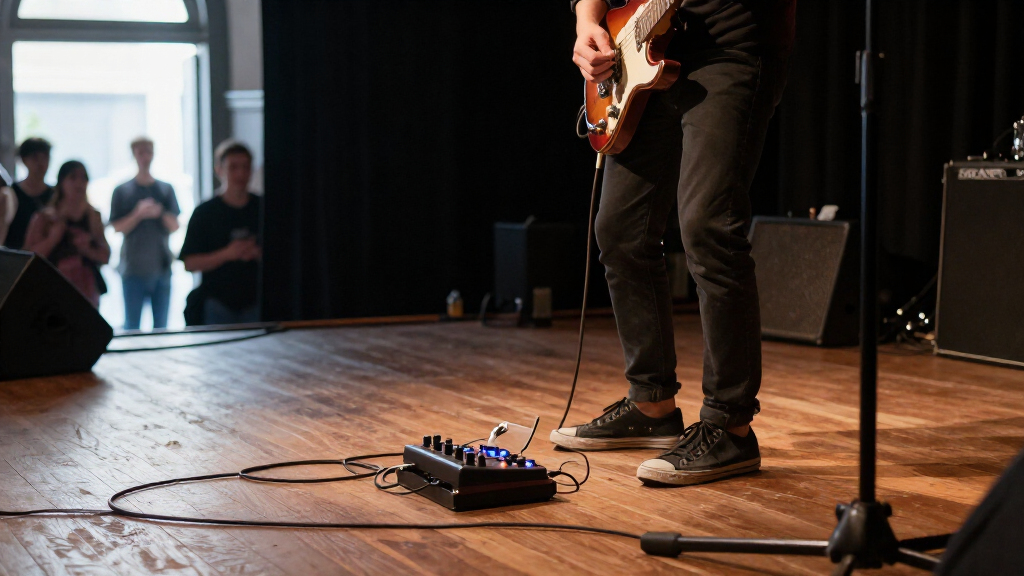
I ranked these loopers by how well their controls, track structure, and connections support real-time stage use. I weighed foot access and hands-free control for floor units, reachable controls for tabletop performers, and the effort required to record, overdub, switch parts, and recover from an unwanted take. I also considered whether a product’s design fits its likely player: a singer with an acoustic guitar has different needs from a beatboxer or a guitarist building a dense arrangement.
The ranking favors useful live control without needless complexity, not the highest track count alone. Flexible stations lead when their added control supports a broader range of stage arrangements; simpler pedals remain strong picks for players who value quick setup and a small footprint. I treated specialized features as advantages only for the performers who can use them, and weighed the tradeoff each design makes in portability, learning curve, and performance flexibility.
Factors to Consider When Choosing Looper For Live Performance
Choosing a live looper starts with your set, not the feature list. Decide what you need to control while playing, how many parts your songs demand, and whether the looper belongs at your feet or within reach on a table. These decisions help prevent paying for complexity you won’t use—or buying a minimal pedal that limits your arrangements.
Match Track Structure to Your Songs
Track count matters only when it maps to parts you need to control separately. A solo guitar performance built around one repeating foundation may work well with a simple loop, while songs with distinct verse, chorus, and ending sections can benefit from independent tracks or more deliberate part changes. Think through one representative song and list what must keep playing, stop, or change at each section. If every part can remain layered in a single loop, extra tracks may add complexity without improving the arrangement. If you need to mute or replace one part without disturbing the others, a basic one-loop pedal can become a creative constraint. Choose around the most demanding song in your set, not a hypothetical studio arrangement.
Choose Controls That Fit Your Stage Position
A floor looper works best when its switches can be reached reliably while you play, sing, and move. A tabletop station can put many controls close at hand, but it assumes you have a stable surface and can reach it during the performance. Don’t mistake a large switch or screen for a good workflow: the important question is whether you can start, overdub, stop, and change sections without looking away for too long. Before buying, sketch where the looper, microphone, instrument, and other pedals will sit onstage. Leave room for cables and foot movement, especially if you use several floor units. A layout mismatch can make a capable looper feel cumbersome.
Plan for Timing and Recovery
Live looping exposes small timing errors, so practice the actions that define your musical phrasing: the first record press, the loop closing point, and the transition between sections. A feature-rich unit can offer more ways to manage parts, but those options only help if they are easy to recall under pressure. Consider what happens after a missed overdub or an accidental stop, and whether your chosen workflow lets you recover without restarting the song. Build a short practice routine around actual foot or hand movements rather than only learning menus. Keep early arrangements simple until your timing feels consistent. The more control changes a song needs, the more valuable a repeatable operating routine becomes.
Check Connections and Signal Flow Before the Gig
Make a complete signal-flow list before choosing a looper: instrument pickups, microphones, effects, amplifiers, and any mixer or PA connection all affect the setup. A unit designed around guitar may not suit a performer who needs vocal processing, while a combined vocal-and-instrument processor may offer a more direct route for an acoustic singer. Check whether the connections and routing you need are available, then confirm how the looper will sit with your existing pedals and sound system. Keep an eye on cable access and power requirements, not just the number of inputs on a product page. A rehearsal with the full rig can reveal routing problems that are easy to miss in a bedroom setup. Don’t assume every looper handles a mixed instrument-and-vocal setup the same way.
Balance Portability Against Performance Range
Compact pedals are easy to fit on a crowded board and quick to carry, but their small footprints usually favor fewer controls and simpler arrangements. Larger stations take more space and setup time, yet can support more involved performances with multiple parts or hands-on editing. Think about the full load you bring to a gig, including power supplies, stands, and other pedals, rather than judging portability by the looper alone. If you perform short sets with a repeatable arrangement, a small unit may be the more dependable choice because there is less to configure. If each song uses a different structure, extra control can reduce workarounds. Pay for a larger format when it solves a recurring stage problem, not just because it offers more features.
Buy for the Workflow You’ll Practice
Loopers reward familiarity, so ease of learning has direct performance value. A beginner may benefit more from a clear record-and-overdub routine than from advanced routing that takes time to set up. Experienced performers may want independent control of parts, hands-free operation, or a layout that supports more deliberate arrangement changes. Before committing, identify the three actions you’ll use most often and check how many steps or movements each takes. Also ask whether you can repeat those actions in the dark or while concentrating on your instrument. A simpler unit can be the stronger live tool if it helps you perform confidently and consistently. Complexity is worthwhile when it serves a specific musical need.
Frequently Asked Questions
Is a simple one-loop pedal enough for playing live?
It can be, especially if your set relies on a repeating foundation and you don’t need to change separate parts during a song. A simpler pedal keeps the main actions direct and takes up less room, which can suit a compact guitar rig. The limitation appears when you need to mute a verse layer, replace a rhythm part, or move between distinct song sections without stopping everything. In that case, separate tracks or more live controls may save time and preserve the arrangement. Choose based on what your songs require onstage, rather than assuming a larger looper is always better.
Should I choose a floor looper or a tabletop looper?
Choose a floor unit if you want to operate the looper with your feet while holding an instrument or singing. A tabletop model can put more controls within reach and suit performers who build arrangements by hand, but it needs a stable, accessible surface. Consider where you stand, whether you move around, and how your microphone and instrument are positioned. If reaching a table would interrupt your playing, a floor layout may be the safer fit. If you need frequent hands-on adjustments and can place the unit close by, tabletop control can make those changes easier.
Do I need separate tracks for a live looping set?
Separate tracks are useful when you need to control parts independently, such as removing a rhythm layer while keeping a bass or vocal loop running. They are less important when each song uses one stable arrangement that can remain layered from start to finish. More tracks can also mean more decisions and more opportunities to make a stage mistake, so they are not an automatic upgrade. Write down which parts of your set need to change independently before choosing. If that list is short, a simpler looper may be easier to operate and practice.
Can I use the same looper for guitar and vocals?
That depends on the inputs, signal path, and vocal tools the unit provides. A guitar-focused pedal may fit a straightforward instrument loop but may not be the most convenient choice for a microphone-based performance. An acoustic singer may prefer a unit designed to combine guitar and vocal processing, while a more elaborate station can suit a performer who needs multiple sources and arrangements. Check the connections and intended workflow against your actual microphone, pickup, and amplification setup. If possible, confirm the complete rig in rehearsal before relying on it for a show.
When is it worth choosing a more complex looper?
A more complex model makes sense when its extra control addresses a real part of your performance, such as switching sections, managing independent layers, or controlling several sources. It can be a poor fit if you mainly record one loop and add a few overdubs, since advanced options may add setup and learning time without changing the result. Consider how often your songs require those capabilities and whether you can practice the controls consistently. Also account for stage space, cables, and the time needed to prepare the unit. Choose complexity for a repeatable musical benefit, not for specifications you may rarely use.
Conclusion
For a versatile floor-based live setup, I’d choose the BOSS RC-600 as the best overall; it suits performers who need more than a basic repeating loop and can make use of its broader control. The BOSS RC-500 is my best-value fit for many players who want dual-track flexibility without moving to a larger station. For a premium, hands-on arrangement workflow, consider the BOSS RC-505mkII or the Singular Sound Aeros Loop Studio, depending on whether reachable tabletop controls or its touch-focused approach better matches your performance. Beginners and guitarists with straightforward looping needs can start with the BOSS RC-1 or compare the compact Ditto 2 and LEKATO options. For acoustic singer-performers, the BOSS VE-8 is the focused choice; for players who want a dedicated looping pedal with a different feature set, look at the Pigtronix Infinity 3 and the BOSS RC-202. Let your stage position, song structure, and control habits settle the choice.