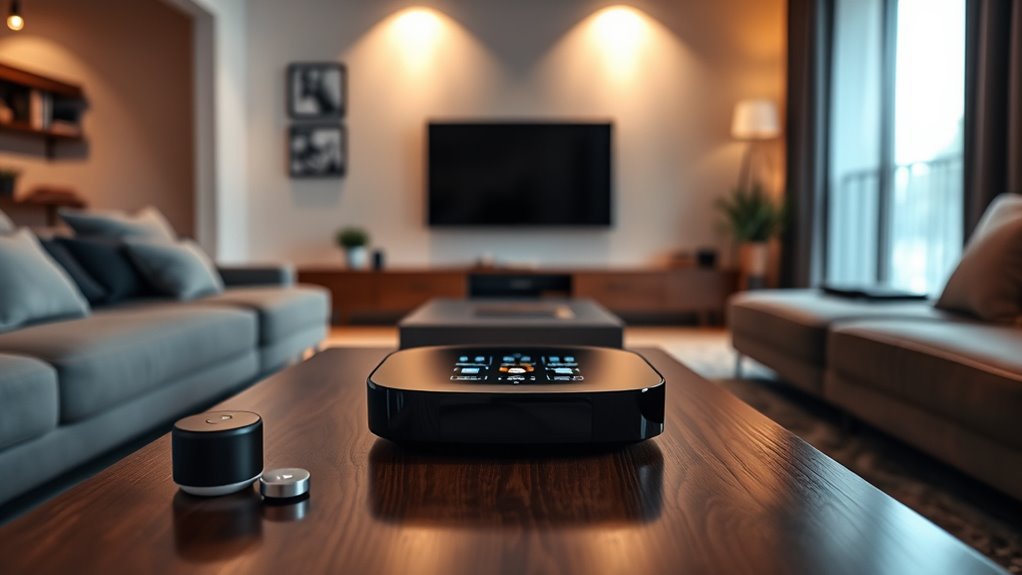

For those seeking a truly integrated smart home experience, premium all-in-one smart home hubs offer the convenience of central control combined with advanced automation capabilities. The Amazon Echo Hub stands out as the best overall choice, thanks to its robust Alexa integration and user-friendly interface. The Homey Pro offers extensive protocol support for versatile setups, while the Home Assistant Green caters to advanced DIY enthusiasts with customizable automation. However, buyers face tradeoffs between ease of use, protocol compatibility, and price. Keep reading for a detailed breakdown of the top options and what fits different needs.

Get audio and creator gear delivered free with Prime
- Fast, free delivery on millions of items
- Prime Video, Amazon Music and more included
- Member-only deals all year
Complete the kit


Key Takeaways
- The top picks excel in protocol support, with models like Homey Pro offering the broadest compatibility across Z-Wave, Zigbee, and Matter.
- Ease of use varies significantly; all-in-one hubs like Amazon Echo Hub prioritize intuitive interfaces, while DIY-focused options require more setup effort.
- Price ranges reflect hardware sophistication and protocol versatility; premium hubs often come with higher costs but deliver more seamless integrations.
- Local control features, such as with Hubitat Elevation, appeal to users prioritizing privacy and reliability without cloud dependency.
- Compatibility with voice assistants like Alexa and Google Assistant is common but varies in depth and ease of integration across models.
| Amazon Echo Hub (newest model), 8″ Smart Home Control Panel with Alexa+ |  | Best Overall Smart Home Hub with Versatile Protocol Support | Display: 8-inch touchscreen, 1280 x 800 resolution | Power requirements: Supports USB-C PD, 5V/2.4A, 9V/3A | Power over Ethernet: Supports PoE with compatible USB-C converter | VIEW ON AMAZON | See Our Full Breakdown |
| SONOFF Bridge Max Smart Home Hub (Bridge-M) |  | Best for Multi-Platform Zigbee and Local Control | Connectivity: Wi-Fi, Ethernet, Zigbee | Supported Devices: Zigbee, BTHome, eWeLink | Antenna Location: Home | VIEW ON AMAZON | See Our Full Breakdown |
| Home Assistant Green Smart Home Hub with Advanced Automation |  | Best for Power Users Wanting Local, Custom Automation | Processor: Quad-core | Storage: 32GB | RAM: 4GB | VIEW ON AMAZON | See Our Full Breakdown |
| Aqara Smart Hub M200, Matter Controller with Zigbee, Wi-Fi, IR |  | Best for Versatile Protocol Support and Local Automation | Dimensions: 3.94 x 3.94 x 1.22 inches | Supported Devices: Up to 40 Zigbee and 40 Thread devices | Connectivity: Wi-Fi 2.4/5 GHz, PoE, USB-C | VIEW ON AMAZON | See Our Full Breakdown |
| Homey Pro (2026) Smart Home Hub with Z-Wave, Zigbee, Wi-Fi, BLE, Infrared, Matter & Thread |  | Best for Extensive Protocol Compatibility and Large Device Ecosystems | Compatibility: Over 50,000 devices from 1,000+ brands | Protocols: Z-Wave Plus, Zigbee, Wi-Fi, BLE, Infrared, Matter, Thread | Local Processing: Yes | VIEW ON AMAZON | See Our Full Breakdown |
| Aeotec Smart Home Hub, Z-Wave, Zigbee, Matter Gateway, Compatible with Alexa and Google Assistant |  | Best Overall All-in-One Smart Home Hub | Connectivity: Wi-Fi, Ethernet | Protocols: Z-Wave, Zigbee, Matter | Compatibility: Alexa, Google Assistant, SmartThings | VIEW ON AMAZON | See Our Full Breakdown |
| Hubitat Elevation C-8 Pro Smart Home Hub, Local Control and Automations |  | Best for Privacy and Local Automations | Processor: 2.0 GHz | RAM: 2 GB | Connectivity: Wi-Fi, Ethernet | VIEW ON AMAZON | See Our Full Breakdown |
| premium allinone smart home hub | Compatibility | Connectivity |
|---|---|---|
| Amazon Echo Hub | WiFi, Zigbee, Thread, Matter, Bluetooth | — |
| SONOFF Bridge Max Smart Home H | — | Wi-Fi, Ethernet, Zigbee |
| Home Assistant Green Smart Hom | — | — |
| Aqara Smart Hub M200 | — | Wi-Fi 2.4/5 GHz, PoE, USB-C |
| Homey Pro | Over 50,000 devices from 1,000+ brands | — |
| Aeotec Smart Home Hub | Alexa, Google Assistant, SmartThings | Wi-Fi, Ethernet |
| Hubitat Elevation C-8 Pro Smar | 1,000+ devices across 100+ brands | Wi-Fi, Ethernet |
More Details on Our Top Picks
Amazon Echo Hub (newest model), 8″ Smart Home Control Panel with Alexa+
The Amazon Echo Hub stands out for its intuitive 8-inch touchscreen combined with broad compatibility across smart home protocols like Zigbee, Thread, and Matter. Its customizable dashboards and privacy features make it a strong choice for users who want seamless control and a polished interface. Compared to the Home Assistant Green, it offers a more user-friendly setup but sacrifices some of the advanced automation flexibility. While it supports a wide array of devices, its reliance on wall mounting and the need for extra accessories for power over Ethernet can be inconvenient. This pick is ideal for homeowners seeking a stylish, integrated hub with voice control and a focus on ease of use.
Pros:- Intuitive 8-inch touchscreen with customizable dashboards
- Supports a wide range of protocols including Zigbee, Thread, and Matter
- Privacy features like mic mute button and sustainable materials
Cons:- Requires wall mounting or separate stand, which can be less flexible
- Power over Ethernet setup may need extra accessories, reducing convenience
Best for: Homeowners wanting a sleek, Alexa-compatible all-in-one control panel with easy setup and broad device support
Not ideal for: Tech-savvy enthusiasts seeking maximum automation customization or portable solutions
- Display:8-inch touchscreen, 1280 x 800 resolution
- Power requirements:Supports USB-C PD, 5V/2.4A, 9V/3A
- Power over Ethernet:Supports PoE with compatible USB-C converter
- Audio:Stereo full-range speakers
- Sensors:Passive infrared (PIR), ambient light sensor
- Compatibility:WiFi, Zigbee, Thread, Matter, Bluetooth
Our verdict“This device suits users who prioritize a user-friendly, visually appealing smart home control with broad compatibility and voice integration.”
SONOFF Bridge Max Smart Home Hub (Bridge-M)
The SONOFF Bridge Max excels in supporting multiple smart ecosystems, including Zigbee, BTHome, and eWeLink, making it a flexible choice for homes with diverse devices. Its local web console offers a secure method for managing your setup without relying solely on cloud services—an advantage over the Amazon Echo Hub’s cloud-dependent approach. However, the setup process can be more technical, and the absence of detailed firmware update info leaves some questions about long-term support. This hub is best suited for users comfortable with configuration who want a multi-protocol device that prioritizes local control and security.
Pros:- Supports multiple ecosystems including Zigbee, BTHome, and eWeLink
- Local web console enhances privacy and control
- Compatible with popular platforms like Alexa, Google, and HomeKit
Cons:- Requires some technical knowledge for setup and integration
- Limited info on firmware updates and app features
Best for: Tech-savvy users who want to integrate Zigbee and BTHome devices with local management capabilities
Not ideal for: Casual users seeking plug-and-play solutions or those who prefer a more polished app interface
- Connectivity:Wi-Fi, Ethernet, Zigbee
- Supported Devices:Zigbee, BTHome, eWeLink
- Antenna Location:Home
- Weight:2.88 ounces
- Power:5 volts
Our verdict“Ideal for users who prioritize multi-protocol support and local control over ease of initial setup.”
Home Assistant Green Smart Home Hub with Advanced Automation
The Home Assistant Green offers a streamlined, fanless design with powerful automation capabilities that appeal to users wanting local control. Its quad-core processor and 32GB storage enable complex routines, surpassing the capabilities of the Echo Hub’s pre-made dashboards. Unlike the Aqara Hub, it requires Ethernet for initial setup, which could be inconvenient for some, and its limited storage might restrict very large setups. This device makes the most sense for DIY enthusiasts or those who want a secure, local-only hub with extensive protocol support like Z-Wave and Zigbee.
Pros:- Fanless, silent operation with a sleek design
- Supports Z-Wave, Zigbee, and Thread for broad device compatibility
- Pre-installed with Home Assistant for easy setup
Cons:- Requires Ethernet connection initially, less flexible for wireless setups
- Limited storage for very extensive device networks
Best for: Experienced smart home users seeking customizable automation with local data control
Not ideal for: Beginners or those preferring wireless, plug-and-play setups with minimal configuration
- Processor:Quad-core
- Storage:32GB
- RAM:4GB
- Power Consumption:A few watts
Our verdict“This hub suits tech enthusiasts aiming for advanced automation and local control, willing to handle initial setup complexity.”
Aqara Smart Hub M200, Matter Controller with Zigbee, Wi-Fi, IR
The Aqara Hub M200 distinguishes itself with support for Zigbee, Thread, Wi-Fi, and IR, making it a flexible option for diverse smart home setups. Its role as a Matter Controller and Thread Border Router provides future-proofing, while local automation ensures reliable performance without internet dependence—an advantage over the Echo Hub’s cloud reliance. However, the IR functionality may be limited to specific devices, and full automation features often require additional sensors or hubs. This device is best for users seeking a multi-protocol hub that offers local control and compatibility with major ecosystems like Apple, Alexa, and Google.
Pros:- Supports Zigbee, Thread, Wi-Fi, and IR for wide device compatibility
- Enables local automations for reliable performance
- Includes PoE support and USB-C for flexible power options
Cons:- IR blaster functionality may be limited and not cover all devices
- Additional sensors or hubs are often needed for full automation
Best for: Homeowners wanting a versatile, protocol-rich hub with local automation and IR capabilities
Not ideal for: Casual users or those wanting a simple, all-in-one touchscreen control panel
- Dimensions:3.94 x 3.94 x 1.22 inches
- Supported Devices:Up to 40 Zigbee and 40 Thread devices
- Connectivity:Wi-Fi 2.4/5 GHz, PoE, USB-C
- Features:Matter Controller, Thread Border Router, IR Blaster
- Weight:4.6 ounces
Our verdict“Best suited for users who prioritize protocol versatility and local automations, accepting some limitations in IR and automation complexity.”
Homey Pro (2026) Smart Home Hub with Z-Wave, Zigbee, Wi-Fi, BLE, Infrared, Matter & Thread
The Homey Pro (2026) offers unmatched device compatibility, supporting over 50,000 devices across Z-Wave, Zigbee, Wi-Fi, BLE, Infrared, Matter, and Thread. Its ability to manage extensive networks with local processing makes it a standout for large, complex smart homes. Compared to the more streamlined Amazon Echo Hub, Homey Pro emphasizes breadth over simplicity, which can lead to a steeper learning curve. Its lack of detailed RAM specs and potential setup complexity mean it’s best for dedicated smart home enthusiasts willing to invest time in configuration. For those with sizable, multi-protocol setups, this hub provides unmatched flexibility.
Pros:- Supports over 50,000 devices from numerous brands
- Local processing for enhanced privacy and automation speed
- Supports all major protocols including Z-Wave, Zigbee, Wi-Fi, BLE, Matter, and Thread
Cons:- Setup and configuration can be complex and time-consuming
- Limited info on RAM and specific hardware details
Best for: Power users with large, multi-protocol smart home ecosystems needing extensive device management
Not ideal for: Casual users or those seeking quick, simple setups with minimal configuration
- Compatibility:Over 50,000 devices from 1,000+ brands
- Protocols:Z-Wave Plus, Zigbee, Wi-Fi, BLE, Infrared, Matter, Thread
- Local Processing:Yes
- Memory:Double RAM (unspecified)
Our verdict“This hub is ideal for advanced users managing large, multi-protocol smart homes who value extensive device support and local control.”
Aeotec Smart Home Hub, Z-Wave, Zigbee, Matter Gateway, Compatible with Alexa and Google Assistant
The Aeotec Smart Home Hub stands out for its broad protocol support, including Z-Wave, Zigbee, and Matter, making it highly versatile for integrating various smart devices. Compared with the Hubitat Elevation C-8 Pro, it offers easier setup via Wi-Fi and Ethernet, which is beneficial for users seeking a straightforward experience, but it leans heavily on the SmartThings app for management, adding some complexity. Its wide compatibility with Alexa and Google Assistant ensures voice control works seamlessly across most devices, yet it’s primarily designed for North American regions, which could limit its usability elsewhere. The inclusion of both Wi-Fi and Ethernet options enhances reliability, especially in busy smart homes. However, the reliance on the SmartThings ecosystem could be a hurdle for those wanting to avoid app fragmentation.
Pros:- Supports multiple protocols (Z-Wave, Zigbee, Matter) for wide device compatibility
- Simple setup via Wi-Fi or Ethernet, making installation accessible
- Automations can run locally, improving speed and system reliability
- Works seamlessly with Alexa and Google Assistant for voice control
Cons:- Primarily tailored for North American regions, limiting international support
- Requires the SmartThings app for setup and ongoing management, adding an extra layer
Best for: Homeowners seeking a flexible, multi-protocol hub with easy setup in North America, who value broad device compatibility and voice assistant integration.
Not ideal for: Users outside North America or those preferring a more autonomous, locally processed system without app dependencies, as this hub depends on SmartThings for full functionality.
- Connectivity:Wi-Fi, Ethernet
- Protocols:Z-Wave, Zigbee, Matter
- Compatibility:Alexa, Google Assistant, SmartThings
- Supported Regions:North America
Our verdict“This pick is ideal for users who want a multi-protocol hub that balances ease of setup with broad device support, especially within North America.”
Hubitat Elevation C-8 Pro Smart Home Hub, Local Control and Automations
The Hubitat Elevation C-8 Pro excels in processing automations locally, which offers faster responses and enhanced privacy compared to cloud-reliant hubs like the Aeotec. It supports a comprehensive array of protocols including Z-Wave 800 Series, Zigbee 3.0, and Matter 1.5, making it compatible with over a thousand devices across multiple brands. While setup may demand some technical skill—especially verifying device compatibility—its active community and no-subscription model make it appealing for dedicated smart home enthusiasts. Unlike the Aeotec hub, which relies on the SmartThings ecosystem, the Hubitat provides a more autonomous experience, with advanced automation options suited for power users. However, its interface and setup process might be daunting for beginners, and some integrations could require extra configuration effort.
Pros:- Processes automations locally for quick response times and privacy
- Supports a wide range of protocols including Z-Wave, Zigbee, and Matter
- Integrates with Alexa, Google Home, and Apple HomeKit for versatile voice control
- No mandatory subscription fees and an active user community for support
Cons:- Setup can be challenging for non-technical users, requiring compatibility checks
- Advanced automation features may be complex for beginners
- Some integrations and customizations need additional configuration steps
Best for: Tech-savvy homeowners seeking fast, reliable automations with strong privacy controls and extensive protocol support, especially those comfortable with a more hands-on setup.
Not ideal for: Less experienced users or those wanting a plug-and-play solution with minimal configuration, as this hub can be complex and requires technical knowledge.
- Processor:2.0 GHz
- RAM:2 GB
- Connectivity:Wi-Fi, Ethernet
- Protocols:Z-Wave 800 Series, Zigbee 3.0, Matter 1.5, Bluetooth
- External Antennas:Yes
- Compatibility:1,000+ devices across 100+ brands
Our verdict“This hub suits experienced users who prioritize local control, privacy, and broad protocol compatibility over plug-and-play simplicity.”

How We Picked
The products in this roundup were selected based on their ability to serve as comprehensive, all-in-one smart home hubs that support multiple protocols, including Z-Wave, Zigbee, and Matter. We evaluated each device’s performance, build quality, ease of setup, and user interface, emphasizing features that enable seamless automation and control. Compatibility with popular voice assistants and smart home ecosystems was also a key factor. We ranked the hubs according to their versatility, user experience, and future-proofing, prioritizing models that offer a balance of advanced capabilities and straightforward operation for a premium segment.| premium allinone smart home hub | Connectivity |
|---|---|
| Amazon Echo Hub | — |
| SONOFF Bridge Max Smart Home H | Wi-Fi, Ethernet, Zigbee |
| Home Assistant Green Smart Hom | — |
| Aqara Smart Hub M200 | Wi-Fi 2.4/5 GHz, PoE, USB-C |
| Homey Pro | — |
| Aeotec Smart Home Hub | Wi-Fi, Ethernet |
| Hubitat Elevation C-8 Pro Smar | Wi-Fi, Ethernet |
Factors to Consider When Choosing Premium Allinone Smart Home Hubs
Choosing a premium all-in-one smart home hub involves balancing several key factors to ensure it meets your automation needs and future plans. Beyond basic compatibility, consider how intuitive the setup and daily use will be, as well as the hub’s ability to support multiple protocols simultaneously. Investing in a device with local control capabilities can enhance privacy and reliability, especially if your internet connection is unreliable. Compatibility with voice assistants and existing smart home ecosystems can streamline your experience, but be mindful of potential limitations or setup complexity. Lastly, evaluate the overall build quality and ongoing software updates, which influence long-term performance and security.Protocol Compatibility and Future-Proofing
Ensure the hub supports a broad range of protocols like Z-Wave, Zigbee, and Matter, as this guarantees compatibility with current and future smart devices. A hub with extensive protocol support reduces the need for multiple controllers and simplifies automation complexity. Consider whether the device is compatible with your existing ecosystem or if it offers a straightforward path to expand as new standards emerge, protecting your investment over time. Avoid hubs with limited protocol support, as they may restrict your device choices and automation flexibility later on.
Ease of Use and Setup
Premium hubs should strike a balance between advanced features and user-friendly interfaces. Devices with intuitive apps, guided setup processes, and clear documentation minimize frustration, especially for those less technically inclined. However, some highly customizable hubs may require more technical skill, which could be a drawback if you prefer simplicity. Think about whether you prioritize quick setup for immediate use or are willing to invest time customizing your automation environment.
Local Control and Data Privacy
Local control capabilities are increasingly important to many users, offering increased privacy, faster response times, and independence from cloud services. Hubs like Hubitat Elevation emphasize local automation, making them appealing for privacy-conscious households. Be aware that some premium hubs rely heavily on cloud connectivity for features, which can introduce latency or service disruptions. Decide if local control is a must-have or a nice-to-have based on your privacy preferences and reliability expectations.
Compatibility with Voice Assistants
Most premium hubs integrate with voice assistants like Alexa and Google Assistant, but the depth of integration varies. Some hubs offer simple voice control, while others enable complex automation commands through voice. Verify whether the hub’s voice support is native or requires additional configuration, as this can affect ease of use. Also, consider the ecosystem you already use; choosing a hub that aligns with your existing voice assistant can reduce setup complexity.
Build Quality and Software Support
A premium hub should have a solid build and a reliable software platform that receives regular updates. Firmware updates improve security, add features, and maintain compatibility with new devices. Avoid hubs with a history of sporadic updates or poor customer support, as these can compromise your system’s stability over time. Investing in a well-supported product ensures your smart home remains functional and secure for years to come.
Frequently Asked Questions
Can I use a premium all-in-one hub with my existing smart devices?
Yes, most premium hubs are designed to support a wide range of protocols and device types, making them compatible with many existing smart home products. However, it’s essential to verify the specific protocols your devices use and confirm that the hub supports them. For example, if you have Zigbee and Z-Wave devices, choose a hub like the Homey Pro that explicitly supports both. Compatibility varies between models, so checking the manufacturer’s device list can prevent future frustrations.
Is it better to buy a hub with local control or cloud reliance?
Opting for a hub with local control offers benefits like increased privacy, faster response times, and reliability during internet outages. Hubs like Hubitat Elevation prioritize local automation, making them attractive for security-sensitive setups. Cloud-dependent hubs often provide easier setup and access to remote features but can face latency or service disruptions if the cloud service experiences issues. Your choice should reflect your priorities around privacy, reliability, and ease of access.
How important is protocol support when choosing a premium hub?
Protocol support is a critical factor because it determines device compatibility and system flexibility. A hub that supports Z-Wave, Zigbee, and Matter ensures you can integrate current and future smart devices without needing additional controllers. Limited protocol support can restrict automation options and require more complicated setups with multiple hubs. A versatile protocol foundation makes your smart home more adaptable and future-proof, especially at a premium price point.
Should I prioritize a hub with a touchscreen or a simple app interface?
While a touchscreen can enhance control and visibility, a well-designed app is often more practical for daily use, especially if you prefer controlling your smart home remotely. Touchscreens may add to the cost and complexity without necessarily providing significant usability benefits. Consider your typical use case: if you want a centralized panel in a common area, a touchscreen might add convenience; for most users, a clean app interface can suffice and offer greater flexibility.
How often should I expect firmware updates for my smart home hub?
Regular firmware updates are vital for maintaining security, improving features, and ensuring compatibility with new devices. Reputable brands tend to provide updates every few months, especially for premium hubs that prioritize longevity. It’s wise to choose a hub from a manufacturer with a track record of ongoing support, as neglecting updates can leave your system vulnerable or incompatible with newer devices over time.
Conclusion
For most users seeking a seamless, reliable, and feature-rich experience, the Amazon Echo Hub offers the best overall value with its intuitive interface and broad ecosystem support. Those who want maximum flexibility and protocol support should consider the Homey Pro or Home Assistant Green, especially if DIY customization appeals. For privacy-minded households, the Hubitat Elevation provides robust local control. Beginners or those upgrading from simpler systems will find the Amazon Echo Hub or Aqara Hub M200 more accessible, while advanced users should look at hubs like Homey Pro or Home Assistant Green for extensive automation capabilities.Halloween Picks
halloween
As an affiliate, we earn on qualifying purchases.