When you need a whole home mesh WiFi system for large homes, the decision comes down to coverage, backhaul technology, and how much you’re willing to pay for future-proofing. After comparing 15 of the most capable systems on the market, the NETGEAR Orbi 970 Series (RBE973S) takes the top spot for its quad-band backhaul and exceptional range, while the Amazon eero Max 7 stands out for effortless setup and the TP-Link Deco X55 offers the best value for Wi-Fi 6 homes. The main tradeoffs you’ll face are Wi-Fi 6 versus Wi-Fi 7, tri-band versus quad-band designs, and whether you need a dedicated wireless backhaul or can rely on wired Ethernet. Keep reading for the full breakdown of each system and which one fits your specific layout and budget.

Get audio and creator gear delivered free with Prime
- Fast, free delivery on millions of items
- Prime Video, Amazon Music and more included
- Member-only deals all year
Complete the kit


Key Takeaways
- Wi-Fi 7 is now standard on most high-end mesh systems, but Wi-Fi 6 models like the TP-Link Deco X55 still deliver reliable coverage for large homes at a fraction of the cost.
- Quad-band systems (like the Orbi 970) consistently outperform tri-band models in large, multi-story homes because they dedicate a separate radio to backhaul, reducing latency and maintaining speeds at the edges.
- The number of nodes matters less than the placement and backhaul method; a 3-pack with a strong dedicated backhaul often beats a 4-pack with shared bandwidth.
- Amazon eero and TP-Link Deco offer the most polished mobile apps, making them the best choices for beginners, while NETGEAR Orbi provides more advanced customization for power users.
- Coverage claims are optimistic; real-world performance in large homes depends on wall materials, interference, and whether you can use wired backhaul between nodes.
| TP-Link Deco 7 BE23 Wi-Fi 7 Dual-Band Mesh System, 3-Pack |  | Best Overall for Broad, Balanced Coverage | Wi-Fi standard: Wi-Fi 7 | Wireless speed: Up to 3.6 Gbps | Bands: Dual-band | VIEW ON AMAZON | See Our Full Breakdown |
| NETGEAR Orbi 870 Series WiFi 7 Tri-Band Mesh System, 3-Pack |  | Best Premium Coverage | Wi-Fi generation: Wi-Fi 7 | Frequency bands: Tri-band, including 6 GHz | Maximum data transfer rate: Up to 21 Gbps | VIEW ON AMAZON | See Our Full Breakdown |
| NETGEAR Orbi 360 Series WiFi 7 Mesh System, 3-Pack |  | Best for Moderate Device Loads | Wi-Fi generation: Wi-Fi 7 | Frequency band: Dual-band | Maximum data transfer rate: Up to 5 Gbps | VIEW ON AMAZON | See Our Full Breakdown |
| NETGEAR Orbi 370 Series WiFi 7 Mesh System, 3-Pack | | Best for App-Guided Setup | Wi-Fi standard: Wi-Fi 7 | Bands: Dual-band | Maximum speed: Up to 5 Gbps | VIEW ON AMAZON | See Our Full Breakdown |
| TP-Link Deco 7 Pro BE67 Tri-Band Wi-Fi 7 Mesh System |  | Best Single-Unit Starting Point | Wi-Fi generation: Wi-Fi 7 | Frequency bands: Tri-band: 2.4 GHz, 5 GHz, and 6 GHz | Maximum combined data rate: Up to 14 Gbps | VIEW ON AMAZON | See Our Full Breakdown |
| Amazon eero Max 7 Tri-Band Wi-Fi 7 Mesh System, 3-Pack |  | Best for Smart Homes and Wired Backhaul | Wi-Fi standard: Wi-Fi 7 (IEEE 802.11a/b/g/n/ac/ax/be) | System size: 3-pack | Coverage: Up to 7,500 sq. ft. | VIEW ON AMAZON | See Our Full Breakdown |
| NETGEAR Orbi 770 Series WiFi 7 Tri-Band Mesh System, 3-Pack |  | Best for Maximum Stated Coverage | WiFi generation: WiFi 7 | System components: Router and two satellites | Coverage: Up to 8,000 sq. ft. | VIEW ON AMAZON | See Our Full Breakdown |
| NETGEAR Orbi RBK13 Whole Home Mesh WiFi System, 1 Router and 2 Satellites |  | Best for Smaller Homes on a Basic WiFi 5 Plan | WiFi standard: 802.11ac (WiFi 5) | System components: 1 router and 2 satellites | Coverage: Up to 4,500 sq. ft. | VIEW ON AMAZON | See Our Full Breakdown |
| TP-Link Deco 7 Pro BE10000 Tri-Band Wi-Fi 7 Whole-Home Mesh System, 3-Pack |  | Best for Flexible Wired Connections | Wi-Fi standard: Wi-Fi 7 (802.11be) | Pack size: 3 units | Coverage: Up to 7,600 sq. ft. | VIEW ON AMAZON | See Our Full Breakdown |
| TP-Link Deco 7 Pro BE67 Tri-Band Wi-Fi 7 Mesh System, 3-Pack |  | Best for Highest Stated Bandwidth | Model: Deco 7 Pro BE67 | Wi-Fi standard: Wi-Fi 7 | Pack size: 3 units | VIEW ON AMAZON | See Our Full Breakdown |
| NETGEAR Orbi 970 Series Quad-Band WiFi 7 Mesh System (RBE973S) | 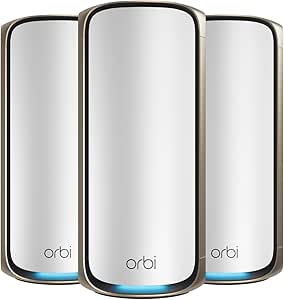 | Best Overall | WiFi standard: WiFi 7 | Frequency band: Quad-band | Max speed: Up to 27 Gbps | VIEW ON AMAZON | See Our Full Breakdown |
| Amazon eero Pro 6E Tri-Band Mesh Wi-Fi System, 3-Pack |  | Best for Smart Home Integration | WiFi standard: WiFi 6E | Coverage: Up to 6,000 sq. ft. (3-pack) | Max speed: Up to 2.3 Gbps | VIEW ON AMAZON | See Our Full Breakdown |
| Linksys Velop Micro 7 Dual-Band Wi-Fi 7 Mesh System, 3-Pack |  | Best for No-Subscription Setup | WiFi standard: WiFi 7 | Frequency band: Dual-band | Max speed: Up to 5 Gbps | VIEW ON AMAZON | See Our Full Breakdown |
| TP-Link Deco X55 AX3000 Wi-Fi 6 Mesh System, 3-Pack |  | Best Value | WiFi standard: WiFi 6 (AX3000) | Coverage: Up to 6,500 sq. ft. | Max devices: 150 | VIEW ON AMAZON | See Our Full Breakdown |
| NETGEAR Orbi 970 Series WiFi 7 Mesh System, 3-Pack | | Best for Multi-Gig Internet | WiFi standard: WiFi 7 | Coverage: Up to 10,000 sq. ft. | Max speed: Up to 27 Gbps | VIEW ON AMAZON | See Our Full Breakdown |
| whole home mesh wifi system for large home | Coverage |
|---|---|
| TP-Link Deco 7 BE23 Wi-Fi 7 Du | Up to 6,500 sq. ft. |
| NETGEAR Orbi 870 Series WiFi 7 | Up to 9,000 sq. ft. |
| NETGEAR Orbi 360 Series WiFi 7 | Up to 6,000 sq. ft. |
| NETGEAR Orbi 370 Series WiFi 7 | Up to 6,000 sq. ft. |
| TP-Link Deco 7 Pro BE67 Tri-Ba | — |
| Amazon eero Max 7 Tri-Band Wi- | Up to 7,500 sq. ft. |
| NETGEAR Orbi 770 Series WiFi 7 | Up to 8,000 sq. ft. |
| NETGEAR Orbi RBK13 Whole Home | Up to 4,500 sq. ft. |
| TP-Link Deco 7 Pro BE10000 Tri | Up to 7,600 sq. ft. |
| TP-Link Deco 7 Pro BE67 Tri-Ba | Up to 8,100 sq. ft. |
| NETGEAR Orbi 970 Series Quad-B | Up to 10,000 sq. ft. |
| Amazon eero Pro 6E Tri-Band Me | Up to 6,000 sq. ft. (3-pack) |
| Linksys Velop Micro 7 Dual-Ban | Up to 6,600 sq. ft. |
| TP-Link Deco X55 AX3000 Wi-Fi | Up to 6,500 sq. ft. |
| NETGEAR Orbi 970 Series WiFi 7 | Up to 10,000 sq. ft. |
More Details on Our Top Picks
TP-Link Deco 7 BE23 Wi-Fi 7 Dual-Band Mesh System, 3-Pack
The Deco 7 BE23 is my strongest all-around fit here for a large home that needs coverage and useful wired connections without moving up to a more specialized system. Its stated 6,500-square-foot coverage exceeds the NETGEAR Orbi 360 and Orbi 370 figures, while two 2.5 Gbps ports on each unit give you options for wired backhaul or multi-gig equipment. That flexibility can help keep mesh links dependable when satellites can connect by Ethernet. The system also supports 150 devices, seamless roaming, VPN connections, and a separate IoT network. Its tradeoff is dual-band rather than tri-band Wi-Fi: unlike the Orbi 870, it has no third band to dedicate to mesh traffic. Coverage depends on the building, and HomeShield premium features require a paid service.
Pros:- Advertised coverage reaches up to 6,500 sq. ft.
- Two 2.5 Gbps WAN/LAN ports on every unit support wired backhaul and multi-gig connections.
- Supports up to 150 devices, with seamless roaming and a separate IoT network.
- VPN connections and both wired and wireless backhaul are supported.
Cons:- Dual-band design lacks the extra band offered by the tri-band NETGEAR Orbi 870.
- HomeShield premium security features require a paid service.
- A modem is required for most internet service providers.
Best for: Owners of large, multi-room homes who want broad mesh coverage, wired backhaul options, and a separate network for smart-home devices.
Not ideal for: Households seeking a tri-band system for heavy simultaneous traffic or buyers who want premium HomeShield features without a recurring subscription.
- Wi-Fi standard:Wi-Fi 7
- Wireless speed:Up to 3.6 Gbps
- Bands:Dual-band
- Package:3 units
- Coverage:Up to 6,500 sq. ft.
- Maximum connected devices:150
- Ports per unit:2 × 2.5 Gbps WAN/LAN
- Backhaul:Wired and wireless
Our verdict“Choose the Deco 7 BE23 for a large home where wide stated coverage and multi-gig wired flexibility matter more than tri-band capacity.”
NETGEAR Orbi 870 Series WiFi 7 Tri-Band Mesh System, 3-Pack
If a very large home needs more coverage headroom, the Orbi 870 makes the clearest case in this group: its router and two satellites are rated for up to 9,000 sq. ft., above the 6,000-square-foot claims for the Orbi 360 and Orbi 370. Its tri-band Wi-Fi 7 design and stated 21 Gbps maximum data rate suit homes with demanding wireless traffic, while a 10 Gig internet port and 2.5 Gig LAN ports leave room for fast connections. It also works with Wi-Fi 6 and Wi-Fi 5 devices, so older clients need not be replaced. The tradeoffs are substantial: this is more system than many households need, and the Armor security trial becomes a separate subscription. It is made for US use, and real coverage varies with construction and satellite placement.
Pros:- Router and two satellites are rated to cover up to 9,000 sq. ft.
- Tri-band Wi-Fi 7 and a stated maximum data rate of 21 Gbps target demanding network use.
- 10 Gig internet and 2.5 Gig LAN ports support fast wired connections.
- Compatible with Wi-Fi 7, Wi-Fi 6, and Wi-Fi 5 devices.
Cons:- Armor requires a separate subscription after the 30-day trial.
- US-only use limits suitability for buyers in other regions.
- Advertised coverage can vary with home layout, building materials, and satellite placement.
Best for: Owners of expansive US homes with fast internet service, many connected devices, and a need for extensive mesh coverage.
Not ideal for: People in smaller homes, buyers outside the United States, or households unwilling to pay separately for Armor after its trial.
- Wi-Fi generation:Wi-Fi 7
- Frequency bands:Tri-band, including 6 GHz
- Maximum data transfer rate:Up to 21 Gbps
- Coverage:Up to 9,000 sq. ft.
- Device capacity:Up to 150 devices
- Included components:1 router and 2 satellites
- Internet port:10 Gig
- LAN ports:2.5 Gig
- Security protocol:WPA3
Our verdict“Pick the Orbi 870 when your large US home needs the broadest stated coverage and tri-band capacity in this group.”
NETGEAR Orbi 360 Series WiFi 7 Mesh System, 3-Pack
The Orbi 360 suits a large home that needs three mesh units but does not have an especially high device count. Its stated 6,000-square-foot coverage is comparable to the Orbi 370, while its limit of 70 devices is well below the Deco 7 BE23’s 150. That makes the Orbi 360 a more focused match for a household with a moderate number of clients rather than a busy smart home. Wi-Fi 7 support, speeds up to 5 Gbps, and compatibility with Wi-Fi 6 and Wi-Fi 5 devices offer a route to newer wireless hardware without leaving older devices behind. The Orbi app provides guided setup, but this model is dual-band, not tri-band like the Orbi 870. Its US-only availability and Armor subscription after the trial also narrow its appeal.
Pros:- Three-unit system is rated for coverage up to 6,000 sq. ft.
- Wi-Fi 7 supports a stated maximum data rate of up to 5 Gbps.
- Works with Wi-Fi 7, Wi-Fi 6, and Wi-Fi 5 devices.
- Orbi app offers guided setup and network management.
Cons:- Device capacity is limited to 70, less than the Deco 7 BE23 and Orbi 870.
- Dual-band design does not provide the extra band found in the Orbi 870.
- US-only use and a separate Armor subscription after the trial limit its fit.
Best for: US households with a large floor plan, a moderate number of connected devices, and a mix of newer and older Wi-Fi equipment.
Not ideal for: Homes with more than 70 connected devices, buyers outside the US, or users who specifically need tri-band mesh.
- Wi-Fi generation:Wi-Fi 7
- Frequency band:Dual-band
- Maximum data transfer rate:Up to 5 Gbps
- Coverage:Up to 6,000 sq. ft.
- Supported devices:Up to 70
- Included units:Router and two satellites
- LAN port bandwidth:2,500 Mbps
- Security protocols:WPA2 and WPA3
Our verdict“Choose the Orbi 360 if you need three Wi-Fi 7 mesh units for a large US home but do not need capacity beyond 70 devices.”
NETGEAR Orbi 370 Series WiFi 7 Mesh System, 3-Pack
The Orbi 370 is a straightforward three-unit Wi-Fi 7 option for a large home where app-guided setup matters more than a long list of advanced features. Its stated 6,000-square-foot coverage and 70-device capacity match the Orbi 360 closely, so I would compare the two based on the details you need rather than assume one serves a larger household. Both are dual-band systems with speeds up to 5 Gbps; the supplied Orbi 370 information highlights guided management and cable or fiber plans up to 2.5 Gbps. Compared with the Deco 7 BE23, it has a lower stated device limit and no listed per-unit multi-gig port details, but the setup path is clear for buyers who want to manage the network in the Orbi app. Armor becomes a paid subscription after its trial, and the system is for US use.
Pros:- Three-unit system is rated for coverage up to 6,000 sq. ft.
- Wi-Fi 7 speeds are listed up to 5 Gbps.
- Orbi app provides guided setup and network management.
- Designed for cable or fiber plans up to 2.5 Gbps.
Cons:- Supports up to 70 devices, fewer than the Deco 7 BE23 and Orbi 870.
- NETGEAR Armor requires a separate subscription after the 30-day trial.
- US-only use and coverage variation limit suitability across regions and home layouts.
Best for: US homeowners who want a three-unit Wi-Fi 7 mesh setup for a large cable- or fiber-connected home and prefer app-guided network management.
Not ideal for: Households with more than 70 devices, buyers outside the United States, or users who need documented multi-gig ports on every mesh unit.
- Wi-Fi standard:Wi-Fi 7
- Bands:Dual-band
- Maximum speed:Up to 5 Gbps
- Coverage:Up to 6,000 sq. ft.
- Device capacity:Up to 70 devices
- Pack size:3
- Internet compatibility:Cable or fiber plans up to 2.5 Gbps
- Region:United States
Our verdict“The Orbi 370 fits US buyers who want guided app setup and 6,000-square-foot stated coverage without a need for more than 70 devices.”
TP-Link Deco 7 Pro BE67 Tri-Band Wi-Fi 7 Mesh System
The Deco 7 Pro BE67 stands apart from the other picks because the supplied package contains one Deco unit, not a router-and-two-satellite set. That makes it a better starting point for buyers planning to build out a compatible mesh over time than an immediate whole-home answer for a large property. Its tri-band Wi-Fi 7 specification, support for up to 200 devices, and combination of 10 Gbps, 2.5 Gbps, and 1 Gbps ports give it a stronger wired and client-capacity profile than the dual-band Orbi 360 and Orbi 370. A USB 3.0 port adds another connection option. The major caveat is conflicting coverage information: the listing gives both 6,000 and 3,100 square feet. The advertised 14 Gbps is a combined theoretical rate, not a guarantee for individual devices.
Pros:- Tri-band Wi-Fi 7 includes 2.4 GHz, 5 GHz, and 6 GHz bands.
- Supports up to 200 devices, more than the listed Orbi 360 and Orbi 370 limits.
- Includes 10 Gbps, 2.5 Gbps, and 1 Gbps WAN/LAN ports plus USB 3.0.
- Supports WPA-PSK, WPA2-PSK, and WPA3 security protocols.
Cons:- Package includes one unit, unlike the three-unit mesh kits elsewhere in this group.
- Supplied coverage claims conflict: one section says 6,000 sq. ft. and another says 3,100 sq. ft.
- The 14 Gbps combined rate is theoretical and depends on compatible devices and conditions.
Best for: Wi-Fi 7 buyers who want one tri-band Deco unit as the start of a planned mesh and need high device capacity or varied multi-gig ports.
Not ideal for: People who need a complete multi-node system for a large home immediately, or buyers who need a clear, consistent coverage figure before choosing.
- Wi-Fi generation:Wi-Fi 7
- Frequency bands:Tri-band: 2.4 GHz, 5 GHz, and 6 GHz
- Maximum combined data rate:Up to 14 Gbps
- Maximum coverage:Listing states up to 6,000 sq. ft. in one section and 3,100 sq. ft. in another
- Device capacity:Up to 200 devices
- Ports:10 Gbps, 2.5 Gbps, and 1 Gbps WAN/LAN; USB 3.0
- Security protocols:WPA-PSK, WPA2-PSK, WPA3
- Included components:One Deco BE67 unit, installation guide, Ethernet cable, and power adapter
Our verdict“Buy the BE67 as a high-capacity, tri-band starting unit if you plan to add mesh coverage, not as a ready-made large-home kit.”
Amazon eero Max 7 Tri-Band Wi-Fi 7 Mesh System, 3-Pack
For a large home with both heavy network traffic and connected smart devices, the eero Max 7 is a particularly capable fit. Its stated coverage reaches 7,500 sq. ft., while its four Ethernet ports per unit—including two 10 GbE ports—give a wired backhaul or multi-gig setup more flexibility than the single-port Orbi RBK13. The built-in Thread, Matter, and Zigbee controller can also reduce the need for separate smart-home hubs. Compared with the TP-Link Deco 7 Pro BE10000, eero supports a larger stated device count, but the Deco includes a USB port and VPN features. The tradeoffs are the need for a supported phone and internet service during setup, plus optional subscription costs for eero Plus security features. Its large units may also take more shelf space than compact mesh hardware.
Pros:- Stated coverage of up to 7,500 sq. ft. and support for more than 750 devices
- Four Ethernet ports per unit, including two 10 GbE ports
- Built-in Thread, Matter, and Zigbee controller support
- Tri-band Wi-Fi 7 with a three-year limited warranty
Cons:- Some eero Plus security features require an optional subscription
- Setup requires a supported iOS or Android device and internet service
- Units measure 7.24 x 8.73 x 3.54 inches each, which may be awkward to place
Best for: Owners of large, device-heavy homes who want multi-gig wired connections and a mesh system that can also control compatible smart-home devices.
Not ideal for: Shoppers who want built-in security features without a subscription, lack an iOS or Android device for setup, or need smaller units for tight spaces.
- Wi-Fi standard:Wi-Fi 7 (IEEE 802.11a/b/g/n/ac/ax/be)
- System size:3-pack
- Coverage:Up to 7,500 sq. ft.
- Device capacity:More than 750 devices
- Bands:Tri-band: 2.4 GHz, 5 GHz, and 6 GHz
- Ethernet ports:Two auto-sensing 10 GbE and two auto-sensing 2.5 GbE per unit
- Maximum speeds:Up to 9.4 Gbps wired and 4.3 Gbps wireless
- Smart-home support:Thread, Matter, and Zigbee controller
- Warranty:3-year limited warranty
Our verdict“Choose the eero Max 7 for a large, connected home that can make use of its smart-home hub and extensive multi-gig Ethernet; skip it if subscription-free security is a priority.”
NETGEAR Orbi 770 Series WiFi 7 Tri-Band Mesh System, 3-Pack
The Orbi 770 is the coverage-first option in this group, with a stated reach of up to 8,000 sq. ft. from its router and two satellites. That gives it a small coverage advantage over the eero Max 7, while its advertised 11 Gbps tri-band WiFi 7 speed and compatibility with WiFi 6 and WiFi 5 devices suit a home upgrading gradually. It is less suited to unusually dense networks: its stated limit is 100 devices, far below eero’s 750-plus capacity. The TP-Link Deco 7 Pro BE67 supports up to 200 devices and lists mixed-speed ports on each unit, while this Orbi’s specified LAN ports top out at 2,500 Mbps. Setup is app-guided, but a separate modem is required, and NETGEAR Armor becomes subscription-based after its 30-day trial.
Pros:- Stated coverage of up to 8,000 sq. ft. from a three-piece system
- Tri-band WiFi 7 with advertised speeds up to 11 Gbps
- Compatible with WiFi 7, WiFi 6, and WiFi 5 devices
- App-guided setup and WPA3 security
Cons:- Device support is capped at 100, lower than the eero Max 7 and Deco 7 Pro BE10000
- Requires a separate modem
- NETGEAR Armor requires a separate subscription after its 30-day trial
Best for: Households with a large floor plan, a cable or fiber modem already in place, and a mix of newer and older WiFi devices.
Not ideal for: Homes with more than 100 connected devices, buyers seeking built-in smart-home controller support, or shoppers avoiding ongoing security subscriptions.
- WiFi generation:WiFi 7
- System components:Router and two satellites
- Coverage:Up to 8,000 sq. ft.
- Supported devices:Up to 100
- Frequency bands:Tri-band
- Maximum data transfer rate:Up to 11 Gbps
- LAN port bandwidth:2,500 Mbps
- Compatibility:WiFi 7, WiFi 6, and WiFi 5 devices
- Internet connection:Existing modem required; compatible with cable and fiber plans up to 2.5 Gbps
Our verdict“Pick the Orbi 770 when broad stated coverage matters more than very high device capacity, and your modem and subscription preferences fit its requirements.”
NETGEAR Orbi RBK13 Whole Home Mesh WiFi System, 1 Router and 2 Satellites
The Orbi RBK13 is the practical step-down choice for buyers whose home is large enough to need mesh coverage but whose internet use does not call for WiFi 7. Its three-piece layout covers up to 4,500 sq. ft., and one network name lets devices roam between router and satellites without manually switching networks. That makes it a simpler, more modest alternative to the WiFi 7 Orbi 770, though the latter claims much broader coverage and substantially higher capacity. The RBK13’s dual-band WiFi 5 and single Gigabit Ethernet port are the limiting factors: it is not built for multi-gig service or extensive wired connections. It also needs a separate modem or gateway. App management, guest networking, and parental-control features add everyday utility, but some security and parental-control features begin as trials.
Pros:- Three-piece mesh system with stated coverage up to 4,500 sq. ft.
- Single network name supports roaming around the home
- App-based setup, guest networking, and parental controls
- Compatible with a range of internet providers when paired with a modem or gateway
Cons:- WiFi 5 and dual-band hardware offer less capacity than the WiFi 7 systems in this roundup
- Only one Gigabit Ethernet port is specified
- Requires a separate modem or gateway
Best for: Households with a moderate-size floor plan, a standard-speed internet plan, and a few dead zones to address without needing WiFi 7.
Not ideal for: Owners of very large homes, multi-gig internet subscribers, or households with many wired devices and newer high-capacity WiFi needs.
- WiFi standard:802.11ac (WiFi 5)
- System components:1 router and 2 satellites
- Coverage:Up to 4,500 sq. ft.
- Maximum WiFi speed:Up to 1.2 Gbps
- Frequency bands:Dual-band: 2.4 GHz and 5 GHz
- Processor:Quad-core 710 MHz
- Ethernet ports:1 Gigabit Ethernet port
- Setup and management:Orbi app
- Modem requirement:Separate modem or gateway required
Our verdict“Choose the RBK13 for modest coverage needs and conventional WiFi use, but move to the Orbi 770 or another WiFi 7 system for a larger or busier home.”
TP-Link Deco 7 Pro BE10000 Tri-Band Wi-Fi 7 Whole-Home Mesh System, 3-Pack
The Deco 7 Pro BE10000 balances wide coverage with a useful set of wired and network-management options. Its three units are rated for up to 7,600 sq. ft. and more than 200 devices, making it a stronger fit for busy homes than the 100-device Orbi 770. Four 2.5 Gbps WAN/LAN ports on each unit give wired equipment and backhaul more room than the RBK13’s single Gigabit port, while a USB 3.0 port and VPN client/server support add flexibility beyond basic mesh coverage. Its combined speed is listed at up to 10 Gbps, below the Deco 7 Pro BE67’s 14 Gbps claim, but the BE10000 still offers a capable WiFi 7 configuration. A separate modem is required, and real wireless performance will depend on layout, placement, and client devices.
Pros:- Stated coverage up to 7,600 sq. ft. and capacity for over 200 devices
- Tri-band Wi-Fi 7 with combined speeds listed up to 10 Gbps
- Four 2.5 Gbps WAN/LAN ports and a USB 3.0 port
- Supports wired and wireless backhaul, VPN client and server, and access point mode
Cons:- A separate modem is required
- Its listed combined speed is lower than the Deco 7 Pro BE67’s up-to-14-Gbps claim
- Actual wireless speeds vary with distance, obstacles, and network conditions
Best for: Large households with several wired devices, more than 100 connected clients, or a need for VPN options alongside mesh coverage.
Not ideal for: Buyers seeking the highest stated combined bandwidth in the Deco lineup or those who need a modem included with the mesh kit.
- Wi-Fi standard:Wi-Fi 7 (802.11be)
- Pack size:3 units
- Coverage:Up to 7,600 sq. ft.
- Device capacity:Over 200 devices
- Frequency bands:Tri-band: 6 GHz, 5 GHz, and 2.4 GHz
- Maximum combined speed:Up to 10 Gbps
- Ethernet ports:Four 2.5 Gbps WAN/LAN ports per unit
- USB port:USB 3.0
- Modem requirement:Separate modem required
Our verdict“Choose the BE10000 for a large, device-heavy home that benefits from multiple 2.5 Gbps ports and VPN support more than the Deco BE67’s higher stated bandwidth.”
TP-Link Deco 7 Pro BE67 Tri-Band Wi-Fi 7 Mesh System, 3-Pack
Among these five systems, the Deco 7 Pro BE67 makes the strongest bandwidth claim: up to 14 Gbps combined, paired with coverage listed at up to 8,100 sq. ft. and capacity for 200 devices. That gives it a reach advantage over the Deco BE10000 and eero Max 7 on paper, while its per-unit mix of 10 Gbps, 2.5 Gbps, and 1 Gbps ports is more varied than the BE10000’s four 2.5 Gbps ports. AI-driven roaming and VPN support add useful network tools for a large home. The high combined figure is not a promise that one device will reach that speed; compatible clients and network conditions matter. Like the BE10000 and Orbi 770, it requires a separate modem, and its 200-device limit is well below eero’s stated 750-plus capacity.
Pros:- Stated coverage up to 8,100 sq. ft. across three units
- Tri-band Wi-Fi 7 with combined bandwidth listed up to 14 Gbps
- Each unit includes 10 Gbps, 2.5 Gbps, and 1 Gbps WAN/LAN ports
- Supports AI-driven roaming and VPN connections
Cons:- A separate modem must be purchased
- Device capacity is lower than the eero Max 7’s stated 750-plus devices
- Advertised speeds and features depend on compatible devices and network conditions
Best for: Owners of large homes with WiFi 7-capable devices and multi-gig wired equipment who want high stated bandwidth and varied Ethernet speeds.
Not ideal for: Households with more than 200 connected devices, buyers without a separate modem, or anyone whose devices cannot make use of WiFi 7 features.
- Model:Deco 7 Pro BE67
- Wi-Fi standard:Wi-Fi 7
- Pack size:3 units
- Coverage:Up to 8,100 sq. ft.
- Device capacity:Up to 200 devices
- Bands:Tri-band
- Combined bandwidth:Up to 14 Gbps
- Ports per unit:10 Gbps WAN/LAN, 2.5 Gbps WAN/LAN, 1 Gbps WAN/LAN, and USB 3.0
- Setup and modem:Deco app for Android and iOS; modem purchased separately
Our verdict“Pick the Deco BE67 if your large home can use its high stated bandwidth and multi-gig ports, but choose eero Max 7 for substantially higher stated device capacity.”
NETGEAR Orbi 970 Series Quad-Band WiFi 7 Mesh System (RBE973S)
This is the flagship pick for a reason. The quad-band WiFi 7 design with a dedicated backhaul keeps every node talking at full speed, which matters when you’re pushing 27 Gbps across 10,000 square feet. Compared to the eero Pro 6E, which tops out at 2.3 Gbps and 6,000 sq. ft., the Orbi 970 is in a different league for very large homes with many devices. The included one-year NETGEAR Armor subscription adds real security value out of the box—something the Linksys Velop Micro 7 skips entirely. The tradeoff: it’s expensive, bulky, and U.S.-only. If you need multi-gig internet support and have a sprawling layout, this is the most future-proof option here.
Pros:- Quad-band WiFi 7 with dedicated backhaul for consistent speeds
- Up to 10,000 sq. ft. coverage and 200 device support
- Includes a one-year NETGEAR Armor subscription
- 10 Gbps LAN port for wired backhaul or high-speed devices
Cons:- Premium price tag that’s hard to justify for smaller homes
- Made for U.S. use only, limiting regional compatibility
- Large satellite units may be intrusive in some rooms
Best for: Large homes over 8,000 sq. ft. with multi-gig fiber or cable plans, heavy streaming, gaming, and 100+ connected devices.
Not ideal for: Budget-conscious buyers or anyone on a standard 1 Gbps plan—you’ll pay a premium for speed you can’t use.
- WiFi standard:WiFi 7
- Frequency band:Quad-band
- Max speed:Up to 27 Gbps
- Coverage:Up to 10,000 sq. ft.
- Included units:1 router + 2 satellites
- Max devices:200
- LAN ports:6 (10 Gbps)
- Security:WPA2/WPA3 + 1-year Armor
Our verdict“If you want the most powerful, future-proof mesh system for a very large home and don’t mind paying for it, this is the pick.”
Amazon eero Pro 6E Tri-Band Mesh Wi-Fi System, 3-Pack
If you live in the Amazon ecosystem, the eero Pro 6E is the smoothest mesh experience you can buy. The TrueMesh technology automatically routes traffic to avoid dead spots, and the app is genuinely simple—setup takes minutes, and you can manage everything remotely. It supports WiFi 6E, giving you access to the 6 GHz band, which is great for reducing congestion in dense neighborhoods. Compared to the TP-Link Deco X55, the eero offers faster tri-band speeds and a cleaner app, but it costs more and some security features require a subscription. The 2.5 Gbps Ethernet port on each node is a nice touch for wired backhaul or connecting a NAS. For homes up to 6,000 sq. ft., this is a reliable, low-hassle system.
Pros:- TrueMesh reduces dead spots automatically
- WiFi 6E includes the 6 GHz band for less interference
- 2.5 Gbps Ethernet port on each unit
- Excellent app with remote management and easy setup
Cons:- Advanced security and some features require a subscription
- Setup requires a smartphone and internet connection
- Coverage is lower than Orbi 970 at 6,000 sq. ft.
Best for: Amazon Prime households and smart home enthusiasts who want effortless setup, app control, and reliable coverage in medium-large homes.
Not ideal for: Gigabit-plus internet users who need more than 2.3 Gbps throughput or those who want a fully free security suite.
- WiFi standard:WiFi 6E
- Coverage:Up to 6,000 sq. ft. (3-pack)
- Max speed:Up to 2.3 Gbps
- Ethernet ports:1x 2.5 Gbps + 1x 1 Gbps per node
- Max devices:100+
- Processor:1 GHz dual-core
- Memory:1024 MB RAM
- Dimensions:5.6 x 5.4 x 2.0 in
Our verdict“For a large home that’s already invested in Alexa and wants a painless mesh system, this is the smart choice.”
Linksys Velop Micro 7 Dual-Band Wi-Fi 7 Mesh System, 3-Pack
This is the mesh system for people who hate apps, accounts, and recurring fees. The Instant-Pair button lets you set up nodes without any app—just press and go. No account, no subscription, no cloud dependency. That’s a refreshing contrast to the eero Pro 6E, which pushes a paid security plan. The Velop Micro 7 delivers WiFi 7 speeds up to 5 Gbps and supports internet plans up to 2.5 Gbps, covering 6,600 sq. ft. with three nodes. The 2.5G auto-sensing port is flexible for either WAN or LAN. However, it’s a dual-band system, so you don’t get a dedicated backhaul band like the Orbi 970—this can impact performance in congested environments. If you want a simple, subscription-free WiFi 7 setup, this is it.
Pros:- App-free setup with Instant-Pair button
- No account or subscription required
- WiFi 7 with support for 2.5 Gbps internet plans
- WPA2/WPA3 security and guest mode included
Cons:- Dual-band design lacks dedicated wireless backhaul
- Per-node coverage figures vary, so real-world range may be less than advertised
- Only three Ethernet ports total, limiting wired connections
Best for: Tech-savvy users who want WiFi 7 without mandatory app accounts, subscriptions, or cloud management.
Not ideal for: Homes with many simultaneous high-bandwidth devices—dual-band backhaul may bottleneck under heavy load.
- WiFi standard:WiFi 7
- Frequency band:Dual-band
- Max speed:Up to 5 Gbps
- Coverage:Up to 6,600 sq. ft.
- Max internet plan:2.5 Gbps
- Ports:3 (2.5G auto-sensing)
- Security:WPA2/WPA3
- Warranty:1 year
Our verdict“If you want a WiFi 7 mesh without the hassle of accounts or fees, this is the most straightforward option available.”
TP-Link Deco X55 AX3000 Wi-Fi 6 Mesh System, 3-Pack
For large homes on a budget, the Deco X55 is the smartest money you can spend. It covers up to 6,500 sq. ft. and supports 150 devices—plenty for most families. The three Gigabit Ethernet ports per unit are a standout feature at this price, allowing wired backhaul or connecting wired devices without extra switches. Compared to the eero Pro 6E, the X55 is slower (AX3000 vs. 2.3 Gbps) and uses WiFi 6 instead of 6E, but it costs significantly less and offers similar coverage. The Deco app is intuitive, and the two-year warranty adds peace of mind. The main tradeoff: no 6 GHz band and no multi-gig ports, so it’s not for future-proofing beyond 1 Gbps internet. But for typical broadband plans, it delivers reliable, whole-home coverage.
Pros:- Excellent coverage-to-price ratio
- Three Gigabit Ethernet ports per node
- Supports wired Ethernet backhaul
- Two-year warranty
Cons:- WiFi 6, not 6E or 7—no 6 GHz band
- Requires a separate modem from your ISP
- Max speed is capped at 1 Gbps per port
Best for: Families with standard 1 Gbps internet who need broad coverage and many device slots without spending a fortune.
Not ideal for: Power users with multi-gig fiber or those who want the latest WiFi 7 features.
- WiFi standard:WiFi 6 (AX3000)
- Coverage:Up to 6,500 sq. ft.
- Max devices:150
- Ethernet ports:3 Gigabit per unit
- Wireless bands:Dual-band
- Backhaul:Wired Ethernet supported
- Setup:Deco app
- Warranty:2 years
Our verdict“If you want solid whole-home WiFi 6 coverage without breaking the bank, this is the value pick.”
NETGEAR Orbi 970 Series WiFi 7 Mesh System, 3-Pack
This Orbi 970 variant is built for homes with serious internet connections. The 10 Gig internet port and 10 Gig LAN port make it the only system here that can fully utilize 10 Gbps fiber plans—something the standard Orbi 970 (RBE973S) also offers, but this version emphasizes multi-gig wired connectivity. It covers up to 10,000 sq. ft. and handles 200 devices with the same quad-band dedicated backhaul as its sibling. Compared to the Linksys Velop Micro 7, this Orbi is far more powerful but also more expensive and requires a subscription after the 30-day Armor trial. If you’re a prosumer with a 5 or 10 Gbps plan, this is the system that won’t bottleneck your wired devices. The tradeoff: you pay a premium and lose the free security subscription that the other Orbi model includes for a year.
Pros:- 10 Gig internet and LAN ports for true multi-gig wired speed
- Quad-band WiFi 7 with dedicated backhaul
- Up to 10,000 sq. ft. coverage and 200 devices
- Compatible with older WiFi devices and major ISPs
Cons:- NETGEAR Armor requires a subscription after 30 days
- U.S. only—no international use
- Actual speeds vary with home layout and placement
Best for: Enthusiasts with multi-gig fiber or cable internet who need 10 Gbps wired throughput and massive coverage.
Not ideal for: Anyone on a standard 1 Gbps plan—the extra port speed won’t matter, and the subscription cost adds up.
- WiFi standard:WiFi 7
- Coverage:Up to 10,000 sq. ft.
- Max speed:Up to 27 Gbps
- Bands:Quad-band
- Internet port:10 Gig
- LAN ports:10 Gig + 2.5 Gig
- Max devices:200
- Security:30-day Armor trial
Our verdict“For those with 5-10 Gbps internet who want a mesh that can keep up, this is the most capable choice.”

How We Picked
I evaluated each mesh system based on five criteria that matter most for large homes: real-world coverage, throughput at distance, backhaul technology (dedicated vs. shared), ease of setup and management, and scalability (can you add more nodes later). I also weighed the value proposition—not just sticker price, but whether the features justify the cost for a typical 3,000–6,000 square foot home.
The ranking prioritizes systems that maintain high speeds throughout the home, not just near the router. A dedicated wireless backhaul or Ethernet backhaul support was a major plus, as was a stable app that doesn’t require constant troubleshooting. I also considered future-proofing: Wi-Fi 7 models got a slight edge for buyers who upgrade devices frequently, but Wi-Fi 6 systems were still ranked highly when they offered better value or simpler setup.
Factors to Consider When Choosing Whole Home Mesh Wifi System For Large Homes
Before you commit to a mesh system, there are a few broader considerations that go beyond the spec sheet. Here’s what I’ve learned about choosing the right system for a large home.
Coverage vs. Placement: The Real Math
Manufacturers quote coverage areas based on open floor plans with ideal conditions, but your home has walls, floors, and interference from appliances and neighbors. A system rated for 8,000 sq. ft. might only cover 5,000 sq. ft. in a real two-story house. Instead of chasing the highest number, look at how many nodes are included and whether you can place them centrally. Two well-placed nodes often outperform three poorly placed ones. Also consider whether the system supports wired backhaul—if you can run Ethernet between nodes, you’ll get dramatically better performance than any wireless backhaul, regardless of the spec.
Wi-Fi 6 vs. Wi-Fi 7: Do You Need to Upgrade?
Wi-Fi 7 is the latest standard, offering lower latency and higher throughput, but it only helps if your devices support it. Most laptops and phones from 2025 onward are Wi-Fi 7 ready, but if you have a mix of older devices, the real-world difference may be small. Wi-Fi 6 systems like the TP-Link Deco X55 are still perfectly capable for streaming, gaming, and video calls—they just lack the multi-gigabit speeds and improved congestion handling of Wi-Fi 7. If you’re on a tight budget or don’t plan to upgrade devices soon, a Wi-Fi 6 mesh is a smarter investment. If you want to future-proof, Wi-Fi 7 is worth the premium, especially in dense neighborhoods where interference is high.
Tri-Band vs. Quad-Band: The Backhaul Question
The number of radios in a mesh system directly affects how data moves between nodes. Tri-band systems share one radio for both backhaul and client traffic, which can cause slowdowns when multiple devices are active. Quad-band systems, like the NETGEAR Orbi 970, dedicate a separate radio exclusively for backhaul, leaving all other radios free for your devices. This is a significant advantage in large homes where the satellite nodes are far from the router. If you have a lot of connected devices or stream 4K/8K video, quad-band is worth the extra cost. For smaller large homes (under 3,500 sq. ft.), a well-designed tri-band system like the eero Max 7 can still perform admirably without the premium price.
App and Management: The Hidden Differentiator
Your mesh system’s app is what you’ll use daily for parental controls, guest networks, and troubleshooting. Amazon eero and TP-Link Deco have the most intuitive apps, with clear status indicators and one-tap features. NETGEAR Orbi’s app is more powerful but can feel cluttered to novices. If you’re not tech-savvy, prioritize a system that offers automatic firmware updates and a simple setup process. Also check whether the app supports remote management and integration with smart home platforms like Alexa or Google Home—these little conveniences make a big difference over the years.
Scalability and Future Expansion
Large homes sometimes need more than three nodes, especially if you have a detached garage, basement, or outdoor areas. Before buying, check whether the system allows you to add additional satellites later and at what cost. Some brands lock you into the same model line, while others allow mixing different models (e.g., TP-Link Deco). Also consider the number of Ethernet ports on each node—if you plan to connect wired devices like gaming consoles or smart TVs, you’ll want at least two ports per node. A system that supports Ethernet backhaul will give you the most flexibility for future expansions.
Frequently Asked Questions
Do I need Wi-Fi 7 for a large home, or is Wi-Fi 6 enough?
Wi-Fi 7 is not a requirement for most large homes today. If your internet plan is under 1 Gbps and your devices are mostly Wi-Fi 6 or older, a Wi-Fi 6 mesh like the TP-Link Deco X55 will deliver excellent performance. Wi-Fi 7 becomes worth the extra cost if you have multi-gigabit internet, many simultaneous high-bandwidth devices, or live in a congested area where Wi-Fi interference is a problem. The Orbi 970 and Deco BE10000 are great choices for future-proofing, but you won’t see the benefits until you upgrade your devices.
How many mesh nodes do I actually need for a 4,000 sq. ft. home?
For a typical 4,000 sq. ft. two-story home, a 3-pack is usually sufficient, but placement matters more than the count. The key is to place the main router near your modem and the satellites in central locations on each floor, ideally with a clear line of sight to each other. If your home has thick walls or a long, narrow layout, you might need a fourth node. Systems like the Orbi 970 and eero Max 7 allow you to add nodes later, so start with a 3-pack and expand only if you have dead zones.
Is a wired backhaul worth the effort in a mesh system?
Yes, if you can run Ethernet cables between nodes, you’ll get the best possible performance—lower latency, higher throughput, and no wireless interference. This is especially true in large homes where satellite nodes are far from the router. Many mesh systems, including the Orbi 970 and Deco X55, support Ethernet backhaul, and the setup is straightforward: just plug a cable from the main node to the satellite’s Ethernet port. If wiring isn’t possible, choose a system with a dedicated wireless backhaul (quad-band) to minimize performance loss.
Can I mix mesh nodes from different brands or models?
No, mesh systems are not interoperable across brands. You must use nodes from the same manufacturer, and ideally the same model line, to maintain seamless roaming and management. Some brands like TP-Link allow mixing different Deco models, but they must all support the same Wi-Fi standard and app. For example, you can add a Deco X55 node to a Deco X60 network, but you can’t mix an eero with a Deco. If you think you’ll expand later, choose a brand with a broad ecosystem that supports mixed nodes.
What’s the difference between tri-band and quad-band mesh systems?
Tri-band systems have three radios: one for the main network (2.4GHz), one for the 5GHz client traffic, and one that’s shared between backhaul and clients. Quad-band systems add a fourth radio, which is dedicated solely to backhaul communication between nodes. This means client traffic never competes with backhaul data, resulting in more consistent speeds throughout the home. For large homes with heavy streaming or gaming, quad-band like the Orbi 970 is the better choice. Tri-band is perfectly fine for smaller large homes or lighter usage, and it’s usually more affordable.
Conclusion
After reviewing all 15 systems, the best overall pick for most large homes is the NETGEAR Orbi 970 Series (RBE973S)—its quad-band backhaul and massive coverage make it the most reliable choice for multi-story layouts and heavy device loads. If you want the best value, the TP-Link Deco X55 delivers solid Wi-Fi 6 performance at a much lower cost, making it ideal for homes that don’t need Wi-Fi 7 yet. For premium buyers who want the absolute fastest speeds and future-proofing, the TP-Link Deco 7 Pro BE10000 is a strong contender with its tri-band Wi-Fi 7 and easy scalability. Beginners will appreciate the Amazon eero Max 7 for its simple app and reliable performance, while those with specific needs like wired backhaul or multi-gig internet should look at the NETGEAR Orbi 770 for its balance of price and features. Ultimately, your choice should hinge on your home’s layout, your internet plan, and whether you’re willing to pay for Wi-Fi 7 now or save with Wi-Fi 6.
Fall Picks

DJI Osmo Action 4 Essential Combo Waterproof 4K Action Camera
As an affiliate, we earn on qualifying purchases.