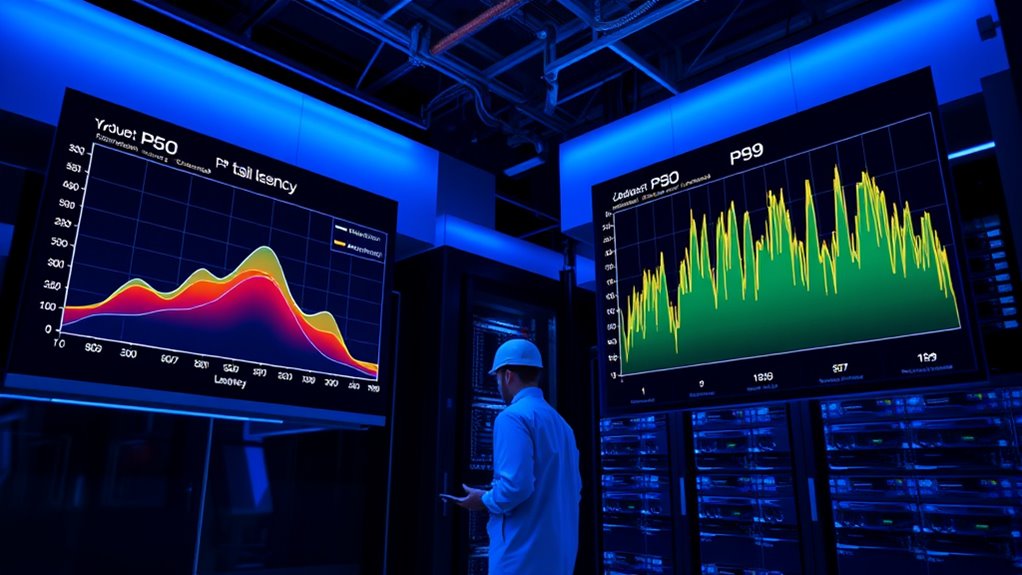

In latency budgeting, balancing P50 and P99 helps you manage both typical and worst-case delays effectively. P50 reflects the usual user experience, while P99 captures rare, impactful latency spikes that can cause frustration. Ignoring tail latencies risks system failures during peaks. Focusing on both metrics and applying tail management strategies guarantees reliable performance. If you want to master this balance and improve system consistency, understanding these key concepts is essential.
Key Takeaways
- P50 latency reflects typical user experience, while P99 targets rare worst-case delays impacting system tail performance.
- Effective latency budgeting balances average (P50) and tail (P99) metrics to ensure consistent system responsiveness.
- Managing tail latency involves identifying bottlenecks, optimizing routes, and implementing hardware upgrades for worst-case scenarios.
- Focusing solely on average latency risks neglecting tail spikes that can cause user dissatisfaction or system failures.
- Continuous performance tuning and strategic load balancing are essential for maintaining acceptable P99 tail latency levels.

Have you ever wondered how real-time systems guarantee smooth performance despite network delays and processing times? The key lies in effective latency budgeting, which involves understanding and managing the various components contributing to overall latency. When working on latency budgets, you need to consider not only average delays but also the tail latencies—those rare but impactful spikes that can disrupt user experience. This is where concepts like P50 and P99 come into play, helping you measure and control the distribution of latency. P50, or the median latency, reflects the experience of most users, while P99 captures the worst-case scenarios that might affect a small subset of users. Managing these different percentiles requires a careful balance of network optimization and performance tuning strategies, ensuring the system remains responsive under varying conditions.
In practice, focusing solely on average latency can be misleading, as it masks the extremes that cause user dissatisfaction or system failures. To address this, you need to analyze your latency distribution exhaustively. For example, minimizing P50 latency helps improve the typical user experience, but neglecting P99 can leave your system vulnerable to rare spikes. To effectively manage the tail, you must identify where delays originate—be it network congestion, server processing bottlenecks, or inefficient data paths. Once identified, performance tuning efforts can be directed at these specific areas, such as optimizing network routes, reducing payload sizes, or upgrading hardware. These adjustments are part of your broader network optimization efforts, aiming to smooth out the latency distribution and reduce tail latencies. Additionally, incorporating well-being techniques such as stress reduction strategies can improve the focus and decision-making of your engineering team, ultimately leading to better system performance.
Tail management becomes especially critical when dealing with high-stakes applications like financial trading, gaming, or real-time analytics, where even small delays can have significant consequences. By setting clear latency budgets—defining acceptable P50 and P99 thresholds—you can design your system to prioritize responsiveness where it counts most. This might involve implementing smarter load balancing, deploying edge servers, or adopting more aggressive caching strategies. The goal is to ensure that performance tuning isn’t just an afterthought but a continuous process aligned with your system’s latency targets. Ultimately, understanding the difference between P50 and P99 and actively managing the tail becomes a crucial part of your overall system design, helping you deliver consistent, reliable performance even under unpredictable network conditions.
network latency monitoring tools
As an affiliate, we earn on qualifying purchases.
As an affiliate, we earn on qualifying purchases.
Frequently Asked Questions
How Do I Decide Between P50 and P99 Latency Targets?
You should decide between P50 and P99 latency targets by conducting a trade-off analysis that balances user experience and system reliability. P50 offers faster response times for most users, but P99 helps with risk mitigation by addressing outliers and tail latency. Consider your application’s criticality and user expectations—if consistent performance is key, aim for P99; otherwise, P50 may suffice for general responsiveness.
What Tools Are Best for Monitoring Latency at Different Percentiles?
Think of your monitoring tools as your dashboard during a space race. You’ll want tools like Prometheus, Grafana, or Datadog for metrics visualization, which help track latency at different percentiles. These platforms also excel at anomaly detection, alerting you when latency spikes unexpectedly. They give you real-time insights, making it easier to spot issues early and keep your system running smoothly at both P50 and P99 levels.
How Does Tail Latency Impact Overall System Performance?
Tail latency can substantially impact your system’s performance because it causes longer queueing delays for a small percentage of requests, which can ripple through your entire service. When load balancing isn’t optimized, these delays worsen, leading to slower response times and degraded user experience. Addressing tail latency involves fine-tuning your load balancing strategies and reducing queueing delays, ensuring more consistent and reliable system performance for all users.
Can Latency Budgeting Improve User Experience in Real-Time Apps?
Yes, latency budgeting can enhance your user experience in real-time apps. By managing network congestion and implementing effective load balancing, you can allocate resources to reduce latency spikes. This ensures smoother interactions and quicker response times, especially during peak traffic. When you prioritize latency budgets, you prevent tail latency issues, making your app more reliable and responsive, ultimately keeping your users happier and more engaged.
What Are Common Pitfalls in Managing Tail Latency?
You risk chaos if you ignore tail latency pitfalls like statistical outliers and resource contention. These issues can cause massive delays, turning your smooth app into a sluggish nightmare. Overlooking proper tail management might lead to unpredictable spikes, frustrating users and damaging reputation. Always monitor for outliers and optimize resource allocation, or you’ll be fighting a losing battle against unpredictable latency spikes that threaten your entire system’s stability.
Conclusion
Think of managing latency like tending a garden. You focus on the p50 for everyday blooms, ensuring smooth growth, but the p99 is like preparing for storms—those rare, intense moments that threaten to ruin everything. When you balance both, you create a resilient garden that thrives most days and withstands the worst. By understanding the differences, you can prevent small delays from becoming major storms, keeping your system healthy and reliable.