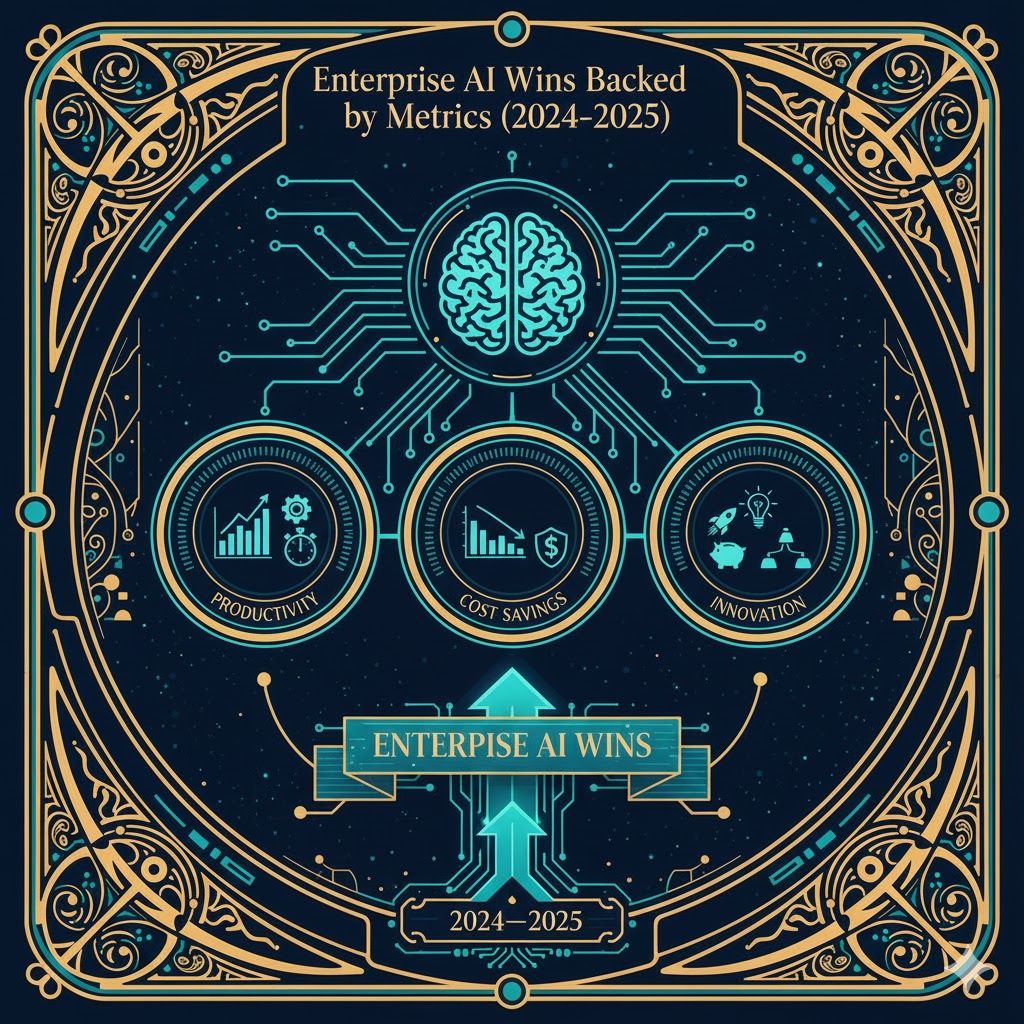

Below is a compact, metrics-driven roundup of enterprise AI deployments that demonstrably moved P&L, productivity, and customer KPIs. Each item cites primary sources.
1) Customer Service Automation at Scale
Klarna AI Assistant (OpenAI-powered)
- Volume: 2.3M conversations in first month; ~⅔ of all service chats.
- Labor equivalent: ~700 FTE workload absorbed by the assistant.
- CX & efficiency: Resolution time cut from 11 min → <2 min, −25% repeat inquiries, CSAT parity with humans.
- Financial impact: Management projected ~$40M profit improvement (2024). Klarna Italia+2OpenAI+2
Salesforce Agentforce 3 (Enterprise AI agents)
- Handle time: −15% average case handle time at Engine.
- Auto-resolution: ~70% of admin chat engagements during peak weeks at 1-800Accountant.
- Retention: +22% subscriber retention at Grupo Globo. Salesforce+1

Ai For Customer Experience And Support: A Practical Guide To Automating Service, Personalizing Interactions, And Driving Customer Loyalty With Artificial Intelligence
As an affiliate, we earn on qualifying purchases.
As an affiliate, we earn on qualifying purchases.
2) Knowledge Work & Productivity
Microsoft 365 Copilot (Forrester TEI & public sector pilots)
- Time saved by activity (survey-based, Forrester TEI): search −29.8%, content creation −34.2%, email writing −20%, data analytics −20.6%, etc.
- UK government trial (20k+ officials): ~26 minutes/day saved (≈ 2 weeks/year), 82% want to keep using it. Forrester+2GOV.UK+2
Microsoft internal telemetry
- Metrification model includes AI-assisted hours, favorability, and net satisfaction to correlate usage with output. (Useful blueprint for enterprises designing their own KPI stack.) Microsoft
Developer Productivity (GitHub Copilot)
- Controlled experiments show significantly faster task completion and improved developer well-being/flow; widely cited internal & external replications report up to ~30% productivity lift depending on task mix. (Use as an upper-bound; your mileage will vary.) The GitHub Blog+1

Untangling AI: Driving Business Success Through Enterprise Automation and AI Agents
As an affiliate, we earn on qualifying purchases.
As an affiliate, we earn on qualifying purchases.
3) Revenue Cycle & Collections
atmira SIREC on Google Cloud (Debt-collection AI)
- Scale: ~114M monthly requests (GKE + Oracle on Google Cloud).
- Business lift: +30–40% recovery rates, +45% payment conversion, −54% operating costs.
- (A strong “traditional ops” case showing agentic decisioning + cloud-native microservices delivering measurable cash-flow outcomes.) Google Cloud
The AI-Powered Professional: How to Work with AI as a Thinking Partner, Not Just a Tool
As an affiliate, we earn on qualifying purchases.
As an affiliate, we earn on qualifying purchases.
4) What These Wins Have in Common
- Clear “money” metric. Each program ties to a primary line-of-business KPI: handle time, deflection %, recovery rate, conversion, or hours saved.
- Agentic patterns. Systems go beyond chat to take actions (routing, form-fills, decisions, case updates) with observability/guardrails (e.g., Salesforce Command Center). Salesforce
- Operational telemetry. Wins are sustained by usage and quality telemetry (e.g., AI-assisted hours; repeat-inquiry rate), not just anecdotes. Microsoft
- Change management. Big deltas (e.g., Klarna) pair automation with process redesign and channel shifts, not just “drop a model in.” Klarna Italia

AI-Powered Developer: Build great software with ChatGPT and Copilot
As an affiliate, we earn on qualifying purchases.
As an affiliate, we earn on qualifying purchases.
5) KPI Playbook You Can Reuse
Customer Operations
- Containment/Auto-resolution rate (%): share of inquiries fully handled by AI.
- AHT / Handle-time: expect 5–20% reductions when agents are AI-assisted; >50% when fully automated for narrow intents. (Benchmarks from Agentforce, Klarna.) Salesforce+1
- Repeat-contact rate: leading indicator of answer accuracy (Klarna saw −25%). OpenAI
- CSAT/QA pass-rate: must track parity vs. human baseline.
Knowledge Work
- Minutes saved/day (top-down surveys + bottom-up telemetry). UK pilot shows ~26 min/day; TEI provides task-level splits. GOV.UK+1
- Cycle times (draft → final), revisions per artifact, meeting hours avoided.
Engineering
- Task time to complete, PR lead time, defect density, incident MTTR; supplement with dev well-being and “focus time” (Copilot research). The GitHub Blog
Revenue & Finance
- Collections recovery rate, payment conversion, DSO, cost-to-collect (atmira SIREC). Google Cloud
6) Fast ROI Math (template)
- Value of time saved = (minutes saved/employee/day ÷ 60) × loaded hourly rate × #employees × workdays/year × utilization factor.
- Ops savings = (baseline cost − post-AI cost) − run-rate AI costs (licenses + compute + oversight).
- Revenue lift = (post-AI conversion/recovery − baseline) × volume × avg. order/value.
- ROI = (Value of time + Ops savings + Revenue lift − Program cost) ÷ Program cost.
7) Risk & Rigor Notes
- Advertising vs. audited outcomes. Some Copilot marketing claims drew scrutiny from US NAD—make sure internal telemetry substantiates public claims. The Verge
- Labor optics. Public narratives around “AI replacing jobs” (e.g., Salesforce commentary) can overshadow the KPI story—build a workforce plan and comms strategy alongside the tech plan. TechRadar
8) Execution Checklist (90 days)
- Pick two “needle” KPIs per function (e.g., AHT + CSAT; minutes saved + cycle time).
- Stand up a sandbox with production-like data flows; implement guardrails + logging on day one.
- Ship two use cases: one assistive (Copilot-style) and one agentic (auto-resolve a narrow intent).
- Instrument ruthlessly: containment, repeat-contact, handle-time, minutes saved, accuracy, exceptions routed to humans.
- Run a 4–6 week controlled pilot with a business case owner; publish a one-page “KPI delta” report with before/after and confidence bands.
- Scale with Ops playbooks (workforce scheduling, exception queues, retraining cadences).
Sources (selection)
- Klarna AI Assistant metrics and $ impact. Klarna Italia+2OpenAI+2
- Salesforce Agentforce 3 customer outcomes. Salesforce+1
- Microsoft 365 Copilot (Forrester TEI & UK government trial). Financial Times+3Forrester+3cdn-dynmedia-1.microsoft.com+3
- GitHub Copilot productivity research & summaries. The GitHub Blog+1
- atmira SIREC (Google Cloud) debt-collections case: scale + KPI deltas. Google Cloud