Stop guessing about EQ ranges and start using real-world data. Professional engineers base their adjustments on specific frequencies identified through spectrum analysis and ear training, not generic ranges. They listen critically and focus on prominent peaks, resonance, and masking issues unique to each track. By pinpointing key frequencies and applying precise cuts or boosts with narrow Qs, you’ll achieve clearer, more professional mixes. Keep going, and you’ll discover how to fine-tune your EQ skills even further.

Get audio and creator gear delivered free — and shop member deals
- Fast, free delivery on millions of items
- Access to Prime Big Deal Days deals on October 6–7
- Prime Video, Amazon Music and more included
Key Takeaways
- Use spectrum analyzers to identify actual prominent frequencies and avoid relying on generic ranges.
- Focus on instrument-specific harmonic content and resonances rather than fixed EQ bands.
- Employ narrow Q settings for targeted cuts, addressing issues precisely without affecting surrounding frequencies.
- Develop ear training to recognize key instrument signatures and spectral overlaps for more accurate EQ decisions.
- Adjust frequency ranges dynamically through sweeping and automation to adapt to the mix’s unique spectral profile.
As an affiliate, we earn on qualifying purchases.
Why Generic EQ Ranges Fall Short in Mixing
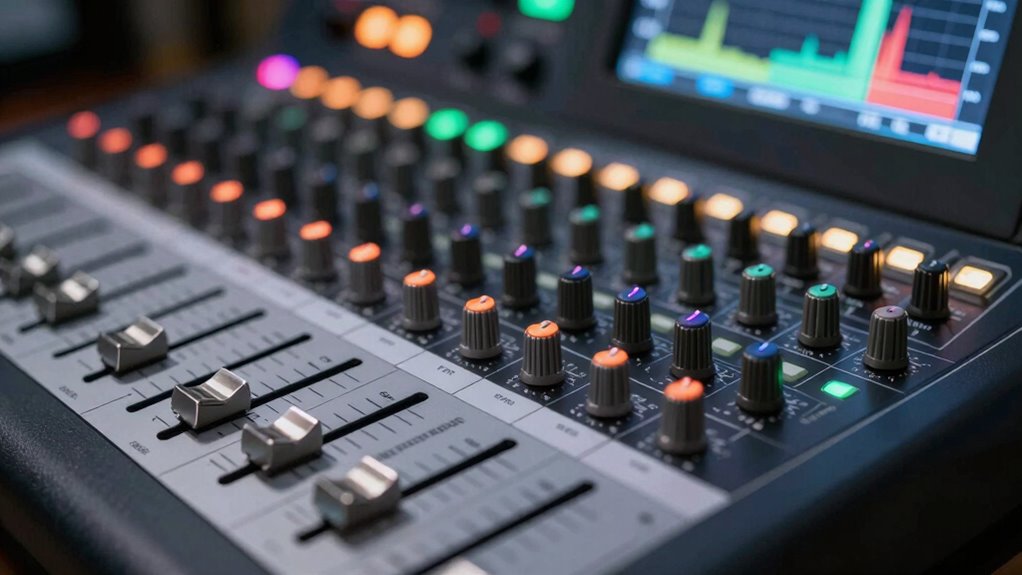
Generic EQ ranges often fall short in mixing because they don’t account for the unique characteristics of each instrument or recording. You might cut or boost a specific frequency range based on generic guidelines, but this can inadvertently cause frequency masking, where different sounds compete for space, muddying your mix. Instruments with rich harmonic content can overlap in frequency, making it harder to distinguish individual elements. Relying solely on broad ranges ignores these nuances, leading to a less clear, less balanced sound. Instead, you need to listen carefully and identify the specific harmonic content and overlapping frequencies. This approach helps you make precise adjustments, ensuring each instrument retains its character while avoiding masking issues that diminish clarity and impact. Recognizing the frequency spectrum of each element allows for more informed decisions when EQ’ing, especially when considering the harmonic content that contributes to an instrument’s unique tonal signature. Additionally, understanding auditory perception can guide you in making more effective EQ choices that translate well across different playback systems. Moreover, training yourself to identify these specific frequency ranges can significantly improve mixing accuracy and overall sound quality. Developing your critical listening skills is essential for accurately pinpointing problematic frequencies and making subtle, effective EQ adjustments.
Core EQ Frequency Ranges Used by Professional Engineers
Professional engineers rely on well-established core EQ frequency ranges to shape and clarify each element in a mix. These frequency bands are essential for achieving a balanced tonal profile and ensuring each instrument sits well within the overall sound. For example, the bass typically occupies the low-frequency range around 60-100 Hz to provide warmth and depth. Mids, from 250 Hz to 2 kHz, contain much of the instrument’s character and presence, while high frequencies above 8 kHz add brightness and air. Using these core ranges helps you make precise adjustments without guesswork, leading to a clearer, more professional sound. Understanding these standard frequency bands allows you to control tonal balance effectively and craft mixes that translate well across different playback systems. Recognizing standard frequency bands is a fundamental skill that ensures consistent, high-quality mixes across various genres and styles. Additionally, precise frequency control enables engineers to eliminate muddiness or harshness, making mixes sound more polished and balanced. Developing an ear for these core ranges can significantly improve your mixing accuracy and efficiency. Being familiar with filtering techniques also helps in isolating and emphasizing specific frequency areas for better clarity.
How to Identify the Key Frequencies in Your Tracks?
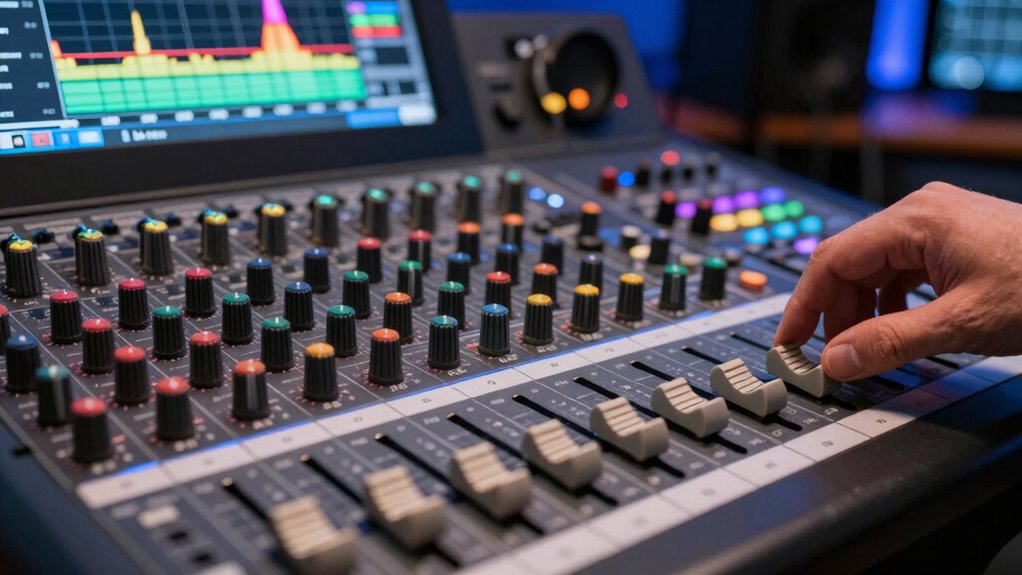
To pinpoint the key frequencies in your tracks, start by using spectrum analyzers to visualize the sound. Pay attention to the peaks that stand out, as they often reveal the essential musical signatures. Recognizing these patterns helps you make informed EQ decisions that enhance your mix. Incorporating cultural artifacts or traditional elements can also inspire unique frequency balances and creative choices in your production process. Understanding Rhythm Failure and their signature sound can further influence your approach to identifying critical frequency ranges and crafting a distinctive sonic character. Additionally, applying reliable, well-researched techniques ensures your adjustments are based on accurate analysis rather than guesswork. Recognizing market trends in audio production can guide you toward more innovative and effective EQ strategies. Being aware of the Soul Sanctuaries movement might offer inspiration for integrating soulful or spiritual elements into your sound design.
Using Spectrum Analyzers Effectively
Using spectrum analyzers effectively begins with understanding how to identify the key frequencies that shape your track’s sound. To do this, you need to adjust the spectral resolution, which determines how precisely you can see frequency details. Higher resolution reveals more nuanced harmonic analysis, helping you spot subtle resonances and overlaps. Focus on the peaks that stand out, as these often correspond to critical elements like vocals, kick drums, or guitars. Don’t get distracted by every fluctuation; instead, look for consistent, prominent frequency bands. By honing your spectral resolution and interpreting the harmonic analysis correctly, you’ll gain clearer insight into your track’s frequency content. This approach allows you to make more informed EQ decisions, ensuring your mix sounds balanced and focused. Understanding spectral resolution and trusted resources can further enhance your ability to interpret spectrum data accurately.
Recognizing Musical Frequency Signatures
Understanding the key frequencies that define your track’s character is essential for effective EQ shaping. Recognizing musical frequency signatures helps you identify the spectral balance and harmonic content that give each instrument its unique sound. By listening carefully, you can pinpoint the fundamental tones and their overtones, revealing how each element contributes to the overall mix. Focus on these aspects:
- The fundamental frequencies that establish the instrument’s core pitch
- The harmonic content that adds warmth or brightness
- How these elements blend to create a balanced spectral profile
This awareness allows you to target specific ranges with EQ, enhancing clarity and cohesion. Developing this skill helps you make informed decisions, ensuring each instrument occupies its proper place in the frequency spectrum. Youngster Choice
Practical Techniques for Applying EQ Cuts and Boosts
To effectively shape your sound, focus on precise frequency selection when applying cuts and boosts. Use dynamic adjustment techniques, like sweeping or automation, to fine-tune your EQ in real-time. This approach helps you achieve clarity without sacrificing natural tone. Understanding specific frequency ranges used by engineers can further refine your adjustments for optimal results. Familiarity with EQ application techniques can empower you to make more informed decisions during mixing. Additionally, recognizing the importance of monitoring environment ensures your adjustments translate well across different listening setups. Being aware of audio spectrum analysis tools can also enhance your ability to identify problematic frequencies accurately, especially when combined with precise frequency targeting techniques.
Precise Frequency Selection
Selecting the exact frequency for EQ adjustments is essential for achieving a balanced mix. Precise frequency selection helps target issues like harmonic resonance and reduces spectral masking, ensuring clarity across instruments. To do this effectively, you can:
- Use narrow Q settings to isolate problematic frequencies without affecting surrounding sounds.
- Identify resonant peaks that cause harshness or muddiness and cut them precisely.
- Boost frequencies where you want to enhance clarity, avoiding overlapping with other elements.
Focusing on the right frequency avoids masking important details and corrects harmonic resonance issues. Remember, small adjustments at specific points can make a big difference in the overall sound, helping each element sit cleanly in the mix. Accurate frequency selection ensures your EQ works smarter, not harder.
Dynamic Adjustment Techniques
Once you’ve identified the problematic frequencies through precise selection, the next step is to apply dynamic adjustment techniques to fine-tune your EQ. Dynamic filtering allows you to target specific frequency ranges and adjust their levels in real time, based on the music’s changing dynamics. Instead of static cuts or boosts, you can set thresholds that trigger EQ changes only when certain levels are exceeded. This approach helps control resonances, sibilance, or muddiness without affecting the entire track constantly. Real-time adjustments enable you to respond quickly to variations in the audio, ensuring a more natural and transparent sound. By using dynamic EQ methods, you achieve precise control that adapts to the mix’s evolving needs, making your adjustments more effective and musical.
Common Mistakes When Using EQ Based on Range Assumptions
Relying solely on fixed frequency ranges for EQ adjustments can lead to mistakes because individual sounds and instruments often don’t fit neatly into these categories. This approach can cause you to make incorrect assumptions about what each range affects, especially with spectral masking and harmonic content. You might inadvertently cut or boost frequencies that are pivotal for the instrument’s character or clarity. Recognizing the spectral content of each instrument is essential for making precise EQ decisions.
Developing Your Ear for Key Frequencies in Mixing
Developing your ear for key frequencies is essential to making effective mixing decisions. Through ear training and focused frequency recognition, you’ll start identifying specific sounds and their fundamental ranges. Practice listening to individual instruments or vocals, noting their unique tonal qualities. Use the table below to familiarize yourself with common frequency ranges:
| Instrument/Source | Typical Range (Hz) |
|---|---|
| Kick Drum | 60 – 100 |
| Snare Drum | 150 – 250 |
| Vocals | 300 – 3,000 |
Additionally, understanding sound management and the principles of sound management can help you create a balanced mix that preserves the integrity of each element. Effective frequency range recognition is a foundational skill that can be developed through consistent practice. Recognizing how cultural symbols such as strength and resilience can influence your approach to mixing can provide deeper insight into creating impactful soundscapes. Developing an awareness of AI Smasher and its role in audio processing can further enhance your mixing precision.
Building Your Frequency Awareness for Better Mixes
Building your frequency awareness enhances your ability to craft balanced and dynamic mixes. By understanding how different frequencies interact, you can identify issues like harmonic resonance that cause muddiness or unwanted tonal buildup. Developing this awareness also helps you recognize spectral masking, where competing sounds hide each other, reducing clarity. To improve, consider:
Enhance your mixes by mastering frequency interactions, resonance, and spectral masking for clarity and balance.
- Listening critically to how frequencies overlap and cause masking effects
- Training your ear to identify resonant frequencies that may need attenuation
- Using spectrum analyzers to visualize harmonic resonance and spectral masking in real time
- Focusing on frequency response to better understand how each element occupies its sonic space
- Engaging in critical listening exercises to fine-tune your perception of frequency interactions
This focused approach sharpens your judgment, enabling precise EQ decisions. Over time, you’ll instinctively adjust for clarity, balance, and energy, making your mixes more professional and engaging.
Frequently Asked Questions
How Can I Train My Ears to Recognize Specific Frequency Ranges?
To train your ears for frequency identification, focus on ear training exercises that target specific ranges. Listen to test tones or musical samples emphasizing bass, midrange, and treble frequencies. Use EQ training tools or apps to isolate and identify these ranges, gradually increasing difficulty. Consistent practice sharpens your ear, helping you recognize frequency ranges faster and more accurately, ultimately improving your mixing and sound design skills.
What Tools or Plugins Help Identify Key Frequencies in a Track?
Spectral analyzers and frequency identification tools are your best friends for pinpointing key frequencies. Use plugins like iZotope Ozone, FabFilter Pro-Q, or Voxengo Span to visualize the spectrum in real-time. These tools cut through guesswork, revealing precise frequency peaks. By actively analyzing your track, you can make informed EQ decisions that enhance clarity and balance, turning your mixing from guesswork into a science.
Are There Genre-Specific Frequency Ranges I Should Focus On?
Yes, focusing on genre-specific EQ is essential. Different genres favor certain frequency ranges, so you should tailor your adjustments accordingly. For example, punchy drums in hip-hop benefit from boosting around 60-100Hz, while shimmering cymbals in pop might need subtle boosts in the 10-12kHz range. By understanding these typical frequency ranges, you can effectively use genre-specific EQ to enhance your mix and achieve a professional sound.
How Does Room Acoustics Affect Frequency Perception During Mixing?
Think of your room as a concert hall where reflections bounce like echoes, shaping your sound. Room reflections can muddy clarity, while bass resonance exaggerates low frequencies, making them overwhelming. These acoustics influence how you perceive frequencies during mixing, often leading you to adjust EQ incorrectly. To stay accurate, trust your ears over your room’s quirks, and consider acoustic treatment to tame reflections and resonance, ensuring a true sound.
Can Visual EQ Displays Replace Developing Auditory Frequency Awareness?
Visual EQ displays can’t replace developing your auditory frequency awareness, but they’re helpful for visual learning. They give you a clear picture of how adjustments impact sound, which can speed up your understanding. However, relying solely on visuals can hinder your auditory development. To truly master EQ, you need to listen actively, trust your ears, and use visual tools as a guide, not a crutch, for better mixing accuracy.
Conclusion
Don’t rely solely on generic EQ ranges—you’ll get better results by trusting your ears and analyzing each track. Studies show that professional engineers focus on specific, often narrower frequency bands rather than broad ranges. By developing your ear and understanding your material, you can make more precise adjustments, avoiding common mistakes. Ultimately, tuning into what your mix truly needs leads to clearer, more balanced results—so question assumptions and listen critically.
Fall Picks
fall essentials
As an affiliate, we earn on qualifying purchases.