
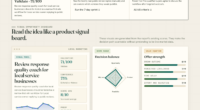
📊 Full opportunity report: The policy menu. There’s no single answer. There’s a menu — and choosing is a values choice in disguise. on ThorstenMeyerAI.com — validation score, market gap, and execution plan.

Get audio and creator gear delivered free with Prime
- Fast, free delivery on millions of items
- Prime Video, Amazon Music and more included
- Member-only deals all year
TL;DR
This article explores the range of policy responses to AI-driven economic change, emphasizing that there is no single correct answer. Instead, choices reflect different societal values and trade-offs, with uncertainty about the labor-shift impact remaining unresolved.
Thorsten Meyer’s latest dispatch argues that managing the economic impacts of AI requires a menu of policy options, not a single answer, because responses are fundamentally questions of societal values rather than purely technical solutions.
The dispatch, part of Meyer’s Post-Labor series, outlines four main responses: doing nothing, implementing universal basic income (UBI), promoting broad ownership (UBC), and funding through common wealth (data dividends, sovereign funds). Each option reflects different priorities—efficiency, security, agency, or fairness—and involves trade-offs that cannot be resolved purely on technical grounds.
He emphasizes that the debate is often misframed as a technical choice, but it is inherently about values—what society considers most important. Meyer critiques each option’s strengths and weaknesses, noting that none is perfect and each carries risks if assumptions prove wrong. The core uncertainty remains whether the labor share decline is real and how quickly it might happen, which complicates policy choice.
The dispatch advocates for an honest presentation of the full policy menu, urging decision-makers and the public to consider robustness and the potential harms of wrong assumptions rather than seeking a definitive solution.
The policy menu.
There’s no single answer.
There’s a menu — and
choosing is a values
choice in disguise.
shift isn’t real, catastrophic if it is
dignifying · fiscally heavy, cause-blind
robust · but slow, concentration-prone
under the question · funds either
The honest service is the menu itself: here are the options, here is what each optimizes for and trades away, here is the funding axis that matters more than the fight everyone is having. The decision is yours, the tradeoffs are real, and the one thing you should not accept is anyone telling you it’s obvious.Thorsten Meyer · The Policy Menu · Post-Labor 03 · Capstone
Implications of a Values-Based Policy Approach
This analysis underscores that policy choices in the AI era are inherently moral decisions, not just technical fixes. Recognizing the diversity of options and their trade-offs allows society to better navigate uncertainty and avoid premature consensus on what might be a fundamentally value-driven debate. It highlights that the real challenge is managing the risks of wrong assumptions about the labor market shift, which could lead to ineffective or harmful policies if overlooked.
As an affiliate, we earn on qualifying purchases.
Recent Developments in AI and Economic Redistribution
The debate over AI’s economic impact has intensified over the past year, with ongoing research questioning whether the decline in labor’s share of income is a temporary fluctuation or a structural shift. Previous dispatches by Meyer examined the ownership case and tested its premise, leading to this comprehensive overview of policy options. The discussion is set against broader concerns about automation, inequality, and the future of work, with policymakers and advocates proposing various responses.
“A policy menu is honest only when each option is presented as its strongest advocates would present it and critiqued as its strongest critics would critique.”
— Thorsten Meyer
The key uncertainty remains whether the decline in labor’s share of income is a structural, long-term trend or a temporary fluctuation. Meyer notes that current data is inconclusive, and the impact of AI on labor markets is still emerging. This unresolved question complicates policy decisions, as different responses are better suited to different scenarios.
Future Directions for Policy and Research
Policymakers and researchers will need to monitor labor market data closely, test the robustness of various policy options, and remain open to adjusting strategies as new evidence emerges. The debate is expected to continue, with a focus on balancing societal values and managing risks associated with uncertainty. Public discourse may shift toward more explicit acknowledgment of the moral dimensions of these choices.
Key Questions
Why is there no single best policy response to AI-driven economic change?
Because each policy option reflects different societal values and priorities, and the impact of AI on labor markets is uncertain, there is no one-size-fits-all solution. Choices involve trade-offs that depend on what society values most—security, fairness, ownership, or efficiency.
What are the main policy options discussed in the dispatch?
The main options are doing nothing, implementing universal basic income (UBI), promoting broad ownership (UBC), and funding responses through common wealth mechanisms like data dividends or sovereign funds.
If the decline in labor’s share is not confirmed or is slower than expected, some policies may be unnecessary or even harmful. This uncertainty means policymakers should prioritize robustness and the potential harms of wrong assumptions.
Why does Meyer emphasize values over technical solutions?
Because the trade-offs involved in each policy response are fundamentally moral choices, not purely technical ones. Recognizing this helps ensure debates are honest and policies align with societal priorities.
Source: ThorstenMeyerAI.com
Halloween Picks
halloween
As an affiliate, we earn on qualifying purchases.