
📊 Full opportunity report: Postpartum Support At Home: Daily Check-ins Make A Difference on IdeaNavigator AI — validation score, market gap, and execution plan.
TL;DR
A pilot program is testing daily postpartum check-ins for first-time mothers discharged early from hospital. Early results suggest this approach may improve recovery monitoring and prompt care when needed. The initiative aims to fill a critical gap in postpartum support.
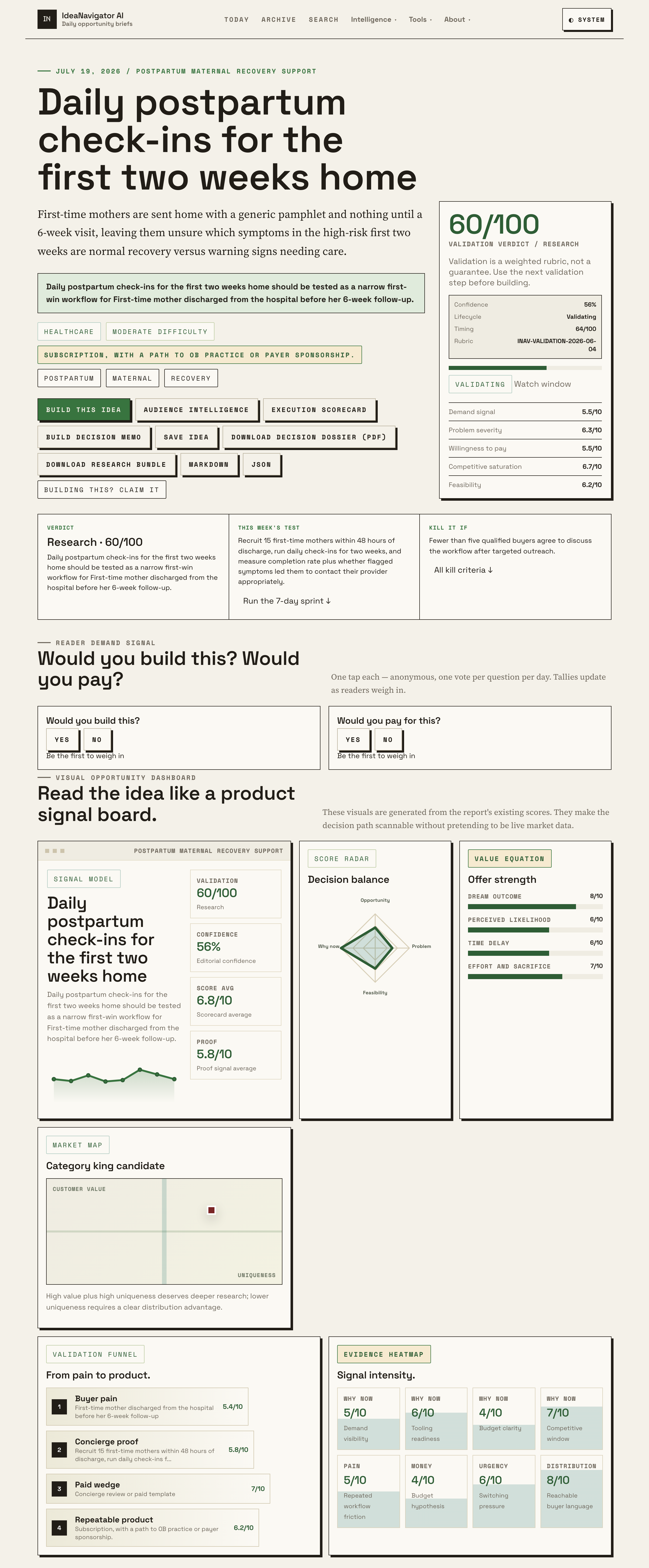
A pilot program is testing daily postpartum check-ins at home for first-time mothers in the first two weeks after hospital discharge. The initiative aims to address gaps in postpartum care, where mothers typically receive minimal contact until their six-week follow-up, potentially improving recovery outcomes and safety.
The program involves recruiting 15 first-time mothers within 48 hours of discharge from the hospital. Participants will receive daily check-ins via a smartphone app, which gather information about recovery, feeding, and mental health. The check-ins are designed to surface symptoms that may require medical attention, prompting mothers to contact their providers if needed.
Developed as a response to maternal health awareness campaigns highlighting the postpartum care gap, this approach leverages smartphone technology to provide personalized, timely support during the high-risk initial two weeks after birth. The program aims to create a recovery profile for each mother, guiding tailored advice and early intervention.
Researchers plan to measure the program’s effectiveness by tracking completion rates, symptom reporting, and whether flagged issues lead to appropriate medical contact. The initial phase is a proof-of-concept to validate the approach before potential wider deployment.
Potential to Transform Postpartum Support and Safety
This initiative could significantly improve postpartum outcomes by providing continuous, personalized support during a vulnerable period. Early detection of warning signs may reduce complications, hospital readmissions, and maternal distress. If successful, the model could become a standard part of postpartum care, especially for first-time mothers discharged early from hospitals.
As an affiliate, we earn on qualifying purchases.
Addressing the Postpartum Support Gap
Typically, first-time mothers are discharged from hospitals with minimal guidance and only see a healthcare provider at the six-week mark. This leaves a critical two-week window where complications such as infections, depression, or feeding issues can develop unnoticed. Recent maternal health campaigns have emphasized the need for more effective postpartum monitoring, and smartphone-based solutions are increasingly viewed as a feasible way to fill this gap.
Previous efforts have focused on education and in-person follow-ups, but resource constraints limit their reach. The current pilot aims to test whether daily digital check-ins can provide a scalable, cost-effective alternative to traditional care models.
“Implementing daily check-ins could revolutionize postpartum care by catching warning signs early and empowering mothers to seek help when needed.”
— an anonymous researcher
Unclear How Effectiveness Will Be Measured
It is not yet confirmed whether the daily check-ins will lead to improved health outcomes or whether mothers will reliably engage with the system. The pilot is still in early stages, and results on its effectiveness and scalability are pending.
Next Steps in Pilot Evaluation and Expansion
The research team plans to complete the initial recruitment and run the two-week check-in cycle. Data collected will include engagement rates, symptom reports, and subsequent medical contacts. If results are positive, the program could expand to larger populations and integrate with existing postpartum care pathways.
Key Questions
How will the daily check-ins work?
Participants will receive daily prompts via a smartphone app asking about their recovery, feeding, and mental health. The system will analyze responses and flag any concerning symptoms for follow-up.
Who is funding this pilot program?
The funding sources are not specified; the initiative is positioned as a potential model for future reimbursement through insurance or healthcare providers.
Could this replace in-person postpartum visits?
Currently, it is designed as a supplement to in-person care, not a replacement. It aims to enhance monitoring during the critical initial two weeks.
What are the privacy considerations?
Details on data privacy and security are not yet specified, but they will be critical factors in broader implementation.
When will results be available?
Initial data from the pilot is expected within a few months, which will inform whether the approach can be scaled further.
Source: IdeaNavigator AI