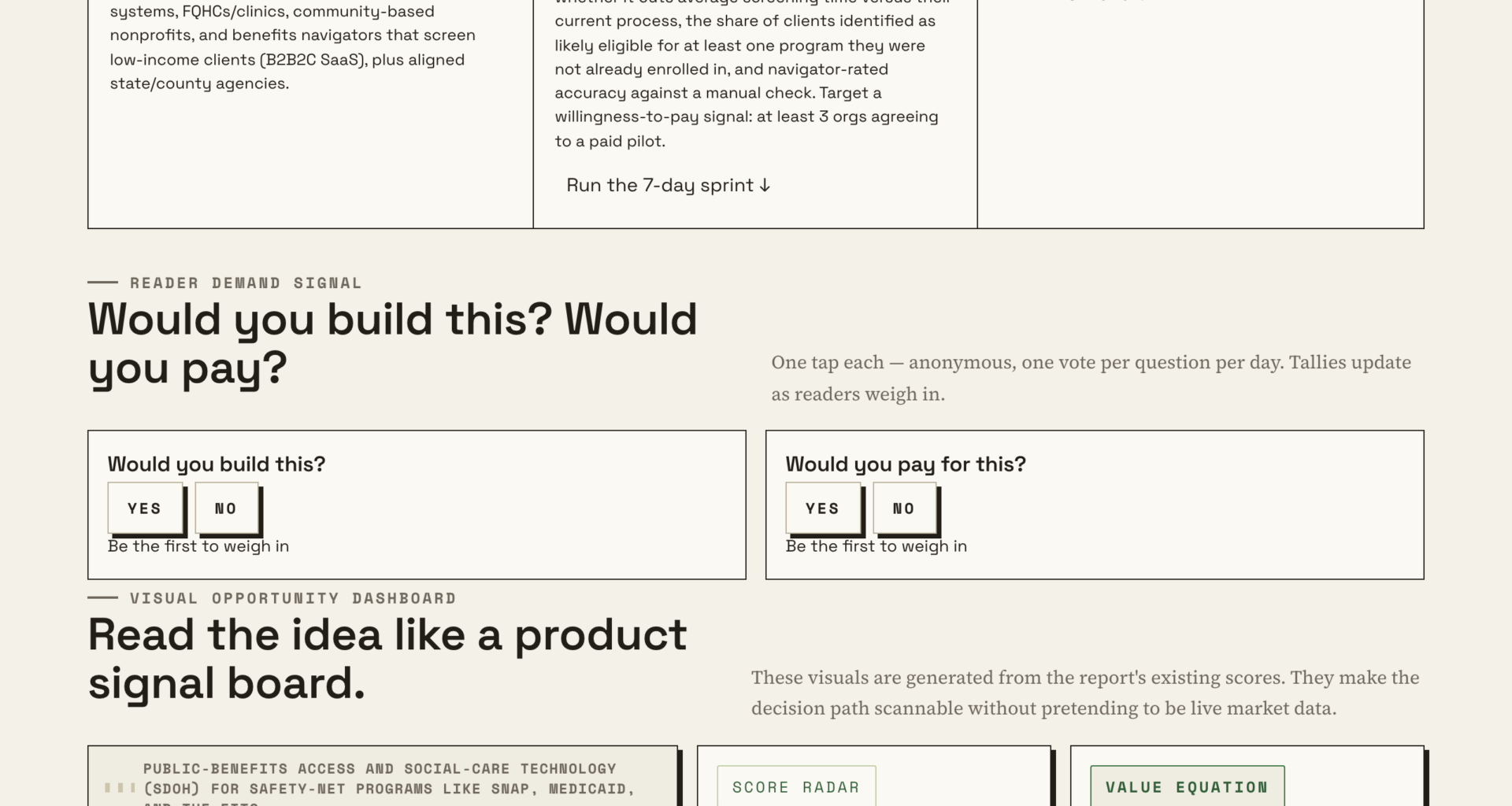

📊 Full opportunity report: Making Social Care More Accessible With Benefit Check Bot Technology on IdeaNavigator AI — validation score, market gap, and execution plan.
Listen free for 30 days with Audible
Thousands of audiobooks and originals — cancel anytime.
Start your free trialAs an affiliate, we earn on qualifying purchases.
TL;DR
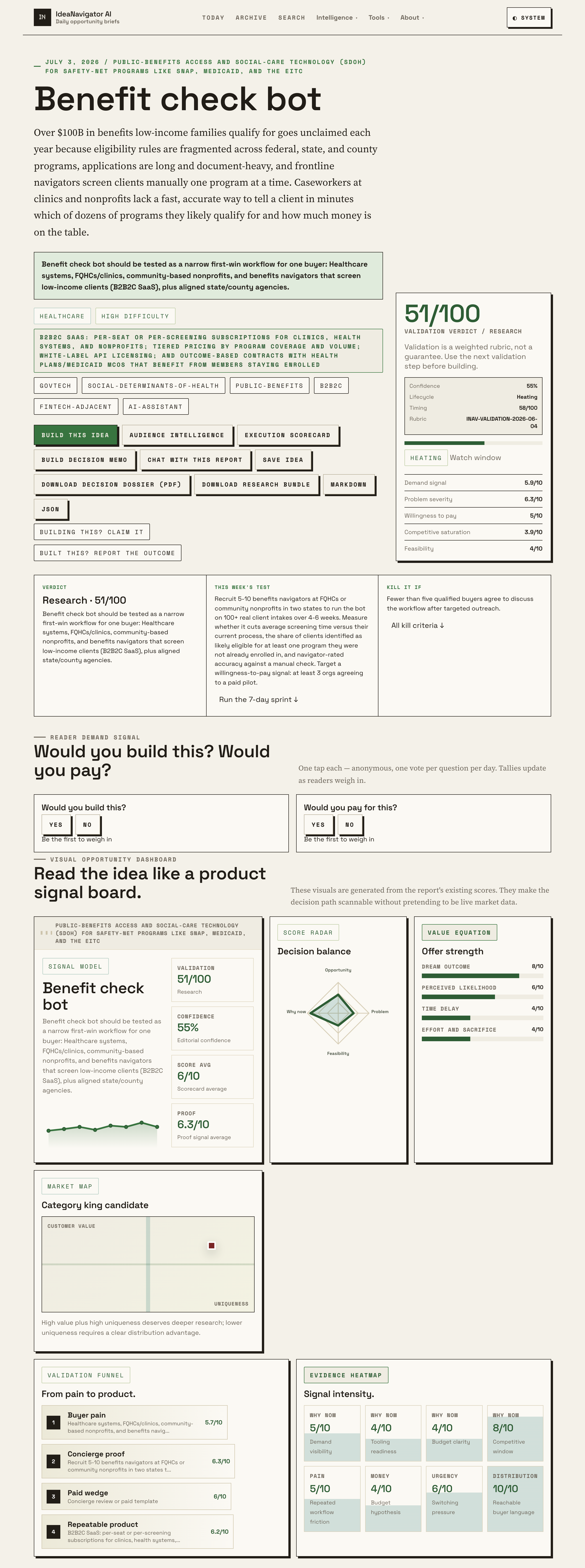
A benefit check bot is being piloted to streamline eligibility screening for low-income social programs. It aims to reduce manual effort, increase accuracy, and boost benefits uptake. The initiative follows the shutdown of a key nonprofit and the surge in Medicaid redeterminations.
A new conversational AI tool is being piloted to help clinics, nonprofits, and government agencies quickly identify eligibility for multiple social benefit programs. This development addresses a significant gap in benefits access, which affects over $100 billion annually in unclaimed assistance for low-income families, according to sources involved in the project.
The benefit check bot, developed as a white-label SaaS product, enables frontline staff and benefits navigators to screen clients via a web widget or SMS. It asks a series of yes/no and multiple-choice questions, then provides an estimated list of eligible programs—including SNAP, Medicaid, EITC/CTC, WIC, and LIHEAP—along with dollar benefit estimates and next-step application links. The initial pilot involves 5-10 benefits navigators across two states, who will test the tool on over 100 real client intakes over a 4-6 week period.
This initiative follows the 2024 shutdown of Benefits Data Trust, a major nonprofit that traditionally managed benefits screening for several states, leaving a capacity gap. The timing coincides with the post-pandemic Medicaid ‘unwinding’ redeterminations, which have increased the demand for efficient eligibility checks. The AI-powered solution leverages conversational technology and multilingual capabilities to deliver near-zero marginal cost screening, reducing reliance on expensive call centers and manual processes.
Developers aim for this pilot to demonstrate reductions in screening time, increased identification of eligible clients, and high accuracy compared to manual checks. The platform also logs anonymized data for organizational dashboards and allows benefits navigators to export summaries to support client applications. The business model includes tiered subscriptions, API licensing, and outcome-based contracts with health plans and Medicaid managed care organizations.
Potential Impact on Benefits Accessibility and Efficiency
This initiative could significantly improve how social benefits are accessed, especially for vulnerable populations. By automating eligibility screening, clinics and nonprofits can serve more clients faster, reduce administrative burdens, and increase benefits uptake—potentially unlocking billions in unclaimed assistance each year. The project also responds to the recent collapse of a key benefits enrollment nonprofit, filling a critical capacity gap. If successful, the tool could be adopted widely across health systems and government agencies, transforming social care delivery and reducing disparities in benefits access.
benefit eligibility screening software
As an affiliate, we earn on qualifying purchases.
As an affiliate, we earn on qualifying purchases.
Background on Benefits Access Challenges and Technological Solutions
For years, low-income families have left over $100 billion in benefits unclaimed annually due to complex eligibility rules, lengthy application processes, and manual screening by caseworkers. The shutdown of Benefits Data Trust in 2024, which provided outsourced benefits screening across seven states, has heightened this challenge. Meanwhile, the post-pandemic Medicaid redetermination process has increased the workload for frontline staff, often leading to delays and missed opportunities for benefits enrollment.
Recent advances in conversational AI and multilingual automation have opened new possibilities for more efficient screening methods. Several health systems and community nonprofits have begun exploring these technologies to streamline eligibility checks, but widespread adoption remains limited. This pilot represents one of the first efforts to rigorously test a chatbot-based solution in real-world settings, with the goal of demonstrating measurable improvements in efficiency and accuracy.
Uncertainties About Pilot Outcomes and Scalability
It is not yet clear how accurately the benefit check bot will perform compared to manual screening in diverse real-world settings. The pilot’s success depends on factors such as client engagement, language support, and integration with existing workflows. Additionally, questions remain about the long-term scalability of the platform, including its ability to handle more states, programs, and larger client volumes without significant customization or cost increases.
Next Steps for Validation and Broader Adoption
Over the coming weeks, the pilot will evaluate the platform’s impact on screening time, accuracy, and client outcomes. If results are promising, developers plan to expand testing to additional states and programs, refine the interface, and develop more integrations with health and social service systems. Successful validation could lead to broader deployment, with health plans and Medicaid agencies exploring outcome-based contracts to incentivize benefits uptake and retention.
Key Questions
How does the benefit check bot work?
The bot uses a conversational interface to ask clients questions about their circumstances. Based on responses, it estimates eligibility for multiple programs and provides links and checklists to facilitate applications.
Who can use this technology?
Clinics, community nonprofits, benefits navigators, and government agencies can embed or use the tool to streamline client screening for social benefits.
What are the expected benefits of using the bot?
Expected benefits include reduced screening time, increased identification of eligible clients, and higher benefits uptake, which can improve financial stability for low-income families.
When will the pilot results be available?
Results from the 4-6 week pilot are expected to be analyzed shortly afterward, with potential plans for wider rollout based on findings.
Are there any privacy concerns?
The platform logs anonymized data and complies with relevant privacy standards. Specific privacy safeguards will be detailed as the pilot progresses.
Source: IdeaNavigator AI
Fall Picks
fall essentials
As an affiliate, we earn on qualifying purchases.