
📊 Full opportunity report: Daily Symptom Notes And Lab Results For TRT Patients on IdeaNavigator AI — validation score, market gap, and execution plan.
TL;DR
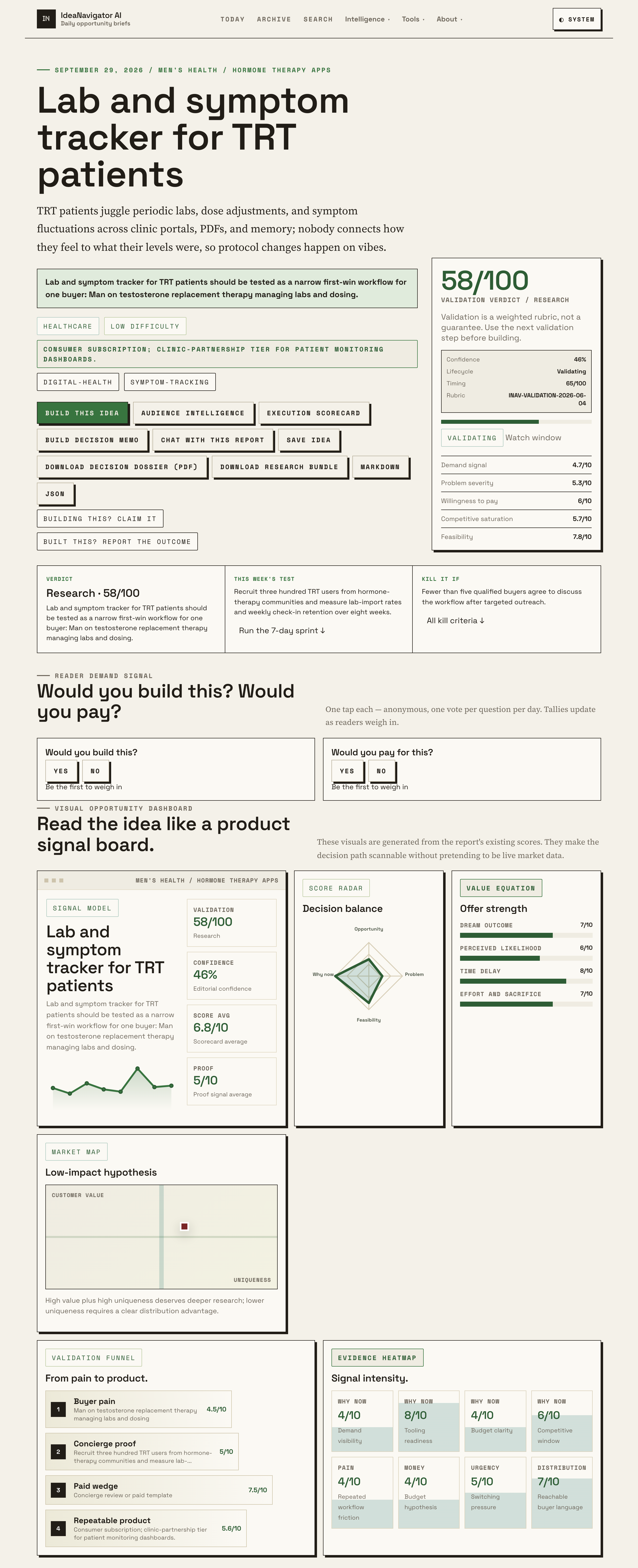
IdeaNavigator AI has outlined a proposed app for men on testosterone replacement therapy, linking imported lab results and dose changes with daily symptom check-ins. The concept calls for an eight-week test with 300 users; there is no evidence in the proposal that the app has been built, launched or clinically validated.
IdeaNavigator AI has outlined a proposed lab and symptom tracker for men receiving testosterone replacement therapy (TRT), describing an app that would connect lab results, dose changes and daily symptom check-ins. The proposal recommends testing demand and user retention with 300 TRT patients over eight weeks; it does not report that a product has launched or that a study is underway. IdeaNavigator AI’s proposal is the source for these product and study details.
According to IdeaNavigator AI’s product concept, the proposed app would let users import lab-result PDFs and view hormone measurements over time alongside dose changes. It would also collect daily symptom check-ins, then prepare trend summaries that patients could take to clinic visits. The concept includes alerts for values moving outside target ranges, but does not specify which tests or ranges would be used, or who would set them.
The proposal identifies men managing TRT labs and dosing as its initial audience. It describes a practical problem: patients may encounter information in clinic portals, PDFs and personal notes, while symptoms and lab values can be difficult to review together. The claim that this fragmentation leads to protocol changes based on “vibes” is IdeaNavigator AI’s characterization, not a finding supported by published patient research in the material provided.
For revenue, IdeaNavigator AI suggests a consumer subscription and a separate clinic-partnership tier with monitoring dashboards. Its proposed validation plan is to recruit 300 users from hormone-therapy communities and track PDF import rates and weekly check-in retention for eight weeks. The proposal gives no subscription price, participating clinics, recruitment date or results.
A Test of Patient Tracking Demand
The concept addresses a coordination task for people whose lab results, treatment doses and reported symptoms may be recorded in separate places. IdeaNavigator AI proposes a timeline combining those details to give patients a more organized account to discuss with a clinician. Whether that format changes care or improves the quality of clinical conversations remains untested.
The proposal’s measures focus on product use and retention: whether participants import lab documents and continue weekly check-ins. Those measures could indicate whether users find the workflow practical. They would not, on their own, show that the app improves treatment decisions, health outcomes or safety. The distinction matters because a tool can be useful for record-keeping without being validated as a clinical decision aid.
IdeaNavigator AI also proposes a clinic dashboard that could let staff review patient-entered information between appointments. The proposal does not explain how clinics would handle alerts, how quickly staff would be expected to respond, or whether monitoring would be part of routine care. Those details would affect the workload and expectations attached to the service.
From Fragmented Records to One Timeline
IdeaNavigator AI frames the idea for men already receiving TRT, rather than as a diagnostic service or a way to determine who should begin treatment. The concept centers on organizing follow-up information: recurring lab tests, dose adjustments and how a patient reports feeling over time. This is the proposal’s stated first use case.
IdeaNavigator AI says the opportunity is timely because TRT prescriptions and telehealth clinics have grown, leaving more patients managing care across providers. The proposal provides no prescription totals, growth rate or time period for that assertion, so the scale of the trend cannot be established from the figures supplied. It presents fragmentation as a product rationale, not as a quantified assessment of the market.
The proposed workflow would bring together information that may otherwise sit across provider portals and downloaded documents. The proposal does not describe integrations with clinics or labs; PDF import is the specified method. It also does not explain how the app would check that imported values are read correctly, account for different units or reference ranges, or handle missing dates and dose details.
Clinical Rules and Study Details
IdeaNavigator AI’s proposal does not name a developer, product, clinical partner or launch date. It also gives no evidence that users have been recruited or that the suggested eight-week evaluation has begun. The stated plan is a validation approach, not a report of completed testing.
Several clinical and privacy questions remain open. The material does not define “target ranges,” explain whether they would be personalized by a clinician, or say what an alert would instruct a user to do. It does not describe how the app would protect sensitive health information, correct extraction errors in lab PDFs or distinguish a symptom entry from a medical assessment. No clinical validation or regulatory status is reported.
The planned sample of 300 users and the two proposed measures are not accompanied by a recruitment method beyond hormone-therapy communities, a comparison group, or criteria for success. Without those details, even completed retention results would be difficult to interpret as evidence about broader patient demand or clinical value.
Recruitment and Product Validation
IdeaNavigator AI describes the next step as recruiting 300 TRT users and tracking lab imports and weekly check-ins over eight weeks. The proposal does not provide a timeline or say who would operate the test. If conducted, results could clarify whether users will maintain the record-keeping routine and whether PDF import is workable for the intended audience.
Further reporting would be needed to establish whether the concept becomes a product, whether clinics participate, and how the app would manage lab interpretation and patient alerts. For now, the confirmed development is a product proposal with a suggested test plan; implementation, adoption and any effect on care remain unknown.
Source: IdeaNavigator AI
Key Questions
Has the TRT tracker launched?
No launch is reported. IdeaNavigator AI describes a product concept and proposed validation plan.
What would the proposed app track?
It would combine lab-result PDFs, dose changes and daily symptom check-ins, with trend summaries and alerts for values outside specified ranges.
Has the eight-week test started?
The proposal recommends testing with 300 users over eight weeks, but gives no start date or results.
Would the app recommend TRT doses?
The proposal describes tracking and alerts, but does not say the app would recommend dose changes. It gives no clinical rules or validation details.
Source: IdeaNavigator AI