
🔍 Read the full analysis: Inside FABLE/175: The “TURBINE — WERK 9” Scroll-Driven Rotor on ThorstenMeyerAI.com

Get audio and creator gear delivered free — and shop member deals
- Fast, free delivery on millions of items
- Access to Prime Big Deal Days deals on October 6–7
- Prime Video, Amazon Music and more included
TL;DR
ThorstenMeyerAI.com presents TURBINE — WERK 9 as an interactive, field-guide-style web experience built around an SVG rotor that moves with the visitor’s scroll. The project page says the interaction links page navigation to the imagined mechanics of an industrial space, but does not identify the team or provide technical specifications, launch timing or performance details.
ThorstenMeyerAI.com’s project page features TURBINE — WERK 9, an interactive web project built around an SVG rotor that responds to scrolling. The page presents it as a digital field guide to an industrial-feeling place and says movement through the page is intended to suggest the motion of machinery. It does not name the creators or provide technical specifications.
ThorstenMeyerAI.com frames the project as an alternative to a conventional brochure-style webpage. According to its description, visitors move through an interface organized as a field guide, rather than simply reading static descriptions and following links. The page identifies the central visual device as a rotor drawn with scalable vector graphics (SVG), whose movement is tied to the visitor’s scroll input.
The project page describes scrolling as the input that drives the rotor animation, linking navigation to the industrial setting the experience aims to evoke. It also says the browser, vector paths and a simple input work together to create a responsive experience. The description does not explain how the SVG is constructed, how the motion is calculated, or whether the rotor corresponds to a particular physical machine.
ThorstenMeyerAI.com presents the project as a design teardown and points readers toward a fuller case study about shaping the rotor’s motion, organizing the visual system and translating a physical-feeling space for the browser. The page also invites readers to visit a live version, but does not give a publication date, name a team or detail the project’s commissioning or production.
FABLE/175 · Interactive Web Field Guide
Inside TURBINE — WERK 9: The Scroll-Driven Rotor
A browser experience turns a familiar gesture into its central visual device: an SVG rotor moves with the visitor’s scroll, suggesting machinery in an industrial-feeling place.
01 / How the experience is framed
A page built around motion
The project description contrasts an exploratory browser experience with a conventional brochure-style page of static descriptions and links.
A field guide
Visitors move through an interface organized around exploring an industrial-feeling place, rather than simply reading about it.
An SVG rotor
The rotor is the recurring graphic link to the setting. SVG is a scalable vector format; the page does not explain how its paths are built.
Scroll drives motion
The page says rotor movement responds to scroll input, making page progression visible as motion.
02 / The stated interaction
From gesture to graphic
The project’s description connects browser navigation with the imagined mechanics of an industrial space.
Visitor scrolls
A familiar browser action becomes the stated input.
Rotor responds
The SVG graphic moves as the visitor progresses through the page.
Place feels in motion
The design aims to evoke machinery and exploration. This is the project’s stated intent, not a measured user outcome.
03 / What the page establishes
Known details, open questions
The available project summary focuses on the central interaction. It does not publish implementation details or evidence about performance.
Creators: The designers, developers, and production team are not named.
Timing: No publication date or project timeline is given.
Technology: The page mentions SVG and scroll input, but not the framework or motion calculations.
Access: Browser compatibility, mobile support, loading performance, and reduced-motion controls are unspecified.
Evidence: No user research, performance measurements, or comparison with a static page is reported.
WERK 9: The title uses this name, but the description does not explain it or identify the place.
Reading the claims carefully: The page describes the experience as responsive and physically evocative. Those are design claims; the summary does not establish visitor response, comprehension, accessibility, or engagement.
Claims ≠ measured outcomes04 / Questions readers may have
Quick answers
The project page points readers toward a live version and a fuller design teardown, without confirming their availability or publication timing.
What is TURBINE — WERK 9?
An interactive, field-guide-style web experience centered on a rotor graphic that responds to scrolling.
How does the rotor move?
The project page says it uses SVG vector paths and scroll input, but does not specify the exact motion or implementation.
Who created it?
The available description does not name the designers, developers, or production team.
Can visitors try it now?
The page invites readers to visit a live room, but the supplied information does not confirm current availability or accessibility.
Scroll Becomes Part of the Rotor
As described by ThorstenMeyerAI.com, the project treats scrolling as an expressive input, rather than only a way to move between blocks of text. The page says the rotor makes progression visible as motion, connecting a familiar browser action to the industrial atmosphere the design aims to evoke. This is the project’s stated design approach; the description does not establish how visitors respond to it.
For designers and readers interested in interactive web work, TURBINE — WERK 9 is an example of an interface organized around one repeated relationship: the visitor scrolls, and the graphic rotor responds. ThorstenMeyerAI.com emphasizes a balance between visual atmosphere and clarity, but reports no user testing and does not establish that the interaction improves comprehension, accessibility or engagement. Those outcomes cannot be inferred from the project summary alone.
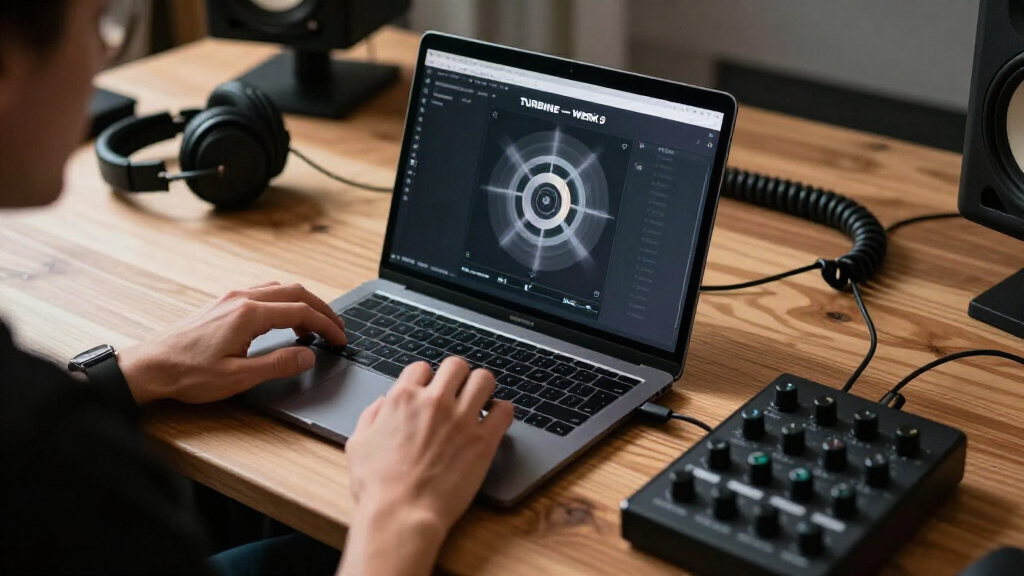
scroll-activated SVG rotor display
As an affiliate, we earn on qualifying purchases.
As an affiliate, we earn on qualifying purchases.
A Field Guide in the Browser
ThorstenMeyerAI.com frames the project around exploring a physical space. Rather than presenting the site as a brochure about a place, its description characterizes it as a browser experience visitors can move through, with the rotor serving as a recurring visual link to the industrial setting. The phrase “WERK 9” appears in the project title; the page provides no further explanation of the name or the place.
The project page describes the experience as combining browser technology, vector paths and scroll input. SVG is a web format for vector graphics that can be scaled without being tied to a fixed pixel size. The page identifies SVG as the format used for the rotor graphic, but does not name the software, code framework or specific animation methods.
Technical Details Still Unpublished
The available project description on ThorstenMeyerAI.com does not identify who designed or developed the project, when it was made public, or whether the live experience is accessible to all visitors. It also gives no information about the rotor’s exact behavior, page structure, browser compatibility, mobile support, loading performance or accessibility provisions such as reduced-motion controls.
The page’s descriptions of the experience as responsive and physically evocative are presented as design claims, not independently documented outcomes. It provides no user research, performance measurements or comparison with a static page. It is also unclear from the description whether the promised full case study is available and whether it contains the construction details mentioned in the project introduction.
The Case Study May Add Detail
ThorstenMeyerAI.com directs readers to a full design teardown and a live room. These are the next places the project page points readers to, but it does not state when the teardown was published or provide a timeline for further updates. If the case study supplies more information, it may clarify how the rotor’s movement was designed and how the visual system supports navigation.
Based on the available project description, the confirmed account remains focused on the central interaction: an SVG rotor tied to page scrolling within a field-guide-style web experience. Further reporting would be needed to establish who made it, how it performs across devices, and what testing or accessibility decisions informed the final design.
Key Questions
What is TURBINE — WERK 9?
According to the project page on ThorstenMeyerAI.com, it is an interactive, field-guide-style web experience centered on a rotor graphic that responds to scrolling.
How does the rotor respond to the visitor?
ThorstenMeyerAI.com says the rotor uses SVG vector paths and moves in response to scroll input. The page does not provide implementation details or specify the exact motion.
Who created the project?
The available description on ThorstenMeyerAI.com does not name the designers, developers or production team. The site presents the project.
Is the live experience available?
The project page invites readers to visit a live room, but the information provided does not confirm its current availability, device support or accessibility features.
What remains unknown about the project?
The project page does not specify its launch date, creators, technical implementation, browser and mobile performance, or accessibility provisions. It also gives no user-testing results.
Source: ThorstenMeyerAI.com
Fall Picks
fall essentials
As an affiliate, we earn on qualifying purchases.