For MIDI controllers for music production, I’d start with the Arturia MiniLab 3 as the best overall balance of playable keys, hands-on controls, and production-friendly software. The Akai MPK Mini Plus is a stronger fit if you want more keys and sequencing features, while the M-Audio Oxygen Pro 61 suits players who need a larger keyboard and extensive control. The main tradeoff is between compact portability, a more expressive playing range, and dedicated pads, faders, or knobs. Your DAW and preferred workflow matter as much as the controller’s feature list. Read on for the full breakdown and a guide to matching the right layout to your setup.

Get audio and creator gear delivered free with Prime
- Fast, free delivery on millions of items
- Prime Video, Amazon Music and more included
- Member-only deals all year
Complete the kit


Key Takeaways
- MiniLab 3 takes the most balanced role: it pairs a compact 25-key layout with performance controls, making it a more rounded production hub than a keyboard-only mini controller.
- Key count changes the workflow: the LPK25 and MicroLab Mk3 prioritize portability, the MPK Mini Plus adds room to play and sequence, and the Oxygen Pro 61 suits parts that benefit from a full keyboard range.
- Pad controllers solve different problems: the APC Mini MK2 and APC40 MKII focus on Ableton-style clip performance, while the LPD8 and Donner STARRYPAD are smaller choices for drum triggering.
- Dedicated controls can beat extra keys: the MIDImix is designed for mixer adjustments, while the ATOM puts pads and transport-oriented production controls ahead of keyboard playing.
- Software and setup affect value: bundled tools can help a new producer get started, but compatibility and control mapping matter more than a bundle if you already have a settled DAW workflow.
| Akai Professional LPK25 25-Key USB MIDI Keyboard Controller |  | Best Compact Keyboard for Expressive Input | Keys: 25 mini keys | Connectivity: USB | Performance controls: Octave up/down buttons and sustain button | VIEW LATEST PRICE | See Our Full Breakdown |
| PreSonus ATOM MIDI Pad Controller with Studio One Artist and Ableton Live Lite |  | Best for Pad-Driven Production | Connectivity: USB | Pads: 16 velocity- and pressure-sensitive RGB pads | Assignable buttons: 20 | VIEW LATEST PRICE | See Our Full Breakdown |
| Akai Professional MPK Mini IV 25-Key USB-C MIDI Keyboard Controller, Black |  | Best All-in-One Compact Controller | Keys: 25 velocity-sensitive mini keys | Pads: 8 velocity- and pressure-sensitive RGB MPC pads | Knobs: 8 assignable 360-degree knobs | VIEW LATEST PRICE | See Our Full Breakdown |
| M-Audio Keystation 49 MK3 USB MIDI Controller |  | Best for Full-Size Keyboard Playing | Keys: 49 full-size velocity-sensitive keys | Connectivity: USB-MIDI; USB-powered | Compatibility: Mac and PC; iOS devices with separately sold Apple to USB Camera Adapter | VIEW LATEST PRICE | See Our Full Breakdown |
| Akai Professional MPK Mini MK3 25-Key USB MIDI Keyboard Controller |  | Best Value Compact Production Starter | Keys: 25 velocity-sensitive mini keys | Connectivity: USB 2.0 Type-B | Pads: 8 backlit velocity-sensitive MPC-style pads | VIEW LATEST PRICE | See Our Full Breakdown |
| Akai Professional APC Mini MK2 USB MIDI Pad Controller |  | Best for Ableton Clip Launching | Pads: 64 RGB-backlit pads | Faders: 9 assignable | Modes: Drum and Note | VIEW LATEST PRICE | See Our Full Breakdown |
| Arturia MicroLab Mk3 25-Key USB MIDI Controller, White |  | Best for Portable Keyboard Input | Keys: 25 | Connectivity: USB-C | Controls: Four buttons and two touch strips | VIEW LATEST PRICE | See Our Full Breakdown |
| Akai Professional APC Key 25 MK2 25-Key USB MIDI Keyboard Controller |  | Best Compact Keyboard-Pad Hybrid | Keys: 25 velocity-sensitive mini keys | Pads: 40 RGB-backlit pads | Rotary knobs: 8 assignable | VIEW LATEST PRICE | See Our Full Breakdown |
| M-Audio Oxygen Pro 61 USB MIDI Keyboard Controller |  | Best for Full Keyboard Production Control | Keys: 61 semi-weighted, velocity-sensitive keys | Aftertouch: Yes | Drum pads: 16 velocity-sensitive RGB-backlit pads | VIEW LATEST PRICE | See Our Full Breakdown |
| Akai Professional MIDImix USB MIDI Mixer Controller |  | Best for Hands-On DAW Mixing | Line faders: 8 | Master fader: 1 | Assignable knobs: 24 | VIEW LATEST PRICE | See Our Full Breakdown |
| Arturia MiniLab 3 25-Key MIDI Controller, White |  | Best for Hands-On Instrument Control | Keys: 25 slim synth-action keys with velocity control | Pads: 8 velocity- and pressure-sensitive RGB pads | Rotary encoders: 8 | VIEW LATEST PRICE | See Our Full Breakdown |
| Akai Professional APC40 MKII USB MIDI Pad Controller |  | Best for Ableton Live Performance | Clip-launch grid: 5×8 RGB pads | Faders: 9 channel faders | Knobs: 8 control knobs | VIEW LATEST PRICE | See Our Full Breakdown |
| Akai Professional LPD8 USB MIDI Pad Controller |  | Best Compact Pad Controller | Pads: 8 velocity-sensitive RGB-backlit pads | Knobs: 8 assignable Q-Link knobs | Presets: 4 programmable preset slots | VIEW LATEST PRICE | See Our Full Breakdown |
| Akai Professional MPK Mini Plus 37-Key USB MIDI Keyboard Controller |  | Best for Hardware-Integrated Production | Keys: 37 velocity-sensitive mini keys | Pads: 8 RGB MPC pads | Assignable knobs: 8 | VIEW LATEST PRICE | See Our Full Breakdown |
| Donner STARRYPAD USB MIDI Drum Pad Controller |  | Best for Expanded Finger-Drum Layouts | Pads: 16 backlit silicone pads | Assignable pads: Up to 48 across 3 banks | Controls: 2 faders, 2 knobs, 3 buttons | VIEW LATEST PRICE | See Our Full Breakdown |
| MIDI controllers for music production | Connectivity | Included software | Keys | Pads |
|---|---|---|---|---|
| Akai Professional LPK25 25-Key | USB | — | 25 mini keys | — |
| PreSonus ATOM MIDI Pad Control | USB | Studio One Artist, Ableton Live Lite, Studio Magic Plug-In Suite | — | 16 velocity- and pressure-sensitive RGB pads |
| Akai Professional MPK Mini IV | USB-C and full-size MIDI Out | Studio Instrument Collection with 1,000+ sounds; Ableton Live Lite 12; 30-day Melodics trial; 2 months of Splice | 25 velocity-sensitive mini keys | 8 velocity- and pressure-sensitive RGB MPC pads |
| M-Audio Keystation 49 MK3 USB | USB-MIDI; USB-powered | MPC Beats, Ableton Live Lite, Velvet, XPand2, Mini Grand, Touch Loops | 49 full-size velocity-sensitive keys | — |
| Akai Professional MPK Mini MK3 | USB 2.0 Type-B | MPC Beats, 3 virtual instruments, and 2 GB of sound content | 25 velocity-sensitive mini keys | 8 backlit velocity-sensitive MPC-style pads |
| Akai Professional APC Mini MK2 | USB | — | — | 64 RGB-backlit pads |
| Arturia MicroLab Mk3 25-Key US | USB-C | Analog Lab Intro and Ableton Live Lite | 25 | — |
| Akai Professional APC Key 25 M | USB | Ableton Live Lite and virtual instruments | 25 velocity-sensitive mini keys | 40 RGB-backlit pads |
| M-Audio Oxygen Pro 61 USB MIDI | USB | MPC Beats, Ableton Live Lite, AIR Music Tech virtual instruments, and Akai Professional MPC Expansion packs | 61 semi-weighted, velocity-sensitive keys | — |
| Akai Professional MIDImix USB | USB | Ableton Live Lite | — | — |
| Arturia MiniLab 3 25-Key MIDI | USB | Ableton Live Lite, Analog Lab Intro, UVI Model D | 25 slim synth-action keys with velocity control | 8 velocity- and pressure-sensitive RGB pads |
| Akai Professional APC40 MKII U | USB 2.0 Type B; USB-powered | — | — | — |
| Akai Professional LPD8 USB MID | USB | — | — | 8 velocity-sensitive RGB-backlit pads |
| Akai Professional MPK Mini Plu | USB, MIDI I/O, CV/Gate | MPC Beats and a choice of Komplete 15 Select bundle | 37 velocity-sensitive mini keys | 8 RGB MPC pads |
| Donner STARRYPAD USB MIDI Drum | USB-C, MIDI in/out | Melodics courses and Cubase LE | — | 16 backlit silicone pads |
More Details on Our Top Picks
Akai Professional LPK25 25-Key USB MIDI Keyboard Controller
The LPK25 makes the most sense when desk space and quick melodic input matter more than a broad playing range. Its 25 mini keys are suited to bass lines, short melodies, and entering parts into a DAW, while octave buttons let me reach notes beyond the physical keys. The built-in arpeggiator and sustain button add performance options without requiring a larger controller. Compared with the Akai MPK Mini IV, the LPK25 gives up pads, knobs, wheels, and a display, so it is less capable as an all-in-one production surface. That simpler layout can be an advantage if I mainly need a compact keyboard beside other studio gear. The tradeoff is a narrow range and mini-key feel, which can make two-handed parts and detailed playing less comfortable.
Pros:- Compact 25-key layout fits easily beside other studio equipment.
- Built-in arpeggiator and sustain button add expressive options.
- Eight programmable presets can recall custom mappings.
- USB-powered setup works with Mac and PC.
Cons:- Mini keys and a 25-key range limit comfortable performance of larger parts.
- No pads, knobs, or wheels for broader hands-on DAW control.
Best for: Producers with limited desk space who mainly enter short melodies, bass lines, or arpeggiated parts into a Mac or PC DAW.
Not ideal for: Players who need full-size keys, a wider range for two-handed parts, or pads and knobs for controlling instruments and mixing.
- Keys:25 mini keys
- Connectivity:USB
- Performance controls:Octave up/down buttons and sustain button
- Arpeggiator:Built-in arpeggiator and clock
- Presets:8 programmable slots
- Compatibility:Mac and PC; compatible with popular music applications
Our verdict“Choose the LPK25 when you want a small, straightforward keyboard for note entry and arpeggios, not an all-in-one controller.”
PreSonus ATOM MIDI Pad Controller with Studio One Artist and Ableton Live Lite
The PreSonus ATOM is the pad-focused choice here: its 16 velocity- and pressure-sensitive RGB pads suit finger drumming, sample triggering, and playing virtual instruments with more nuance than a basic button grid. Four rotary encoders and 20 assignable buttons add control beyond the pads, while eight banks let me organize different assignments. Its included Studio One Artist and Ableton Live Lite make it a particularly practical starting point for producers who want a pad workflow and software in one package. Compared with the Akai MPK Mini IV, ATOM offers twice as many pads and a more pad-centered layout, but it has no keyboard for entering melodic parts. Some functions also depend on the music application, so its hands-on benefits vary with the chosen setup.
Pros:- Sixteen velocity- and pressure-sensitive RGB pads support nuanced playing.
- Twenty assignable buttons and four encoders provide hands-on control.
- Eight assignable pad banks allow different layouts for production tasks.
- Includes Studio One Artist, Ableton Live Lite, and Studio Magic Plug-In Suite.
Cons:- No keyboard, so melodic parts require another controller or mouse-based input.
- Some functions depend on the selected application and its integration.
Best for: Beatmakers and sample-based producers who want expressive pads, assignable controls, and included DAW software for a computer or supported mobile setup.
Not ideal for: Keyboard players who need keys for melodic note entry, or producers seeking consistent control behavior across different applications.
- Connectivity:USB
- Pads:16 velocity- and pressure-sensitive RGB pads
- Assignable buttons:20
- Rotary encoders:4
- Pad banks:8 assignable banks
- Power:USB bus-powered
- Included software:Studio One Artist, Ableton Live Lite, Studio Magic Plug-In Suite
- Compatibility:Windows, macOS, iOS, and Android
Our verdict“Pick ATOM for a software-supported, pad-first workflow; choose a keyboard-and-pad controller if you also need keys.”
Akai Professional MPK Mini IV 25-Key USB-C MIDI Keyboard Controller, Black
The MPK Mini IV packs a broad set of production controls into a portable 25-key format. Alongside velocity-sensitive mini keys, it has eight pressure-sensitive RGB pads, eight assignable knobs, pitch and modulation wheels, and a full-color screen. That range makes it more adaptable than the simpler Akai LPK25, especially when I want to enter notes, trigger samples, and adjust instrument parameters from one device. Its Chord and Scale modes and arpeggiator can help turn compact-keyboard input into fuller musical ideas, while full-size MIDI Out supports setups beyond a direct computer connection. The compromise is the familiar 25-key limit and small key feel; producers who prioritize a broader, more comfortable playing range may prefer the M-Audio Keystation 49 MK3. USB-C operation also means a connected host is needed for power.
Pros:- Combines mini keys, pressure-sensitive pads, and eight assignable knobs.
- Pitch and modulation wheels offer direct performance control.
- Chord and Scale modes and an arpeggiator support melodic idea building.
- Full-size MIDI Out and a full-color screen broaden its studio utility.
Cons:- Mini keys and a 25-key range can constrain longer or two-handed parts.
- USB-powered operation requires a connected device.
Best for: Portable producers who want keys, pads, knobs, performance controls, and MIDI Out in one compact controller.
Not ideal for: Players who need full-size keys or a wider range, or who want a controller that can operate without a connected host.
- Keys:25 velocity-sensitive mini keys
- Pads:8 velocity- and pressure-sensitive RGB MPC pads
- Knobs:8 assignable 360-degree knobs
- Connectivity:USB-C and full-size MIDI Out
- Display:Full-color screen
- Performance controls:Pitch and modulation wheels; push/turn encoder
- Performance features:Arpeggiator with Pattern, Freeze, and Mutate; Chord and Scale modes
- Compatibility:Mac, Windows, and mobile setups
- Included software:Studio Instrument Collection with 1,000+ sounds; Ableton Live Lite 12; 30-day Melodics trial; 2 months of Splice
Our verdict“Choose the MPK Mini IV if you want the most varied compact control set here and can work within 25 mini keys.”
M-Audio Keystation 49 MK3 USB MIDI Controller
The Keystation 49 MK3 is the clearest fit for producers who want a more familiar keyboard feel rather than a crowded control surface. Its 49 full-size velocity-sensitive keys provide more room for melodies and two-handed parts than the 25-key Akai controllers in this lineup. Pitch and modulation wheels support expressive instrument playing, while octave and transport controls help with common DAW tasks without adding pads and knobs that keyboard-first users may not need. Compared with the Akai MPK Mini IV, it trades portable all-in-one control for a larger playing range and full-size keys. A volume fader and included software add practical value, but the sustain pedal is separate, and connecting an iOS device requires an adapter sold separately. It is a more focused choice for playing than for beat triggering or extensive parameter control.
Pros:- Forty-nine full-size velocity-sensitive keys support more natural playing and wider parts.
- Pitch and modulation wheels add expressive control.
- Transport, directional, octave, and volume controls support basic DAW operation.
- Includes MPC Beats, Ableton Live Lite, and virtual instruments.
Cons:- No drum pads or assignable rotary knobs for hands-on beat and parameter control.
- Sustain pedal is sold separately.
- iOS use requires a separately sold Apple to USB Camera Adapter.
Best for: Keyboard-first producers who want full-size keys and a wider range for playing virtual instruments and sequencing on Mac or PC.
Not ideal for: Beatmakers who need velocity-sensitive pads and multiple assignable knobs, or mobile producers who do not have the required iOS adapter.
- Keys:49 full-size velocity-sensitive keys
- Connectivity:USB-MIDI; USB-powered
- Compatibility:Mac and PC; iOS devices with separately sold Apple to USB Camera Adapter
- Controls:Volume fader, transport and directional buttons, pitch and modulation wheels, octave buttons
- Pedal input:1/4 in (6.3 mm) sustain pedal input
- Included software:MPC Beats, Ableton Live Lite, Velvet, XPand2, Mini Grand, Touch Loops
Our verdict“Choose the Keystation 49 MK3 if key range and full-size playing matter more than pads or extensive controller controls.”
Akai Professional MPK Mini MK3 25-Key USB MIDI Keyboard Controller
The MPK Mini MK3 suits a producer who wants more than a note-entry keyboard without stepping up to a larger controller. Its 25 velocity-sensitive mini keys, eight MPC-style pads, and eight assignable knobs cover melodies, drum patterns, and basic instrument adjustments in one USB-powered unit. The joystick combines pitch and modulation control, and the arpeggiator adds a useful performance tool for building parts. Compared with the newer MPK Mini IV, the MK3 has a more basic control set and lacks the listed full-color screen, Chord and Scale modes, and full-size MIDI Out. In return, it keeps the core compact keyboard-and-pad workflow approachable and includes MPC Beats, virtual instruments, and sound content. The mini keys still limit comfortable playing, and production depends on a compatible computer and DAW.
Pros:- Combines 25 keys, eight pads, and eight assignable knobs in a compact unit.
- Joystick provides pitch and modulation control without separate wheels.
- Built-in arpeggiator supports performance and idea generation.
- Includes MPC Beats, three virtual instruments, and 2 GB of sound content.
Cons:- Mini keys and a 25-key range limit comfortable playing of larger parts.
- Lacks the MPK Mini IV’s listed screen, Chord and Scale modes, and full-size MIDI Out.
- Requires a compatible computer and DAW for production.
Best for: Newer computer-based producers who want a compact keyboard, drum pads, knobs, and starter software in one controller.
Not ideal for: Players who need full-size keys, advanced performance modes, a screen, or standalone control away from a compatible computer and DAW.
- Keys:25 velocity-sensitive mini keys
- Connectivity:USB 2.0 Type-B
- Pads:8 backlit velocity-sensitive MPC-style pads
- Knobs:8 assignable 360-degree knobs
- Controls:4-way pitch and modulation joystick; built-in arpeggiator
- Compatibility:Windows and Mac
- Material:Plastic
- Included software:MPC Beats, 3 virtual instruments, and 2 GB of sound content
Our verdict“Pick the MPK Mini MK3 for a compact starter setup with keys and pads, but choose the MPK Mini IV for its expanded controls.”
Akai Professional APC Mini MK2 USB MIDI Pad Controller
The APC Mini MK2 makes the most sense for producers who build tracks by launching clips and want mixer control close at hand. Its 64 RGB pads show clip states at a glance, while nine assignable faders put level and parameter changes within reach. Compared with the APC Key 25 MK2, it gives up a playable keyboard in favor of a larger pad grid and more faders; that makes it a better fit for session control than entering melodies. Drum and Note modes add ways to use the grid beyond launching clips, but the controller is designed around Ableton Live, so it is less appealing for producers using other DAWs. It is compact and USB-powered, though a carrying bag is not included.
Pros:- 64 RGB pads provide clear visual feedback for clip launching.
- Nine assignable faders support hands-on mixer and device control.
- Drum and Note modes add uses beyond launching clips.
- Compact, USB-powered setup is easy to connect to a computer.
Cons:- Its strongest integration is with Ableton Live, limiting its appeal for other DAW workflows.
- No keys are provided for direct melodic playing.
- A carrying bag is not included.
Best for: Ableton Live producers who want a portable clip-launching grid and hands-on mixer faders rather than a keyboard.
Not ideal for: Players who need keys for melodic input or producers whose main DAW is not Ableton Live.
- Pads:64 RGB-backlit pads
- Faders:9 assignable
- Modes:Drum and Note
- Connectivity:USB
- Hardware interface:USB 2.0 Type B
- Compatible platforms:Mac and Windows
- Supported software:Ableton Live
- Color:Black
Our verdict“Choose the APC Mini MK2 if Ableton clip launching and fader control matter more to your workflow than having a keyboard.”
Arturia MicroLab Mk3 25-Key USB MIDI Controller, White
The MicroLab Mk3 is a straightforward choice for producers who need keys in a small setup and want a controller that can move between a desk and a laptop bag. Its 25-key slim keybed keeps the footprint down, while chord mode, two touch strips, and included Analog Lab Intro presets give new projects a useful starting point. Unlike the APC Key 25 MK2, it has no clip-launching pad grid; its emphasis is on playing notes and shaping sounds with compact controls. The included Ableton Live Lite adds a way to begin producing, but the keyboard’s short range can mean frequent octave changes during fuller arrangements. It also draws power over USB-C, so it needs a connected computer or other compatible host rather than working as a standalone instrument.
Pros:- Lightweight 25-key design suits small desks and mobile setups.
- Slim keybed provides a compact way to enter notes.
- Analog Lab Intro includes 500 presets for sound exploration.
- Chord mode and two touch strips add performance options beyond basic keys.
Cons:- The 25-key range can require frequent octave changes.
- USB-powered operation requires a connected host device.
- Four buttons and two touch strips offer fewer dedicated controls than larger controllers.
Best for: Laptop-based beginners and mobile producers who want compact keys, starter software, and presets in a small controller.
Not ideal for: Players who need a broad keyboard range, extensive hands-on controls, or a standalone instrument.
- Keys:25
- Connectivity:USB-C
- Controls:Four buttons and two touch strips
- Performance feature:Chord mode
- Included software:Analog Lab Intro and Ableton Live Lite
- Presets:500 Analog Lab Intro presets
- Compatible platforms:Mac and Windows 10/11
- Color:White
Our verdict“Pick the MicroLab Mk3 if portability and simple keyboard input outweigh the need for more keys or dedicated clip-launching controls.”
Akai Professional APC Key 25 MK2 25-Key USB MIDI Keyboard Controller
The APC Key 25 MK2 combines a small keyboard with a clip-launching grid, making it a practical middle ground for producers who switch between playing notes and triggering Ableton sessions. Its 40 RGB pads and eight assignable knobs bring more session control than the keyboard-focused MicroLab Mk3, while the 25 velocity-sensitive mini keys support expressive note entry. That hybrid layout saves desk space, but neither section is as expansive as a dedicated controller: the keys cover a limited range, and the pad grid is smaller than the APC Mini MK2’s 64-pad array. Ableton Live Lite and virtual instruments provide a starting software setup, while the Live integration favors Ableton users. Producers wanting wider keyboard coverage may prefer the Oxygen Pro 61, though it takes up more room.
Pros:- Combines 25 velocity-sensitive mini keys with 40 RGB clip-launching pads.
- Eight assignable knobs provide hands-on parameter control.
- Ableton Live integration supports a session-oriented workflow.
- Ableton Live Lite and virtual instruments are included.
Cons:- The 25-key mini keyboard limits playable range without octave changes.
- The pad grid is smaller than the 64-pad APC Mini MK2.
- A carrying bag is not included.
Best for: Ableton Live users with limited desk space who want both playable keys and a clip-launching grid in one controller.
Not ideal for: Players who need full-range keys, a larger clip grid, or controls aimed primarily at a non-Ableton DAW.
- Keys:25 velocity-sensitive mini keys
- Pads:40 RGB-backlit pads
- Rotary knobs:8 assignable
- Connectivity:USB
- Supported software:Ableton Live
- Included software:Ableton Live Lite and virtual instruments
- Compatible platforms:Mac and PC
- Color:Black
Our verdict“Choose the APC Key 25 MK2 when one compact controller needs to handle both note entry and Ableton clip launching.”
M-Audio Oxygen Pro 61 USB MIDI Keyboard Controller
For a producer who wants one controller to cover broad keyboard parts, drum input, and DAW mixing, the Oxygen Pro 61 offers the widest playing range in this group. Its 61 semi-weighted keys with aftertouch give more room for two-handed parts and expressive control than the compact MicroLab Mk3 or APC Key 25 MK2. Sixteen velocity-sensitive pads, eight knobs, and nine faders also make it more suited to shaping a session from the hardware. Smart Chord, Smart Scale, an arpeggiator, and DAW auto-mapping can speed up common production tasks, while the 5-pin MIDI output adds a connection for compatible external gear. The larger control surface is less convenient for tight desks, and its main functions depend on a computer and music software; downloads are also required for software and firmware.
Pros:- 61 semi-weighted, velocity-sensitive keys with aftertouch support expressive playing.
- Sixteen velocity-sensitive RGB pads, eight knobs, and nine faders cover several production tasks.
- Smart Chord, Smart Scale, arpeggiator, and DAW auto-mapping add workflow tools.
- 5-pin MIDI output supports connection to compatible external gear.
Cons:- The larger keyboard and control set take up more space than the compact options.
- Main functions depend on a computer and compatible music production software.
- Software and firmware require downloads.
Best for: Home-studio producers who want a broad key range, expressive playing, and hands-on DAW and drum controls in one unit.
Not ideal for: Travel-focused musicians or producers with limited desk space who only need a small keyboard or pad controller.
- Keys:61 semi-weighted, velocity-sensitive keys
- Aftertouch:Yes
- Drum pads:16 velocity-sensitive RGB-backlit pads
- Assignable knobs:8
- Assignable faders:9
- Connectivity:USB
- MIDI output:5-pin MIDI
- Additional controls:Pitch and modulation wheels, arpeggiator, Smart Chord, Smart Scale
- Included software:MPC Beats, Ableton Live Lite, AIR Music Tech virtual instruments, and Akai Professional MPC Expansion packs
Our verdict“Choose the Oxygen Pro 61 if your production work benefits from a full 61-key range and dedicated hands-on controls more than portability.”
Akai Professional MIDImix USB MIDI Mixer Controller
The Akai MIDImix is built for producers who want to control mixer levels and parameters without reaching for a mouse, rather than for playing notes or launching a large grid of clips. Eight line faders, a master fader, 24 assignable knobs, and 16 buttons give it a denser mixing layout than the keyboard-and-pad APC Key 25 MK2. Its compact form and metal construction suit a mobile or crowded production desk, while the included Ableton Live Lite and 1-to-1 Live mapping make setup especially direct for Ableton users. That focus also narrows its appeal: it has no keys or traditional MIDI DIN output, and users of other DAWs may need to map controls themselves. It is a dedicated control surface, not an all-purpose performance controller.
Pros:- Eight line faders and a master fader provide direct level control.
- Twenty-four assignable knobs and 16 buttons offer broad hands-on parameter access.
- Compact, lightweight design suits mobile production and crowded desks.
- Metal construction and Ableton Live Lite inclusion support a focused mixing setup.
Cons:- No keys or pads for melodic playing or clip-grid performance.
- No traditional MIDI DIN output.
- Native mapping focuses on Ableton Live; other DAWs may require manual assignment.
Best for: Ableton Live producers who mix with multiple faders and knobs and want a compact controller dedicated to DAW control.
Not ideal for: Musicians who need keyboard input, traditional MIDI DIN connections, or ready-made integration with a DAW other than Ableton Live.
- Line faders:8
- Master fader:1
- Assignable knobs:24
- Buttons:16
- Mixer channel quantity:16
- Connectivity:USB
- Supported software:Ableton Live
- Included software:Ableton Live Lite
- Material:Metal
Our verdict“Pick the MIDImix if your priority is controlling DAW mixing with faders and knobs, not playing or triggering parts.”
Arturia MiniLab 3 25-Key MIDI Controller, White
The MiniLab 3 balances keyboard playing with controls for shaping sounds and managing a session. Its 25 velocity-sensitive slim keys suit compact desks, while eight encoders and four faders give you more direct control than the pad-focused Akai LPD8. Eight velocity- and pressure-sensitive pads add a second way to trigger drums or clips, and the display with clickable browsing knob can make software navigation less dependent on a mouse. Included Ableton Live Lite and Analog Lab Intro provide useful starting points for music production. The tradeoff is its two-octave range: it is less comfortable for extended two-handed parts than the 37-key Akai MPK Mini Plus. USB-only connectivity also makes it a computer-centered choice rather than a hub for external MIDI or CV gear.
Pros:- Combines velocity-sensitive keys and pads for both melodic playing and beat triggering
- Eight encoders and four faders provide hands-on control of instruments and mixes
- Display, browsing knob, and arpeggiator support a more self-contained workflow
- Includes Ableton Live Lite, Analog Lab Intro, and UVI Model D
Cons:- The 25-key range can constrain two-handed playing and wider parts
- USB is the only listed connection, limiting direct integration with external hardware
- Plastic construction may feel less substantial than a metal-bodied controller
Best for: Bedroom producers who want a compact keyboard, drum pads, and several hands-on controls for working with software instruments and DAWs.
Not ideal for: Players who need a wider keyboard for two-handed parts or producers who want MIDI or CV connections for external hardware.
- Keys:25 slim synth-action keys with velocity control
- Pads:8 velocity- and pressure-sensitive RGB pads
- Rotary encoders:8
- Faders:4
- Connectivity:USB
- Other controls:2 capacitive touch sensors, arpeggiator, display, clickable browsing knob
- Compatibility:Mac and Windows 10
- Included software:Ableton Live Lite, Analog Lab Intro, UVI Model D
- Dimensions and weight:8.6 × 14 × 2.1 in; 3.1 lb
Our verdict“Choose the MiniLab 3 if you want a compact, software-focused controller that combines keys, pads, faders, and encoders in one unit.”
Akai Professional APC40 MKII USB MIDI Pad Controller
The APC40 MKII is built around launching and mixing clips in Ableton Live, not playing melodies from a keyboard. Its 5×8 RGB clip grid gives session material a visual layout, while nine channel faders, eight knobs, and an assignable crossfader let you adjust levels and effects without reaching for the mouse. Compared with the smaller Akai APC Mini MK2 in this roundup, the APC40 MKII offers a more extensive mixer-style control surface and a dedicated crossfader. That makes it a stronger fit for live sets and clip-based production, but a weaker all-purpose choice: it has no keys, and its layout is designed primarily around Ableton Live. It is also a relatively large surface, so producers with limited desk space may prefer a compact controller such as the Akai LPD8.
Pros:- 5×8 RGB grid provides a visual interface for launching clips
- Nine channel faders support direct level adjustments across a session
- Assignable crossfader and eight knobs add hands-on mixing and effect control
- USB-powered setup and included Ableton Live Lite support computer-based production
Cons:- Designed primarily for Ableton Live, limiting its appeal as a general-purpose controller
- No keyboard for playing melodies or chords
- Larger footprint than compact pad controllers such as the Akai LPD8
Best for: Ableton Live producers and performers who arrange music with clips and want dedicated channel mixing controls on the desk.
Not ideal for: Keyboard-first composers, producers using other DAWs as their main workflow, or anyone who needs a small controller for a crowded workspace.
- Clip-launch grid:5×8 RGB pads
- Faders:9 channel faders
- Knobs:8 control knobs
- Crossfader:Assignable A/B
- Connectivity:USB 2.0 Type B; USB-powered
- Footswitch input:1/4-inch TS jack
- Software compatibility:Ableton Live 9.1.3 or later
- Supported platforms:Mac and Windows
- Dimensions and weight:9.96 × 16.68 × 1.8 in; 1.8 kg
Our verdict“Pick the APC40 MKII if your production or performance workflow centers on Ableton clips and mixer control rather than keyboard playing.”
Akai Professional LPD8 USB MIDI Pad Controller
If you already play notes another way and need a small surface for drum hits and software controls, the LPD8 keeps the job simple. Its eight velocity-sensitive RGB pads handle basic finger drumming, while eight assignable knobs can control parameters such as filter cutoff or effects sends. At 12.12 × 3.24 inches, it takes up less desk space than the keyboard-and-pad Arturia MiniLab 3 and is easier to fit into a portable setup. That compactness also sets its limits: eight pads and four programmable preset slots offer less room for varied kits and mappings than the 16-pad Donner STARRYPAD, which also adds banks and MIDI connections. The LPD8 is USB-powered and computer-oriented, and preset management requires a computer, so it is best as a focused companion rather than the centerpiece of a production rig.
Pros:- Compact footprint is easy to fit beside a laptop or keyboard
- Eight velocity-sensitive RGB pads support expressive drum triggering
- Eight assignable knobs provide direct parameter control
- USB-powered and compatible with Mac, Windows, and popular DAWs
Cons:- Only eight pads, fewer than the Donner STARRYPAD’s 16-pad layout
- Four programmable preset slots limit the number of stored mappings
- A computer is required to manage presets
Best for: Traveling beatmakers and producers who want a small pad-and-knob surface beside a laptop or existing keyboard.
Not ideal for: Producers who need more than eight playing pads, a built-in keyboard, or broader control without relying on a computer to manage presets.
- Pads:8 velocity-sensitive RGB-backlit pads
- Knobs:8 assignable Q-Link knobs
- Presets:4 programmable preset slots
- Connectivity:USB
- Compatibility:Mac and Windows
- Dimensions:12.12 × 3.24 × 1.32 in
- Weight:0.4 kg
- Materials:Metal and plastic
Our verdict“Choose the LPD8 as a portable add-on when you need a small set of pads and knobs, not a complete production controller.”
Akai Professional MPK Mini Plus 37-Key USB MIDI Keyboard Controller
The MPK Mini Plus makes more sense than a standard compact MIDI keyboard if your setup includes hardware as well as a computer. Its 37 velocity-sensitive mini keys give you a full three-octave span, more room for melodies and chord work than the 25-key Arturia MiniLab 3. Eight RGB MPC pads and eight assignable knobs cover beat triggering and software control, while the 64-step sequencer can support composing without relying entirely on a DAW. USB, MIDI I/O, and CV/Gate connections set it apart from the computer-only Akai LPD8 and MiniLab 3, making it the more flexible pick for compatible synths and modular gear. The compromise is size of feel, not footprint: mini keys may not suit players accustomed to full-size keys, and only one USB port is listed.
Pros:- 37 keys provide a broader playing range than 25-key controllers such as the MiniLab 3
- MIDI I/O and CV/Gate support connection to compatible external instruments
- Built-in 64-step sequencer supports composing beyond a computer-based workflow
- Eight RGB MPC pads and eight knobs provide useful performance and software controls
Cons:- Mini keys may feel cramped for players used to full-size keyboards
- Only one USB port is listed
- Its extra sequencing and hardware connections may be unnecessary for a DAW-only setup
Best for: Producers who want a compact keyboard for DAW work and a controller that can also connect to compatible MIDI or CV/Gate hardware.
Not ideal for: Pianists who prefer full-size keys or producers who only need a simple, inexpensive-to-configure pad or keyboard surface.
- Keys:37 velocity-sensitive mini keys
- Pads:8 RGB MPC pads
- Assignable knobs:8
- Sequencer:64-step
- Connectivity:USB, MIDI I/O, CV/Gate
- Compatible platforms:Mac and Windows
- Included software:MPC Beats and a choice of Komplete 15 Select bundle
Our verdict“Pick the MPK Mini Plus if you want more playing range and hardware connections than a basic compact MIDI keyboard provides.”
Donner STARRYPAD USB MIDI Drum Pad Controller
The STARRYPAD suits beatmakers who want more trigger space than an eight-pad controller can provide. Its 16 backlit pads can be assigned across three banks, giving you up to 48 assignments without squeezing everything onto one surface. Two faders, two knobs, tap tempo, and note repeat add useful performance controls, while MIDI in/out makes it a more hardware-friendly pad option than the USB-only Akai LPD8. The wider layout and multiple banks are especially helpful when switching between drum sounds, samples, or other mapped functions. It does not replace a keyboard like the Akai MPK Mini Plus, though, and it produces no sound on its own: you still need compatible DAW or other sound-generating software. iPhone and iPad users also need an Apple Lightning-to-USB adapter for connection.
Pros:- 16 velocity-sensitive pads expand the playing surface beyond the Akai LPD8’s eight pads
- Three banks provide up to 48 assignable pad positions
- Faders, knobs, tap tempo, and note repeat support performance control
- USB-C and MIDI in/out offer computer and compatible hardware connections
Cons:- Does not produce sound without a DAW or other compatible sound source
- No keyboard for playing melodies or chords
- iPhone and iPad connection requires an Apple Lightning-to-USB adapter
Best for: Finger drummers and sample-based producers who need multiple pad banks, performance controls, and MIDI connections in a DAW setup.
Not ideal for: Keyboard players seeking a single controller for melodic parts, or mobile iPhone and iPad users who do not have the required adapter.
- Pads:16 backlit silicone pads
- Assignable pads:Up to 48 across 3 banks
- Controls:2 faders, 2 knobs, 3 buttons
- Connectivity:USB-C, MIDI in/out
- Compatible platforms:Mac, Windows, Android, iOS
- Included software:Melodics courses and Cubase LE
- Material:Silicone
Our verdict“Choose the STARRYPAD if you need a larger, banked pad layout for beatmaking and already have software or hardware to generate sound.”
How We Picked
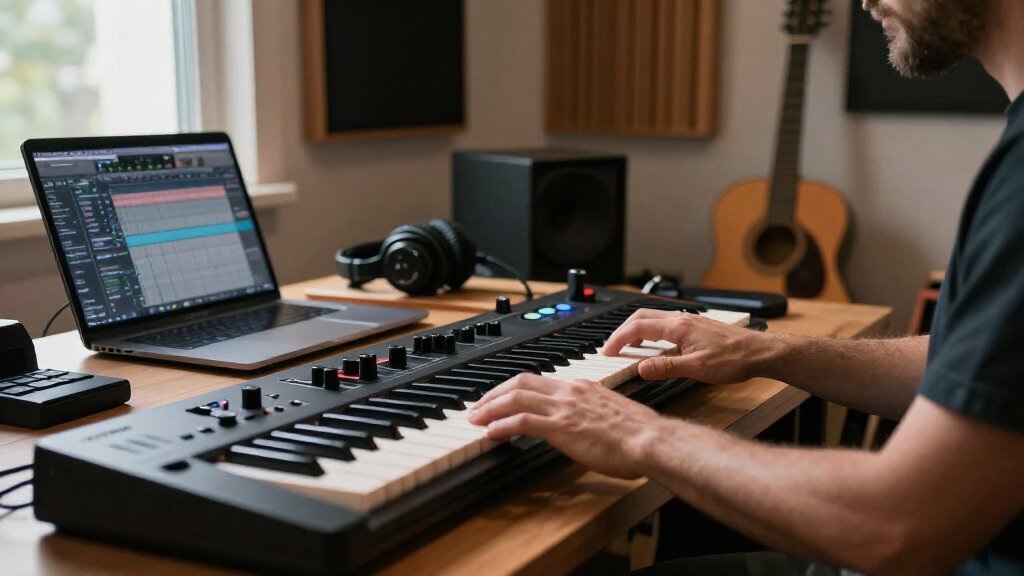
I compared these controllers by the jobs they can perform in a music-production setup: entering notes, triggering drums, controlling software instruments, mixing, and launching clips. I weighed playable range, control layout, portability, build and connection basics, DAW fit, and whether bundled software adds a useful starting point. A controller earns a higher place when its layout supports several common production tasks without making its main purpose unclear.
The ranking reflects role and versatility rather than feature count alone. The MiniLab 3 leads as a compact all-rounder; the MPK Mini Plus and Oxygen Pro 61 rank well for players who need more range or control depth. Dedicated tools such as the APC40 MKII, MIDImix, and LPD8 sit lower in an all-purpose list, not because they lack value, but because they suit narrower workflows. Small keyboard options remain useful for portability, while buyers seeking a full playing range should favor larger models.
Factors to Consider When Choosing MIDI Controllers For Music Production
Before choosing a controller, decide which part of your production process feels restricted: playing notes, programming drums, adjusting a mix, or performing clips. The most useful controller is often the one that removes friction from that task, not the one with the longest feature list. These broader checks can help prevent a mismatch between your setup and your day-to-day workflow.
Choose the Control Surface That Matches Your Main Task
Start by naming the action you repeat most often in your DAW. A keyboard controller is the natural choice for melodies, chords, and bass lines, while pads are better for finger-drumming and triggering samples. Faders and knobs can make mixing or changing instrument parameters more direct, and clip grids suit live arrangement and loop launching. A hybrid controller can cover several jobs, but its controls may be smaller or less specialized than a dedicated unit. Avoid paying for a layout you will rarely touch; a clear fit for your main task usually beats a feature-packed compromise.
Pick a Key Range You Can Actually Use
Compact keyboards save desk space and travel well, but their limited range can require frequent octave changes when playing two-handed parts. A 37-key model offers more room without taking up as much space as a full-size board, while a 49- or 61-key controller suits players who want broader melodic and chord access. Key count alone does not determine feel, so check whether the key size and action suit your playing style. Producers who mainly enter short phrases may not benefit from a larger keyboard. A common mistake is buying a tiny controller for portability, then finding that octave switching slows down every session.
Check DAW Compatibility and Control Mapping
Compatibility is more than whether a controller sends MIDI: the useful question is how much setup its controls need in your DAW. Some layouts are built around clip launching or a particular software workflow, while others work as general-purpose MIDI devices that need manual mapping. Check operating-system and DAW support, available scripts, and whether the controls can be assigned to the instruments and mixer functions you use. Bundled software may help a new producer begin, but it is less valuable if you already own a preferred DAW and sound library. A little research here can prevent buying a controller whose most appealing controls are awkward in your setup.
Decide Whether Pads, Knobs, or Faders Matter Most
Extra controls are useful when they match a task you perform regularly. Pads can speed up drum programming and sample triggering; knobs can help shape synth parameters; faders make level changes more immediate. More controls can also mean a larger footprint and more mapping work, so count the controls you expect to use rather than treating every additional button as a benefit. If your workflow is centered on software instruments, keys and assignable knobs may be more useful than a large clip grid. If you mix or perform live, dedicated faders or launch buttons may justify giving up some keyboard space.
Account for Desk Space, Portability, and Connections
Measure the space where the controller will live, including room for a mouse, laptop, and any other instruments. A compact controller is easier to pack and keep connected, while larger boards offer more playing room but can dominate a small desk. Confirm the connection type and any power needs against your computer and hub setup, especially if you plan to use the controller away from a fixed studio. USB connectivity is convenient, but cable reach and port availability can still affect placement. Think about where you will use it most often rather than choosing only by its folded-up or packed size.
Spend More for a Real Workflow Gain
A larger or more advanced controller is worth choosing when it removes a repeated limitation, such as running out of keys, needing more direct mix control, or wanting hands-on sequencing. It is less compelling if the extra features duplicate functions already handled comfortably with a mouse or existing hardware. For a first controller, ease of setup and a clear layout can matter more than a long control list. For experienced producers, a specialized surface may improve speed even if it cannot replace a keyboard. Make the upgrade decision around a specific bottleneck in your sessions, not the assumption that a more elaborate controller automatically improves production.
Frequently Asked Questions
Should I buy a 25-key controller or a larger keyboard for production?
Choose 25 keys if you mainly enter short phrases, bass lines, or simple chords and need a small desk footprint. Frequent two-handed playing or parts that span several octaves will make octave switching tedious, so a 37-, 49-, or 61-key layout may suit you better. The MPK Mini Plus gives more range than the smallest options while remaining compact, whereas the Oxygen Pro 61 is aimed at a broader playing range. Also check key size and feel, since a larger key count does not guarantee a better playing experience. Let your usual parts, rather than a general idea of future needs, guide the choice.
Can I use a pad controller without a keyboard controller?
Yes, if your main work involves drum triggering, sample playback, clip launching, or mixer control. The ATOM, APC models, LPD8, MIDImix, and STARRYPAD each focus on tasks that do not require a traditional keyboard layout. You can also draw notes into a piano roll or play them with a computer keyboard, though that may feel less immediate for melodic parts. If you regularly record chords or synth lines, a pad-only controller can leave a gap in your setup. Choose one on its own when its specific workflow is your priority, or pair it with a compact keyboard later.
Will an Ableton-focused controller work with another DAW?
Many controllers can send MIDI to other DAWs, but the experience may differ from the workflow they were designed around. Basic note input and assignable controls may work, while clip launching, transport functions, or display feedback can require manual setup or may be less seamless. Before buying, check your DAW’s controller scripts and the manufacturer’s compatibility details. If you use multiple DAWs, a more general-purpose keyboard or pad layout may be easier to remap. Prioritize the software you use most often rather than assuming every feature will carry over unchanged.
Is a bundled software package a good reason to choose one controller?
A bundle can be helpful if you are starting from scratch and want instruments or production software ready to use. Its value drops if you already have a DAW, preferred plug-ins, or a library that covers the same needs. Check what is included and whether the software is compatible with your computer and workflow before treating it as a deciding factor. The controller’s key feel, layout, and mapping will shape everyday use long after a starter bundle has served its purpose. Compare the hardware fit first, then count included software as an extra when it fills a genuine gap.
Do I need a dedicated mixer or clip-launch controller if my DAW has a mouse interface?
No; a mouse can handle mixing and arrangement tasks, particularly when you produce at a desk and work mainly with a screen. A dedicated surface becomes more useful when you make repeated level changes, launch clips in performance, or want to adjust multiple controls without clicking through menus. The APC Mini MK2 and APC40 MKII focus on clip-based control, while the MIDImix centers on hands-on mixer adjustments. A dedicated controller also takes up space and may need setup or mapping, so it is not automatically a better choice. Buy one when physical controls solve a recurring slowdown in your workflow.
Conclusion
For most producers seeking one compact controller for several studio tasks, I’d choose the Arturia MiniLab 3 as best overall. The Akai MPK Mini IV or MPK Mini MK3 can make sense as value-focused compact keyboard choices, while the MPK Mini Plus is my pick for players who want more keys and sequencing options in a small format. Beginners who want a straightforward portable keyboard can start with the Akai LPK25; those who need a wider playing range should look at the M-Audio Oxygen Pro 61 as the premium choice. For specific needs, choose the APC40 MKII for hands-on clip performance, the MIDImix for mixer control, or the LPD8 for compact pad triggering. Match the controller to your main production task, then check that its DAW support fits your setup.
Halloween Picks
halloween
As an affiliate, we earn on qualifying purchases.