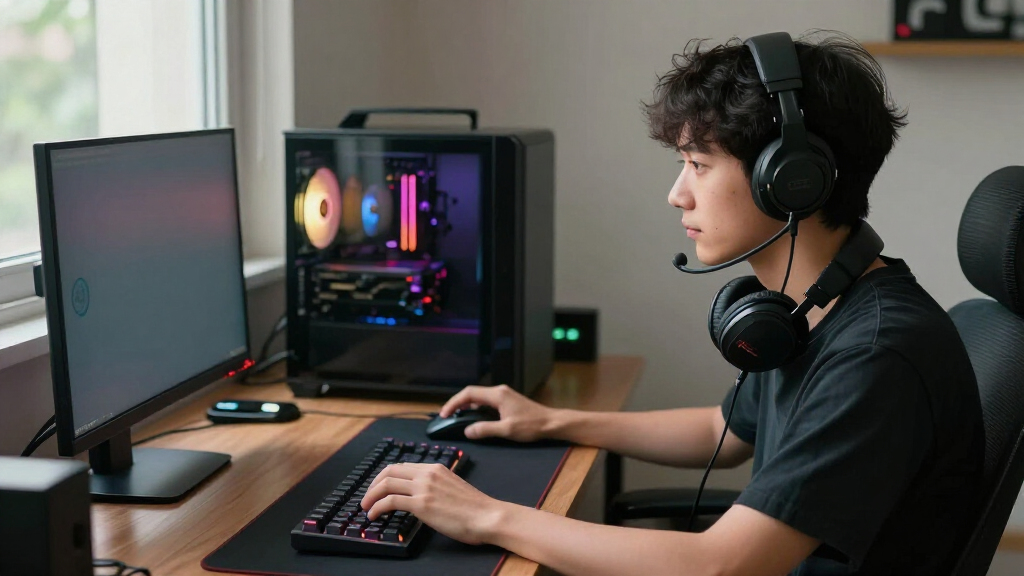

Among these 15 best gaming PCs, my best overall pick is the Skytech Gaming Desktop with Ryzen 7 9850X3D and GeForce RTX 5080, a strong match for demanding games and high-resolution displays. The Skytech Azure pairs the same processor with Radeon graphics, while the MSI Codex Z2 offers a more restrained configuration with an RTX 5070 and 2TB SSD. The main tradeoffs are graphics power, memory and storage capacity, and how much flexibility you want for future upgrades. A powerful GPU can matter more than an extravagant processor for gaming, while lower-spec systems may suit entry-level play but leave less headroom. Read on for the full breakdown, ranking logic, and advice on choosing a PC for your games and setup.

Get audio and creator gear delivered free with Prime
- Fast, free delivery on millions of items
- Prime Video, Amazon Music and more included
- Member-only deals all year
Complete the kit


Key Takeaways
- The RTX 5080 systems lead on graphics headroom: the Skytech Ryzen 7 9850X3D and STORMCRAFT Phantom combine high-end GPUs with gaming-focused Ryzen processors, making them the strongest fits here for demanding settings.
- Two RX 9070 XT desktops offer a distinct alternative: the Skytech Azure and KOTIN pair that graphics card with different Ryzen 7 processors, giving shoppers a choice between matching the Azure with a 9850X3D or the KOTIN with a 9700X.
- RTX 5070 options vary more than their GPU names suggest: the Alienware Aurora, MSI Codex Z2, iBUYPOWER Element, and CyberPowerPC Gamer Xtreme differ in processor, SSD capacity, and platform, so the GPU alone does not settle the comparison.
- Memory and storage can be a hidden cost of entry-level picks: the ZYNEEX S5 and Skytech Archangel list 16GB RAM and 1TB storage, while several more capable systems provide 32GB and 2TB.
- A large spec sheet does not automatically mean better gaming performance: the Horizon Autherium lists 64GB RAM and 5TB storage, but its RTX 5070 OC makes graphics capability a key point to compare against its less elaborate rivals.
| Skytech Gaming Desktop with Ryzen 7 9850X3D, GeForce RTX 5080, 32GB DDR5 RAM, and 2TB SSD |  | Best Overall for High-End Gaming | Processor: AMD Ryzen 7 9850X3D, 4.7 GHz base, up to 5.6 GHz | Graphics: NVIDIA GeForce RTX 5080, 16GB GDDR7; brand may vary | Memory: 32GB DDR5 6000 RGB | VIEW LATEST PRICE | See Our Full Breakdown |
| Skytech Azure Gaming Desktop with Ryzen 7 9850X3D, Radeon RX 9070 XT, 32GB DDR5 RAM, and 2TB SSD |  | Best AMD Graphics Pick | Processor: AMD Ryzen 7 9850X3D, 4.7 GHz base, up to 5.6 GHz | Graphics: AMD Radeon RX 9070 XT, 16GB GDDR6 | Memory: 32GB DDR5 5600 | VIEW LATEST PRICE | See Our Full Breakdown |
| Skytech King 95 Gaming Desktop with Ryzen 7 9800X3D and GeForce RTX 5070 Ti |  | Best for 1440p Gaming | Processor: AMD Ryzen 7 9800X3D, 4.7 GHz base, up to 5.2 GHz | Graphics: NVIDIA GeForce RTX 5070 Ti, 16GB GDDR7; brand may vary | Memory: 32GB DDR5 6000 RGB | VIEW LATEST PRICE | See Our Full Breakdown |
| STORMCRAFT Phantom Gaming PC with RTX 5080 and Ryzen 7 9800X3D |  | Best Support and Warranty | Processor: AMD Ryzen 7 9800X3D, 8 cores, 16 threads, 4.7 GHz base, up to 5.2 GHz | Graphics: NVIDIA RTX 5080, 16GB GDDR7, 256-bit | Memory: 32GB DDR5 6000MHz RGB | VIEW LATEST PRICE | See Our Full Breakdown |
| iBUYPOWER Element Gaming Desktop, Ryzen 9 7900X, GeForce RTX 5070 12GB, 32GB DDR5 RAM, 1TB NVMe SSD |  | Best for Gaming and Content Creation | Processor: AMD Ryzen 9 7900X, 4.7 GHz base, up to 5.6 GHz | Graphics: NVIDIA GeForce RTX 5070, 12GB | Memory: 32GB DDR5 RGB, 4800MHz | VIEW LATEST PRICE | See Our Full Breakdown |
| MSI Codex Z2 Gaming Desktop, Ryzen 7 8700F, GeForce RTX 5070, 32GB DDR5, 2TB SSD |  | Best for Ready-to-Play 4K Gaming | Processor: AMD Ryzen 7 8700F, 8 cores and 16 threads, up to 5.0 GHz | Graphics: NVIDIA GeForce RTX 5070 | Memory: 32GB DDR5, 6000 MHz | VIEW LATEST PRICE | See Our Full Breakdown |
| ZYNEEX S5 Gaming Desktop PC with Ryzen 5 5500, GeForce RTX 3050, 16GB RAM, and 1TB NVMe SSD |  | Best for Entry-Level 1080p Gaming | Processor: AMD Ryzen 5 5500, 6 cores and 12 threads, up to 4.2 GHz | Graphics: GeForce RTX 3050, 6GB GDDR6 | Memory: 16GB DDR4, 3200 MHz | VIEW LATEST PRICE | See Our Full Breakdown |
| The Horizon Autherium Dragon RGB I9 RTX Gaming PC, 64GB RAM, 5TB Storage, Core i9, RTX 5070 OC |  | Best for High-Capacity Multitasking | Processor: Unlocked Intel Core i9, up to 5.4 GHz; exact model not specified | Graphics: Factory-overclocked GeForce RTX 5070, 12GB GDDR7 | Memory: 64GB | VIEW LATEST PRICE | See Our Full Breakdown |
| ZOTAC MEK Gaming Desktop PC with Ryzen 7 9700X and GeForce RTX 5060 Ti 16GB |  | Best for Liquid-Cooled Gaming and Creation | Processor: AMD Ryzen 7 9700X, 8 cores and 16 threads, up to 5.5 GHz | Graphics: NVIDIA GeForce RTX 5060 Ti, 16GB GDDR7 | Memory: 32GB DDR5-6000MHz | VIEW LATEST PRICE | See Our Full Breakdown |
| KOTIN Gaming Desktop PC with Ryzen 7 9700X and Radeon RX 9070 XT |  | Best for Radeon-Focused Gaming | Processor: AMD Ryzen 7 9700X, 3.8 GHz base, up to 5.5 GHz | Graphics: AMD Radeon RX 9070 XT, 16GB GDDR6 | Memory: 32GB DDR5 | VIEW LATEST PRICE | See Our Full Breakdown |
| Alienware Aurora Gaming Desktop with RTX 5070 and Intel Core Ultra 7 265F |  | Best for a Polished Gaming Experience | Processor: Intel Core Ultra 7 265F | Graphics: NVIDIA GeForce RTX 5070, 12GB GDDR7 | Memory: 32GB DDR5 | VIEW LATEST PRICE | See Our Full Breakdown |
| YAWYORE Gaming Desktop PC with AMD Ryzen 7 5700X and GeForce RTX 5060 |  | Best for Buyers Who Prioritize Memory | Processor: AMD Ryzen 7 5700X, 8 cores and 16 threads, up to 4.6GHz | Graphics: GeForce RTX 5060, 8GB GDDR7; brand may vary | Memory: 32GB DDR4 3200MHz (2 x 16GB) | VIEW LATEST PRICE | See Our Full Breakdown |
| Skytech Archangel 5 Gaming Desktop, Intel Core i5-14400F, RTX 5060, 16GB DDR5, 1TB NVMe SSD |  | Best Starter Gaming PC | Processor: Intel Core i5-14400F, up to 4.7GHz | Graphics: NVIDIA GeForce RTX 5060, 8GB GDDR7; brand may vary | Memory: 16GB DDR5-6000 | VIEW LATEST PRICE | See Our Full Breakdown |
| CyberPowerPC Gamer Xtreme Gaming Desktop, AMD Ryzen 9 9900X, GeForce RTX 5070 12GB |  | Best for Gaming and Heavy Multitasking | Processor: AMD Ryzen 9 9900X, 12 cores, 4.4GHz | Chipset: AMD B850 | Graphics: NVIDIA GeForce RTX 5070, 12GB | VIEW LATEST PRICE | See Our Full Breakdown |
| CyberPowerPC Gamer Master Gaming Desktop, Ryzen 7 8700F, GeForce RTX 5060 Ti 8GB |  | Best for a Step-Up Midrange GPU | Processor: AMD Ryzen 7 8700F, 8 cores, 4.1GHz | Graphics: NVIDIA GeForce RTX 5060 Ti, 8GB | Memory: 16GB DDR5, 4800 MHz | VIEW LATEST PRICE | See Our Full Breakdown |
| gaming PC | Processor | Graphics | Memory | Storage |
|---|---|---|---|---|
| Skytech Gaming Desktop with Ry | AMD Ryzen 7 9850X3D, 4.7 GHz base, up to 5.6 GHz | NVIDIA GeForce RTX 5080, 16GB GDDR7; brand may vary | 32GB DDR5 6000 RGB | 2TB NVMe M.2 SSD |
| Skytech Azure Gaming Desktop w | AMD Ryzen 7 9850X3D, 4.7 GHz base, up to 5.6 GHz | AMD Radeon RX 9070 XT, 16GB GDDR6 | 32GB DDR5 5600 | 2TB Gen4 NVMe M.2 SSD |
| Skytech King 95 Gaming Desktop | AMD Ryzen 7 9800X3D, 4.7 GHz base, up to 5.2 GHz | NVIDIA GeForce RTX 5070 Ti, 16GB GDDR7; brand may vary | 32GB DDR5 6000 RGB | 2TB Gen4 NVMe M.2 SSD |
| STORMCRAFT Phantom Gaming PC w | AMD Ryzen 7 9800X3D, 8 cores, 16 threads, 4.7 GHz base, up to 5.2 GHz | NVIDIA RTX 5080, 16GB GDDR7, 256-bit | 32GB DDR5 6000MHz RGB | 2TB NVMe Gen4 SSD |
| iBUYPOWER Element Gaming Deskt | AMD Ryzen 9 7900X, 4.7 GHz base, up to 5.6 GHz | NVIDIA GeForce RTX 5070, 12GB | 32GB DDR5 RGB, 4800MHz | 1TB NVMe SSD |
| MSI Codex Z2 Gaming Desktop | AMD Ryzen 7 8700F, 8 cores and 16 threads, up to 5.0 GHz | NVIDIA GeForce RTX 5070 | 32GB DDR5, 6000 MHz | 2TB M.2 NVMe SSD |
| ZYNEEX S5 Gaming Desktop PC wi | AMD Ryzen 5 5500, 6 cores and 12 threads, up to 4.2 GHz | GeForce RTX 3050, 6GB GDDR6 | 16GB DDR4, 3200 MHz | 1TB NVMe SSD |
| The Horizon Autherium Dragon R | Unlocked Intel Core i9, up to 5.4 GHz; exact model not specified | Factory-overclocked GeForce RTX 5070, 12GB GDDR7 | 64GB | 5TB total: 1TB M.2 NVMe SSD and 4TB 7200RPM HDD |
| ZOTAC MEK Gaming Desktop PC wi | AMD Ryzen 7 9700X, 8 cores and 16 threads, up to 5.5 GHz | NVIDIA GeForce RTX 5060 Ti, 16GB GDDR7 | 32GB DDR5-6000MHz | 1TB NVMe M.2 SSD |
| KOTIN Gaming Desktop PC with R | AMD Ryzen 7 9700X, 3.8 GHz base, up to 5.5 GHz | AMD Radeon RX 9070 XT, 16GB GDDR6 | 32GB DDR5 | 1TB PCIe 4.0 NVMe SSD |
| Alienware Aurora Gaming Deskto | Intel Core Ultra 7 265F | NVIDIA GeForce RTX 5070, 12GB GDDR7 | 32GB DDR5 | 1TB SSD |
| YAWYORE Gaming Desktop PC with | AMD Ryzen 7 5700X, 8 cores and 16 threads, up to 4.6GHz | GeForce RTX 5060, 8GB GDDR7; brand may vary | 32GB DDR4 3200MHz (2 x 16GB) | 1TB M.2 NVMe PCIe SSD |
| Skytech Archangel 5 Gaming Des | Intel Core i5-14400F, up to 4.7GHz | NVIDIA GeForce RTX 5060, 8GB GDDR7; brand may vary | 16GB DDR5-6000 | 1TB NVMe M.2 SSD |
| CyberPowerPC Gamer Xtreme Gami | AMD Ryzen 9 9900X, 12 cores, 4.4GHz | NVIDIA GeForce RTX 5070, 12GB | 32GB DDR5, 4800 MT/s | 1TB PCIe 4.0 NVMe SSD |
| CyberPowerPC Gamer Master Gami | AMD Ryzen 7 8700F, 8 cores, 4.1GHz | NVIDIA GeForce RTX 5060 Ti, 8GB | 16GB DDR5, 4800 MHz | 1TB PCIe 4.0 NVMe SSD |
More Details on Our Top Picks
Skytech Gaming Desktop with Ryzen 7 9850X3D, GeForce RTX 5080, 32GB DDR5 RAM, and 2TB SSD
The Skytech King 95 is my strongest all-around pick here for buyers who want high-end gaming performance without stepping up to a workstation-style processor. Its RTX 5080 and Ryzen 7 9850X3D make a stronger graphics pairing than the RTX 5070 Ti in the Skytech King 95 with Ryzen 7 9800X3D, while 32GB of DDR5 and a 2TB NVMe drive leave room for a large game library and demanding multitasking. The 360mm liquid cooler is a useful match for a performance-focused build, but the tower will need space and the graphics card brand may vary. Wi-Fi 5 is also an older wireless standard, and some ports or components can vary. I’d choose this over the Radeon-based Skytech Azure when NVIDIA graphics are the priority; the Azure remains a sensible alternative for buyers who prefer AMD graphics.
Pros:- RTX 5080 with 16GB GDDR7 is suited to demanding graphics workloads and high-resolution gaming.
- Ryzen 7 9850X3D and 32GB DDR5 provide a strong gaming and multitasking foundation.
- 2TB NVMe storage gives more room for games than the 1TB iBUYPOWER Element.
- 360mm liquid cooler and included keyboard and mouse reduce setup needs.
Cons:- Graphics-card brand may vary, so the exact card partner is not guaranteed.
- Wi-Fi 5 is an older wireless standard than newer Wi-Fi generations.
- Some ports and components may vary, limiting certainty about the final configuration.
Best for: PC gamers seeking a high-end NVIDIA graphics card, substantial storage, and a fast gaming-focused processor in one prebuilt tower.
Not ideal for: Buyers with limited desk space, a preference for newer Wi-Fi standards, or a strict need for a specific graphics-card brand and port selection.
- Processor:AMD Ryzen 7 9850X3D, 4.7 GHz base, up to 5.6 GHz
- Graphics:NVIDIA GeForce RTX 5080, 16GB GDDR7; brand may vary
- Memory:32GB DDR5 6000 RGB
- Storage:2TB NVMe M.2 SSD
- Cooling:360mm AIO liquid CPU cooler with ARGB fans
- Wireless:Wi-Fi 5 (802.11ac)
- Operating system:Windows 11 Home 64-bit
- Warranty:1 year parts and labor
Our verdict“Choose this King 95 if you want an RTX 5080 gaming desktop with ample memory and storage, and can accommodate its large, variable-component build.”
Skytech Azure Gaming Desktop with Ryzen 7 9850X3D, Radeon RX 9070 XT, 32GB DDR5 RAM, and 2TB SSD
The Skytech Azure makes the most sense for players who want a powerful gaming-focused processor paired with AMD graphics rather than an NVIDIA card. Its Radeon RX 9070 XT with 16GB GDDR6, 32GB of DDR5, and 2TB Gen4 SSD form a capable high-end configuration, while the same Ryzen 7 9850X3D appears in the Skytech RTX 5080 desktop. That comparison makes the graphics tradeoff plain: the RTX 5080 model is the stronger fit for buyers set on NVIDIA, while this Azure is the AMD alternative. A 360mm cooler and tempered-glass case add visual appeal, though the 5600 DDR5 memory is slower than the 6000 memory listed in several competitors. Component models and I/O ports may vary, and its Wi-Fi 5 is not a newer wireless standard.
Pros:- Radeon RX 9070 XT with 16GB GDDR6 provides a substantial graphics configuration.
- Ryzen 7 9850X3D targets gaming performance while supporting demanding multitasking.
- 2TB Gen4 NVMe storage offers generous space for installed games.
- 360mm AIO cooler and tempered-glass case with ARGB fans suit a showcase build.
Cons:- DDR5-5600 memory is slower than the DDR5-6000 listed for several alternatives.
- Component models and I/O ports may vary between systems.
- 802.11ac Wi-Fi is an older wireless generation.
Best for: Gamers who specifically want Radeon graphics, a high-end AMD gaming processor, and 2TB of fast storage in a tempered-glass desktop.
Not ideal for: Buyers committed to NVIDIA graphics, who want clearly specified component brands and ports, or who prioritize faster listed memory.
- Processor:AMD Ryzen 7 9850X3D, 4.7 GHz base, up to 5.6 GHz
- Graphics:AMD Radeon RX 9070 XT, 16GB GDDR6
- Memory:32GB DDR5 5600
- Storage:2TB Gen4 NVMe M.2 SSD
- Cooling:360mm AIO liquid CPU cooler with ARGB fans
- Wireless:802.11ac
- Case:Skytech Azure tempered-glass gaming case, black
- Warranty:1 year parts and labor
Our verdict“Pick the Azure if Radeon graphics are your preference and you want a strong gaming configuration with 2TB storage, rather than the RTX 5080 Skytech.”
Skytech King 95 Gaming Desktop with Ryzen 7 9800X3D and GeForce RTX 5070 Ti
For buyers targeting 1440p gaming, this Skytech King 95 offers a more measured graphics tier than the RTX 5080 systems without dropping to a basic midrange setup. The RTX 5070 Ti with 16GB GDDR7, Ryzen 7 9800X3D, 32GB DDR5-6000, and 2TB Gen4 SSD make a balanced combination for gaming and everyday creative tasks. Compared with the Skytech RTX 5080 King 95, it gives up graphics headroom; that makes the RTX 5080 model the clearer choice for buyers chasing maximum performance, while this one is easier to justify for a 1440p-focused build. Its 360mm cooler and included keyboard and mouse are welcome, but the graphics-card brand and additional ports may vary. Wi-Fi is 802.11ac rather than a newer standard.
Pros:- RTX 5070 Ti with 16GB GDDR7 suits a dedicated 1440p gaming setup.
- Ryzen 7 9800X3D and 32GB DDR5-6000 give the system a strong gaming-focused core.
- 2TB Gen4 NVMe SSD provides ample space for a substantial game library.
- 360mm AIO cooling and included keyboard and mouse simplify initial setup.
Cons:- RTX 5070 Ti has less graphics headroom than the RTX 5080 in the Skytech King 95 and STORMCRAFT Phantom.
- Graphics-card brand and additional ports may vary.
- 802.11ac Wi-Fi lacks the newer wireless standard found on some current systems.
Best for: Gamers building around a 1440p monitor who want a strong NVIDIA GPU, 2TB storage, and bundled peripherals.
Not ideal for: Buyers who want the strongest graphics option in this group, need a guaranteed GPU brand, or require a newer wireless standard.
- Processor:AMD Ryzen 7 9800X3D, 4.7 GHz base, up to 5.2 GHz
- Graphics:NVIDIA GeForce RTX 5070 Ti, 16GB GDDR7; brand may vary
- Memory:32GB DDR5 6000 RGB
- Storage:2TB Gen4 NVMe M.2 SSD
- Cooling:360mm AIO liquid CPU cooler with ARGB fans
- Connectivity:802.11ac Wi-Fi
- Operating system:Windows 11 Home 64-bit
- Warranty:1 year parts and labor
Our verdict“Choose this King 95 for a well-equipped 1440p-focused NVIDIA build; move to an RTX 5080 model if maximum graphics headroom matters more.”
STORMCRAFT Phantom Gaming PC with RTX 5080 and Ryzen 7 9800X3D
The STORMCRAFT Phantom pairs an RTX 5080 with the Ryzen 7 9800X3D, making it a strong choice for buyers who want high-end NVIDIA graphics and place extra weight on support coverage. Like the Skytech RTX 5080 King 95, it has 32GB DDR5-6000, 2TB Gen4 storage, and a 360mm liquid cooler. Its differentiator is the stated coverage: two years for parts, three years for labor, one year for shipping, plus lifetime technical support. That package gives it a clearer support story than the Skytech models’ one-year parts-and-labor warranty. Seven adjustable ARGB fans and an 850W Gold power supply round out the build. The tradeoffs are a sizeable case and less CPU headroom on paper than the Ryzen 7 9850X3D Skytech, so buyers prioritizing the newest listed processor may prefer that model.
Pros:- RTX 5080 with 16GB GDDR7 provides high-end NVIDIA graphics capability.
- 32GB DDR5-6000 and 2TB Gen4 SSD support gaming and large local libraries.
- Seven adjustable ARGB fans and a 360mm AIO cooler provide extensive cooling hardware.
- Includes lifetime technical support and longer stated parts and labor coverage than the Skytech options.
Cons:- The 17 × 9.25 × 17-inch case needs substantial desk or floor space.
- Ryzen 7 9800X3D has a lower stated maximum boost clock than the 9850X3D in two Skytech systems.
- Support coverage is split across different terms for parts, labor, and shipping.
Best for: High-end gamers who want an RTX 5080 desktop and value extended labor coverage and ongoing technical support.
Not ideal for: Buyers with little room for a full-size tower or those who prioritize the Ryzen 7 9850X3D processor in the Skytech RTX 5080 system.
- Processor:AMD Ryzen 7 9800X3D, 8 cores, 16 threads, 4.7 GHz base, up to 5.2 GHz
- Graphics:NVIDIA RTX 5080, 16GB GDDR7, 256-bit
- Memory:32GB DDR5 6000MHz RGB
- Storage:2TB NVMe Gen4 SSD
- Cooling:360mm AIO liquid cooler
- Power supply:850W, Gold certified
- Case dimensions:17 × 9.25 × 17 inches
- Warranty and support:2 years parts, 3 years labor, 1 year shipping; lifetime technical support
Our verdict“Choose the Phantom if RTX 5080 performance and extended support matter more to you than a smaller footprint or the newer listed Ryzen 7 9850X3D.”
iBUYPOWER Element Gaming Desktop, Ryzen 9 7900X, GeForce RTX 5070 12GB, 32GB DDR5 RAM, 1TB NVMe SSD
The iBUYPOWER Element is the most creator-oriented option in this group: its Ryzen 9 7900X has more cores than the Ryzen 7 processors in the Skytech King 95 and STORMCRAFT Phantom, which can suit streaming and CPU-heavy content work alongside gaming. The RTX 5070 still gives it a capable NVIDIA graphics foundation, but its 12GB of graphics memory and 1TB SSD are more modest than the 16GB cards and 2TB drives in those higher-tier alternatives. Its 240mm liquid cooler is also smaller than their 360mm units. The system includes Wi-Fi, Bluetooth, a keyboard, and an RGB mouse, though it is a substantial 36-pound tower and uses 802.11ac Wi-Fi. I’d favor it for mixed workloads, not for buyers seeking the strongest gaming GPU or the largest included game library.
Pros:- Ryzen 9 7900X offers a higher-core-count processor for gaming alongside CPU-heavy creative tasks.
- RTX 5070 provides a capable NVIDIA graphics option.
- 32GB DDR5 RGB memory supports multitasking and content workflows.
- Includes a 240mm liquid cooler, Wi-Fi, Bluetooth, keyboard, and RGB mouse.
Cons:- 1TB SSD offers less storage than the 2TB drives in the Skytech and STORMCRAFT systems.
- RTX 5070 has 12GB of graphics memory, below the 16GB listed for the RTX 5080 and RTX 5070 Ti alternatives.
- The 36-pound, 20 × 9.1 × 17.4-inch tower is bulky to place and move.
Best for: Streamers and content creators who want a higher-core-count Ryzen 9 processor alongside an NVIDIA gaming GPU and bundled peripherals.
Not ideal for: Gamers prioritizing maximum graphics performance, more than 1TB of built-in storage, or a lighter, smaller desktop.
- Processor:AMD Ryzen 9 7900X, 4.7 GHz base, up to 5.6 GHz
- Graphics:NVIDIA GeForce RTX 5070, 12GB
- Memory:32GB DDR5 RGB, 4800MHz
- Storage:1TB NVMe SSD
- Cooling:240mm liquid CPU cooling
- Wireless:802.11ac Wi-Fi and Bluetooth
- Dimensions and weight:20 × 9.1 × 17.4 inches; 36 pounds
- Operating system:Windows 11 Home
Our verdict“Pick the iBUYPOWER Element if streaming or content work makes its Ryzen 9 processor more useful to you than the stronger graphics and larger SSDs in the 2TB alternatives.”
MSI Codex Z2 Gaming Desktop, Ryzen 7 8700F, GeForce RTX 5070, 32GB DDR5, 2TB SSD
I’d choose the MSI Codex Z2 for a strong balance of graphics, memory, and storage without the extra capacity and cooling features of more elaborate builds. Its GeForce RTX 5070 and 32GB of DDR5 make it better equipped for demanding games than the ZYNEEX S5, whose RTX 3050 and 16GB RAM are aimed at a more limited 1080p setup. The 2TB NVMe SSD also leaves more room for a game library than the ZOTAC MEK’s 1TB drive. Four system fans provide straightforward air cooling, but buyers who specifically want a liquid-cooled system should look at the ZOTAC MEK or KOTIN instead. The Ryzen 7 8700F is a capable eight-core match for gaming and multitasking, though the Codex Z2 doesn’t offer the newer Ryzen 7 9700X found in those alternatives.
Pros:- GeForce RTX 5070 graphics paired with an eight-core Ryzen 7 processor
- 32GB DDR5 memory supports gaming alongside common multitasking
- 2TB NVMe SSD provides more included storage than several alternatives in this group
- Four cooling fans and customizable RGB lighting
Cons:- Air cooling may not suit buyers specifically seeking an AIO liquid cooler
- Ryzen 7 8700F is an older processor option than the Ryzen 7 9700X in the ZOTAC MEK and KOTIN
Best for: PC gamers who want an RTX 5070, 32GB of memory, and room for a large game library in a ready-to-use desktop.
Not ideal for: Buyers who prioritize liquid cooling or a newer Ryzen 7 9700X processor over the Codex Z2’s larger included SSD.
- Processor:AMD Ryzen 7 8700F, 8 cores and 16 threads, up to 5.0 GHz
- Graphics:NVIDIA GeForce RTX 5070
- Memory:32GB DDR5, 6000 MHz
- Storage:2TB M.2 NVMe SSD
- Cooling:Air cooling with four system fans
- Operating system:Windows 11 Home
- Connectivity:Wi-Fi 6, Bluetooth, USB Type-C, HDMI, DisplayPort, and Ethernet
- Dimensions:16 × 8.38 × 19 inches
Our verdict“Choose the MSI Codex Z2 if you want RTX 5070 gaming with 32GB of memory and a spacious 2TB SSD, and don’t require liquid cooling.”
ZYNEEX S5 Gaming Desktop PC with Ryzen 5 5500, GeForce RTX 3050, 16GB RAM, and 1TB NVMe SSD
The ZYNEEX S5 is the entry-level choice in this group: it pairs a six-core Ryzen 5 5500 with an RTX 3050 6GB, 16GB of RAM, and a 1TB NVMe SSD. That makes it a more modest gaming system than the MSI Codex Z2, whose RTX 5070 and 32GB of memory give it substantially more headroom for demanding games and heavier multitasking. The S5’s listed maximum display resolution is 1920 × 1080, so I’d treat it as a fit for a 1080p setup rather than a route to high-resolution gaming. Its prebuilt configuration, Wi-Fi, and Bluetooth keep setup simple, but the 16GB memory may feel limiting for some editing or multitasking workloads. Choose it for basic gaming needs, not for a powerful system you expect to grow into.
Pros:- Dedicated GeForce RTX 3050 graphics for gaming
- 1TB NVMe SSD provides solid-state storage for games and applications
- Built-in Wi-Fi and Bluetooth simplify desk setup
- Prebuilt desktop includes Windows 11 Home
Cons:- Listed maximum display resolution is 1920 × 1080
- 16GB DDR4 memory offers less headroom than the 32GB systems in this roundup
- RTX 3050 is a more limited graphics option than the RTX 5070 in the MSI Codex Z2
Best for: First-time PC gamers building a 1080p setup who want a prebuilt tower with Wi-Fi and Bluetooth.
Not ideal for: Players targeting higher-resolution gaming or demanding games with lots of simultaneous apps; its RTX 3050, 16GB RAM, and listed 1080p maximum are limiting.
- Processor:AMD Ryzen 5 5500, 6 cores and 12 threads, up to 4.2 GHz
- Graphics:GeForce RTX 3050, 6GB GDDR6
- Memory:16GB DDR4, 3200 MHz
- Maximum memory:64GB
- Storage:1TB NVMe SSD
- Operating system:Windows 11 Home
- Cooling:ARGB air cooling
- Video outputs:DisplayPort, HDMI, and DVI
Our verdict“Pick the ZYNEEX S5 for a straightforward 1080p starter PC, but choose a stronger system such as the MSI Codex Z2 if you need more gaming headroom.”
The Horizon Autherium Dragon RGB I9 RTX Gaming PC, 64GB RAM, 5TB Storage, Core i9, RTX 5070 OC
The Horizon Autherium Dragon is the capacity-focused pick: its stated configuration combines 64GB of RAM, 5TB across an NVMe SSD and hard drive, a factory-overclocked RTX 5070, and a 360mm liquid cooler. That generous memory and storage make it more suited to large game libraries and work alongside gaming than the MSI Codex Z2, which has 32GB of RAM and a 2TB SSD. The graphics tier, however, is still an RTX 5070, so the extra capacity doesn’t make it a stronger gaming choice on graphics alone. The listing describes the processor as an unlocked Core i9 up to 5.4GHz but doesn’t identify its exact model, which leaves less clarity than the ZOTAC MEK’s specified Ryzen 7 9700X. Its large 11-fan cooling setup and 35-pound tower also make it a substantial, feature-heavy option.
Pros:- 64GB RAM provides more capacity than the 32GB systems elsewhere in this group
- 5TB combined storage includes a 1TB NVMe SSD and a 4TB hard drive
- Factory-overclocked GeForce RTX 5070 with 12GB GDDR7
- 360mm liquid cooler and stated 11-fan cooling arrangement
Cons:- Processor model is not specified, despite the Core i9 and up-to-5.4GHz description
- RTX 5070 graphics do not distinguish it from the MSI Codex Z2 on graphics tier alone
- Large 35-pound tower and extensive cooling setup may be excessive for a gaming-first buyer
Best for: Gamers who also run memory-heavy creative or analysis workloads and want substantial included storage plus liquid cooling.
Not ideal for: Buyers seeking a clearly identified processor model, a compact tower, or a graphics upgrade over other RTX 5070 desktops.
- Processor:Unlocked Intel Core i9, up to 5.4 GHz; exact model not specified
- Graphics:Factory-overclocked GeForce RTX 5070, 12GB GDDR7
- Memory:64GB
- Storage:5TB total: 1TB M.2 NVMe SSD and 4TB 7200RPM HDD
- Operating system:Windows 11 Pro
- Cooling:360mm liquid cooler; listing states 11 total fans
- Power supply:850W, 80+ Gold
- Connectivity:Wi-Fi, Bluetooth, Ethernet, USB-C, HDMI, and DisplayPort
- Dimensions and weight:17 × 18 × 18 inches; 35 pounds
Our verdict“Choose the Horizon Autherium Dragon for its unusually high memory and storage capacity, not for a graphics advantage over other RTX 5070 PCs.”
ZOTAC MEK Gaming Desktop PC with Ryzen 7 9700X and GeForce RTX 5060 Ti 16GB
The ZOTAC MEK combines a Ryzen 7 9700X with an RTX 5060 Ti carrying 16GB of GDDR7, 32GB DDR5, and a 360mm liquid cooler. I’d favor it for a mix of gaming and processor-heavy creative work: its newer eight-core CPU and included liquid cooling set it apart from the air-cooled MSI Codex Z2. The graphics comparison is less straightforward. The MSI has an RTX 5070, while the MEK’s 16GB of graphics memory may appeal to buyers whose workloads benefit from more VRAM; the supplied specs don’t establish that one is faster across games. Its 1TB SSD is half the MSI’s storage capacity, so a large game library may call for expansion. Wi-Fi 6E, Bluetooth 5.3, and support for up to four displays round out a capable, flexible tower.
Pros:- Ryzen 7 9700X offers eight cores and boost speeds up to 5.5GHz
- GeForce RTX 5060 Ti includes 16GB of GDDR7 memory
- 360mm AIO liquid cooler and 850W 80+ Gold power supply
- Wi-Fi 6E, Bluetooth 5.3, and outputs for up to four displays
Cons:- 1TB NVMe SSD provides less included storage than the MSI Codex Z2’s 2TB drive
- Complete system warranty is one year, with the longer three-year coverage applying to the GPU
- Warranty return shipping is available only to U.S. addresses
Best for: Gamers and content creators who value a Ryzen 7 9700X, liquid cooling, 16GB of graphics memory, and multi-display support.
Not ideal for: Players who want more included SSD space or prefer the MSI Codex Z2’s RTX 5070 graphics configuration.
- Processor:AMD Ryzen 7 9700X, 8 cores and 16 threads, up to 5.5 GHz
- Graphics:NVIDIA GeForce RTX 5060 Ti, 16GB GDDR7
- Memory:32GB DDR5-6000MHz
- Storage:1TB NVMe M.2 SSD
- Cooling:360mm AIO liquid cooler with three 120mm RGB fans
- Power supply:850W, 80+ Gold
- Connectivity:Wi-Fi 6E, Bluetooth 5.3, and Gigabit Ethernet
- Warranty:1-year complete system warranty; 3-year GPU warranty
Our verdict“Choose the ZOTAC MEK for its newer Ryzen 7 processor, liquid cooling, and 16GB graphics memory, provided 1TB of storage is enough or you plan to expand it.”
KOTIN Gaming Desktop PC with Ryzen 7 9700X and Radeon RX 9070 XT
The KOTIN is the Radeon alternative for buyers who want a Ryzen 7 9700X paired with a Radeon RX 9070 XT and 16GB of graphics memory. Compared with the ZOTAC MEK, it shares the same processor tier and 32GB of DDR5, but swaps the RTX 5060 Ti for a Radeon RX 9070 XT and adds Wi-Fi 7. The available specs don’t establish a universal performance winner, so I’d base the choice on graphics preference and the games or applications you use. KOTIN also includes a 360mm liquid cooler and a built-in 11.3-inch status display, a distinctive extra that adds visual flair but isn’t needed for gaming. Its 1TB SSD matches the ZOTAC’s capacity, while the 850W Gold-rated supply and lifetime technical support add practical reassurance. Older VGA or DVI monitors need an adapter.
Pros:- Ryzen 7 9700X paired with a Radeon RX 9070 XT featuring 16GB GDDR6
- 32GB DDR5 and a PCIe 4.0 NVMe SSD
- 360mm ARGB liquid cooler and 850W 80 PLUS Gold power supply
- Wi-Fi 7 and a built-in 11.3-inch status display
Cons:- 1TB SSD offers less included capacity than the MSI Codex Z2’s 2TB drive
- VGA and DVI monitors require an HDMI or DisplayPort adapter
- Video cable must connect to the graphics card ports, not the motherboard
Best for: Gamers who prefer an AMD Radeon graphics card and want a Ryzen 7 9700X, liquid cooling, Wi-Fi 7, and a built-in system display.
Not ideal for: Buyers who need more than 1TB of included storage, use older VGA or DVI monitors without adapters, or want a system without extra display hardware.
- Processor:AMD Ryzen 7 9700X, 3.8 GHz base, up to 5.5 GHz
- Graphics:AMD Radeon RX 9070 XT, 16GB GDDR6
- Memory:32GB DDR5
- Storage:1TB PCIe 4.0 NVMe SSD
- Cooling:360mm ARGB liquid CPU cooler
- Display:Built-in 11.3-inch smart display
- Wireless connectivity:Wi-Fi 7 and Bluetooth
- Power supply:850W, 80 PLUS Gold certified
- Warranty and support:1-year parts and labor warranty; lifetime technical support
Our verdict“Pick the KOTIN if you want a Radeon-based gaming system with a Ryzen 7 9700X and Wi-Fi 7, and don’t mind its 1TB SSD or display connections.”
Alienware Aurora Gaming Desktop with RTX 5070 and Intel Core Ultra 7 265F
The Alienware Aurora pairs an RTX 5070 with 12GB of GDDR7 and an Intel Core Ultra 7 265F, making it a stronger fit for demanding gaming than the RTX 5060 systems in this group. Its 32GB of DDR5 also gives demanding games and multitasking more breathing room than the Skytech Archangel 5’s 16GB. AlienFX lighting and performance profiles add convenient system controls, while the airflow-focused case is designed to manage heat and noise. The tradeoff is a large, nearly 34-pound tower, and the listing does not include a display. Compared with the more powerful Ryzen 9 and RTX 5070 CyberPowerPC Gamer Xtreme, the Aurora offers less CPU headroom, but its Alienware software and 12GB graphics memory make it a well-rounded gaming choice.
Pros:- RTX 5070 with 12GB GDDR7 for demanding games
- 32GB DDR5 memory
- AlienFX lighting and Alienware Command Center profiles
- Wi-Fi 7 and Killer 2.5 Gb Ethernet
Cons:- Large chassis weighs 33.9 pounds
- No display is included
- Air cooling rather than liquid CPU cooling
Best for: Gamers who want a branded, ready-to-configure desktop with RTX 5070 graphics, 32GB of memory, and built-in lighting and performance controls.
Not ideal for: Buyers with limited desk or floor space, or anyone seeking the strongest processor in this lineup; the tower is bulky and the Gamer Xtreme has a 12-core Ryzen 9.
- Processor:Intel Core Ultra 7 265F
- Graphics:NVIDIA GeForce RTX 5070, 12GB GDDR7
- Memory:32GB DDR5
- Storage:1TB SSD
- Operating system:Windows 11 Home
- Connectivity:Wi-Fi 7, Bluetooth, Killer 2.5 Gb Ethernet
- Cooling:Air cooled
- Dimensions and weight:18.05 x 7.76 x 16.46 inches; 33.9 pounds
Our verdict“Choose the Aurora if you want RTX 5070 gaming, 32GB memory, and Alienware’s integrated controls in a substantial tower.”
YAWYORE Gaming Desktop PC with AMD Ryzen 7 5700X and GeForce RTX 5060
The YAWYORE stands out among the RTX 5060 options by pairing its graphics card with 32GB of DDR4 memory and a Ryzen 7 5700X. That extra capacity can suit players who keep several apps open alongside games, while the 1TB NVMe SSD provides room for a useful game library. Compared with the Skytech Archangel 5, YAWYORE doubles the listed memory, but uses DDR4 rather than DDR5 and gives up the Skytech’s included keyboard and mouse. Its RTX 5060 has 8GB of GDDR7 and supports ray tracing and DLSS 4, though the listing specifies a maximum display resolution of 1920 x 1080. Component details are less certain: the graphics-card brand may vary, and the cooling description conflicts between air cooling and a liquid cooler. I’d choose it for capacity, not for a clearly documented build.
Pros:- 32GB of DDR4 memory for gaming alongside other applications
- 1TB M.2 NVMe PCIe SSD
- RTX 5060 supports ray tracing and DLSS 4
- Wi-Fi and Bluetooth included
Cons:- Graphics-card brand may vary
- Cooling information conflicts between air and liquid cooling
- Listed maximum display resolution is 1920 x 1080
Best for: 1080p players who multitask, want 32GB of memory and wireless connectivity, and are comfortable confirming component and cooling details with the seller.
Not ideal for: Buyers who want clearly specified cooling and components, DDR5 memory, or an included keyboard and mouse; the Skytech Archangel 5 offers a more explicit accessory and parts list.
- Processor:AMD Ryzen 7 5700X, 8 cores and 16 threads, up to 4.6GHz
- Graphics:GeForce RTX 5060, 8GB GDDR7; brand may vary
- Memory:32GB DDR4 3200MHz (2 x 16GB)
- Storage:1TB M.2 NVMe PCIe SSD
- Motherboard:MSI B550M-A PRO
- Power supply:650W, 80 Plus Bronze
- Operating system:Windows 11
- Connectivity:Wi-Fi and Bluetooth
Our verdict“Pick the YAWYORE if 32GB of memory matters more to you than DDR5, bundled peripherals, or fully consistent component details.”
Skytech Archangel 5 Gaming Desktop, Intel Core i5-14400F, RTX 5060, 16GB DDR5, 1TB NVMe SSD
The Archangel 5 is the most straightforward entry point here for a first gaming desktop: it combines an RTX 5060, 16GB of DDR5, and a 1TB NVMe SSD, then adds a keyboard and mouse so a new owner has the basics to get started. Its i5-14400F and graphics card are aimed at 1080p gaming; buyers who need more room for demanding games and multitasking may prefer the YAWYORE’s 32GB, though that model uses DDR4 and has unclear cooling details. The white tempered-glass case and ARGB fans give this Skytech a more visible setup style than the Alienware Aurora’s more restrained airflow-led pitch. There are caveats: the component brands may vary, the power-supply model is not specified, and 16GB leaves less memory headroom than the 32GB systems in this group.
Pros:- RTX 5060 with 8GB GDDR7
- 1TB NVMe M.2 SSD
- Keyboard and mouse included
- White tempered-glass case with ARGB fans
Cons:- 16GB of memory offers less headroom than the YAWYORE’s 32GB
- Graphics-card brand and some component models may vary
- Power-supply model is not specified
Best for: First-time PC gamers seeking a 1080p-focused desktop with a keyboard and mouse included and a familiar Windows setup.
Not ideal for: Players who run memory-heavy games, creative applications, or many background programs, or buyers who want exact component brands and a specified power supply.
- Processor:Intel Core i5-14400F, up to 4.7GHz
- Graphics:NVIDIA GeForce RTX 5060, 8GB GDDR7; brand may vary
- Memory:16GB DDR5-6000
- Storage:1TB NVMe M.2 SSD
- Operating system:Windows 11 Home 64-bit
- Case:Skytech Archangel 5, white tempered glass
- Wireless:802.11ac
- Included accessories and warranty:Gaming keyboard and mouse; 1-year parts and labor
Our verdict“Choose the Archangel 5 as a starter setup for 1080p gaming if bundled peripherals matter more than 32GB of memory or fully specified components.”
CyberPowerPC Gamer Xtreme Gaming Desktop, AMD Ryzen 9 9900X, GeForce RTX 5070 12GB
The Gamer Xtreme is the CPU-heavy pick in this batch: its 12-core Ryzen 9 9900X sits alongside an RTX 5070 with 12GB of graphics memory, 32GB of DDR5, and liquid CPU cooling. That combination suits someone who games while streaming, editing, or running other demanding workloads better than the more gaming-focused Core Ultra 7 configuration in the Alienware Aurora. Both use an RTX 5070 with 12GB, so the Xtreme’s clearest distinction is processor capacity and liquid cooling rather than a different graphics tier. The tradeoff is its listed DDR5 speed of 4800 MT/s, which is slower than some DDR5 configurations, and the 1TB SSD is modest for a large game and media collection. A wired keyboard and mouse are included, but no display is listed.
Pros:- 12-core Ryzen 9 9900X processor
- RTX 5070 with 12GB of graphics memory
- 32GB DDR5 memory and liquid CPU cooling
- Lifetime technical support and one-year parts-and-labor warranty
Cons:- DDR5 memory is listed at 4800 MT/s
- 1TB SSD may constrain large game and media libraries
- No display is listed as included
Best for: Players who stream, edit video, or run CPU-heavy applications alongside games and want an RTX 5070 system with 32GB of memory.
Not ideal for: Buyers focused only on gaming who would rather prioritize storage capacity or faster-listed memory; the Alienware Aurora also pairs an RTX 5070 with 32GB and offers Wi-Fi 7.
- Processor:AMD Ryzen 9 9900X, 12 cores, 4.4GHz
- Chipset:AMD B850
- Graphics:NVIDIA GeForce RTX 5070, 12GB
- Memory:32GB DDR5, 4800 MT/s
- Storage:1TB PCIe 4.0 NVMe SSD
- Cooling:Liquid CPU cooling
- Connectivity:Wi-Fi 6, Bluetooth 5.3, LAN
- Video outputs:1 HDMI, 3 DisplayPort
Our verdict“Choose the Gamer Xtreme if you need strong CPU capacity for gaming plus streaming or content work, rather than a gaming-only configuration.”
CyberPowerPC Gamer Master Gaming Desktop, Ryzen 7 8700F, GeForce RTX 5060 Ti 8GB
The Gamer Master sits between the RTX 5060 desktops and the RTX 5070 systems in this group, using an RTX 5060 Ti with 8GB and an eight-core Ryzen 7 8700F. That makes it a useful step up from the Skytech Archangel 5’s RTX 5060, while costing you the Archangel’s 16GB DDR5-6000 specification only in capacity terms: this CyberPowerPC also lists 16GB, but at 4800 MHz. Its 1TB PCIe 4.0 SSD, Wi-Fi 6, Bluetooth 5.3, and bundled keyboard and mouse cover the core setup needs. The main compromise is memory: 16GB may be restrictive for demanding games and multitasking, while the 8GB graphics memory is less generous than the 12GB RTX 5070 in the Alienware Aurora. It favors GPU tier over memory headroom.
Pros:- RTX 5060 Ti dedicated graphics
- Eight-core Ryzen 7 8700F processor
- 1TB PCIe 4.0 NVMe SSD
- Wi-Fi 6, Bluetooth 5.3, and keyboard and mouse included
Cons:- 16GB DDR5 may limit demanding games and multitasking
- RTX 5060 Ti has 8GB of graphics memory
- Memory is listed at 4800 MHz
Best for: Gamers seeking an RTX 5060 Ti system with a bundled keyboard and mouse, and who are willing to upgrade memory if their games or workloads demand more.
Not ideal for: Buyers who want 32GB of memory out of the box or more graphics memory for demanding titles; the Aurora has 12GB of graphics memory and 32GB system memory.
- Processor:AMD Ryzen 7 8700F, 8 cores, 4.1GHz
- Graphics:NVIDIA GeForce RTX 5060 Ti, 8GB
- Memory:16GB DDR5, 4800 MHz
- Maximum memory:192GB
- Storage:1TB PCIe 4.0 NVMe SSD
- Operating system:Windows 11 Home
- Wireless:Wi-Fi 6, Bluetooth 5.3
- Video outputs:1 HDMI, 2 DisplayPort
Our verdict“Pick the Gamer Master if you want an RTX 5060 Ti with bundled peripherals and can accept 16GB of memory and 8GB of graphics memory.”
How We Picked
I compared these desktops on the parts that shape day-to-day gaming: graphics hardware, processor class, memory, storage, and how well each configuration balances those components. I gave stronger placement to systems with higher-tier graphics paired with capable gaming processors, then considered whether the listed memory and SSD capacity support a comfortable start without immediate upgrades. I also looked at practical fit: a player chasing demanding visuals has different needs from someone choosing a first PC for mainstream games.
The order reflects those tradeoffs rather than brand recognition or a single headline specification. The RTX 5080 and RX 9070 XT systems lead for graphics headroom, followed by well-balanced RTX 5070 and RTX 5060 Ti options. Systems with older or entry-tier graphics, less memory, or less clarity about the configuration rank lower for buyers seeking a broadly capable gaming PC. I do not assume unlisted details such as case airflow, exact power supply, upgrade access, or real-world frame rates; buyers should verify those before choosing.
| gaming PC | Operating system |
|---|---|
| Skytech Gaming Desktop with Ry | Windows 11 Home 64-bit |
| Skytech Azure Gaming Desktop w | — |
| Skytech King 95 Gaming Desktop | Windows 11 Home 64-bit |
| STORMCRAFT Phantom Gaming PC w | — |
| iBUYPOWER Element Gaming Deskt | Windows 11 Home |
| MSI Codex Z2 Gaming Desktop | Windows 11 Home |
| ZYNEEX S5 Gaming Desktop PC wi | Windows 11 Home |
| The Horizon Autherium Dragon R | Windows 11 Pro |
| ZOTAC MEK Gaming Desktop PC wi | — |
| KOTIN Gaming Desktop PC with R | — |
| Alienware Aurora Gaming Deskto | Windows 11 Home |
| YAWYORE Gaming Desktop PC with | Windows 11 |
| Skytech Archangel 5 Gaming Des | Windows 11 Home 64-bit |
| CyberPowerPC Gamer Xtreme Gami | — |
| CyberPowerPC Gamer Master Gami | Windows 11 Home |
Factors to Consider When Choosing Best Gaming PCs
Specs can narrow the shortlist, but the right gaming PC depends on your display, game library, and willingness to upgrade. I use the following checks to avoid paying for capacity that will go unused—or buying a system that needs changes soon after setup.
Match the Graphics Card to Your Display
Start with the resolution and refresh rate of the monitor you own or plan to buy, then compare graphics cards around that goal. More GPU headroom is useful for higher resolutions and demanding visual settings, but it may be wasted if you mainly play lighter games on a modest display. A common mistake is choosing a PC around the processor name while overlooking the GPU, which usually has a larger effect on game rendering. Also check whether the games you play favor particular graphics features or ecosystems. If you are unsure, prioritize a balanced GPU and monitor pairing over the most expensive component you can find.
Treat the Processor as Part of a Balanced System
A faster processor can help in simulation, strategy, and competitive games where frame rates are high, but it does not compensate for a graphics card that cannot meet your visual goals. Compare the processor and GPU together rather than assuming a larger core count means better gaming. Think about non-gaming work too: streaming, video editing, and running demanding applications can make additional CPU capacity more useful. Before paying extra for a premium chip, check whether the graphics card and memory are strong enough to benefit from the full system budget. The best balance changes with your games and workload.
Plan Memory and Storage Around Your Game Library
Memory affects multitasking and helps avoid a quick upgrade, while storage determines how many large games you can keep installed. A 16GB configuration can be a sensible starting point for lighter use, but players who keep many applications open or want more headroom may prefer 32GB. SSD capacity matters more as modern game installs grow; a 1TB drive can fill sooner than expected if you maintain a large library. Do not judge capacity by the headline alone: confirm whether storage is SSD-based and whether an additional drive can be installed. Leave room in your decision for the cost and effort of later upgrades.
Check Upgrade Access Before You Buy
Prebuilt systems can differ in how easily you can replace memory, storage, cooling, or the graphics card. Ask for the motherboard model, power supply capacity, case dimensions, and available drive slots when those details are not listed. A compact or proprietary design may make future changes harder, even if its current parts look appealing. Confirm that the power supply can support a future GPU and that the case has enough clearance before planning upgrades. If you prefer a PC that works without tinkering, prioritize a balanced setup now over hypothetical upgrades later.
Look Beyond the Headline Parts
Cooling, noise, connectivity, and support can shape ownership just as much as a processor or graphics card. Large amounts of RAM or storage do not prove that a system has a good airflow design or a suitable power supply. Check the exact wireless standard, rear and front ports, warranty terms, and whether the PC arrives with the operating system you need. RGB lighting and a liquid cooler may suit your preferences, but neither guarantees better gaming performance. When a listing omits core build details, treat that uncertainty as a reason to verify the configuration rather than assume it is covered.
Frequently Asked Questions
Should I choose an RTX 5080 desktop or an RX 9070 XT desktop?
Choose by the games, display, and graphics features you care about rather than by the brand name alone. In this lineup, the Skytech RTX 5080 and STORMCRAFT Phantom stand out as high-end GeForce options, while the Skytech Azure and KOTIN give you RX 9070 XT configurations. Compare independent performance data for your specific games and resolution, then check features such as upscaling, ray tracing, and software support. The processor and memory configuration also differ, so compare the full system. If you already use a particular graphics ecosystem, that may make the decision easier.
Is a 16GB gaming PC enough, or should I choose 32GB?
Sixteen gigabytes can work for a first gaming PC, particularly if you mostly play a few games and close other applications while playing. Thirty-two gigabytes gives more room for multitasking, newer demanding games, and applications such as voice chat or streaming tools. In this roundup, the ZYNEEX S5 and Skytech Archangel list 16GB, while several higher-tier systems list 32GB or more. Check whether the memory can be upgraded and whether the PC has open slots before deciding. If an upgrade is awkward or costly, starting with more memory may be the simpler choice.
Is the largest storage capacity the best reason to pick a gaming PC?
Only if you will use it: a large library or sizeable media files can make extra capacity convenient, but storage does not make games render faster. Check whether the listed capacity is SSD storage, and look for details on additional M.2 slots or drive bays. The Horizon Autherium advertises 5TB of storage, while several alternatives list 1TB or 2TB SSDs, so confirm the drive types and layout before comparing capacity. A smaller SSD with an easy expansion path may suit you better than paying for storage you will not fill. Keep your budget focused on the graphics card if gaming performance is the priority.
Which specifications should I verify when a prebuilt listing leaves out build details?
Ask for the exact power supply model and wattage, motherboard model, memory layout, and storage type. Those details affect safety, upgrade options, and how easy it may be to diagnose or change a component later. Confirm the case dimensions and graphics card clearance if you expect to upgrade the GPU. Check cooling, port selection, wireless capability, operating system, and warranty coverage as well. A long parts list is not a substitute for clear information about the components that are not named.
How do I choose between an RTX 5070 desktop and an RTX 5060 Ti desktop?
First compare the exact graphics configuration and independent results for your target resolution and games; the GPU label alone does not tell the whole story. The roundup includes RTX 5070 systems with different processors and SSD capacities, as well as RTX 5060 Ti models with different memory configurations. A less powerful GPU may be a better fit for a mainstream display or a tighter system budget, while more graphics headroom can help with demanding settings. Consider how long you plan to keep the PC and whether you would rather upgrade later. Verify the full specification, especially system memory and the graphics card’s listed VRAM.
Conclusion
For the broadest high-performance gaming fit in this group, I recommend the Skytech Gaming Desktop with Ryzen 7 9850X3D and RTX 5080 as best overall. For buyers who want a premium graphics alternative, compare the Skytech Azure and KOTIN RX 9070 XT systems; their processors differ, so choose based on the rest of your workload. The MSI Codex Z2 is a sensible value-minded shortlist pick among the named RTX 5070 options, with 32GB memory and a 2TB SSD, while the Skytech Archangel 5 or ZYNEEX S5 may suit a beginner seeking a more modest starting configuration. For a high-capacity storage setup, examine the Horizon Autherium closely and verify its drive details and build components. Match the GPU to your monitor, confirm the parts that listings leave unspecified, and choose the PC whose tradeoffs fit how you actually play.
Halloween Picks
halloween
As an affiliate, we earn on qualifying purchases.