🔍 Read the full analysis: Can You Run Larger AI Models Locally On A Mac Mini? on ThorstenMeyerAI.com

Get audio and creator gear delivered free with Prime
- Fast, free delivery on millions of items
- Prime Video, Amazon Music and more included
- Member-only deals all year
TL;DR
Apple is positioning its Mac mini for always-on AI, and published model requirements show that some mid-size open models can run locally on configurations with enough unified memory. A model’s weights, operating system and context all compete for memory, while the Mac mini’s memory bandwidth is far below that of a data-center GPU. The available information does not establish real-world performance across models or workloads.
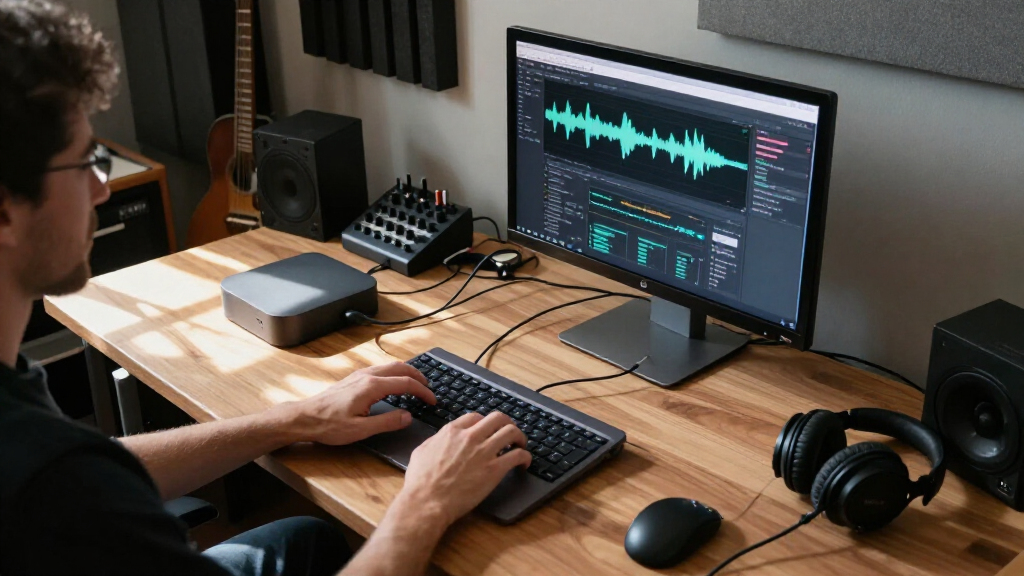
Apple is pitching its Mac mini as a desktop for always-on AI agents, and published memory requirements indicate that some mid-size open models can run on the machine without cloud access. The largest configuration offers 64 GB of unified memory, but model weights, macOS and an AI app must share that pool, so fit depends on the model, its precision and the amount of conversation context.
Apple introduced the new Mac mini on August 25, 2026, calling it “the leading desktop for always-on agentic computing” in its press release, according to the supplied source material. The lineup described there includes M6 models with 16 to 32 GB of unified memory and M5 Pro models with 24 to 64 GB. U.S. list prices shown on Apple’s website on November 16 start at $899 for a 16 GB model and reach $3,199 for a 64 GB M5 Pro configuration with 1 TB of storage.
Model makers’ published figures give a rough guide to what fits. Google lists its Gemma 4 31B model at about 17.5 GB in 4-bit precision and 34.9 GB in 8-bit precision. OpenAI says its gpt-oss-20b runs “within 16GB of memory.” Those figures describe model requirements, not a guarantee of smooth performance on every Mac mini: the computer also needs memory for macOS, other applications and the prompt or conversation context.
The upper end remains out of reach for a single 64 GB Mac mini under the cited specifications. OpenAI sizes gpt-oss-120b for a single 80 GB GPU. Apple says Thunderbolt 5 can let users cluster multiple Mac mini systems to run large models on device, but the supplied material does not give benchmark results for that setup.
Local AI’s Memory and Speed Trade-Off
Running a model locally can appeal to people who want to keep prompts and documents on their own computer, use AI without an internet connection or avoid paying a cloud service for each request. The source article also points to low idle power: it says the Mac mini can idle at 4 watts while an agent waits for work. That figure is presented by the source, not as an independently tested measurement here.
The limits matter as much as the benefits. Apple’s M5 Pro has 307 GB/s of memory bandwidth, while Nvidia lists 3.35 TB/s for its H100 SXM GPU. The source calculates the latter is about 11 times the M5 Pro figure. This comparison is between stated hardware bandwidth specifications, not a direct test of how quickly particular models answer. Still, it illustrates why fitting a model does not mean matching data-center speed.
For buyers, the practical question is not simply whether “AI runs” on a Mac mini. It is whether a chosen model fits with enough room left for context and other software, and whether its response speed suits the task. A higher-memory configuration may handle larger weights, but the listed prices rise with those configurations.
Products Worth Considering

DJI Mini 5 Pro Fly More Combo Plus with DJI RC 2

Apple Watch Series 10 GPS 46mm with Silver Aluminum Case and Blue Cloud Sport Loop

Logitech MX Keys S Combo Wireless Keyboard and Mouse, Graphite
As an affiliate, we earn on qualifying purchases.
How Unified Memory Shapes Model Fit
AI models store learned values called weights, which need to remain in fast memory while the model generates a response. Apple silicon uses unified memory: Apple’s MLX documentation says the CPU and GPU have direct access to the same pool. This differs from many PC setups, where a graphics card has separate memory that can limit which models fit on the GPU.
Lower-precision versions, often called quantized models, use less memory than higher-precision versions, though the source notes that reducing precision can come with some loss in quality. Google’s Gemma documentation says its memory figures cover static model weights only; longer context windows require additional memory. It also cautions that a mixture-of-experts model such as Gemma 4 26B A4B still has all 26 billion parameters loaded, even though it activates four billion per token.
That puts the published figures in perspective. A 16 GB machine may accommodate some smaller or compressed models, but it has little spare capacity once system memory and context are accounted for. At 32 GB, the source says Gemma 4 26B A4B at 4-bit (about 14.4 GB) or Gemma 4 31B at 4-bit (about 17.5 GB) may fit. A 64 GB configuration can hold the 31B model at 8-bit according to Google’s weight estimate; its 16-bit version is listed at 69.9 GB and exceeds that capacity.
Performance Depends on the Workload
The cited memory estimates do not establish how quickly each model will respond on each Mac mini configuration, or how performance changes with longer prompts, concurrent applications and different local-AI software. Google’s estimates cover model weights, while the usable memory pool must also support macOS, apps and context. The source does not provide standardized, independent benchmark results across the listed systems.
It is also unclear how well Apple’s proposed Thunderbolt 5 clustering works for particular model sizes and tasks, including its speed and setup requirements. The comparison with the H100 uses published bandwidth specifications; it is not a like-for-like model benchmark. The supplied material gives no detailed energy, cost-per-task or output-quality comparison with cloud services.
Check Requirements Before Buying
Anyone considering a Mac mini for local AI should match a model’s published memory requirement to the machine’s available unified memory, leaving headroom for context and other programs. Model documentation and local-AI app guidance are likely to change as software and hardware are updated, so buyers should check current requirements for the exact model and app they plan to use.
The next useful evidence would be independent, reproducible tests reporting response speed, memory use and output quality across Mac mini configurations and common workloads. Until those results are available, published weight sizes can show what may fit, but they do not settle whether the machine will be fast enough for a particular use.
Key Questions
Can a Mac mini run an AI model without using the cloud?
Yes, some models can run locally if they fit in available memory and the selected software supports them. The source cites OpenAI’s gpt-oss-20b as running “within 16GB of memory,” while noting that the system and context also require memory.
What is the largest model a 64 GB Mac mini can run?
The supplied figures do not define one universal maximum. Google lists Gemma 4 31B at about 34.9 GB at 8-bit, but its 16-bit version is 69.9 GB and exceeds 64 GB before accounting for the operating system, apps or context.
Does a model fitting in memory mean it will be fast?
No. Memory capacity helps determine whether the model can load, while memory bandwidth and workload affect performance. The source compares the M5 Pro’s 307 GB/s with Nvidia’s H100 SXM figure of 3.35 TB/s, but supplies no direct benchmark for model response times.
Why does model precision matter?
Lower precision, such as 4-bit rather than 8-bit, can reduce the memory used by model weights and allow a larger model to fit. The source notes that this compression can involve some cost in quality; the effect depends on the model and task.
Can several Mac minis be combined for a larger model?
Apple says Thunderbolt 5 allows users to cluster Mac minis to run large models on device. The supplied material does not give performance benchmarks or detailed requirements for that approach, so its practical limits remain unclear.
Source: ThorstenMeyerAI.com