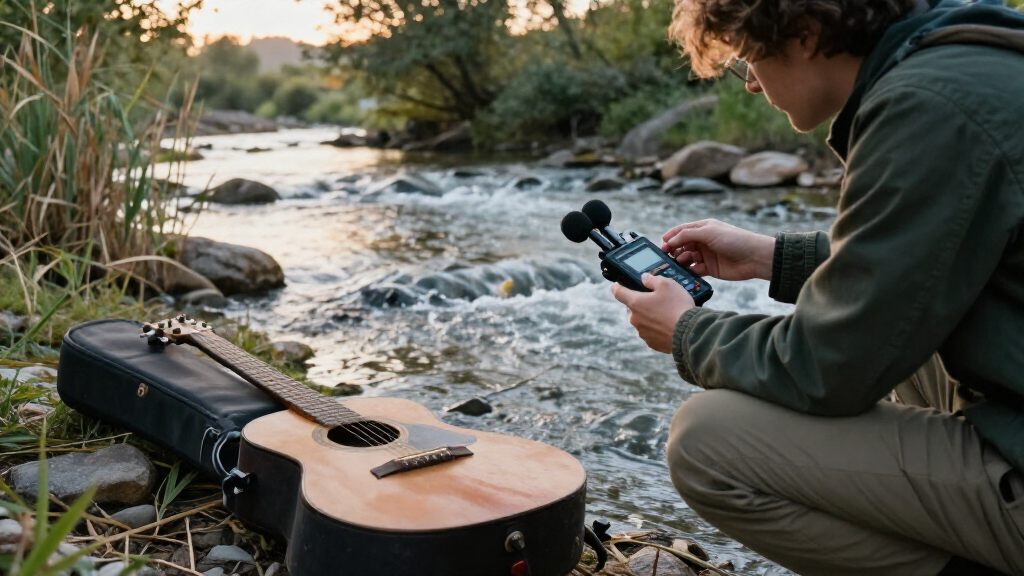
For most musicians, the Zoom F3 is the best overall portable field recorder here: its two XLR inputs and 32-bit float recording suit unpredictable rehearsals and live sources. The TASCAM DR-40XP stands out for musicians who want built-in microphones plus external inputs, while the Zoom H1essential offers a simpler, lighter stereo setup. The main tradeoff is between pocketable convenience and the input control, connectivity, and expandability of larger recorders. I compare all 15 options by recording needs, workflow, and portability below so you can find the right fit.

Get audio and creator gear delivered free with Prime
- Fast, free delivery on millions of items
- Prime Video, Amazon Music and more included
- Member-only deals all year
Complete the kit


Key Takeaways
- The Zoom F3 models lead for external microphones: they combine two XLR inputs with 32-bit float recording, making them a strong fit for recording sources whose levels are hard to predict.
- Bundle differences matter less than recorder differences: several F3 listings repeat the same core recorder, while the included card, headphones, batteries, cables, or mounting plate change what is ready to use.
- Built-in stereo mics make a different kind of recorder useful: the H1essential, H2essential, Roland R-07, and Xvive XV1-R favor quick, self-contained capture over XLR-based microphone setups.
- More inputs bring more setup decisions: the Zoom F6 and H4essential, along with the TASCAM DR-40XP, suit musicians needing multiple sources or flexible routing better than a basic stereo handheld.
- USB audio features can extend a recorder’s role: the DR-05XP, DR-07XP, and DR-40XP can also work as USB-C audio interfaces, which may make them more useful in a home recording workflow.
| Zoom F3 2-Channel Field Recorder Bundle with 64GB Memory Card, Headphones, Rechargeable Batteries, and Charger |  | Best Overall for External Mics | Channels: 2 | Recording format: 32-bit float | Maximum sample rate: 192 kHz | VIEW LATEST PRICE | See Our Full Breakdown |
| Zoom H1essential Handy Recorder Bundle with Lavalier Microphone and Accessories |  | Best for Beginners and Quick Ideas | Recording format: 32-bit float | Onboard microphones: Built-in X/Y microphones | Maximum sound pressure level: 120 dB SPL | VIEW LATEST PRICE | See Our Full Breakdown |
| TASCAM DR-40XP 4-Channel Portable Field Recorder and USB-C Audio Interface |  | Best for Multichannel Practice and Live Capture | Recording channels: Up to 4 | Recording formats: 32-bit float, 24-bit, and 16-bit WAV | Sample rates: 44.1, 48, and 96 kHz | VIEW LATEST PRICE | See Our Full Breakdown |
| Zoom F3 Portable 2-Input Field Recorder Bundle with 64GB microSDXC Card, Mounting Plate, and 20 ft XLR Cable |  | Best for Mounted or Remote XLR Setups | Inputs and tracks: 2 locking XLR inputs; 2 tracks | Recording format: 32-bit float WAV | Maximum sample rate: 192 kHz | VIEW LATEST PRICE | See Our Full Breakdown |
| Roland R-07 High-Resolution Handheld Audio Recorder, Black |  | Best for Wireless Control and Everyday Stereo Recording | Recording formats: MP3 and WAV | WAV options: 44.1, 48, 88.2, or 96 kHz; 16- or 24-bit | Built-in microphones: Stereo | VIEW LATEST PRICE | See Our Full Breakdown |
| Zoom H1essential Portable Stereo Recorder |  | Best for Beginners | Microphones: Built-in X/Y stereo microphones | Recording format: WAV, 32-bit float | Connectivity: USB-C | VIEW LATEST PRICE | See Our Full Breakdown |
| Zoom F3 2-Input, 2-Track Portable Field Recorder Bundle with AKG K240 Studio Pro Headphones and 32GB microSDHC Card |  | Best XLR Bundle | Inputs: 2 locking XLR | Tracks: 2 | Recording format: WAV, 32-bit float | VIEW LATEST PRICE | See Our Full Breakdown |
| Zoom H4essential Handheld Recorder |  | Best All-Rounder | Recording tracks: 4 | Recording format: WAV, 32-bit float | Maximum sample rate: 96 kHz | VIEW LATEST PRICE | See Our Full Breakdown |
| Zoom F3 Professional 2-Channel Field Recorder |  | Best for External-Mic Field Rigs | Channels: 2 | Recording format: WAV, 32-bit float | Inputs: 2 locking XLR/TRS | VIEW LATEST PRICE | See Our Full Breakdown |
| Zoom H2essential Handheld Recorder |  | Best for Flexible Stereo and Surround Capture | Microphones: 3 built-in | Recording patterns: 9 selectable | Recording modes: Mono, stereo, and surround | VIEW LATEST PRICE | See Our Full Breakdown |
| TASCAM DR-05XP 32-Bit Float Portable Field Recorder and USB-C Audio Interface | 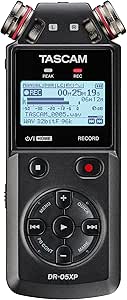 | Best Overall for Simple Stereo Recording | Recording modes: 32-bit float, 24-bit, 16-bit | Formats: WAV, MP3 | Sample rates: 44.1, 48, 96 kHz | VIEW LATEST PRICE | See Our Full Breakdown |
| Zoom H1 XLR 2-Channel Portable Recorder |  | Best Compact Recorder for External Mics | Recording format: WAV | Recording resolution: 32-bit float, up to 96 kHz | Inputs: 2 locking XLR/TRS combo inputs; 3.5 mm stereo input | VIEW LATEST PRICE | See Our Full Breakdown |
| TASCAM DR-07XP Portable 32-Bit Float Field Recorder and USB-C Audio Interface |  | Best for Adjustable Stereo Capture | Recording modes: 32-bit float, 24-bit, 16-bit | Formats: WAV, MP3 | Sample rates: 44.1, 48, 96 kHz | VIEW LATEST PRICE | See Our Full Breakdown |
| Zoom F6 Professional Field Recorder |  | Best for Multitrack Field Production | Recording format and bit depth: WAV, 32-bit float | Inputs: 6 XLR | Maximum tracks: 14 | VIEW LATEST PRICE | See Our Full Breakdown |
| Xvive XV1-R Portable Stereo Audio Recorder with 32-Bit Float and X/Y Microphones |  | Best for Phone-Friendly Recording | Recording formats: WAV (32-bit float or 24-bit PCM), AAC | Maximum sample rate: 96 kHz | Microphones: Built-in X/Y directional microphones | VIEW LATEST PRICE | See Our Full Breakdown |
| portable field recorders for musician | Weight | Recording format | Power |
|---|---|---|---|
| Zoom F3 2-Channel Field Record | 8.5 oz with batteries | 32-bit float | AA, USB, or AC; battery life varies by battery type |
| Zoom H1essential Handy Recorde | — | 32-bit float | — |
| TASCAM DR-40XP 4-Channel Porta | 6.1 oz | — | — |
| Zoom F3 Portable 2-Input Field | 8.48 oz | 32-bit float WAV | 2 AA batteries |
| Roland R-07 High-Resolution Ha | — | — | 2 AA batteries or USB bus power |
| Zoom H1essential Portable Ster | 92 g | WAV, 32-bit float | 2 AAA batteries |
| Zoom F3 2-Input | — | WAV, 32-bit float | — |
| Zoom H4essential Handheld Reco | 243 g | WAV, 32-bit float | 2 AA batteries |
| Zoom F3 Professional 2-Channel | 8.48 ounces | WAV, 32-bit float | 2 AA batteries or USB |
| Zoom H2essential Handheld Reco | 6.72 ounces | — | — |
| TASCAM DR-05XP 32-Bit Float Po | 4.48 oz | — | — |
| Zoom H1 XLR 2-Channel Portable | 6.4 oz | WAV | — |
| TASCAM DR-07XP Portable 32-Bit | 4.8 oz | — | — |
| Zoom F6 Professional Field Rec | 2.4 lb | — | 4 AA batteries included; multiple power options |
| Xvive XV1-R Portable Stereo Au | — | — | 2 AA batteries |
More Details on Our Top Picks
Zoom F3 2-Channel Field Recorder Bundle with 64GB Memory Card, Headphones, Rechargeable Batteries, and Charger
For musicians recording with external microphones, this F3 bundle makes a strong all-around choice: its two locking XLR inputs, phantom power, and 32-bit float recording support a dependable setup without constant level adjustments. Compared with the TASCAM DR-40XP, it gives up onboard microphones and four-channel recording, but its included rechargeable batteries, charger, headphones, and card make it more ready to record with XLR mics out of the box. Its compact metal body and remote app control also suit sessions where the recorder needs to sit near the performers rather than the operator.
The tradeoff is a focused two-input design; musicians wanting to capture a room with built-in mics or record several sources at once should look elsewhere. The included 64GB card is usable, though the recorder supports larger cards.
Pros:- 32-bit float recording reduces the need to set input gain precisely.
- Two locking XLR inputs provide phantom power for compatible microphones.
- Bundle includes headphones, a 64GB card, rechargeable AA batteries, and a charger.
- USB-C interface operation and app-based remote control expand its studio and field uses.
Cons:- Two-channel recording limits capture of larger ensembles or multiple mic positions.
- No onboard microphones for fast ambient or rehearsal-room recordings.
Best for: Musicians recording one stereo pair or two mono sources through XLR microphones who want a compact recorder and a useful starter accessory kit.
Not ideal for: Songwriters who want built-in microphones for quick room recordings, or ensembles that need more than two simultaneous inputs.
- Channels:2
- Recording format:32-bit float
- Maximum sample rate:192 kHz
- Inputs:2 XLR inputs with phantom power
- Outputs:3.5 mm headphone and line outputs
- USB:USB-C audio interface, up to 24-bit/96 kHz
- Weight:8.5 oz with batteries
- Power:AA, USB, or AC; battery life varies by battery type
- Included accessories:64GB memory card, headphones, four AA NiMH batteries, and four-bay charger
Our verdict“Choose this bundle for a ready-to-use, two-mic XLR rig; choose the TASCAM DR-40XP instead if built-in microphones and four-channel capture matter more.”
Zoom H1essential Handy Recorder Bundle with Lavalier Microphone and Accessories
This bundle is aimed at musicians who want to capture ideas quickly without assembling a separate mic-and-recorder kit. The built-in X/Y microphones handle spontaneous rehearsals and song sketches, while 32-bit float recording helps protect against level changes when a performance gets louder than expected. Compared with the Roland R-07, the H1essential offers 32-bit float capture and arrives with a lavalier mic, windscreen, card, and batteries; the Roland counters with Bluetooth monitoring and a more flexible range of WAV and MP3 settings.
Pre-record and auto-record functions can help catch an unplanned start, and overdubbing is useful for layering ideas. Still, its compact, simple setup is not a substitute for multiple XLR inputs, and the listed mic operation is mono. Musicians who need stereo XLR microphones or more routing options should step up to a recorder such as the TASCAM DR-40XP.
Pros:- 32-bit float recording helps accommodate unpredictable performance levels.
- Built-in X/Y microphones make quick recording possible without extra gear.
- Bundle includes a lavalier microphone, windscreen, 32GB card, and four AAA batteries.
- Pre-record, auto-record, and overdubbing support flexible idea capture.
Cons:- Listed microphone operation mode is mono, limiting its fit for stereo music capture.
- Four AAA batteries are required for battery operation.
- Does not provide the dual XLR inputs and phantom power found on the Zoom F3.
Best for: Songwriters and solo musicians who want to record rehearsals, demos, and passing ideas with minimal setup, plus a lavalier for close capture.
Not ideal for: Ensembles needing true stereo external-mic inputs, phantom power, or multichannel recording.
- Recording format:32-bit float
- Onboard microphones:Built-in X/Y microphones
- Maximum sound pressure level:120 dB SPL
- Headphone output:3.5 mm
- Supported storage:Up to 1 TB
- Included accessories:Lavalier condenser microphone, 32GB microSDHC card, furry windscreen, four AAA batteries, and cloth
- Recording features:Overdubbing, pre-record, auto-record, and playback-speed adjustment
Our verdict“Pick the H1essential bundle for fast, low-fuss song sketches and close lavalier recording, but choose a recorder with XLR inputs for serious stereo mic work.”
TASCAM DR-40XP 4-Channel Portable Field Recorder and USB-C Audio Interface
The DR-40XP earns its place for musicians who need more than a simple stereo snapshot. It can record from its adjustable onboard microphones and two external XLR/TRS inputs at the same time, giving a player room to capture a stereo ensemble image alongside a direct or close-mic source. Compared with the two-channel Zoom F3, the TASCAM offers four-channel recording and built-in A-B or X-Y mic configurations; the F3 is the more focused choice when locking XLR connections and a compact external-mic rig matter more than onboard capture.
Its USB-C 2-in/2-out interface also supports computer or compatible mobile workflows, and the listed 32-bit float formats add flexibility when recording changing dynamics. The compromise is a less complete out-of-box setup: batteries and a microSD card are not included. Musicians who only need two external mic inputs may find the extra recording options unnecessary.
Pros:- Records onboard microphones and external inputs simultaneously for up to four-channel capture.
- Adjustable A-B and X-Y microphones suit different room and ensemble recordings.
- Two XLR/TRS inputs support external microphones and other sources.
- USB-C 2-in/2-out interface functionality supports computer and compatible mobile setups.
Cons:- MicroSD card and batteries are not included.
- Larger feature set may be unnecessary for musicians who only need two XLR inputs.
- Maximum listed sample rate is 96 kHz, below the Zoom F3’s 192 kHz ceiling.
Best for: Small ensembles and instrumentalists who want to record onboard stereo ambience alongside up to two external mic or line sources.
Not ideal for: Musicians seeking a ready-to-go bundle with storage and batteries included, or those who only need a compact two-XLR recorder.
- Recording channels:Up to 4
- Recording formats:32-bit float, 24-bit, and 16-bit WAV
- Sample rates:44.1, 48, and 96 kHz
- Built-in microphones:Adjustable A-B or X-Y unidirectional condenser microphones
- Maximum SPL:125 dB
- External inputs:2 XLR/TRS inputs
- USB interface:2-in/2-out USB-C
- Weight:6.1 oz
- Included accessories:MicroSD card and batteries not included
Our verdict“Choose the DR-40XP when capturing built-in stereo sound and external sources together matters more than the F3’s simpler XLR-focused setup.”
Zoom F3 Portable 2-Input Field Recorder Bundle with 64GB microSDXC Card, Mounting Plate, and 20 ft XLR Cable
This F3 bundle is a practical match for musicians who need to place a recorder away from the performance area: the mounting plate and 20-foot XLR cable make positioning external microphones easier without buying those pieces separately. Like the other Zoom F3 bundle in this lineup, it records two channels in 32-bit float at up to 192 kHz through locking XLR inputs. The other F3 package adds headphones and rechargeable batteries with a charger, so it is the more complete choice for monitoring and power; this version favors mic placement flexibility.
The F3’s compact metal body and wide-level capture suit field sessions where performance dynamics are difficult to predict. The tradeoff is that it has no onboard microphones and remains limited to two tracks, unlike the four-channel TASCAM DR-40XP. Its 64GB card is included, but its listed supported-card limit is 512GB, and battery power requires two AA cells.
Pros:- 32-bit float recording and dual AD converters handle a wide range of input levels.
- Locking XLR inputs support a secure two-microphone setup.
- Bundle includes a 64GB card, mounting plate, and 20-foot XLR cable.
- Compact metal casing includes mounting bars and a tripod mount.
Cons:- Two-track recording cannot capture larger multichannel setups like the TASCAM DR-40XP.
- Requires two AA batteries, which are not listed as included.
- No onboard microphones for quick room or rehearsal recordings.
Best for: Musicians recording with external XLR microphones who need a mounting plate and long cable to place the recorder or mic rig away from the player.
Not ideal for: Musicians who need onboard microphones, more than two tracks, or a bundle with headphones and rechargeable batteries.
- Inputs and tracks:2 locking XLR inputs; 2 tracks
- Recording format:32-bit float WAV
- Maximum sample rate:192 kHz
- Recording modes:Mono and stereo
- Supported memory cards:SD cards up to 512GB
- Included accessories:64GB microSDXC card, mounting plate, and 20 ft XLR male-to-female cable
- Power:2 AA batteries
- Dimensions:3.04 × 2.95 × 1.88 inches
- Weight:8.48 oz
Our verdict“Choose this F3 package if cable reach and mounting are your priorities; the other F3 bundle is better equipped for monitoring and rechargeable power.”
Roland R-07 High-Resolution Handheld Audio Recorder, Black
The R-07 suits musicians who value a small handheld recorder with straightforward stereo capture and wireless convenience. Its Bluetooth control and monitoring can make placement easier when the recorder is across a room, while one-touch templates and Hybrid Limiting help streamline ordinary rehearsal or practice recording. Compared with the Zoom H1essential, the Roland offers Bluetooth features and a wider choice of WAV and MP3 recording settings, but it does not list 32-bit float capture; the Zoom is the safer pick when unpredictable volume swings are the main concern.
The built-in stereo microphones, headphone output, speaker, and mic/aux input give it useful flexibility for practice, playback, and simple external-source connections. However, storage media is separate, and this model’s listed formats top out at 24-bit/96 kHz WAV. It is less suited to musicians building a phantom-powered XLR setup, where the Zoom F3 is the clearer fit.
Pros:- Built-in stereo microphones capture performances without an external mic setup.
- Bluetooth supports remote control and wireless monitoring.
- WAV and MP3 options accommodate different recording and file-size needs.
- Runs on two AA batteries or USB bus power and includes a built-in speaker.
Cons:- Does not list 32-bit float recording, unlike the Zoom H1essential and F3.
- MicroSD or SDHC storage media must be supplied separately.
- Mic/aux input does not provide the dual phantom-powered XLR inputs offered by the Zoom F3.
Best for: Solo musicians and songwriters who want a compact stereo recorder with remote Bluetooth control for rehearsals, practice, and quick demos.
Not ideal for: Musicians who need 32-bit float recording, phantom-powered XLR inputs, or a supplied memory card.
- Recording formats:MP3 and WAV
- WAV options:44.1, 48, 88.2, or 96 kHz; 16- or 24-bit
- Built-in microphones:Stereo
- Wireless features:Bluetooth control and monitoring; Qualcomm aptX playback
- Display:2.4-inch graphic LCD with white backlight
- Storage:MicroSD and SDHC cards; listed capacity 32GB
- Power:2 AA batteries or USB bus power
- Battery life:Up to 16 hours recording or 30 hours playback
- Inputs and outputs:Mic/aux input and 3.5 mm headphone output
Our verdict“Pick the R-07 for convenient Bluetooth-assisted stereo practice recording, but choose the H1essential for 32-bit float or the F3 for XLR microphones.”
Zoom H1essential Portable Stereo Recorder
The Zoom H1essential is the most approachable choice here for musicians who want to capture rehearsals, songwriting ideas, or ambient stereo sound without packing external microphones. Its built-in X/Y stereo mics and 32-bit float recording make it easier to record changing dynamics without setting input gain in advance. Compared with the H4essential, it is smaller and simpler, but it lacks the two XLR/TRS inputs that let that model connect professional microphones or instruments. USB-C microphone mode also gives it a second role for computer or mobile recording. The tradeoffs are its reliance on AAA batteries and SD-card storage, so it is less suited to a setup built around external mics or direct instrument connections.
Pros:- Built-in X/Y microphones capture stereo performances without extra gear.
- 32-bit float recording helps accommodate sudden changes in performance volume.
- USB-C microphone mode supports recording with a computer or compatible mobile device.
- Spoken menu guidance and a simple workflow make operation more accessible.
Cons:- No XLR or TRS inputs for connecting external microphones or instruments.
- Requires two AAA batteries and records to a separately supplied SD card.
Best for: Songwriters and musicians who want a small, straightforward recorder for rehearsals, practice sessions, and location ambience.
Not ideal for: Musicians who need XLR inputs for external microphones or multiple isolated sources; the H4essential is a better fit for those sessions.
- Microphones:Built-in X/Y stereo microphones
- Recording format:WAV, 32-bit float
- Connectivity:USB-C
- Storage:SD card, up to 1 TB
- Headphone jack:3.5 mm
- Power:2 AAA batteries
- Maximum recording time:Up to 10 hours
- Weight:92 g
Our verdict“Choose the H1essential for uncomplicated stereo capture on the go, but step up to the H4essential if you need external inputs.”
Zoom F3 2-Input, 2-Track Portable Field Recorder Bundle with AKG K240 Studio Pro Headphones and 32GB microSDHC Card
This F3 bundle is the most ready-to-monitor option in the group for musicians who record with external microphones: it includes two locking XLR inputs, AKG K240 Studio Pro headphones, and a memory card. Its 32-bit float workflow and dual A/D converters help capture performances with a broad range of levels, while the rugged metal casing and mounting points suit field rigs better than the handheld H1essential or H4essential. The cost of that focused design is flexibility: it records only two tracks and has no built-in microphones listed, so it cannot grab a quick stereo room recording on its own. Compared with the F3 sold without this bundle, the recorder’s core recording role is similar; this version is differentiated by the included monitoring and storage essentials.
Pros:- Two locking XLR inputs help keep microphone connections secure.
- 32-bit float recording and dual A/D converters accommodate a wide range of performance levels.
- Rugged metal construction includes mounting bars and a tripod mount.
- Bundle includes AKG headphones, a 32GB card, and AA batteries.
Cons:- Two inputs and two tracks limit recording of larger ensembles or separately isolated sources.
- No built-in microphones are specified, so standalone ambient recording requires external mics.
Best for: Musicians with XLR microphones who want a compact two-channel recorder with headphones and a memory card included for field monitoring.
Not ideal for: Players who need built-in mics for fast, self-contained rehearsal recording or more than two isolated tracks.
- Inputs:2 locking XLR
- Tracks:2
- Recording format:WAV, 32-bit float
- Maximum sampling rate:192 kHz
- Maximum supported SD card:512 GB
- Included memory card:32GB microSDHC with SD adapter
- Included headphones:AKG K240 Studio Pro, semi-open circumaural
- Construction:Metal casing with mounting bars and tripod mount
Our verdict“Pick this bundle for a compact external-mic rig with monitoring gear included, not for all-in-one stereo recording or multitrack sessions.”
Zoom H4essential Handheld Recorder
The H4essential bridges quick handheld recording and more involved musician setups. Its built-in stereo mics can capture a room or rehearsal, while two XLR/TRS inputs add the option to connect external microphones or other compatible sources; four-track recording supports combining these approaches. Like the H1essential, it offers 32-bit float and spoken menu guidance, but it gives up some compactness for added connections and a color LCD. Compared with the F3, this is the more self-contained choice because it includes built-in mics, though the F3 offers a more dedicated two-channel XLR design and supports sampling rates up to 192 kHz. The H4essential’s 96 kHz ceiling, AA power, and small screen are the tradeoffs for its versatile handheld format.
Pros:- Built-in stereo mics and two XLR/TRS inputs cover both quick captures and external-mic setups.
- Four-track recording allows more flexible combinations of sources.
- 32-bit float recording helps handle unpredictable performance dynamics.
- USB-C supports recording or streaming with compatible devices while backing up to SD.
Cons:- Its 96 kHz maximum sample rate is below the F3’s listed 192 kHz maximum.
- Requires two AA batteries, and the 2-inch screen leaves limited space for on-device monitoring.
Best for: Musicians who want one handheld recorder for room captures, external microphones, and four-track combinations.
Not ideal for: Field recordists who need a rugged, dedicated XLR recorder or sampling rates above 96 kHz; the F3 better suits that focused setup.
- Recording tracks:4
- Recording format:WAV, 32-bit float
- Maximum sample rate:96 kHz
- Microphones:Built-in stereo microphones
- Inputs:2 XLR/TRS
- Connectivity:USB-C
- Power:2 AA batteries
- Weight:243 g
Our verdict“Choose the H4essential if you need a self-contained handheld that can grow from stereo room recording to a four-track external-input setup.”
Zoom F3 Professional 2-Channel Field Recorder
The standalone Zoom F3 makes the most sense when your recording plan already includes external microphones. Its two locking XLR/TRS inputs, low-noise preamps, and 32-bit float WAV recording favor dependable capture of quiet passages and sudden peaks without constant level adjustments. Against the bundled F3, this version keeps the same two-channel focus but does not list the headphones, memory card, or batteries included with that package. It is also less immediately self-contained than the H4essential, whose built-in stereo mics can record a room without an added mic rig. Flexible AA or USB power and long listed recording time suit extended sessions, but two channels place a firm limit on ensemble tracking. The product data also conflicts about a built-in microphone, so I would choose it on its external-input workflow.
Pros:- 32-bit float WAV capture helps manage performances with unpredictable levels.
- Locking XLR/TRS inputs help keep connections secure in a mobile rig.
- Low-noise preamps support clean capture from external microphones.
- Can run on two AA batteries or USB power, with up to 73 hours of listed recording time.
Cons:- Two channels restrict recording larger groups as separate tracks.
- The listed package does not specify headphones, a memory card, or included batteries.
- Product details conflict about a built-in microphone, so standalone mic capture is unclear.
Best for: Musicians recording with external XLR or TRS microphones who want a compact recorder for two-channel field capture.
Not ideal for: Musicians who want built-in microphones, bundled monitoring accessories, or more than two simultaneous channels.
- Channels:2
- Recording format:WAV, 32-bit float
- Inputs:2 locking XLR/TRS
- Preamps:Ultra-low-noise
- Storage capacity:Up to 512 GB
- Power:2 AA batteries or USB
- Maximum recording time:Up to 73 hours
- Weight:8.48 ounces
Our verdict“Choose the standalone F3 for a compact, externally mic’d two-channel rig, and choose the bundle if included headphones and storage matter.”
Zoom H2essential Handheld Recorder
The H2essential is the most adaptable pick here for musicians who want to change how a handheld recorder hears a space. Its three built-in microphones and nine recording patterns support mono, stereo, and surround capture, giving it more placement choices than the simpler X/Y-only H1essential. It also records in 32-bit float and can serve as a USB microphone, so it can shift from location recording to a computer-based session. The tradeoff is that it has no external XLR inputs listed, unlike the H4essential, which is the stronger choice when connecting studio or live microphones matters. Its small 1.3-inch screen may also feel constrained when reviewing settings. Audible menu navigation in seven languages is a distinctive accessibility feature, while Bluetooth timecode sync is useful only with compatible H2essential units.
Pros:- Three built-in microphones and nine patterns provide flexible recording perspectives.
- Supports mono, stereo, and surround recording modes.
- 32-bit float recording and USB microphone operation suit both field and computer-based work.
- Audible menu navigation is available in seven languages.
Cons:- No external XLR inputs are specified for connecting professional microphones.
- The 1.3-inch screen provides limited space for viewing settings.
- Bluetooth timecode sync requires compatible H2essential units.
Best for: Musicians and sound recordists who want a handheld recorder for varied room perspectives, including mono, stereo, and surround capture.
Not ideal for: Players who need to connect external XLR microphones or monitor a complex setup on a larger screen; the H4essential is a better match.
- Microphones:3 built-in
- Recording patterns:9 selectable
- Recording modes:Mono, stereo, and surround
- Recording resolution:Up to 32-bit float/96 kHz
- Storage:SD card, up to 2 TB
- USB interface:USB 3.0 Type-C
- Battery life:Up to 20 hours
- Weight:6.72 ounces
Our verdict“Pick the H2essential for a self-contained recorder with multiple spatial capture patterns, but choose the H4essential for external microphone connections.”
TASCAM DR-05XP 32-Bit Float Portable Field Recorder and USB-C Audio Interface
The TASCAM DR-05XP is my most balanced pick for musicians who want a grab-and-go stereo recorder without a multitrack setup. Its built-in omnidirectional mics and 32-bit float recording suit rehearsals, songwriting ideas, and loud sources up to 125 dB SPL, while the USB-C connection also lets it serve as a 2-in/2-out computer interface. Compared with the DR-07XP, it lacks adjustable AB/XY microphones, so stereo placement is less adaptable; in return, its straightforward built-in mic setup is easy to point and record. The Zoom H1 XLR is a better fit when you need external XLR mics, but the DR-05XP is lighter and offers longer stated battery life. I would skip it for band sessions that need multiple isolated inputs. Batteries and a memory card are not included.
Pros:- 32-bit float recording offers flexibility when source levels change unexpectedly.
- Built-in microphones handle sound pressure levels up to 125 dB SPL.
- USB-C supports use as a 2-in/2-out audio interface.
- Specified battery life of up to 17.5 hours suits long recording days.
Cons:- Built-in omnidirectional microphones do not offer the DR-07XP’s adjustable AB/XY positioning.
- No XLR inputs for connecting professional microphones directly.
- Requires separately purchased AA batteries and a memory card.
Best for: Songwriters and solo musicians who want to capture rehearsals, demos, and ambient stereo sound with minimal setup.
Not ideal for: Bands or location recordists who need XLR inputs, separate tracks, or adjustable stereo mic patterns.
- Recording modes:32-bit float, 24-bit, 16-bit
- Formats:WAV, MP3
- Sample rates:44.1, 48, 96 kHz
- Microphones:Built-in omnidirectional condenser microphones
- Maximum SPL:125 dB SPL
- USB interface:2-in/2-out USB-C
- Storage support:Up to 512 GB
- Power and battery life:2 AA batteries; up to 17.5 hours with alkaline batteries
- Weight:4.48 oz
Our verdict“Choose the DR-05XP for uncomplicated stereo music capture and USB-C interface use, but pick a multitrack recorder if you need separate sources.”
Zoom H1 XLR 2-Channel Portable Recorder
The Zoom H1 XLR is the compact choice here for musicians who already own microphones and want a simple recorder with proper connectors. Its two locking XLR/TRS combo inputs accept mic or line-level sources, and 32-bit float capture at up to 96 kHz reduces the need to set gain precisely before a take. The OLED waveform display gives a quick visual check, while the 3.5 mm stereo input adds another connection option. Unlike the built-in-mic TASCAM DR-05XP or DR-07XP, this model is centered on external sources rather than recording a room straight out of the box. Its two inputs also limit it to small setups compared with the six-input Zoom F6. Battery life is specified at up to 10 hours, and you need to supply both AA batteries and an SDXC card.
Pros:- Two locking XLR/TRS combo inputs support microphones and instruments.
- 32-bit float WAV recording reaches up to 96 kHz.
- OLED waveform display helps monitor the recording visually.
- Compact 6.4-ounce body includes USB-C connectivity.
Cons:- No built-in microphones are specified, so ambient recording requires an external mic.
- Two inputs cannot handle larger multitrack band sessions like the Zoom F6.
- AA batteries and an SDXC card are not included.
Best for: Musicians recording one stereo pair or two external mic/instrument sources who need locking connectors in a small recorder.
Not ideal for: Players who want built-in microphones for fast ambient recording, or ensembles that need more than two XLR/TRS inputs.
- Recording format:WAV
- Recording resolution:32-bit float, up to 96 kHz
- Inputs:2 locking XLR/TRS combo inputs; 3.5 mm stereo input
- Output:3.5 mm headphone output
- Display:0.96-inch OLED
- Storage:SDXC cards up to 1 TB
- Battery life:Up to 10 hours on 2 AA batteries
- USB:USB Type-C
- Weight:6.4 oz
Our verdict“Pick the H1 XLR if your priority is recording through two external mics or instruments in a compact package, not self-contained stereo capture.”
TASCAM DR-07XP Portable 32-Bit Float Field Recorder and USB-C Audio Interface
The TASCAM DR-07XP makes the most sense when built-in microphones are central to the way you record, but you want more control over stereo perspective than the DR-05XP provides. Its adjustable AB/XY condenser microphones let musicians choose a broader stereo image or a more focused arrangement, which helps adapt the recorder to a rehearsal room, instrument, or performance. It also records in 32-bit float and doubles as a 2-in/2-out USB-C interface. Compared with the Xvive XV1-R, the DR-07XP offers the stated 17.5-hour battery life and supports cards up to 512 GB; the Xvive, by contrast, lists a higher 130 dB SPL ceiling and USB-microphone compatibility with mobile devices. The DR-07XP remains a stereo recorder, not a substitute for the Zoom F6 when separate multitrack sources are needed. Batteries and card are sold separately.
Pros:- Adjustable AB/XY condenser microphones offer two stereo recording configurations.
- 32-bit float, 24-bit, and 16-bit recording options.
- Works as a 2-in/2-out USB-C audio interface.
- Supports microSD cards up to 512 GB and up to 17.5 hours of alkaline-battery operation.
Cons:- Built-in mics are not a replacement for multiple isolated XLR inputs.
- AA batteries and a memory card are not included.
- At 4.8 ounces, it is slightly heavier than the DR-05XP.
Best for: Musicians who record acoustic instruments, rehearsals, or live rooms and want to adjust the stereo image using the built-in mics.
Not ideal for: Producers seeking multiple XLR inputs or buyers who need a recorder supplied with batteries and a memory card.
- Recording modes:32-bit float, 24-bit, 16-bit
- Formats:WAV, MP3
- Sample rates:44.1, 48, 96 kHz
- Microphones:Adjustable stereo AB/XY condenser microphones
- Maximum SPL:125 dB SPL
- USB interface:2-in/2-out USB-C
- Memory cards:microSD, microSDHC, microSDXC up to 512 GB
- Power and battery life:2 AA batteries; up to 17.5 hours with alkaline batteries
- Weight:4.8 oz
Our verdict“Choose the DR-07XP over the DR-05XP when adjustable AB/XY stereo mics matter more than the simplest possible point-and-record setup.”
Zoom F6 Professional Field Recorder
The Zoom F6 sits in a different class from the handheld stereo recorders in this lineup. Its six XLR inputs, up to 14 tracks, and 32-bit float recording are built for capturing a band, ensemble, or film-related music session with sources kept separate for editing. Timecode I/O also makes it more useful for musicians working alongside video crews than the DR-05XP, DR-07XP, or Xvive XV1-R. Dual AD converters support a wide recording range, while multiple power options and wireless control suit more involved field setups. The tradeoff is size and complexity: at 2.4 pounds, it is far less pocketable than the Zoom H1 XLR, and six inputs may be unnecessary for a solo songwriter. Its listed 8 GB storage also makes storage planning part of the setup.
Pros:- Six XLR inputs and up to 14 tracks support complex recording setups.
- 32-bit float recording with dual AD converters captures a wide dynamic range.
- Timecode I/O supports audio and video synchronization.
- Multiple power options, wireless control, and USB interface operation offer setup flexibility.
Cons:- At 2.4 pounds, it is substantially less portable than the handheld recorders here.
- Its multitrack features add complexity that can be unnecessary for stereo field recording.
- The listed internal storage is 8 GB, so storage capacity needs attention.
Best for: Ensemble musicians, session recordists, and music-video crews who need multiple isolated XLR sources and timecode synchronization.
Not ideal for: Solo musicians who mainly want a lightweight recorder with built-in microphones for quick stereo demos.
- Recording format and bit depth:WAV, 32-bit float
- Inputs:6 XLR
- Maximum tracks:14
- Timecode:I/O
- Storage capacity:8 GB
- Power:4 AA batteries included; multiple power options
- Headphone jack:3.5 mm
- Dimensions:4 × 4.5 × 2.5 in
- Weight:2.4 lb
Our verdict“Choose the F6 when isolated tracks, multiple XLR sources, or timecode matter more than a light, self-contained stereo recorder.”
Xvive XV1-R Portable Stereo Audio Recorder with 32-Bit Float and X/Y Microphones
The Xvive XV1-R is a useful fit for musicians who want built-in stereo microphones and a recorder that can also connect as a USB microphone to computers and mobile devices. Its X/Y directional mics handle up to 130 dB SPL, and auto-record and pre-record functions can help catch a performance that begins before the operator is ready. Compared with the TASCAM DR-07XP, the XV1-R adds stated PC, Mac, iOS, and Android USB-microphone compatibility and AAC recording, but the DR-07XP has adjustable AB/XY mics, a headphone jack, and longer stated battery life. The XV1-R has no headphone output, so monitoring during a take is less convenient. Its microSD support tops out at 128 GB, and files split automatically at 4 GB. I’d choose it for portable capture and device connectivity, not critical monitored sessions.
Pros:- Built-in X/Y microphones support stereo capture up to 130 dB SPL.
- 32-bit float and 24-bit PCM WAV recording up to 96 kHz.
- USB-C USB microphone compatibility includes PC, Mac, iOS, and Android.
- Auto-record and pre-record features can help capture performances promptly.
Cons:- No headphone jack for direct monitoring.
- microSD support is limited to 128 GB.
- Files split automatically at 4 GB.
Best for: Mobile musicians and songwriters who want built-in X/Y stereo recording and USB-microphone compatibility with phones, tablets, or computers.
Not ideal for: Recordists who need to monitor through headphones while recording, or who want larger memory-card support and adjustable mic positioning.
- Recording formats:WAV (32-bit float or 24-bit PCM), AAC
- Maximum sample rate:96 kHz
- Microphones:Built-in X/Y directional microphones
- Maximum SPL:130 dB SPL
- Storage:microSD up to 128 GB
- USB microphone compatibility:PC, Mac, iOS, Android
- USB audio:USB-C, USB Audio Class 2.0; 48 kHz
- Recording time:Up to 12 hours
- Power:2 AA batteries
Our verdict“Pick the XV1-R if mobile USB-microphone use and built-in X/Y capture are priorities, but choose the DR-07XP for headphone monitoring and more flexible mic placement.”
How We Picked
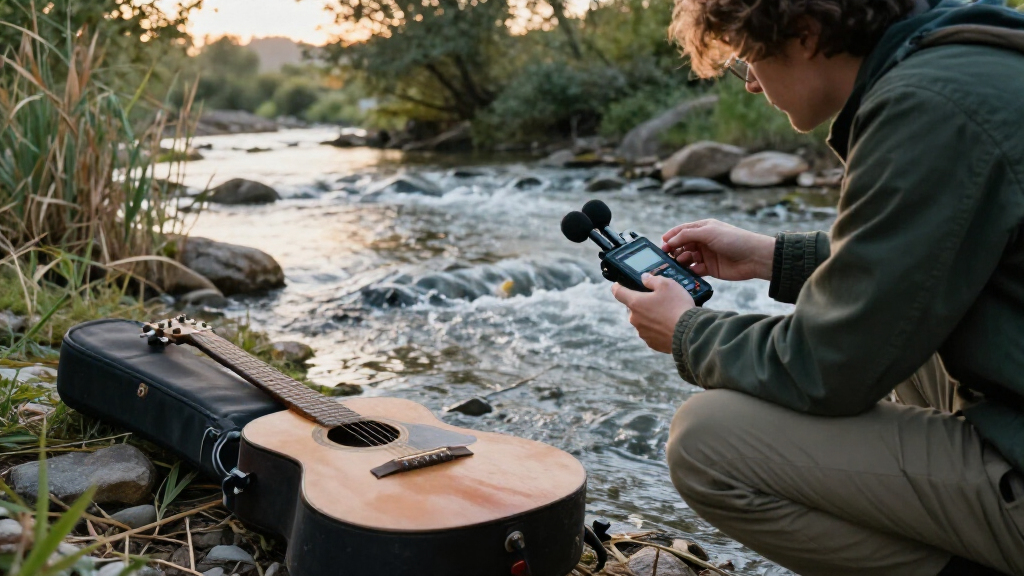
I compared these recorders around the demands musicians face away from a fixed studio: capturing rehearsals, concerts, instruments, room sound, and ideas without knowing exactly how loud a source will be. The main criteria were input options, onboard microphone usefulness, recording format, channel capacity, portability, monitoring and control, and the ability to connect to a computer. I also considered whether a model can cover more than one job, such as serving as a USB audio interface.
The ranking favors recorders that offer a useful balance of dependable capture options and manageable setup for a broad range of musicians. Dedicated XLR models rank well for external-mic flexibility, while handheld stereo units earn their place through speed and portability. Models with more channels can suit complex sessions, but extra capacity does not help every buyer and may add bulk or workflow overhead. Where the same recorder appears in several bundles, I treat the recorder’s core capabilities as the deciding factor and the included accessories as a convenience, not a performance upgrade.
Factors to Consider When Choosing Portable Field Recorders For Musicians
Start with the recording situations you actually face, not the longest feature list. A recorder that is easy to set up and carry may capture more useful music than a larger unit left at home. These choices can help you match the recorder to your sources and working habits.
Choose Built-In Mics or External Inputs
Built-in stereo microphones make sense for quick room recordings, songwriting ideas, and audience or rehearsal ambience. External inputs give you control over microphone placement and let you use mics suited to a particular instrument or room. A common mistake is buying XLR inputs for flexibility without owning, or planning to buy, compatible microphones and cables. The reverse mistake is expecting a handheld’s built-in mics to solve every placement challenge, especially when the recorder must sit far from the source. If you record both spontaneous ideas and carefully miked performances, look for a setup that can cover both without making routine capture cumbersome.
Match Input Count to the Session
Count independent sources you need to record at the same time, not just the number of musicians in the room. A solo instrument and room ambience may need only two channels, while a small ensemble can call for separate microphones or direct feeds. More inputs can preserve options for mixing later, but they also mean more cables, stands, setup time, and potential file-management work. Buying too few inputs can force a stereo mix before you have balanced the instruments; buying far more than you use adds complexity without improving a simple capture. For live recording, leave room for an audience or room microphone if that sound matters to you.
Understand 32-Bit Float and Gain Control
32-bit float recording can provide more room to recover recordings whose levels were set too low or too high, which is useful when a performance is unpredictable. It does not fix distortion created by a microphone, preamp, or sound source before the signal reaches the recorder. Nor does it remove the need to place microphones well and monitor what is being captured. Some musicians may prefer conventional gain controls and clear level-setting habits, especially for a repeatable studio-style session. Choose the format for the problems it can solve, rather than treating it as a substitute for recording technique.
Plan for Monitoring and Fast Operation
A recorder is only helpful if you can confirm that it is receiving the sound you want. Check how the device handles headphone monitoring, input-level changes, file selection, and starting a recording when you are wearing headphones or working in low light. A small handheld may be faster to carry and start, while a recorder with more routing options can take longer to configure. If you record concerts or performances you cannot repeat, practice the setup before the event and make a short test recording. Easy controls and a clear monitoring routine may matter more than rarely used features.
Consider the Full Carry Kit
Compare the whole setup you will take to a session, not only the recorder’s size. XLR cables, microphones, headphones, batteries, mounts, and wind protection can add more bulk than the recorder itself. Bundles may save time by including useful accessories, but check that those items match your microphones and recording habits. A supplied memory card or headphones should be treated as a convenience; it does not make two versions of the same recorder perform differently. For musicians who travel light, a self-contained stereo recorder can be the better choice even if a larger model offers more connection options.
Decide Whether USB Recording Adds Real Value
A recorder that also works as a USB audio interface can reduce the number of devices needed for a home setup. That feature is useful when you want to record into a computer as well as capture sessions away from it. Before choosing on that basis, check that the interface workflow, computer compatibility, and number of usable inputs suit your intended sessions. USB connectivity alone does not guarantee a convenient substitute for a dedicated studio interface. If most of your music recording happens away from a computer, prioritize standalone operation and portable power instead.
Frequently Asked Questions
Should I choose the Zoom F3 or a handheld recorder for recording a rehearsal?
Choose the F3 if you already have XLR microphones, want to position them independently, or need two external inputs with 32-bit float capture. A handheld such as the H1essential is simpler when placing one device in the room for a stereo record is enough. The TASCAM DR-40XP offers a middle ground for musicians who want built-in microphones and external-input flexibility. Think about how much setup your rehearsal can accommodate, not just how many connectors you might use someday. If fast capture matters more than microphone choice, a handheld can be the more practical tool.
Is 32-bit float recording necessary for music?
No; it is most useful when recording levels may change unexpectedly or when there is little time to set gain before a performance. It can make level recovery more forgiving, but it cannot repair a badly placed microphone or distortion that happened before the signal was recorded. A carefully set conventional recording can sound excellent for rehearsals and instruments with consistent levels. Consider whether unpredictable dynamics are a regular problem in your recording situations. If they are, 32-bit float may add useful flexibility; if not, prioritize inputs, monitoring, and ease of operation.
Can a portable recorder replace a USB audio interface?
Some recorders in this group, including several TASCAM XP models, offer USB-C audio-interface functionality, so they can serve both portable and computer-based recording roles. Whether one replaces your interface depends on the input count, monitoring workflow, software compatibility, and controls you need at your desk. A portable recorder may be a convenient all-in-one choice for modest setups, but it is not automatically the best fit for a complex studio workflow. Check the connection and recording modes for the exact model before relying on it for a session. If computer recording is your main use, compare its interface features with your current needs rather than assuming USB support is enough.
Do I need a bundle, or should I buy the recorder on its own?
A bundle is useful when its included items solve immediate needs, such as providing a memory card, cables, power accessories, or headphones. It is less compelling when you already own compatible accessories or when the included items do not suit your microphones and monitoring preferences. Several listings here bundle the same Zoom F3 recorder, so the accessory package changes convenience rather than the core recording capability. Make a checklist of what you already own before choosing between bundles. That helps prevent paying for duplicate gear or discovering that a key cable is still missing.
How many inputs should I get if I want to record a band?
There is no single channel count for every band: it depends on whether you want a stereo record of the room or separate control over each instrument later. A stereo handheld can capture the full performance quickly, while a multichannel recorder can preserve individual sources for editing and mixing. More channels also call for additional microphones, stands, cables, and setup time. If you often record a band live, list the sources you would genuinely want to adjust independently and count those rather than counting band members. If you mainly want a record of the performance, a simpler stereo setup may be easier to place and manage.
Conclusion
For the broadest balance of external-mic flexibility and unpredictable-level handling, I recommend the Zoom F3 as the best overall pick; choose a bundle based on which accessories you actually need. The TASCAM DR-05XP is a strong value choice for musicians who want a compact recorder with USB-C interface capability, while the Zoom F6 is the best premium direction for sessions that need more inputs and multichannel flexibility. Beginners who want to start recording without building an XLR kit should look at the Zoom H1essential. For built-in microphones plus external connections, consider the TASCAM DR-40XP; for a wider range of built-in stereo capture, the Zoom H2essential offers a distinct handheld alternative. Choose according to the sources you record and the setup you will carry—not the longest feature list.