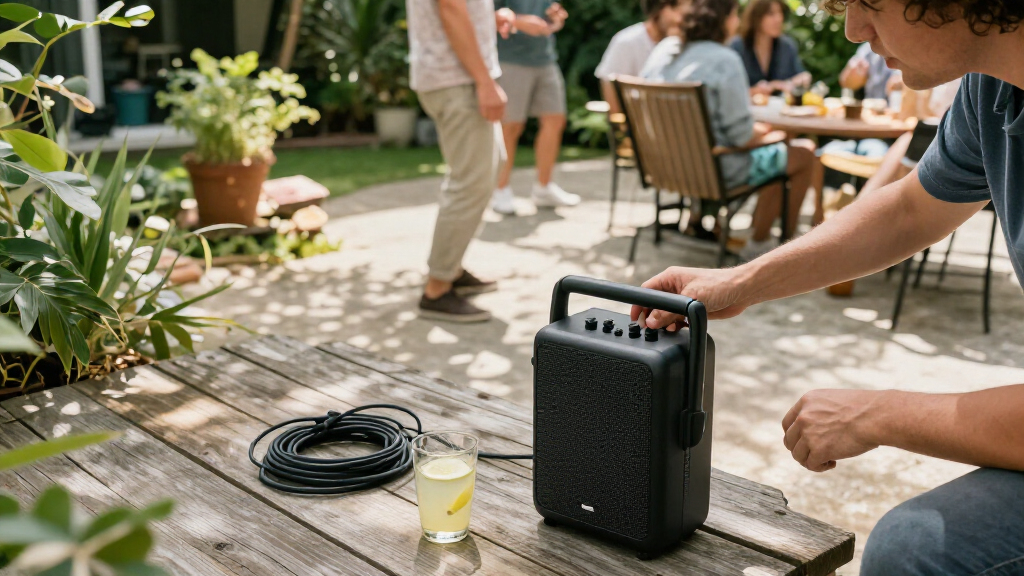
For most home events, I’d start with the Yamaha STAGEPAS 600BT: its mixer-based design suits hosts who need flexible inputs and control for speech and music. The Fender Passport Event S2 is a more self-contained choice, while the Pyle PWMA230BT fits smaller gatherings where a rechargeable battery matters. The main tradeoff is between a tidy, easy-to-carry speaker and a larger system with more input control or coverage. I compare all 13 options by setup, sound system format, portability, and fit for home use below.

Get audio and creator gear delivered free with Prime
- Fast, free delivery on millions of items
- Prime Video, Amazon Music and more included
- Member-only deals all year
Complete the kit

Key Takeaways
- The Yamaha STAGEPAS 600BT stands out for buyers who want a mixer-led setup; it offers a different kind of control from the single-speaker Pyle options.
- The Fender Passport Event S2 favors a contained, carry-friendly package, while separate speaker-and-mixer kits ask the host to manage more pieces.
- Pyle’s lineup spans very different event needs: rechargeable battery models suit locations without convenient power, while dual-speaker kits are better suited to flexible placement.
- A larger woofer or high wattage claim does not by itself settle the choice; for a home event, input needs, room size, and how much gear you want to set up matter just as much.
- The PRORECK CLUB 6000 and Party 15 are aimed at buyers willing to accommodate a larger system, while compact portable models make more sense when storage and quick setup lead.
| NBVOICE Portable 300W PA System with 8-Channel Mixer, Bluetooth, Microphone and Speaker Stands |  | Best for Multi-Mic Home Events | Power output: 300 watts | Speakers: Two 8-inch two-way speakers | Mixer: Detachable, self-powered 8-channel mixer | VIEW LATEST PRICE | See Our Full Breakdown |
| Pyle PPHP849KT Dual 8-Inch Active/Passive PA Speaker System with Bluetooth, Microphone, and Stands |  | Best for Simple Two-Speaker Coverage | Speaker configuration: One active and one passive speaker | Woofer size: 8 inches per speaker | Maximum power output: 700 watts | VIEW LATEST PRICE | See Our Full Breakdown |
| Yamaha STAGEPAS 600BT Portable PA System with Bluetooth |  | Best Premium Mixer Flexibility | Model: STAGEPAS 600BT | Output wattage: 680 watts | Mixer: Detachable 10-channel mixer | VIEW LATEST PRICE | See Our Full Breakdown |
| Pyle PSBT125A 1200W Portable Bluetooth PA Speaker with Wireless Microphone |  | Best for Battery-Powered Home Parties | Output wattage: 1200 watts | Speaker components: 12-inch subwoofer and 3-inch tweeter | Frequency response: 55 Hz–20 kHz | VIEW LATEST PRICE | See Our Full Breakdown |
| Pyle PSBT105A Portable Bluetooth PA Speaker with 10-Inch Subwoofer |  | Best Compact Rechargeable Pick | Power output: 1000 watts | Speaker components: 10-inch subwoofer and 3-inch tweeter | Connectivity: Bluetooth, USB, SD card, and 3.5 mm AUX | VIEW LATEST PRICE | See Our Full Breakdown |
| Pyle 8-Channel Bluetooth PA System with Dual 8-Inch Speakers and Microphone |  | Best for Multiple Audio Sources | Channels: 8 | Speakers: Two 8-inch full-range speakers with 1-inch tweeters | Power output: 300 watts | VIEW LATEST PRICE | See Our Full Breakdown |
| Pyle PPHP1049KT 10-Inch Bluetooth PA Speaker Kit with Stands and Microphone |  | Best for Easy, Elevated Setup | Speaker configuration: One active and one passive 10-inch speaker | Power: 500 W RMS; 1000 W peak | Bluetooth: Version 4.0; stated range of 100+ feet | VIEW LATEST PRICE | See Our Full Breakdown |
| Fender Passport Event S2 Portable PA System Bundle |  | Best for Fast, Organized Setup | Power output: 375 watts RMS | Mixer channels: 7 | Speakers: Two 8-inch speakers with 1.2-inch horn-loaded tweeters | VIEW LATEST PRICE | See Our Full Breakdown |
| PRORECK CLUB 6000 PA Speaker System with Bluetooth |  | Best for Bass-Heavy, Larger Home Events | System components: One active subwoofer, one passive subwoofer, four 6-inch line array speakers | Peak power: 6,000 watts | Frequency response: 50 Hz–20 kHz | VIEW LATEST PRICE | See Our Full Breakdown |
| PRORECK Party 12 12-Inch Powered PA Speaker System with Bluetooth, USB, SD, FM Radio, Remote, and Stands |  | Best for Big-Speaker Party Playback | System type: Two-way active and passive PA speaker set | Peak power: 1,800 watts | Woofer and tweeter: 12-inch woofer and 1-inch tweeter | VIEW LATEST PRICE | See Our Full Breakdown |
| PRORECK Party 15 Portable 15-Inch Powered PA Speaker System with Bluetooth |  | Best for Larger Home Gatherings | Speaker configuration: Active and passive 2-way speakers | Woofer size: 15 inches | Power: 200 W RMS; 2000 W P.M.P.O. | VIEW LATEST PRICE | See Our Full Breakdown |
| Pyle PWMA230BT Portable Bluetooth PA Speaker System with Rechargeable Battery and Microphone |  | Best for Karaoke and Flexible Inputs | Power: 200 W RMS; 400 W peak | Speaker: 8-inch full-range speaker | Microphone inputs: 2 x 1/4-inch | VIEW LATEST PRICE | See Our Full Breakdown |
| Pyle Portable Bluetooth PA Speaker System – Indoor Outdoor Karaoke Sound System w/Wireless Mic, Audio Recording, Rechargeable Battery, USB/SD Reader, Stand Mount, for Party, Crowd Control – Pyle |  | Best Compact Pick for Small Home Events | Power: 600 W listed | Speaker configuration: 6.5-inch subwoofer and 3-inch treble speaker | Bluetooth: Bluetooth 3.0; range up to 33+ feet | VIEW LATEST PRICE | See Our Full Breakdown |
| portable PA systems for home event | Weight | Connectivity |
|---|---|---|
| NBVOICE Portable 300W PA Syste | 44 pounds | — |
| Pyle PPHP849KT Dual 8-Inch Act | 14.81 kg | Bluetooth, AUX, USB, SD, and XLR microphone input |
| Yamaha STAGEPAS 600BT Portable | — | Bluetooth |
| Pyle PSBT125A 1200W Portable B | — | — |
| Pyle PSBT105A Portable Bluetoo | 14.3 pounds | Bluetooth, USB, SD card, and 3.5 mm AUX |
| Pyle 8-Channel Bluetooth PA Sy | 44.8 pounds | Bluetooth, USB, SD, XLR, 1/4-inch, RCA, AUX |
| Pyle PPHP1049KT 10-Inch Blueto | — | — |
| Fender Passport Event S2 Porta | — | Bluetooth |
| PRORECK CLUB 6000 PA Speaker S | 55 pounds | Bluetooth 5.0, USB, SD, stereo RCA, 3.5 mm AUX, 6.35 mm and XLR combo inputs |
| PRORECK Party 12 12-Inch Power | 60 pounds | Bluetooth, USB, SD card, FM radio, RCA, XLR, 1/4-inch microphone input, Speakon output |
| PRORECK Party 15 Portable 15-I | 81.6 pounds | — |
| Pyle PWMA230BT Portable Blueto | — | — |
| Pyle Portable Bluetooth PA Spe | 7.7 pounds | — |
More Details on Our Top Picks
NBVOICE Portable 300W PA System with 8-Channel Mixer, Bluetooth, Microphone and Speaker Stands
For a family gathering with several speakers, singers, or instruments, I’d choose the NBVOICE’s detachable 8-channel mixer over the simpler controls on the Pyle PPHP849KT. Four combo inputs and four balanced TRS inputs give a host room to connect multiple sources, while the included two stands and wired microphone make it a ready-to-set-up pair of speakers. Bluetooth 5.3 adds convenient music playback between announcements or performances. Its suitcase-style layout and accessory compartment help keep the pieces together, but the 44-pound total weight is a real drawback when carrying it between rooms or up stairs. The mixer’s outputs are line-level, so unlike a system designed to expand with powered connections, it cannot power extra passive speakers. I’d pick it for varied home events, not future speaker expansion.
Pros:- Detachable 8-channel mixer accommodates several sound sources.
- Includes two foldable speaker stands, speaker cables, and a wired microphone.
- Bluetooth 5.3 supports wireless music playback.
- Suitcase-style design includes storage for accessories.
Cons:- At 44 pounds, the system can be cumbersome to move.
- Line-level mixer outputs cannot power additional passive speakers.
Best for: Hosts who need separate connections for several microphones, instruments, or playback sources at home.
Not ideal for: Buyers who regularly carry equipment up stairs or want to add passive speakers for a larger space.
- Power output:300 watts
- Speakers:Two 8-inch two-way speakers
- Mixer:Detachable, self-powered 8-channel mixer
- Bluetooth:Version 5.3
- Inputs:Combo 1/4-inch/XLR, balanced 1/4-inch TRS, RCA, 3.5 mm, USB, FM, and Bluetooth
- Included accessories:Two foldable stands, speaker cables, wired microphone, microphone cable, and remote
- Dimensions:22 × 12 × 22 inches
- Weight:44 pounds
Our verdict“Choose the NBVOICE when your home events need flexible multi-source mixing and a complete two-speaker setup, but skip it if easy carrying or expansion matters more.”
Pyle PPHP849KT Dual 8-Inch Active/Passive PA Speaker System with Bluetooth, Microphone, and Stands
The Pyle PPHP849KT suits a home host who wants sound from two positions without dealing with a separate mixer: one active speaker feeds its passive partner, and the kit includes stands and a microphone. Bluetooth, USB, and SD playback give you several ways to run background music, while the rear panel offers direct adjustments for microphone level, master volume, bass, and treble. Compared with the NBVOICE, this is a simpler, less mixer-focused setup; it has fewer listed connection options for handling multiple live sources. Its 700-watt figure is a maximum rating, not a promise of continuous output, and only one speaker is powered. That active/passive arrangement means the second cabinet depends on the first, so it is less flexible if you want independent powered speakers. I’d favor it for straightforward announcements and playlists rather than performances with several inputs.
Pros:- Includes an active speaker, passive partner, stands, and microphone.
- Plays audio through Bluetooth, USB, SD, or AUX.
- Rear controls provide direct microphone, master, bass, and treble adjustments.
- XLR microphone input supports a wired mic connection.
Cons:- Only one speaker is powered; the second relies on the active cabinet.
- The 700-watt output is listed as a maximum rating.
- Provides fewer mixing connections than the NBVOICE’s detachable 8-channel mixer.
Best for: Home hosts who want a two-speaker setup for announcements and music, with stands and a microphone included.
Not ideal for: Musicians or event hosts who need several independent inputs or two separately powered speakers.
- Speaker configuration:One active and one passive speaker
- Woofer size:8 inches per speaker
- Maximum power output:700 watts
- Frequency response:65 Hz–18 kHz
- Connectivity:Bluetooth, AUX, USB, SD, and XLR microphone input
- Controls:Master volume, microphone volume, treble, and bass
- Included accessories:Speaker stands, microphone, remote, and power cable
- Weight:14.81 kg
Our verdict“Pick the PPHP849KT for a ready-made, easy-to-operate speaker pair for basic home gatherings, not for multi-source mixing or independent speaker placement.”
Yamaha STAGEPAS 600BT Portable PA System with Bluetooth
When a home event includes several microphones, instruments, or playback sources, I’d put the Yamaha STAGEPAS 600BT ahead of the Pyle PPHP849KT: its detachable 10-channel mixer offers considerably more room to manage different inputs. Bluetooth makes it easy to add music from a phone, and the one-button Intelligent Feedback Suppressor is a practical help when microphones and speakers share a room. Yamaha also describes flexible PA and monitoring configurations, which can suit events that shift from speeches to performances. The tradeoff is a more involved, corded setup than a single rechargeable speaker such as the Pyle PSBT125A, and the listed weight of 0.27 g appears unreliable, so I wouldn’t use that figure to judge portability. It makes the most sense for hosts who value mixing control and feedback management over battery operation or minimal setup.
Pros:- Detachable 10-channel mixer supports a broad range of connected sources.
- Intelligent Feedback Suppressor uses one-button operation.
- Bluetooth enables wireless music playback.
- Flexible PA or monitoring configurations suit varied event formats.
Cons:- Requires corded electric power.
- The listed weight of 0.27 g appears inaccurate, making portability hard to judge from the supplied specs.
- More involved than a single rechargeable speaker such as the Pyle PSBT125A.
Best for: Hosts running home performances, presentations, or celebrations with multiple microphones and other audio sources.
Not ideal for: Buyers who need a battery-powered speaker, a single-cabinet setup, or a dependable listed weight for planning frequent transport.
- Model:STAGEPAS 600BT
- Output wattage:680 watts
- Mixer:Detachable 10-channel mixer
- Mixer inputs:4 mono/line and 6 mono/3 stereo line
- Speaker components:10-inch woofer and 1.4-inch compression-driver voice coil
- Connectivity:Bluetooth
- Power source:Corded electric
- Included components:Two 6 m speaker cables, 2 m power cord, cover panel, pads, cable ties, and ferrite cores
Our verdict“Choose the STAGEPAS 600BT for home events where mixer capacity and feedback control matter more than battery convenience or the simplest setup.”
Pyle PSBT125A 1200W Portable Bluetooth PA Speaker with Wireless Microphone
For a home party that may move between rooms or out to a patio, the Pyle PSBT125A has an advantage the corded NBVOICE and Yamaha STAGEPAS 600BT do not: a built-in rechargeable battery. Its 12-inch subwoofer and 3-inch tweeter pair with Bluetooth, USB, SD, and auxiliary playback, giving a host several ways to keep music running without a full mixer setup. The echo, bass, and treble controls and recording feature make it more adaptable for casual karaoke or rehearsal than a basic music speaker. But this is a single portable cabinet, not the two-speaker, multi-input arrangement offered by the NBVOICE. The supplied microphone requires two AA batteries, and USB/SD support tops out at 32 GB. I’d choose it for flexible placement and playback options, while skipping it for events that need several separately managed microphones or instruments.
Pros:- Rechargeable battery allows placement away from a wall outlet.
- 12-inch subwoofer and 3-inch tweeter support music and voice playback.
- Bluetooth, USB, SD, AUX, and RCA inputs provide varied playback options.
- Recording and echo, bass, and treble controls add karaoke and rehearsal flexibility.
Cons:- The included microphone requires two AA batteries, which are not included.
- USB and SD storage support is limited to 32 GB.
- Single-cabinet format offers less placement flexibility than the NBVOICE two-speaker kit.
Best for: Hosts who need a rechargeable PA speaker for music, casual karaoke, or announcements in different areas of a home.
Not ideal for: Event organizers who need a two-speaker stereo-style setup or a mixer with multiple independent microphone and instrument channels.
- Output wattage:1200 watts
- Speaker components:12-inch subwoofer and 3-inch tweeter
- Frequency response:55 Hz–20 kHz
- Bluetooth:Version 4.2; range up to 33+ feet
- Audio formats:MP3, WMA, and WAV
- USB/SD support:Up to 32 GB
- Inputs:1/4-inch microphone/guitar, RCA line, and 3.5 mm AUX
- Battery:Two 3.7 V, 2200 mAh rechargeable lithium-ion batteries
Our verdict“Choose the PSBT125A for battery-powered music and casual karaoke around the home, but look elsewhere for multi-channel mixing or two-speaker coverage.”
Pyle PSBT105A Portable Bluetooth PA Speaker with 10-Inch Subwoofer
The Pyle PSBT105A is the more compact battery-powered alternative to the PSBT125A: its 10-inch subwoofer cabinet is smaller than that model’s 12-inch design, making it a more manageable fit for a living room or a small home event. Bluetooth, USB, SD, and AUX playback cover everyday music sources, while recording and echo, bass, and treble controls give karaoke and spoken audio some added flexibility. At 14.3 pounds, it is a single speaker rather than a two-cabinet kit like the Yamaha STAGEPAS 600BT, so it is easier to position but offers less separation across a room. The listed Bluetooth range is up to 33 feet, and the specs don’t state a battery runtime, so I wouldn’t choose it for a long event without a plan for power. It’s a better fit for modest gatherings than for broad coverage or multi-mic setups.
Pros:- Rechargeable battery supports use away from a power outlet.
- At 14.3 pounds, it is lighter than many two-speaker PA kits.
- Bluetooth, USB, SD, and AUX cover common music sources.
- Recording, echo, bass, and treble controls add basic performance flexibility.
Cons:- Bluetooth range is limited to up to 33 feet.
- Single-speaker format provides less room coverage flexibility than the Yamaha STAGEPAS 600BT pair.
- The supplied specs do not state battery runtime.
Best for: People who want a relatively light, rechargeable speaker for small home gatherings, background music, or casual karaoke.
Not ideal for: Hosts needing broad two-speaker coverage, multiple independent microphone inputs, or a specified battery runtime for long events.
- Power output:1000 watts
- Speaker components:10-inch subwoofer and 3-inch tweeter
- Connectivity:Bluetooth, USB, SD card, and 3.5 mm AUX
- Bluetooth range:Up to 33 feet
- Battery:Rechargeable
- Channels:2
- Dimensions:12.4 × 10.2 × 19.5 inches
- Weight:14.3 pounds
Our verdict“Pick the PSBT105A for a compact, rechargeable speaker at smaller home events, but choose a two-speaker system when coverage and room placement matter more.”
Pyle 8-Channel Bluetooth PA System with Dual 8-Inch Speakers and Microphone
For home events where several people or devices need to connect, this Pyle kit’s eight-channel mixer is its main advantage. It pairs two 8-inch speakers with Bluetooth, USB, SD, XLR, 1/4-inch, and RCA connections, so a host can combine music playback, microphones, and other audio gear without relying on a single input. Compared with the Fender Passport Event S2, it offers one more mixer channel and more playback formats, while Fender has a more transport-focused suitcase-style design. The tradeoff is the Pyle’s 44.8-pound bundle, which includes separate speakers, stands, and cables to manage. Its stands also adjust only to 48 inches, limiting placement flexibility. I’d choose it for a stationary home setup with varied sources, not for frequent room-to-room moves.
Pros:- Eight mixer channels accommodate multiple audio sources.
- Bluetooth, USB, SD, XLR, 1/4-inch, RCA, and AUX provide varied connection options.
- Includes two speakers, a wired microphone, tripod stands, and connection cables.
- Separate speakers allow left-right placement around a gathering.
Cons:- The 44.8-pound bundle can be cumbersome to move and store.
- Included stands adjust only up to 48 inches.
- Corded electric operation requires access to mains power.
Best for: Hosts who want to connect several microphones, instruments, and playback devices for home parties or presentations.
Not ideal for: People who need a lightweight system to carry between rooms or want taller speaker stands.
- Channels:8
- Speakers:Two 8-inch full-range speakers with 1-inch tweeters
- Power output:300 watts
- Connectivity:Bluetooth, USB, SD, XLR, 1/4-inch, RCA, AUX
- Power source:Corded electric
- Weight:44.8 pounds
- Included components:Mixer, two speakers, wired microphone, two tripod stands, two 1/4-inch audio cables, power cable
- Warranty:1-year limited
Our verdict“Choose this Pyle if your home events need many connected sources and the system can stay mostly in one place.”
Pyle PPHP1049KT 10-Inch Bluetooth PA Speaker Kit with Stands and Microphone
The PPHP1049KT suits home hosts who want a straightforward two-speaker kit with tall adjustable stands and familiar playback options. Its active and passive 10-inch speakers, wired microphone, remote, Bluetooth, USB, and SD playback cover common party and announcement needs without the eight-channel mixer complexity of the Pyle 8-Channel Bluetooth PA System. The stands reach 82.7 inches, giving hosts more placement height than that Pyle bundle’s stands, which top out at 48 inches. On the other hand, this model’s stated inputs and controls are more modest: it offers microphone and AUX connections with master, microphone, treble, and bass adjustments rather than a broad set of mixer channels. Bluetooth 4.0 and a 32 GB USB/SD limit also put a ceiling on its playback flexibility. I’d favor it for simple home events, not elaborate multi-source setups.
Pros:- Includes one active and one passive speaker, two stands, a wired microphone, and a remote.
- Stand height adjusts from 59.1 to 82.7 inches.
- Bluetooth, USB, SD, AUX, and microphone inputs cover common home-event sources.
- LCD and dedicated controls allow adjustment of master volume, microphone volume, treble, and bass.
Cons:- USB and SD playback supports a maximum capacity of 32 GB.
- Bluetooth 4.0 is an older connection standard.
- Its input selection is less suited to complex setups than the Pyle 8-Channel PA.
Best for: Home party hosts who want a pair of speakers, tall stands, a wired microphone, and simple playback controls in one kit.
Not ideal for: Musicians or event hosts who need several mixer channels, extensive professional connections, or playback from larger USB and SD storage.
- Speaker configuration:One active and one passive 10-inch speaker
- Power:500 W RMS; 1000 W peak
- Bluetooth:Version 4.0; stated range of 100+ feet
- Inputs:USB, SD, 3.5 mm AUX, 1/4-inch SpeakOn, XLR microphone
- Supported audio formats:MP3, WMA
- Maximum USB/SD capacity:32 GB
- Stand height:59.1–82.7 inches
- Included accessories:Two stands, wired microphone, remote control, power cable
Our verdict“Pick the PPHP1049KT for a ready-to-set-up home party kit with tall stands and straightforward controls, rather than a multi-source mixer.”
Fender Passport Event S2 Portable PA System Bundle
The Fender Passport Event S2 is the clearest fit for hosts who value a portable, integrated setup over a long list of playback formats. Its seven-channel mixer combines mic/line inputs, an instrument input, stereo AUX, and Bluetooth, while the suitcase-style design and included stands, microphone kit, and instrument cable help keep a home event’s essentials together. Compared with the Pyle 8-Channel Bluetooth PA System, Fender has one fewer channel but a design aimed more directly at transport and quick setup; Pyle offers USB and SD playback plus a wider selection of listed connections. The Fender’s 375 watts RMS and dual 8-inch speakers are suited to small and medium gatherings, not large spaces. It also needs mains power, so it won’t serve a patio or room without an outlet. I’d choose it for convenient home events with microphones or an instrument.
Pros:- Suitcase-style design supports transport and a more organized setup.
- Seven-channel mixer includes mic/line, instrument, stereo AUX, and Bluetooth sources.
- Bundle includes speaker stands, microphone accessories, and an instrument cable.
- Dual 8-inch speakers and horn-loaded tweeters suit small to medium home events.
Cons:- Corded electric operation requires access to mains power.
- Designed for small to medium venues rather than large spaces.
- Does not list USB or SD playback, unlike the Pyle 8-Channel PA.
Best for: Hosts and casual performers who want an organized, portable system for small to medium home gatherings, with mic, instrument, and Bluetooth sources.
Not ideal for: People needing battery operation, USB or SD playback, or sound coverage for a large event space.
- Power output:375 watts RMS
- Mixer channels:7
- Speakers:Two 8-inch speakers with 1.2-inch horn-loaded tweeters
- Inputs:Four XLR/1/4-inch combo mic/line inputs, hi-Z instrument input, stereo AUX
- Connectivity:Bluetooth
- Power source:Corded electric
- Included accessories:Microphone kit, speaker stands, instrument cable
- Warranty:2-year limited pro audio warranty
Our verdict“Choose the Fender Passport Event S2 if a portable, organized setup for a modest home event matters more than USB/SD playback or extra mixer channels.”
PRORECK CLUB 6000 PA Speaker System with Bluetooth
For a home event where music needs more low-end presence, the CLUB 6000’s dual subwoofers and four-speaker line array set it apart from the simpler two-speaker Pyle and Fender bundles. Its six-channel system includes two microphone inputs, Bluetooth 5.0, USB and SD playback, and several wired connections, giving hosts plenty of ways to handle music and announcements. The stated 6,000-watt figure is peak power, so it should not be read as continuous output; the more useful distinction here is the system’s larger, multi-piece layout. That layout can suit a bigger gathering better than the Fender Passport Event S2, but it also makes transport and setup less convenient. The 55-pound weight and three-package shipment add logistical friction. I’d pick this for a home event with space for a full array, not for a quick, compact setup.
Pros:- Two subwoofers and four 6-inch line array speakers create a larger system layout than the two-speaker options.
- Bluetooth 5.0, USB, and SD support several convenient music sources.
- Two microphone inputs and multiple wired input types support music and announcements.
- Built-in handles support moving the components, and the engineered-wood subwoofer enclosure is designed to reduce resonance.
Cons:- The 55-pound system has multiple components to assemble and transport.
- Ships in three separate packages, complicating delivery and setup planning.
- The stated 6,000-watt figure is peak power, not continuous output.
Best for: Hosts planning larger, music-focused home gatherings who have room to assemble and position a multi-component speaker array.
Not ideal for: People who need a compact, quick-to-carry PA or who want a simple all-in-one setup for a small room.
- System components:One active subwoofer, one passive subwoofer, four 6-inch line array speakers
- Peak power:6,000 watts
- Frequency response:50 Hz–20 kHz
- Channels:6
- Connectivity:Bluetooth 5.0, USB, SD, stereo RCA, 3.5 mm AUX, 6.35 mm and XLR combo inputs
- Microphone inputs:2-channel
- Weight:55 pounds
- Enclosure material:Engineered wood
Our verdict“Choose the CLUB 6000 for a space-conscious host who wants a multi-piece, bass-focused system for a larger home event and can accommodate its setup demands.”
PRORECK Party 12 12-Inch Powered PA Speaker System with Bluetooth, USB, SD, FM Radio, Remote, and Stands
The PRORECK Party 12 is the pick here for hosts who want a 12-inch woofer and several built-in ways to play music, including Bluetooth, USB, SD, and FM radio. Its active-and-passive speaker pair, wired microphone, remote, and stands make it a more ready-made party bundle than a single-speaker setup. Compared with the Fender Passport Event S2, it trades Fender’s suitcase-style portability and seven-channel mixer for a larger woofer and more standalone playback options. The Party 12 also lists XLR, RCA, and 1/4-inch microphone connections, though its stated controls are focused on master and mic volume, treble, and bass rather than a full multi-channel mixer. At 60 pounds and requiring corded power, it is better suited to a fixed home event space than frequent carrying. The built-in wheels help with movement, but do not remove the lifting burden.
Pros:- 12-inch woofer, 1-inch tweeter, and titanium diaphragm compression driver form a larger speaker setup than the 8-inch Fender bundle.
- Bluetooth, USB, SD card, and FM radio provide several music playback choices.
- Includes two stands, a wired microphone, a remote, and a power cord.
- Built-in transport wheels help move the 60-pound system across a level floor.
Cons:- At 60 pounds, lifting and carrying the system can be difficult.
- Corded electric operation limits placement to areas with mains power.
- Its playback-oriented controls are less suited to complex mixing than the Pyle 8-Channel PA.
Best for: Hosts who want a two-speaker party system with a larger woofer, multiple music playback options, and a wired microphone.
Not ideal for: People who need a lightweight PA to carry often, battery-powered operation, or a mixer for many simultaneous sources.
- System type:Two-way active and passive PA speaker set
- Peak power:1,800 watts
- Woofer and tweeter:12-inch woofer and 1-inch tweeter
- Driver:Titanium diaphragm compression driver
- Connectivity:Bluetooth, USB, SD card, FM radio, RCA, XLR, 1/4-inch microphone input, Speakon output
- Audio controls:Master volume, microphone volume, treble, bass
- Weight:60 pounds
- Included accessories:Two stands, remote control, wired microphone, power cord
Our verdict“Pick the Party 12 for a mostly stationary home party setup that prioritizes a larger woofer and flexible music playback over easy carrying or advanced mixing.”
PRORECK Party 15 Portable 15-Inch Powered PA Speaker System with Bluetooth
For a home event where filling a large room matters more than easy storage, the PRORECK Party 15 offers a bigger two-speaker setup than the compact Pyle PWMA230BT. Its 15-inch woofer, active and passive speakers, and included stands suit dance parties or announcements for a sizable group. Bluetooth is joined by FM radio, USB, and SD playback, giving hosts several ways to play music without relying on a phone. The wired microphone and remote add useful event controls, while the equalizer and display make playback adjustments more direct.
The tradeoff is substantial: the complete system weighs 81.6 pounds, so wheels and handles help but do not make it a light carry. It also needs power and is not water resistant. Choose it over the smaller Pyle when room-filling coverage and a paired-speaker setup take priority; skip it if frequent moving or compact storage matters more.
Pros:- Active and passive 15-inch speakers provide a larger setup than compact single-speaker options.
- Includes two stands, a wired microphone, cables, and remote.
- Bluetooth, FM, USB, and SD playback give hosts multiple music sources.
- Handles and transport wheels help move the 81.6-pound system.
Cons:- At 81.6 pounds, it remains cumbersome to lift and store despite its wheels.
- Not water resistant, limiting use in wet or exposed outdoor settings.
- Requires a power connection, unlike the rechargeable Pyle PWMA230BT and Pyle portable karaoke model.
Best for: Hosts running indoor parties or family events in larger rooms who want two speakers, stands, and several built-in playback options.
Not ideal for: People who need a lightweight, battery-powered system for quick room changes or outdoor events where the speaker could get wet.
- Speaker configuration:Active and passive 2-way speakers
- Woofer size:15 inches
- Power:200 W RMS; 2000 W P.M.P.O.
- Playback:Bluetooth, FM radio, USB, SD card
- Inputs and outputs:1/4-inch mic, RCA line input and output, Speakon output
- Dimensions:19 x 30 x 29 inches
- Weight:81.6 pounds
- Included:Active speaker, passive speaker, two stands, wired microphone, Speakon cable, power cable, remote
Our verdict“Choose the Party 15 for larger indoor home events where two speakers and broad playback options matter more than light weight or battery operation.”
Pyle PWMA230BT Portable Bluetooth PA Speaker System with Rechargeable Battery and Microphone
The Pyle PWMA230BT is a practical fit for home karaoke, speeches, and small gatherings where guests may bring instruments as well as phones. Its two microphone inputs and two instrument inputs give it more direct connection flexibility than the PRORECK Party 15, while the included wireless mic keeps a host free to move around. Front-panel controls for bass, treble, echo, and channel volume let you adjust the sound without adding a mixer.
Its rechargeable battery, telescoping handle, and caster wheels make moving it between rooms easier than hauling the 81.6-pound PRORECK. The compromise is an 8-inch full-range speaker, which is a smaller, more compact format than that two-speaker system. Battery life is listed at up to 10 hours, but charging takes about 8–10 hours, so it suits planned events better than quick back-to-back use. The wireless microphone also needs two AA batteries.
Pros:- Wireless microphone is included, with two microphone inputs for additional vocal connections.
- Two instrument inputs support small home performances without relying on a separate mixer.
- Rechargeable battery, caster wheels, and telescoping handle support room-to-room portability.
- Bass, treble, echo, and channel-volume controls are accessible on the front panel.
Cons:- The 8-inch speaker is a more compact format than the PRORECK Party 15’s two-speaker, 15-inch-woofer setup.
- Charging takes approximately 8–10 hours.
- The included wireless microphone requires two AA batteries.
Best for: Karaoke hosts and families who want a rolling, rechargeable speaker with a wireless mic and separate connections for microphones and instruments.
Not ideal for: Hosts who need a large two-speaker setup for a spacious room or who cannot plan around the long battery charging time.
- Power:200 W RMS; 400 W peak
- Speaker:8-inch full-range speaker
- Microphone inputs:2 x 1/4-inch
- Instrument inputs:2 x 1/4-inch
- Included microphone:Wireless dynamic microphone
- Battery:12 V, 7 Ah lead-acid rechargeable
- Battery life:Up to 10 hours
- Dimensions:14.7 x 10.6 x 11.2 inches
Our verdict“Pick the PWMA230BT for mobile home karaoke or small performances when battery operation and multiple mic and instrument inputs matter more than a larger speaker setup.”
Pyle Portable Bluetooth PA Speaker System – Indoor Outdoor Karaoke Sound System w/Wireless Mic, Audio Recording, Rechargeable Battery, USB/SD Reader, Stand Mount, for Party, Crowd Control – Pyle
For a smaller home event where easy carrying and simple karaoke features matter more than broad room coverage, this compact Pyle PA speaker is the lightest and smallest option among these three: listed at 7.7 pounds and about 10.6 x 9 x 13 inches. It pairs Bluetooth streaming with USB and microSD playback, and its recording function can save streamed audio or vocals to a card or flash drive. That makes it more useful for capturing a casual singing session than the Pyle PWMA230BT, which instead offers more microphone and instrument inputs.
The included wireless microphone and rechargeable battery support a casual party setup without a separate mixer, but the 6.5-inch subwoofer and 3-inch tweeter are aimed at a more compact system than the PRORECK Party 15’s paired speakers. Its battery is specified as 4400 mAh, but no run time is provided, so I would not choose it for a long event without a power plan. The speaker stand is not included, and the microphone needs two AA batteries.
Pros:- Compact 7.7-pound design is easier to carry and store than the Pyle PWMA230BT or PRORECK Party 15.
- Records streamed audio or microphone vocals to USB or microSD storage.
- Bluetooth, USB, microSD, and AUX provide several playback choices.
- Includes a wireless microphone and has a 35 mm stand mount.
Cons:- The 6.5-inch subwoofer and 3-inch tweeter make it a smaller-scale choice than the PRORECK Party 15.
- Battery capacity is listed, but battery run time is not provided.
- Speaker stand is not included, and the wireless microphone requires two AA batteries.
Best for: Apartment hosts, small-family gatherings, and casual karaoke users who value a lightweight speaker with recording and USB or microSD playback.
Not ideal for: Hosts expecting strong coverage across a large room, needing a stand in the box, or requiring a stated battery run time for a long event.
- Power:600 W listed
- Speaker configuration:6.5-inch subwoofer and 3-inch treble speaker
- Bluetooth:Bluetooth 3.0; range up to 33+ feet
- Playback:Bluetooth, USB, microSD, 3.5 mm AUX
- Recording:Records streamed audio or microphone vocals to USB or SD as MP3
- Battery:4400 mAh, 3.7 V lithium rechargeable
- Dimensions:10.6 x 9 x 13 inches
- Weight:7.7 pounds
Our verdict“Choose this Pyle for compact, casual home karaoke and recording, but favor a larger system when your gathering needs broader sound coverage.”
How We Picked
I compared these systems through the needs of home events: clear speech, music playback, practical input options, setup effort, portability, and how much equipment a host must store and connect. I also weighed whether each format fits a small living room, a larger gathering, or an event that may move outside. A mixer-based system can offer more control, but it may take more time and space than a self-contained speaker.
The ranking favors systems that appear to balance useful event control with manageable setup and portability, rather than treating wattage or speaker size as a shortcut for quality. The Yamaha STAGEPAS 600BT and Fender Passport Event S2 lead for their more complete event-oriented formats; battery-powered Pyle choices earn attention for location flexibility. Larger PRORECK systems and simpler single-speaker kits serve narrower needs, so I place them according to their likely fit rather than treating them as interchangeable. Product names and listed features provide the basis for comparison; I do not assume unlisted runtime, coverage, or sound performance.
| portable PA systems for home event | Connectivity |
|---|---|
| NBVOICE Portable 300W PA Syste | — |
| Pyle PPHP849KT Dual 8-Inch Act | Bluetooth, AUX, USB, SD, and XLR microphone input |
| Yamaha STAGEPAS 600BT Portable | Bluetooth |
| Pyle PSBT125A 1200W Portable B | — |
| Pyle PSBT105A Portable Bluetoo | Bluetooth, USB, SD card, and 3.5 mm AUX |
| Pyle 8-Channel Bluetooth PA Sy | Bluetooth, USB, SD, XLR, 1/4-inch, RCA, AUX |
| Pyle PPHP1049KT 10-Inch Blueto | — |
| Fender Passport Event S2 Porta | Bluetooth |
| PRORECK CLUB 6000 PA Speaker S | Bluetooth 5.0, USB, SD, stereo RCA, 3.5 mm AUX, 6.35 mm and XLR combo inputs |
| PRORECK Party 12 12-Inch Power | Bluetooth, USB, SD card, FM radio, RCA, XLR, 1/4-inch microphone input, Speakon output |
| PRORECK Party 15 Portable 15-I | — |
| Pyle PWMA230BT Portable Blueto | — |
| Pyle Portable Bluetooth PA Spe | — |
Factors to Consider When Choosing Portable PA Systems For Home Events
Before choosing, I’d plan the event around the room and the person running the sound, not just the speaker. A home PA has to be easy to place, connect, and put away, and its best configuration depends on whether speech, playlists, karaoke, or several microphones will lead the event.
Match the system format to your event
A single powered speaker keeps the setup simple, but it may leave you with fewer ways to position sound or connect several sources. A kit with two speakers can spread sound across a wider room, though it adds stands, cables, and more setup steps. Mixer-based systems give a host more control over microphones and playback, but that control is useful only if someone is comfortable managing the settings. A common mistake is choosing a multi-piece kit for a small gathering where nobody wants to run the mixer. For casual speech and a playlist, simplicity can matter more than the number of inputs.
Plan for the room and the audience
Room layout changes what “enough sound” means: a speaker facing a small seated group has a different job from one covering a long room or a patio. Think about where guests will stand, whether furniture blocks the speaker, and whether sound must reach more than one area. Avoid assuming that a larger speaker or a wattage figure alone guarantees better coverage; placement and the system design also affect how evenly sound reaches listeners. If speech is central, intelligibility matters more than pushing music volume. For a mixed indoor-outdoor event, plan for the outdoor location to need more coverage than a compact living room.
Count inputs before buying
Write down every source you expect to use: microphones, a phone, a keyboard, or a karaoke player. Then check that the system has suitable connections and a way to manage those sources together. Bluetooth is convenient for playing music, but it does not replace microphone inputs or mixer controls. Hosts often focus on wireless playback and discover too late that their planned microphone setup needs a different connection. If multiple people will speak or perform, input flexibility can justify accepting a larger system. If the event is just one mic and background music, a simpler arrangement may be easier to run.
Decide whether battery power is worth the tradeoff
A rechargeable speaker can make placement easier when a suitable power outlet is not nearby, including some patios and temporary event spaces. Battery operation also adds a planning question: check the manufacturer’s stated runtime for the conditions you expect, and have a power plan if the event runs long. Do not assume every product described as portable has a rechargeable battery; portability can mean a carryable enclosure rather than cordless operation. For events close to household power, a corded system may avoid battery-runtime uncertainty. Choose battery power for location flexibility, not simply because it sounds like an extra feature.
Budget space and setup time, not just transport
Portability includes how many pieces you carry, where they live between events, and how long it takes to connect them. Stands can help place speakers above a crowd, but they need storage and room to set up safely. A compact all-in-one model is easier to store, while a speaker-and-mixer kit can offer more control at the cost of extra hardware. Before choosing a larger system, measure the storage spot and consider whether one person will be moving it. For occasional home parties, a system that is quick to unpack may get more use than a more elaborate setup.
Pay for the capability you will use
Extra inputs, paired speakers, recording features, and larger enclosures can be worthwhile when an event plan calls for them. They add little value if the system will mostly play a phone playlist for a small group. Compare what each feature changes in practice: more control can help a host balance speech and music, while a battery can change where the event can happen. Do not treat bundled microphones or stands as a guarantee that the setup suits every room; check the intended use and compatibility details. I’d spend more for a clear need, such as several simultaneous sources or cordless placement, rather than for a longer feature list.
Frequently Asked Questions
Is a mixer-based PA system worth it for a typical home party?
It can be, if your event uses more than one microphone or audio source and someone can manage the controls. A mixer lets you handle sources together, which is more useful for speeches, karaoke, or small performances than for a single playlist. For music from a phone and occasional announcements, a self-contained speaker may be quicker to set up. Think about who will operate it before choosing extra controls. If no one wants that job, simpler often works better.
Should I choose one speaker or a two-speaker kit for a home event?
One speaker is often easier to place and store, especially for a small room where guests are gathered in one area. A two-speaker setup can help distribute sound across a wider space, but adds stands and connections to manage. Consider the room shape and where listeners will be, rather than choosing by speaker count alone. If the event moves between rooms, the simpler system may be easier to use. For a long room or separated listening areas, paired speakers may better suit the layout.
When does a rechargeable PA make sense for home events?
Battery power is useful when you want to place a speaker away from an outlet or host in a spot where running a cord is inconvenient. It can also reduce cable clutter in some setups. Check the stated runtime against your event length and the way you plan to use the system, since runtime can vary with operating conditions. Keep a backup power option in mind for longer gatherings. If the speaker will stay near an outlet, a corded model may be the simpler choice.
Can I use a portable PA system for both karaoke and speeches?
Many of the systems in this roundup include a microphone or microphone-oriented features, but the right fit depends on how many sources you need at once. Check the input layout and controls before assuming a bundled mic will cover your karaoke setup. Speech needs clear, manageable microphone sound, while karaoke may involve a microphone and separate music playback together. A mixer-based model can make source management easier when several inputs are involved. For occasional announcements and one music source, a simpler speaker may be sufficient.
How much should I prioritize speaker size or listed wattage?
Use those specifications as part of the comparison, not as a complete measure of suitability. A larger enclosure may suit buyers seeking a more substantial setup, but it also takes more room to move and store. Listed wattage alone does not tell you how well sound will carry through your particular room or how clear speech will be. Think first about audience size, room layout, and whether music or spoken announcements matter most. Then compare the system’s inputs, portability, and placement options alongside its size and power claims.
Conclusion
For the broadest mix of event control and a portable format, I’d choose the Yamaha STAGEPAS 600BT as best overall. The Fender Passport Event S2 is my pick for buyers who value a contained, straightforward package, while the rechargeable Pyle PWMA230BT best suits gatherings where access to power shapes speaker placement. For beginners, I’d favor a simpler all-in-one option over a mixer-heavy setup unless they already know they need several inputs. Choose the PRORECK CLUB 6000 or Party 15 only if a larger system fits your space and event plans; for most home hosts, an easy-to-place system with the right connections is a better match than size alone.