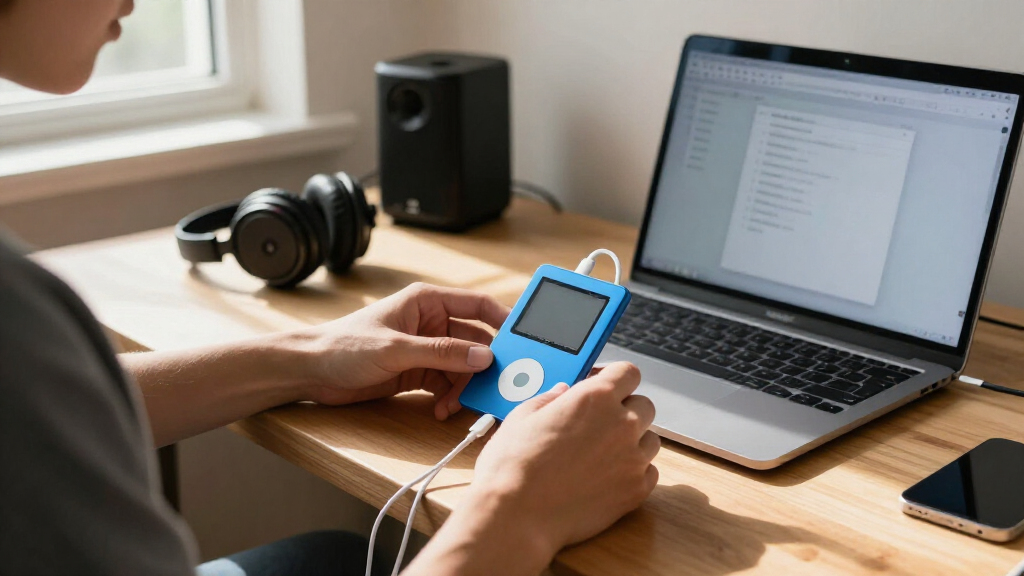

TL;DR
A developer says they built a boot chain that starts Rockbox from an iPod Nano 5G’s NAND storage without a computer or button sequence after installation. The method adapts an earlier font-based exploit and bypasses a resource-signature check using a device-specific private record. The report describes the technique and its limits, but does not establish that it is a supported or risk-free installation process.
A developer has reported a fully untethered Rockbox boot for the iPod Nano 5G, allowing the alternative music-player software to load from the device’s NAND storage without a computer or button sequence after installation. The approach adapts a font-based exploit and uses a firmware-validation bypass; the report describes a technical result, not an Apple-supported installation method.

Get audio and creator gear delivered free with Prime
- Fast, free delivery on millions of items
- Prime Video, Amazon Music and more included
- Member-only deals all year
The author says the work began with an unresolved question: whether ipod_sun, a font-based exploit previously demonstrated on the Nano 6G and 7G, could be adapted to the 5G. Existing DFU exploits, including wInd3x, already offered a way to run code on the 5G, the report says, but required connecting a computer each time the device was started. The author used wInd3x to inspect the player and develop a boot process that persists across restarts.
The reported method uses a malformed font to exploit CVE-2010-1797, a stack-overflow vulnerability in the FreeType CFF font parser. The author first describes an approach that swaps firmware-directory entries so the normal operating system starts under the disk-mode resource-validation policy. That path still requires the user to select disk mode with the device’s buttons, so it does not meet the author’s goal of an automatic normal boot.
The proposed second bypass targets the normal boot path. According to the report’s reverse-engineered account, a bootloader module checks a private NAND record called PRVD for a FirmwareStatus value. Setting bit 1 while leaving bit 0 clear makes the boot routine return before it checks the signature on the resource image that contains the font. The author says the record’s integrity tag is device-specific, meaning code execution on the individual player is needed to create and save a valid record. The article says the work concerns the latest Nano 5G firmware, version 1.0.2 (34A20020).
A Computer-Free Boot for Rockbox
For owners of an aging Nano 5G, the reported result could make Rockbox more convenient to use: after installation, the player can start the alternative firmware from its own storage rather than relying on a computer and a repeated DFU procedure. The author says the aim was to have an up-to-date music player that does not need an internet connection. Rockbox support also offers an alternative to the software and features Apple originally supplied, though the source does not detail which Rockbox functions were tested in this setup.
The report also matters to people studying device security because it describes how separate firmware checks interact: a resource-signature policy, a boot-state record in NAND, and a vulnerable font parser. Its findings suggest that a validation decision in the normal boot path can affect whether modified resources reach the parser. That is the author’s technical interpretation of the reverse-engineered code; the source does not include an independent security review.
This is not the same as a general-purpose, simple jailbreak guide. The method depends on a device-bound integrity tag and on first gaining code execution on the specific player. Incorrect changes to firmware or private NAND data could prevent a device from booting. The supplied excerpt does not provide enough information to assess installation risk, recovery options, or compatibility across different Nano 5G units.
Products Worth Considering

Samsung Odyssey G55C 32-Inch QHD 1000R Curved Gaming Monitor

LG UltraGear 27G640A-B 27-Inch QHD IPS Gaming Monitor, 300Hz, 1ms, G-SYNC Compatible, FreeSync Premium, DisplayHDR 400, HDMI 2.1, USB-C, Adj

Apple MacBook Air 15-inch Laptop with M5 Chip, 16GB Memory, 512GB SSD, and Liquid Retina Display (Midnight)
As an affiliate, we earn on qualifying purchases.
From DFU Exploits to Persistent Boot
The iPod Nano 5G stores firmware and user data on NAND flash, which the report says appears as a logical disk through a flash translation layer. Its partitions include a private area for persistent device state, a firmware partition, and a user-data volume. The font resources are stored in an rsrc image within the firmware directory.
Earlier ipod_sun work on the Nano 6G and 7G combined a resource-validation bypass with a vulnerable font parser. The author says the 5G’s disk-mode path could be used to skip the resource check, but it required manually selecting that mode on each restart. The new work is presented as a way to avoid that step by changing the state read by the normal boot process. The article also says the author found a way to make the existing exploit fully untethered on the Nano 7G, and likely the 6G, but provides no further confirmation in the supplied material.
“My motivation was simple: an up-to-date music player without an internet connection.”
— The developer, describing the goal of the project
Installation Risks and Device Support
The supplied report establishes that its author describes a working boot chain, but it does not identify the exact testing procedure, provide independent verification, or state how many devices were tested. It is also unclear whether the method works on Nano 5G firmware versions other than 1.0.2 (34A20020), or whether hardware differences affect the result.
The source excerpt does not provide a complete installation guide, a recovery procedure for a failed flash, or a detailed account of what happens if the private record is malformed. It also does not establish that the approach has been reviewed by Apple or by an independent security researcher. The author’s suggestion that Apple’s status value may avoid repeating signature checks to save boot time or energy is explicitly a hypothesis, not a confirmed explanation of Apple’s design.
Further Testing and Release Details
The source describes the technical approach and points to a video demonstration, but the material supplied here does not specify a release date, a public installation package, or plans for broader testing. The next useful confirmation would be reproducible testing by other Nano 5G owners and clear documentation of supported firmware, required setup, and recovery steps.
Until those details are available, readers should treat the result as a developer-reported exploit and boot-chain project rather than a routine modification. Any future guide or code release would need to clarify how the device-specific PRVD record is created and how users can restore a player if the process fails.
Key Questions
What does “untethered” mean in this report?
It means the author says the Nano 5G can start Rockbox from its own NAND storage after installation, without a computer or a special button sequence at each boot.
Does this work on every iPod Nano 5G?
The supplied material does not establish support across all units or firmware versions. The technical details refer to firmware 1.0.2 (34A20020), and the author says the PRVD integrity tag is device-specific.
Is this an official Apple method?
No. The source describes a developer’s reverse-engineered exploit and modified boot process. It does not describe an Apple-supported installation.
What exploit does the method use?
The report says a malformed font triggers CVE-2010-1797, a FreeType CFF parser stack-overflow vulnerability. A separate boot-policy bypass allows the modified font resource to be loaded on the normal boot path.
Is there enough information here to install it safely?
No complete installation or recovery instructions are included in the supplied source material. It does not explain how to recover from a failed modification, so the report alone should not be treated as a step-by-step guide.
Source: viktorkrapivin.com