
TL;DR

Get audio and creator gear delivered free with Prime
- Fast, free delivery on millions of items
- Prime Video, Amazon Music and more included
- Member-only deals all year
Mistral is betting on European sovereignty, open weights, and deployment flexibility to carve out a niche. While it emphasizes control, critics argue it may lag behind in reasoning and size, raising doubts about long-term competitiveness.
When a European AI startup talks about sovereignty, it’s not just about control — it’s about independence from the U.S. giants. But beneath that rallying cry lies a tough question: is Mistral playing a different game because it has a real edge, or because it’s already falling behind in the race for the most capable models?
At the recent AI Now Summit in Paris, Mistral’s shift from a model-focused lab to a full-stack provider caught attention. They’re not just building models anymore — they’re promising control, compliance, and enterprise-grade deployment. But with competitors pouring out technical breakthroughs, critics wonder if Mistral’s strategy is a smart move or a sign of weakness.
Different game, or already lost?
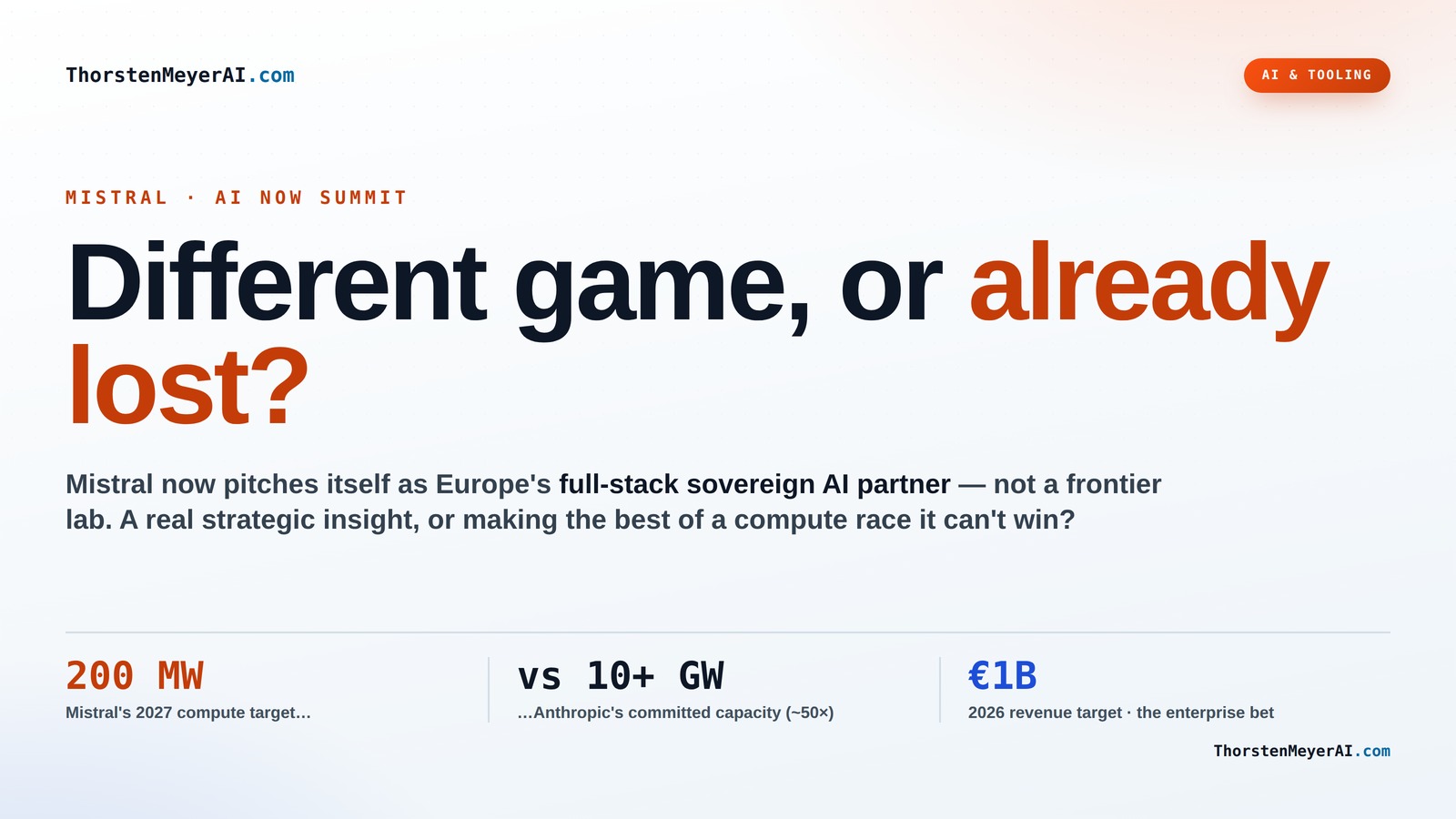
Mistral now pitches itself as Europe’s full-stack AI provider — compute, models, platform, consultancy — not a frontier-model lab. Is that a real strategic insight, or making the best of a race it can’t win? Both readings fit the same facts.
From model lab to full-stack provider
The clearest signal from the summit wasn’t a model — it was a posture. Heavy on enterprise logos and partnerships (ASML, BNP Paribas, Alexa+), light on new-model announcements. That absence is exactly what skeptics seized on.
Compute
40MW Paris DC + Sweden build · 200MW target by 2027
Models
Open & custom · efficient · you own and run them
Platform
Forge for custom models · Vibe for Work agent
Consultancy
Sales teams, integrators, EU provenance & support
Small & focused, or large & general?
Mistral bets on specialized small models. The claim isn’t that they win a reasoning leaderboard — they don’t. It’s that on the metrics that matter in production agent systems, a purpose-built small model wins. Flip the metric to see the case reverse.
Small specialized vs large general — by what you measure
In token-heavy agentic apps making hundreds of calls, speed/energy/cost compound. Toggle the metric.
Narrow models doing real work
Each is one model doing one thing efficiently — the tangible version of the strategy. Strong on their own terms; the open question is whether the bundle beats a free Chinese open-weight download.
On-prem KYC compliance
Mistral models run inside the bank’s walls for know-your-customer checks. Sensitive financial data never leaves. (BNP was Mistral’s first customer, 2023.)
Voxtral multilingual voice
A focused voice model powering Alexa+ across Europe — speed and efficiency over raw size.
Robostral industrial robotics
Plus a “physics AI” push (via the Emmi acquisition) into aerospace, automotive & semiconductor design and simulation.
Document AI / OCR at scale
Large-scale text extraction — the unglamorous, high-volume enterprise work small models excel at.
The strategy is downstream of the compute gap
Once you see the raw numbers, “why is Mistral behind?” answers itself — and the specialized-small-model strategy starts looking partly like a smart adaptation to a binding constraint, not a pure philosophical choice.
Compute & capital · Mistral vs a frontier leader, this same week
Not a knock — it’s the constraint that forces the efficiency-first, sovereignty-wedge strategy. Adapting intelligently to your position is what good strategy is.
“I want them to win, but I’m worried”
That ambivalence is the most accurate read of where Mistral sits. The enterprise pivot gets read two opposite ways — and both deserve airing.
On-prem, real sales teams, the Koyeb deployment acquisition, EU provenance — exactly what regulated enterprises want, and stickier than consumer mindshare. Targeting €1B revenue in 2026 with 1,000 staff, up from 15 people and one customer in 2023. US closed-API labs structurally can’t match the sovereignty axis.
“Software consultancy with a data center,” not a foundation-model moat. Enterprise B2B is where European startups go when they can’t win consumer or world-scale SaaS. Why pay Mistral on-prem when you could run Qwen free? One paying Le Chat Pro user said the quality gap with frontier labs is now hard to ignore.
Key Takeaways
- Mistral’s focus on sovereignty and open weights appeals to European enterprises and governments concerned with control and compliance.
- Its models prioritize deployment flexibility and efficiency over raw reasoning power, which may limit competitiveness in AI benchmarks.
- Control over model weights and data residency can be a real advantage in regulated markets, but may not be enough to outpace giants on innovation.
- Smaller, purpose-built models can outperform large ones in enterprise workflows by offering speed and cost benefits.
- The long-term success hinges on whether sovereignty remains a durable moat or just a niche advantage in a rapidly evolving AI landscape.
As an affiliate, we earn on qualifying purchases.
What Does ‘Sovereign’ Actually Mean for Mistral?
‘Sovereign’ in Mistral’s world isn’t just a buzzword — it’s a core selling point. It means European control, data residency, and the ability to run models on-premise, behind enterprise firewalls. Think of a German bank or a French government agency that refuses to send sensitive data to U.S. cloud giants.
This focus on local hosting and open weights means customers aren’t locked into a closed API. They get to own their models, fine-tune them, and keep control over their data, which is a huge deal in highly regulated markets.
For example, BNP Paribas running Mistral models on-prem for compliance shows how this plays out in real life — it’s about trust, control, and independence.
By emphasizing sovereignty, Mistral is effectively positioning itself as a partner for institutions wary of external dependencies and data sovereignty issues. This has significant implications: it may limit their immediate scalability compared to cloud giants but could foster deeper trust and loyalty in sensitive sectors. The tradeoff lies in balancing control with performance and innovation — a tightrope walk that could define their long-term relevance.

Is Mistral Really Competing on Model Quality, or Just Control?
Mistral’s core pitch isn’t about having the best reasoning models — it’s about control, customization, and deployment flexibility. Its models like Mistral 7B and Mixtral are open-weight, downloadable, and designed for self-hosting.
Compare that with OpenAI or Anthropic, which rely on API-only access and lack the ability to own or modify the weights. But here’s the catch: recent chatter suggests Mistral’s models might lag behind in reasoning and accuracy.
In fact, some critics say Mistral has “fallen far behind” in reasoning capability since late 2025, raising doubts if its open weights can match the performance of proprietary giants.
This gap in technical performance raises fundamental questions about the long-term viability of Mistral’s strategy. While control and customization are attractive, they come with the tradeoff of potentially sacrificing the cutting-edge reasoning and scale that define the current AI race. If Mistral cannot close this gap, its niche may become increasingly marginal, risking obsolescence in a landscape that prizes both control and capability.

How Important Is the Model’s Technical Performance Anyway?
Performance isn’t just about beating benchmarks — it’s about doing what you need in real-world workflows. Mistral argues that small, purpose-built models excel in speed, energy efficiency, and cost per token — critical for enterprise and edge deployment.
Take the European Patent Office’s Document AI — a narrow, fast model that extracts text at high speed and low cost. It’s not a giant reasoning model, but it gets the job done efficiently.
This focus on small models might seem like a tradeoff, but for many enterprise uses, it’s the smarter choice. The tradeoff involves sacrificing some reasoning depth for operational efficiency, which can be decisive when deploying at scale or in resource-constrained environments. However, this approach raises questions about whether Mistral can keep pace with larger models in tasks requiring complex inference or nuanced understanding. The implication is that Mistral’s strategy favors reliable, fast, and cost-effective deployment over pushing the boundaries of AI reasoning — a calculated risk that could limit their potential in more demanding applications.

Who Benefits Most From Mistral’s Strategy: Governments, Enterprises, or Developers?
Mistral’s focus on sovereignty and open weights appeals to a specific crowd: European enterprises and governments that want control over their AI stack. They value data privacy, compliance, and the ability to modify models without relying on a single provider.
Developers who want flexible, self-hosted models also find this appealing. But for the broader AI market, the question is whether this niche can sustain Mistral’s growth or if they’re simply avoiding the fierce scale competition.
In a sense, Mistral is betting that sovereignty and control are long-term advantages, especially as regulatory landscapes tighten in Europe. This strategy could carve out a resilient niche, but it risks becoming a shrinking one if the core technical performance gaps aren’t addressed. Their advantage hinges on whether the value of control outweighs the need for cutting-edge reasoning, especially as global competitors accelerate their innovation cycles.

Is Sovereignty a Long-Term Moat or Just a Niche?
Many see sovereignty as a strategic moat that shields Mistral from U.S.-dominated AI ecosystems. It’s about building a resilient, independent AI infrastructure that’s less vulnerable to geopolitical shifts. For more insights, see this analysis.
But critics argue that sovereignty might be a temporary advantage, especially if the quality gap widens or if open models improve faster. The real risk? Mistral could become a niche supplier, unable to compete on reasoning or scale.
On the flip side, as Europe’s regulations tighten and data control becomes non-negotiable, sovereignty could turn into a durable advantage — if Mistral keeps pace technically. The key implication is that sovereignty’s long-term value depends heavily on Mistral’s ability to innovate technically while maintaining control, which is a complex balancing act. If they fail to close the performance gap, sovereignty alone may no longer suffice to sustain competitive relevance in the broader AI landscape.
Frequently Asked Questions
Is Mistral competing on model quality or just control?
Mistral’s main strength isn’t in beating U.S. giants on reasoning or benchmark scores. It’s in offering control, customization, and deployment options that appeal to regulated markets and enterprises. However, recent performance gaps suggest it might be lagging behind in core AI capabilities.Can open-weight models really replace closed API giants?
Open weights give control and flexibility, but often at the cost of raw performance. For many enterprise uses, they work well enough — especially when speed, customization, and data residency matter more than cutting-edge reasoning. The question is whether open models can catch up in reasoning quality.Will sovereignty become a long-term advantage?
It depends. As regulations tighten and data control becomes non-negotiable, sovereignty could turn into a durable edge. But if technical performance continues to lag, Mistral risks becoming a specialized supplier rather than a market leader.Who are Mistral’s biggest customers?
European banks, governments, and large enterprises that prioritize control, compliance, and local deployment. They value the ability to own and fine-tune models, especially in sensitive or regulated industries.Is Mistral’s strategy a sign of conceding the AI race?
Not necessarily. It’s a deliberate choice to focus on sovereignty and control rather than just pushing for the highest reasoning scores. Whether this strategy pays off depends on how the AI landscape evolves and if technical gaps can be closed.Conclusion
Mistral’s strategy of emphasizing sovereignty, open weights, and deployment control is a smart move for certain markets — but it’s not without risks. If the company can bridge the performance gap and keep innovating, sovereignty might become a lasting advantage.
Otherwise, it’s a gamble that controlling the stack is better than leading the race in reasoning. For now, Europe’s AI independence depends on whether Mistral’s focus shifts from niche control to frontier performance — a story worth watching.

Halloween Picks
halloween
As an affiliate, we earn on qualifying purchases.