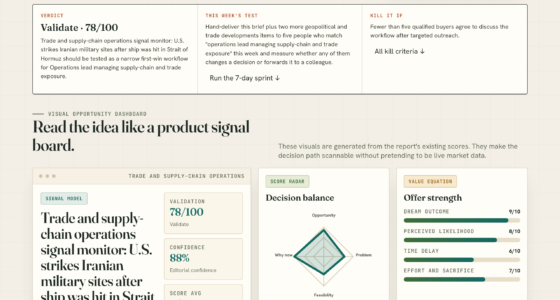
📊 Full opportunity report: The $725 Billion Question: Hyperscaler Capex Q1 2026 and What the Earnings Don’t Answer on ThorstenMeyerAI.com — validation score, market gap, and execution plan.

Get audio and creator gear delivered free with Prime
- Fast, free delivery on millions of items
- Prime Video, Amazon Music and more included
- Member-only deals all year
TL;DR
In Q1 2026, Microsoft, Amazon, Alphabet, and Meta revealed a combined AI capital expenditure of approximately $725 billion, the largest in history. Despite strong earnings, market concerns about GPU constraints and revenue translation cast doubt on future growth prospects.
The four largest hyperscalers—Microsoft, Amazon, Alphabet, and Meta—announced a combined AI capital expenditure of approximately $725 billion in Q1 2026, marking the largest investment cycle in modern tech history. This surge in spending underscores their commitment to expanding AI infrastructure but raises questions about the sustainability of revenue growth and profitability.
Microsoft reported a Q3 fiscal 2026 capex of $30.88 billion, with an annual guidance of around $190 billion, emphasizing capacity constraints driven by AI demand. Amazon’s Q1 capex reached $44.2 billion, with its chip business hitting a $20 billion revenue run rate, indicating a shift toward in-house silicon to reduce dependency on NVIDIA. Alphabet’s Q1 capex was $35.67 billion, more than doubling YoY, with a significant focus on TPU silicon and a cloud backlog exceeding $460 billion. Meta’s capex is estimated between $125-145 billion, with both ends of its guidance raised by $10 billion, reflecting infrastructure expansion efforts.
Overall, these companies are outspending their free cash flow and raising debt to fund their buildout, with capex-to-revenue ratios rising from 10-15% pre-AI to 25-30% now. Morgan Stanley estimates the total global AI infrastructure capex at around $740 billion, also up 69% YoY. Despite these investments, market reactions have been mixed, with NVIDIA’s stock falling after earnings despite record data center revenues, prompting discussions about whether GPU constraints are easing or if other factors are influencing AI deployment.
$725 billion. The question capex doesn’t answer.
April 29, 2026. Largest capital-expenditure cycle in modern tech history. Lock-in across the Big Four.
Microsoft $190B. Amazon $200B. Alphabet $185B. Meta $125-145B. Up from $670B high-end consensus going in. +69% YoY surge over 2025. NVIDIA fell on the news. The structural questions — depreciation, power, in-house silicon, demand-pull, geopolitical — resolve through 2027-2028.
Four hyperscalers. $725B committed.
Each hyperscaler beat-and-raised in the same 24-hour window April 29. Microsoft / Amazon / Alphabet / Meta. The capex commitment is non-discretionary at this scale — companies cannot back out without creating asset write-downs and capacity gaps.
Three paths. One question.
The capex buildout resolves through one of three structural paths. The honest assessment: the demand signals are real, the supply signals are real, and the balance between them is the structural question.
- Demand +60-100% YoYEnterprise translates fully.
- Utilization 85%+NVIDIA pricing power holds.
- $2.8T by 2028Jensen trajectory matches.
- No impairmentCapex fully accretive.
- Outcome: Multiples expand. Foundation for next decade.
- Demand +30-60% YoYPartial translation.
- Utilization 75-85%Weaker pockets visible.
- NVDA decel 75% → 30-50%Manageable adjustment.
- $30-80B impairmentLimited 2028 cycles.
- Outcome: Multiples compress modestly. No crisis.
- Demand +15-30% YoYEnterprise falls short.
- Utilization 65-75%Capacity glut visible.
- $150-300B impairmentBig Four 2027-2028.
- NVDA sharp decelPricing compression.
- Outcome: 30-50% multiple compression. Post-2001 telecom analog.
Five vectors. Interdependent.
Capital-allocation risks of this magnitude resolve through specific structural channels. The vectors are not independent — power constraints delay deployment which compresses utilization which triggers impairment.
Capital intensity has reset upward as the new baseline for tech-platform leadership. The competitive moat is partly capital availability rather than purely product or technology innovation. Tech-platform leadership now requires capital-deployment scale that fewer companies can execute.
Four assignments. By role.
Reset on structural pricing-power compression.
Bull case requires NVIDIA to maintain addressable share through FY27-FY28; in-house silicon migration argues that share compresses. Position accordingly. Consider AMD, Broadcom, downstream networking suppliers as partial substitutes that may benefit from compression. Stop pricing the $2.8T-by-2028 ceiling literally.
Treat capex as tailwind and risk factor.
Microsoft best-positioned through capacity-constrained Azure demand. Alphabet best-positioned through TPU silicon independence. Amazon best-positioned through Trainium/Inferentia revenue diversification. Meta most exposed through internal-product-only revenue offset. Position differentially rather than treating Big Four as equivalent.
Use the buildout to negotiate.
Capacity becoming abundant; pricing under structural pressure. 2-3 year contracts with capacity guarantees + price-discount escalators that capture unit-cost reduction as buildout absorbs. Multi-cloud sourcing more attractive as capacity scarcity ends. The negotiating window opens through 2026-2027.
Plan for capacity glut by H2 2027.
Capex commitment produces more compute than current demand absorbs at current pricing. API pricing pressure compounds through 2027-2028. China sphere cost gap (5-30× cheaper) makes more acute. Margin guidance for next 18 months should explicitly model capacity-driven price compression. Hedge accordingly in S-1 disclosures.
Implications of Record-Breaking AI Infrastructure Spending
This level of investment reflects a strategic emphasis on expanding AI infrastructure capacity to meet increasing demand. The disparity between investment levels and market performance, notably NVIDIA’s stock decline, highlights ongoing uncertainties about whether these expenditures will result in proportional revenue growth or if industry constraints—such as power, cooling, and proprietary silicon—may limit returns. Stakeholders should consider the potential for this capital expenditure cycle to influence long-term industry profitability and valuation.
high-performance GPU for AI data centers
As an affiliate, we earn on qualifying purchases.
As an affiliate, we earn on qualifying purchases.
Historical and Industry Context of AI Capex Growth
Prior to 2026, hyperscaler capital expenditure typically represented 10-15% of revenue, but the AI growth has increased this ratio to 25-30%, with projections reaching 35% in 2027. The previous major capex cycle was driven by cloud expansion and enterprise services, whereas the current surge is primarily focused on AI compute infrastructure. Investments from second-tier players like Tencent and Alibaba contribute to an estimated global AI infrastructure capex of $740 billion, according to Morgan Stanley. This concentrated investment indicates a strategic shift toward AI capabilities, though the impact on revenue remains uncertain amid market pressures and technological developments.
“Our plan remains largely unchanged, with a $200 billion capex target for 2026, including significant investment in in-house silicon.”
— Andy Jassy, Amazon CEO
“Our TPU v6 ramp will determine how much of our compute can be served without NVIDIA.”
— Sundar Pichai, Alphabet CEO
Unresolved Questions About Revenue Impact and Constraints
The extent to which these substantial capital investments will translate into corresponding revenue and earnings growth remains uncertain. Market concerns persist regarding whether GPU supply constraints are easing or if other bottlenecks—such as power, cooling, or proprietary silicon—are now limiting AI deployment. The long-term profitability outlook for this investment cycle is still being evaluated, especially in light of recent declines in NVIDIA’s stock despite record revenues.
Next Steps for Industry Growth and Investor Confidence
Future quarterly earnings reports and industry data will help assess whether the hyperscalers’ investments are leading to the anticipated revenue growth. Monitoring developments in AI compute constraints, silicon innovations, and pricing trends will be important. Additionally, investors will likely focus on profitability metrics and the potential for market saturation, as well as the impact of increased debt levels on financial stability.
Key Questions
What does the $725 billion capex mean for AI industry growth?
This level of investment indicates a significant industry commitment to expanding AI infrastructure, but the translation into sustainable revenue growth remains uncertain amid market and technological challenges.
Are GPUs still the bottleneck in AI deployment?
Market reactions suggest questions about GPU constraints; some industry experts believe that other factors like power, cooling, or custom silicon may now be limiting AI expansion.
How might this level of spending impact hyperscalers’ profitability?
While the investments are aimed at supporting future growth, the high capital outlay raises questions about short-term profitability, especially if revenue growth does not meet expectations.
Will NVIDIA benefit from this investment cycle?
NVIDIA is expected to benefit from increased GPU demand, but recent stock declines suggest market doubts about whether GPUs remain the primary constraint or if other factors are influencing the industry.
Source: ThorstenMeyerAI.com
Fall Picks
fall essentials
As an affiliate, we earn on qualifying purchases.