

To design 80–200kW racks effectively, focus on containment strategies like hot and cold aisle containment to improve airflow and cooling efficiency. Manage airflow with perforated tiles, blanking panels, and real-time temperature monitoring to prevent hotspots. Prioritize safety by clearly labeling components, implementing lockout/tagout procedures, and ensuring proper grounding. Continuous adjustments and vigilant safety protocols help maintain reliable operation while optimizing cooling performance. Explore these concepts further to guarantee your rack design is efficient and secure.
Key Takeaways
- Implement hot and cold aisle containment to optimize airflow and enhance cooling efficiency for high-density racks.
- Use perforated tiles, blanking panels, and vents to direct airflow precisely and prevent hotspots.
- Incorporate safety features such as clear labeling, accessible disconnects, and proper grounding for electrical safety.
- Regularly monitor temperature and humidity to adjust airflow and maintain optimal environmental conditions.
- Design for safe access, adequate clearance, and compliance with industry safety standards to ensure reliable operation.
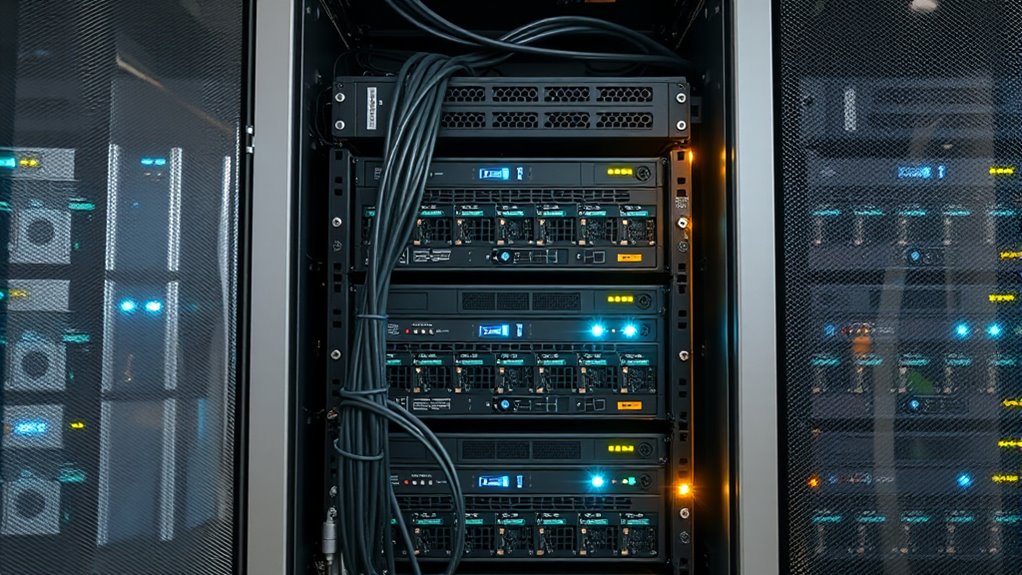
Are you ready to optimize your data center with racks designed for 80–200kW power loads? If so, you need to pay close attention to ventilation optimization. Effective airflow management is vital at these power levels to prevent overheating and ensure reliable operation. Start by designing containment solutions that channel cool air directly to the equipment intakes and exhaust hot air efficiently. Hot aisle containment, for example, creates a barrier that separates hot exhaust air from cool supply air, reducing mixing and improving overall cooling performance. Cold aisle containment works similarly, keeping the chilled air confined where it’s needed most. These strategies not only improve cooling efficiency but also allow you to use less energy, lowering operational costs.
Optimize data center cooling with containment strategies that direct airflow and reduce energy costs.
Proper ventilation isn’t just about airflow; it’s about controlling the environment within your racks to maintain ideal temperatures. Installing perforated tiles, blanking panels, and strategically placed vents can help direct airflow precisely where it’s needed. Monitoring temperature and humidity in real-time lets you make adjustments on the fly, preventing hotspots that could damage equipment. Additionally, understanding the contrast ratio of your cooling systems can help evaluate their effectiveness in maintaining optimal environment conditions. Remember, ventilation optimization isn’t a one-time setup—it’s an ongoing process that requires regular evaluation and fine-tuning to respond to changing load conditions and hardware upgrades.
Safety protocols are equally important when designing racks for high power loads. Ensuring safe operation involves more than just preventing overheating; it includes protecting personnel and equipment from electrical hazards. Clearly label all high-voltage components and implement lockout/tagout procedures during maintenance. Use fire suppression systems suitable for electrical fires, and keep fire exits unobstructed. Proper grounding and bonding are essential to prevent static buildup and electrical faults that could lead to sparks or equipment failure. Regular inspections and adherence to industry standards like IEEE and NFPA guidelines will help you maintain a safe environment.
Additionally, your rack design should incorporate features that facilitate safe access and quick shutdowns if necessary. This might include clear signage, accessible disconnect switches, and adequate clearance space around equipment. Training staff on safety protocols and emergency procedures ensures everyone knows how to handle potential issues swiftly and effectively. Combining extensive safety protocols with optimized ventilation creates a resilient infrastructure that handles high loads safely and efficiently. This proactive approach minimizes downtime, reduces risk, and supports the continuous, reliable operation of your data center.
data center containment panels
As an affiliate, we earn on qualifying purchases.
As an affiliate, we earn on qualifying purchases.
Frequently Asked Questions
How Do I Choose the Best Containment System for High-Density Racks?
To select the best containment system for high-density racks, consider your rack security needs and how efficiently it manages airflow. Opt for systems that prevent hot spots and optimize cooling, reducing energy use. Guarantee the containment supports reliable power distribution and is easy to access for maintenance. Also, choose a system compatible with your existing infrastructure, providing safety and security for your high-power equipment.
What Are the Key Airflow Considerations for 80–200kw Rack Designs?
You need to focus on airflow optimization to prevent hotspots and guarantee efficient thermal management. Keep hot and cold aisle containment well-sealed to direct airflow precisely where it’s needed. Use perforated tiles and strategically placed fans to balance airflow, avoiding turbulence or stagnation. Remember, effective airflow design not only cools your high-density racks but also prolongs equipment lifespan, making thermal management a critical part of your overall system reliability.
How Can I Ensure Safety Compliance in High-Power Rack Environments?
You can guarantee safety compliance in high-power rack environments by implementing proper fire suppression systems and maintaining effective electrical grounding. Regularly inspect fire suppression equipment and ensure it’s suitable for high-power setups. Proper electrical grounding prevents faults and reduces fire risk. Adhere to industry standards and conduct safety audits consistently, training staff on emergency procedures, and keeping documentation up-to-date to meet compliance requirements confidently.
What Materials Are Recommended for Durable Rack Containment Structures?
You should choose containment materials with high durability, like galvanized steel, aluminum, or reinforced composites, to guarantee long-lasting rack structures. These materials resist corrosion, wear, and impact, maintaining containment integrity under heavy loads and thermal stress. Prioritize options that meet safety standards and offer excellent fire resistance. Using durable containment materials helps protect equipment, maintain airflow, and ensure overall safety in high-power rack environments.
How Do Cooling Strategies Vary Between Different Rack Power Levels?
When it comes to cooling strategies, you’ll find that as rack power levels increase, liquid cooling becomes more essential for effective thermal management. For lower power racks, airflow and traditional cooling might suffice, but higher power racks demand more aggressive methods like direct liquid cooling to prevent hotspots. You need to adapt your approach, ensuring each rack’s cooling solution matches its thermal load, because one size rarely fits all in this game.
high density server rack cooling fans
As an affiliate, we earn on qualifying purchases.
As an affiliate, we earn on qualifying purchases.
Conclusion
So, there you have it—designing 80–200kW racks is just a walk in the park, right? Just toss in some containment, crank up the airflow, and voilà—you’re a cooling genius. Who needs safety standards when you’ve got all the tricks up your sleeve? Just remember, a little chaos keeps things exciting. Happy rack designing—may your temperatures stay low and your safety margins stay high, or at least pretend they do!
rack temperature monitoring sensors
As an affiliate, we earn on qualifying purchases.
As an affiliate, we earn on qualifying purchases.
electrical safety lockout tags
As an affiliate, we earn on qualifying purchases.
As an affiliate, we earn on qualifying purchases.