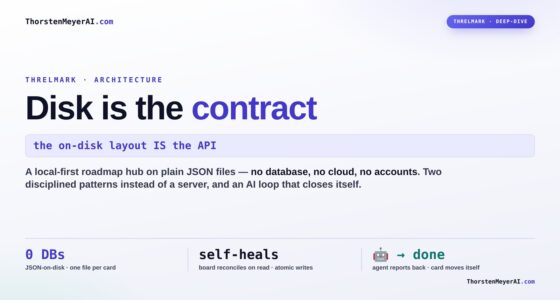
🔍 Read the full analysis: How The PyTorch Training Loop Learns From Data on ThorstenMeyerAI.com

Get audio and creator gear delivered free with Prime
- Fast, free delivery on millions of items
- Prime Video, Amazon Music and more included
- Member-only deals all year
TL;DR
PyTorch’s training loop learns by making predictions, measuring their error, calculating gradients and updating model parameters. The framework also sits between developers’ code and the chips that run it, making recent native PyTorch support for Google TPUs and AWS Trainium relevant to hardware choice. Switching chips can still require changes to reach peak performance.
PyTorch learns from data by repeatedly comparing a model’s predictions with expected answers, calculating the resulting error and adjusting the model’s parameters. In an explainer published November 22, ThorstenMeyerAI.com outlines that training loop and the framework’s role in connecting developers’ code to computing hardware, as Google and Meta promote native PyTorch support for Google’s TPUs and AWS releases a PyTorch backend for Trainium in public beta.
The loop begins with tensors, PyTorch’s multidimensional data structures for values such as inputs, model weights and outputs. A model uses its parameters to calculate a prediction. A loss function then measures how far that prediction is from the expected result. The loss is a number representing the model’s error for that batch of data; it is not, by itself, proof that the model understands the task.
PyTorch’s autograd system tracks operations performed on tensors and calculates gradients, which indicate how changing parameters would affect the loss. An optimizer uses those gradients to update the parameters. In a typical training step, code clears old gradients, runs a forward pass, computes the loss, calls backpropagation and takes an optimizer step. Repeating that process across batches and passes through a dataset can improve the model’s performance on the training objective.
The explainer describes PyTorch as eager by default: Python operations execute as the program reaches them, with the calculation structure assembled as work proceeds. That design supports interactive debugging. PyTorch’s optional torch.compile can compile parts of a program to improve execution speed, though the result depends on the model, hardware and workload. GPUs and other accelerators handle much of the numerical work; the training loop supplies the sequence of calculations and updates.
How PyTorch Shapes Chip Choices
PyTorch matters beyond the mechanics of training because it is a layer between AI developers’ code and accelerator hardware. Teams often build models and workflows around a framework, so access to familiar PyTorch tools on additional chips can make it easier to evaluate alternatives to a current supplier. Google and Meta said their October 20 TorchTPU announcement aimed to make porting a model to a TPU require as little as changing a device name in one line of code. AWS’s TorchNeuron entered public beta the same day for its Trainium chips.
That compatibility could widen hardware options for organizations managing training costs or supply constraints. It does not mean every model will move without engineering work, or that every chip will deliver the same speed. The source reports that TorchTPU’s authors say reaching peak performance may still require changes. Businesses must also weigh software maturity, support, availability and the performance of their particular workloads.
For people using AI products, the training loop is usually invisible. Its outcomes help determine how models are built and updated, while framework and hardware choices affect the resources required. The direct effects on any given product depend on choices made by its developers; PyTorch support alone does not establish that a model will become cheaper, faster or more capable.
Products Worth Considering

Logitech MX Mechanical Wireless Illuminated Keyboard, Tactile Quiet, Graphite

Samsung Galaxy Tab A11+ 11-Inch Wi-Fi Tablet, 128GB, 6GB RAM, Silver

Apple Watch SE 3 GPS 40mm Smartwatch
As an affiliate, we earn on qualifying purchases.
From Meta Project to Foundation
PyTorch began in 2016, with its first public release in January 2017, according to the 2019 research paper by Adam Paszke and co-authors. The paper describes a design in which the library operates as a regular Python program under the user’s control; much of its underlying implementation is written in C++ for performance. The project moved to the PyTorch Foundation, a project of the Linux Foundation, on September 12, 2022. Its governance separates business decisions by the foundation from technical decisions made by maintainers, according to the source.
The article says PyTorch 2.15 was released October 28, 2026, and describes PyTorch as open source under a permissive BSD-style license. Its comparison with JAX and TensorFlow focuses on programming approach rather than declaring a winner: PyTorch is eager by default with optional compilation, JAX centers on composable function transformations, and TensorFlow 2 is eager by default with graph-building through tf.function. Those differences can affect how teams write, debug and deploy models.
“Every aspect of PyTorch is a regular Python program under the full control of its user.”
— Adam Paszke and 20 co-authors, in the 2019 PyTorch research paper
Where Chip Portability Stops
The announcements do not establish that every PyTorch model will run identically or perform equally across Nvidia, AMD, Apple, Intel, Google and AWS hardware. The source says native backends are available for those platforms, but compatibility and peak performance are different questions. TorchNeuron was in public beta when reported, and the material does not provide independent benchmarks or adoption figures for either it or TorchTPU.
It is also unclear how much engineering work different organizations will need to move existing workloads, or whether the changes will lower their total costs. Outcomes depend on hardware access, model architecture, software support and optimization. The article’s training-loop explanation describes standard PyTorch mechanisms, but it does not supply a performance comparison among frameworks or chips.
What Teams Can Test Next
The next practical step for developers is to test their own workloads on the backends available to them, measuring model correctness, speed and operating cost rather than relying on compatibility claims alone. Teams considering TorchTPU or TorchNeuron will need to track backend support and maturity, and check whether their models require hardware-specific changes.
Further releases, documentation and independent benchmarks could clarify how much porting work is needed and how performance varies by task. The source material does not identify a specific benchmark date or adoption milestone. For now, the confirmed development is broader native PyTorch support; its practical effect will depend on what teams can run successfully.
Key Questions
How does a PyTorch training loop learn?
It makes predictions from input data, measures the error with a loss function, calculates gradients through autograd and uses an optimizer to update model parameters. The process repeats over batches of training data.
What does autograd do?
Autograd tracks tensor operations and calculates gradients showing how parameter changes affect the loss. Those gradients help an optimizer decide how to update the parameters.
Does native PyTorch support mean models can move between chips unchanged?
No. The October 20 announcements aimed to make porting easier, but the source says peak performance on a TPU may still require changes. Requirements depend on the model, backend and hardware.
What is torch.compile for?
torch.compile can compile parts of PyTorch programs in an effort to improve execution speed. The benefit varies with the workload and hardware; it is not a guarantee that every program will run faster.
Source: ThorstenMeyerAI.com