
🔍 Read the full analysis: Compare 10 Mobile Workstation Laptops For AI Performance In 2027 on ThorstenMeyerAI.com

Get audio and creator gear delivered free with Prime
- Fast, free delivery on millions of items
- Prime Video, Amazon Music and more included
- Member-only deals all year
TL;DR
The supplied comparison names 10 mobile workstation models for AI and other professional workloads, but provides detailed recommendations for only three: the ThinkPad P1 Gen 7, ThinkPad P14s Gen 7 and Dell Precision 7680. It does not provide a complete 2027 model list, verified benchmarks, prices or testing results, so the remaining entries cannot be responsibly ranked from the available material.
A 2027-oriented guide to 10 mobile workstation laptops says buyers must balance AI-capable processors, professional graphics, cooling and portability, but the supplied material identifies only three models in detail: Lenovo’s ThinkPad P1 Gen 7 and P14s Gen 7, and Dell’s Precision 7680. It offers buying criteria rather than a verifiable 10-model benchmark comparison, leaving readers without complete rankings, prices or test results.
The guide calls the ThinkPad P1 Gen 7 its best overall choice for professionals seeking a relatively sleek system with dedicated NVIDIA RTX graphics. It recommends the ThinkPad P14s Gen 7 for buyers who want a 14-inch system and describes its AMD Ryzen AI performance as a strength. For demanding engineering workloads, it points to the Dell Precision 7680, citing its larger thermal headroom. These are the source’s assessments; the supplied text does not provide side-by-side measurements to verify them.
The guide says newer Intel Core Ultra and AMD Ryzen AI chips can improve battery efficiency, while potentially trailing older HX-series processors in peak multicore rendering performance. It also argues that sustained cooling matters more than short bursts for lengthy jobs such as video encoding, CAD assemblies and machine-learning workloads. No benchmark scores, workload durations or methodology results are included in the material provided.
Other selection points include professional GPU drivers and ISV certification, display technology, serviceability and connectivity. The guide favors professional NVIDIA RTX graphics for software stability in some CAD and simulation applications, while noting OLED’s contrast benefits and higher power use. It also flags that users may need docks where thin laptops omit ports such as HDMI, USB-A or Ethernet.
The 10 picks
- 1
 Dell Precision 7680 16-Inch Workstation Laptop, Intel Core i7-13850HX, NVIDIA…View on Amazon →
- 2
 Dell Precision 7680 Laptop, NVIDIA RTX 2000 Ada 8GB, Intel i7-13850HX, 32GB DDR5View on Amazon →
- 3
 Lenovo ThinkPad P1 Gen 7, w/ Ultra 7, NVIDIA RTX 3000, 16" 2.8K, 32GB RAMView on Amazon →
- 4
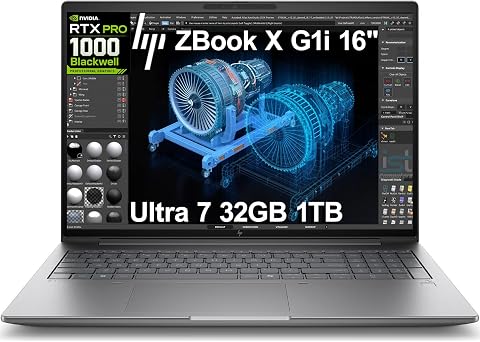 HP ZBook X G1i 16-inch Laptop, Intel Core Ultra 7 265H, NVIDIA RTX PRO 1000 B…View on Amazon →
- 5
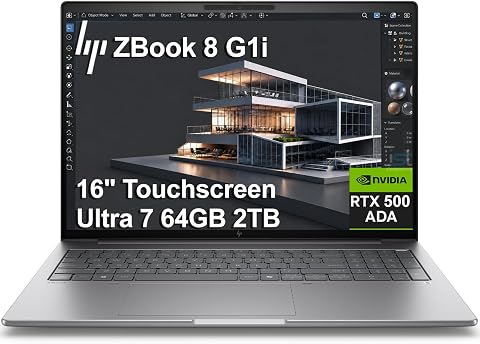 HP ZBook 8 G1i AI Mobile Workstation Laptop (16" FHD+ Touchscreen, Intel Ultr…View on Amazon →
- 6
 HP ZBook 8 G1i AI Mobile Workstation Laptop (16" 4K 120Hz, Intel Ultra 7 265H…View on Amazon →
- 7
 Lenovo ThinkPad P16s Gen 4 16-inch OLED Touchscreen Mobile WorkstationView on Amazon →
- 8
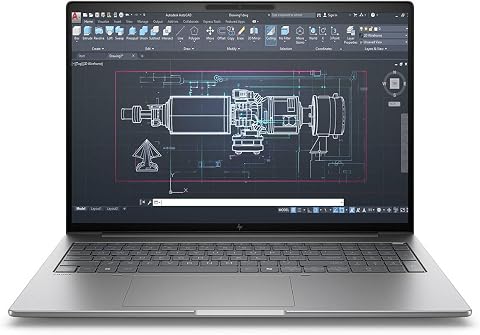 HP ZBook 8 G1i 16" Mobile Workstation – WUXGA – 60 Hz – Intel Core Ultra 7 25…View on Amazon →
- 9
 Lenovo ThinkPad P16s Gen 4 16-Inch Business LaptopView on Amazon →
- 10
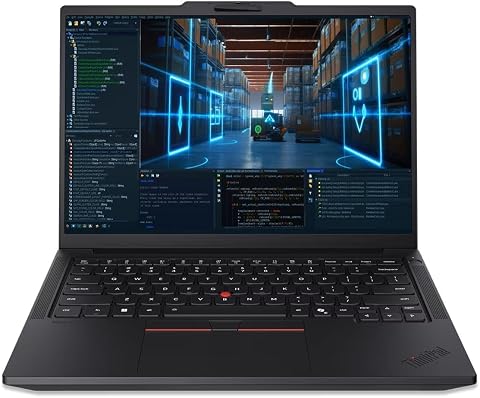 Lenovo ThinkPad P14s Gen 7 Mobile Workstation (2026) – 14" Touch, AMD Ryzen A…View on Amazon →
Cooling Shapes Long AI Workloads
For people running AI inference, data preparation, rendering or engineering software away from a desk, a laptop’s performance under prolonged load can matter more than its brief peak speed. The guide’s emphasis on thermal limits and sustained performance is relevant because a compact chassis may be easier to carry but has less room to dissipate heat than a larger workstation. Actual performance still depends on each model’s configuration and workload, details not documented here.
The article also highlights a practical purchasing issue: an AI-capable processor alone does not establish that a machine is suitable for every professional workflow. Buyers should check GPU memory and software support, relevant ISV certification, battery needs, display requirements and ports. Without configurations, prices and measured results for all 10 laptops, readers cannot use this source alone to determine which model offers the best value or strongest AI performance.
Products Worth Considering

Apple Watch SE 3 GPS 40mm Smartwatch

Bose QuietComfort True Wireless Earbuds with Active Noise Cancellation, Bluetooth 5.3, USB-C Charging, IPX4, Black

Samsung Galaxy Tab A11+ 8GB RAM, 256GB Storage, Gray
As an affiliate, we earn on qualifying purchases.
The Guide’s Selection Criteria
The source says it evaluates systems by their ability to sustain performance during extended tasks, alongside build quality, serviceability and professional software compatibility. It also considers keyboards, trackpads, webcams and display accuracy. However, although it describes this evaluation approach, the supplied material contains no test log, scoring rubric or model-by-model evidence showing how those criteria were applied.
Its broader advice is to match hardware to work rather than simply select the highest headline specification. A designer may put greater weight on color accuracy and OLED contrast, while a mobile engineer may prioritize cooling, upgrade access or physical connections. A data scientist’s needs can vary with whether work runs locally or on remote systems. The guide names RTX Ada and Blackwell architectures and newer CPU families, but gives no specific configurations or release-year verification for a complete 2027 lineup.
““The Lenovo ThinkPad P1 Gen 7 stands out as the best overall pick for professionals who need a sleek chassis without sacrificing the reliability of dedicated NVIDIA RTX graphics.””
— ThorstenMeyerAI.com guide
Seven Models Lack Supporting Detail
The supplied source does not name or describe seven of the promised 10 laptops. It also does not state the tested configurations, benchmark results, prices, battery runtimes, display measurements or temperatures behind its recommendations. As a result, no full ranking or reliable model-to-model comparison can be reproduced from this material.
The guide’s 2027 framing is also not accompanied by a publication date or a list of confirmed 2027 releases. It is unclear whether its model references reflect current configurations, planned products or a general buying framework. Claims about driver stability, throttling and battery efficiency are presented as guidance, but no independent test results or software-version-specific certification records are supplied.
Verify Models Before Buying
Readers should check manufacturers’ current product pages for exact processor, GPU, memory, display and port configurations, then confirm pricing and availability in their region. For professional applications, they should consult the relevant software vendor’s certification list and compare sustained-load reviews that identify the tested configuration and workload.
A complete 10-model ranking would require the guide to identify every laptop and publish comparable evidence, including measured performance, battery life, thermals and price. Until those details are available, the three named recommendations should be treated as source-attributed suggestions, not as a verified 2027 league table.
Key Questions
Which laptops does the supplied guide recommend?
It names the Lenovo ThinkPad P1 Gen 7 as its overall pick, the ThinkPad P14s Gen 7 for a compact 14-inch option and the Dell Precision 7680 for demanding engineering work. It does not identify the other seven models in the provided material.
Does the source prove which laptop is fastest for AI?
No. It provides no comparable AI benchmarks, configurations or measured results. Its recommendations are editorial assessments, not a demonstrated performance ranking.
Why does cooling matter for a mobile workstation?
Long rendering, engineering and AI workloads can keep the processor and graphics chip under load. The guide says larger chassis may sustain higher speeds for longer, but does not provide test measurements for the named systems.
What should buyers verify before choosing a model?
Check the exact hardware configuration, current price and availability, battery and cooling tests, required ports, and software-vendor certification for the applications you use. A model name alone does not specify its full capabilities.
Source: ThorstenMeyerAI.com