
How to Play the Detaché Bow Stroke on Cello
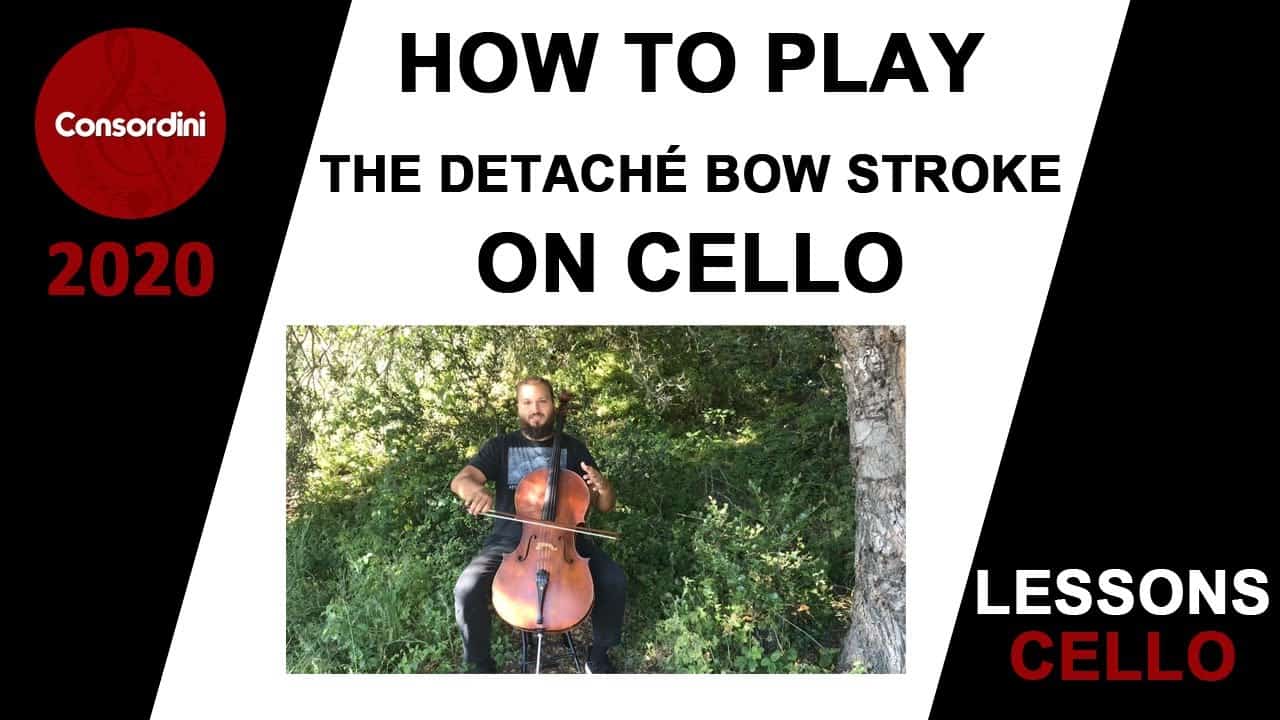
The detaché cello bow stroke is one of the most commonly used bow strokes. It simply means detached, and is in contrast on either side to legato, which means connected or slurred, and marcato, which means accented. To play detaché we will need to first have practiced our bow hold and make a sound with the full bow, but as we start to practice scales and repertoire, we will need to change bow directions more frequently than all the way at the tip or frog.
The first key to this is to make sure your bow hold allows your fingers to be springy and flexible.
As you change bow directions you are dealing with quite a lot of physics, from the friction of the hairs on the string, to the change in velocity, to managing how pulling the string changes the speed, direction, and intensity of the string’s vibration.
So it is very easy to get a poor sound doing this.
This leads to the second key, which is to establish a good buildup of core sound, release, and intention of direction. Your core sound is the most resonant, full sound, with the weight of your arm going into the string.
When done properly, this will be the “fullest” sound because you will also hear harmonics (higher notes) ringing out above the main note you’re playing, and it will also project the furthest.
Release is when you play lighter to focus in on the overtones more than the core depth. Finally with intention of direction you attenuate your attention to what each bow direction means both physically and aurally (what does it sound like).
One thing we work on as cellists is having up bows that more or less sound the same as down bows.
This actually was not true in the baroque era, when bows curved the other way, and down bows were significantly louder than up bows – and composed for accordingly.
But nowadays we have the modern bow shape, which is meant to allow for more versatility, and we expect to hear notes mostly sound the same.
A few more things to look out for. Make sure the hairs of the bow are all flat on the string. Sometimes, when playing very lightly, you turn the bow towards you and play on fewer hairs.
Though cellists typically do not turn the bow away from themselves, as violinists might. However, for the most part flat hairs will get you a better sound.
Amazon Product B09BZZ3MM7
As an affiliate, we earn on qualifying purchases.
Amazon Product B0DJGDC3BD
As an affiliate, we earn on qualifying purchases.
Amazon Product B0F7Z4QZTT
As an affiliate, we earn on qualifying purchases.
Amazon Product B0DXXYS4BJ
As an affiliate, we earn on qualifying purchases.