
Introduction
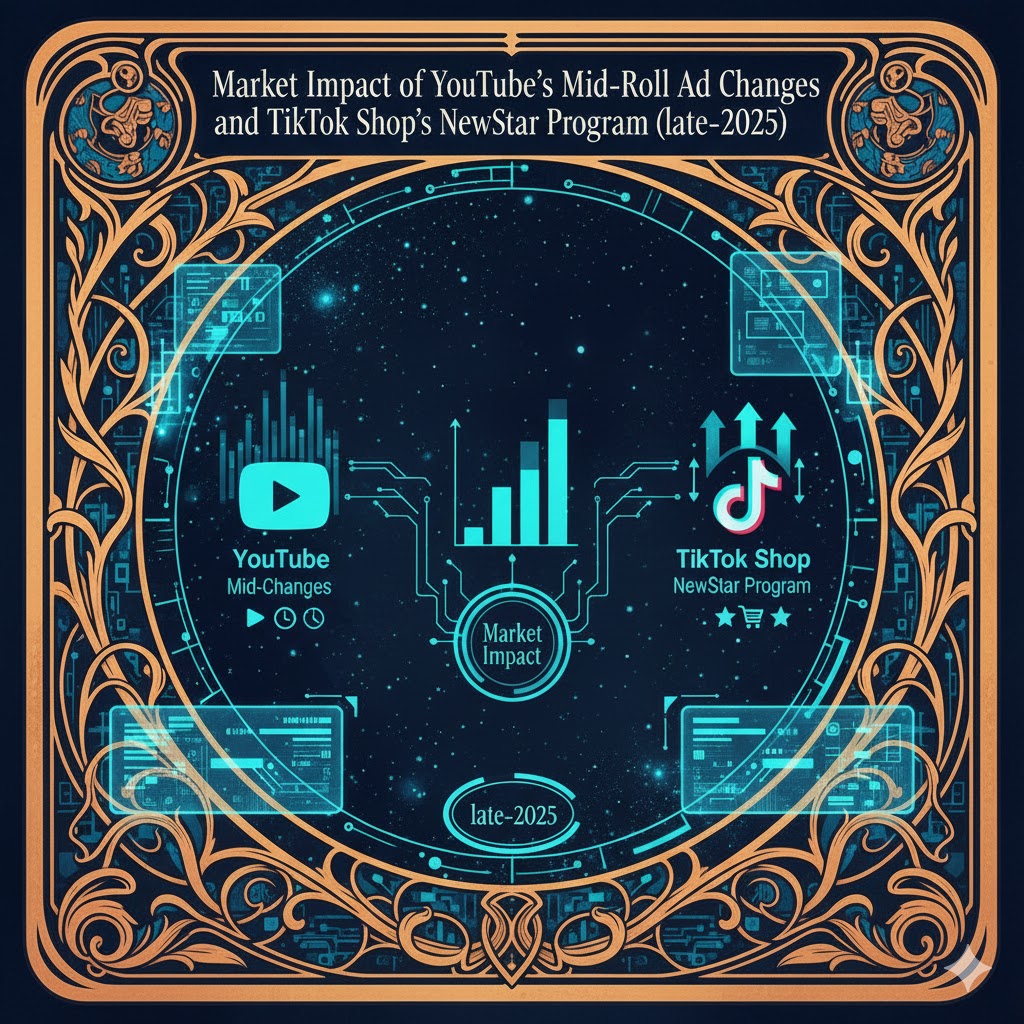
In 2025 digital advertising and social commerce continued to grow despite economic uncertainty. WPP forecast that global advertising revenues would reach $1.08 trillion in 2025 with digital advertising representing 73 % of total ad spend, rising to over 80 % when digital extensions (e.g., connected‑TV) are includedstoryboard18.com. This growth has been fuelled by a shift from traditional media to platforms such as YouTube and TikTok, which combine entertainment, social networking and commerce. However, consumers increasingly complain about irrelevant ads and brand‑safety issues, and they have become more price‑sensitive due to rising living costsadmonsters.com. Against this backdrop, two high‑profile platform initiatives were launched in 2025: YouTube’s mid‑roll ad revamp (implemented from 12 May 2025) and TikTok Shop’s NewStar Product Sales Incentive Program (running 1–30 November 2025). This report analyses the impact of these changes on the advertising market, the broader economy, and consumers.
YouTube automatic mid-roll ad placement tool
As an affiliate, we earn on qualifying purchases.
As an affiliate, we earn on qualifying purchases.
1. YouTube’s Mid‑Roll Ad Revamp
1.1 Overview of the Policy
YouTube introduced a new mid‑roll ad policy from 12 May 2025. The platform now automatically places ads at natural breakpoints (scene transitions, pauses) instead of inserting them mid‑sentence or mid‑actionsocialmediatoday.com. Creators can use a hybrid model that combines manual ad slots with automatic ones, and a new feedback tool indicates which manual slots are considered “interruptive”searchenginejournal.com. For older videos uploaded before 24 February 2025, YouTube automatically adds ad slots unless creators opt outsearchenginejournal.com.
1.2 Impact on the Advertising Market
- Revenue uplift for creators – YouTube reported that channels using both manual and automatic mid‑rolls saw an average 5 % increase in ad revenueemarketer.com. This suggests that machine‑learning‑driven placement finds additional non‑disruptive ad opportunities that manual placement missesbirdeye.com.
- More attractive to advertisers – By reducing disruptive mid‑sentence ads, the platform aims to retain viewers and reduce ad‑blocker useemarketer.com. This could improve advertisers’ return on ad spend and attract budgets away from rivals such as TikTok and Instagramemarketer.com.
- Alignment with broader market trends – Consumers are increasingly frustrated with irrelevant ads; a survey found 44 % of Americans feel overlooked by advertisers and 67 % are annoyed by ads following them across platformsadmonsters.com. YouTube’s focus on natural breaks and a hybrid model directly addresses ad fatigue, potentially improving brand safety and viewer sentiment.
- Competitive pressure on rival platforms – As YouTube refines its ad experience, other platforms that rely on mid‑roll ads (e.g., TikTok, Facebook) may need to improve their own placement systemsemarketer.com. YouTube’s changes could set a new baseline for acceptable ad intrusiveness across the industry.
- Potential downward pressure on ad prices – By increasing the inventory of non‑disruptive ad slots, YouTube might temporarily increase supply, which could moderate cost‑per‑mille (CPM) rates. However, improved user retention could offset this by boosting total watch time, preserving revenue.
1.3 Implications for the Economy
- Platform revenue and jobs – YouTube is part of Google’s advertising business, which anchors a substantial share of digital ad spend. Even a modest 5 % revenue lift for millions of creators could translate into hundreds of millions of dollars of additional income shared between Google and creators, supporting jobs in the creator economy.
- Macroeconomic spillovers – Better monetization of long‑form video encourages creators to invest more in production, editing and marketing services, supporting ancillary industries (e.g., video editing software, production teams, influencer agencies). It also increases the attractiveness of content creation as a career, potentially adding to the 3.1 million U.S. jobs already directly tied to TikTok/YouTube‑type platformsemarketer.com.
- Consumer welfare – Natural‑break placement reduces interruption, making ad‑supported YouTube more palatable for viewers. This can mitigate churn to subscription services (e.g., YouTube Premium) and help keep more ad‑supported content free. In the long run, a healthier advertising ecosystem reduces the need for subscription paywalls and supports diverse media voices.
1.4 Implications for Consumers
- Reduced ad fatigue – By avoiding mid‑sentence interruptions, the update addresses a major user complaint and may reduce the adoption of ad blockersemarketer.com.
- Better content flow – Viewers experience smoother storytelling, which may increase watch time and satisfaction.
- Potential increase in ad frequency – Because automatic placements identify more “natural” ad slots, viewers might see slightly more ads in longer videos. However, improved relevance could make ads more tolerable. Importantly, if a creator previously used fixed‑interval mid‑rolls, the new system may reduce the total number of ads if many of those slots are deemed interruptivebirdeye.com.
![WavePad Free Audio Editor – Create Music and Sound Tracks with Audio Editing Tools and Effects [Download]](https://m.media-amazon.com/images/I/B1HPw+BmlXS._SL500_.png "Market Impact of YouTube’s Mid‑Roll Ad Changes and TikTok Shop’s NewStar Program (late‑2025) 3")
WavePad Free Audio Editor – Create Music and Sound Tracks with Audio Editing Tools and Effects [Download]
Easily edit music and audio tracks with one of the many music editing tools available.
As an affiliate, we earn on qualifying purchases.
As an affiliate, we earn on qualifying purchases.
2. TikTok Shop’s NewStar Product Sales Incentive Program (Nov 2025)
2.1 Program Overview
TikTok Shop launched a NewStar Product Sales Incentive Program for the U.S. from 1 to 30 November 2025seller-us.tiktok.com. The goal is to encourage sellers to list new products and accelerate “cold‑start” items. Two reward plans are offered:
| Incentive | Qualification | Reward | Cap |
|---|---|---|---|
| New Product Sales Incentive | New products listed between 1 Oct – 30 Nov 2025 that meet performance criteria (at least one order; shop performance score ≥ 3.5; listing quality rated Fair or Good; at least five images)seller-us.tiktok.com | US$15 advertising credit per productseller-us.tiktok.com | US$3,000/month per seller |
| Cold‑Start Incentive | “Successful cold start” products (i.e., newly listed products achieving ≥ US$250 GMV and ≥ 3 orders during the period and offering an early‑bird discount or free/refundable sample)seller-us.tiktok.com | US$55 advertising credit per productseller-us.tiktok.com | US$3,000/month per seller |
Rewards are credited monthly into the seller’s Ads Manager account for reinvestment in TikTok Shop advertising.
2.2 Impact on the Social Commerce Market
- Stimulating supply of new products – The incentives encourage sellers to list more new products and ensure high‑quality listings (minimum five images)seller-us.tiktok.com. This expands product variety on TikTok Shop, making it a more competitive marketplace relative to Amazon and Shopify.
- Boosting ad spend within the ecosystem – Because rewards are provided as advertising credits, sellers must reinvest them into TikTok Shop ads. This creates a virtuous cycle: sellers who successfully launch new products receive more credits to promote those items, driving sales and additional advertising revenue for TikTok.
- Reducing cold‑start friction – Many social commerce products fail to gain traction due to lack of visibility. By rewarding sellers who achieve US$250+ GMV and at least 3 orders, TikTok lowers the barrier to discovering new items, potentially increasing the number of merchants who find early success.
- Encouraging data‑driven listing quality – The program requires shops to maintain a performance score ≥ 3.5 and listing quality rated at least Fair or Goodseller-us.tiktok.com. This could raise overall platform standards, improving shopper trust and conversion rates.
- Potential shift of marketing budgets – As TikTok Shop scales, brands may shift part of their paid media budgets from traditional retail and search advertising to social commerce. Retail TouchPoints reported that TikTok Shop U.S. gross merchandise value (GMV) jumped from $15.1 M in July 2023 to $1.1 B in July 2025 and that the number of U.S. shops grew 5,000 % over two yearsretailtouchpoints.com. Incentives like NewStar could accelerate this momentum.
- Consolidation of TikTok’s e‑commerce ecosystem – TikTok Shop global GMV reached roughly $26 B in the first half of 2025marketingltb.com. By encouraging new product launches and increased advertising, TikTok positions itself as a credible rival to established marketplaces. However, growth remains heavily reliant on low‑priced goods and impulse buyingmarketingltb.com.
2.3 Implications for the Economy
- Support for small businesses – TikTok’s economic footprint is substantial: a report found 4.7 million U.S. jobs benefit from TikTok (including 3.1 million using it directly), 7.5 million U.S. businesses are on the platform, and 74 % of U.S. businesses say TikTok allowed them to increase sales or expandemarketer.com. The NewStar program targets small sellers, potentially creating thousands of micro‑entrepreneurs and boosting local economies.
- Job creation in social commerce – As more merchants and influencers join TikTok Shop, demand for marketing, fulfilment, customer‑service and logistics roles increases. In 2025, global TikTok Shop sellers were estimated at over 15 million, with average order values in the U.S. between $25–$60marketingltb.com. Additional incentives may attract even more sellers and service providers.
- Shift in consumer spending – “Scroll‑to‑spend” behaviour means purchases are increasingly impulse‑driven. A survey in 2025 found 71 % of TikTok users purchased items they discovered in their feedstackinfluence.com. High engagement can lead to over‑consumption and may divert spending from traditional retailers, altering revenue patterns across sectors.
- Regulatory risk – TikTok faces potential U.S. bans due to national security concerns. Analysts note that brands are hedging by investing in Instagram and other platformsstackinfluence.com. A ban or forced divestiture could disrupt sellers who depend on TikTok Shop; however, a sale of U.S. operations could preserve economic contributions.
2.4 Implications for Consumers
- Expanded product selection and discounts – More sellers and new product launches mean consumers have greater choice and may benefit from early‑bird discounts and samples required for the Cold‑Start incentiveseller-us.tiktok.com.
- Heightened impulse‑buying – TikTok’s algorithm merges entertainment with commerce, driving unplanned purchases. The rise in holiday shopping intent from 76.1 % in 2024 to 83.2 % in 2025 among U.S. usersgreenbook.org illustrates how TikTok Shop is turning everyday browsing into shopping events.
- Risk of over‑consumption and privacy concerns – The ease of in‑app purchasing can encourage spending beyond budgets, especially among younger demographics. Regulatory debates around data security and targeted marketing may impact user trust and adoption.

AI Hidden Camera Detector,High Precision Bug & WiFi Scanner Finder,All in One Hidden Devices Detector with 6 Sensitivity Levels & 4 Detection Modes,GPS Trackers for Hotel,Bathroom,Office,Car&Travel
6 in 1 Privacy Protector:This multi-functional tracker detector integrates 6 core protection features: RF signal detection, red-light optical…
As an affiliate, we earn on qualifying purchases.
As an affiliate, we earn on qualifying purchases.
3. Broader Economic and Competitive Context
- Digital advertising dominance – With digital ad revenues comprising over 70 % of global ad spendstoryboard18.com, platforms like YouTube and TikTok wield outsized influence. Any platform‑level change can ripple through the advertising supply chain—affecting media buying agencies, brand strategies and consumer prices.
- Consumers’ cost‑of‑living pressure – Around 9 in 10 Americans worry about rising living costsemarketer.com. This price sensitivity shapes how ad loads and discounts are perceived; more relevant, less intrusive ads may be tolerated if they help keep content free.
- Shift to first‑party data and brand safety – The demise of third‑party cookies and rising brand‑safety concerns have pushed advertisers toward channels with rich first‑party data (retail media networks, in‑store media)emarketer.com. TikTok Shop’s rich user data and YouTube’s insights into watch patterns make them attractive, but also raise privacy questions.

The Smart Monetization System: Turn Followers into Customers Using AI, Psychology & Automated Sales: A Practical Blueprint for Creators Who Want to … influence, wealth, and personal brand growth)
As an affiliate, we earn on qualifying purchases.
As an affiliate, we earn on qualifying purchases.
4. Conclusions and Outlook
- YouTube’s mid‑roll revamp is a strategically modest but meaningful change. A 5 % revenue lift may appear small, but at YouTube’s scale it adds significant revenue and signals a shift toward user‑centric ad experiences. The update addresses consumer frustration over irrelevant adsadmonsters.com, potentially improving brand sentiment and making YouTube more competitive.
- Creators need to adapt. Channels relying solely on manual mid‑rolls or placing ads at fixed intervals could see revenue decline because interruptive placements are deprioritisedbirdeye.com. Adopting the hybrid model and creating natural breakpoints in content will be essential.
- TikTok Shop’s NewStar program underlines the platform’s ambition to dominate social commerce. By rewarding new product listings and early sales with ad credits, TikTok lowers the barrier for small businesses and stimulates in‑platform advertisingseller-us.tiktok.com. The program could accelerate adoption and increase GMV beyond the $26 B achieved in H1 2025marketingltb.com.
- Macro‑economic benefits are real but come with risks. Both initiatives support job growth in the creator and social‑commerce economies. However, TikTok’s regulatory challenges and the potential oversupply of low‑quality products could dampen long‑term benefits. Consumers benefit from more choices and less disruptive ads, but they also face greater temptation to make impulse purchases.
- Competitive landscape will intensify. As YouTube improves ad experiences and TikTok invests heavily in commerce, other platforms (Facebook/Instagram, Amazon Live, Snapchat) will need to respond with better ad relevance, more transparent monetization, and innovations such as shoppable video and AI‑driven commerce. For brands and agencies, diversifying media investments and building first‑party data capabilities will be crucial.
In summary, the mid‑roll revamp and NewStar program are part of a broader evolution toward user‑centric advertising and commerce. They demonstrate that digital platforms can balance monetization with user experience and that incentives can drive economic activity. The success of these programs will depend on execution, regulatory outcomes and the ability of creators and sellers to adapt.