
As a producer, knowing the key frequency ranges helps you create clear, balanced mixes. Focus on vocals around 200 Hz to 5 kHz, boosting slightly in the midrange for presence. Bass instruments sit between 40-250 Hz, with kick drums punching at 60-100 Hz. Enhance brightness with 8-20 kHz, but tame harshness carefully. Understanding these ranges and overlaps ensures each element stands out—keep going to uncover more tips for ideal mixing.

Get audio and creator gear delivered free with Prime
- Fast, free delivery on millions of items
- Prime Video, Amazon Music and more included
- Member-only deals all year
Key Takeaways
- Focus on vocal clarity around 1-3 kHz with subtle boosts and cuts below 200 Hz to reduce muddiness.
- Emphasize low-end fundamentals (40-250 Hz) for warmth, while cutting around 200 Hz to prevent boxiness.
- Enhance brightness and air by boosting 8-20 kHz, and tame harshness with gentle cuts if needed.
- Use midrange (250 Hz to 2 kHz) carefully to create space and reduce masking between instruments and vocals.
- Understand each element’s core frequency range to apply precise EQ and balance the overall mix effectively.
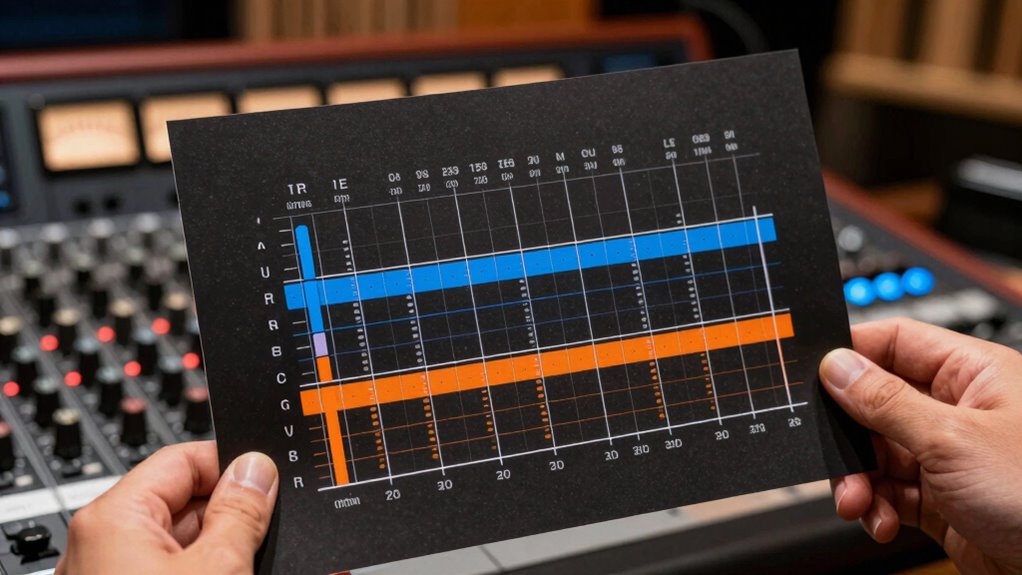
Ever wondered how to quickly identify the essential frequency ranges for different instruments and sounds? As a producer, understanding where each element sits in the frequency spectrum is fundamental for creating a balanced mix. Vocal placement, in particular, relies heavily on knowing the right frequency ranges to emphasize or cut. When you’re working on vocals, you want to find that sweet spot where the voice sits comfortably without clashing with other instruments. Typically, the human voice occupies the midrange, roughly between 200 Hz and 5 kHz, with the clarity and presence often found around 1-3 kHz. To make vocals sit well in your mix, you might boost slightly in this range but cut any muddiness below 200 Hz or harshness above 5 kHz. Using effective mixing techniques, like EQ cuts and boosts, helps carve out space for vocals, guaranteeing they remain clear and upfront without overpowering or getting lost. Recognizing these frequency ranges allows you to apply precise mixing techniques that enhance each instrument’s character. For example, bass instruments generally occupy the low end, from about 40 Hz to 250 Hz. When mixing, you may need to gently cut muddiness around 200 Hz or boost the fundamental frequencies of the bass to add warmth and depth. Kick drums also sit in this low range but tend to have a punch around 60-100 Hz. Using eq, you can accentuate the punch or reduce boxiness, depending on the style you’re aiming for. High-frequency ranges, from 8 kHz to 20 kHz, are essential for adding air and brightness to sounds. Cymbals, hi-hats, and shimmer effects thrive here, and careful boosting can make your mix sound more open and lively. Conversely, overly harsh sounds can be tamed with subtle cuts in this range. Midrange frequencies from 250 Hz to 2 kHz are where many instruments and vocals overlap, so knowing how to carve out space with precise EQ adjustments becomes imperative. Recognizing how exfoliation helps in controlling oil production and preventing buildup is crucial for achieving a clean, clear mix. Recognizing the importance of masking issues and how different sounds can compete for the same space helps in making better mixing decisions. Incorporating knowledge about projector technology, such as contrast ratio and color accuracy, can also influence how you perceive and interpret the visual aspect of your mixes during video production or multimedia projects. Additionally, understanding the role of dynamic range in your mix helps ensure that loud and soft sounds are balanced properly, preventing listener fatigue. Using proper mixing techniques, like subtractive EQ, allows you to reduce masking issues—where two sounds compete for the same frequency—and improve clarity. By understanding these ranges and applying thoughtful EQ, you help each element shine without cluttering the mix. Ultimately, the key to a professional sound is not just knowing the frequency ranges but applying this knowledge strategically in your mixing process. This approach guarantees each instrument and vocal sits perfectly in the mix, leaving space for everything to breathe and come through clearly.
studio monitor speakers for mixing
As an affiliate, we earn on qualifying purchases.
As an affiliate, we earn on qualifying purchases.
Frequently Asked Questions
How Do I Identify Which Frequencies Need Boosting or Cutting?
To identify which frequencies to boost or cut, listen closely and use spectral masking as your guide—if one sound hides others, consider cutting those overlapping frequencies. Focus on harmonic balancing, ensuring each element has space in the mix. Use EQ to subtly boost or cut specific ranges, and trust your ears to find the right balance. Regularly solo tracks to isolate and evaluate the frequency spectrum effectively.
What Tools Are Best for Precise Frequency Adjustments?
For precise frequency adjustments, you should use spectral analysis tools like a spectrum analyzer to visualize problem areas clearly. EQ with narrow bandwidths helps target specific frequencies, and automation allows dynamic adjustments throughout your mix. Combining spectral analysis with EQ automation lets you fine-tune your sound in real-time, ensuring each element sits perfectly in the mix without unwanted overlaps or muddiness.
How Does Room Acoustics Affect Frequency Response?
Room acoustics can substantially impact your frequency response, with studies showing that 60% of audio issues stem from poor room design. Room resonances cause certain frequencies to amplify or cancel out, creating uneven sound. Acoustic treatment helps control these resonances, smoothing out the response. By addressing room acoustics, you guarantee your mixes translate well across different playback systems, giving your productions a clearer, more professional sound.
Can Different Genres Require Different Frequency Ranges?
Yes, different genres often require different frequency ranges. Genre-specific processing tailors the mix to highlight characteristic sounds, making certain frequency ranges more prominent. For example, bass-heavy genres like hip-hop focus on lower frequencies, while acoustic genres emphasize mid and high ranges. Understanding frequency range variations helps you craft a balanced mix that suits each genre’s unique sound profile. Adjusting EQ and processing accordingly ensures your track sounds ideal within its stylistic context.
How Often Should I Revisit My Frequency EQ Settings?
You should revisit your EQ settings whenever your stereo imaging starts to blur and your dynamic range feels squashed—like your mix is auditioning for a one-note wonder. Think of it as giving your ears a spa day. Regular tweaks help maintain clarity and balance, ensuring your mix doesn’t turn into a muddy mess. So, listen critically, and adjust as needed—your tracks will thank you with crisp stereo imaging and a lively dynamic range.
Conclusion
Think of the frequency spectrum as a vast ocean, with each range a different wave you can ride. Mastering this chart is like learning to surf—catch the right wave at the right time, and your sound will flow effortlessly. Remember, your ears are your compass, guiding you through these waters. With this cheat sheet, you’re equipped to navigate the sonic currents, turning raw signals into a compelling, balanced mix that resonates like a perfectly tuned instrument.
Halloween Picks
halloween
As an affiliate, we earn on qualifying purchases.