

API keys can be your weakest security link if they’re not managed properly. Using broad permissions increases your risk of unauthorized data access, while infrequent rotations leave vulnerabilities open for longer. Regularly updating keys, limiting permissions to only what’s needed, and maintaining strict hygiene practices can greatly improve your security. To protect your environment and reduce risks, it’s essential to understand how these strategies work together—discover more on how to strengthen your API security now.
Key Takeaways
- Proper API key management involves regular rotation, scope restriction, and monitoring to prevent misuse and limit vulnerability windows.
- Limiting permissions and scopes minimizes attack surfaces and reduces the risk of unauthorized data access.
- Automated tools and strict lifecycle policies help identify, revoke, and replace unused or compromised API keys efficiently.
- Regular credential hygiene, including unique keys for each environment and prompt revocation of outdated keys, enhances security.
- Educating teams on best practices ensures consistent handling, reducing human error and strengthening overall API security.

API Analytics for Product Managers: Understand key API metrics that can help you grow your business
As an affiliate, we earn on qualifying purchases.
As an affiliate, we earn on qualifying purchases.
Understanding the Role of API Keys in Application Security

Have you ever wondered how applications verify your identity when they communicate with external services? That’s where API keys come into play. They act as unique identifiers, enabling secure access control between your app and third-party services. To keep your system safe, follow best practices, such as generating strong, unpredictable keys and avoiding hardcoding them. Properly managing API keys means restricting their scope and permissions, ensuring they only grant necessary access. Regularly rotating keys and monitoring usage also help prevent misuse. API keys aren’t just about convenience; they’re a critical part of your security strategy. When implemented correctly, they help protect sensitive data and maintain your application’s integrity, making access control more robust and less vulnerable to attacks. Incorporating security features like high refresh rates and proper calibration can further enhance your application’s overall safety and performance. Additionally, understanding the importance of vetted methods for managing credentials can significantly reduce potential vulnerabilities. Implementing proper key management ensures that your API keys are stored securely and used appropriately. Recognizing the significance of security hygiene in API key handling is essential for maintaining a resilient security posture. Paying attention to regular audits of your API key usage can uncover potential security gaps and improve overall protection.
API key rotation software
As an affiliate, we earn on qualifying purchases.
As an affiliate, we earn on qualifying purchases.
Why API Keys Are the Weakest Link in Your Security Chain

While API keys are essential for integrating with external services, they often become the weakest link in your security chain because they’re typically simple to obtain, reuse, or compromise. Attackers can exploit poorly protected keys to access sensitive data or impersonate your application. Using access tokens with robust encryption methods helps mitigate risks, but many still rely on plain-text keys. To strengthen security, rotate keys regularly, implement scoped permissions, and avoid embedding keys directly in code. Consider this: proper key management practices are crucial for maintaining the integrity of your security infrastructure. Additionally, understanding the limits of API keys can help you design more secure systems and reduce vulnerabilities. Recognizing the importance of free floating concepts in security can help prevent overreliance on static keys and encourage dynamic security measures. Incorporating regular audits can further identify potential weaknesses and improve overall security posture. Implementing multi-factor authentication can also add an extra layer of security to API key usage.

The Operational Excellence Library; Mastering API Security Best Practices
As an affiliate, we earn on qualifying purchases.
As an affiliate, we earn on qualifying purchases.
The Risks of Giving API Keys Broad Permissions

Giving API keys broad permissions substantially increases the risk of unauthorized access and data breaches. When you grant excessive permissions, credential mismanagement becomes more likely, as users or applications can inadvertently or intentionally access sensitive data or perform unintended actions. Permission overreach means that API keys provide more access than necessary, making it easier for malicious actors to exploit vulnerabilities if these keys fall into the wrong hands. This broad access reduces your control over how data is used and increases the potential impact of any security incident. By over-permissioning your API keys, you create an unnecessary attack surface, elevating the chances of abuse. To mitigate this, always follow the principle of least privilege and restrict API key permissions to only what’s essential for their specific purpose. Additionally, understanding API key scope can help you better manage and limit these permissions, especially considering the Gold IRA market, where security and trust are paramount. Implementing regular key rotations further minimizes long-term exposure and reduces the window of opportunity for misuse. Regularly auditing permission levels ensures that access remains appropriate and aligns with current security policies.
API key scope restriction tools
As an affiliate, we earn on qualifying purchases.
As an affiliate, we earn on qualifying purchases.
How Infrequent API Key Rotations Increase Security Risks

Infrequent API key rotations substantially weaken your security posture by increasing the window of opportunity for malicious actors to exploit compromised credentials. When you delay rotating keys, you give attackers more time to use stolen or leaked credentials without detection. Low rotation frequency often leads to stagnant credential complexity, making keys predictable or easier to guess over time. Without regular rotations, even strong initial credentials become vulnerable as they age, especially if other security measures lapse. Frequent rotation helps mitigate these risks by limiting the lifespan of a compromised key, reducing the chance of exploitation. Consistently updating your API keys guarantees that even if a breach occurs, the damage remains contained, and your overall security remains resilient against evolving threats.
Best Practices for Rotating API Keys Regularly

To effectively protect your systems, you should establish a routine for rotating API keys on a regular schedule. Regular rotation minimizes risks by ensuring that compromised keys become useless promptly. When rotating, prioritize token revocation to invalidate old keys and prevent unauthorized access. Set key expiration dates to enforce automatic invalidation after a specific period, reducing the window of opportunity for misuse. Automate the rotation process where possible to maintain consistency and reduce human error. Communicate changes clearly to your team to avoid disruptions. Remember, frequent key rotation limits exposure and makes it easier to detect suspicious activity. Incorporating encryption best practices ensures that your data remains protected throughout the key lifecycle. Additionally, understanding security protocols helps reinforce your overall approach to safeguarding sensitive information. Implementing regular audits can further identify vulnerabilities and ensure compliance with security standards, creating a comprehensive security framework.
Setting Precise Scopes to Limit API Key Access and Minimize Damage
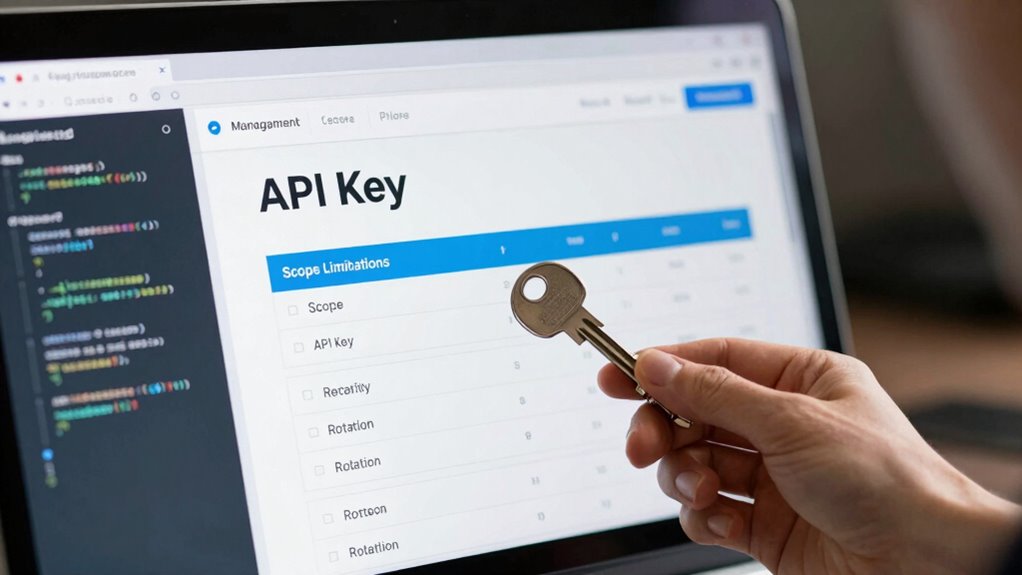
To reduce risk, you should define the minimum necessary access for each API key, granting only what’s essential. Regularly reviewing these permissions helps catch any overreach or outdated access. Keeping scopes precise safeguards your systems and minimizes potential damage. Understanding slang terms can also help in recognizing informal communications that might pose security risks.
Define Minimum Necessary Access
Setting precise scopes for your API keys is essential to limit access and reduce potential damage if keys are compromised. By defining the minimum necessary access, you strengthen your access control and improve credential management. Focus on granting only the permissions needed for specific tasks, avoiding broad privileges that could be exploited. Use a table like this to identify scope levels:
| Scope Level | Description |
|---|---|
| Read-only | View data, no modifications |
| Write | Add or update data |
| Delete | Remove data |
| Admin | Manage users and permissions |
| Full access | All operations, highest risk |
This approach minimizes exposure, ensuring each key has just enough access to function, reducing the risk if compromised. Incorporating best rated vacuum cleaners into your security practices emphasizes the importance of choosing the right tools and settings to safeguard your systems. Additionally, regularly reviewing and rotating your API keys enhances security by limiting the window of opportunity for malicious use. Moreover, implementing least privilege principles ensures that each API key operates with only the necessary permissions, further minimizing security risks. Enforcing strict scope restrictions helps prevent unintended access and potential damage from compromised keys, and adopting regular security audits can identify vulnerabilities before they are exploited.
Regularly Review Permissions
Reviewing permissions regularly guarantees your API keys stay aligned with your current needs and security standards. By routinely evaluating and tightening scopes, you improve permission hygiene and reduce potential attack surfaces. This proactive approach helps prevent permission creep, which can lead to unnecessary access and vulnerabilities. Additionally, understanding the importance of filtering access scopes ensures that each API key is granted only what is necessary, minimizing damage if a key is compromised. This practice ensures that each API key has only the necessary access, minimizing damage if a key is compromised. Regular reviews help you identify unused or overly broad permissions, prompting immediate adjustments. Maintaining good credential hygiene involves removing outdated keys and refining scopes to limit exposure. Staying proactive in permission management also supports compliance with security policies. Ultimately, consistent permission reviews empower you to control access precisely, strengthen your security posture, and prevent privilege escalation, making your API environment safer and more resilient.
How to Maintain Proper Hygiene With Your API Credentials

To keep your API credentials secure, you should use unique credentials for different applications. Limiting API permissions guarantees that even if a key is compromised, damage is minimized. Regularly rotating your keys helps prevent long-term misuse and keeps your system safe. Proper credential management ensures that access is closely controlled and monitored across your infrastructure.
Use Unique Credentials
Ensuring each API key is unique is essential for maintaining security and minimizing risks. Credential uniqueness helps you track and manage access effectively, preventing overlaps that could compromise your system. By implementing token differentiation, you make it harder for attackers to reuse or guess credentials. Protect your infrastructure by assigning distinct credentials for different services and environments.
Remember, the more unique your credentials, the easier it is to identify suspicious activity and respond swiftly. Keep these principles in mind:
- Safeguard each key with its own set of permissions
- Avoid reusing credentials across projects
- Regularly audit token differentiation practices
- Assign specific credentials for sensitive data
- Maintain a clear record of credential issuance
Prioritize uniqueness to strengthen your overall security hygiene.
Limit API Permissions
Limiting API permissions is an essential step in maintaining proper security hygiene for your credentials. By setting permission boundaries, you define the exact actions and data each API key can access, reducing risk if credentials are compromised. Access segmentation further strengthens security by isolating different parts of your system, ensuring that a breach in one area doesn’t grant access to everything. Use the principle of least privilege: give API keys only the permissions they need to perform their tasks. Regularly review these permissions to identify and remove any unnecessary access. This proactive approach minimizes potential attack surfaces, protects sensitive data, and helps you maintain tighter control over your API ecosystem. Proper permission management is a cornerstone of good security hygiene. Additionally, understanding the power of electric bikes can help you make informed decisions about their use and security in your systems. Implementing access controls aligned with your organizational policies further enhances your security posture and mitigates potential vulnerabilities.
Rotate Keys Regularly
Have you ever considered how often your API keys should be rotated to maintain security? Regular rotation is essential for credential hygiene and effective key governance. By staying proactive, you reduce the risk of exposure and prevent malicious access.
Remember:
- Protect your data from breaches
- Minimize the impact of compromised keys
- Build trust with clients and partners
- Demonstrate strong security practices
- Stay ahead of evolving threats
Rotating keys isn’t just a routine; it’s a crucial step to ensure your API credentials remain secure. Consistent rotations show a commitment to security hygiene and help you catch vulnerabilities early. Keep your keys fresh, your systems safe, and your reputation intact.
Common Mistakes Organizations Make When Managing API Keys

One of the most common mistakes organizations make when managing API keys is failing to enforce strict access controls. Without proper access control, keys can be over-privileged, increasing the risk of misuse or breach. Poor credential management often leads to sharing keys across teams or storing them insecurely, making them vulnerable to theft. You might neglect to regularly review or revoke unused keys, leaving outdated credentials active. Implementing fine-grained access control ensures each API key only grants the permissions necessary for its purpose. Regularly auditing credential management practices helps catch over-permissioned or unused keys, reducing attack surfaces. Failing to enforce these controls can result in unauthorized access, data leaks, and compromised systems—issues that are entirely preventable with disciplined management practices. Additionally, understanding the scope of each API key can prevent excessive permissions that pose security risks. Incorporating credential hygiene practices, such as rotation and secure storage, further strengthens overall security.
How to Detect and Remove Old or Unused API Keys

You need to regularly review your API keys to identify which ones are outdated or unused. Automated tools can facilitate this process by flagging inactive keys, while access activity monitoring helps you spot suspicious or unnecessary ones. Combining these strategies ensures you keep your system secure and minimize potential risks.
Regular Key Audits
Are your API keys still in use, or are some lingering unused and vulnerable? Regular key audits are essential for maintaining credential hygiene and reducing attack surfaces. By scheduling consistent audits, you can identify outdated keys and revoke them before malicious actors exploit them. During these reviews, you’ll uncover secrets buried in forgotten code or stale integrations. Imagine the relief of knowing your environment is secure and lean.
- Prevent security breaches with proactive cleanup
- Reduce the risk of accidental data leaks
- Ensure only necessary access persists
- Maintain compliance with industry standards
- Save time and resources by avoiding reactive fixes
Set an audit frequency that fits your environment, and stick to it. Regular audits keep your API keys healthy, trusted, and less vulnerable.
Automated Removal Tools
Automated removal tools streamline the process of identifying and deleting outdated or unused API keys, reducing the risk of human error and oversight. By integrating these tools into your key management practices, you improve your api hygiene and minimize security vulnerabilities. They scan your system regularly to flag inactive or expired keys, making it easier to remove unnecessary access points quickly. This automation guarantees that old keys don’t linger unnoticed, which could otherwise be exploited. Implementing automated removal processes also helps enforce policies for key lifecycle management, maintaining a cleaner, safer environment. With these tools, you can focus on proactive security measures instead of reactive cleanup, ensuring your API infrastructure remains robust and well-maintained. Automated removal is a vital step toward better key hygiene and more secure API practices.
Access Activity Monitoring
Monitoring access activity is a key step in identifying outdated or unused API keys before they become security risks. By regularly reviewing access logs, you can spot keys with little or no activity, reducing potential threat detection gaps. This proactive approach helps you understand how your API keys are being used and reveals suspicious patterns or anomalies.
Stay vigilant by:
- Reviewing access logs for unusual activity
- Identifying keys with no recent usage
- Tracking access patterns over time
- Removing or rotating inactive keys
- Ensuring only necessary keys are active
This process helps you close security gaps, prevent abuse, and maintain control over your API ecosystem. Detecting unused keys early safeguards your systems and minimizes vulnerability windows.
Automating API Key Rotation: Tools and Strategies

Implementing automated API key rotation can substantially enhance your security posture by reducing the risk of compromised credentials. By integrating tools that handle token management, you ensure keys are rotated regularly without manual intervention, maintaining strong credential hygiene. These tools often include features like scheduled rotations, secure storage, and audit logs, giving you consistent control over your API keys. Automation minimizes human error and guarantees keys are never used beyond their intended lifespan, limiting exposure if credentials are compromised. Popular solutions include CI/CD pipelines, secret management platforms like HashiCorp Vault, and cloud provider services such as AWS Secrets Manager or Azure Key Vault. Adopting these strategies helps you maintain a proactive security stance, reducing vulnerabilities associated with static API keys.
Securing API Keys in Development, Testing, and Production

Securing API keys across development, testing, and production environments is essential to prevent unauthorized access and data breaches. Proper credential management guarantees only authorized users can access sensitive systems, reducing risks. Implement strict access control to limit who can view or modify keys, and enforce role-based permissions. Regularly audit key usage to identify suspicious activity. Avoid hardcoding keys in code repositories, and restrict environment access.
- Feel the anxiety of a breach exposing sensitive data
- Experience relief when access control is tight
- Feel empowered with clear credential management strategies
- Avoid the nightmare of compromised environments
- Gain confidence knowing your API keys are protected
Storing API Keys Safely Using Environment Variables

You should store your API keys securely by using environment variables instead of hardcoding them. This practice helps safeguard your keys from accidental exposure and keeps your codebase clean. Managing environment variables carefully ensures your application’s security remains intact across development and deployment.
Secure Storage Practices
Have you considered how storing API keys directly in your code or configuration files can expose sensitive information? Proper secure storage is essential for effective key management. Using environment variables helps keep secrets out of your codebase, reducing risk. Ensure your environment variables are protected with strict access controls and encrypted storage solutions. Avoid hardcoding keys, which can be accidentally committed or leaked. Regularly audit your storage practices and rotate keys to minimize potential damage. Remember, secure storage isn’t just about hiding keys; it’s about safeguarding your entire infrastructure.
- Protect sensitive info from accidental exposure
- Prevent unauthorized access to secrets
- Reduce the risk of credential leaks
- Simplify key rotation and updates
- Strengthen overall security posture
Environment Variable Management
Using environment variables to store API keys is a practical way to keep sensitive information out of your codebase. This approach enhances credential hygiene by preventing keys from accidentally leaking into version control or shared files. You can set environment variables on your system or within deployment platforms, ensuring that your application accesses keys securely at runtime. Avoid hardcoding keys directly into your source code, as this creates unnecessary risk. Regularly review and rotate these environment variables to maintain security. By managing API keys through environment variables, you minimize exposure and reduce the chances of credential compromise. This simple yet effective practice helps you uphold best security standards and keeps your sensitive credentials protected from potential breaches.
Applying the Principle of Least Privilege to API Access

Applying the principle of least privilege to API access involves granting users and applications only the permissions necessary to perform their specific tasks. Proper credential management and access restrictions are essential to minimize risks. By limiting API keys to only what’s needed, you reduce the attack surface and prevent accidental or malicious misuse.
Limit API permissions to essential tasks, reducing risks and preventing misuse.
- Protect sensitive data from unnecessary exposure
- Prevent privilege escalation and data breaches
- Ensure accountability through precise access logs
- Minimize the damage from compromised keys
- Foster a security-conscious culture in your organization
Focusing on access restrictions means regularly reviewing permissions and removing unnecessary privileges. Credential management should include strict control over API key issuance and revocation. When you apply the least privilege, you strengthen your security posture and keep your systems safer.
Monitoring API Key Usage for Suspicious Activity

Monitoring API key usage is essential to detect and respond to suspicious activity before it leads to a data breach or system compromise. You should leverage behavioral analytics to establish normal usage patterns and identify deviations. Anomaly detection tools can flag unusual login times, unexpected IP addresses, or sudden spikes in activity that don’t fit typical behavior. Regularly reviewing logs helps you spot potential threats early. Set up alerts for abnormal API calls or access patterns, enabling quick investigation. This proactive approach minimizes the window for malicious actors to misuse compromised keys. By continuously monitoring usage and applying behavioral analytics, you strengthen your security posture and reduce the risk of unnoticed breaches through your API keys.
Responding Quickly When an API Key Is Compromised

When you detect signs that an API key has been compromised, acting swiftly can prevent significant damage. Your incident response must be immediate and decisive to contain the breach before it escalates. Prioritize breach containment by revoking the compromised key and rotating it with a new one. Keep your team alert and ready to assist in isolating affected systems. Remember, every second counts to limit exposure and stop attackers from exploiting further vulnerabilities.
- Feel the urgency of the moment, knowing lives are at stake
- Experience the adrenaline of halting malicious activity
- Feel empowered by quick, decisive action
- Recognize the importance of swift incident response
- Be confident in your ability to contain the breach rapidly
Educating Your Team on Proper API Key Security Practices

Educating your team on proper API key security practices is essential to prevent breaches and maintain system integrity. You need to emphasize access control, ensuring team members understand who should have access and under what circumstances. Proper credential management is critical—train everyone to generate unique API keys, rotate them regularly, and avoid sharing keys across projects. Make it clear that API keys are like passwords; they must be kept confidential and stored securely. Regular training sessions and clear documentation help reinforce these practices. Encourage your team to review permissions periodically and delete unused keys promptly. By fostering a culture of security awareness around credential management and access control, you reduce the risk of accidental exposure or misuse, strengthening your overall security posture.
Using API Gateway and Management Tools to Control API Keys

Using API Gateway and management tools helps you implement key rotation strategies, enforce granular access controls, and monitor API usage effectively. These tools give you the ability to automate security measures and respond quickly to potential issues. By leveraging them, you guarantee your API keys remain secure and your access remains tightly controlled.
Key Rotation Strategies
Implementing regular key rotation is essential for maintaining API security, and leveraging API gateways and management tools makes this process more manageable. By setting token expiration policies, you ensure keys automatically become invalid after a certain period, reducing risk. Using key revocation features allows you to swiftly disable compromised or outdated keys, minimizing damage. Effective strategies include:
- Automating key rotations to reduce human error
- Enforcing short-lived tokens for better control
- Monitoring key usage to identify suspicious activity
- Responding swiftly with revocation when needed
- Minimizing exposure by limiting key scopes during rotation
These practices keep your API environment resilient, preventing attackers from exploiting stale keys and ensuring your security stays airtight. Proper key rotation isn’t just good hygiene—it’s your frontline defense.
Granular Access Controls
Effective management of API keys goes beyond simple rotation; it requires precise control over who can access specific resources. That’s where granular controls come into play. Using an API gateway or management platform, you can segment access based on roles, applications, or user groups. This access segmentation ensures each API key grants only the permissions necessary for its purpose, reducing risk if a key is compromised. You can set fine-tuned policies to restrict endpoints, limit request rates, or specify data visibility. By implementing these controls, you minimize your attack surface and prevent over-privileged access. Granular access controls give you the power to tailor API permissions tightly, ensuring that users and applications only see what they need—making your API ecosystem more secure and manageable.
Monitoring and Auditing
How can you guarantee your API keys remain secure over time? By leveraging API gateway and management tools for continuous monitoring and auditing. These tools enable you to track credential management activities, detect suspicious behaviors, and enforce security policies. Regular audit frequency helps catch vulnerabilities early, ensuring your API keys aren’t compromised. To keep your system resilient, consider these critical actions:
- *Stay vigilant with real-time alerts for unusual API activity*
- *Maintain strict control over credential management procedures*
- *Regularly review audit logs for anomalies*
- *Rotate keys proactively based on audit insights*
- *Implement layered security measures to prevent breaches*
Consistent monitoring and thorough auditing strengthen your defenses, making it harder for attackers to exploit weak points. Protect your API ecosystem by making these practices an ongoing priority.
Real-World API Key Breaches: Lessons Learned

When API keys are mishandled or left exposed, organizations can suffer severe security breaches. Credential theft often occurs when keys are stored insecurely or shared improperly, enabling attackers to access sensitive data or manipulate systems. These breaches highlight the importance of misuse prevention strategies, such as restricting key permissions and rotating keys regularly. In many cases, attackers exploit poorly managed API keys to infiltrate networks, leading to data leaks and service disruptions. Learning from these incidents shows that neglecting proper key management creates vulnerabilities that are easy to exploit. To avoid similar pitfalls, organizations must implement strict access controls, monitor key usage, and respond swiftly to suspicious activity. Proper hygiene around API key handling is critical to safeguarding your infrastructure from real-world threats.
Building a Robust API Key Lifecycle Management Process

Creating a robust API key lifecycle management process is essential to maintaining your system’s security and integrity. You must actively manage the credential lifecycle, from creation to expiration, to prevent vulnerabilities. Proper key hygiene ensures outdated or unused keys are revoked promptly, reducing attack surfaces. Implement strict controls around key issuance, regularly review access permissions, and automate rotations where possible to minimize human error. Keep an eye on expired or compromised keys, and revoke them immediately. Establish clear policies for key creation, rotation, and revocation to foster discipline and consistency. Remember, neglecting key hygiene or mishandling credential lifecycle increases risk. By diligently overseeing each stage, you safeguard your infrastructure from potential breaches and maintain trust in your API ecosystem.
Combining Rotation, Scopes, and Hygiene for Better Security

To improve your API security, you should regularly rotate your keys, so compromised ones become useless. Defining precise access scopes guarantees each key only grants necessary permissions, reducing risk. Enforcing strong hygiene practices, like removing unused keys, keeps your system clean and less vulnerable.
Implement Regular Key Rotation
Regularly rotating your API keys is essential for maintaining robust security. It strengthens the key lifecycle, reducing the risk of compromised credentials lingering unnoticed. Proper rotation keeps your credential hygiene intact, preventing outdated or unused keys from becoming attack vectors. When you implement a routine rotation schedule, you actively limit exposure and improve overall security posture.
Consider these emotional benefits:
- Feel confident knowing your data is protected
- Reduce anxiety over potential breaches
- Maintain control over who accesses your systems
- Strengthen your trustworthiness with clients
- Stay proactive against evolving threats
Define Precise Access Scopes
Defining precise access scopes is essential for maximizing the security benefits of your API keys. You need to limit each key’s access scope to only what’s necessary for its specific task. This improves permission granularity, reducing the risk if a key is compromised. Instead of granting broad, unrestricted access, specify exact endpoints, data, or actions the key can perform. Fine-tuning access scopes helps prevent accidental misuse and minimizes damage potential. Always review and adjust these scopes as your application evolves, ensuring they remain aligned with your security policies. Clear, precise access scopes act as an essential layer of defense, ensuring each API key has only the permissions it truly needs—and nothing more. This targeted approach substantially enhances your overall security posture.
Enforce Strong Hygiene Practices
Implementing strong hygiene practices for your API keys involves more than just setting precise access scopes; it requires a thorough approach that combines key rotation, scope management, and ongoing maintenance. Good credential hygiene prevents vulnerabilities and builds trust. By actively managing your keys, you reduce the risk of breaches and protect sensitive data. Maintain consistent key hygiene by regularly auditing and deleting unused or compromised keys. Enforce strict rotation policies to limit exposure if a key is compromised. Avoid complacency—security is an ongoing commitment.
- Feel the relief of knowing your data is protected
- Experience confidence with proactive key management
- Avoid devastating breaches caused by negligence
- Empower your team with disciplined credential hygiene
- Rest easy knowing your security is airtight
Future Trends in API Key Security and Authentication

As cybersecurity threats continue to evolve, future trends in API key security and authentication are leaning toward more adaptive and resilient solutions. You’ll see increased reliance on token expiration, ensuring API keys automatically become invalid after a set period, reducing the risk of misuse if compromised. Biometric authentication is also becoming more prevalent, offering a seamless yet secure way to verify identities without relying solely on static keys. These advancements aim to minimize vulnerabilities by making access controls more dynamic and user-specific. Expect implementations that combine short-lived tokens with biometric data, providing a layered defense that adapts to emerging threats. As a result, API security will shift from static, long-term keys to more sophisticated, context-aware authentication mechanisms.
Strengthening Your API Security by Addressing Its Weakest Points

To effectively enhance your API security, you need to identify and address its weakest points before attackers do. Focus on critical areas like token expiration to limit the lifespan of compromised tokens, reducing risk. Strengthen credential complexity by enforcing strong, unique keys to prevent brute-force attacks. Regularly rotate API keys so that even if a key is compromised, damage is minimized. Limit API key scopes to restrict access to only necessary functions, reducing the attack surface. Monitor for suspicious activity and implement automated alerts to catch threats early. By closing these gaps, you safeguard your data, reputation, and user trust, making it harder for malicious actors to exploit your API vulnerabilities.
Frequently Asked Questions
How Can API Key Misuse Impact Overall Application Security?
Misusing API keys can seriously compromise your application’s security by bypassing access control measures. If an API key is leaked or misused, attackers gain unauthorized access to sensitive data or services. This highlights the importance of threat modeling to identify vulnerabilities. Regularly rotating keys and limiting scopes help prevent misuse, ensuring your application stays protected from potential breaches and maintaining your overall security posture.
What Are the Signs of Compromised API Keys?
You’ll notice signs of compromised API keys if you see token leakage or unexpected activity, like unusual login attempts or data access. Unauthorized access might cause sudden spikes in usage or errors in your application. Keep an eye on logs for unfamiliar IP addresses or endpoints. If you detect these signs, act quickly to revoke the compromised keys to prevent further damage and secure your system.
How Often Should API Keys Be Reviewed and Revoked?
Ever wonder how often you should review and revoke your API keys? You should do this regularly—at least quarterly—to guarantee security. Implement key rotation strategies and conduct access auditing to spot any suspicious activity. If you notice any signs of compromise or outdated permissions, revoke keys immediately. Keeping your keys fresh minimizes risks and maintains your system’s integrity. Don’t wait for an incident; stay proactive with routine reviews.
Can API Key Management Be Automated Effectively?
Yes, you can automate API key management effectively by implementing automated rotation and key lifecycle management. By setting up systems that automatically rotate keys at regular intervals and monitor their lifecycle, you reduce risk and improve security. Automated tools also help revoke compromised keys quickly, ensuring continuous protection. This proactive approach minimizes manual effort, maintains best practices, and keeps your API access secure without constant oversight.
What Are Emerging Threats Targeting API Key Security?
Emerging threats like token theft and espionage pose serious risks to your API key security. Hackers target weak points to steal tokens, then misuse them for unauthorized access or data breaches. To defend yourself, stay vigilant, monitor for suspicious activity, and implement strong security measures. Continually updating and rotating keys helps prevent attackers from exploiting stolen tokens, reducing your overall vulnerability to these evolving threats.
Conclusion
If you ignore rotating your API keys, you’re practically handing hackers the keys to your kingdom. Broad permissions and poor hygiene turn your weakest link into a fortress for attackers. Keep your API keys fresh, scoped, and clean, or risk facing catastrophic breaches that could cripple your entire system overnight. Stay vigilant with your API security, because if you let this slide, you might as well invite chaos into your digital world.