
TL;DR

Get audio and creator gear delivered free with Prime
- Fast, free delivery on millions of items
- Prime Video, Amazon Music and more included
- Member-only deals all year
Lawn fertilizer supplies nutrients that help grass grow, recover from stress, and maintain color, but a soil test should guide what you apply. Compare the NPK ratio, release style, coverage, and label directions before choosing a replacement; a similar bag size or product name does not guarantee a similar formula. Apply only the labeled amount when your grass is actively growing, and keep excess nutrients off pavement and out of waterways.
A bag that once covered your whole lawn can leave you with a surprisingly tricky question: what should you buy when you can’t find the same formula? The answer isn’t simply “pick another green bag.” Lawn fertilizer labels describe different nutrient mixes, release speeds, and coverage areas, and the wrong match can waste product or stress the grass you’re trying to improve.
This guide explains how to read the numbers, check what your lawn actually needs, and compare several alternatives to a 32-0-5 granular fertilizer described as covering up to 4,000 square feet. It also shows you why products that look similar on one specification may be very different in use. Think of choosing fertilizer like choosing a recipe: the package is the ingredient list, but your lawn is the dish you’re making.
You’ll come away with a practical way to compare options, measure your lawn, and apply fertilizer with less guesswork. The key facts are simple: test the soil, follow the label, and match the product to the grass. A fertilizer can help with nutrient shortages, but it cannot fix shade, poor drainage, compacted soil, or pests.
Read NPK numbers as percentages by weight of nitrogen, phosphate (P₂O₅), and potash (K₂O); a similar package size does not mean a similar nutrient mix.
Use a soil test to guide nutrient choices, especially before applying phosphorus to an established lawn.
Compare alternatives by their stated NPK ratio, intended use, form, coverage, and directions; verify missing details on the current product label.
Measure the lawn and apply only the labeled rate when your grass is actively growing and conditions suit the product.
Keep fertilizer off pavement and storm drains, and follow the label’s watering, storage, and re-entry instructions.
Read the three fertilizer numbers before you buy
Lawn fertilizer NPK numbers tell you the percentages by weight of nitrogen, phosphate, and potash, listed in that order. Nitrogen usually supports leafy growth and green color, phosphorus supports root development, and potassium helps grass maintain its functions and cope with stress. A label reading 32-0-5 therefore has a very different nutrient balance from 14-14-14, even if both products come in granular form.
Those numbers describe concentration, not the amount your lawn will receive by themselves. The application rate determines how much product is spread over an area, so a high-nitrogen formula used at a low rate may deliver a similar nitrogen amount to a lower-analysis product used more generously. The label rate ties the analysis to a usable dose; changing either one without recalculating can mean too little nutrition or turf damage.
Those numbers are not a complete recipe for lawn care. They tell you what the product supplies, but not whether your soil needs those nutrients, how quickly the product releases them, or how much you should apply. A soil test adds the missing context. It can identify nutrient deficiencies and soil pH issues that a fertilizer bag cannot diagnose from your lawn’s color alone.
Imagine your grass looks pale in a sunny patch beside a driveway. It’s tempting to assume it needs a high-nitrogen product, but compacted soil, poor watering, or heat stress can also leave turf looking tired. Adding nutrients without finding the cause is like adding salt to a meal that needs more water: you’ve changed something, but not necessarily the thing that was wrong. Excess nitrogen can also push rapid leaf growth that the roots and water supply cannot support, creating more mowing and potentially increasing nutrient loss.
Read the NPK ratio as a nutrient mix, not a quality score. More nitrogen does not automatically mean a better lawn fertilizer for your yard.
When comparing products, note the full ratio, the grass or use named on the label, and any instructions about application season. If a listing doesn’t state an NPK ratio, don’t assume it matches a familiar formula. Check the product label directly before you buy or spread it. A close ratio can help you shortlist a replacement, but only the soil test and labeled rate indicate whether it fits your lawn’s needs.
As an affiliate, we earn on qualifying purchases.
Test your soil so you don’t feed a problem the wrong way
A soil test helps you decide whether your lawn needs fertilizer and which nutrients it may be missing. It can also show whether soil pH needs attention. That matters because a lawn can look weak even when it has plenty of nutrients; the root cause might be drainage, shade, compaction, pests, or grass that doesn’t suit the site.
Suppose the grass under a mature maple stays thin while the sunny front lawn looks healthy. Spreading the same fertilizer across both areas may not solve the shaded patch: tree roots compete for water, and limited light may be the bigger constraint. A test can tell you whether nutrients are part of the problem, while a close look at light, soil moisture, and foot traffic helps explain the rest. Treating different patches separately can cost more time, but it avoids applying nutrients where they are unlikely to help.
Many established lawns do not need extra phosphorus unless a soil test shows a deficiency. That is one reason to check before choosing a product with a large middle NPK number. Phosphorus can move with runoff into lakes and streams, where it may contribute to excess algae growth; applying it without a demonstrated need brings environmental cost without a likely lawn benefit. Local rules may also restrict phosphorus use, so check your local guidance as well as the bag.
You can treat a soil test like a mechanic’s diagnostic check. The test identifies likely trouble under the surface; it doesn’t repair every problem for you. If the result points to low potassium, for instance, a product’s nitrogen content alone won’t address that finding. Follow the test recommendations and compare them with the label’s permitted uses and rates. If the test and product directions do not line up, look for a better-matched product or ask a local extension service how to meet the recommendation safely.
- Check soil pH if the test includes it; a pH issue can affect nutrient availability.
- Look beyond fertilizer for standing water, hard soil, heavy shade, pests, or watering trouble.
- Use local guidance for nutrient rules, especially near waterways.
The practical payoff is fewer blind applications. You buy lawn fertilizer supplies that answer a known need instead of hoping a broad product fixes whatever made the grass look off. Testing adds a step and sometimes a fee, but it can prevent buying an unsuitable formula and repeating applications that do not solve the underlying problem.
Compare replacement fertilizers by what your lawn will actually get
A useful replacement comparison checks nutrient ratio, formulation, coverage, and intended use together. Similar package weights can hide very different coverage and nutrient mixes, while a product with a familiar brand name may still use a different formula. Treat each specification as one clue, then confirm the current package label before applying anything.
The reference product in this comparison is Pennington Full Season Lawn Fertilizer 32-0-5, described as an 11.2-pound granular product covering up to 4,000 square feet. The alternatives below have some overlapping specifications, but the overlap does not prove they are direct formula matches. Several listed ratios are unavailable in the supplied product details, and one option is described for flowers and vegetables rather than lawn grass.
| Product | Form and stated coverage | Details to verify |
|---|---|---|
| Osmocote Smart-Release Plant Food Flower & Vegetable | Granules; 8 lb; 320 sq. ft. | Listed as 14-14-14; stated target is flowers and vegetables, so check whether lawn use is allowed. |
| Jonathan Green Corn Gluten Lawn Fertilizer | Granules; 15 lb; 5,000 sq. ft. | Product details list 10-0-2; compare its directions and intended use with your lawn needs. |
| Scotts Turf Builder Liquid Lawn Food | Liquid; 32 fl oz; up to 2,000 sq. ft. | Listed for lawn grass; confirm the current nutrient analysis and application directions. |
| GreenView Fairway Formula Fall Lawn Fertilizer | Granules; 45 lb; 15,000 sq. ft. | Fall lawn product; confirm its nutrient ratio and whether the timing suits your grass. |
The table’s coverage figures describe the area each package is said to treat at its own directions; they do not establish equal nutrient delivery. For example, a 4,000-square-foot yard is larger than the stated coverage for the Osmocote product and twice the stated coverage for the Scotts liquid product. You would need multiple packages to cover the whole area at those stated rates, and using less than the directions to stretch one package could underfeed or misapply it. The Jonathan Green and GreenView listings state more coverage, but coverage alone does not tell you whether their nutrient mix suits your soil. Match each product to the label, not just the yard-size number.
The products also trade convenience and fit differently. Granules can suit a broad lawn when you have the right spreader, while liquid may be easier to direct on a smaller area but requires consistent mixing or hose-end application. A flower-and-vegetable product may have an appealing analysis yet still be inappropriate for turf if the label does not allow lawn use. A fall lawn formula may fit a seasonal need but be poorly timed for grass outside its intended growth period.
Use this comparison as a screening tool. If a listing omits the NPK ratio or describes a different target, pause and inspect the package information before treating it as a lawn substitute. A true replacement is the one that supplies the needed nutrients at a practical rate over your measured area, not simply the closest match in package size.
Choose granular or liquid based on how you’ll apply it
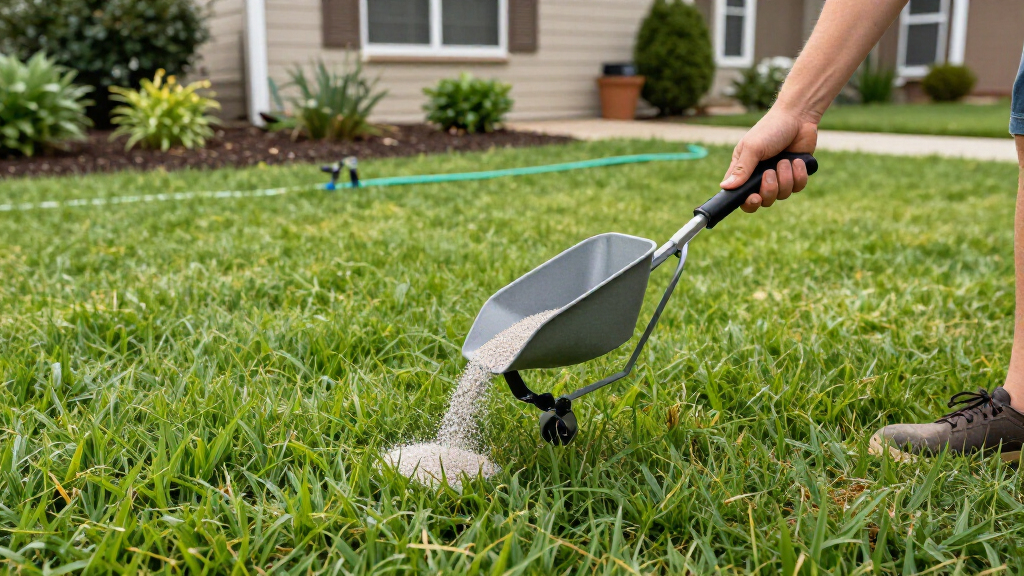
Granular and liquid lawn fertilizers differ in how you handle and spread them, so choose the form you can apply evenly according to its label. Granules are small particles spread over turf, usually with a hand or push spreader. Liquid products are mixed or applied as directed, often with a hose-end applicator. Neither form is automatically the right choice for every yard.
Picture a narrow lawn with flower beds along both edges. Granules can be convenient over a broad, open area, but careless spreading can scatter them onto a walkway or into a bed. A liquid product may make it easier to treat a defined patch, though you still need to follow the coverage rate and avoid uneven passes. In either case, the tool and technique matter as much as the product form.
Some fertilizers use slow-release nitrogen that feeds grass more gradually. Quick-release nitrogen can green turf faster, but rapid growth may increase the risk of burn or nutrient loss if you misapply it. The product label is the best guide to release style and watering directions; don’t infer performance from the word “full season” or from the package weight alone.
Think of application like painting a fence. A good paint can still leave stripes if you rush or overlap randomly; a good fertilizer can create uneven growth if you leave gaps or double up. Calibrate a spreader if the label calls for it, walk at a steady pace, and avoid applying product to hard surfaces.
- Granules: check spreader settings and sweep stray particles from pavement back onto the lawn when appropriate.
- Liquid: follow dilution and application instructions, and keep each pass consistent.
- Either form: use the stated coverage and rate; don’t estimate by eye.
For a small patch, the easiest product to control may be the one you can measure and distribute evenly. For a larger lawn, coverage and the right spreading equipment become more important.
Apply the right amount at a time your grass can use it
Apply lawn fertilizer at the label rate when your grass is actively growing and can use the nutrients. The right season depends on grass type, climate, soil, and local conditions, so a fixed calendar from another region may not fit your yard. Cool-season and warm-season grasses follow different growth cycles.
- Identify your grass and current conditions. Note whether it is actively growing, heat-stressed, drought-stressed, or recovering from damage.
- Measure the treatment area. A lawn that measures 40 feet by 50 feet covers 2,000 square feet, not the entire lot if the house and beds take up space.
- Read the current product label. Match its rate, timing, watering, and re-entry instructions to your situation.
- Spread evenly and protect hard surfaces. Keep granules and spray off sidewalks, driveways, and storm drains.
- Check weather and follow cleanup directions. Avoid applying before heavy rain and sweep stray granules back onto turf.
The measured area and label rate work together: if you treat less area than you calculated, the same quantity becomes a higher dose per square foot. For example, a homeowner with a warm-season lawn in a hot, dry spell shouldn’t copy a neighbor’s cool-season fall routine. Fertilizing stressed grass can add strain or damage; wait for suitable conditions and follow regional advice and the product directions.
Overapplication can scorch turf, encourage weak rapid growth, and send excess nutrients into waterways. More product does not mean faster repair. Underapplication caused by stretching a package too far can also fail to meet the intended treatment rate. If you spill fertilizer or think you applied too much, follow the product label and local extension guidance rather than improvising with extra water or another treatment.
Measure first, then apply the labeled rate. Guessing from the size of the bag makes it easy to put too much in one pass.
Use fertilizer as one part of a healthier lawn routine
Fertilizer supplies nutrients, but healthy turf also depends on mowing, watering, soil condition, and the right grass for the site. Nutrients that help grass grow can’t make a shade-loving patch appear in deep shade or drain a soggy low spot. Use fertilizer to address a nutrient need, and fix the growing conditions that keep the lawn from using those nutrients well.
Consider a thin strip beside a path where people walk every day. The soil may be packed hard, so water runs off instead of reaching the roots. Spreading fertilizer there can produce little improvement. Aerating compacted soil when needed, adjusting foot traffic, and watering deeply but not excessively may do more to help the grass recover from stress.
Mowing at an appropriate height helps protect the turf, and leaving fine grass clippings on the lawn can return nutrients as they break down. That doesn’t replace a soil test or a needed fertilizer treatment, but it may reduce what you need to apply over time. A lawn-care routine works more like a team than a single hero product: each practice supports the others.
Organic and recycled nutrient sources, including compost-based products and materials from plants or animals, appeal to many homeowners. Their nutrient content and release rates can vary, though, and “organic” does not automatically mean harmless or right for every lawn. Read the analysis, intended use, and handling directions just as you would for a conventional product.
If your lawn turns yellow, check the pattern before reaching for fertilizer. A uniform change might point you toward nutrients or seasonal dormancy; a patch beside a downspout may signal excess water, while a worn track may need attention to soil compaction. When the cause is unclear, local extension guidance or a soil test can narrow the possibilities.
Keep children, pets, and nearby water in mind while you apply
Follow the fertilizer label’s handling, watering, and re-entry directions to protect people, pets, and nearby waterways. Products differ, so one general waiting time cannot safely describe every bag or bottle. Store fertilizer securely and use the product only on the sites and plants named on its label.
Imagine you’re spreading granules on Saturday morning while a dog waits at the patio door. Keep the pet away from the treated area for the period stated on the product label, and follow any watering instructions before access resumes. If the directions say to water the lawn, do so as directed; if they don’t, don’t invent a rule from another product.
Runoff can carry excess nutrients into storm drains, creeks, and lakes. Sweep stray granules off sidewalks and driveways rather than rinsing them into the street, and avoid spreading before heavy rain. Phosphorus restrictions vary by jurisdiction and can change, so check local requirements before buying or applying a phosphorus-containing product.
Keep lawn fertilizer away from vegetable beds unless the label explicitly permits that use. A lawn formula may have nutrient proportions or other product directions that do not suit edible crops. For instance, an ornamental or lawn product sitting near a kitchen garden is not automatically safe to scatter around tomatoes.
- Read the label before opening the bag. Check protective steps, storage, watering, and re-entry instructions.
- Keep product on the lawn. Sweep hard surfaces clean and protect storm drains.
- Use only for labeled purposes. Don’t assume lawn fertilizer is suitable for vegetables.
These small habits make application more predictable and reduce the chance that your lawn-care routine becomes a water-quality problem.
Frequently Asked Questions
When should I fertilize my lawn?
Fertilize when your grass is actively growing and local conditions suit the product. Timing depends on whether you have cool-season or warm-season grass, your climate, and the label’s directions. A neighbor’s schedule may not fit your yard.
How often should I apply lawn fertilizer?
There is no single schedule for every lawn. Use soil-test recommendations, grass type, local guidance, and the product label to set timing and frequency. Applying more often than directed can damage turf and increase runoff.
Does an established lawn need phosphorus?
Many established lawns do not need added phosphorus unless a soil test shows a deficiency. Local rules may restrict phosphorus products, so check current requirements where you live before applying them.
Can lawn fertilizer fix yellow or thin grass?
Only if a nutrient shortage is part of the cause. Shade, pests, disease, poor drainage, compaction, and watering problems can also make grass thin or yellow, so inspect the lawn and consider a soil test before treating it.
Should I water after applying fertilizer?
Follow the product label because watering directions vary. Avoid applying before heavy rain, and don’t rinse granules from pavement into a storm drain. Sweep stray particles back onto the lawn when the product directions allow.
Is organic lawn fertilizer safer?
Organic products can be useful, but their nutrient content and release rates vary. They still need correct handling and application, and overuse can harm turf or contribute to runoff. Read the label and match the product to your lawn’s needs.
Can I use lawn fertilizer in a vegetable garden?
Use it there only if the product label permits that use. Lawn formulas may have nutrient proportions or directions that are unsuitable for edible crops, so choose a product labeled for the plants you plan to grow.
Conclusion
Choose lawn fertilizer by matching the label to your lawn’s tested needs, measured area, and growing conditions. A familiar brand, a similar bag weight, or a broad coverage claim can help you narrow the options, but none tells you by itself that the nutrient mix is right. Check the NPK ratio, confirm lawn use, and follow the current directions before you spread anything.
Then give the grass the support it can use: sound mowing, sensible watering, and soil that lets roots breathe. The right fertilizer should feel less like a guess and more like a measured recipe, leaving your lawn greener without sending the extra ingredients down the street.
Fall Picks
fall essentials
As an affiliate, we earn on qualifying purchases.