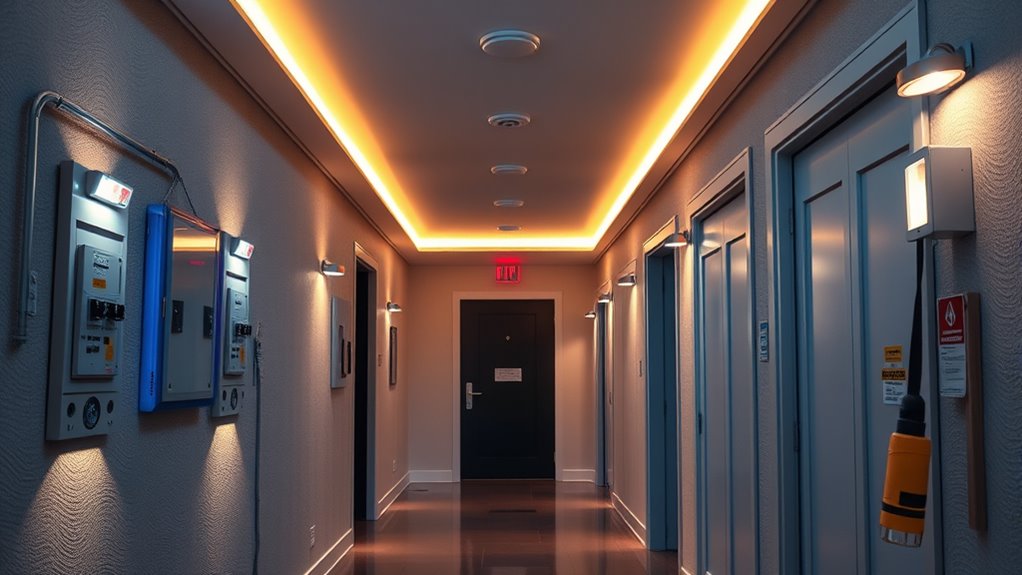

To build a whole-home emergency lighting plan, start by evaluating all escape routes, ensuring doors, windows, and hallways are well-lit and unobstructed. Choose reliable fixtures like LED emergency lights, and place them strategically along exit pathways, stairs, and high-risk zones. Plan for backup power sources such as batteries or generators, and install clear signage for directions. Regularly inspect, test, and maintain your system, keeping detailed records. If you continue exploring, you’ll discover how to customize your plan to fit your home’s unique features and risks.
Key Takeaways
- Assess all rooms and pathways to determine optimal locations for emergency lighting and escape routes.
- Ensure fixtures and signage meet local codes and standards, including visibility, illumination duration, and installation requirements.
- Plan for sufficient coverage by spacing lights 40-50 feet apart and positioning near exits, stairs, and obstacles.
- Incorporate reliable power sources, such as batteries or backup generators, and schedule regular testing and maintenance.
- Document the entire plan, including layout, fixture specifications, testing procedures, and compliance with regulatory standards.

Philips Wi-Fi Door Lock, WiFi Smart Lock Keyless Entry Deadbolt for Front Door, Compatible with Alexa & Google Assistant, Remote Control, Built-in WiFi, APP Fingerprint Passcode Unlock, Auto Locking
𝐅𝐥𝐞𝐱𝐢𝐛𝐥𝐞 𝐖𝐚𝐲𝐬 𝐭𝐨 𝐔𝐧𝐥𝐨𝐜𝐤: Unlock the way you want: app, passcode, fingerprint, physical key, or voice via Alexa/Google...
As an affiliate, we earn on qualifying purchases.
Assessing Your Home’s Escape Routes and Safety Zones
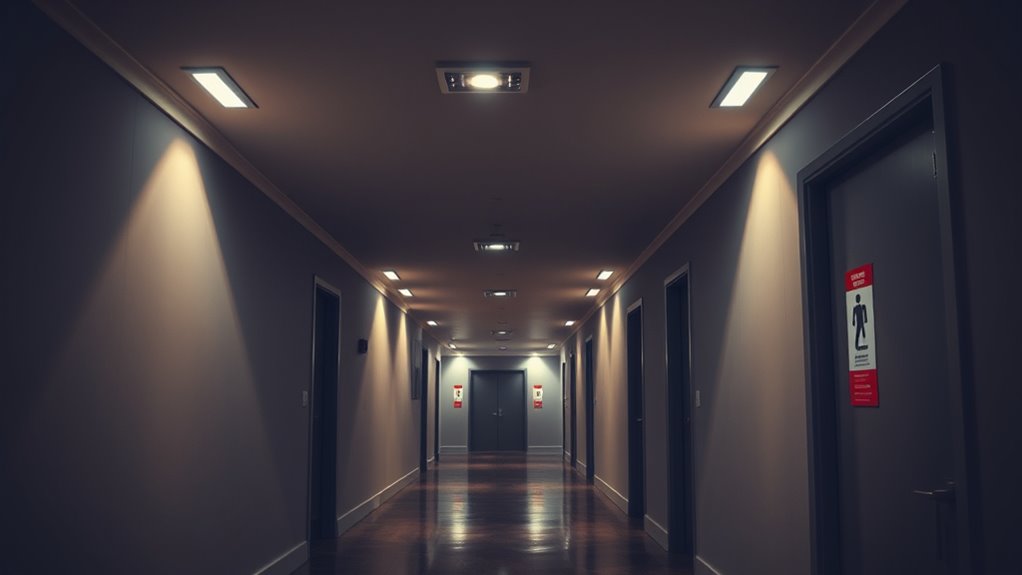
Evaluating your home’s escape routes and safety zones is a crucial step in ensuring your family’s safety during emergencies. First, check that escape routes meet minimum size standards: at least 2.10 meters high and 2 meters wide for the main escape path. Ensure passageways and doors maintain clearances of at least 1.95 meters in height and similar widths, free from obstacles like fire extinguishers or door hardware that could block movement. Avoid using escalators, spiral stairs, or fixed ladders as primary routes; straight stairs are preferable unless exceptions apply. Make sure each room has two accessible exits—like doors and windows—that can open quickly. Clearly mark escape routes on a home map, considering each floor’s layout and potential barriers, to enhance familiarity and facilitate drills. Additionally, properly planning the escape route length ensures quick evacuation, especially in high-risk areas, and helps prevent delays during emergencies. Recognizing the importance of escape route dimensions can also motivate you to stay calm and focused during an actual escape. Incorporating knowledge about home safety can further improve your preparedness and response strategies. Furthermore, understanding emergency lighting can illuminate escape paths during power outages and improve visibility.

ULTRALOQ Bolt SE Smart Lock, Built-in Wi-Fi, Matter Over Thread, Works with Apple Home, Alexa, Google, 7-in-1 Keyless Entry Deadbolt with Fingerprint ID, App, Keypad, Remote Control, 18 Months Battery
𝟕-𝐢𝐧-𝟏 𝐊𝐞𝐲𝐥𝐞𝐬𝐬 𝐄𝐧𝐭𝐫𝐲 𝐃𝐨𝐨𝐫 𝐋𝐨𝐜𝐤: Fingerprint ID + Passcodes + Smartphone App + Web Portal + EKey /...
As an affiliate, we earn on qualifying purchases.
Understanding Regulatory Requirements and Standards
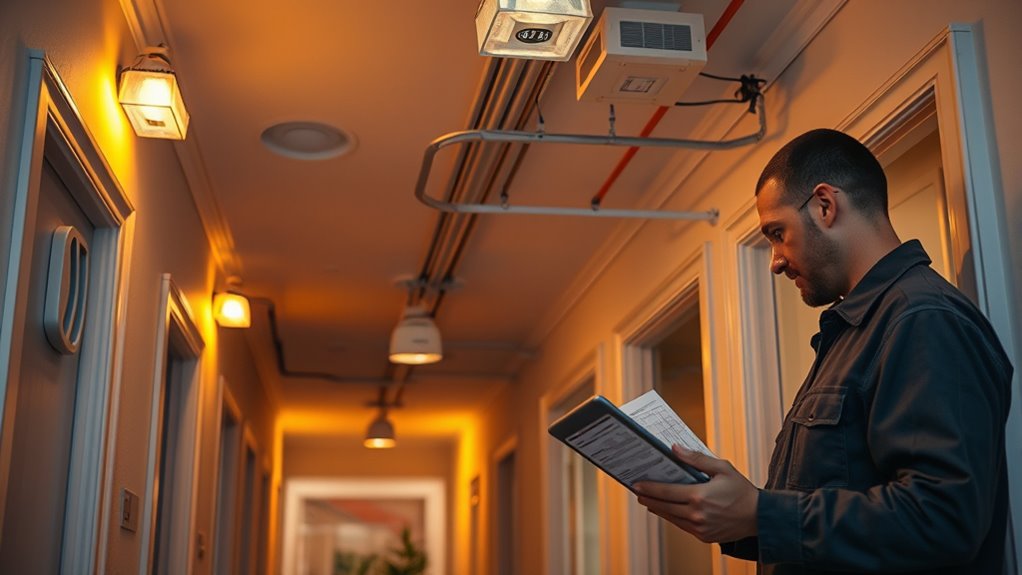
Understanding regulatory requirements and standards is essential to guarantee your emergency lighting system is compliant and reliable. You need to know the key codes, testing protocols, and maintenance practices that apply to your building, including local variations. Staying informed helps you avoid penalties and guarantees occupant safety during emergencies. Emergency exit lights are mandated in nearly all commercial buildings, with few exceptions, and understanding these requirements ensures that your system will activate promptly and provide adequate illumination during power failures. Familiarity with Self Watering Plant Pots can also inform maintenance schedules for lighting systems, as both require regular monitoring to ensure proper function. Additionally, understanding the signs of spoiled lemon juice can help in maintaining equipment related to beverage or food service areas within your building, ensuring safety and compliance. Recognizing the nutritional advantages of green juice can also influence the maintenance of kitchen appliances used for healthy food options, supporting overall health standards. Furthermore, implementing routine sound testing procedures can help verify system functionality and adherence to safety standards, ensuring reliable operation during emergencies.
Code Compliance Essentials
Regulatory requirements and standards set the foundation for designing effective emergency lighting systems that guarantee safety during power failures. The NFPA 101 Life Safety Code is your primary guide, requiring at least 1 foot-candle of illumination on exit paths for a minimum of 90 minutes. The International Building Code mainly applies to new constructions and renovations, while OSHA standards reinforce these rules for workplaces. Local Authorities Having Jurisdiction (AHJ) may impose additional requirements based on regional hazards or occupancy types. Emergency lighting must automatically activate within 10 seconds of power loss, providing proper illumination along all critical egress points. Power supplies like batteries or generators must meet safety standards such as UL 924 and ensure continuous operation for at least 90 minutes, depending on building needs. Additionally, compliance with these standards ensures the reliability and effectiveness of emergency lighting systems during crises. Ensuring that these systems are regularly tested and maintained is crucial to meet reliability standards, and implementing preventive maintenance protocols helps minimize system failures during emergencies. Regular inspections and maintenance protocols help identify potential issues before emergencies occur, further supporting system dependability.
Testing and Maintenance
To guarantee emergency lighting systems operate reliably during power failures, regular testing and maintenance are essential. You must adhere to regulatory standards to ensure system performance and safety. Conduct monthly functional tests, or daily if using central battery systems, to verify lights activate automatically within 10 seconds of power loss and meet intensity standards. Perform annual full discharge tests to confirm battery capacity and system endurance. Keep detailed records of all tests and maintenance activities, including dates, outcomes, and repairs, to demonstrate compliance and identify recurring issues. Regular inspections should also cover physical damage, cleanliness, wiring integrity, and obstructions. Ensuring these tasks are done consistently helps maintain reliable emergency lighting and aligns with safety standards. Additionally, understanding regulatory requirements ensures your emergency lighting plan remains compliant and effective in all situations. Incorporating self-awareness into your maintenance routine can help identify potential system vulnerabilities before they lead to failure. Regular training and staying informed about industry standards further enhance your ability to maintain a dependable emergency lighting system. Moreover, staying updated on technological advancements can introduce new tools and methods for more efficient maintenance and testing processes.
Local Regulations Variations
Building an emergency lighting plan requires more than just following general standards; it also means knowing how local authorities interpret and enforce those rules. Local jurisdictions may impose stricter or additional requirements based on climate, hazards, or building use. For example, some AHJs demand longer battery backups, specialized fixtures, or unique placement. Permitting and inspections vary, so consulting with local officials is essential. Failure to comply can result in fines or penalties. Here’s a quick overview:
| Building Type | Exemptions/Requirements | Special Considerations |
|---|---|---|
| Residential dwellings | Usually exempt from emergency lighting mandates | Check local exemptions |
| Assembly spaces | May require lighting in corridors and exits | Verify occupant load regulations |
| Healthcare facilities | Must meet NFPA 99 standards | Location-specific specs |
| Commercial buildings | Follow IBC and NEC standards, possibly stricter | Local amendments may apply |
Additionally, understanding building codes and how they are applied locally is vital for ensuring compliance and safety. It is also important to recognize that local enforcement can vary significantly, affecting how strictly these standards are implemented. Recognizing the interpretation of regulations by local authorities helps ensure that your emergency lighting plan aligns with enforcement practices and avoids potential issues. Being aware of regulatory nuances can further assist in tailoring your plan to meet specific local requirements.
Veise VE029 WiFi Smart Lever Lock, Fingerprint Keyless Entry Door Lock with Handle, Built-in WiFi, Remote App Control, Electronic Digital Knob for Front Door and Bedroom, IP65 Waterproof, Matte Black
Built-in WiFi for Remote Access:Control your lock from anywhere via 2.4GHz Wi-Fi - no hub needed. Get instant...
As an affiliate, we earn on qualifying purchases.
Selecting Appropriate Emergency Lighting Fixtures

Choosing the right emergency lighting fixtures involves considering their types, features, and how well they fit your building’s layout. You need to match power sources, like batteries or central systems, with the specific needs of each area. Proper placement guarantees reliable coverage, so you can guide occupants safely during power outages. Incorporating Pimple Patch technology in emergency lighting fixtures can enhance durability and skin-friendly properties in certain environments. Additionally, understanding the effectiveness of eye patches can inform decisions on selecting fixtures that offer reliable performance under various conditions. Recognizing the importance of comfort and support solutions can also influence the choice of fixtures that are easier to maintain and less intrusive in the environment.
Fixture Types and Features
Selecting the right emergency lighting fixtures involves understanding the various types available and their key features to guarantee safety and compliance. Different fixtures serve specific spaces and purposes, so choose accordingly.
- Wall-mounted and ceiling-mounted units are common, featuring adjustable lamp heads with internal batteries for automatic operation during power failures.
- Recessed emergency lights blend into walls or ceilings, offering discreet illumination perfect for offices, galleries, and retail spaces.
- Remote-head units centralize batteries and power multiple lamp heads, ideal for large areas like warehouses or tunnels, simplifying maintenance and expanding coverage.
Key features include LED technology for efficiency, adjustable optics for directing light, and weatherproof designs for outdoor use. Matching fixture types with your space ensures effective, reliable emergency lighting.
Power Source Compatibility
Ensuring your emergency lighting fixtures have compatible power sources is essential for reliable operation during outages. Emergency lighting circuits must be isolated from non-emergency loads, following NFPA 70 and NEC requirements, to prevent interference or failure. Wiring from emergency sources needs to be entirely independent unless specific exceptions apply, such as junction boxes feeding only emergency loads. Automatic transfer switches or dedicated switchboard sections facilitate seamless switching between normal and emergency power. The capacity of backup power must handle all emergency loads simultaneously or incorporate load shedding to prioritize critical circuits. Batteries must maintain at least 87.5% of nominal voltage for 1.5 hours, with proper design and construction standards. Adhering to UL 924 controls and standards ensures your emergency lighting system remains compliant and dependable during power outages.
Placement and Coverage Strategies
Proper placement and coverage of emergency lighting fixtures are essential to guarantee safe evacuation and continuous visibility during power outages. To achieve this, you need to strategically position fixtures along all exit routes, ensuring at least 1 foot-candle illumination at floor level. Consider these key strategies:
- Space fixtures 40 to 50 feet apart in corridors and large spaces, with closer spacing for higher ceilings or complex layouts.
- Avoid dark spots or shadows by overlapping light coverage, directing fixtures toward walkways and exits.
- Install additional lights in high-risk zones, such as stairways, corners, and utility rooms, to prevent unlit areas.
These measures help ensure a uniform, reliable lighting system that guides occupants safely to exits.

Philips Wi-Fi Smart Lock with Handles, WiFi Keyless Entry Front Door Lock Set, Keypad Deadbolt with Handle App Fingerprint Code Unlocking, Auto Locking, Built-in WiFi, Remote Control & Voice Unlock
𝐖𝐢-𝐅𝐢 𝐃𝐨𝐨𝐫 𝐋𝐨𝐜𝐤 𝐇𝐚𝐧𝐝𝐥𝐞 𝐒𝐞𝐭: The package includes 2 lever handles and Philips wifi lock, allowing you to...
As an affiliate, we earn on qualifying purchases.
Planning Power Sources and Backup Systems

Planning power sources and backup systems is essential to guarantee reliable emergency lighting during outages. You should consider various options, like self-contained battery systems, which are ideal for small areas, and central battery systems for larger homes, supporting multiple sections. Portable generators and solar batteries offer off-grid solutions, especially useful during extended outages. Rechargeable LED bulbs are simple, cost-effective alternatives for everyday rooms. When selecting batteries, prioritize lithium-ion for longer life and lower maintenance, ensuring your system provides at least 90 minutes to 3 hours of illumination as required. Regularly monitor and maintain batteries with intelligent charging systems. Integrate backup systems seamlessly with your home’s electrical setup, ensuring automatic activation during power failures and load management to prevent overloads, keeping your home safe and illuminated.
Strategically Placing Emergency Lights for Maximum Coverage

Once you’ve selected reliable power sources and backup systems, the next step is to position emergency lights for ideal coverage. Proper placement guarantees safety during outages by eliminating dark spots and covering all egress routes. Focus on these key points:
- Space lights approximately 40-50 feet apart in corridors and open areas, adjusting for ceiling heights over 10 feet by reducing spacing accordingly.
- Install fixtures near corners, partitions, and obstacles to prevent shadows and dark zones.
- Overlap coverage areas to avoid gaps, especially along evacuation paths, stairways, and critical routes.
Additionally, prioritize lighting in exit access points, stairways, ramps, and utility rooms. Use planning tools or photometric analysis to verify full coverage, ensuring compliance with safety standards.
Incorporating Emergency Signage and Directional Indicators

Effective emergency signage and directional indicators are essential for guiding occupants safely during an outage. You should install exit signs at all emergency egress doors, ensuring they’re visible from every point in hallways or corridors. Use illuminated directional arrows and symbols to clarify the route, especially at intersections or junctions. Signs must be compliant with ANSI/UL 924 standards, with lettering at least 4 inches high for clear visibility. Place signage where obstructions aren’t present, and consider tactile or Braille features for ADA compliance. Proper illumination is key: signs should stay lit for at least 1.5 hours and turn on within 10 seconds of power loss. Regular testing guarantees backup systems are functional.
| Signage Type | Placement | Illumination Standards |
|---|---|---|
| Exit Signs | All emergency exit doors | 5 foot-candles, 4-inch lettering |
| Directional Arrows | Intersections, stairwells | Continuous illumination |
| Supplementary Signs | Pathways, junctions | Consistent, glare-free lighting |
Establishing Inspection, Testing, and Maintenance Protocols

Regular inspection, testing, and maintenance are essential to guarantee your emergency lighting system functions reliably during a power outage. Consistent checks help identify issues before they compromise safety. Here are key steps:
- Conduct monthly visual inspections to ensure fixtures are unobstructed, clean, and securely mounted, while checking for corrosion or damage.
- Perform monthly 30-second activation tests to confirm lights turn on properly, and conduct annual 90-minute tests to verify battery backup performance.
- Record all findings meticulously, including test results, repairs, and maintenance activities, to maintain compliance and facilitate audits.
Documenting Your Emergency Lighting System and Procedures

To guarantee your emergency lighting system remains reliable and compliant, thorough documentation of all related procedures and components is essential. You should keep detailed installation certificates from qualified professionals, showing the system was installed per codes like NFPA 101 and UL 924. Maintain records of inspections, testing logs, and maintenance activities, including battery capacity tests and corrective actions taken. Additionally, create clear emergency procedures, user instructions, and roles for occupants. Regulatory compliance records should include proof of adherence to standards and correspondence with authorities. Use the following table to organize your documentation:
| Documentation Type | Key Details | Purpose |
|---|---|---|
| Installation & Certification | Certificates, layouts | Certification & reference |
| Maintenance & Testing | Logs, test results | System reliability |
| Emergency Procedures | Manuals, protocols | User guidance & safety |
Tailoring Your Plan to Specific Home Features and Risks

Evaluating your home’s unique features and potential risks is essential for creating an emergency lighting plan that truly meets your needs. You need to contemplate specific aspects to ensure safety and compliance.
- Identify all egress routes, including primary and secondary exits, and ensure they’re well-lit along the entire path.
- Note architectural elements like stairs, multi-level floors, and corridor turns that require targeted lighting.
- Recognize hazardous areas such as steps, equipment zones, or fire call points that need specialized illumination.
Adjust lighting intensity and duration based on these features, following standards like BS5266 or NFPA. Incorporate outdoor zones, high-risk areas, and mobility challenges to tailor your plan effectively.
Frequently Asked Questions
How Often Should Emergency Lighting Systems Be Tested in a Home?
You should test your home’s emergency lighting monthly and annually. Monthly, activate each light for at least 30 seconds to verify they work properly and check for damage. Annually, perform a full 90-minute test to validate batteries and system endurance during extended outages. Keep detailed records of all tests. Automated systems can help simplify this process, but regular physical inspections are vital for safety and compliance.
What Are the Best Battery Options for Backup Emergency Lighting?
Think of choosing batteries like selecting a trusty steed for a long journey. Lithium Iron Phosphate (LiFePO4) batteries top the list, offering high energy density, long life, and safety features. Lead calcium batteries are budget-friendly and reliable, especially in cold weather. NiCd and NiMH options suit specific needs but require more maintenance. Pick the one that balances your home’s emergency power needs, safety, and budget best.
How Do Local Codes Differ From National Emergency Lighting Standards?
You’ll find local codes often differ from national standards by requiring higher illumination levels or longer backup durations. They may also specify different power sources, such as onsite generators instead of batteries, or enforce stricter testing and monitoring procedures. Local amendments can reflect regional risks, infrastructure reliability, or safety priorities, so you should check your area’s specific regulations to verify your emergency lighting system complies fully with both local and national requirements.
Can Portable Emergency Lights Be Integrated Into a Permanent System?
Think of portable emergency lights as the Swiss Army knives of safety—adaptable and versatile. Yes, they can be integrated into permanent systems using mounting options, wireless controls, or emergency backup units. You’ll want to guarantee compatibility with existing fixtures and control protocols. With proper mounting and connection, they seamlessly supplement or enhance your permanent emergency lighting, providing flexibility and reliable backup during power failures.
What Maintenance Tasks Are Essential for Ensuring Reliable Emergency Lighting?
You need to regularly inspect your emergency lighting fixtures for damage, corrosion, or obstructions. Test them monthly by pressing test buttons or simulating outages, and conduct longer annual tests to confirm backup operation. Check batteries for swelling or leaks, replace worn or failed units, and keep vents and connections clean. Also, document all activities, follow safety standards, and train personnel to make certain your system stays reliable and compliant.
Conclusion
By following these steps, you’ll create an emergency lighting plan that’s as reliable as a trusted lighthouse guiding ships safely home. Regularly assess and maintain your system to guarantee it’s always ready when you need it most. Remember, a well-designed plan is your home’s safety net, giving you peace of mind like a warm blanket on a cold night. Stay proactive, and your home will be prepared for any emergency that comes your way.