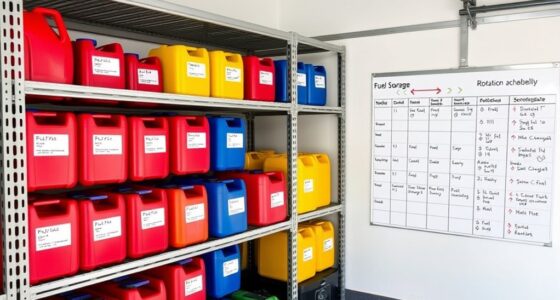
To accurately calculate fuel consumption for standby generators, you need to know your generator’s output, fuel type, and load level. For diesel, multiply the load in kW by the specific fuel consumption rate in g/kWh and adjust for fuel density. Natural gas and propane require flow rate estimates based on demand and operational factors. Proper calculations help you plan fuel needs, optimize efficiency, and avoid waste. Keep exploring to learn more key tips to refine your estimates.
Key Takeaways
- Use generator load (kW) and specific fuel consumption rate (g/kWh or L/kWh) to calculate fuel needs accurately.
- Convert fuel consumption to volume using fuel density (e.g., g or L per unit) for precise measurement.
- Adjust calculations based on load percentage, as efficiency varies with load, typically peaking at 50-80%.
- For natural gas, determine flow rate (CFH) at full load, considering pressure and environmental factors for accuracy.
- Incorporate reserve margins and runtime estimates to ensure sufficient fuel supply during outages or extended operation.

WEN 4,750-Watt 120V/240V Dual Fuel Portable Generator with Wheel Kit and Electric Start (DF475T)
Switch between gasoline (4750 surge watts, 3800 running watt) and propane (4350 surge, 3500 running) with the simple…
As an affiliate, we earn on qualifying purchases.
As an affiliate, we earn on qualifying purchases.
Understanding the Basics of Fuel Consumption

Understanding the basics of fuel consumption is essential for managing standby generators effectively. Your fuel use depends mainly on the generator’s output power (kW) and its fuel consumption rate per kW-hour. Different fuels, like natural gas, propane, gasoline, or diesel, measure consumption differently—cubic feet or gallons. Proper sizing is vital: oversizing wastes fuel, while undersizing reduces efficiency. Modern generators with variable speed and load matching improve efficiency and lower fuel use. Fuel consumption varies considerably by fuel type; propane often uses more fuel per hour than diesel or gasoline at similar power levels due to energy density and engine design. Additionally, understanding the correct measurement units for fuel is crucial for accurate estimations. Knowing these fundamentals helps you estimate operating costs, select the right fuel, and plan fuel supply effectively.

GRYVOZE 1 Inch Digital Turbine Fuel Flow Meter, 2.6-26 GPM Inline NPT Thread Flowmeter with 3/4 in Adapters for Water, Diesel, Gas Oil, Gasoline, and Other Liquids – Supports Gallon, QTS, PTS, L, m³
Accurate Measurements – Our digital turbine flow meter provides precise readings with a high accuracy of ±1%, ensuring…
As an affiliate, we earn on qualifying purchases.
As an affiliate, we earn on qualifying purchases.
How Load Affects Generator Fuel Use

The load your generator handles directly impacts its fuel consumption—operating closer to full capacity typically yields better fuel efficiency. When running at high loads, engines operate near ideal efficiency, using less fuel per kW-hour. Conversely, at low loads, fuel use per unit increases because the engine is underutilized, wasting fuel and accelerating wear. To visualize this, consider the following:
| Load Level | Fuel Consumption Pattern | Efficiency Effect |
|---|---|---|
| Quarter load | Higher fuel per kW-hour | Less efficient, more waste |
| Half load | Moderate fuel use, better efficiency | Improved fuel economy |
| Full load | Lowest fuel per kW-hour | Most efficient operation |
Matching load to capacity keeps fuel costs down and extends generator lifespan. Optimal efficiency is achieved when the generator operates at or near its rated capacity, minimizing fuel waste and maximizing performance. Additionally, maintaining proper maintenance practices ensures the generator continues to operate efficiently over time.

Gas Detector Oxygen Detector, YF-5800H Ultrasonic Oxygen Detector for Oxygen Concentration Pressure and Flow, Handheld Natural Gas Detector for PSA Oxygen Concentrator, Data Hold Gas Meter
3-in-1 Gas Meter for PSA Systems: Designed as a professional gas detector for PSA oxygen concentrators, this oxygen…
As an affiliate, we earn on qualifying purchases.
As an affiliate, we earn on qualifying purchases.
Calculating Diesel Generator Fuel Needs

Calculating the fuel needs of a diesel generator involves more than just knowing its power rating; it requires understanding how much fuel it consumes at various loads and operating conditions. You can estimate fuel consumption with the formula: Fuel (L/h) = (Engine Power in kW × Fuel Rate in g/kWh) / (1000 × Diesel Density). Typically, diesel density is about 0.84 kg/L. For example, a 200 kW generator with a 210 g/kWh rate consumes around 50 liters per hour. Alternatively, use load-based calculations with specific fuel consumption (SFC): Fuel (L/h) = Load (kW) × SFC (L/kWh). SFC varies by load, so adjusting for actual conditions improves accuracy. Understanding fuel efficiency is crucial for effective operational planning and cost management. Combining these methods ensures precise fuel needs estimation, essential for budgeting and operational planning.
propane generator fuel gauge
As an affiliate, we earn on qualifying purchases.
As an affiliate, we earn on qualifying purchases.
Estimating Natural Gas Consumption
To estimate your natural gas consumption, you need to understand your generator’s gas flow rate based on its wattage and load. Several factors, like generator efficiency, ambient temperature, and maintenance, influence how much gas you’ll actually use. Knowing these variables helps you better predict your fuel needs and manage costs effectively. Generator efficiency plays a significant role in how accurately your consumption estimates reflect real-world usage. Additionally, understanding natural gas flow rates can help you compare different generator models and select the most economical option for your needs.
Gas Flow Rate Estimation
Estimating natural gas consumption for standby generators requires understanding how gas flow rate relates to generator load and system parameters. Gas flow rate, measured in cubic feet per hour (CFH), directly correlates with the generator’s full load demand. For example, a Generac SG500 consumes roughly 6,000 CFH at full load. To ensure reliable operation, you should select a regulator rated at least 1.5 times the maximum flow, such as 9,000 CFH for a 6,000 CFH load. Keep in mind that pressure differential across the regulator limits flow capacity, so consider upstream and downstream pressures. Additionally, pipe size and length influence flow rate due to frictional losses. Correcting for environmental factors like temperature and pressure guarantees accurate flow estimation, preventing undersizing or oversizing fuel systems. Properly accounting for environmental conditions ensures your fuel calculations are precise and reliable.
Factors Influencing Usage
The natural gas consumption of your standby generator depends heavily on how much load it carries during operation. Larger generators with higher kilowatt ratings naturally consume more gas per hour, especially at full capacity. Running your generator at partial load reduces fuel use, as consumption scales linearly with load percentage. Efficiency varies with generator age and design; newer, well-maintained units use less fuel, while aging models become less efficient. Generator size should match your actual power needs to avoid unnecessary fuel costs. Fluctuations in load demand also impact consumption, with higher peaks increasing fuel use. Additionally, inverter generators generate only as much power as needed, saving fuel. Natural gas availability and pressure also influence fuel efficiency and consumption rates. Proper maintenance and regular inspections can further improve fuel efficiency and extend the lifespan of your generator. Understanding these factors helps optimize your fuel consumption and manage operating costs effectively.
Propane Consumption and Its Variability
Propane consumption for standby generators varies markedly depending on several factors, including the generator’s size, load level, and operational practices. For example, a 5 kW generator typically uses 2 to 3 gallons per hour, while household-sized units consume 2 to 4 gallons depending on size and load. Larger generators, like 20 kW models, can burn 3 to 5 gallons per hour at full capacity. Consumption scales nonlinearly with power output, so running at partial loads (around 25%) reduces usage considerably, often to about 1.1 gallons per hour for a 22 kW unit. Ambient temperature, operational habits, and generator efficiency also influence fuel use, making it essential to weigh these factors for accurate planning and tank sizing. Proper maintenance can also improve fuel efficiency and extend the operational lifespan of your generator. Additionally, understanding fuel consumption rates helps in estimating run times and ensures adequate fuel storage.
Planning Runtime and Fuel Supply

Understanding how long your standby generator can run relies on considering both the load you place on it and the amount of fuel available. Heavier loads burn fuel faster, reducing runtime, so prioritize essential appliances and use energy-efficient devices to extend operation. Know your generator’s fuel capacity and consumption rate to accurately estimate how long it can operate before refueling. Always plan for extra fuel reserves to handle longer outages or unexpected load increases. Maintaining scheduled fuel deliveries or onsite storage tanks ensures fuel availability when needed. Regularly monitor fuel levels and consumption to prevent surprises. Keep in mind that exceeding recommended runtime limits can cause overheating and damage, so track operation time carefully to maximize reliability and lifespan. Understanding your generator’s fuel efficiency can help optimize its performance and prevent unnecessary fuel use. Proper planning helps you stay prepared and avoid system failures. Additionally, familiarizing yourself with fuel consumption rates can aid in making more accurate predictions and planning for potential outages.
Factors That Impact Fuel Efficiency

Your generator’s fuel efficiency depends heavily on load levels and size. Running a generator below or above its ideal capacity can waste fuel and cause unnecessary wear. Matching the generator size to your actual needs and managing loads effectively helps save fuel and extends equipment life. Proper sizing ensures optimal performance, which is crucial for maintaining efficiency and reducing operational costs. Additionally, understanding merchant services and choosing reliable providers can help manage costs associated with fuel and maintenance.
Load Level Effects
How does the load level on a standby generator influence its fuel efficiency? Operating below 30-50% of rated load causes incomplete combustion, leading to wet stacking, carbon deposits, and decreased fuel efficiency. Running at low loads results in unburned fuel buildup, damaging engine components and increasing maintenance needs. Generators fine-tuned for 50-80% load operate most efficiently, while underloading causes disproportionate fuel consumption. Understanding optimal load ranges is essential for maintaining fuel economy. Proper load management can also help prevent engine wear caused by inefficient operation.
Generator Size Impact
Generator size has a direct impact on fuel efficiency, as larger units typically consume more fuel to produce the same amount of power. When you select a bigger generator than needed, it wastes fuel during partial loads because they operate less efficiently outside their ideal capacity. For example, a 20 kW diesel generator uses about 0.1 gallons of fuel per kWh, totaling around 2 gallons per hour at full load. Conversely, smaller units like a 10 kW natural gas generator consume roughly 100 cubic feet of gas per kWh, showing how size influences fuel use considerably. Properly sizing your generator ensures you’re not overspending on fuel, especially during light loads. Balancing capacity with demand helps maximize efficiency and reduce operational costs over time. Additionally, choosing a generator with appropriate capacity minimizes unnecessary fuel consumption and prolongs the unit’s lifespan.
Practical Tips for Accurate Fuel Calculation

Accurate fuel calculation begins with a thorough load assessment to guarantee you’re estimating consumption based on real operational demands. Knowing your generator’s actual power output helps you avoid overestimating or underestimating fuel needs. Use load percentage data to understand how much of the generator’s capacity will be utilized—whether at 25%, 50%, or full load—and consider fluctuations during testing or outages. Incorporate historical data or field tests that record fuel consumption at various loads for greater precision. Understanding load profiles is essential for precise fuel planning. To enhance accuracy, regularly review and update your fuel consumption data to reflect changes in load patterns or generator performance.
Frequently Asked Questions
How Does Ambient Temperature Influence Generator Fuel Consumption?
Ambient temperature directly impacts your generator’s fuel consumption. In cold weather, your generator burns more fuel because it works harder due to less efficient combustion and thicker fuel. Hot temperatures can cause overheating or vapor lock, leading to increased fuel use during restarts or shutdowns. Maintaining ideal operating temperatures with proper cooling and fuel management helps improve efficiency, saving you fuel and reducing operational costs.
What Is the Impact of Generator Age on Fuel Efficiency?
As your generator ages, its fuel efficiency declines markedly. Mechanical wear, corrosion, and reduced component performance cause it to use more fuel for the same power output. Older units struggle with maintaining load, leading to higher consumption and increased operational costs. Without regular maintenance, efficiency drops further. Upgrading to newer models with advanced technology can restore fuel economy, lower emissions, and improve reliability, saving you money in the long run.
Are There Differences in Fuel Consumption Between Inverter and Conventional Generators?
You’ll notice that inverter generators sip fuel more sparingly than conventional ones, especially at light to medium loads. Their smart, adaptive engines adjust speed like a dancer responding to the music, saving up to 75% fuel compared to the steady, relentless pace of traditional models. So, if you want your generator to be a thrifty partner on those quiet nights, inverters are your best bet for cutting costs and reducing waste.
How Do Altitude and Air Quality Affect Generator Fuel Use?
Altitude and air quality considerably impact your generator’s fuel use. At higher elevations, your generator works harder due to thinner air, increasing fuel consumption by about 20-30%, especially above 5000 feet. Poor air quality, dust, or humidity reduce combustion efficiency, making your generator burn more fuel to produce the same power. To optimize performance, consider proper sizing, high-altitude kits, and regular maintenance to counteract these effects.
Can Fuel Additives Improve Fuel Efficiency for Standby Generators?
Ever wondered if additives could boost your generator’s fuel efficiency? They can, but only if used correctly. Fuel stabilizers and biocides help maintain fuel quality, prevent contamination, and promote smoother combustion, which can lower fuel consumption. However, they won’t fix underlying issues like poor maintenance. To get the most out of additives, follow manufacturer instructions and make certain your generator is well-maintained. Proper use makes a noticeable difference.
Conclusion
Now that you’ve mastered the art of fuel calculations, you can confidently keep your generator running longer than your neighbor’s wildest party plans. No more guessing games or mysterious fuel shortages—just precise numbers and a well-fed machine. Think of yourself as the wizard of wattage, summoning power from thin air with math as your spellbook. So go ahead, plan wisely, and let your generator drink just enough to keep the lights on—no more, no less.