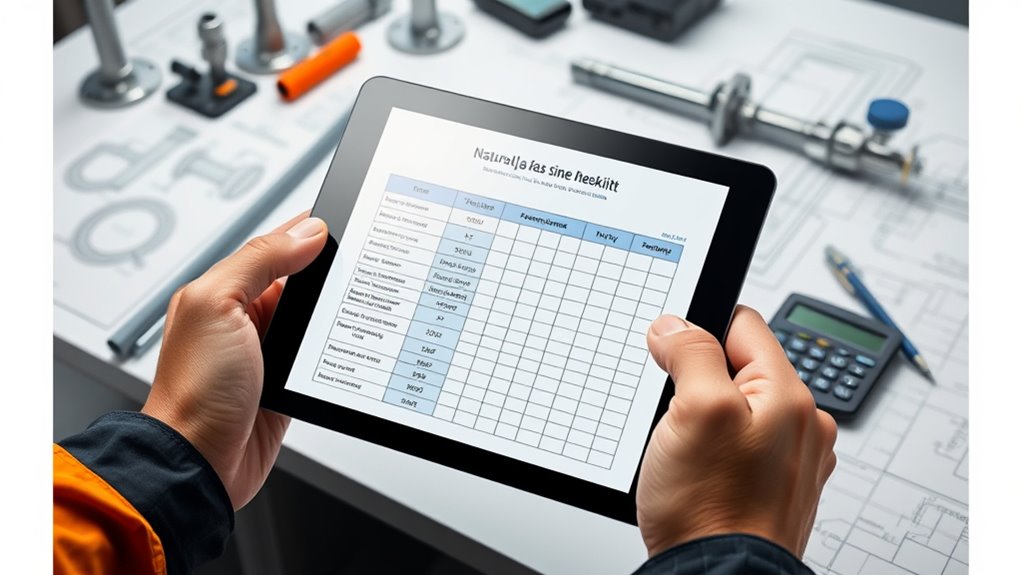

To quickly size a natural gas line, first determine your total gas demand by adding up all appliance requirements in CFH, ensuring you use accurate specs. Measure the longest pipe run, then add about 20% for fittings and bends. Divide your piping into segments from the meter to each appliance, calculating demand for each. Refer to standard sizing tables to select the right pipe size for each segment, keeping pressure drops minimal. If you want more detailed steps, you’ll find helpful tips ahead.
Key Takeaways
- Calculate total gas load by summing appliances’ BTU/hr or CFH, considering simultaneous operation.
- Measure the longest pipe run from the meter to the furthest appliance, adding 20% for pressure losses.
- Segment the piping system, label each segment, and determine cumulative downstream demand for proper sizing.
- Select pipe sizes from standard tables based on segment length, demand, and allowable pressure drop (~0.5 inch WC).
- Verify inlet pressure (~0.5 psi), document measurements, and choose pipe sizes that allow future expansion and minimal pressure drop.
Quick Guide to Gas Line Sizing in 15 Minutes
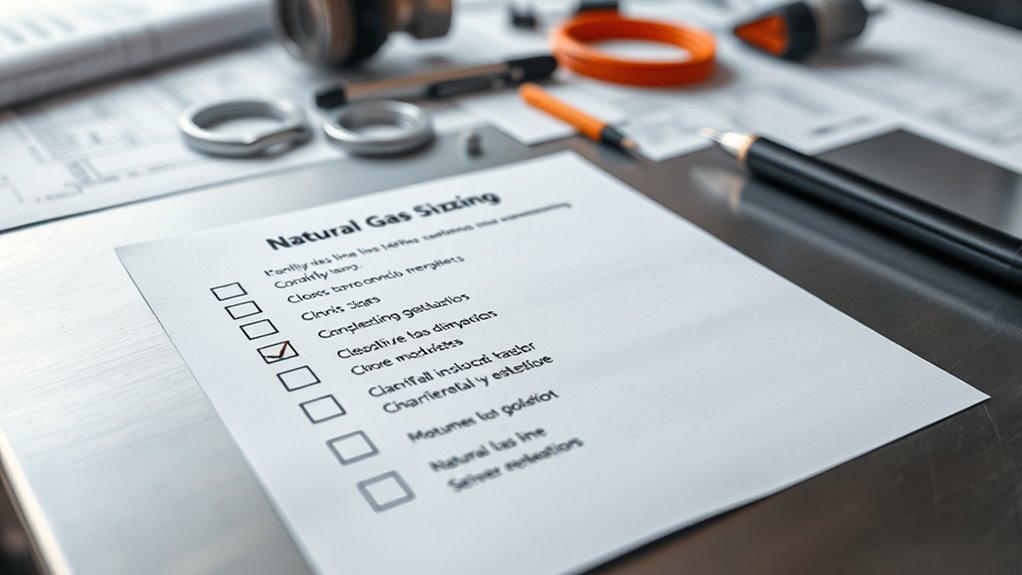
Planning the proper sizing of your natural gas line is essential to guarantee safe and efficient operation of all connected appliances. You want to make sure the pipe can deliver the right amount of gas without excessive pressure drops or safety issues. To start, determine the total gas load by adding up the demand of all appliances. Use manufacturer specs or standard tables to find each appliance’s BTU/hr or CFH. Convert BTU/hr to CFH if needed, using the common ratio: about 1,000 CFH equals 1,000,000 BTU/hr. Remember to take into account all appliances running simultaneously since their combined demand impacts your sizing. Confirm the maximum load for each appliance to prevent undersizing, which could lead to insufficient gas flow or pressure.
Next, measure the index length—the longest pipe run from the gas meter to the furthest appliance. Add roughly 20% to this length to account for pressure losses caused by fittings, bends, and other fittings. Use standardized tables or codes to find the equivalent length for fittings and include this in your measurement. When measuring, always use the pipe’s centerline distance to get accurate results. This index length becomes the baseline for sizing each pipe segment, ensuring your calculations reflect real-world conditions. Accurate measurement is crucial for proper pipe sizing.
Measure the longest pipe run, add 20% for fittings, and use centerline distance for accurate sizing calculations.
Divide your gas piping into segments, starting from the meter and working toward each appliance. Label these sections systematically, like segment 1, segment 2, and so forth. For each segment, calculate the cumulative gas load based on downstream appliances. Keep pipe runs as straight as possible; minimize bends and fittings to reduce pressure drops. Record the length and flow data for every segment for future reference and verification.
Now, refer to approved pipe sizing tables or charts designed specifically for natural gas. Match each segment’s length and demand with the appropriate pipe size, considering the allowable pressure drop—generally around 0.5 inch of water column. If exact data isn’t available, choose the next larger size to ensure safety and future capacity. Respect the specific tables for different pipe materials, such as black steel or CSST.
Apply standard pressure loss allowances, typically 0.5 inch water column per run, and verify your inlet pressure at the meter, usually at or below 0.5 psi. Adjust your sizing if your gas type or operating conditions differ from standard assumptions, especially in extreme cold or high-altitude environments. Work backward from the most remote outlet to the meter, making sure each segment can handle the cumulative load with minimal pressure drop. Oversizing pipes can provide a buffer for future load increases.
Finally, document all measurements, calculations, and selected pipe sizes meticulously. Keep a clear record of your gas load, segment lengths, and sizing decisions to take into account compliance with local codes and standards. This thorough approach guarantees a safe, efficient, and reliable natural gas system, all achievable in just about 15 minutes with careful planning. [Proper planning and measurement are essential for safety.
Frequently Asked Questions
What Tools Are Needed for Quick Gas Line Sizing?
To quickly size a gas line, you’ll need a tape measure or laser distance meter to measure pipe lengths accurately. Pressure gauges help confirm inlet pressure, while flow rate calculators or BTU charts estimate total load. Use pipe sizing tables matching your gas type and pressure, along with software or apps for fast calculations. Having these tools on hand guarantees you can efficiently determine the correct pipe size and complete the job safely.
Can This Checklist Be Used for Commercial Gas Systems?
You can’t rely on this checklist for commercial gas systems because it’s designed mainly for residential setups with lower pressures and loads. Commercial systems often operate at higher pressures and handle larger BTU demands, requiring precise calculations, engineering methods, or specialized software. Always check with your local authority and follow the applicable codes, ensuring your system is correctly sized for safety, efficiency, and compliance.
How Accurate Is a 15-Minute Gas Line Sizing Method?
A 15-minute gas line sizing method is like a quick sketch—useful but not perfectly detailed. You’ll get a rough estimate that works well for preliminary planning or small projects, but it’s not as precise as detailed calculations. Variances in appliance demands, fittings, and actual pipe conditions can cause errors. Always verify with detailed analysis or local codes for final designs, especially in complex or high-stakes systems.
Are There Safety Considerations During Rapid Gas Line Calculations?
Yes, safety considerations are vital during rapid gas line calculations. You must verify system pressures, guarantee accurate load estimates, and follow local codes to prevent hazards like leaks or under-supply. Rushing can lead to mistakes, so double-check sizing tables and pressure ratings. Always involve qualified professionals for verification and installation, and avoid shortcuts. Proper safety measures protect you from potential fires, explosions, or dangerous gas leaks.
Does This Checklist Comply With Local Building Codes?
Yes, this checklist complies with local building codes. It guarantees you follow the required sizing methods, consider maximum load demands, and account for pipe length and pressure. While it simplifies the process, it still emphasizes verifying calculations against code requirements, obtaining permits, and documenting your work. This balanced approach keeps your installation safe, efficient, and fully compliant—much like following a reliable map while steering through unfamiliar roads.
Conclusion
By following this quick checklist, you can confidently size your natural gas lines and avoid costly mistakes. For example, imagine a small restaurant that upgraded its equipment but overlooked proper line sizing—it faced pressure issues and service delays. Don’t let that be you. Use these simple steps to guarantee safe, efficient gas flow. Taking just 15 minutes now can save you time, money, and headaches down the road.