In data centers, choosing between PTP and NTP impacts your system’s accuracy, security, and performance. NTP suits general tasks with millisecond precision, while PTP offers nanosecond-level synchronization essential for high-speed applications like AI, blockchain, and financial trading. If your environment demands ultra-high precision, PTP is the better fit. Otherwise, NTP may be enough. Understanding these protocols helps you optimize your infrastructure—continue exploring to find the best solution for your needs.
Key Takeaways
- PTP offers nanosecond-level accuracy, essential for AI applications requiring precise synchronization.
- NTP provides millisecond accuracy, suitable for general data center operations but less ideal for AI workloads.
- High-performance networks benefit from PTP’s low latency and improved stability over NTP.
- Accurate time sync is critical for AI decision-making, data integrity, and security in data centers.
- Hardware support and security features influence the choice between PTP and NTP for specific AI and data center needs.
Why Accurate Time Synchronization Matters in Data Centers

Accurate time synchronization is crucial in data centers because it guarantees that all systems and devices operate in harmony. Without synchronization, time zone discrepancies can cause data mismatches, logging errors, and security issues. Daylight saving adjustments further complicate timing, as they require systems to update clocks accurately to avoid confusion or data inconsistency. When your data center’s clocks are out of sync, it becomes difficult to trace transactions, analyze logs, or coordinate tasks across servers. This can lead to delays, errors, or security vulnerabilities. Ensuring precise time synchronization helps maintain data integrity, supports regulatory compliance, and boosts overall efficiency. Time synchronization protocols play a vital role in achieving this accuracy. Moreover, as network infrastructure becomes more complex and interconnected, the importance of precise timing increases exponentially. A failure in synchronization can also impact automated processes, which depend on exact timing to function correctly. In an environment where every second counts, keeping time aligned is essential for smooth operations and reliable performance, especially as distributed systems rely on consistent timing, synchronization inaccuracies can undermine the stability of applications and services.
Understanding Time Protocols: NTP and PTP Explained
To guarantee your data center’s timing is precise, you need to understand how NTP and PTP work. These protocols differ in their fundamental design, accuracy levels, and ideal use cases. Recognizing these differences helps you choose the right protocol for your specific synchronization needs.
Protocol Fundamentals Overview
Understanding the fundamentals of time synchronization protocols is essential for ensuring precise coordination within data centers. NTP and PTP are designed to keep systems aligned, but they operate differently. NTP relies on hierarchical servers to distribute time, while PTP offers higher precision through hardware timestamping. Quantum clocks are emerging as game-changers, providing ultra-accurate time references that can enhance synchronization. Blockchain synchronization also depends on precise timing to validate transactions securely across distributed ledgers.
- NTP’s simplicity suits broad network needs, while PTP’s accuracy benefits high-performance environments.
- Quantum clocks push the boundaries of precision, impacting future protocols.
- Blockchain requires exact timing to prevent fraud and double-spending.
- Both protocols underpin the backbone of modern, synchronized data centers.
Synchronization Accuracy Levels
Determining the appropriate synchronization accuracy level depends on your data center’s specific needs and performance requirements. For high-precision tasks, like financial trading or AI training, you need nanosecond accuracy, often achieved with PTP. Less sensitive operations, such as logging or monitoring, can rely on millisecond accuracy with NTP. Your hardware considerations—like network switches and clocks—impact achievable precision. Protocol security is also crucial; PTP often includes security features to prevent tampering, whereas NTP’s simpler design may require additional safeguards. Visualize these accuracy levels:
| Accuracy Level | Use Case | Hardware Considerations |
|---|---|---|
| Millisecond | Monitoring, logging | Standard network equipment |
| Microsecond | Financial data, AI | Specialized hardware |
| Nanosecond | Scientific, high-frequency trading | Precise clocks, secure protocols |
| Sub-millisecond | Virtualization, testing | Moderate hardware |
| Millisecond | General data center ops | Basic network setup |
Use Case Differentiations
Different time protocols serve distinct use cases within data centers, and choosing the right one depends on your specific needs. NTP is suitable for general network synchronization, providing millisecond precision, ideal for routine operations. PTP, on the other hand, offers nanosecond-level accuracy, making it essential for applications requiring precise hardware synchronization.
Consider these differences:
- NTP is software-based, easier to deploy, and works well for most network devices.
- PTP relies on hardware timestamping, delivering superior precision.
- Use NTP for non-critical tasks like logging and monitoring.
- Opt for PTP when timing accuracy impacts automation, finance, or AI workloads.
Matching your use case to the appropriate time protocol ensures excellent performance and synchronization fidelity across your data center.
How Do NTP and PTP Work? Protocol Mechanics Simplified
You’ll want to understand how NTP and PTP keep your data center synchronized, starting with their hierarchy levels and how they determine which clocks to rely on. Then, look at how these protocols exchange messages to measure time differences and adjust clocks accordingly. Finally, you’ll see the specific methods they use to fine-tune timings and ensure accurate synchronization across your network.
Synchronization Hierarchy Explained
Understanding how NTP (Network Time Protocol) and PTP (Precision Time Protocol) fit into the synchronization hierarchy is essential for grasping how data centers maintain accurate time. These synchronization protocols operate within a structured time hierarchy that ensures precise coordination across devices. At the top are primary reference clocks like atomic clocks or GPS sources, which set the standard. Below are the main levels:
- Stratum 0: High-accuracy sources like atomic clocks.
- Stratum 1: Servers directly connected to primary sources.
- Stratum 2: Servers syncing with Stratum 1 devices.
- End devices: Devices syncing down the hierarchy, maintaining consistency and precision.
This hierarchy guarantees that all networked equipment stays synchronized, which is critical for AI and data center operations.
Message Exchange Process
To guarantee accurate time synchronization, NTP and PTP devices exchange a series of timestamped messages that allow each system to calculate and correct timing differences. For example, NTP uses client-server exchanges, while PTP employs master-slave messaging with precise timestamps. These messages follow a pattern:
| Message Type | Purpose |
|---|---|
| Sync | Sends current time from master |
| Delay Request | Measures delay to master |
| Delay Response | Responds with timestamp info |
| Follow-up | Provides precise timestamps |
This process impacts cybersecurity, as exposing message data can threaten security, and energy consumption, since frequent exchanges consume power. The efficiency and security of this message exchange directly influence the reliability and safety of your data center’s time sync. Smart home technology emphasizes the importance of secure and efficient communication protocols to protect sensitive data and optimize energy use.
Clock Adjustment Methods
Both NTP and PTP use specialized algorithms and message exchanges to adjust clocks precisely. They constantly compare your device’s time with reference sources, accounting for network delays. NTP handles complex factors like time zones and leap seconds by adjusting offsets smoothly, ensuring synchronization across global data centers. PTP, on the other hand, is more precise, often fitting into local networks for nanosecond accuracy, making it ideal for sensitive operations. Both protocols rely on timestamp exchanges to detect drift and correct it swiftly. They ensure your clocks stay aligned, even when leap seconds are added or removed, preventing timing errors. These methods keep data consistent and reliable, essential for AI workloads and high-frequency trading systems. Understanding time synchronization is crucial for maintaining data integrity in modern digital infrastructure.
Comparing Accuracy: Is PTP More Precise Than NTP?
Precision in time synchronization can considerably impact data center operations, especially when accuracy is critical. PTP generally offers higher precision than NTP because it reduces clock drift by synchronizing clocks more frequently and directly with a master clock. This minimizes the effects of protocol latency, which can introduce delays and timing errors. While NTP can achieve accuracy within milliseconds, PTP often reaches sub-microsecond precision, making it ideal for applications demanding exact timing. The difference becomes especially noticeable under conditions with high network traffic or longer distances, where protocol latency can cause greater discrepancies. If your data center relies on precise timing for activities like high-frequency trading or real-time analytics, PTP’s enhanced accuracy can be a game-changer.
Which Protocol Fits Your Needs? Use Cases for NTP and PTP
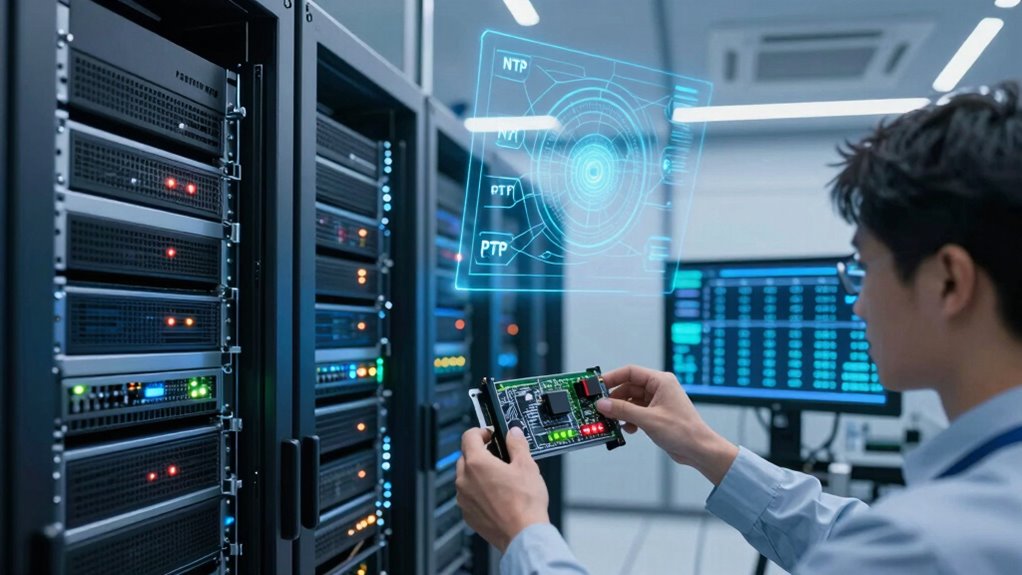
Choosing between NTP and PTP depends on your precision needs, network complexity, and budget. If you require high accuracy in a simple setup, PTP might be the right choice, but it can be more costly and complex to implement. Consider how these factors align with your data center’s specific timing requirements before making a decision.
Precision Requirements Variance
Understanding your data center’s timing needs is vital because not all synchronization protocols offer the same level of accuracy. The choice depends on how tightly you need to control time precision and the acceptable synchronization variance. For high-precision tasks like financial trading or scientific computing, microsecond or even nanosecond accuracy is essential, favoring PTP. In contrast, less demanding environments can rely on NTP, which offers millisecond-level precision.
Consider these points:
- Time accuracy required for your applications
- Tolerance for synchronization variation
- Impact of latency on your system
- Cost and complexity of implementing high-precision protocols
- Synchronization protocols are continually evolving to meet diverse needs.
Matching your needs guarantees maximum performance and resource use, especially when AI systems depend on accurate timing for decision-making.
Network Complexity Factors
Determining which synchronization protocol fits your data center often hinges on the network’s complexity and infrastructure. If your network experiences frequent congestion or high traffic, NTP can handle moderate loads but may struggle with precision during peak times. Conversely, PTP is designed for low-latency, highly accurate synchronization, making it suitable for complex, high-performance environments. Network congestion can introduce delays, so selecting a protocol that maintains security against cyber threats is essential; PTP offers advanced protocol security features, while NTP may require additional safeguards. Consider your infrastructure’s capacity to support protocol security measures, as well as the need for real-time precision. Ultimately, the decision depends on balancing network traffic, security requirements, and the desired synchronization accuracy.
Cost and Implementation
Selecting the right synchronization protocol depends largely on your data center’s budget, existing infrastructure, and specific operational needs. When considering cost and implementation, perform a thorough cost analysis to compare upfront expenses and ongoing maintenance. PTP often requires specialized hardware, increasing initial costs but offering higher precision for critical applications. NTP is generally more affordable, with simpler setup and broader vendor options. Your vendor selection influences compatibility, support, and future scalability. Consider these factors:
- Hardware requirements and associated costs
- Ease of deployment and integration complexity
- Long-term maintenance expenses
- Availability of vendor support and updates
Balancing these elements helps you choose a protocol that fits your budget while meeting your precision needs. Clear vendor selection and cost analysis ensure smooth implementation and reliable synchronization.
Cost and Complexity: Choosing Between PTP and NTP

Choosing between Precision Time Protocol (PTP) and Network Time Protocol (NTP) often hinges on cost and complexity considerations. A thorough cost analysis reveals that NTP is generally less expensive to deploy, requiring minimal hardware and simpler setup, which makes it suitable for many standard data center needs. PTP, on the other hand, involves higher initial costs due to specialized network equipment and more intricate configuration, impacting complexity management. If your operations demand ultra-precise timing, investing in PTP might justify the added expense and complexity. However, for less critical applications, NTP offers a straightforward, cost-effective solution. Weighing these factors helps you make an informed decision aligned with your data center’s performance requirements and budget constraints.
How to Implement NTP and PTP in Your Data Center
Implementing NTP and PTP in your data center involves configuring the appropriate hardware and network settings to guarantee accurate time synchronization. You’ll need to focus on proper time zone management to ensure consistent timestamps across systems. Additionally, plan for leap second adjustments to prevent timing errors during these occasional events. Proper modern kitchen technology integration can further enhance operational efficiency and precision in managing these systems. Here are key steps:
Ensure precise time sync by configuring hardware, managing time zones, and planning for leap seconds in your data center.
- Set up NTP servers with reliable time sources and configure clients accordingly
- Deploy PTP-aware switches and network devices for high-precision synchronization
- Adjust network configurations to prioritize time sync traffic and reduce latency
- Regularly monitor synchronization status to identify drift or issues
- Consider environmental factors such as seasonal variations that can affect timing accuracy and adjust configurations accordingly
Hardware Requirements for PTP and NTP: What You Need
To guarantee accurate time synchronization, you need specific hardware components for PTP and NTP. Understanding the server infrastructure and network equipment compatibility is equally important. Let’s explore what’s required to set up a reliable and precise timing system in your data center. Additionally, ensuring your network hardware supports precise time protocols is crucial for optimal performance.
PTP Hardware Components Needed
Precise time synchronization with PTP requires specific hardware components that guarantee accuracy and reliability. To achieve this, you need specialized devices capable of supporting high-precision timing. Quantum clocks are increasingly important, offering ultra-precise reference sources for synchronization. Your hardware setup should also include boundary clocks and transparent clocks to manage timing distribution effectively. Network switches with PTP-aware features help reduce jitter and delay variations. For applications like Blockchain synchronization, hardware must deliver nanosecond-level precision consistently. Additionally, PTP-enabled network interface cards (NICs) ensure minimal latency and improved timing accuracy. These components work together to support the demanding requirements of modern data centers, especially when integrating advanced technologies like Quantum clocks and ensuring AI systems operate on synchronized data. Incorporating hardware standards ensures compatibility and optimal performance across diverse network environments. Implementing synchronization protocols further enhances precision and system reliability in complex network setups. For optimal performance, considering hardware compatibility is essential to ensure seamless integration of all components. Moreover, selecting components that adhere to timing accuracy standards is crucial for maintaining consistency in high-precision environments.
NTP Server Infrastructure Requirements
A reliable NTP server infrastructure requires carefully selected hardware components that guarantee accurate time distribution across your data center. You need robust servers capable of handling multiple client requests and maintaining stability under load. The hardware should support a stable power supply and have precise system clocks, preferably with temperature-compensated crystal oscillators (TCXOs). Establishing a clear hierarchy structure is essential, starting with stratum 0 devices like atomic clocks or GPS receivers, connected to stratum 1 servers, which distribute time to lower strata. This hierarchy ensures accurate synchronization and reduces delays. Confirm your hardware can handle the time protocol’s requirements, providing consistent, precise time signals to your entire network. Proper infrastructure is key to maintaining synchronization accuracy and system reliability.
Network Equipment Compatibility
Ensuring your network equipment supports PTP and NTP is essential for achieving accurate time synchronization across your data center. Hardware compatibility is critical; not all switches, routers, or network cards handle these protocols effectively. You need devices that offer built-in support or can be upgraded for protocol interoperability. Look for equipment with precise timestamping capabilities for PTP, especially if you require sub-microsecond accuracy. Additionally, confirm that your hardware can handle NTP synchronization without introducing delays or jitter. Compatibility issues can lead to inconsistent timekeeping, affecting data integrity and AI workloads. To guarantee smooth operation, verify your network gear meets protocol standards and supports synchronization features needed for your specific environment. Proper hardware compatibility guarantees reliable, precise time sync across your infrastructure. Hardware compatibility is a key factor in ensuring seamless protocol operation and avoiding synchronization issues.
The Impact of Time Drift on Data Integrity and Security

When time drifts out of sync in data centers, it can compromise both data integrity and security. Inaccurate timestamps can lead to data mismatches, making it difficult to verify transaction authenticity or trace events. This affects cryptographic security, as many encryption protocols rely on precise time for key exchanges and authentication. furthermore, time drift can cause inconsistencies in logs and audit trails, increasing vulnerability to fraud or cyberattacks. Fixing these issues often requires additional energy-consuming processes, such as re-synchronization and error correction, which can escalate energy consumption. Ultimately, even minor time discrepancies can undermine confidence in your system’s security and data accuracy, highlighting the importance of maintaining precise synchronization to protect critical information and reduce unnecessary energy use. Proper reliance on trustworthy infrastructure like PTP and NTP helps ensure consistent and secure timekeeping across data centers.
Why AI and Real-Time Analytics Need Precise Time Sync
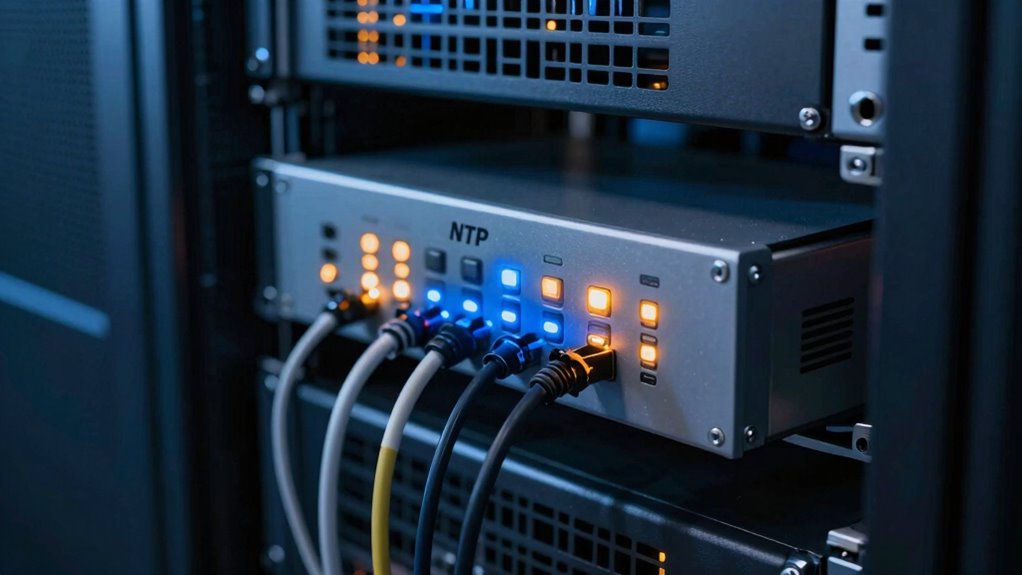
AI and real-time analytics rely on precise time synchronization to guarantee data accuracy and maintain correct event sequences. When timestamps are off, decision-making becomes unreliable and insights may be compromised. Accurate time sync supports better AI performance and more dependable analytics outcomes. Implementing smart tweaks in synchronization methods can significantly enhance system reliability.
Ensuring Data Accuracy
Accurate time synchronization is essential for data integrity in modern data centers, especially as real-time analytics and AI systems process vast streams of information. Precise timing ensures data consistency, reliable event ordering, and correct interpretation across systems. When managing time zones and daylight saving changes, synchronization becomes even more critical to prevent data discrepancies. Without it, data can become misaligned, leading to faulty insights or operational errors. To maintain data accuracy, you need to:
- Use synchronized clocks across all servers
- Adjust for daylight saving shifts seamlessly
- Correctly handle time zone differences
- Prevent timestamp mismatches that skew analytics
- Incorporate media literacy to understand the importance of accurate data and avoid misinformation.
Additionally, understanding the precision of time protocols like PTP and NTP can help optimize synchronization strategies to match the specific needs of AI and real-time analytics applications. Recognizing the role of synchronization in data security can further enhance system reliability and prevent potential cyber threats that exploit timing inconsistencies.
Enabling Precise Event Sequencing
Precise time synchronization is essential for guaranteeing that events are accurately ordered and interpreted in real-time analytics and AI systems. Without it, data points might appear out of sequence, leading to incorrect conclusions. Quantum synchronization offers ultra-precise timing capabilities that can match or surpass traditional methods, enabling near-instantaneous coordination across devices. Biological clocks, like circadian rhythms, demonstrate nature’s inherent ability to maintain synchronized processes, inspiring advanced timing techniques. In data centers, applying these principles helps ensure event sequences are consistent, even at nanosecond accuracy. This level of precision allows AI algorithms to analyze streaming data accurately, detect anomalies, and respond in real-time. Ultimately, leveraging quantum synchronization and biological clock-inspired methods makes precise event sequencing reliable, supporting complex AI operations that depend on accurate timing.
Supporting AI Decision-Making
Since real-time analytics rely on timely data to inform decisions, synchronized timing across systems is essential for AI to function effectively. Precise time sync enables AI systems to interpret data accurately, especially in critical applications like autonomous vehicles or financial trading. Quantum synchronization offers ultra-precise timing, surpassing traditional methods, ensuring AI decisions are based on consistent data. Biological clocks, though naturally occurring, highlight the importance of natural synchronization processes for complex systems. Achieving this level of coordination allows AI to:
- Improve decision accuracy in dynamic environments
- Reduce errors caused by time discrepancies
- Enable seamless integration of distributed sensors
- Support advanced real-time analytics and predictive modeling
In essence, high-precision time sync is crucial for AI to make reliable, real-time decisions that impact safety and efficiency.
What Happens When Time Sync Fails in Your AI Systems

When time synchronization fails in your AI systems, it can cause immediate and severe disruptions. Without accurate timing, you risk encountering a time anomaly, where data logs become inconsistent, and decision-making processes lose coherence. This inconsistency can lead to incorrect results or system errors that ripple through your operations. Furthermore, compromised protocol security may expose vulnerabilities, allowing malicious actors to manipulate time data or disrupt synchronization altogether. Such failures erode trust in your AI’s outputs and can cause cascading failures across interconnected systems. Additionally, reliance on precise timing is crucial for synchronization protocols to function correctly, and any failure can undermine the entire system’s reliability. If your time sync isn’t reliable, your AI’s ability to analyze, respond, and learn effectively is compromised. Ensuring robust, secure synchronization is critical to prevent these damaging issues and maintain system integrity, especially since time accuracy is fundamental for coordinating complex AI-driven processes.
When Is NTP Sufficient for Your Data Center?
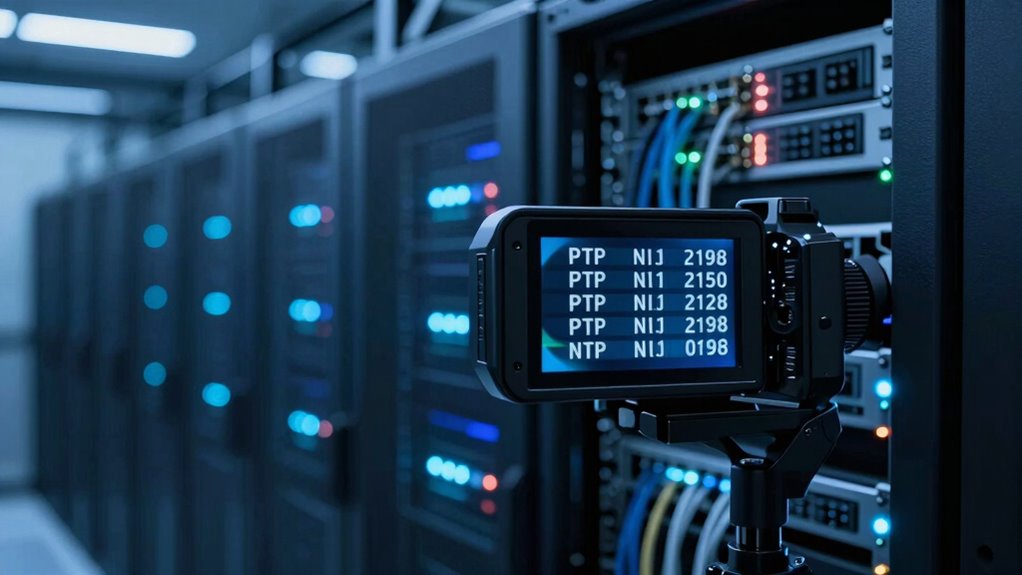
NTP (Network Time Protocol) is often sufficient for many data center operations when your timing requirements are moderate and security concerns are limited. If your systems don’t demand ultra-precise synchronization, NTP can handle the job effectively. It aligns well with satellite synchronization methods, ensuring your servers stay in sync across locations. Quantum clocks aren’t necessary here, as they’re reserved for high-precision needs. Use NTP if your applications tolerate millisecond accuracy and your infrastructure isn’t exposed to high-security risks. It’s suitable for standard data processing, logging, and monitoring tasks. Keep in mind, NTP works well when your operations aren’t affected by tiny timing discrepancies. For most data centers with typical workloads, NTP provides a reliable, cost-effective solution that maintains acceptable accuracy levels.
When Should You Use PTP for High-Precision Sync?

High-precision synchronization becomes essential when your data center handles time-sensitive applications such as financial trading, telecommunications, or scientific research. Use PTP when nanosecond accuracy is critical, especially for quantum encryption and blockchain integration where even tiny discrepancies can cause issues. PTP provides the precision needed for secure data transmission and consensus algorithms. Consider implementing PTP if your infrastructure supports hardware timestamping and you require consistent, reliable synchronization. Here’s a quick comparison:
| Use Case | Accuracy Level | Key Benefit |
|---|---|---|
| Financial Trading | High | Minimize latency, prevent arbitrage |
| Quantum Encryption | Very High | Maintain secure key exchange |
| Blockchain Integration | Precise | Ensure transaction ordering |
| Telecom Networks | High | Reduce jitter and delay |
| Scientific Research | Very High | Precise measurements |
Use PTP when your needs demand the utmost precision.
Troubleshooting Common PTP and NTP Issues

Troubleshooting Common PTP and NTP issues can be challenging, especially when synchronization drifts or failures disrupt your data center operations. Latency issues often cause time discrepancies, so check network paths for delays and jitter. Power consumption can also impact synchronization accuracy; high power use may lead to unstable clocks or hardware failures. To troubleshoot effectively, consider these steps:
- Verify network latency and jitter to identify delays
- Ensure all devices are configured with correct time settings
- Check for hardware issues that could cause power-related clock instability
- Monitor network traffic for congestion affecting synchronization signals
- Review home energy practices that influence hardware performance and stability
Addressing these common issues helps improve stability and reduces the risk of time drifts, keeping your data center running smoothly.
Key Factors to Consider When Selecting a Time Protocol
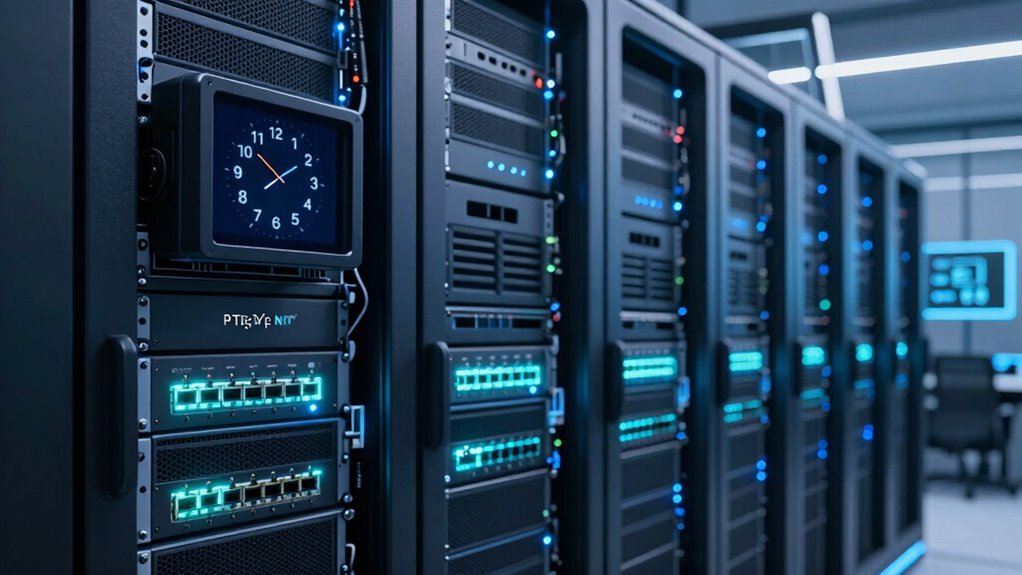
Selecting the right time protocol is vital for maintaining accurate synchronization across your data center. Consider whether your applications require ultra-precise timing, which might benefit from quantum clocks, offering unparalleled accuracy for critical operations. If blockchain synchronization is part of your infrastructure, choose a protocol that guarantees secure, tamper-proof timekeeping. PTP (Precision Time Protocol) often suits environments demanding nanosecond accuracy, while NTP is sufficient for less time-sensitive tasks. Evaluate your latency tolerance, scalability needs, and hardware compatibility. Also, consider future-proofing; protocols that integrate seamlessly with emerging technologies like quantum clocks can provide long-term benefits. Ultimately, your choice should align with your data center’s performance demands, security requirements, and planned technological advancements.
Future Trends in Time Synchronization for AI and Data Centers

As artificial intelligence and data center technologies continue to evolve, future trends in time synchronization will focus on enhancing accuracy, security, and integration with emerging innovations. Quantum clocks promise unprecedented precision, enabling synchronization at a new level for AI workloads and financial systems. Blockchain synchronization will become essential for secure, tamper-proof timestamping, ensuring data integrity across distributed networks. Expect increased adoption of hybrid protocols that combine PTP and NTP for peak performance. Additionally, AI-driven adaptive synchronization systems will automatically adjust to network conditions, reducing latency and errors. These advancements will enable data centers to handle complex computations more reliably, maintain tighter security, and seamlessly integrate with future-proof technologies. Staying ahead means embracing these innovations to optimize your infrastructure’s synchronization capabilities.
Integrating PTP and NTP With Your Network Infrastructure
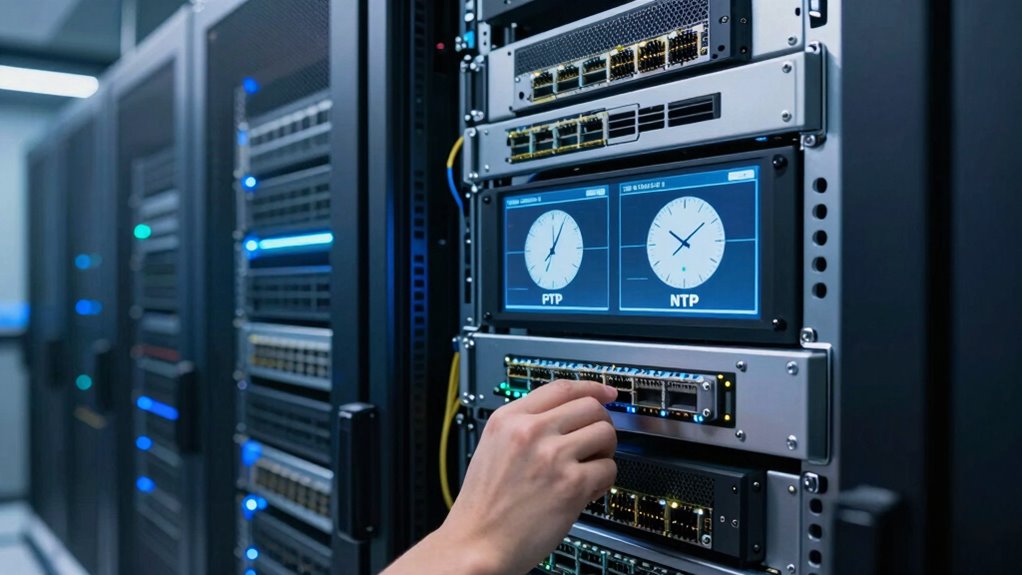
Have you considered how integrating Precision Time Protocol (PTP) and Network Time Protocol (NTP) can optimize your network’s synchronization? Combining these protocols allows you to support both legacy hardware and modern devices, ensuring accurate timing across your infrastructure. For legacy hardware that relies on NTP, seamless integration keeps your system synchronized without costly upgrades. Meanwhile, PTP enhances precision for critical applications. Wireless synchronization becomes more reliable when both protocols work together, reducing jitter and drift. Proper integration involves deploying PTP-aware switches and NTP servers strategically positioned within your network. This setup minimizes latency issues and maintains consistent time distribution. Additionally, understanding time synchronization standards helps you select the most appropriate deployment strategies. Recognizing legacy hardware compatibility is essential to ensure your entire network remains synchronized during the transition. Ultimately, blending PTP and NTP helps you create a flexible, resilient infrastructure that meets diverse synchronization needs efficiently.
Real-World Examples of High-Precision Time Sync in Data Centers
Many data centers have already seen the benefits of integrating PTP and NTP for robust time synchronization. High-precision timing is vital for applications like quantum clocks, which require nanosecond accuracy, and blockchain timestamping, ensuring secure, tamper-proof records. Real-world examples include financial trading floors, where microsecond precision minimizes latency and arbitrage risks. In cloud environments, synchronized clocks enable seamless data consistency and integrity. Data centers handling quantum computing experiments rely on ultra-precise clocks to coordinate operations. Additionally, blockchain platforms depend on synchronized timestamps for validating transactions and maintaining trust. These examples highlight how advanced time sync technologies support critical, high-stakes operations across industries, ensuring data integrity, security, and performance at scale. Time synchronization enhances overall system reliability and operational efficiency. Moreover, the integration of precise timekeeping systems helps prevent discrepancies that could lead to data corruption or security breaches, especially in environments that depend on accurate clock synchronization. A focus on time accuracy is essential for maintaining trust in digital transactions and operations.
Tips for Maintaining Accurate Time Across Large-Scale Environments
Maintaining accurate time across large-scale environments requires a proactive approach that combines the right technology with diligent management. To minimize time skew, guarantee all devices synchronize regularly using high-precision protocols like PTP or NTP, depending on your accuracy needs. Monitor timestamp consistency across servers and network equipment to identify discrepancies early. Implement centralized time sources and maintain strict access controls to prevent unauthorized changes that can introduce drift. Regularly audit your synchronization setup and update firmware or software to fix bugs affecting time accuracy. Keep network latency low and stable to avoid skew caused by delays. Additionally, understanding time synchronization protocols and their limitations can help tailor your strategy for optimal results. By actively managing these factors, you ensure synchronized logs, accurate data analysis, and reliable system operations, essential for seamless large-scale environment performance.
Ensuring Consistent Time Accuracy for Critical Applications
Ensuring consistent time accuracy for critical applications requires strict synchronization protocols and rigorous validation processes. Precise timing is essential to maintain Blockchain security, where even minor discrepancies can compromise data integrity. Quantum computing advancements threaten current encryption standards, making reliable time sync more vital for future-proofing security measures. To achieve this, you should:
- Use high-precision protocols like PTP for nanosecond accuracy
- Regularly validate time sources against authoritative references
- Implement redundancy to prevent single points of failure
- Monitor for anomalies that could signal synchronization issues or emerging threats
Maintaining this rigor ensures your systems remain resilient against evolving security challenges, keeping critical applications stable and trustworthy in an era of rapid technological change.
Final Thoughts: Choosing the Best Protocol for Your Data Center and AI Needs
Choosing the right time synchronization protocol for your data center and AI applications depends on your specific performance, security, and scalability needs. If you operate legacy systems that require precise timing, PTP often offers superior accuracy, especially in wired environments. For environments with wireless synchronization, NTP might be sufficient but can face latency issues. Consider your security requirements—PTP can be secured with encryption, making it ideal for sensitive data. Scalability is also key; PTP scales well for large, complex setups, while NTP is simpler to deploy. Ultimately, evaluate whether your infrastructure supports wired or wireless synchronization and how critical precise timing is for your workloads. This will help you select the protocol that best aligns with your data center’s demands.
Frequently Asked Questions
How Does Quantum Computing Influence Time Synchronization Protocols?
Quantum computing influences time synchronization protocols by enabling ultra-precise quantum clocks that surpass traditional atomic clocks. You can leverage entanglement synchronization, where particles remain connected regardless of distance, to achieve unprecedented accuracy. This technology helps eliminate latency and errors in synchronization processes, making data centers more reliable. As quantum tech advances, you’ll see improved coordination across distributed systems, boosting AI performance and ensuring seamless, highly synchronized operations.
Can Blockchain Technology Enhance Time Accuracy in Data Centers?
Yes, blockchain technology can enhance time accuracy in data centers by leveraging its security features and consensus mechanisms. Blockchain’s decentralized nature ensures tamper-proof records, reducing synchronization errors. Its consensus mechanisms, like proof-of-work or proof-of-stake, help validate time-stamped transactions, maintaining precise and secure synchronization. This integration boosts reliability, minimizes discrepancies, and guarantees data integrity, which is vital for AI and other sensitive applications relying on accurate timing.
What Are the Environmental Impacts of Deploying PTP Versus NTP?
Deploying PTP dramatically ramps up energy consumption and hardware waste compared to NTP, like fueling a rocket to the moon. PTP’s precise synchronization demands more powerful servers and specialized equipment, leading to excessive energy use and frequent hardware upgrades. NTP, on the other hand, is leaner, conserving energy and reducing hardware waste. So, choosing PTP over NTP can profoundly harm the environment by increasing resource consumption and electronic waste.
How Do Emerging AI Algorithms Affect Synchronization Precision Requirements?
Emerging AI algorithms demand higher neural synchronization, pushing your system’s algorithm precision to new levels. You need tighter time sync to guarantee data consistency and accurate neural processing. As AI models become more complex, even millisecond discrepancies can impact outcomes. To meet these demands, you’ll likely prioritize synchronization methods like PTP that offer superior precision, ensuring your AI operates seamlessly and maintains ideal performance in real-time neural synchronization tasks.
Are There Regulatory Standards for Time Accuracy in Global Data Centers?
Yes, regulatory standards for time accuracy in global data centers exist to ensure regulatory compliance and operational integrity. You need to adhere to industry standards like ISO 13491 and IEC 62439, which specify precise time synchronization requirements. These standards help you maintain data integrity, security, and synchronization accuracy, especially when dealing with financial transactions or critical infrastructure. Staying compliant guarantees your data center operates smoothly across borders and meets global regulatory expectations.
Conclusion
Remember, a stitch in time saves nine—especially in data centers. Choosing the right synchronization protocol, whether NTP or PTP, guarantees your systems stay accurate and reliable. For AI applications demanding precision, PTP might be your best bet. Stay proactive with your time management, because when it comes to data, timing isn’t just everything—it’s the only thing that counts. Make smart choices today to keep your data center running smoothly tomorrow.