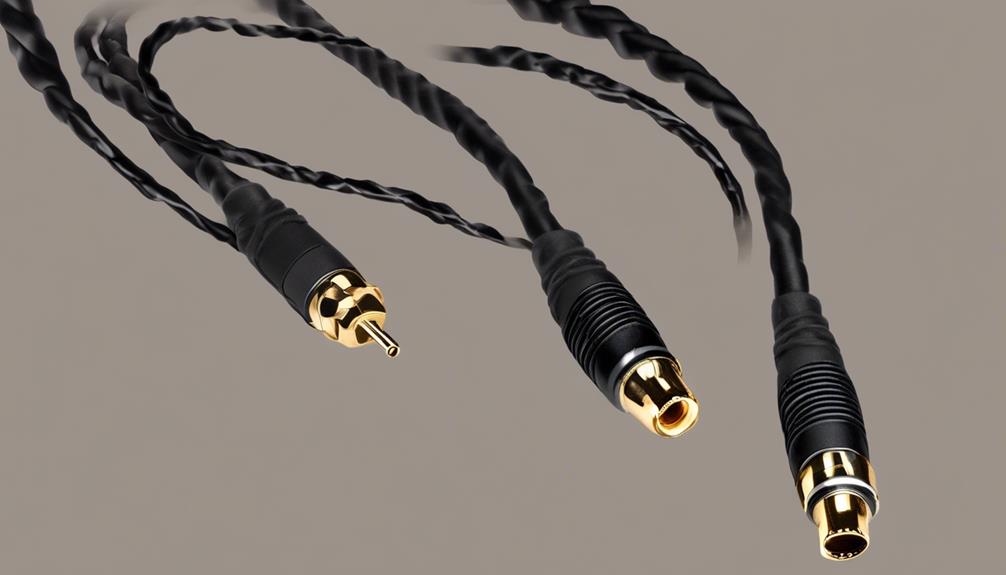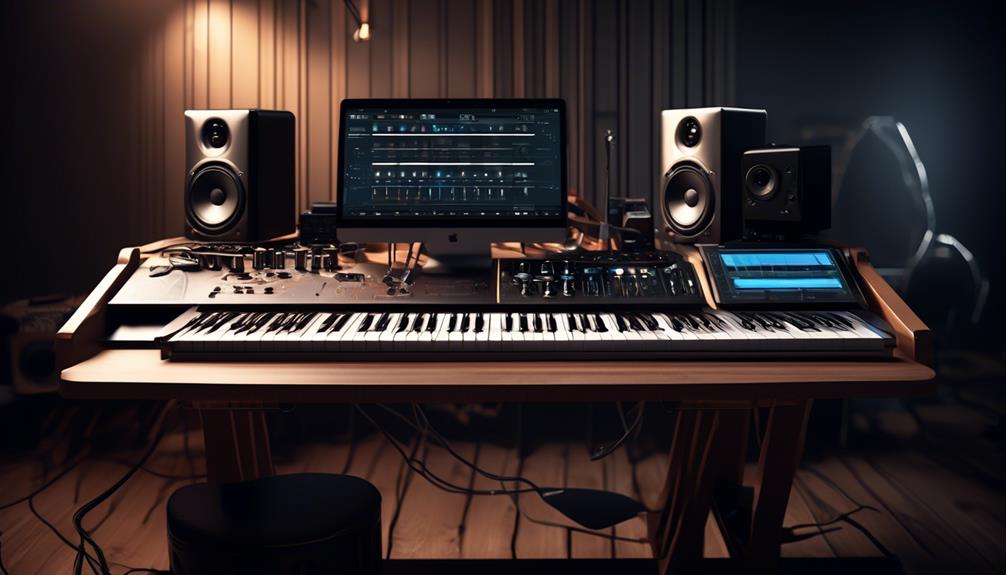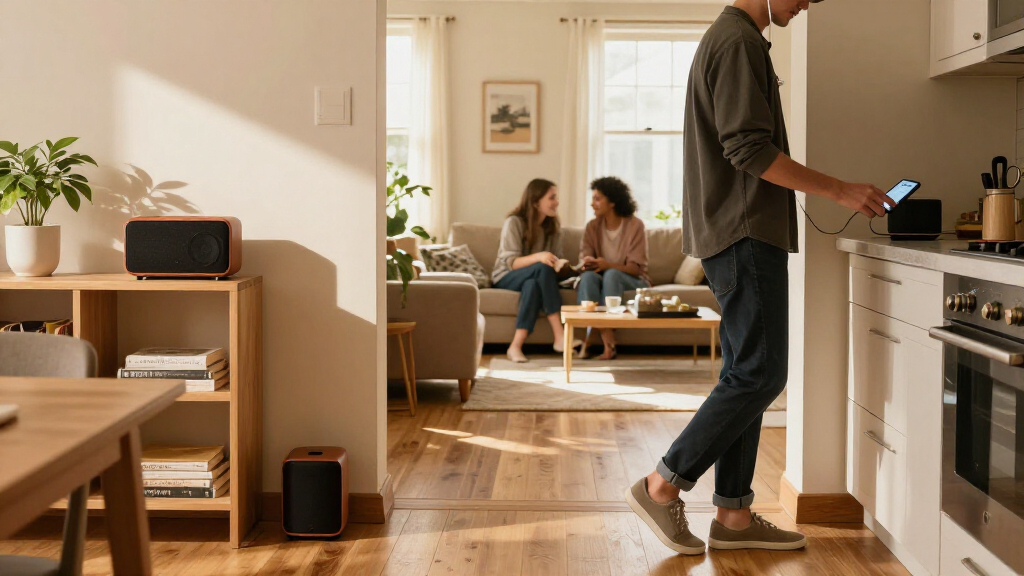

The best multi-room audio systems depend on whether you want easy wireless speaker groups or dedicated audio in several rooms. I rank the Juke+ 6-Zone Audio Amplifier best overall for its six amplified zones and support for AirPlay 2 and Spotify Connect. The Sonos One SL 4-Pack is a simpler route for adding synchronized speakers, while the Dayton Audio DAX88 suits larger, source-rich installations. The main tradeoff is between straightforward setup and the wiring, planning, and flexibility of a distributed system. Read on for the full comparison, buying advice, and picks for different homes.

Get audio and creator gear delivered free with Prime
- Fast, free delivery on millions of items
- Prime Video, Amazon Music and more included
- Member-only deals all year
Complete the kit


Key Takeaways
- Juke+ leads for mixed-room installations: its six zones and AirPlay 2 and Spotify Connect support offer more room-by-room flexibility than speaker bundles.
- Sonos and Google simplify wireless grouping: the One SL 4-Pack and Nest Audio 3-Pack suit buyers who want matched speakers without planning a multi-zone amplifier.
- Dayton Audio DAX88 is built for larger systems: eight sources and eight zones give it more routing capacity, with added setup and wiring demands.
- Auracast sets emphasize convenient speaker linking: Avantree Harmony and Venucast Harmony options offer a different path from Wi-Fi systems, but buyers should check compatibility and intended coverage.
- Outdoor and ceiling kits solve specific installation problems: Herdio and STUDIOFINIX include multiple speakers and zone amplification, while Rocksteady Stadium is a more portable speaker-and-subwoofer bundle.
| Juke+ 6-Zone Audio Amplifier, 100 Watts per Channel, AirPlay 2 and Spotify Connect |  | Best for Whole-Home Custom Installs | Zones: 6 | Channels: 12 | Power: 100 watts per channel | VIEW LATEST PRICE | See Our Full Breakdown |
| Google Nest Audio Smart Speakers (3-Pack) |  | Best for Google Home Beginners | Quantity: 3 speakers | Connectivity: Wi-Fi, Bluetooth | Voice assistant: Google Assistant | VIEW LATEST PRICE | See Our Full Breakdown |
| Venucast Harmony A3 Auracast Wireless Multi-Speaker Audio System |  | Best for Long-Range Powered Speaker Linking | Audio technology: Auracast, Bluetooth | Connectivity: Optical, RCA, 3.5 mm AUX, Bluetooth | Maximum range: 328 ft (100 m) in open space | VIEW LATEST PRICE | See Our Full Breakdown |
| Avantree Harmony 2 Multi-Room Wireless Speaker System |  | Best for Simple Indoor TV and Music Sharing | Latency: Under 30 ms | Connectivity: Optical, AUX, Bluetooth | Setup: Automatic speaker connection; no app required | VIEW LATEST PRICE | See Our Full Breakdown |
| Venucast Harmony A2 Wireless Auracast Speaker System with 3 Speakers |  | Best No-Wi-Fi Starter Kit | Included components: 1 transmitter and 3 speakers | Connectivity: Bluetooth, optical, AUX, Auracast | EQ modes: Balance, Voice, Bass | VIEW LATEST PRICE | See Our Full Breakdown |
| Herdio 6.5-Inch Bluetooth Ceiling Speaker Set with 8-Channel, 4-Zone Amplifier (8 Speakers) |  | Best Built-In Whole-Home Value | Speaker count: 8 | Speaker size: 6.5-inch woofer, 1-inch tweeter | Amplifier: 8-channel, 4-zone | VIEW LATEST PRICE | See Our Full Breakdown |
| Rocksteady Stadium 4 Bluetooth Speaker and Subwoofer Bundle |  | Best for Indoor-Outdoor Flexibility | Bundle: 4 speakers and 1 wireless subwoofer | Playback time: Up to 30 hours at 50% volume | Bluetooth range: Up to 150 feet | VIEW LATEST PRICE | See Our Full Breakdown |
| Avantree Harmony A1 Auracast Multi-Room Wireless Speaker System |  | Best Expandable TV-and-Music System | Included components: 1 transmitter and 3 speakers | Wireless technology: Auracast | Wireless range: Up to 100 meters (varies with obstacles) | VIEW LATEST PRICE | See Our Full Breakdown |
| STUDIOFINIX 4-Inch 8-Speaker, 4-Zone Bluetooth Outdoor Audio System |  | Best for Outdoor Zones | Speaker count: 8 passive speakers | Zones: 4 independent zones | Speaker size: 4 inches | VIEW LATEST PRICE | See Our Full Breakdown |
| Sonos One SL Wireless Speaker, 4-Pack, Black |  | Best App-Controlled Ecosystem | Brand: Sonos | Model: One SL | Quantity: 4 speakers | VIEW LATEST PRICE | See Our Full Breakdown |
| Dio Node Multiroom Wi-Fi Home Speakers, 5-Pack |  | Best Whole-Home Coverage Pick | Pack Size: 5 speakers | Connectivity: Wi-Fi, Apple AirPlay 2 | Speaker Size: 4 inches | VIEW LATEST PRICE | See Our Full Breakdown |
| Dayton Audio DAX88 8-Source, 8-Zone Bridgeable Distributed Audio Matrix Amplifier |  | Best Built-In Whole-Home System | Sources: 8 | Zones: 8 | Power Output: 75W per channel; up to 260W bridged | VIEW LATEST PRICE | See Our Full Breakdown |
| Dio Node Multiroom Wi-Fi Speakers, 3-Pack |  | Best Budget Apple-Friendly Trio | Pack Size: 3 speakers | Connectivity: Wi-Fi, Apple AirPlay 2 | Compatible Devices: Apple TV, iPad, iPhone, iPod | VIEW LATEST PRICE | See Our Full Breakdown |
| Sonos Era 100 SL Compact Microphone-Free Speaker, White |  | Best Single-Room Sound Quality | Color: White | Microphone: None | Connectivity: Wi-Fi, Bluetooth, line-in | VIEW LATEST PRICE | See Our Full Breakdown |
| multi-room audio system | Connectivity |
|---|---|
| Juke+ 6-Zone Audio Amplifier | — |
| Google Nest Audio Smart Speake | Wi-Fi, Bluetooth |
| Venucast Harmony A3 Auracast W | Optical, RCA, 3.5 mm AUX, Bluetooth |
| Avantree Harmony 2 Multi-Room | Optical, AUX, Bluetooth |
| Venucast Harmony A2 Wireless A | Bluetooth, optical, AUX, Auracast |
| Herdio 6.5-Inch Bluetooth Ceil | — |
| Rocksteady Stadium 4 Bluetooth | — |
| Avantree Harmony A1 Auracast M | — |
| STUDIOFINIX 4-Inch 8-Speaker | Bluetooth 5.4, USB, AUX, microphone, TF card, optical |
| Sonos One SL Wireless Speaker | — |
| Dio Node Multiroom Wi-Fi Home | Wi-Fi, Apple AirPlay 2 |
| Dayton Audio DAX88 8-Source | Analog and digital inputs/outputs; integrated Wi-Fi |
| Dio Node Multiroom Wi-Fi Speak | Wi-Fi, Apple AirPlay 2 |
| Sonos Era 100 SL Compact Micro | Wi-Fi, Bluetooth, line-in |
More Details on Our Top Picks
Juke+ 6-Zone Audio Amplifier, 100 Watts per Channel, AirPlay 2 and Spotify Connect
The Juke+ is the most installation-focused pick here: its six zones and 12 channels let me send independent streams to different parts of a home, instead of grouping a few standalone speakers around one feed. AirPlay 2 and Spotify Connect make everyday listening straightforward, while the equalizer lets me tune rooms that sound different from one another. Compared with the Google Nest Audio 3-Pack, it offers more control over a distributed speaker system, but requires compatible speakers and a rack or equipment space. Its analog and optical inputs, plus preamp outputs, also leave room for external sources and expansion. The tradeoff is a more involved setup: app control depends on Wi-Fi, and the listed streaming services may depend on future firmware updates.
Pros:- Six zones support independent listening in different rooms
- AirPlay 2 and Spotify Connect provide direct streaming options
- Room-specific equalizer can help tune sound across different spaces
- Analog and optical inputs plus preamp outputs support system expansion
Cons:- App-based control requires a working Wi-Fi network
- Requires compatible speakers and a separate installation
- Additional streaming services may depend on future firmware updates
Best for: Homeowners planning a wired, multi-zone speaker installation who want separate streams and room-by-room tuning
Not ideal for: Renters or buyers seeking a simple, self-contained wireless speaker bundle with no rack or installation planning
- Zones:6
- Channels:12
- Power:100 watts per channel
- Streaming:AirPlay 2, Spotify Connect, Bluetooth
- Inputs:RCA analog, optical
- Outputs:Preamp outputs
- Control:Juke Audio app over Wi-Fi
- Mounting:1U rack-mountable
Our verdict“Choose the Juke+ for a configurable, installed whole-home system with independent zones; skip it if you want speakers ready to use out of the box.”
Google Nest Audio Smart Speakers (3-Pack)
For a buyer starting from scratch, the three-speaker bundle makes multi-room listening approachable: place a speaker in each room, group them for shared playback, or pair two for stereo. Google Assistant adds hands-free playback and smart-home commands, giving this set a broader everyday role than the Venucast Harmony A2, which focuses on sending audio to its included speakers. Wi-Fi and Chromecast-enabled apps suit a home already using Google services, and Bluetooth provides another connection option. The compromise is less flexibility for dedicated installations: unlike the Juke+, it does not provide a six-zone amplifier with independent room streams and installation inputs. Smart-home controls also depend on compatible devices, while supported streaming services can vary. I’d choose this bundle for ease and voice control, not for a custom speaker system.
Pros:- Three speakers provide a ready-made starting point for multi-room playback
- Two speakers can be paired for stereo sound
- Google Assistant enables voice playback and compatible smart-home control
- Wi-Fi and Bluetooth offer more than one connection method
Cons:- Smart-home control requires compatible devices
- Streaming service availability may vary
- Offers less installation and zone flexibility than a dedicated amplifier such as the Juke+
Best for: Households already using Google Assistant that want simple grouped playback and voice control in three rooms
Not ideal for: Buyers building a wired multi-zone installation or seeking independent audio streams for many rooms
- Quantity:3 speakers
- Connectivity:Wi-Fi, Bluetooth
- Voice assistant:Google Assistant
- Multi-room audio:Grouped playback
- Stereo pairing:Pair two speakers
- Compatibility:Android, iOS, Chromecast-enabled apps
Our verdict“Pick the Nest Audio bundle for easy Google-centered listening across a few rooms, rather than a configurable installed audio system.”
Venucast Harmony A3 Auracast Wireless Multi-Speaker Audio System
The Harmony A3 suits buyers who already have powered speakers and want to distribute one source across them without running audio cable between rooms. Its Auracast-based link can reach up to 328 feet in open space, making it a more useful fit for a spread-out home or small venue than the indoor-focused Avantree Harmony 2. Optical, RCA, AUX, and Bluetooth connections give it several ways to take audio from a TV, phone, or laptop, and additional receivers can extend the setup. That reach comes with a key limitation: the system is for powered speakers, not passive speakers that need an amplifier. Its push-button controls are also simpler than app-based systems such as the Juke+, but offer less room-by-room source management. Expect range to fall when walls or other obstacles intervene.
Pros:- Can synchronize one source across multiple powered speakers
- Expandable receiver system can add listening points
- Optical, RCA, AUX, and Bluetooth inputs accommodate varied sources
- Listed open-space range reaches up to 328 feet
Cons:- Does not work with passive speakers
- Actual range may be reduced outside open spaces
- Push-button control does not offer the zone management of the Juke+
Best for: Owners of powered speakers who need to send one source over a long distance across a home, patio, or small venue
Not ideal for: Buyers with passive speakers or anyone who needs multiple independent room streams and app-based zone control
- Audio technology:Auracast, Bluetooth
- Connectivity:Optical, RCA, 3.5 mm AUX, Bluetooth
- Maximum range:328 ft (100 m) in open space
- Audio output mode:Stereo
- Control method:Push button
- Speaker compatibility:Powered speakers; passive speakers not supported
- Item weight:160 g
- Power:3 included lithium-ion batteries
Our verdict“Choose the Harmony A3 to link powered speakers over a long open-space run, provided you do not need passive-speaker support or separate room streams.”
Avantree Harmony 2 Multi-Room Wireless Speaker System
The Harmony 2 is a practical choice when the goal is to hear one source in sync around an indoor space without managing an app. Its under-30 ms latency is especially relevant for TV dialogue and spoken content, where noticeable delay between rooms can distract. Speakers auto-connect, and optical, AUX, and Bluetooth inputs cover common TVs, phones, and laptops. Compared with the Venucast Harmony A3, this system is framed more narrowly around indoor use and automatic setup, while the A3 lists longer open-space range and receiver expansion. The Harmony 2’s tradeoffs are its limited maximum volume for large outdoor venues and its microphone compatibility: USB, direct XLR, and TRRS headset microphones are unsupported. Buyers seeking independent room streams should look to the Juke+ instead.
Pros:- Under-30 ms latency helps keep audio synchronized across speakers
- Automatic speaker connection avoids app-based setup
- Optical, AUX, and Bluetooth inputs support common source devices
- Designed for indoor multi-room listening
Cons:- Limited maximum volume makes it unsuitable for large outdoor venues
- Does not support USB, direct XLR, or TRRS headset microphones
- Does not offer the Juke+’s independent zone streams
Best for: People who want synchronized TV dialogue, music, or spoken audio across indoor rooms with minimal setup
Not ideal for: Large outdoor venue operators, users relying on unsupported microphones, or households needing separate streams by room
- Latency:Under 30 ms
- Connectivity:Optical, AUX, Bluetooth
- Setup:Automatic speaker connection; no app required
- Recommended use:Indoor multi-room audio
- Microphone input requirement:Line-level 3.5 mm TRS or RCA output
- Unsupported microphones:USB, direct XLR, 3.5 mm TRRS headset
Our verdict“Pick the Harmony 2 for straightforward indoor playback from one source, especially when synced TV audio matters more than zone-by-zone control.”
Venucast Harmony A2 Wireless Auracast Speaker System with 3 Speakers
With a transmitter and three included speakers, the Harmony A2 gives a small home, shop, or restaurant a ready-made way to spread one audio source across several spaces. It needs no Wi-Fi or app, so setup avoids the network dependency of the Juke+ and the Google-centered account setup associated with the Nest Audio. Bluetooth, optical, and AUX inputs accommodate common sources, while Balance, Voice, and Bass modes offer quick tonal adjustments without a room-by-room equalizer. Extra compatible speakers can expand the system, and Auracast support broadens that path. The tradeoff is source flexibility: Bluetooth works best with the device near the transmitter, and the included kit is aimed at synchronized shared audio rather than separate streams for different rooms. For custom zones, the Juke+ is the more capable pick.
Pros:- Includes a transmitter and three speakers for multi-room playback
- Works without Wi-Fi or an app
- Bluetooth, optical, and AUX inputs suit common audio sources
- Three EQ modes provide quick sound adjustments and compatible speakers can be added
Cons:- Bluetooth works best when the source device is near the transmitter
- Designed for synchronized shared audio rather than independent room streams
- EQ choices are simpler than the Juke+ room-specific equalizer
Best for: Small homes and businesses that want a simple shared background-audio setup without relying on Wi-Fi or an app
Not ideal for: Listeners who need independent room streams, detailed per-room tuning, or Bluetooth transmission over a long distance
- Included components:1 transmitter and 3 speakers
- Connectivity:Bluetooth, optical, AUX, Auracast
- EQ modes:Balance, Voice, Bass
- Network requirement:No Wi-Fi required
- Scalability:Supports additional Harmony A2 speakers and Auracast-compatible devices
Our verdict“Choose the Harmony A2 for easy shared audio across three spaces without network setup, but choose an amplifier if rooms need separate streams.”
Herdio 6.5-Inch Bluetooth Ceiling Speaker Set with 8-Channel, 4-Zone Amplifier (8 Speakers)
This option stands out for buyers who want invisible, whole-home coverage without paying custom-installer prices. Eight flush-mount speakers paired with an 8-channel, 4-zone amplifier means four rooms get independently powered, independently controlled audio — a structure that mirrors far pricier matrix amplifiers like the Dayton Audio DAX88, but at a fraction of the complexity. Compared with the STUDIOFINIX outdoor system, the 6.5-inch woofers here deliver noticeably fuller low-mid response indoors. The tradeoff is permanence: you’re cutting six ceiling holes per zone, and the 30-foot Bluetooth range means your phone needs to stay near the amplifier. This pick makes the most sense for renovators and new builds rather than renters.
Pros:- Eight speakers and a 4-zone amplifier included in one package
- Independent power and volume control per zone
- 6.5-inch woofers produce fuller sound than compact 4-inch alternatives
- Flush-mount design keeps speakers completely out of sight
Cons:- Requires cutting permanent holes in ceilings and running in-wall cabling
- Bluetooth range limited to 30 feet from the amplifier
Best for: Homeowners mid-renovation who want discreet, wired multi-room audio in up to four rooms without an installer
Not ideal for: Renters or anyone unwilling to cut ceiling holes — installation is permanent and labor-intensive
- Speaker count:8
- Speaker size:6.5-inch woofer, 1-inch tweeter
- Amplifier:8-channel, 4-zone
- Bluetooth:Version 5.4, 30 ft range
- Inputs:Bluetooth, USB, TF card, AUX
- Cutout diameter:6.3 inches
- Installation depth:3.15 inches
Our verdict“A strong fit for owners who want invisible four-zone audio installed once and forgotten — skip it if you can’t modify your ceilings.”
Rocksteady Stadium 4 Bluetooth Speaker and Subwoofer Bundle
This bundle takes a completely different approach than the wired Herdio or STUDIOFINIX kits: zero installation. Four battery-powered speakers and a wireless subwoofer can move from living room to patio to backyard party in minutes, with a 150-foot Bluetooth range that dwarfs the Herdio’s 30 feet. Channel assignment lets you spread speakers across rooms or cluster them for stereo. The subwoofer, with its front-facing bass driver, fills a gap that compact systems like the Sonos One SL 4-pack simply can’t address. Be realistic about the numbers, though: the 30-hour battery claim is measured at 50% volume, and the vague “water resistant” rating means you shouldn’t leave these outside in rain.
Pros:- Fully portable with up to 30 hours of playback per charge
- Dedicated wireless subwoofer adds real bass depth
- 150-foot Bluetooth range supports genuinely large spaces
- Expandable channel assignment for flexible room placement
Cons:- Battery life quoted at 50% volume — louder use cuts it sharply
- No specific IP water-resistance rating, so exposure is a gamble
Best for: Entertainers who shuttle audio between indoors, patio, and yard and want a subwoofer without wiring anything
Not ideal for: Listeners wanting a permanent, app-controlled whole-home system — batteries need charging and speakers can walk off
- Bundle:4 speakers and 1 wireless subwoofer
- Playback time:Up to 30 hours at 50% volume
- Bluetooth range:Up to 150 feet
- Subwoofer drivers:5.11-inch front driver and rear bass drum
- Audio modes:Full Bass and Deep Bass EQ
- Inputs:Bluetooth and 3.5 mm aux
- Water resistance:Water resistant (no IP rating)
Our verdict“The most flexible pick here for people who refuse to choose between indoor and outdoor listening — just don’t expect installer-grade permanence.”
Avantree Harmony A1 Auracast Multi-Room Wireless Speaker System
Where the Sonos One SL locks you into one ecosystem, the Harmony A1 bets on Auracast — an open standard that lets you add any compatible speaker later. The included transmitter with optical input is the real differentiator: plug it into your TV and get synchronized audio across the three included speakers, something neither the Rocksteady bundle nor the wired Herdio set handles gracefully. Range is impressive on paper — up to 100 meters — but honest buyers should read the fine print: walls and floors shrink that figure, and Bluetooth sources work best when close to the transmitter. Compared with the similar Venucast Harmony A2, this system’s optical input makes it the better fit for home-theater-adjacent setups.
Pros:- Optical input enables direct TV audio distribution
- Open Auracast standard allows mixing in third-party speakers
- Up to 100-meter wireless range in open conditions
- Bluetooth, optical, and AUX inputs cover nearly any source
Cons:- Bluetooth source devices must stay near the transmitter
- Range degrades considerably with walls and obstacles
Best for: Households who want one system to share TV audio and background music across rooms, with room to grow
Not ideal for: Buyers with thick interior walls or large multi-story homes — real-world range will fall well short of 100 meters
- Included components:1 transmitter and 3 speakers
- Wireless technology:Auracast
- Wireless range:Up to 100 meters (varies with obstacles)
- Inputs:Bluetooth, optical, AUX
- Expandability:Additional Harmony A1 speakers and Auracast devices
Our verdict“The smart choice for TV-centric multi-room audio with a future-proof expansion path — just verify your layout isn’t too wall-heavy.”
STUDIOFINIX 4-Inch 8-Speaker, 4-Zone Bluetooth Outdoor Audio System
This kit solves the problem the Herdio ceiling set can’t: weather. With an IP44 rating and wall-mount brackets, these eight passive speakers are built for patios, pool areas, and covered porches, all driven by a four-zone amplifier rated at 800 watts maximum. The input selection is broader than anything else in this lineup — optical, microphone, USB, TF card, AUX, and Bluetooth 5.4 — making it viable for both streaming and announcements. Compared with the battery-powered Rocksteady bundle, you gain permanence and independent zone switching at the amplifier, but you lose portability and accept visible speaker wire runs to each unit. The 4-inch drivers also sacrifice bass depth, which matters less outdoors than it does in a living room.
Pros:- IP44 rating for protected outdoor installation
- Four zones with independent on/off control at the amplifier
- Widest input selection in this lineup, including optical and microphone
- Eight speakers and all cabling included
Cons:- Passive speakers require running wire to every mounting location
- 4-inch drivers produce limited bass without a subwoofer
Best for: Homeowners outfitting a patio, deck, or pool area with permanent, weather-resistant multi-zone audio
Not ideal for: Bass-focused listeners or anyone unwilling to route speaker cables along exterior walls
- Speaker count:8 passive speakers
- Zones:4 independent zones
- Speaker size:4 inches
- Maximum output power:800 watts
- Water resistance:IP44
- Connectivity:Bluetooth 5.4, USB, AUX, microphone, TF card, optical
- Warranty:1 year
Our verdict“The practical pick for weatherproof zone-by-zone outdoor sound — skip it if trailing cables or thin bass would bother you.”
Sonos One SL Wireless Speaker, 4-Pack, Black
This is the pick for buyers who prioritize software over speakers. The Sonos app and Apple AirPlay 2 give you true multi-room control — different music in different rooms, grouped zones, and sync that wireless kits like the Avantree Harmony A1 only approximate. Each unit is compact and humidity resistant, so bathrooms and kitchens are fair game, and pairing with a Sonos soundbar opens a surround-sound upgrade path no other product here offers. The tradeoffs are ecosystem lock-in and the absence of a microphone, so there’s no voice control — if that matters, the Google Nest Audio 3-pack covers it, though with less audio polish. And unlike the wired STUDIOFINIX kit, expansion means buying more Sonos hardware at Sonos prices.
Pros:- Best-in-class app and AirPlay 2 multi-room control
- Humidity-resistant design suits kitchens and bathrooms
- Upgrade path to surround sound with Sonos soundbars
- Compact size fits shelves, counters, and nightstands
Cons:- No built-in microphone means no voice control
- Ecosystem lock-in — expansion requires more Sonos hardware
Best for: Apple-centric households who want polished app-based multi-room control and may add a Sonos soundbar later
Not ideal for: Buyers who want voice assistants built in or who resist being locked into a single brand’s ecosystem
- Brand:Sonos
- Model:One SL
- Quantity:4 speakers
- Color:Black
- Microphone:None
- Wireless control:Sonos app, Apple AirPlay 2
- Humidity resistant:Yes
Our verdict“The easiest recommendation for buyers who value seamless app control and long-term ecosystem growth over raw hardware value.”
Dio Node Multiroom Wi-Fi Home Speakers, 5-Pack
This five-speaker bundle makes the most sense for buyers who want full-home multi-room audio in a single purchase without wiring anything into the walls. Because every unit speaks Apple AirPlay 2, spreading synced music across five rooms is a matter of shelf placement and app setup rather than an installer visit. Compared with the Sonos One SL 4-Pack, the Dio Node set trades away refined acoustics — its 220 Hz frequency floor means real bass depth is off the table — in exchange for covering one extra room at a far friendlier budget. The metal-and-polycarbonate enclosures feel sturdier than typical plastic shelf speakers at this tier. The privacy angle is also part of the pitch: no built-in microphones, which mirrors the Sonos SL philosophy but with more speakers per box.
Pros:- Five speakers cover an entire home from one purchase
- AirPlay 2 support enables tight multi-room sync across all units
- No microphones for privacy-focused buyers
- Interoperates with over 100 other speaker models, easing future expansion
Cons:- Frequency response bottoms out at 220 Hz, so bass is thin
- No voice assistant support since there are no microphones
- Not water resistant, ruling out bathrooms, kitchens near sinks, and patios
Best for: Homeowners outfitting a whole house or large apartment with background music in every major room, especially Apple-centric households
Not ideal for: Listeners who want thumping low end or voice assistant control — the high frequency floor and mic-free design rule out both
- Pack Size:5 speakers
- Connectivity:Wi-Fi, Apple AirPlay 2
- Speaker Size:4 inches
- Enclosure Material:Metal, polycarbonate
- Frequency Response:220 Hz
- Signal-to-Noise Ratio:85 dB
- Mounting:Shelf mount
- Built-in Microphones:No
Our verdict“Buy this if you want affordable whole-home coverage and clean integration with Apple devices; skip it if you care about bass or voice control.”
Dayton Audio DAX88 8-Source, 8-Zone Bridgeable Distributed Audio Matrix Amplifier
The DAX88 is the powerhouse of this lineup and plays an entirely different game than plug-and-play Wi-Fi speakers. As a rack-mountable matrix amplifier, it routes eight sources to eight independent zones at 75 watts per channel — or up to 260 watts bridged — which is the kind of muscle the Dio Node 5-Pack or a Google Nest 3-Pack simply cannot approach. This is the option for new construction or renovation, where in-ceiling and in-wall speakers get wired back to a central rack, similar in concept to the Herdio ceiling speaker kit but with far more zones and source flexibility. Analog, digital, and Wi-Fi inputs mean streaming and legacy gear coexist happily, and the five-year warranty signals real confidence in the hardware. The tradeoff is commitment: this demands wiring, planning, and likely a rack or closet to house it.
Pros:- Eight independent zones with eight simultaneous sources for true whole-home flexibility
- 75W per channel, bridgeable to 260W for demanding speakers or larger rooms
- Analog, digital, and Wi-Fi inputs accommodate both streaming and legacy equipment
- Backed by a five-year warranty
Cons:- Requires a wired speaker infrastructure and rack space, unlike Wi-Fi alternatives
- Bridged output requires manual channel configuration, adding setup complexity
Best for: Builders, renovators, and custom-install buyers who want true whole-home distributed audio with serious power per zone
Not ideal for: Renters or anyone wanting a zero-installation solution — this amplifier assumes wired speakers, a rack, and a planned layout
- Sources:8
- Zones:8
- Power Output:75W per channel; up to 260W bridged
- Connectivity:Analog and digital inputs/outputs; integrated Wi-Fi
- Control:Dayton Audio Matrio app (iOS and Android)
- Mounting:Rack-mountable
- Warranty:5 years
Our verdict“This is the pick for permanent, high-power whole-home audio — pass if you cannot run speaker wire.”
Dio Node Multiroom Wi-Fi Speakers, 3-Pack
Think of this as the starter version of the Dio Node 5-Pack: same AirPlay 2 foundation, same mic-free privacy stance, same gray metal-and-polycarbonate shelves speakers — just three rooms instead of five. That makes it a smarter entry point for smaller homes or anyone testing multi-room audio before committing further, and the ecosystem claim means you can add the five-pack’s speakers (or other compatible models) later without starting over. Against the Sonos Era 100 SL, the appeal is coverage over quality: three rooms of background sound versus one room of genuinely better audio. The honest limitation is power — 5 watts maximum output per speaker keeps this firmly in background-music territory, so a loud party will expose its ceiling quickly. And like its bigger sibling, the Apple-first compatibility means Android households should look elsewhere.
Pros:- Three rooms of synced AirPlay 2 audio at a lower entry cost than the 5-pack
- Expands later with additional compatible speakers
- No built-in microphones for privacy
- Compact 4-inch footprint fits most shelves easily
Cons:- 5-watt maximum output limits volume to background listening
- Compatibility is clearly pitched at Apple devices, leaving Android users underserved
- Not water resistant for kitchens, bathrooms, or outdoor use
Best for: Apple-household buyers in apartments or smaller homes who want affordable synced audio in two or three rooms
Not ideal for: Android users and anyone who wants room-filling volume — the 5-watt output and Apple-centric design are real constraints
- Pack Size:3 speakers
- Connectivity:Wi-Fi, Apple AirPlay 2
- Compatible Devices:Apple TV, iPad, iPhone, iPod
- Maximum Output Power:5 watts
- Speaker Size:4 inches
- Dimensions:7.5 × 2.4 × 5.5 inches
- Enclosure Material:Metal, polycarbonate
- Built-in Microphone:No
Our verdict“A sensible low-commitment way into multi-room audio for Apple loyalists — as long as loud volume isn’t a requirement.”
Sonos Era 100 SL Compact Microphone-Free Speaker, White
Where the Dio Node packs prioritize quantity of rooms, the Era 100 SL bets everything on quality within one room. Dual angled tweeters and a midwoofer deliver genuine stereo separation and bass depth that no 5-watt shelf speaker can touch, and Trueplay tuning adapts the sound to your room’s acoustics — a feature nobody else in this batch offers. It also plays well as a building block: add units over time to form a Sonos multi-room system, including pairing with the Sonos One SL 4-Pack for whole-home coverage at a higher per-room price. The line-in jack is a quiet advantage for vinyl owners who want a turntable in the mix. The obvious tradeoff is scale — one speaker covers one room, and there’s no microphone for voice control by design.
Pros:- True stereo imaging from dual angled tweeters plus a midwoofer for real bass
- Trueplay room tuning tailors sound to your space
- Line-in accepts a turntable or other wired sources
- Both Wi-Fi and Bluetooth streaming for maximum flexibility
Cons:- Covers only one room, so whole-home coverage requires buying multiple units
- No microphone means no voice assistant control
- Premium price per room compared to multi-speaker bundles
Best for: Audiophiles and vinyl owners building a Sonos multi-room system one room at a time, starting with the room that matters most
Not ideal for: Budget-conscious buyers covering a whole home — one speaker per room at Sonos pricing adds up fast compared to multi-packs
- Color:White
- Microphone:None
- Connectivity:Wi-Fi, Bluetooth, line-in
- Audio Components:Dual angled tweeters and midwoofer
- Room Tuning:Trueplay
Our verdict“Buy this for the best single-room sound in the lineup and expand with Sonos over time; choose a multi-pack if coverage matters more than fidelity.”
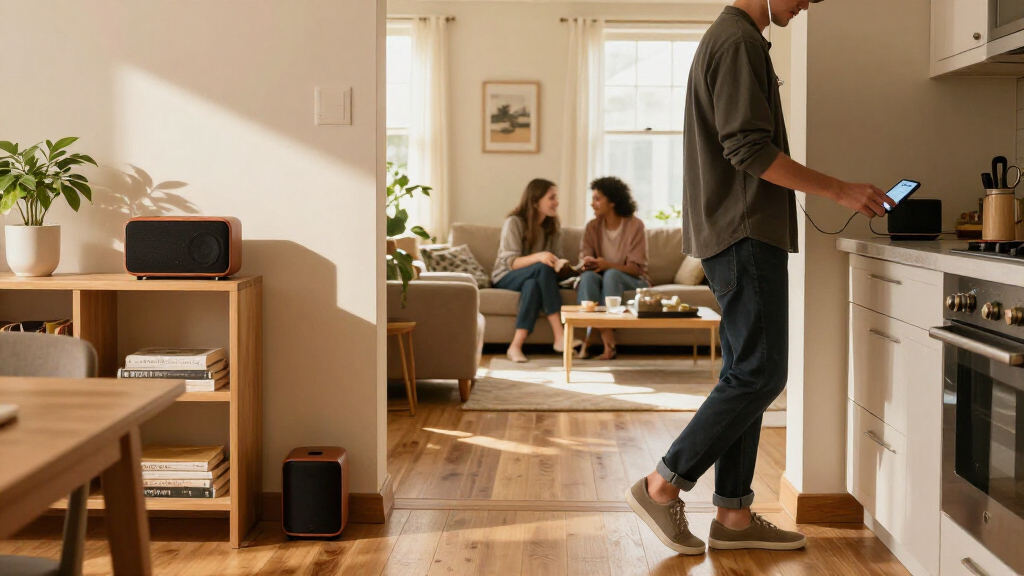
How We Picked
I compared these systems by how well they address the central multi-room choice: adding independent audio zones, grouping speakers for synchronized playback, or installing distributed speakers in fixed locations. I weighed the stated room and zone capacity, source and streaming support, speaker count, installation needs, and whether each system appears suited to indoor, outdoor, or ceiling use. I also considered how much planning a buyer may need before purchase, since a multi-zone amplifier and a wireless speaker pack solve different problems.
The Juke+ ranks first as a flexible middle ground between a simple speaker bundle and a larger installation: it supports six zones and familiar streaming connections. Sonos One SL and Google Nest Audio follow as accessible grouped-speaker choices, while the Dayton DAX88 earns a distinct role for homes needing many sources and zones. The remaining picks rank by their narrower strengths—Auracast linking, bundled room coverage, outdoor placement, or compact individual speakers—and by the tradeoffs buyers should weigh, including wiring, platform fit, and installation complexity.
Factors to Consider When Choosing Best Multi-room Audio Systems
Before choosing a system, decide how audio should move through your home: from portable speakers, through fixed ceiling speakers, or from a central amplifier to separate rooms. That choice affects wiring, app compatibility, future expansion, and how independently each room can play audio.
Choose Between Wireless Groups and Fixed Zones
Wireless speaker groups are easiest to place and rearrange, which works well in rentals or homes where running cable is impractical. Fixed zones suit planned installations where speakers belong in ceilings, walls, or outdoor areas. A common mistake is treating a four-speaker bundle as four independent zones; speaker count and independently controlled zones are different things. Check how many rooms can play different sources at once, not only how many speakers are included. If your rooms need separate volume or content control, prioritize zone capacity. If synchronized playback matters more, a grouped-speaker ecosystem may be enough.
Check Streaming and Device Compatibility
Make a list of the phones, music services, and existing speakers everyone in the household uses. AirPlay 2, Spotify Connect, Google Home, Sonos, and Auracast each shape how devices join playback, so a system’s headline speaker count cannot tell you whether it will fit your routines. Confirm support for your preferred services and the specific control method you plan to use. Bluetooth linking can be convenient, but it may not provide the same network-based control or room grouping as Wi-Fi systems. Avoid buying into a platform based only on one compatible phone if other household members need access too. Leave room in your decision for how the system will work when the original purchaser is away.
Plan Sources, Zones, and Future Expansion
Count both the rooms you want now and the audio sources you may want to connect, such as a television, turntable, or media player. Zone count describes where audio can go; source count describes what can be routed there. Buyers often focus on the current room count and overlook whether the system can add another zone or handle simultaneous sources later. A central matrix amplifier can suit a larger renovation, but it needs a wiring plan and compatible speakers. A speaker pack is quicker to start with, though expansion may depend on the same brand or platform. Choose for a realistic next step in your home, not an imagined whole-house project.
Account for Wiring and Installation
Ceiling and outdoor systems can keep speakers out of the way, but their placement, cable paths, and amplifier location need advance thought. Check whether the package includes the amplifier, all required speakers, and the connections needed for your layout. If you are renovating, running speaker cable before walls or ceilings are closed can make a fixed-zone setup more practical. In a finished home, wireless systems may avoid disruption, though power outlets and network coverage still constrain placement. Do not assume Bluetooth range or Wi-Fi reach will cover every room through dense walls. Sketch the intended speaker locations before comparing bundle sizes.
Match the System to the Listening Area
A speaker meant for a compact room may not fill a large open living space, and a portable subwoofer bundle serves a different purpose from discreet ceiling audio. Think about listening distance, background noise, and whether the room is indoors, outdoors, or open to both. Outdoor installations call for gear designed for that setting; an indoor speaker should not be treated as weatherproof unless its specifications say so. More speakers do not automatically mean better coverage if they are poorly placed or share too few zones. Consider whether you need even background sound, focused listening, or stronger bass. That use case can matter more than the number of speakers in the box.
Pay for Control You Will Actually Use
A larger amplifier can be worthwhile when you need many zones, multiple sources, and room-by-room routing. For a few rooms that usually play the same music, its added wiring and configuration may offer little benefit. Likewise, a multi-speaker pack is less useful if you only need one room today and have no plan to expand. Compare the control you gain—independent playback, separate volume, input selection—with the setup work it requires. Beginners often benefit from a matched wireless set; installers and renovation projects may gain more from a matrix system. Choose the simplest architecture that covers the rooms and listening patterns you can name.
Frequently Asked Questions
Can I play different music in different rooms?
That depends on whether the system supports independent zones and sources, rather than only synchronized groups. Multi-zone amplifiers such as the Juke+ and Dayton DAX88 are designed around room-by-room routing, with the DAX88 offering more listed zones and sources. Wireless speaker systems may allow separate groups, but the exact behavior depends on their app and platform. Check whether simultaneous playback of different sources is supported, since a system may group speakers without giving each room independent content. If that capability is essential, confirm it before buying.
Should I choose Wi-Fi speakers, Bluetooth speakers, or an amplifier?
Wi-Fi speakers are often a good fit when you want app-based grouping and simple placement around the home. Bluetooth systems can make speaker linking straightforward, but check their range, device compatibility, and how many speakers can play together. An amplifier makes more sense when you want fixed speakers, multiple rooms, or central control over sources. The right choice depends on whether flexibility, simple setup, or independent zones matters most. Decide that first; otherwise, comparing speaker counts can lead you toward the wrong system type.
Do I need the same brand of speaker in every room?
Using one ecosystem can make grouping and control more predictable, especially when the system relies on a shared app or platform. Some standards and streaming methods can connect products across brands, but compatible playback does not guarantee identical group controls or room management. Check which products can join the same groups and whether each brand requires its own app. If you are mixing systems, test the intended control path on paper before purchase. A single brand is convenient, while a mixed setup can make sense when a particular room has a distinct need.
Are ceiling speakers worth installing for whole-home audio?
Ceiling speakers can provide discreet, fixed coverage in kitchens, hallways, or outdoor-adjacent spaces where a freestanding speaker would get in the way. They are most practical during a renovation or when cable routes and amplifier placement are already planned. Installation is more involved than setting out a wireless speaker, and the result is less portable. Check the number of independently controlled zones and the amplifier included in the package; a large speaker count alone does not tell you how flexible the setup will be. For a finished home or changing room layout, wireless speakers may be a simpler fit.
How many zones do I need for a multi-room audio system?
Start by counting rooms that need independent volume or content control, rather than counting every speaker. Two speakers in one room may form a single zone, while a kitchen and patio may need separate zones even if they usually play the same music. Add a zone only when you have a clear reason to control that area separately. If you expect to expand, check whether the system can add zones without replacing the central equipment. For a small set of rooms that usually listen together, a grouped-speaker pack can avoid paying for routing capacity you may never use.
Conclusion
For most buyers planning several rooms, I recommend the Juke+ 6-Zone Audio Amplifier as the best overall balance of room control and familiar streaming support. The best value in this lineup depends on your setup: the Google Nest Audio 3-Pack is a straightforward wireless starting point, while a bundled ceiling or outdoor kit may make more sense when you need fixed coverage. For a premium, expandable installation with many sources, consider the Dayton Audio DAX88, provided you are ready for its added planning. Beginners should start with the Sonos One SL 4-Pack or Nest Audio pack and choose the ecosystem that fits their devices. For compact rooms, compare the Sonos Era 100 SL; for outdoor zones, look at STUDIOFINIX or Herdio; and for Auracast speaker linking, consider Avantree or Venucast. Pick the system that matches your room controls and installation plans, rather than the one with the longest speaker list.
Halloween Picks
halloween
As an affiliate, we earn on qualifying purchases.